A birthday on the globe
17 January on the globe: what happened in the world on this day, and who was born
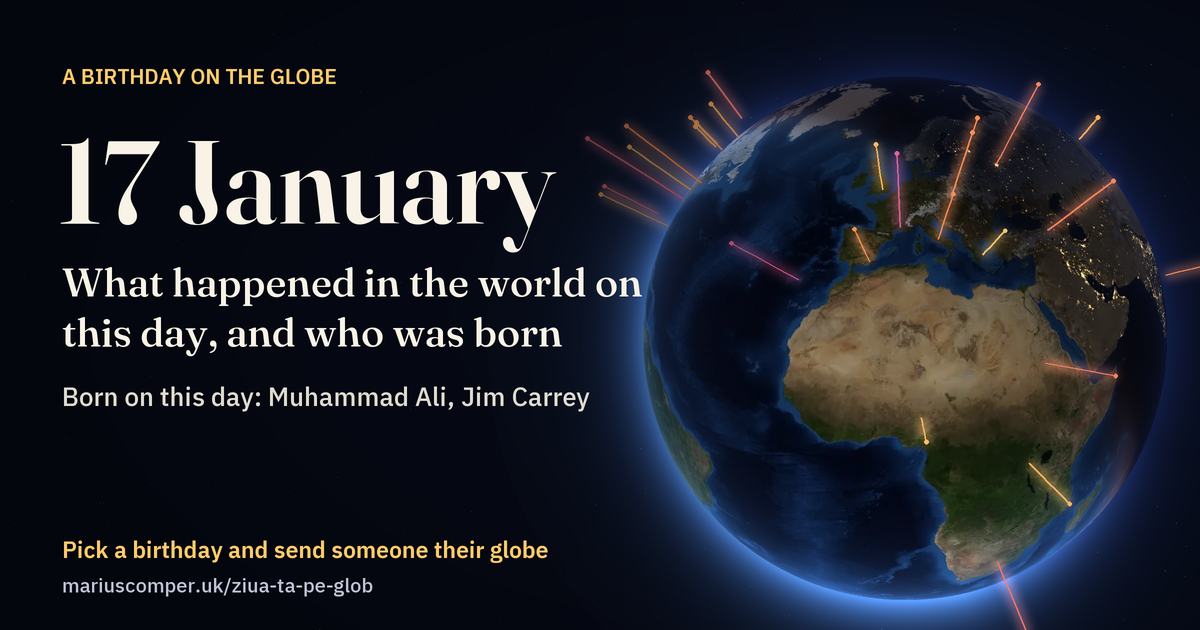
For 17 January, the English Wikipedia lists 62 events and 260 births. 30 of the events stand at their places as rays of light; six more are dashed circles, where the sentence links only to a country or a sea. The taller the ray, the longer ago it happened. The people born that day come further down, as blue points.
A birthday, yours or someone else’s:
Turn it into a greetingScroll: the globe turns to each place
The day you were born, on the globe.
Three things from your day
Scroll: your day first, then 17 January through the years
The Earth on 17 January
The picture on the globe was assembled by NASA from satellite photographs taken in January 2004: the snow, the ice and the green are those of the month.
On 17 January the Sun passes straight overhead at noon along the parallel of 20.8° south. In London, the day lasts about 8 hours 25 minutes.
Beyond 69° south the Sun no longer sets; beyond 69° north it no longer rises.
The line between day and night is tilted on the globe exactly as on this day of the year. On the dark side you can see the lights of towns.
Europe · Avignon
1377
Pope Gregory XI reaches Rome, after deciding to move the Papacy back to Rome from Avignon.
On the map: Avignon.
Also on the day’s list of Wikipedia in Romanian and Chinese.
Europe · Madeira
1524
Giovanni da Verrazzano sets sail westward from Madeira to find a sea route to the Pacific Ocean.
On the map: Madeira.
Also on the day’s list of Wikipedia in Spanish.
Europe · Moscow Art Theatre
1904
Anton Chekhov's The Cherry Orchard receives its premiere performance at the Moscow Art Theatre.
On the map: Moscow Art Theatre.
Also on the day’s list of Wikipedia in Chinese.
Africa · Sand River Convention
1852
The United Kingdom signs the Sand River Convention with the South African Republic.
On the map: Sand River Convention.
Oceans · Wake Island
1899
The United States takes possession of Wake Island in the Pacific Ocean.
On the map: Wake Island.
17 January
What the other Wikipedias remember#
For these years the English list has nothing on this day. The events below come from the same day’s lists on Wikipedia in Chinese and Spanish and were translated for this page.
From Wikipedia in Chinese · Milan
395
The Roman emperor Theodosius I dies in Milan; afterwards the empire's territory is divided into western and eastern parts.
On the map: Milan.
Translated from the list on Wikipedia in Chinese.
From Wikipedia in Spanish · The Hague
1986
In The Hague, the protocol establishing diplomatic relations between Israel and Spain is signed.
On the map: The Hague.
Translated from the list on Wikipedia in Spanish.
17 January
Born on 17 January#
The English Wikipedia lists 260 births for this day. The blue points are the birthplaces of 60 of these people: those written about in the most Wikipedia editions, where Wikidata gives a place of birth.
Born on 17 January
1942
Muhammad Ali, American boxer and activist (died 2016)
Place of birth: Louisville.
Born on 17 January
1962
Jim Carrey, Canadian-American actor, comedian, and producer
Place of birth: Newmarket.
Born on 17 January
1600
Pedro Calderón de la Barca, Spanish playwright and poet (died 1681)
Place of birth: Madrid.
Born on 17 January
1820
Anne Brontë, English author and poet (died 1849)
Place of birth: Thornton.
Born in Britain and Ireland
1984
Calvin Harris, Scottish singer-songwriter, DJ, and producer
Place of birth: Dumfries.
Born in Britain and Ireland
1969
Naveen Andrews, English actor
Place of birth: Lambeth.
Born in Britain and Ireland
1899
Nevil Shute, English engineer and author (died 1960)
Place of birth: Ealing.
17 January
Number one in the charts that week
At the cinema
An animal recorded that day
The record can be seen in GBIF, which brings together wildlife records from around the world.
All your birthdays
The weather that day
Data: Met Office Hadley Centre (HadCET); NOAA (GHCN-Daily, Mauna Loa).
Above the Earth
Sources: Jonathan McDowell, GCAT (launches); GFZ Potsdam (Kp index). Days are counted in Universal Time.
Football that day
International matches played that day:
Source: the “International football results” dataset kept by Mart Jürisoo (CC0).
Also that day
The earthquake’s page at the USGS
Source: the USGS catalogue. The day is counted in Universal Time (UTC).
In those days
Make a link for someone
Type the name, pick the day and the year of birth. The link opens straight on their day, with their name in the greeting.
The link carries the name, date and place typed here; anyone who gets it can see them.
Put another birthday beside it
Your mother’s, your child’s, a friend’s: the two days appear side by side.
Below: 17 January through the years.
The whole globe of the day
Drag the globe to turn it. Touch a ray or a point to read what happened there.
Everything Wikipedia lists for 17 January
The list is the English Wikipedia’s, in its own wording, as it stood in October 2026. 26 events have no place on the map: the sentence links to no place with coordinates, only to places too wide to mark, or to several countries.
- 38 BC
Octavian divorces his wife Scribonia and marries Livia Drusilla, ending the fragile peace between the Second Triumvirate and Sextus Pompey.
no place on the mapWikipedia: Augustus - 1362
Saint Marcellus' flood kills at least 25,000 people on the shores of the North Sea.
no place on the mapWikipedia: Saint Marcellus's flood - 1377
Pope Gregory XI reaches Rome, after deciding to move the Papacy back to Rome from Avignon.
Europe · AvignonWikipedia: Pope Gregory XI - 1524
Giovanni da Verrazzano sets sail westward from Madeira to find a sea route to the Pacific Ocean.
Europe · MadeiraWikipedia: Giovanni da Verrazzano - 1562
France grants religious toleration to the Huguenots in the Edict of Saint-Germain.
no place on the mapWikipedia: Huguenots - 1595
During the French Wars of Religion, Henry IV of France declares war on Spain.
no place on the mapWikipedia: French Wars of Religion - 1608
Emperor Susenyos I of Ethiopia surprises an Oromo army at Ebenat; his army reportedly kills 12,000 Oromo at the cost of 400 of his men.
no place on the mapWikipedia: Susenyos I - 1648
England's Long Parliament passes the "Vote of No Addresses", breaking off negotiations with King Charles I and thereby setting the scene for the second phase of the English Civil War.
no place on the mapWikipedia: English Civil War - 1649
The Second Ormonde Peace creates an alliance between the Irish Royalists and Confederates during the War of the Three Kingdoms. The coalition was then decisively defeated during the Cromwellian conquest of Ireland.
Britain & Ireland · Confederate IrelandWikipedia: Cromwellian conquest of Ireland - 1773
Captain James Cook leads the first expedition to sail south of the Antarctic Circle.
no place on the mapWikipedia: James Cook - 1781
American Revolutionary War: Battle of Cowpens: Continental troops under Brigadier General Daniel Morgan defeat British forces under Lieutenant Colonel Banastre Tarleton at the battle in South Carolina.
North America · Battle of CowpensWikipedia: Battle of Cowpens - 1799
Maltese patriot Dun Mikiel Xerri, along with a number of other patriots, is executed.
Europe · MaltaWikipedia: Malta - 1811
Mexican War of Independence: In the Battle of Calderón Bridge, a heavily outnumbered Spanish force of 6,000 troops defeats nearly 100,000 Mexican revolutionaries.
Latin America · Battle of Calderón BridgeWikipedia: Battle of Calderón Bridge - 1852
The United Kingdom signs the Sand River Convention with the South African Republic.
Africa · Sand River ConventionWikipedia: Sand River Convention - 1873
A group of Modoc warriors defeats the United States Army in the First Battle of the Stronghold, part of the Modoc War.
North America · First Battle of the StrongholdWikipedia: First Battle of the Stronghold - 1885
A British force defeats a large Dervish army at the Battle of Abu Klea in the Sudan.
Africa · Battle of Abu KleaWikipedia: Battle of Abu Klea - 1893
Lorrin A. Thurston, along with the Citizens' Committee of Public Safety, led the Overthrow of the Kingdom of Hawaii and the government of Queen Liliʻuokalani.
North America · HonoluluWikipedia: Overthrow of the Hawaiian Kingdom - 1899
The United States takes possession of Wake Island in the Pacific Ocean.
Oceans · Wake IslandWikipedia: Wake Island - 1903
El Yunque National Forest in Puerto Rico becomes part of the United States National Forest System as the Luquillo Forest Reserve.
Latin America · Puerto RicoWikipedia: El Yunque National Forest - 1904
Anton Chekhov's The Cherry Orchard receives its premiere performance at the Moscow Art Theatre.
Europe · Moscow Art TheatreWikipedia: Moscow Art Theatre - 1912
British polar explorer Captain Robert Falcon Scott reaches the South Pole, one month after Roald Amundsen.
no place on the mapWikipedia: Robert Falcon Scott - 1915
Russia defeats Ottoman Turkey in the Battle of Sarikamish during the Caucasus Campaign of World War I.
Asia · Battle of SarikamishWikipedia: Caucasus campaign - 1917
The United States pays Denmark $25 million for the Virgin Islands.
Latin America · United States Virgin IslandsWikipedia: United States Virgin Islands - 1918
Finnish Civil War: The first serious battles take place between the Red Guards and the White Guard.
no place on the mapWikipedia: Finnish Civil War - 1920
Alcohol Prohibition begins in the United States as the Volstead Act goes into effect.
no place on the mapWikipedia: Prohibition in the United States - 1941
Franco-Thai War: Vichy French forces inflict a decisive defeat over the Royal Thai Navy.
Asia · Battle of Ko ChangWikipedia: Franco-Thai War - 1943
World War II: Greek submarine Papanikolis captures the 200-ton sailing vessel Agios Stefanos and mans her with part of her crew.
no place on the mapWikipedia: World War II - 1944
World War II: Allied forces launch the first of four assaults on Monte Cassino with the intention of breaking through the Winter Line and seizing Rome, an effort that would ultimately take four months and cost 105,000 Allied casualties.
Europe · Battle of Monte CassinoWikipedia: Battle of Monte Cassino - 1945
Swedish diplomat Raoul Wallenberg is taken into Soviet custody while in Hungary; he is never publicly seen again.
Asia · Soviet UnionWikipedia: Raoul Wallenberg - 1945
The SS-Totenkopfverbände begin the evacuation of the Auschwitz concentration camp as the Red Army closes in.
Europe · Auschwitz concentration campWikipedia: SS-Totenkopfverbände - 1945
World War II: Australian troops advanced along the northern part of Bougainville Island (in present-day Papua New Guinea) and began fighting Japanese forces in the Battle of Tsimba Ridge.
Oceania · Battle of Tsimba RidgeWikipedia: World War II - 1945
World War II: The Vistula–Oder Offensive forces German troops out of Warsaw.
Europe · WarsawWikipedia: Vistula–Oder offensive - 1946
The UN Security Council holds its first session.
no place on the mapWikipedia: United Nations Security Council - 1948
The Renville Agreement between the Netherlands and Indonesia is ratified.
no place on the mapWikipedia: Renville Agreement - 1950
The Great Brink's Robbery: Eleven thieves steal more than $2 million from an armored car company's offices in Boston.
North America · Great Brink's RobberyWikipedia: Great Brink's Robbery - 1950
United Nations Security Council Resolution 79 relating to arms control is adopted.
no place on the mapWikipedia: United Nations Security Council Resolution 79 - 1961
Former Congolese Prime Minister Patrice Lumumba is murdered together with former Minister of Youth and Sports of the Republic of the Congo Maurice Mpolo and former Senator from Kasai Province Joseph Okito in circumstances suggesting the support and complicity of the governments of Belgium and the United States.
no place on the mapWikipedia: First Congolese Republic - 1961
U.S. President Dwight D. Eisenhower delivers a televised farewell address to the nation three days before leaving office, in which he warns against the accumulation of power by the "military–industrial complex" as well as the dangers of massive spending, especially deficit spending.
no place on the mapWikipedia: Dwight D. Eisenhower - 1966
Palomares incident: A B-52 bomber collides with a KC-135 Stratotanker over Spain, killing seven airmen, and dropping three 70-kiloton nuclear bombs near the town of Palomares and another one into the sea.
Europe · 1966 Palomares accidentWikipedia: 1966 Palomares accident - 1969
Black Panther Party members Bunchy Carter and John Huggins are killed during a meeting in Campbell Hall on the campus of UCLA.
North America · University of California, Los AngelesWikipedia: University of California, Los Angeles - 1977
Capital punishment in the United States resumes after a ten-year hiatus, as convicted murderer Gary Gilmore is executed by firing squad in Utah.
no place on the mapWikipedia: Capital punishment in the United States - 1981
President of the Philippines Ferdinand Marcos lifts martial law eight years and five months after declaring it.
no place on the mapWikipedia: President of the Philippines - 1989
Patrick Purdy opens fire at an elementary school in Stockton, California, killing five and wounding 31 others.
North America · Stockton schoolyard shootingWikipedia: Stockton schoolyard shooting - 1991
Crown Prince Harald of Norway becomes King Harald V, following the death of his father, King Olav V.
no place on the mapWikipedia: Harald V - 1991
Gulf War: Operation Desert Storm begins early in the morning as aircraft strike positions across Iraq, it is also the first major combat sortie for the F-117. LCDR Scott Speicher's F/A-18C Hornet from VFA-81 is shot down by a Mig-25 and is the first American casualty of the War. Iraq fires eight Scud missiles into Israel in an unsuccessful bid to provoke Israeli retaliation.
no place on the mapWikipedia: Gulf War - 1992
During a visit to South Korea, Japanese Prime Minister Kiichi Miyazawa apologizes for forcing Korean women into sexual slavery during World War II.
no place on the mapWikipedia: Comfort women - 1994
The 6.7 Mw Northridge earthquake shakes the Greater Los Angeles Area with a maximum Mercalli intensity of IX (Violent), leaving 57 people dead and more than 8,700 injured.
North America · 1994 Northridge earthquakeWikipedia: 1994 Northridge earthquake - 1995
The 6.9 Mw Great Hanshin earthquake shakes the southern Hyōgo Prefecture with a maximum Shindo of 7, leaving 5,502–6,434 people dead, and 251,301–310,000 displaced.
Asia · Kobe earthquakeWikipedia: Kobe earthquake - 1996
The Czech Republic applies for membership in the European Union.
no place on the mapWikipedia: Czech Republic - 1997
Cape Canaveral Air Force Station: A Delta II carrying the GPS IIR-1 satellite explodes 13 seconds after launch, dropping 250 tons of burning rocket remains around the launch pad.
North America · Cape Canaveral Space Force StationWikipedia: Cape Canaveral Space Force Station - 1998
Clinton–Lewinsky scandal: Matt Drudge breaks the story of the Bill Clinton–Monica Lewinsky affair on his Drudge Report website.
North America · Clinton–Lewinsky scandalWikipedia: Clinton–Lewinsky scandal - 1999
In Little Saigon, California, a series of protests began when the owner of a video rental store displayed an image of Ho Chi Minh.
North America · Little Saigon, Orange CountyWikipedia: Hi-Tek incident - 2002
Mount Nyiragongo erupts in the Democratic Republic of the Congo, displacing an estimated 400,000 people.
Africa · Mount NyiragongoWikipedia: Mount Nyiragongo - 2007
The Doomsday Clock is set to five minutes to midnight in response to North Korea's nuclear testing.
Asia · North KoreaWikipedia: Doomsday Clock - 2008
British Airways Flight 38 crashes short of the runway at Heathrow Airport, injuring 47.
Britain & Ireland · British Airways Flight 38Wikipedia: British Airways Flight 38 - 2010
Rioting begins between Muslim and Christian groups in Jos, Nigeria, results in at least 200 deaths.
Africa · 2010 Jos riotsWikipedia: 2010 Jos riots - 2013
Former cyclist Lance Armstrong confesses to his doping in an airing of Oprah's Next Chapter.
no place on the mapWikipedia: Lance Armstrong - 2013
Shahzad Luqman is murdered by members of Golden Dawn in Petralona, Athens, leading the creation of new measures to combat race-based attacks in Greece.
Europe · PetralonaWikipedia: Murder of Shahzad Luqman - 2016
President Barack Obama announces the Joint Comprehensive Plan of Action, an agreement intended to limit Iran's nuclear program.
no place on the mapWikipedia: Iran nuclear deal - 2017
The search for Malaysia Airlines Flight 370 is announced to be suspended.
no place on the mapWikipedia: Malaysia Airlines Flight 370 - 2023
An avalanche strikes Nyingchi, Tibet, killing 28 people.
no place on the mapWikipedia: 2023 Nyingchi avalanche - 2026
Indonesia Air Transport ATR 42 crashed near Mount Bulusaraung in South Sulawesi, after losing contact en route to Makassar.
Asia · 2026 Indonesia Air Transport ATR 42 crashWikipedia: 2026 Indonesia Air Transport ATR 42 crash
What the other Wikipedias remember
For these years the English list has nothing on this day. The events below come from the same day’s lists on Wikipedia in Chinese and Spanish and were translated for this page.
- 395
The Roman emperor Theodosius I dies in Milan; afterwards the empire's territory is divided into western and eastern parts.
- 1986
In The Hague, the protocol establishing diplomatic relations between Israel and Spain is signed.
Who was born on 17 January
In order of how many Wikipedia editions have an article about each. The first 60 of 260 are shown.
- 1706
Benjamin Franklin, American publisher, inventor, and politician, 6th President of Pennsylvania (died 1790)
- 1942
Muhammad Ali, American boxer and activist (died 2016)
LouisvilleWikipedia: Muhammad Ali - 1964
Michelle Obama, American lawyer and activist, 44th First Lady of the United States
ChicagoWikipedia: Michelle Obama - 1962
Jim Carrey, Canadian-American actor, comedian, and producer
NewmarketWikipedia: Jim Carrey - 1863
David Lloyd George, Welsh lawyer and politician, Prime Minister of the United Kingdom (died 1945)
ManchesterWikipedia: David Lloyd George - 1899
Al Capone, American mob boss (died 1947)
BrooklynWikipedia: Al Capone - 1600
Pedro Calderón de la Barca, Spanish playwright and poet (died 1681)
- 1820
Anne Brontë, English author and poet (died 1849)
ThorntonWikipedia: Anne Brontë - 1504
Pope Pius V (died 1572)
Bosco MarengoWikipedia: Pope Pius V - 1863
Konstantin Stanislavski, Russian actor and director (died 1938)
- 1922
Betty White, American actress, game show panelist, television personality, and animal rights activist (died 2021)
Oak ParkWikipedia: Betty White - 1927
Eartha Kitt, American actress and singer (died 2008)
- 1933
Dalida, Egyptian-French singer and actress (died 1987)
ShobraWikipedia: Dalida - 1980
Zooey Deschanel, American singer-songwriter and actress
Los AngelesWikipedia: Zooey Deschanel - 1983
Álvaro Arbeloa, Spanish footballer
SalamancaWikipedia: Álvaro Arbeloa - 1940
Tabaré Vázquez, Uruguayan physician and politician, 39th President of Uruguay (died 2020)
MontevideoWikipedia: Tabaré Vázquez - 1984
Calvin Harris, Scottish singer-songwriter, DJ, and producer
DumfriesWikipedia: Calvin Harris - 1955
Pietro Parolin, Italian cardinal
SchiavonWikipedia: Pietro Parolin - 1957
Steve Harvey, American actor, comedian, television personality and game show host
- 1732
Stanisław August Poniatowski, Polish-Lithuanian king (died 1798)
- 1931
James Earl Jones, American actor (died 2024)
ArkabutlaWikipedia: James Earl Jones - 1982
Dwyane Wade, American basketball player
ChicagoWikipedia: Dwyane Wade - 2001
Enzo Fernández, Argentinian footballer
General San MartínWikipedia: Enzo Fernández - 1911
George Stigler, American economist and academic, Nobel Prize laureate (died 1991)
- 1937
Alain Badiou, French philosopher and academic
- 1969
Tiësto, Dutch DJ and producer
BredaWikipedia: Tiësto - 1860
Douglas Hyde, Irish academic and politician, 1st President of Ireland (died 1949)
CastlereaWikipedia: Douglas Hyde - 1954
Robert F. Kennedy, Jr., American environmental lawyer, writer, and conspiracy theorist
Washington, D.C.Wikipedia: Robert F. Kennedy Jr. - 1943
René Préval, Haitian agronomist and politician, 52nd President of Haiti (died 2017)
MarmeladeWikipedia: René Préval - 1952
Ryuichi Sakamoto, Japanese pianist, composer, and producer (died 2023)
- 1969
Naveen Andrews, English actor
LambethWikipedia: Naveen Andrews - 1834
August Weismann, German biologist, zoologist, and geneticist (died 1914)
FrankfurtWikipedia: August Weismann - 1905
Guillermo Stábile, Argentinian footballer and manager (died 1966)
Buenos AiresWikipedia: Guillermo Stábile - 1871
Nicolae Iorga, Romanian historian and politician, 34th Prime Minister of Romania (died 1940)
BotoșaniWikipedia: Nicolae Iorga - 1973
Cuauhtémoc Blanco, Mexican footballer and actor
Mexico CityWikipedia: Cuauhtémoc Blanco - 1987
Oleksandr Usyk, Ukrainian boxer
SimferopolWikipedia: Oleksandr Usyk - 1342
Philip the Bold, Duke of Burgundy (died 1404)
PontoiseWikipedia: Philip the Bold - 1880
Mack Sennett, Canadian-American actor, director, and producer (died 1960)
MelbourneWikipedia: Mack Sennett - 1922
Luis Echeverría, Mexican academic and politician, 50th President of Mexico (died 2022)
Mexico CityWikipedia: Luis Echeverría - 1949
Andy Kaufman, American actor and comedian (died 1984)
New York CityWikipedia: Andy Kaufman - 1997
Jake Paul, American boxer, actor, rapper, and social media personality
ClevelandWikipedia: Jake Paul - 1948
Davíð Oddsson, Icelandic politician, 21st Prime Minister of Iceland (died 2026)
ReykjavíkWikipedia: Davíð Oddsson - 1988
Héctor Moreno, Mexican footballer
CuliacánWikipedia: Héctor Moreno - 1463
Frederick III, Elector of Saxony (died 1525)
Castle Hartenfels TorgauWikipedia: Frederick III of Saxony - 1940
Kipchoge Keino, Kenyan athlete
Nandi CountyWikipedia: Kipchoge Keino - 1985
Simone Simons, Dutch singer-songwriter
HoensbroekWikipedia: Simone Simons - 1949
Anita Borg, American computer scientist and academic (died 2003)
ChicagoWikipedia: Anita Borg - 1970
Genndy Tartakovsky, Russian-American animator, director, and producer
- 1899
Nevil Shute, English engineer and author (died 1960)
EalingWikipedia: Nevil Shute - 1917
M. G. Ramachandran, Indian actor, director, and politician, 3rd Chief Minister of Tamil Nadu (died 1987)
- 1971
Kid Rock, American singer-songwriter, producer, and actor
RomeoWikipedia: Kid Rock - 1429
Antonio del Pollaiuolo, Italian artist (diedc. 1498)
- 1989
Kelly Marie Tran, American actress
San DiegoWikipedia: Kelly Marie Tran - 1994
Lucy Boynton, American-English actress
New York CityWikipedia: Lucy Boynton - 1612
Thomas Fairfax, English general and politician (died 1671)
Denton Hall, WharfedaleWikipedia: Thomas Fairfax - 1969
Lukas Moodysson, Swedish director, screenwriter, and author
- 1734
François-Joseph Gossec, French composer and conductor (died 1829)
- 1949
Mick Taylor, English singer-songwriter and guitarist
Welwyn Garden CityWikipedia: Mick Taylor - 1962
Denis O'Hare, American actor and singer
Kansas CityWikipedia: Denis O'Hare - 1971
Richard Burns, English race car driver (died 2005)
ReadingWikipedia: Richard Burns
What is celebrated on 17 January
- Christian feast day: Anthony the Great
- Christian feast day: Blessed Angelo Paoli
- Christian feast day: Blessed Gamelbert of Michaelsbuch
- Christian feast day: Charles Gore (Church of England)
- Christian feast day: Jenaro Sánchez Delgadillo (one of Saints of the Cristero War)
- Christian feast day: Mildgyth
- Christian feast day: Our Lady of Pontmain
- Christian feast day: Sulpitius the Pious
- Christian feast day: January 17 (Eastern Orthodox liturgics)
- National Day (Menorca, Spain)
- The opening ceremony of Patras Carnival, celebrated until Clean Monday. (Patras, Greece)
A greeting link for someone
Type a name and, if you like, the year of birth. The link opens with a greeting, and beside each event it says how old the person turned that day, or how many years before their birth it happened.
The name and the year go only into the link you send.
All 366 days
How the globe is made
Where the events come from
Each edition of this page uses the day’s list from Wikipedia in its own language: Romanian, English, Spanish, Chinese. The lists are written by volunteers and differ from one edition to the next; the text of each event is Wikipedia’s, with a link to the article. A row that appears twice in a list is shown once. The lists have not been checked event by event: they are Wikipedia’s, mistakes included.
For events before 1582, and for countries that moved to the Gregorian calendar later (Britain in 1752, Russia in 1918), the same day may be counted Old Style in one list and New Style in another.
The chapter “What the other Wikipedias remember” adds up to five events a day from the lists of the other three editions, only for years in which the English list has nothing on that day. They were translated for this page, passed the same filters as the tour, and are not counted among the events of the English list.
How an event gets onto the map
The place comes from Wikidata. If the sentence links to the article about the event itself (a battle, an opening, an earthquake), dated to the same year, the ray stands on its coordinates or on those of its location. Otherwise it stands on the first place the sentence links to: a town, a building, a mountain, an island. This second step can be wrong: sometimes the sentence only mentions the place. That is why the page says, under each event, which place the ray stands on.
When the sentence links to a single state or province, or to a single sea, lake or desert larger than 5,000 km², the globe shows a dashed circle, not a ray. The circle has the area Wikidata gives, with its radius kept between 1.2° and 16°, or a radius of 4.5° when Wikidata gives no area; it says only that the sentence links to that place. Organisations, ships, spacecraft, museum objects, rivers, mountain ranges, languages and continents are never used as places. When a sentence names several states and no exact place, the event stays in the list only.
What the height means
The height of a ray shows how many years have passed, on a logarithmic scale: 10 years, 100 years and 1,000 years are equal steps apart; anything older than about 2,600 years has the tallest ray. The colour runs from pale yellow for recent years to violet for antiquity.
Where the tour stops
In each region the tour stops at up to three events (five in Britain and Ireland), chosen mainly by three things: whether Wikipedia’s editors put the event in the “On this day” box of their main page (the English, Spanish and Chinese editions), how many Wikipedia editions have an article about it, and how many of the four lists include it. Events whose sentence or article is about a war, an attack, a crime or a disaster are left out of the tour; they stay in the whole list, in Wikipedia’s wording. The filter is a list of words and a list of Wikidata types, so it can miss some.
The tour of births names the people with articles in the most editions and leaves aside those whom the list or Wikidata describes as rulers, politicians, commanders, leaders of movements or criminals; they stay in the list.
The Earth and the Sun
The daytime images are NASA’s Blue Marble Next Generation mosaics, one for each month of 2004; the night side is Black Marble 2016. The tilt of the line between day and night is computed for the day; the hour is chosen so that the place being read is in daylight. The latitude where the Sun stands overhead is the average of the four years of the leap cycle; in a given year it can differ by up to 0.4°.
The day you were born
The number ones come from the weekly lists on Wikipedia: Billboard for the United States (from 1940; the Hot 100 from August 1958), the UK Singles Chart (from November 1952), Los 40 Principales for Spain (from July 1966) and, for Romania, the Romanian Top 100 and Airplay 100 (2001–2021, with missing weeks). The page shows the chart of the week in which the day of birth falls, with its date; Billboard and the UK chart are dated at the end of their week. For Romania before 2001 and for China these sources have no weekly chart.
The films are those that reached cinemas in the United States up to ten days before or three days after that day (some of them in a few cinemas at first), from the English Wikipedia’s yearly lists (from 1968), in order of how many editions have an article about them. The events “in those days” are the ones on the neighbouring days’ lists that carry the year of birth, passed through the same filter as the tour.
The day of birth, year included
The Moon, the star sign and the constellation are worked out by the page itself, for noon Universal Time on the day. The lit part of the Moon is rounded and can differ by a few per cent from that at the hour of birth. The sign follows the usual zodiac of twelve equal parts starting at the March equinox; the constellation is the one the Sun actually stood in front of, by the borders set by the International Astronomical Union, and within a day of a border the page does not name it. When the Sun changes sign while it is that day anywhere on Earth, the page gives the moment of crossing, rounded to ten minutes and accurate to within about a quarter of an hour, and the clock time in a few cities, with the time zone and summer time of that year.
The year in the Chinese calendar is the one your device’s own calendar gives for the date, checked against the Hong Kong Observatory’s tables. “All your birthdays” uses the same sources as the rest of the chapter for the same day in every year since the birth: the temperature, well-known launches that took place on that very day, matches of the teams the edition follows, snow deeper than 10 cm and strong geomagnetic storms. The three things at the top and the four on the picture are chosen in a fixed order (the song, the animal, a full Moon, a well-known launch before an ordinary earthquake); on the picture you can change them.
When the link carries a year of birth, the page adds a few things about that exact day. The weather is the Met Office’s Central England temperature record and the readings from New York’s Central Park; the “usual high” is the average of the daily highs of 1961–1990 for that date, with two days either side. The carbon dioxide figure is the monthly mean at the Mauna Loa observatory, where measurements begin in March 1958.
The earthquake is the one with the largest magnitude in the USGS catalogue for that day, counted in Universal Time. Before the 1960s the catalogue has gaps even above magnitude 5.5, so in the older years many days have no earthquake. The page gives only the magnitude and the place: the country the epicentre falls in or, when the epicentre is at sea within 300 km of a coast, the nearest country; farther out, only the ocean.
The launches are those that reached orbit or left for the Moon and the planets, from Jonathan McDowell’s GCAT catalogue. If nothing left that day, the page shows the nearest launch within three days before or after, and says how many days away it was. The geomagnetic storm appears only when the Kp index reached at least 5 in one of the day’s eight three-hour intervals.
The animal comes from GBIF: an observation made by a person (the animal seen or heard, or its tracks), dated to that exact day, with coordinates and a CC0 or CC BY licence. Only a few hundred well-known species are searched (mammals, birds, turtles, butterflies); of those noted that day, mammals and species with articles in many Wikipedia editions come first; birds noted almost every day, and species used recently, wait their turn. Observations dated 1 January are left out, because records without a day are often filed there. An observation shows that the animal was recorded there, not how many animals there were.
The matches are those between national teams. Only matches of England, Scotland, Wales, Northern Ireland, the Republic of Ireland, the United States, Canada and Australia are shown, along with those at the big final tournaments. The picture to send is drawn in the page from the day’s globe and the facts above, and stays on your device until you send it.
Sources
- Events, births and holidays: the day’s page on Wikipedia, text under CC BY-SA 4.0.
- Coordinates, places of birth and the number of editions: Wikidata (CC0).
- The Earth by day: NASA Blue Marble Next Generation. The Earth by night: NASA Black Marble 2016.
- Borders and regions: Natural Earth.
- World population and births per year: UN World Population Prospects 2024.
- Charts and films: Wikipedia’s lists for Billboard, the UK Singles Chart, Los 40 Principales, Romanian Top 100, Airplay 100 and American films by year (CC BY-SA 4.0).
- Weather: Met Office Hadley Centre, HadCET (Open Government Licence) and NOAA GHCN-Daily, New York Central Park. Carbon dioxide: NOAA Global Monitoring Laboratory, Mauna Loa.
- Earthquakes: the USGS catalogue. Launches: Jonathan McDowell, GCAT (CC BY). Kp index: GFZ Potsdam (CC BY 4.0). Matches: International football results, Mart Jürisoo (CC0).
- Animal observations: GBIF, with a link to each record; species names come from Wikidata.