A birthday on the globe
25 April on the globe: what happened in the world on this day, and who was born
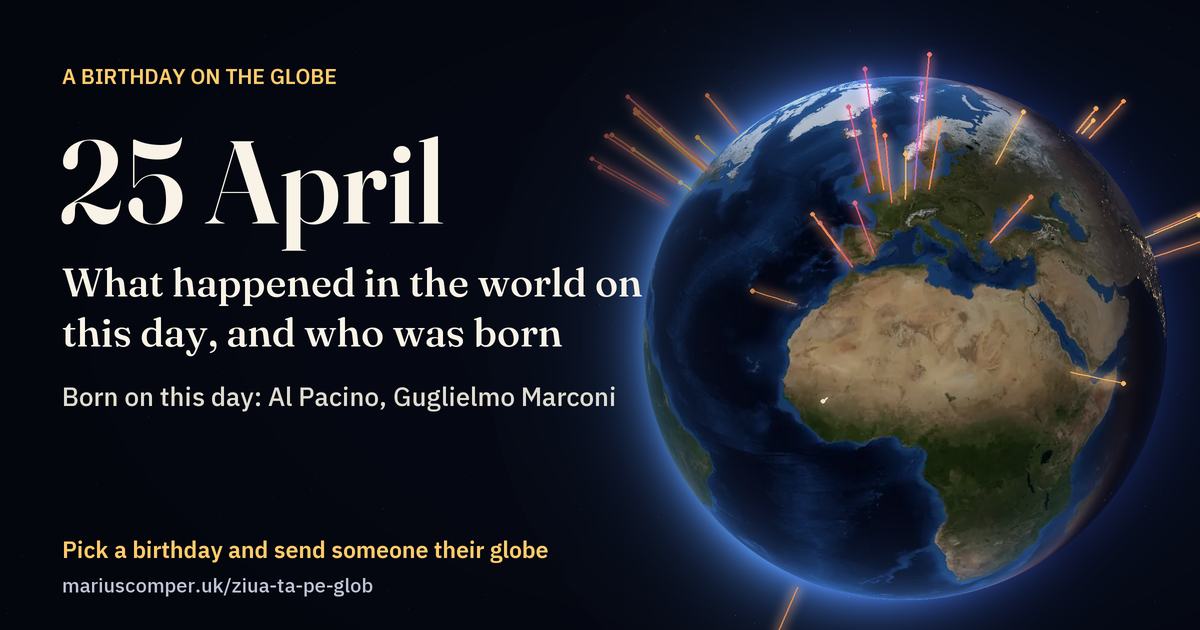
For 25 April, the English Wikipedia lists 61 events and 219 births. 38 of the events stand at their places as rays of light; five more are dashed circles, where the sentence links only to a country or a sea. The taller the ray, the longer ago it happened. The people born that day come further down, as blue points.
A birthday, yours or someone else’s:
Turn it into a greetingScroll: the globe turns to each place
The day you were born, on the globe.
Three things from your day
Scroll: your day first, then 25 April through the years
The Earth on 25 April
The picture on the globe was assembled by NASA from satellite photographs taken in April 2004: the snow, the ice and the green are those of the month.
On 25 April the Sun passes straight overhead at noon along the parallel of 13.3° north. In London, the day lasts about 14 hours 30 minutes.
Beyond 77° north the Sun no longer sets; beyond 77° south it no longer rises.
The line between day and night is tilted on the globe exactly as on this day of the year. On the dark side you can see the lights of towns.
Britain & Ireland · British Museum
1955
Following restoration at the British Museum, the Emesa Helmet was placed on display there before its return to Syria.
On the map: British Museum.
Europe · Paderborn
799
After mistreatment and disfigurement by the citizens of Rome, Pope Leo III flees to the Frankish court of king Charlemagne at Paderborn for protection.
On the map: Paderborn.
Also on the day’s list of Wikipedia in Spanish.
Europe · Neumünster Abbey
2005
Bulgaria and Romania sign the Treaty of Accession 2005 to join the European Union.
On the map: Neumünster Abbey.
Asia · Tsuruga Nuclear Power Plant
1981
More than 100 workers are exposed to radiation during repairs of at the Tsuruga Nuclear Power Plant in Japan.
On the map: Tsuruga Nuclear Power Plant.
North America · Supreme Court of the United States
1938
U.S. Supreme Court delivers its opinion in Erie Railroad Co. v. Tompkins and overturns a century of federal common law.
On the map: Supreme Court of the United States.
Also on the day’s list of Wikipedia in Spanish.
North America · San Francisco
1945
United Nations Conference on International Organization: Founding negotiations for the United Nations begin in San Francisco.
On the map: San Francisco.
Also on the day’s list of Wikipedia in Romanian and Chinese.
Wikipedia: United Nations Conference on International Organization
North America · St. Lawrence Seaway
1959
The Saint Lawrence Seaway, linking the North American Great Lakes and the Atlantic Ocean, officially opens to shipping.
On the map: St. Lawrence Seaway.
Also on the day’s list of Wikipedia in Spanish.
25 April
What the other Wikipedias remember#
For these years the English list has nothing on this day. The events below come from the same day’s lists on Wikipedia in Chinese and were translated for this page.
From Wikipedia in Chinese · Milan
1926
The opera Turandot, composed by the Italian composer Giacomo Puccini, is performed for the first time at La Scala in Milan.
On the map: Milan.
Translated from the list on Wikipedia in Chinese.
25 April
Born on 25 April#
The English Wikipedia lists 219 births for this day. The blue points are the birthplaces of 60 of these people: those written about in the most Wikipedia editions, where Wikidata gives a place of birth.
Born on 25 April
1940
Al Pacino, American actor and director
Place of birth: Manhattan.
Born on 25 April
1874
Guglielmo Marconi, Italian businessman and inventor, developed Marconi's law, Nobel Prize laureate (died 1937)
Place of birth: Bologna.
Born on 25 April
1947
Johan Cruyff, Dutch footballer and manager (died 2016)
Place of birth: Betondorp.
Born on 25 April
1900
Wolfgang Pauli, Austrian-Swiss-American physicist and academic, Nobel Prize laureate (died 1958)
Place of birth: Vienna.
Born on 25 April
1917
Ella Fitzgerald, American singer (died 1996)
Place of birth: Newport News.
Born in Britain and Ireland
1963
David Moyes, Scottish footballer and manager
Place of birth: Glasgow.
Born in Britain and Ireland
1988
Jonathan Bailey, English actor
Place of birth: Wallingford.
Born in Britain and Ireland
1873
Walter de la Mare, English poet, short story writer, and novelist (died 1956)
Place of birth: Charlton.
25 April
Number one in the charts that week
At the cinema
An animal recorded that day
The record can be seen in GBIF, which brings together wildlife records from around the world.
All your birthdays
The weather that day
Data: Met Office Hadley Centre (HadCET); NOAA (GHCN-Daily, Mauna Loa).
Above the Earth
Sources: Jonathan McDowell, GCAT (launches); GFZ Potsdam (Kp index). Days are counted in Universal Time.
Football that day
International matches played that day:
Source: the “International football results” dataset kept by Mart Jürisoo (CC0).
Also that day
The earthquake’s page at the USGS
Source: the USGS catalogue. The day is counted in Universal Time (UTC).
In those days
Make a link for someone
Type the name, pick the day and the year of birth. The link opens straight on their day, with their name in the greeting.
The link carries the name, date and place typed here; anyone who gets it can see them.
Put another birthday beside it
Your mother’s, your child’s, a friend’s: the two days appear side by side.
Below: 25 April through the years.
The whole globe of the day
Drag the globe to turn it. Touch a ray or a point to read what happened there.
Everything Wikipedia lists for 25 April
The list is the English Wikipedia’s, in its own wording, as it stood in October 2026. 18 events have no place on the map: the sentence links to no place with coordinates, only to places too wide to mark, or to several countries.
- 404 BC
Admiral Lysander and King Pausanias of Sparta blockade Athens and bring the Peloponnesian War to a successful conclusion.
no place on the mapWikipedia: Peloponnesian War - 775
The Battle of Bagrevand puts an end to an Armenian rebellion against the Abbasid Caliphate. Muslim control over the South Caucasus is solidified and its Islamization begins, while several major Armenian nakharar families lose power and their remnants flee to the Byzantine Empire.
no place on the mapWikipedia: Battle of Bagrevand - 799
After mistreatment and disfigurement by the citizens of Rome, Pope Leo III flees to the Frankish court of king Charlemagne at Paderborn for protection.
Europe · PaderbornWikipedia: Disfigurement - 1464
A Yorkist army under the Baron Montagu defeats a Lancastrian army under the Duke of Somerset in the battle of Hedgeley Moor during the Wars of the Roses.
Britain & Ireland · Battle of Hedgeley MoorWikipedia: Battle of Hedgeley Moor - 1607
Eighty Years' War: The Dutch fleet destroys the anchored Spanish fleet at Gibraltar.
Europe · Battle of GibraltarWikipedia: Battle of Gibraltar - 1643
First English Civil War: Despite being vastly outnumbered, a Parliamentarian force under James Chudleigh defeated a Royalist army near Okehampton, Devon, at the Battle of Sourton Down.
Britain & Ireland · Battle of Sourton DownWikipedia: Battle of Sourton Down - 1644
Transition from Ming to Qing: The Chongzhen Emperor, the last Emperor of Ming China, commits suicide during a peasant rebellion led by Li Zicheng.
Asia · Ming dynastyWikipedia: Transition from Ming to Qing - 1707
A coalition of Britain, the Netherlands and Portugal is defeated by a Franco-Spanish army at Almansa (Spain) in the War of the Spanish Succession.
Europe · Battle of AlmansaWikipedia: Battle of Almansa - 1792
"La Marseillaise" (the French national anthem) is composed by Claude Joseph Rouget de Lisle.
no place on the mapWikipedia: La Marseillaise - 1792
Highwayman Nicolas J. Pelletier becomes the first person executed by guillotine.
no place on the mapWikipedia: Highwayman - 1808
Dano-Swedish War of 1808–1809: The Battle of Trangen takes place at Trangen in Flisa, Hedemarkens Amt, between Swedish and Norwegian troops.
Europe · FlisaWikipedia: Battle of Trangen - 1829
Charles Fremantle arrives in HMS Challenger off the coast of modern-day Western Australia prior to declaring the Swan River Colony for the British Empire.
no place on the mapWikipedia: Charles Fremantle - 1846
Thornton Affair: Open conflict begins over the disputed border of Texas, triggering the Mexican–American War.
North America · Thornton AffairWikipedia: Thornton Affair - 1849
The Governor General of Canada, Lord Elgin, signs the Rebellion Losses Bill, outraging Montreal's English population and triggering the Montreal Riots.
North America · Burning of the Parliament Buildings in MontrealWikipedia: Burning of the Parliament Buildings in Montreal - 1859
British and French engineers break ground for the Suez Canal.
no place on the mapWikipedia: Suez Canal - 1862
American Civil War: Forces under U.S. Admiral David Farragut demand the surrender of the Confederate city of New Orleans, Louisiana.
North America · Capture of New OrleansWikipedia: American Civil War - 1864
American Civil War: In the Battle of Marks' Mills, a force of 8,000 Confederate soldiers attacks 1,800 Union soldiers and a large number of wagon teamsters, killing or wounding 1,500 Union combatants.
North America · Battle of Marks' MillsWikipedia: Battle of Marks' Mills - 1882
French and Vietnamese troops clash in Tonkin, when Commandant Henri Rivière seizes the citadel of Hanoi with a small force of marine infantry.
Asia · Imperial Citadel of Thăng LongWikipedia: Battle of Hanoi - 1892
Véry bombing during the Ère des attentats (1892–1894).
Europe · Véry bombingWikipedia: Véry bombing - 1898
Spanish–American War: The United States Congress declares that a state of war between the U.S. and Spain has existed since April 21, when an American naval blockade of the Spanish colony of Cuba began.
no place on the mapWikipedia: Spanish–American War - 1915
World War I: The Battle of Gallipoli begins: The invasion of the Turkish Gallipoli Peninsula by British, French, Indian, Newfoundland, Australian and New Zealand troops begins with landings at Anzac Cove and Cape Helles.
Asia · Landing at Cape HellesWikipedia: World War I - 1916
The first issue of Irish War News was published in Ireland.
no place on the mapWikipedia: Irish War News - 1920
A march by blind people from across the United Kingdom to protest poor working conditions ended at Trafalgar Square, London.
Britain & Ireland · Trafalgar SquareWikipedia: 1920 blind march - 1920
At the San Remo conference, the principal Allied Powers of World War I adopt a resolution to determine the allocation of Class "A" League of Nations mandates for administration of the former Ottoman-ruled lands of the Middle East.
Asia · Ottoman EmpireWikipedia: San Remo conference - 1932
Gladys Elinor Watkins consecrated the carillon of the National War Memorial in Wellington, New Zealand.
Oceania · National War MemorialWikipedia: National War Memorial - 1933
Nazi Germany issues the Law Against Overcrowding in Schools and Universities limiting the number of Jewish students able to attend public schools and universities.
Europe · Nazi GermanyWikipedia: Nazi Germany - 1938
U.S. Supreme Court delivers its opinion in Erie Railroad Co. v. Tompkins and overturns a century of federal common law.
North America · Supreme Court of the United StatesWikipedia: Supreme Court of the United States - 1944
The United Negro College Fund is incorporated.
no place on the mapWikipedia: UNCF - 1945
United Nations Conference on International Organization: Founding negotiations for the United Nations begin in San Francisco.
North America · San FranciscoWikipedia: United Nations Conference on International Organization - 1945
World War II: Liberation Day (Italy): The National Liberation Committee for Northern Italy calls for a general uprising against the German occupation and the Italian Social Republic.
Europe · Italian Social RepublicWikipedia: Liberation Day - 1945
World War II: The last German troops retreat from Finnish soil in Lapland, ending the Lapland War. Military actions of the Second World War end in Finland.
no place on the mapWikipedia: Lapland War - 1945
World War II: United States and Soviet reconnaissance troops meet in Torgau and Strehla along the River Elbe, cutting the Wehrmacht of Nazi Germany in two. This would be later known as Elbe Day.
Europe · TorgauWikipedia: World War II - 1946
Two passenger trains collided in Naperville, Illinois, leaving 45 people dead and some 125 injured.
North America · Naperville, IllinoisWikipedia: Naperville train disaster - 1951
Korean War: Assaulting Chinese forces are forced to withdraw after heavy fighting with UN forces, primarily made up of Australian and Canadian troops, at the Battle of Kapyong.
Asia · Battle of KapyongWikipedia: Korean War - 1953
Francis Crick and James Watson publish "Molecular Structure of Nucleic Acids: A Structure for Deoxyribose Nucleic Acid" describing the double helix structure of DNA.
no place on the mapWikipedia: Francis Crick - 1954
The first practical solar cell is publicly demonstrated by Bell Telephone Laboratories.
no place on the mapWikipedia: Solar cell - 1955
Following restoration at the British Museum, the Emesa Helmet was placed on display there before its return to Syria.
Britain & Ireland · British MuseumWikipedia: British Museum - 1959
The Saint Lawrence Seaway, linking the North American Great Lakes and the Atlantic Ocean, officially opens to shipping.
North America · St. Lawrence SeawayWikipedia: St. Lawrence Seaway - 1960
The U.S. Navy submarine Triton completed the first submerged circumnavigation of the world.
no place on the mapWikipedia: United States Navy - 1961
Robert Noyce is granted a patent for an integrated circuit.
no place on the mapWikipedia: Robert Noyce - 1964
109 individuals were arrested in a police raid on a gay bar near Chicago.
North America · ChicagoWikipedia: Fun Lounge police raid - 1972
Vietnam War: Nguyen Hue Offensive: The North Vietnamese 320th Division forces 5,000 South Vietnamese troops to retreat and traps about 2,500 others northwest of Kontum.
Asia · Kon TumWikipedia: Vietnam War - 1974
Carnation Revolution: A leftist military coup in Portugal overthrows the authoritarian-conservative Estado Novo regime.
Europe · Carnation RevolutionWikipedia: Carnation Revolution - 1980
One hundred forty-six people are killed when Dan-Air Flight 1008 crashes near Los Rodeos Airport in Tenerife, Canary Islands.
Europe · Dan-Air Flight 1008Wikipedia: Dan-Air Flight 1008 - 1981
More than 100 workers are exposed to radiation during repairs of at the Tsuruga Nuclear Power Plant in Japan.
Asia · Tsuruga Nuclear Power PlantWikipedia: Tsuruga Nuclear Power Plant - 1982
British prime minister Margaret Thatcher told journalists in Downing Street to "rejoice" upon hearing news of the successful recapture of South Georgia from Argentine forces in the Falklands War.
Oceans · South GeorgiaWikipedia: Operation Paraquet - 1982
Israel completes its withdrawal from the Sinai Peninsula per the Camp David Accords.
no place on the mapWikipedia: Camp David Accords - 1983
Cold War: American schoolgirl Samantha Smith is invited to visit the Soviet Union by its leader Yuri Andropov after he read her letter in which she expressed fears about nuclear war.
Asia · Soviet UnionWikipedia: Cold War - 1983
The first issue of The Jakarta Post was published in Indonesia.
no place on the mapWikipedia: The Jakarta Post - 1986
Mswati III was crowned King of Swaziland, succeeding his father Sobhuza II.
no place on the mapWikipedia: Mswati III - 1990
Violeta Chamorro takes office as the President of Nicaragua, the first woman to hold the position.
no place on the mapWikipedia: Violeta Chamorro - 2004
The March for Women's Lives brings over one million protesters, mostly pro-choice, to Washington D.C. to protest the Partial-Birth Abortion Ban Act of 2003, and other restrictions on abortion.
North America · NorthwestWikipedia: March for Women's Lives - 2005
A seven-car commuter train derails and crashes into an apartment building near Amagasaki Station in Japan, killing 107, including the driver.
Asia · Amagasaki derailmentWikipedia: Amagasaki derailment - 2005
Bulgaria and Romania sign the Treaty of Accession 2005 to join the European Union.
Europe · Neumünster AbbeyWikipedia: Treaty of Accession 2005 - 2005
The final piece of the Obelisk of Axum is returned to Ethiopia after being stolen by the invading Italian army in 1937.
Africa · Obelisk of AxumWikipedia: Obelisk of Axum - 2007
Boris Yeltsin's funeral: The first to be sanctioned by the Russian Orthodox Church for a head of state since the funeral of Emperor Alexander III in 1894.
Europe · Central Clinical HospitalWikipedia: Death and state funeral of Boris Yeltsin - 2012
Daniel Chong is discovered in a holding room in San Diego, having been incarcerated for five days without food or water.
North America · San DiegoWikipedia: San Diego - 2014
The Flint water crisis begins when officials at Flint, Michigan switch the city's water supply to the Flint River, leading to lead and bacteria contamination.
North America · Flint water crisisWikipedia: Flint water crisis - 2015
At least 8,962 are killed in Nepal after a massive 7.8 magnitude earthquake strikes Nepal.
Asia · April 2015 Nepal earthquakeWikipedia: April 2015 Nepal earthquake - 2026
Malian minister of defence Sadio Camara is killed during the start of coordinated attacks in the country.
Africa · KatiWikipedia: Killing of Sadio Camara - 2026
Shots are fired outside of the White House Correspondents' Dinner in the Washington Hilton where U.S. President Donald Trump and members of his cabinet are attending. One injury is reported and a suspect is taken into custody.
North America · 2026 White House Correspondents' Dinner shootingWikipedia: 2026 White House Correspondents' Dinner shooting
What the other Wikipedias remember
For these years the English list has nothing on this day. The events below come from the same day’s lists on Wikipedia in Chinese and were translated for this page.
- 1926
The opera Turandot, composed by the Italian composer Giacomo Puccini, is performed for the first time at La Scala in Milan.
Who was born on 25 April
In order of how many Wikipedia editions have an article about each. The first 60 of 219 are shown.
- 1940
Al Pacino, American actor and director
ManhattanWikipedia: Al Pacino - 1874
Guglielmo Marconi, Italian businessman and inventor, developed Marconi's law, Nobel Prize laureate (died 1937)
BolognaWikipedia: Guglielmo Marconi - 1947
Johan Cruyff, Dutch footballer and manager (died 2016)
BetondorpWikipedia: Johan Cruyff - 1599
Oliver Cromwell, English general and politician, Lord Protector of Great Britain (died 1658)
HuntingdonWikipedia: Oliver Cromwell - 1900
Wolfgang Pauli, Austrian-Swiss-American physicist and academic, Nobel Prize laureate (died 1958)
- 1917
Ella Fitzgerald, American singer (died 1996)
Newport NewsWikipedia: Ella Fitzgerald - 1214
Louis IX of France (died 1270)
- 1969
Renée Zellweger, American actress and producer
- 1993
Raphaël Varane, French footballer
- 1284
Edward II of England (died 1327)
Caernarfon CastleWikipedia: Edward II - 1903
Andrey Kolmogorov, Russian mathematician and academic (died 1987)
- 1946
Vladimir Zhirinovsky, Russian colonel, lawyer, and politician (died 2022)
- 1849
Felix Klein, German mathematician and academic (died 1925)
DüsseldorfWikipedia: Felix Klein - 1981
Felipe Massa, Brazilian racing driver
São PauloWikipedia: Felipe Massa - 1949
Dominique Strauss-Kahn, French economist, lawyer, and politician, French Minister of Finance
Neuilly-sur-SeineWikipedia: Dominique Strauss-Kahn - 1976
Tim Duncan, American basketball player
ChristianstedWikipedia: Tim Duncan - 1945
Björn Ulvaeus, Swedish singer-songwriter and producer
Lundby church parishWikipedia: Björn Ulvaeus - 1963
David Moyes, Scottish footballer and manager
GlasgowWikipedia: David Moyes - 1927
Albert Uderzo, French author and illustrator (died 2020)
FismesWikipedia: Albert Uderzo - 1964
Hank Azaria, American actor, voice artist, comedian and producer
QueensWikipedia: Hank Azaria - 1946
Talia Shire, American actress
New York CityWikipedia: Talia Shire - 1970
Jason Lee, American skateboarder, actor, comedian and producer
OrangeWikipedia: Jason Lee - 1900
Gladwyn Jebb, English politician and diplomat, Secretary-General of the United Nations (died 1996)
YorkshireWikipedia: Gladwyn Jebb - 1908
Edward R. Murrow, American journalist (died 1965)
GreensboroWikipedia: Edward R. Murrow - 1941
Bertrand Tavernier, French actor, director, producer, and screenwriter (died 2021)
6th arrondissement of LyonWikipedia: Bertrand Tavernier - 1843
Princess Alice of the United Kingdom (died 1878)
Buckingham PalaceWikipedia: Princess Alice of the United Kingdom - 1921
Karel Appel, Dutch painter and sculptor (died 2006)
AmsterdamWikipedia: Karel Appel - 1862
Edward Grey, 1st Viscount Grey of Fallodon, English ornithologist and politician, Secretary of State for Foreign and Commonwealth Affairs (died 1933)
- 1952
Vladislav Tretiak, Russian ice hockey player and coach
OrudyevoWikipedia: Vladislav Tretiak - 1981
Anja Pärson, Swedish skier
- 1228
Conrad IV of Germany (died 1254)
- 1851
Leopoldo Alas, Spanish author, critic, and academic (died 1901)
ZamoraWikipedia: Leopoldo Alas - 2000
Dejan Kulusevski, Swedish footballer
Spånga-Kista församlingWikipedia: Dejan Kulusevski - 1897
Mary, Princess Royal and Countess of Harewood (died 1965)
- 1939
Tarcisio Burgnich, Italian footballer and manager (died 2021)
- 1980
Alejandro Valverde, Spanish cyclist
- 1767
Nicolas Oudinot, French general (died 1847)
Bar-le-DucWikipedia: Nicolas Oudinot - 1930
Paul Mazursky, American actor, director, and screenwriter (died 2014)
New York CityWikipedia: Paul Mazursky - 1955
Américo Gallego, Argentinian footballer and coach
MorterosWikipedia: Américo Gallego - 1990
Jean-Éric Vergne, French racing driver
PontoiseWikipedia: Jean-Éric Vergne - 1928
Cy Twombly, American-Italian painter and sculptor (died 2011)
LexingtonWikipedia: Cy Twombly - 1932
Nikolai Kardashev, Russian astrophysicist (died 2019)
- 1985
Giedo van der Garde, Dutch racing driver
- 1988
Jonathan Bailey, English actor
WallingfordWikipedia: Jonathan Bailey - 1923
Albert King, American singer-songwriter, guitarist, and producer (died 1992)
IndianolaWikipedia: Albert King - 1947
Jeffrey DeMunn, American actor
BuffaloWikipedia: Jeffrey DeMunn - 1966
Femke Halsema, Dutch sociologist, academic, and politician
HaarlemWikipedia: Femke Halsema - 1942
Jon Kyl, American lawyer and politician (died 2026)
OaklandWikipedia: Jon Kyl - 1968
Thomas Strunz, German footballer
DuisburgWikipedia: Thomas Strunz - 1976
Gilberto da Silva Melo, Brazilian footballer
Rio de JaneiroWikipedia: Gilberto - 1989
Gedhun Choekyi Nyima, the 11th Panchen Lama
Lhari CountyWikipedia: Gedhun Choekyi Nyima - 1956
Dominique Blanc, French actress, director, and screenwriter
7th arrondissement of LyonWikipedia: Dominique Blanc - 1988
Sara Paxton, American actress
Woodland HillsWikipedia: Sara Paxton - 1287
Roger Mortimer, 1st Earl of March, English politician, Lord Lieutenant of Ireland (died 1330)
Wigmore CastleWikipedia: Roger Mortimer, 1st Earl of March - 1873
Walter de la Mare, English poet, short story writer, and novelist (died 1956)
CharltonWikipedia: Walter de la Mare - 1932
Lia Manoliu, Romanian discus thrower and politician (died 1998)
ChișinăuWikipedia: Lia Manoliu - 1976
Rainer Schüttler, German tennis player and coach
KorbachWikipedia: Rainer Schüttler - 1995
Lewis Baker, English footballer
- 1776
Princess Mary, Duchess of Gloucester and Edinburgh (died 1857)
Buckingham PalaceWikipedia: Princess Mary, Duchess of Gloucester and Edinburgh - 1929
Yvette Williams, New Zealand long jumper, shot putter, and discus thrower (died 2019)
DunedinWikipedia: Yvette Williams
What is celebrated on 25 April
- Anzac Day (Australia, New Zealand, Tonga)
- Christian feast day: Mark the Evangelist
- Christian feast day: Franca Visalta
- Christian feast day: Giovanni Battista Piamarta
- Christian feast day: Major Rogation (Western Christianity)
- Christian feast day: Maughold
- Christian feast day: Peter of Saint Joseph de Betancur
- Christian feast day: Philo and Agathopodes
- Christian feast day: Anianus of Alexandria
- Christian feast day: Blessed Robert Anderton
- Christian feast day: April 25 (Eastern Orthodox liturgics)
- Freedom Day (Portugal)
- Liberation Day (Italy)
- Military Foundation Day (North Korea)
A greeting link for someone
Type a name and, if you like, the year of birth. The link opens with a greeting, and beside each event it says how old the person turned that day, or how many years before their birth it happened.
The name and the year go only into the link you send.
All 366 days
How the globe is made
Where the events come from
Each edition of this page uses the day’s list from Wikipedia in its own language: Romanian, English, Spanish, Chinese. The lists are written by volunteers and differ from one edition to the next; the text of each event is Wikipedia’s, with a link to the article. A row that appears twice in a list is shown once. The lists have not been checked event by event: they are Wikipedia’s, mistakes included.
For events before 1582, and for countries that moved to the Gregorian calendar later (Britain in 1752, Russia in 1918), the same day may be counted Old Style in one list and New Style in another.
The chapter “What the other Wikipedias remember” adds up to five events a day from the lists of the other three editions, only for years in which the English list has nothing on that day. They were translated for this page, passed the same filters as the tour, and are not counted among the events of the English list.
How an event gets onto the map
The place comes from Wikidata. If the sentence links to the article about the event itself (a battle, an opening, an earthquake), dated to the same year, the ray stands on its coordinates or on those of its location. Otherwise it stands on the first place the sentence links to: a town, a building, a mountain, an island. This second step can be wrong: sometimes the sentence only mentions the place. That is why the page says, under each event, which place the ray stands on.
When the sentence links to a single state or province, or to a single sea, lake or desert larger than 5,000 km², the globe shows a dashed circle, not a ray. The circle has the area Wikidata gives, with its radius kept between 1.2° and 16°, or a radius of 4.5° when Wikidata gives no area; it says only that the sentence links to that place. Organisations, ships, spacecraft, museum objects, rivers, mountain ranges, languages and continents are never used as places. When a sentence names several states and no exact place, the event stays in the list only.
What the height means
The height of a ray shows how many years have passed, on a logarithmic scale: 10 years, 100 years and 1,000 years are equal steps apart; anything older than about 2,600 years has the tallest ray. The colour runs from pale yellow for recent years to violet for antiquity.
Where the tour stops
In each region the tour stops at up to three events (five in Britain and Ireland), chosen mainly by three things: whether Wikipedia’s editors put the event in the “On this day” box of their main page (the English, Spanish and Chinese editions), how many Wikipedia editions have an article about it, and how many of the four lists include it. Events whose sentence or article is about a war, an attack, a crime or a disaster are left out of the tour; they stay in the whole list, in Wikipedia’s wording. The filter is a list of words and a list of Wikidata types, so it can miss some.
The tour of births names the people with articles in the most editions and leaves aside those whom the list or Wikidata describes as rulers, politicians, commanders, leaders of movements or criminals; they stay in the list.
The Earth and the Sun
The daytime images are NASA’s Blue Marble Next Generation mosaics, one for each month of 2004; the night side is Black Marble 2016. The tilt of the line between day and night is computed for the day; the hour is chosen so that the place being read is in daylight. The latitude where the Sun stands overhead is the average of the four years of the leap cycle; in a given year it can differ by up to 0.4°.
The day you were born
The number ones come from the weekly lists on Wikipedia: Billboard for the United States (from 1940; the Hot 100 from August 1958), the UK Singles Chart (from November 1952), Los 40 Principales for Spain (from July 1966) and, for Romania, the Romanian Top 100 and Airplay 100 (2001–2021, with missing weeks). The page shows the chart of the week in which the day of birth falls, with its date; Billboard and the UK chart are dated at the end of their week. For Romania before 2001 and for China these sources have no weekly chart.
The films are those that reached cinemas in the United States up to ten days before or three days after that day (some of them in a few cinemas at first), from the English Wikipedia’s yearly lists (from 1968), in order of how many editions have an article about them. The events “in those days” are the ones on the neighbouring days’ lists that carry the year of birth, passed through the same filter as the tour.
The day of birth, year included
The Moon, the star sign and the constellation are worked out by the page itself, for noon Universal Time on the day. The lit part of the Moon is rounded and can differ by a few per cent from that at the hour of birth. The sign follows the usual zodiac of twelve equal parts starting at the March equinox; the constellation is the one the Sun actually stood in front of, by the borders set by the International Astronomical Union, and within a day of a border the page does not name it. When the Sun changes sign while it is that day anywhere on Earth, the page gives the moment of crossing, rounded to ten minutes and accurate to within about a quarter of an hour, and the clock time in a few cities, with the time zone and summer time of that year.
The year in the Chinese calendar is the one your device’s own calendar gives for the date, checked against the Hong Kong Observatory’s tables. “All your birthdays” uses the same sources as the rest of the chapter for the same day in every year since the birth: the temperature, well-known launches that took place on that very day, matches of the teams the edition follows, snow deeper than 10 cm and strong geomagnetic storms. The three things at the top and the four on the picture are chosen in a fixed order (the song, the animal, a full Moon, a well-known launch before an ordinary earthquake); on the picture you can change them.
When the link carries a year of birth, the page adds a few things about that exact day. The weather is the Met Office’s Central England temperature record and the readings from New York’s Central Park; the “usual high” is the average of the daily highs of 1961–1990 for that date, with two days either side. The carbon dioxide figure is the monthly mean at the Mauna Loa observatory, where measurements begin in March 1958.
The earthquake is the one with the largest magnitude in the USGS catalogue for that day, counted in Universal Time. Before the 1960s the catalogue has gaps even above magnitude 5.5, so in the older years many days have no earthquake. The page gives only the magnitude and the place: the country the epicentre falls in or, when the epicentre is at sea within 300 km of a coast, the nearest country; farther out, only the ocean.
The launches are those that reached orbit or left for the Moon and the planets, from Jonathan McDowell’s GCAT catalogue. If nothing left that day, the page shows the nearest launch within three days before or after, and says how many days away it was. The geomagnetic storm appears only when the Kp index reached at least 5 in one of the day’s eight three-hour intervals.
The animal comes from GBIF: an observation made by a person (the animal seen or heard, or its tracks), dated to that exact day, with coordinates and a CC0 or CC BY licence. Only a few hundred well-known species are searched (mammals, birds, turtles, butterflies); of those noted that day, mammals and species with articles in many Wikipedia editions come first; birds noted almost every day, and species used recently, wait their turn. Observations dated 1 January are left out, because records without a day are often filed there. An observation shows that the animal was recorded there, not how many animals there were.
The matches are those between national teams. Only matches of England, Scotland, Wales, Northern Ireland, the Republic of Ireland, the United States, Canada and Australia are shown, along with those at the big final tournaments. The picture to send is drawn in the page from the day’s globe and the facts above, and stays on your device until you send it.
Sources
- Events, births and holidays: the day’s page on Wikipedia, text under CC BY-SA 4.0.
- Coordinates, places of birth and the number of editions: Wikidata (CC0).
- The Earth by day: NASA Blue Marble Next Generation. The Earth by night: NASA Black Marble 2016.
- Borders and regions: Natural Earth.
- World population and births per year: UN World Population Prospects 2024.
- Charts and films: Wikipedia’s lists for Billboard, the UK Singles Chart, Los 40 Principales, Romanian Top 100, Airplay 100 and American films by year (CC BY-SA 4.0).
- Weather: Met Office Hadley Centre, HadCET (Open Government Licence) and NOAA GHCN-Daily, New York Central Park. Carbon dioxide: NOAA Global Monitoring Laboratory, Mauna Loa.
- Earthquakes: the USGS catalogue. Launches: Jonathan McDowell, GCAT (CC BY). Kp index: GFZ Potsdam (CC BY 4.0). Matches: International football results, Mart Jürisoo (CC0).
- Animal observations: GBIF, with a link to each record; species names come from Wikidata.