A birthday on the globe
26 April on the globe: what happened in the world on this day, and who was born
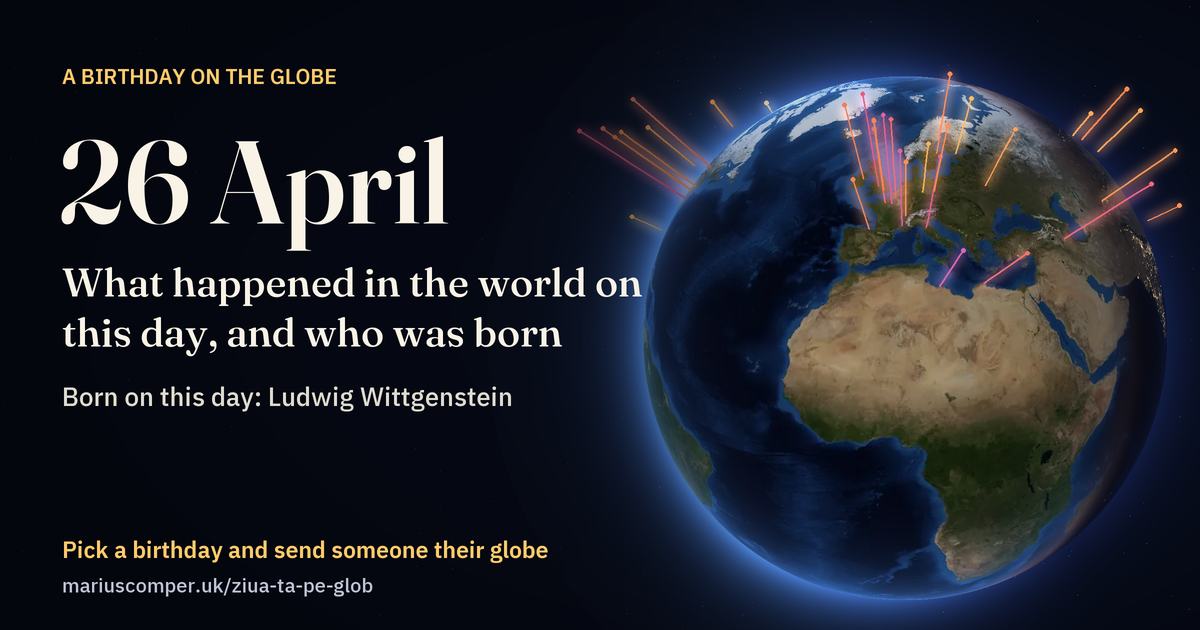
For 26 April, the English Wikipedia lists 57 events and 196 births. 33 of the events stand at their places as rays of light; six more are dashed circles, where the sentence links only to a country or a sea. The taller the ray, the longer ago it happened. The people born that day come further down, as blue points.
A birthday, yours or someone else’s:
Turn it into a greetingScroll: the globe turns to each place
The day you were born, on the globe.
Three things from your day
Scroll: your day first, then 26 April through the years
The Earth on 26 April
The picture on the globe was assembled by NASA from satellite photographs taken in April 2004: the snow, the ice and the green are those of the month.
On 26 April the Sun passes straight overhead at noon along the parallel of 13.6° north. In London, the day lasts about 14 hours 35 minutes.
Beyond 76° north the Sun no longer sets; beyond 76° south it no longer rises.
The line between day and night is tilted on the globe exactly as on this day of the year. On the dark side you can see the lights of towns.
Britain & Ireland · Stratford-upon-Avon
1564
Playwright William Shakespeare is baptized in Stratford-upon-Avon, Warwickshire, England (date of birth is unknown).
On the map: Stratford-upon-Avon.
Britain & Ireland · Westminster Abbey
1923
The Duke of York (the future King George VI) weds Lady Elizabeth Bowes-Lyon at Westminster Abbey.
On the map: Westminster Abbey.
Also on the day’s list of Wikipedia in Romanian.
Wikipedia: Wedding of Prince Albert and Lady Elizabeth Bowes-Lyon
Europe · Corbeil-Essonnes
1326
The kingdom of France and the kingdom of Scotland agree on a treaty of mutual aid at Corbeil.
On the map: Corbeil-Essonnes.
Europe · L'Aigle
1803
Thousands of meteor fragments fall from the skies of L'Aigle, France; the event convinces European scientists that meteors exist.
On the map: L'Aigle.
Also on the day’s list of Wikipedia in Romanian.
Europe · Geneva
1954
The Geneva Conference, an effort to restore peace in Indochina and Korea, begins.
On the map: Geneva.
Also on the day’s list of Wikipedia in Chinese.
North America · Cape Henry
1607
The Virginia Company colonists make landfall at Cape Henry.
On the map: Cape Henry.
North America · Port Newark–Elizabeth Marine Terminal
1956
SS Ideal X, the world's first successful container ship, leaves Port Newark, New Jersey, for Houston, Texas.
On the map: Port Newark–Elizabeth Marine Terminal.
North America · UCSF Medical Center
1981
Dr. Michael R. Harrison of the University of California, San Francisco Medical Center performs the world's first human open fetal surgery.
On the map: UCSF Medical Center.
26 April
Born on 26 April#
The English Wikipedia lists 196 births for this day. The blue points are the birthplaces of 59 of these people: those written about in the most Wikipedia editions, where Wikidata gives a place of birth.
Born on 26 April
1889
Ludwig Wittgenstein, Austrian-English philosopher and academic (died 1951)
Place of birth: Neuwaldegg.
Born on 26 April
1798
Eugène Delacroix, French painter and lithographer (died 1863)
Place of birth: Saint-Maurice.
Born on 26 April
1963
Jet Li, Chinese-Singaporean martial artist, actor, and producer
Place of birth: Beijing.
Born on 26 April
1917
I. M. Pei, Chinese-American architect, designed the National Gallery of Art and Bank of China Tower (died 2019)
Place of birth: Guangzhou.
Born on 26 April
1898
Vicente Aleixandre, Spanish poet and author, Nobel Prize laureate (died 1984)
Place of birth: Seville.
Born in Britain and Ireland
1879
Owen Willans Richardson, English physicist and academic, Nobel Prize laureate (died 1959)
Place of birth: Dewsbury.
Born in Britain and Ireland
1932
Michael Smith, English-Canadian biochemist and geneticist, Nobel Prize laureate (died 2000)
Place of birth: Blackpool.
Born in Britain and Ireland
1710
Thomas Reid, Scottish philosopher and academic (died 1796)
Place of birth: Strachan.
26 April
Number one in the charts that week
At the cinema
An animal recorded that day
The record can be seen in GBIF, which brings together wildlife records from around the world.
All your birthdays
The weather that day
Data: Met Office Hadley Centre (HadCET); NOAA (GHCN-Daily, Mauna Loa).
Above the Earth
Sources: Jonathan McDowell, GCAT (launches); GFZ Potsdam (Kp index). Days are counted in Universal Time.
Football that day
International matches played that day:
Source: the “International football results” dataset kept by Mart Jürisoo (CC0).
Also that day
The earthquake’s page at the USGS
Source: the USGS catalogue. The day is counted in Universal Time (UTC).
In those days
Make a link for someone
Type the name, pick the day and the year of birth. The link opens straight on their day, with their name in the greeting.
The link carries the name, date and place typed here; anyone who gets it can see them.
Put another birthday beside it
Your mother’s, your child’s, a friend’s: the two days appear side by side.
Below: 26 April through the years.
The whole globe of the day
Drag the globe to turn it. Touch a ray or a point to read what happened there.
Everything Wikipedia lists for 26 April
The list is the English Wikipedia’s, in its own wording, as it stood in October 2026. 18 events have no place on the map: the sentence links to no place with coordinates, only to places too wide to mark, or to several countries.
- 1289
Following weeks of bombardment, the city of Tripoli falls to the Mamluks under Qalawun. The Mamluks massacre all men they find and enslave the women and children.
Africa · Fall of TripoliWikipedia: Fall of Tripoli - 1326
The kingdom of France and the kingdom of Scotland agree on a treaty of mutual aid at Corbeil.
Europe · Corbeil-EssonnesWikipedia: Treaty of Corbeil - 1336
Francesco Petrarca (Petrarch) ascends Mont Ventoux.
Europe · Mont VentouxWikipedia: Petrarch - 1478
The Pazzi family attack on Lorenzo de' Medici in order to displace the ruling Medici family kills his brother Giuliano during High Mass in Florence Cathedral.
Europe · Pazzi conspiracyWikipedia: Pazzi conspiracy - 1564
Playwright William Shakespeare is baptized in Stratford-upon-Avon, Warwickshire, England (date of birth is unknown).
Britain & Ireland · Stratford-upon-AvonWikipedia: William Shakespeare - 1607
The Virginia Company colonists make landfall at Cape Henry.
North America · Cape HenryWikipedia: Virginia Company - 1721
A massive earthquake devastates the Iranian city of Tabriz.
Asia · 1721 Tabriz earthquakeWikipedia: 1721 Tabriz earthquake - 1777
Sybil Ludington, aged 16, allegedly rides 40 miles (64 km) to alert American colonial forces to the approach of British regular forces.
no place on the mapWikipedia: Sybil Ludington - 1794
Battle of Beaumont during the Flanders Campaign of the War of the First Coalition.
Europe · Beaumont-en-CambrésisWikipedia: Battle of Beaumont - 1802
Napoleon Bonaparte signs a general amnesty to allow all but about one thousand of the most notorious émigrés of the French Revolution to return to France.
no place on the mapWikipedia: Napoleon - 1803
Thousands of meteor fragments fall from the skies of L'Aigle, France; the event convinces European scientists that meteors exist.
Europe · L'AigleWikipedia: L'Aigle - 1805
First Barbary War: United States Marines capture Derne under the command of First Lieutenant Presley O'Bannon.
Africa · Battle of DernaWikipedia: First Barbary War - 1865
Union cavalry troopers corner and shoot dead John Wilkes Booth, assassin of President Abraham Lincoln, in Virginia.
North America · Assassination of Abraham LincolnWikipedia: Assassination of Abraham Lincoln - 1900
Fires destroy Canadian cities Ottawa and Hull, reducing them to ashes in 12 hours. Twelve thousand people are left without a home.
North America · 1900 Hull–Ottawa fireWikipedia: 1900 Hull–Ottawa fire - 1903
Atlético Madrid Association football club is founded.
no place on the mapWikipedia: Atlético Madrid - 1915
World War I: Italy secretly signs the Treaty of London pledging to join the Allied Powers.
Britain & Ireland · LondonWikipedia: World War I - 1916
Easter Rising: Battle of Mount Street Bridge.
Britain & Ireland · County MeathWikipedia: Easter Rising - 1920
Ice hockey makes its Olympic debut at the Antwerp Games with center Frank Fredrickson scoring seven goals in Canada's 12–1 drubbing of Sweden in the gold medal match.
no place on the mapWikipedia: 1920 Summer Olympics - 1923
The Duke of York (the future King George VI) weds Lady Elizabeth Bowes-Lyon at Westminster Abbey.
Britain & Ireland · Westminster AbbeyWikipedia: Wedding of Prince Albert and Lady Elizabeth Bowes-Lyon - 1925
Paul von Hindenburg defeats Wilhelm Marx in the second round of the German presidential election to become the first directly elected head of state of the Weimar Republic.
Europe · Weimar RepublicWikipedia: 1925 German presidential election - 1933
The Gestapo, the official secret police force of Nazi Germany, is established by Hermann Göring.
Europe · Nazi GermanyWikipedia: Gestapo - 1937
Spanish Civil War: Guernica, Spain, is bombed by the German Condor Legion and the Italian Aviazione Legionaria.
Europe · Bombing of GuernicaWikipedia: Bombing of Guernica - 1941
Boris Kidrič and Edvard Kardelj founded the Liberation Front of the Slovene Nation, the main anti-fascist Slovene civil-resistance and political organization during World War II.
no place on the mapWikipedia: Boris Kidrič - 1942
Benxihu Colliery accident in Manchukuo leaves 1,549 Chinese miners dead.
Asia · Benxihu CollieryWikipedia: Benxihu Colliery - 1943
The Easter Riots break out in Uppsala, Sweden.
Europe · Old Uppsala archaeological areaWikipedia: Easter Riots - 1944
Georgios Papandreou becomes head of the Greek government-in-exile based in Egypt.
Africa · EgyptWikipedia: Georgios Papandreou - 1944
World War II: Heinrich Kreipe is captured by Allied commandos in occupied Crete.
no place on the mapWikipedia: World War II - 1945
World War II: Battle of Bautzen: Last successful German tank-offensive of the war and last noteworthy victory of the Wehrmacht.
Europe · BautzenWikipedia: Battle of Bautzen - 1945
World War II: Filipino troops of the 66th Infantry Regiment, Philippine Commonwealth Army, USAFIP-NL and the American troops of the 33rd and 37th Infantry Division, United States Army liberate Baguio as they fight against the Japanese forces under General Tomoyuki Yamashita.
Asia · BaguioWikipedia: Baguio - 1954
The Geneva Conference, an effort to restore peace in Indochina and Korea, begins.
Europe · GenevaWikipedia: 1954 Geneva Conference - 1954
The first clinical trials of Jonas Salk's polio vaccine begin in Fairfax County, Virginia.
North America · Fairfax County, VirginiaWikipedia: Jonas Salk - 1956
SS Ideal X, the world's first successful container ship, leaves Port Newark, New Jersey, for Houston, Texas.
North America · Port Newark–Elizabeth Marine TerminalWikipedia: SS Ideal X - 1958
Final run of the Baltimore and Ohio Railroad's Royal Blue from Washington, D.C., to New York City after 68 years, the first U.S. passenger train to use electric locomotives.
no place on the mapWikipedia: Baltimore and Ohio Railroad - 1960
Forced out by the April Revolution, President of South Korea Syngman Rhee resigns after 12 years of dictatorial rule.
Asia · First Republic of KoreaWikipedia: April Revolution - 1962
NASA's Ranger 4 spacecraft crashes into the Moon.
no place on the mapWikipedia: NASA - 1962
The British space programme launches its first satellite, the Ariel 1.
no place on the mapWikipedia: British space programme - 1963
In Libya, amendments to the constitution transform Libya (United Kingdom of Libya) into one national unity (Kingdom of Libya) and allow for female participation in elections.
no place on the mapWikipedia: Libya - 1964
Tanganyika and Zanzibar merge to form the United Republic of Tanzania.
no place on the mapWikipedia: Tanganyika - 1966
A new government is formed in the Republic of the Congo, led by Ambroise Noumazalaye.
Africa · Republic of the CongoWikipedia: Republic of the Congo - 1966
The magnitude 5.1 Tashkent earthquake affects the largest city in Soviet Central Asia with a maximum MSK intensity of VII (Very strong). Tashkent is mostly destroyed and 15–200 are killed.
Asia · 1966 Tashkent earthquakeWikipedia: 1966 Tashkent earthquake - 1970
The Convention Establishing the World Intellectual Property Organization enters into force.
no place on the mapWikipedia: WIPO Convention - 1981
Dr. Michael R. Harrison of the University of California, San Francisco Medical Center performs the world's first human open fetal surgery.
North America · UCSF Medical CenterWikipedia: Michael R. Harrison - 1986
The Chernobyl disaster occurs in the Ukrainian Soviet Socialist Republic.
Europe · Chernobyl disasterWikipedia: Chernobyl disaster - 1989
People's Daily publishes the April 26 Editorial which inflames the nascent Tiananmen Square protests.
Asia · 1989 Tiananmen Square protests and massacreWikipedia: 1989 Tiananmen Square protests and massacre - 1989
The deadliest known tornado strikes Central Bangladesh, killing upwards of 1,300, injuring 12,000, and leaving as many as 80,000 homeless.
no place on the mapWikipedia: Daulatpur–Saturia tornado - 1991
Fifty-five tornadoes break out in the central United States. Before the outbreak's end, Andover, Kansas, would record the year's only F5 tornado.
North America · 1991 Great Plains tornado outbreakWikipedia: 1991 Great Plains tornado outbreak - 1993
The Space Shuttle Columbia is launched on mission STS-55 to conduct experiments aboard the Spacelab module.
no place on the mapWikipedia: Space Shuttle Columbia - 1994
China Airlines Flight 140 crashes at Nagoya Airport in Japan, killing 264 of the 271 people on board.
Asia · China Airlines Flight 140Wikipedia: China Airlines Flight 140 - 1994
South Africa begins its first multiracial election, which is won by Nelson Mandela's African National Congress.
Africa · South AfricaWikipedia: 1994 South African general election - 1999
Outbreak of CIH computer virus.
no place on the mapWikipedia: CIH - 2002
Robert Steinhäuser kills 16 at Gutenberg-Gymnasium in Erfurt, Germany, before committing suicide.
Europe · Erfurt school massacreWikipedia: Erfurt school massacre - 2005
Cedar Revolution: Under international pressure, Syria withdraws the last of its 14,000 troop military garrison in Lebanon, ending its 29-year military domination of that country (Syrian occupation of Lebanon).
no place on the mapWikipedia: Cedar Revolution - 2007
Controversy surrounding the relocation of the Bronze Soldier of Tallinn, a Soviet Red Army World War II memorial in Tallinn, Estonia, erupted into mass protests and riots.
Europe · Bronze Soldier of TallinnWikipedia: Bronze Soldier of Tallinn - 2015
Nursultan Nazarbayev is re-elected President of Kazakhstan with 97.7% of the vote, one of the biggest vote shares in Kazakhstan's history.
no place on the mapWikipedia: Nursultan Nazarbayev - 2015
Peaceful protesters install the first anti-monument in Mexico, Antimonumento +43, as a call for justice and remembrance to commemorate the 2014 Iguala mass kidnapping, later inspiring similar memorials elsewhere in the country and Latin America.
Latin America · Antimonumento +43Wikipedia: Iguala mass kidnapping - 2017
The Shandong was launched for the People's Liberation Army Navy, China's first domestically built aircraft carrier.
no place on the mapWikipedia: Chinese aircraft carrier Shandong - 2025
A car ramming attack at a Lapu-Lapu Day festival kills 11 people and injures at least 30 in Vancouver, Canada.
North America · 2025 Vancouver car attackWikipedia: 2025 Vancouver car attack
Who was born on 26 April
In order of how many Wikipedia editions have an article about each. The first 60 of 196 are shown.
- 121
Marcus Aurelius, Roman emperor (died 180)
- 1889
Ludwig Wittgenstein, Austrian-English philosopher and academic (died 1951)
NeuwaldeggWikipedia: Ludwig Wittgenstein - 1798
Eugène Delacroix, French painter and lithographer (died 1863)
Saint-MauriceWikipedia: Eugène Delacroix - 1963
Jet Li, Chinese-Singaporean martial artist, actor, and producer
BeijingWikipedia: Jet Li - 1970
Melania Trump, Slovene-American model; 47th First Lady of the United States
Novo MestoWikipedia: Melania Trump - 1917
I. M. Pei, Chinese-American architect, designed the National Gallery of Art and Bank of China Tower (died 2019)
GuangzhouWikipedia: I. M. Pei - 1894
Rudolf Hess, German politician and Deputy Führer in Nazi regime until 1941 (died 1987)
AlexandriaWikipedia: Rudolf Hess - 1898
Vicente Aleixandre, Spanish poet and author, Nobel Prize laureate (died 1984)
- 1933
Arno Allan Penzias, German-American physicist and academic, Nobel Prize laureate (died 2024)
- 1879
Owen Willans Richardson, English physicist and academic, Nobel Prize laureate (died 1959)
DewsburyWikipedia: Owen Richardson - 1785
John James Audubon, French-American ornithologist and painter (died 1851)
Les CayesWikipedia: John James Audubon - 1980
Channing Tatum, American actor and producer
CullmanWikipedia: Channing Tatum - 1319
John II of France (died 1364)
Le MansWikipedia: John II of France - 1575
Marie de' Medici, wife of Henry IV of France (died 1642)
FlorenceWikipedia: Marie de' Medici - 1900
Charles Francis Richter, American seismologist and physicist (died 1985)
OverpeckWikipedia: Charles Richter - 1787
Ludwig Uhland, German poet, philologist, and historian (died 1862)
TübingenWikipedia: Ludwig Uhland - 1977
Tom Welling, American actor
Putnam ValleyWikipedia: Tom Welling - 1980
Jordana Brewster, Panamanian-American actress
Panama CityWikipedia: Jordana Brewster - 1932
Michael Smith, English-Canadian biochemist and geneticist, Nobel Prize laureate (died 2000)
BlackpoolWikipedia: Michael Smith - 1865
Akseli Gallen-Kallela, Finnish artist (died 1931)
- 1933
Carol Burnett, American actress, singer, and producer
San AntonioWikipedia: Carol Burnett - 1958
Giancarlo Esposito, American actor, director, and producer
CopenhagenWikipedia: Giancarlo Esposito - 1977
Samantha Cristoforetti, Italian astronaut
- 1978
Stana Katic, Canadian actress
HamiltonWikipedia: Stana Katic - 1965
Kevin James, American actor and comedian
MineolaWikipedia: Kevin James - 1994
Daniil Kvyat, Russian racing driver
- 1940
Giorgio Moroder, Italian singer-songwriter and producer
UrtijëiWikipedia: Giorgio Moroder - 1648
Peter II of Portugal (died 1706)
Ribeira PalaceWikipedia: Peter II of Portugal - 1985
John Isner, American tennis player
GreensboroWikipedia: John Isner - 1914
Bernard Malamud, American novelist and short story writer (died 1986)
BrooklynWikipedia: Bernard Malamud - 1961
Joan Chen, Chinese-American actress, director, producer, and screenwriter
ShanghaiWikipedia: Joan Chen - 1710
Thomas Reid, Scottish philosopher and academic (died 1796)
StrachanWikipedia: Thomas Reid - 1918
Fanny Blankers-Koen, Dutch sprinter and long jumper (died 2004)
- 764
Al-Hadi, Abbasid caliph (died 786)
- 1943
Peter Zumthor, Swiss architect and academic, designed the Therme Vals
- 1782
Maria Amalia of Naples and Sicily, Queen of France (died 1866)
Palace of CasertaWikipedia: Maria Amalia of Naples and Sicily - 1889
Anita Loos, American author, playwright, and screenwriter (died 1981)
Mount ShastaWikipedia: Anita Loos - 1905
Jean Vigo, French director and screenwriter (died 1934)
18th arrondissement of ParisWikipedia: Jean Vigo - 1975
Joey Jordison, American musician and songwriter (died 2021)
Des MoinesWikipedia: Joey Jordison - 757
Hisham I of Córdoba (died 796)
- 1822
Frederick Law Olmsted, American journalist and designer, co-designed Central Park (died 1903)
HartfordWikipedia: Frederick Law Olmsted - 1990
Jonathan dos Santos, Mexican footballer
MonterreyWikipedia: Jonathan dos Santos - 1896
Ernst Udet, leading German fighter pilot in World War I and Chief of Procurement and Supply in the Luftwaffe (died 1941)
FrankfurtWikipedia: Ernst Udet - 2001
Thiago Almada, Argentine footballer
Fuerte ApacheWikipedia: Thiago Almada - 1897
Douglas Sirk, German-American director and screenwriter (died 1987)
HamburgWikipedia: Douglas Sirk - 1912
A. E. van Vogt, Canadian-American author (died 2000)
- 1941
Claudine Auger, French model and actress (died 2019)
5th arrondissement of ParisWikipedia: Claudine Auger - 1774
Christian Leopold von Buch, German geologist and paleontologist (died 1853)
- 1886
Ma Rainey, American singer-songwriter (died 1939)
ColumbusWikipedia: Ma Rainey - 1916
Morris West, Australian author and playwright (died 1999)
St KildaWikipedia: Morris West - 1897
Eddie Eagan, American boxer and bobsledder (died 1967)
DenverWikipedia: Eddie Eagan - 1932
Francis Lai, French accordion player and composer (died 2018)
- 1967
Marianne Jean-Baptiste, English actress and singer-songwriter
- 1949
Carlos Bianchi, Argentinian footballer and manager
Buenos AiresWikipedia: Carlos Bianchi - 1925
Michele Ferrero, Italian entrepreneur (died 2015)
DoglianiWikipedia: Michele Ferrero - 1938
Duane Eddy, American singer-songwriter, guitarist, and actor (died 2024)
CorningWikipedia: Duane Eddy - 1994
Odysseas Vlachodimos, Greek international footballer
StuttgartWikipedia: Odysseas Vlachodimos - 1997
Amber Midthunder, American actress
Santa FeWikipedia: Amber Midthunder - 1937
Jean-Pierre Beltoise, French racing driver and motorcycle racer (died 2015)
Boulogne-BillancourtWikipedia: Jean-Pierre Beltoise - 1972
Kiko, Spanish footballer
Jerez de la FronteraWikipedia: Kiko
What is celebrated on 26 April
- Chernobyl disaster related observances: Day of Remembrance of the Chernobyl tragedy (Belarus)
- Chernobyl disaster related observances: Memorial Day of Radiation Accidents and Catastrophes (Russia)
- Christian feast day: Aldobrandesca (or Alda)
- Christian feast day: Lucidius of Verona
- Christian feast day: Our Lady of Good Counsel
- Christian feast day: Pope Anacletus and Marcellinus
- Christian feast day: Rafael Arnáiz Barón
- Christian feast day: Riquier
- Christian feast day: Paschasius Radbertus
- Christian feast day: Robert Hunt (Episcopal Church (USA))
- Christian feast day: Blessed Stanisław Kubista
- Christian feast day: Stephen of Perm, see also Old Permic Alphabet Day
- Christian feast day: Trudpert
- Christian feast day: April 26 (Eastern Orthodox liturgics)
A greeting link for someone
Type a name and, if you like, the year of birth. The link opens with a greeting, and beside each event it says how old the person turned that day, or how many years before their birth it happened.
The name and the year go only into the link you send.
All 366 days
How the globe is made
Where the events come from
Each edition of this page uses the day’s list from Wikipedia in its own language: Romanian, English, Spanish, Chinese. The lists are written by volunteers and differ from one edition to the next; the text of each event is Wikipedia’s, with a link to the article. A row that appears twice in a list is shown once. The lists have not been checked event by event: they are Wikipedia’s, mistakes included.
For events before 1582, and for countries that moved to the Gregorian calendar later (Britain in 1752, Russia in 1918), the same day may be counted Old Style in one list and New Style in another.
The chapter “What the other Wikipedias remember” adds up to five events a day from the lists of the other three editions, only for years in which the English list has nothing on that day. They were translated for this page, passed the same filters as the tour, and are not counted among the events of the English list.
How an event gets onto the map
The place comes from Wikidata. If the sentence links to the article about the event itself (a battle, an opening, an earthquake), dated to the same year, the ray stands on its coordinates or on those of its location. Otherwise it stands on the first place the sentence links to: a town, a building, a mountain, an island. This second step can be wrong: sometimes the sentence only mentions the place. That is why the page says, under each event, which place the ray stands on.
When the sentence links to a single state or province, or to a single sea, lake or desert larger than 5,000 km², the globe shows a dashed circle, not a ray. The circle has the area Wikidata gives, with its radius kept between 1.2° and 16°, or a radius of 4.5° when Wikidata gives no area; it says only that the sentence links to that place. Organisations, ships, spacecraft, museum objects, rivers, mountain ranges, languages and continents are never used as places. When a sentence names several states and no exact place, the event stays in the list only.
What the height means
The height of a ray shows how many years have passed, on a logarithmic scale: 10 years, 100 years and 1,000 years are equal steps apart; anything older than about 2,600 years has the tallest ray. The colour runs from pale yellow for recent years to violet for antiquity.
Where the tour stops
In each region the tour stops at up to three events (five in Britain and Ireland), chosen mainly by three things: whether Wikipedia’s editors put the event in the “On this day” box of their main page (the English, Spanish and Chinese editions), how many Wikipedia editions have an article about it, and how many of the four lists include it. Events whose sentence or article is about a war, an attack, a crime or a disaster are left out of the tour; they stay in the whole list, in Wikipedia’s wording. The filter is a list of words and a list of Wikidata types, so it can miss some.
The tour of births names the people with articles in the most editions and leaves aside those whom the list or Wikidata describes as rulers, politicians, commanders, leaders of movements or criminals; they stay in the list.
The Earth and the Sun
The daytime images are NASA’s Blue Marble Next Generation mosaics, one for each month of 2004; the night side is Black Marble 2016. The tilt of the line between day and night is computed for the day; the hour is chosen so that the place being read is in daylight. The latitude where the Sun stands overhead is the average of the four years of the leap cycle; in a given year it can differ by up to 0.4°.
The day you were born
The number ones come from the weekly lists on Wikipedia: Billboard for the United States (from 1940; the Hot 100 from August 1958), the UK Singles Chart (from November 1952), Los 40 Principales for Spain (from July 1966) and, for Romania, the Romanian Top 100 and Airplay 100 (2001–2021, with missing weeks). The page shows the chart of the week in which the day of birth falls, with its date; Billboard and the UK chart are dated at the end of their week. For Romania before 2001 and for China these sources have no weekly chart.
The films are those that reached cinemas in the United States up to ten days before or three days after that day (some of them in a few cinemas at first), from the English Wikipedia’s yearly lists (from 1968), in order of how many editions have an article about them. The events “in those days” are the ones on the neighbouring days’ lists that carry the year of birth, passed through the same filter as the tour.
The day of birth, year included
The Moon, the star sign and the constellation are worked out by the page itself, for noon Universal Time on the day. The lit part of the Moon is rounded and can differ by a few per cent from that at the hour of birth. The sign follows the usual zodiac of twelve equal parts starting at the March equinox; the constellation is the one the Sun actually stood in front of, by the borders set by the International Astronomical Union, and within a day of a border the page does not name it. When the Sun changes sign while it is that day anywhere on Earth, the page gives the moment of crossing, rounded to ten minutes and accurate to within about a quarter of an hour, and the clock time in a few cities, with the time zone and summer time of that year.
The year in the Chinese calendar is the one your device’s own calendar gives for the date, checked against the Hong Kong Observatory’s tables. “All your birthdays” uses the same sources as the rest of the chapter for the same day in every year since the birth: the temperature, well-known launches that took place on that very day, matches of the teams the edition follows, snow deeper than 10 cm and strong geomagnetic storms. The three things at the top and the four on the picture are chosen in a fixed order (the song, the animal, a full Moon, a well-known launch before an ordinary earthquake); on the picture you can change them.
When the link carries a year of birth, the page adds a few things about that exact day. The weather is the Met Office’s Central England temperature record and the readings from New York’s Central Park; the “usual high” is the average of the daily highs of 1961–1990 for that date, with two days either side. The carbon dioxide figure is the monthly mean at the Mauna Loa observatory, where measurements begin in March 1958.
The earthquake is the one with the largest magnitude in the USGS catalogue for that day, counted in Universal Time. Before the 1960s the catalogue has gaps even above magnitude 5.5, so in the older years many days have no earthquake. The page gives only the magnitude and the place: the country the epicentre falls in or, when the epicentre is at sea within 300 km of a coast, the nearest country; farther out, only the ocean.
The launches are those that reached orbit or left for the Moon and the planets, from Jonathan McDowell’s GCAT catalogue. If nothing left that day, the page shows the nearest launch within three days before or after, and says how many days away it was. The geomagnetic storm appears only when the Kp index reached at least 5 in one of the day’s eight three-hour intervals.
The animal comes from GBIF: an observation made by a person (the animal seen or heard, or its tracks), dated to that exact day, with coordinates and a CC0 or CC BY licence. Only a few hundred well-known species are searched (mammals, birds, turtles, butterflies); of those noted that day, mammals and species with articles in many Wikipedia editions come first; birds noted almost every day, and species used recently, wait their turn. Observations dated 1 January are left out, because records without a day are often filed there. An observation shows that the animal was recorded there, not how many animals there were.
The matches are those between national teams. Only matches of England, Scotland, Wales, Northern Ireland, the Republic of Ireland, the United States, Canada and Australia are shown, along with those at the big final tournaments. The picture to send is drawn in the page from the day’s globe and the facts above, and stays on your device until you send it.
Sources
- Events, births and holidays: the day’s page on Wikipedia, text under CC BY-SA 4.0.
- Coordinates, places of birth and the number of editions: Wikidata (CC0).
- The Earth by day: NASA Blue Marble Next Generation. The Earth by night: NASA Black Marble 2016.
- Borders and regions: Natural Earth.
- World population and births per year: UN World Population Prospects 2024.
- Charts and films: Wikipedia’s lists for Billboard, the UK Singles Chart, Los 40 Principales, Romanian Top 100, Airplay 100 and American films by year (CC BY-SA 4.0).
- Weather: Met Office Hadley Centre, HadCET (Open Government Licence) and NOAA GHCN-Daily, New York Central Park. Carbon dioxide: NOAA Global Monitoring Laboratory, Mauna Loa.
- Earthquakes: the USGS catalogue. Launches: Jonathan McDowell, GCAT (CC BY). Kp index: GFZ Potsdam (CC BY 4.0). Matches: International football results, Mart Jürisoo (CC0).
- Animal observations: GBIF, with a link to each record; species names come from Wikidata.