A birthday on the globe
7 March on the globe: what happened in the world on this day, and who was born
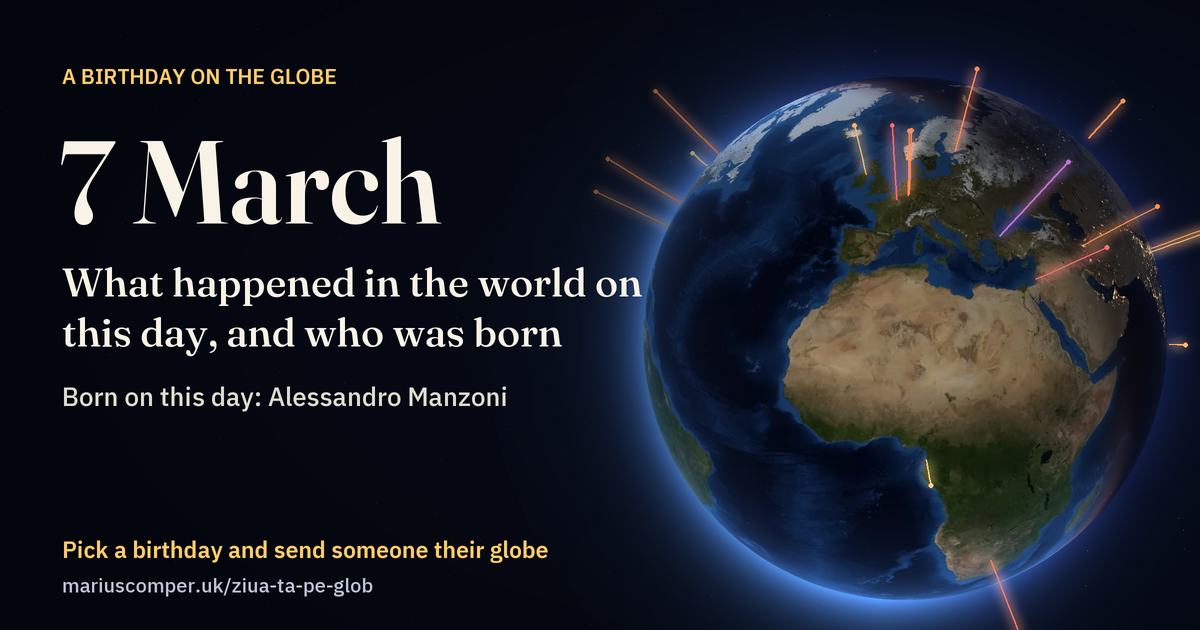
For 7 March, the English Wikipedia lists 38 events and 145 births. 18 of the events stand at their places as rays of light; seven more are dashed circles, where the sentence links only to a country or a sea. The taller the ray, the longer ago it happened. The people born that day come further down, as blue points.
A birthday, yours or someone else’s:
Turn it into a greetingScroll: the globe turns to each place
The day you were born, on the globe.
Three things from your day
Scroll: your day first, then 7 March through the years
The Earth on 7 March
The picture on the globe was assembled by NASA from satellite photographs taken in March 2004: the snow, the ice and the green are those of the month.
On 7 March the Sun passes straight overhead at noon along the parallel of 5.1° south. In London, the day lasts about 11 hours 20 minutes.
Beyond 85° south the Sun no longer sets; beyond 85° north it no longer rises.
The line between day and night is tilted on the globe exactly as on this day of the year. On the dark side you can see the lights of towns.
Europe · Parliament House, Helsinki
1931
The Parliament House of Finland is officially inaugurated in Helsinki, Finland.
On the map: Parliament House, Helsinki.
Asia · 7 March Speech of Sheikh Mujibur Rahman
1971
Sheikh Mujibur Rahman, political leader of then East Pakistan (present day-Bangladesh), delivers his historic 7th March speech in the Racecourse Field (Now Suhrawardy Udyan) in Dhaka.
On the map: the coordinates Wikidata gives for the article “7 March Speech of Sheikh Mujibur Rahman”.
7 March
What the other Wikipedias remember#
For these years the English list has nothing on this day. The events below come from the same day’s lists on Wikipedia in Romanian and were translated for this page.
From Wikipedia in Romanian · South Pole
1912
The success of Roald Amundsen's expedition to the South Pole (14 December 1911) is announced publicly, when the ship Fram arrives at Hobart, in Australia.
On the map: South Pole.
Translated from the list on Wikipedia in Romanian.
7 March
Born on 7 March#
The English Wikipedia lists 145 births for this day. The blue points are the birthplaces of 60 of these people: those written about in the most Wikipedia editions, where Wikidata gives a place of birth.
Born on 7 March
1785
Alessandro Manzoni, Italian author and poet (died 1873)
Place of birth: Milan.
Born on 7 March
1875
Maurice Ravel, French pianist, composer, and conductor (died 1937)
Place of birth: Ciboure.
Born on 7 March
1872
Piet Mondrian, Dutch-American painter (died 1944)
Place of birth: Amersfoort.
Born on 7 March
1792
John Herschel, English mathematician and astronomer (died 1871)
Place of birth: Slough.
Born in Britain and Ireland
1994
Jordan Pickford, English footballer
Place of birth: Washington.
Born in Britain and Ireland
1963
E. L. James, English author
Place of birth: London.
Born in Britain and Ireland
1957
Robert Harris, English journalist and author
Place of birth: Nottingham.
7 March
Number one in the charts that week
At the cinema
An animal recorded that day
The record can be seen in GBIF, which brings together wildlife records from around the world.
All your birthdays
The weather that day
Data: Met Office Hadley Centre (HadCET); NOAA (GHCN-Daily, Mauna Loa).
Above the Earth
Sources: Jonathan McDowell, GCAT (launches); GFZ Potsdam (Kp index). Days are counted in Universal Time.
Football that day
International matches played that day:
Source: the “International football results” dataset kept by Mart Jürisoo (CC0).
Also that day
The earthquake’s page at the USGS
Source: the USGS catalogue. The day is counted in Universal Time (UTC).
In those days
Make a link for someone
Type the name, pick the day and the year of birth. The link opens straight on their day, with their name in the greeting.
The link carries the name, date and place typed here; anyone who gets it can see them.
Put another birthday beside it
Your mother’s, your child’s, a friend’s: the two days appear side by side.
Below: 7 March through the years.
The whole globe of the day
Drag the globe to turn it. Touch a ray or a point to read what happened there.
Everything Wikipedia lists for 7 March
The list is the English Wikipedia’s, in its own wording, as it stood in October 2026. 13 events have no place on the map: the sentence links to no place with coordinates, only to places too wide to mark, or to several countries.
- 161
Marcus Aurelius and L. Commodus (who changes his name to Lucius Verus) become joint emperors of Rome on the death of Antoninus Pius.
no place on the mapWikipedia: Marcus Aurelius - 321
Emperor Constantine I decreed that Sunday, the day honoring the sun god Sol Invictus, would be the Roman day of rest.
no place on the mapWikipedia: Constantine the Great - 681
The Third Council of Constantinople deposes patriarch Macarius I of Antioch.
Asia · Third Council of ConstantinopleWikipedia: Third Council of Constantinople - 1138
Konrad III von Hohenstaufen is elected king of Germany at Coblenz in the presence of the papal legate Theodwin.
no place on the mapWikipedia: Conrad III of Germany - 1277
The University of Paris issues the last in a series of condemnations of various philosophical and theological theses.
no place on the mapWikipedia: Condemnations of 1210–1277 - 1573
A peace treaty is signed between the Ottoman Empire and the Republic of Venice, ending the Ottoman–Venetian War and leaving Cyprus in Ottoman hands.
no place on the mapWikipedia: Ottoman–Venetian War - 1799
Napoleon Bonaparte captures Jaffa in Palestine and his troops proceed to kill more than 2,000 Albanian captives.
Asia · Siege of JaffaWikipedia: Siege of Jaffa - 1814
Emperor Napoleon I of France wins the Battle of Craonne.
Europe · Battle of CraonneWikipedia: Battle of Craonne - 1826
Shrigley abduction: 15-year old Ellen Turner is abducted by Edward Gibbon Wakefield, a future figure in the establishment of colonies in South Australia and New Zealand.
no place on the mapWikipedia: Shrigley abduction - 1850
Senator Daniel Webster gives his "Seventh of March" speech endorsing the Compromise of 1850 in order to prevent a possible civil war.
no place on the mapWikipedia: Compromise of 1850 - 1871
José Paranhos, Viscount of Rio Branco, began a four-year premiership as Prime Minister of the Empire of Brazil, the longest in the state's history.
Latin America · Empire of BrazilWikipedia: José Paranhos, Viscount of Rio Branco - 1876
Alexander Graham Bell is granted a patent for an invention he calls the "telephone".
no place on the mapWikipedia: Alexander Graham Bell - 1900
The German ocean liner SS Kaiser Wilhelm der Grosse became the first ship to send a wireless telegraph message to an onshore receiver.
no place on the mapWikipedia: Ocean liner - 1902
Second Boer War: Boers, led by Koos de la Rey, defeat the British at the Battle of Tweebosch.
Africa · Battle of TweeboschWikipedia: Battle of Tweebosch - 1921
The short-lived socialist Labin Republic is proclaimed.
Europe · Labin RepublicWikipedia: Labin Republic - 1931
The Parliament House of Finland is officially inaugurated in Helsinki, Finland.
Europe · Parliament House, HelsinkiWikipedia: Parliament House, Helsinki - 1936
Nazi German forces re-occupied the demilitarized Rhineland, violating both the Treaty of Versailles and the Locarno Treaties that were signed after World War I.
Europe · Remilitarisation of the RhinelandWikipedia: Remilitarisation of the Rhineland - 1941
World War II: Günther Prien and the crew of German submarine U-47, one of the most successful U-boats of World War II, disappear without a trace.
no place on the mapWikipedia: World War II - 1945
World War II: The American 9th Armored Division unexpectedly captures an intact bridge over the Rhine.
Europe · Battle of RemagenWikipedia: Battle of Remagen - 1951
Iranian prime minister Ali Razmara is assassinated by Khalil Tahmasebi, a member of the Islamic fundamentalist Fada'iyan-e Islam, outside a mosque in Tehran.
Asia · TehranWikipedia: Ali Razmara - 1951
Korean War: Operation Ripper: United Nations troops led by General Matthew Ridgway begin an assault against Chinese forces.
Asia · Operation RipperWikipedia: Korean War - 1951
Northwest Orient Airlines Flight 307 crashes in Lynnhurst, Minneapolis, killing 15 people.
North America · Northwest Orient Airlines Flight 307Wikipedia: Northwest Orient Airlines Flight 307 - 1965
Aeroflot Flight 542 crashes in the Yermakovsky District, killing all 31 aboard.
Asia · Yermakovsky DistrictWikipedia: Aeroflot Flight 542 - 1965
Bloody Sunday: A group of 600 civil rights marchers are brutally attacked by state and local police in Selma, Alabama.
North America · Selma, AlabamaWikipedia: Selma to Montgomery marches - 1968
Vietnam War: The United States and South Vietnam began Operation Truong Cong Dinh to sweep the area surrounding the Mekong Delta town of Mỹ Tho to root out Viet Cong forces in the area.
Asia · Mekong DeltaWikipedia: Vietnam War - 1971
Sheikh Mujibur Rahman, political leader of then East Pakistan (present day-Bangladesh), delivers his historic 7th March speech in the Racecourse Field (Now Suhrawardy Udyan) in Dhaka.
Asia · 7 March Speech of Sheikh Mujibur RahmanWikipedia: 7 March Speech of Sheikh Mujibur Rahman - 1985
The charity single "We Are the World" by the supergroup USA for Africa was released, and went on to sell more than 20 million copies.
no place on the mapWikipedia: Charity record - 1986
Challenger Disaster: Divers from the USS Preserver locate the crew cabin of Challenger on the ocean floor.
North America · Space Shuttle Challenger disasterWikipedia: Space Shuttle Challenger disaster - 1989
Iran and the United Kingdom break diplomatic relations after a fight over Salman Rushdie and his controversial novel, The Satanic Verses.
Asia · IranWikipedia: Iran - 1990
Teachers in West Virginia began a labor strike that involved several thousand educators across the state.
North America · West VirginiaWikipedia: 1990 West Virginia teachers' strike - 2006
The terrorist organisation Lashkar-e-Taiba coordinates a series of bombings in Varanasi, India.
Asia · VaranasiWikipedia: 2006 Varanasi bombings - 2007
Garuda Indonesia Flight 200 crashes at Adisutjipto International Airport in the Special Region of Yogyakarta, Indonesia, killing 21 people.
Asia · Garuda Indonesia Flight 200Wikipedia: Garuda Indonesia Flight 200 - 2007
Reform of the House of Lords: The British House of Commons votes to make the upper chamber, the House of Lords, 100% elected.
no place on the mapWikipedia: Reform of the House of Lords - 2009
Massereene Barracks shooting: The Real Irish Republican Army kills two British soldiers and injures two other soldiers and two civilians at Massereene Barracks, the first British military deaths in Northern Ireland since the end of The Troubles.
Britain & Ireland · Massereene Barracks shootingWikipedia: Massereene Barracks shooting - 2009
The Kepler space telescope, designed to discover Earth-like planets orbiting other stars, was launched.
no place on the mapWikipedia: Kepler space telescope - 2021
At least 108 die and 615 are injured in the 2021 Bata explosions in Bata, Equatorial Guinea.
Africa · 2021 Bata explosionsWikipedia: 2021 Bata explosions - 2024
Hannah Gutierrez-Reed is found guilty of involuntary manslaughter in the death of Halyna Hutchins on the set of the movie Rust, the first time someone has been found guilty for causing a death on a movie set.
North America · Rust shooting incidentWikipedia: Rust shooting incident - 2024
Sweden officially joins NATO, becoming its 32nd member.
Europe · SwedenWikipedia: NATO
What the other Wikipedias remember
For these years the English list has nothing on this day. The events below come from the same day’s lists on Wikipedia in Romanian and were translated for this page.
- 1912
The success of Roald Amundsen's expedition to the South Pole (14 December 1911) is announced publicly, when the ship Fram arrives at Hobart, in Australia.
Who was born on 7 March
In order of how many Wikipedia editions have an article about each. The first 60 of 145 are shown.
- 1785
Alessandro Manzoni, Italian author and poet (died 1873)
- 1875
Maurice Ravel, French pianist, composer, and conductor (died 1937)
CiboureWikipedia: Maurice Ravel - 1850
Tomáš Garrigue Masaryk, Austrian-Czech politician, 1st President of Czechoslovakia (died 1937)
HodonínWikipedia: Tomáš Masaryk - 1970
Rachel Weisz, English actress
WestminsterWikipedia: Rachel Weisz - 1872
Piet Mondrian, Dutch-American painter (died 1944)
AmersfoortWikipedia: Piet Mondrian - 1792
John Herschel, English mathematician and astronomer (died 1871)
SloughWikipedia: John Herschel - 1956
Bryan Cranston, American actor, director, and producer
HollywoodWikipedia: Bryan Cranston - 1693
Clement XIII, pope of the Catholic Church (died 1769)
- 1904
Reinhard Heydrich, German SS officer and a principle architect of the Holocaust (died 1942)
Halle (Saale)Wikipedia: Reinhard Heydrich - 1908
Anna Magnani, Italian actress (died 1973)
- 189
Publius Septimius Geta, Roman emperor (died 211)
MilanWikipedia: Geta - 1994
Jordan Pickford, English footballer
WashingtonWikipedia: Jordan Pickford - 1765
Nicéphore Niépce, French inventor, invented photography (died 1833)
Chalon-sur-SaôneWikipedia: Nicéphore Niépce - 1938
David Baltimore, American biologist and academic, Nobel Prize laureate (died 2025)
ManhattanWikipedia: David Baltimore - 1980
Laura Prepon, American actress
WatchungWikipedia: Laura Prepon - 1857
Julius Wagner-Jauregg, Austrian physician and academic, Nobel Prize laureate (died 1940)
- 1960
Ivan Lendl, Czech tennis player and coach
OstravaWikipedia: Ivan Lendl - 1936
Georges Perec, French author (died 1982)
19th arrondissement of ParisWikipedia: Georges Perec - 1964
Bret Easton Ellis, American author and screenwriter
Los AngelesWikipedia: Bret Easton Ellis - 1998
Amanda Gorman, American poet and activist
Los AngelesWikipedia: Amanda Gorman - 1963
E. L. James, English author
LondonWikipedia: E. L. James - 1984
Mathieu Flamini, French footballer
MarseilleWikipedia: Mathieu Flamini - 1849
Luther Burbank, American botanist (died 1926)
LancasterWikipedia: Luther Burbank - 1837
Henry Draper, American physician and astronomer (died 1882)
Prince Edward CountyWikipedia: Henry Draper - 1957
Robert Harris, English journalist and author
NottinghamWikipedia: Robert Harris - 1971
Peter Sarsgaard, American actor
Scott Air Force BaseWikipedia: Peter Sarsgaard - 1915
Jacques Chaban-Delmas, French general and politician, Prime Minister of France (died 2000)
13th arrondissement of ParisWikipedia: Jacques Chaban-Delmas - 1971
Matthew Vaughn, English director and producer
- 1922
Olga Ladyzhenskaya, Russian mathematician and academic (died 2004)
KologrivWikipedia: Olga Ladyzhenskaya - 1974
Jenna Fischer, American actress
Fort WayneWikipedia: Jenna Fischer - 1995
Haley Lu Richardson, American actress
- 1678
Filippo Juvarra, Italian architect, designed the Basilica of Superga (died 1736)
MessinaWikipedia: Filippo Juvarra - 1946
John Heard, American actor and producer (died 2017)
Washington, D.C.Wikipedia: John Heard - 1964
Wanda Sykes, American comedian, actress, and screenwriter
PortsmouthWikipedia: Wanda Sykes - 1671
Rob Roy MacGregor, Scottish outlaw (died 1734)
GlengyleWikipedia: Rob Roy MacGregor - 1886
G. I. Taylor, English mathematician and physicist (died 1975)
St John's WoodWikipedia: G. I. Taylor - 1902
Heinz Rühmann, German actor (died 1994)
- 1930
Antony Armstrong-Jones, 1st Earl of Snowdon, English photographer and politician (died 2017)
- 1959
Donna Murphy, American actress and singer
New York CityWikipedia: Donna Murphy - 1952
William Boyd, British author and screenwriter
- 1962
Taylor Dayne, American singer-songwriter and actress
ManhattanWikipedia: Taylor Dayne - 1958
Rik Mayall, English comedian, actor, and screenwriter (died 2014)
HarlowWikipedia: Rik Mayall - 1984
Brandon T. Jackson, American actor and comedian
- 1917
Betty Holberton, American engineer and programmer (died 2001)
PhiladelphiaWikipedia: Betty Holberton - 1983
Manucho, Angolan footballer
LuandaWikipedia: Manucho - 1974
Tobias Menzies, English actor
- 1934
Willard Scott, American television personality and actor (died 2021)
AlexandriaWikipedia: Willard Scott - 1995
Aboubakar Kamara, French footballer
GonesseWikipedia: Aboubakar Kamara - 1975
T. J. Thyne, American actor
- 1904
Ivar Ballangrud, Norwegian speed skater (died 1969)
- 1944
Ranulph Fiennes, English soldier and explorer
WindsorWikipedia: Ranulph Fiennes - 1942
Michael Eisner, American businessman
New York CityWikipedia: Michael Eisner - 1973
Sébastien Izambard, French tenor and producer
- 1992
Bel Powley, English actress
LondonWikipedia: Bel Powley - 1839
Ludwig Mond, German-born chemist and British industrialist who discovered the metal carbonyls (died 1909)
KasselWikipedia: Ludwig Mond - 1903
Maud Lewis, Canadian folk artist (died 1970)
South OhioWikipedia: Maud Lewis - 1945
Elizabeth Moon, American author
McAllenWikipedia: Elizabeth Moon - 1959
Nick Searcy, American actor
CullowheeWikipedia: Nick Searcy - 1994
Chase Kalisz, American swimmer
Bel AirWikipedia: Chase Kalisz - 1715
Ewald Christian von Kleist, German soldier and poet (died 1759)
What is celebrated on 7 March
- Christian feast day: Blessed Leonid Feodorov (Russian Greek Catholic Church)
- Christian feast day: María Antonia de Paz y Figueroa
- Christian feast day: Perpetua and Felicity
- Christian feast day: Siméon-François Berneux (part of The Korean Martyrs)
- Christian feast day: Teresa Margaret of the Sacred Heart
- Christian feast day: March 7 (Eastern Orthodox liturgics)
- Maritime Day in Slovenia
A greeting link for someone
Type a name and, if you like, the year of birth. The link opens with a greeting, and beside each event it says how old the person turned that day, or how many years before their birth it happened.
The name and the year go only into the link you send.
All 366 days
How the globe is made
Where the events come from
Each edition of this page uses the day’s list from Wikipedia in its own language: Romanian, English, Spanish, Chinese. The lists are written by volunteers and differ from one edition to the next; the text of each event is Wikipedia’s, with a link to the article. A row that appears twice in a list is shown once. The lists have not been checked event by event: they are Wikipedia’s, mistakes included.
For events before 1582, and for countries that moved to the Gregorian calendar later (Britain in 1752, Russia in 1918), the same day may be counted Old Style in one list and New Style in another.
The chapter “What the other Wikipedias remember” adds up to five events a day from the lists of the other three editions, only for years in which the English list has nothing on that day. They were translated for this page, passed the same filters as the tour, and are not counted among the events of the English list.
How an event gets onto the map
The place comes from Wikidata. If the sentence links to the article about the event itself (a battle, an opening, an earthquake), dated to the same year, the ray stands on its coordinates or on those of its location. Otherwise it stands on the first place the sentence links to: a town, a building, a mountain, an island. This second step can be wrong: sometimes the sentence only mentions the place. That is why the page says, under each event, which place the ray stands on.
When the sentence links to a single state or province, or to a single sea, lake or desert larger than 5,000 km², the globe shows a dashed circle, not a ray. The circle has the area Wikidata gives, with its radius kept between 1.2° and 16°, or a radius of 4.5° when Wikidata gives no area; it says only that the sentence links to that place. Organisations, ships, spacecraft, museum objects, rivers, mountain ranges, languages and continents are never used as places. When a sentence names several states and no exact place, the event stays in the list only.
What the height means
The height of a ray shows how many years have passed, on a logarithmic scale: 10 years, 100 years and 1,000 years are equal steps apart; anything older than about 2,600 years has the tallest ray. The colour runs from pale yellow for recent years to violet for antiquity.
Where the tour stops
In each region the tour stops at up to three events (five in Britain and Ireland), chosen mainly by three things: whether Wikipedia’s editors put the event in the “On this day” box of their main page (the English, Spanish and Chinese editions), how many Wikipedia editions have an article about it, and how many of the four lists include it. Events whose sentence or article is about a war, an attack, a crime or a disaster are left out of the tour; they stay in the whole list, in Wikipedia’s wording. The filter is a list of words and a list of Wikidata types, so it can miss some.
The tour of births names the people with articles in the most editions and leaves aside those whom the list or Wikidata describes as rulers, politicians, commanders, leaders of movements or criminals; they stay in the list.
The Earth and the Sun
The daytime images are NASA’s Blue Marble Next Generation mosaics, one for each month of 2004; the night side is Black Marble 2016. The tilt of the line between day and night is computed for the day; the hour is chosen so that the place being read is in daylight. The latitude where the Sun stands overhead is the average of the four years of the leap cycle; in a given year it can differ by up to 0.4°.
The day you were born
The number ones come from the weekly lists on Wikipedia: Billboard for the United States (from 1940; the Hot 100 from August 1958), the UK Singles Chart (from November 1952), Los 40 Principales for Spain (from July 1966) and, for Romania, the Romanian Top 100 and Airplay 100 (2001–2021, with missing weeks). The page shows the chart of the week in which the day of birth falls, with its date; Billboard and the UK chart are dated at the end of their week. For Romania before 2001 and for China these sources have no weekly chart.
The films are those that reached cinemas in the United States up to ten days before or three days after that day (some of them in a few cinemas at first), from the English Wikipedia’s yearly lists (from 1968), in order of how many editions have an article about them. The events “in those days” are the ones on the neighbouring days’ lists that carry the year of birth, passed through the same filter as the tour.
The day of birth, year included
The Moon, the star sign and the constellation are worked out by the page itself, for noon Universal Time on the day. The lit part of the Moon is rounded and can differ by a few per cent from that at the hour of birth. The sign follows the usual zodiac of twelve equal parts starting at the March equinox; the constellation is the one the Sun actually stood in front of, by the borders set by the International Astronomical Union, and within a day of a border the page does not name it. When the Sun changes sign while it is that day anywhere on Earth, the page gives the moment of crossing, rounded to ten minutes and accurate to within about a quarter of an hour, and the clock time in a few cities, with the time zone and summer time of that year.
The year in the Chinese calendar is the one your device’s own calendar gives for the date, checked against the Hong Kong Observatory’s tables. “All your birthdays” uses the same sources as the rest of the chapter for the same day in every year since the birth: the temperature, well-known launches that took place on that very day, matches of the teams the edition follows, snow deeper than 10 cm and strong geomagnetic storms. The three things at the top and the four on the picture are chosen in a fixed order (the song, the animal, a full Moon, a well-known launch before an ordinary earthquake); on the picture you can change them.
When the link carries a year of birth, the page adds a few things about that exact day. The weather is the Met Office’s Central England temperature record and the readings from New York’s Central Park; the “usual high” is the average of the daily highs of 1961–1990 for that date, with two days either side. The carbon dioxide figure is the monthly mean at the Mauna Loa observatory, where measurements begin in March 1958.
The earthquake is the one with the largest magnitude in the USGS catalogue for that day, counted in Universal Time. Before the 1960s the catalogue has gaps even above magnitude 5.5, so in the older years many days have no earthquake. The page gives only the magnitude and the place: the country the epicentre falls in or, when the epicentre is at sea within 300 km of a coast, the nearest country; farther out, only the ocean.
The launches are those that reached orbit or left for the Moon and the planets, from Jonathan McDowell’s GCAT catalogue. If nothing left that day, the page shows the nearest launch within three days before or after, and says how many days away it was. The geomagnetic storm appears only when the Kp index reached at least 5 in one of the day’s eight three-hour intervals.
The animal comes from GBIF: an observation made by a person (the animal seen or heard, or its tracks), dated to that exact day, with coordinates and a CC0 or CC BY licence. Only a few hundred well-known species are searched (mammals, birds, turtles, butterflies); of those noted that day, mammals and species with articles in many Wikipedia editions come first; birds noted almost every day, and species used recently, wait their turn. Observations dated 1 January are left out, because records without a day are often filed there. An observation shows that the animal was recorded there, not how many animals there were.
The matches are those between national teams. Only matches of England, Scotland, Wales, Northern Ireland, the Republic of Ireland, the United States, Canada and Australia are shown, along with those at the big final tournaments. The picture to send is drawn in the page from the day’s globe and the facts above, and stays on your device until you send it.
Sources
- Events, births and holidays: the day’s page on Wikipedia, text under CC BY-SA 4.0.
- Coordinates, places of birth and the number of editions: Wikidata (CC0).
- The Earth by day: NASA Blue Marble Next Generation. The Earth by night: NASA Black Marble 2016.
- Borders and regions: Natural Earth.
- World population and births per year: UN World Population Prospects 2024.
- Charts and films: Wikipedia’s lists for Billboard, the UK Singles Chart, Los 40 Principales, Romanian Top 100, Airplay 100 and American films by year (CC BY-SA 4.0).
- Weather: Met Office Hadley Centre, HadCET (Open Government Licence) and NOAA GHCN-Daily, New York Central Park. Carbon dioxide: NOAA Global Monitoring Laboratory, Mauna Loa.
- Earthquakes: the USGS catalogue. Launches: Jonathan McDowell, GCAT (CC BY). Kp index: GFZ Potsdam (CC BY 4.0). Matches: International football results, Mart Jürisoo (CC0).
- Animal observations: GBIF, with a link to each record; species names come from Wikidata.