A birthday on the globe
2 October on the globe: what happened in the world on this day, and who was born
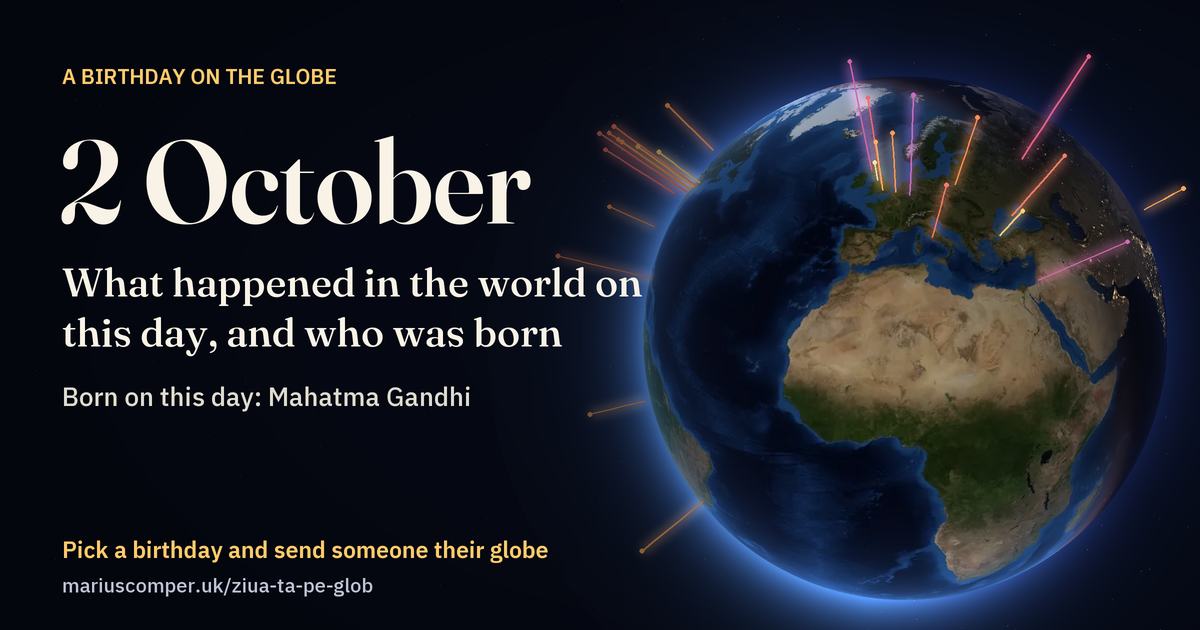
For 2 October, the English Wikipedia lists 42 events and 163 births. 26 of the events stand at their places as rays of light; four more are dashed circles, where the sentence links only to a country or a sea. The taller the ray, the longer ago it happened. The people born that day come further down, as blue points.
A birthday, yours or someone else’s:
Turn it into a greetingScroll: the globe turns to each place
The day you were born, on the globe.
Three things from your day
Scroll: your day first, then 2 October through the years
The Earth on 2 October
The picture on the globe was assembled by NASA from satellite photographs taken in October 2004: the snow, the ice and the green are those of the month.
On 2 October the Sun passes straight overhead at noon along the parallel of 3.5° south. In London, the day lasts about 11 hours 35 minutes.
Beyond 86° south the Sun no longer sets; beyond 86° north it no longer rises.
The line between day and night is tilted on the globe exactly as on this day of the year. On the dark side you can see the lights of towns.
Europe · Livadiya
1879
Qing China signed the Treaty of Livadia with the Russian Empire, but the terms were so unfavorable that the Chinese government refused to ratify the treaty.
On the map: Livadiya.
Also on the day’s list of Wikipedia in Chinese.
North America · Shubert Theatre
1913
The Shubert Theatre opened on Broadway with a production of Hamlet.
On the map: Shubert Theatre.
North America · Supreme Court of the United States
1967
Thurgood Marshall is sworn in as the first African-American justice of the United States Supreme Court.
On the map: Supreme Court of the United States.
2 October
What the other Wikipedias remember#
For these years the English list has nothing on this day. The events below come from the same day’s lists on Wikipedia in Spanish and were translated for this page.
From Wikipedia in Spanish · Mount Royal
1535
At the foot of Mount Royal (Canada), Jacques Cartier arrives at the Iroquoian village of Hochelaga (the future Montreal) and claims the whole territory for France.
On the map: Mount Royal.
Translated from the list on Wikipedia in Spanish.
From Wikipedia in Spanish · Hiroshima
1994
In Hiroshima (Japan), the 12th Asian Games begin.
On the map: Hiroshima.
Translated from the list on Wikipedia in Spanish.
The article on Wikipedia in Spanish: Juegos Asiáticos de 1994
2 October
Born on 2 October#
The English Wikipedia lists 163 births for this day. The blue points are the birthplaces of 60 of these people: those written about in the most Wikipedia editions, where Wikidata gives a place of birth.
Born on 2 October
1869
Mahatma Gandhi, Indian freedom fighter, activist and philosopher (died 1948)
Place of birth: Porbandar.
Born on 2 October
1904
Graham Greene, English novelist, playwright, and critic (died 1991)
Place of birth: Berkhamsted.
Born on 2 October
1951
Sting, English singer-songwriter and actor
Place of birth: Wallsend.
Born on 2 October
1890
Groucho Marx, American comedian and actor (died 1977)
Place of birth: Manhattan.
Born on 2 October
1852
William Ramsay, Scottish chemist and academic, Nobel Prize laureate (died 1916)
Place of birth: Glasgow.
Born in Britain and Ireland
1933
John Gurdon, English biologist and academic, Nobel Prize laureate (died 2025)
Place of birth: Dippenhall.
Born in Britain and Ireland
1832
Edward Burnett Tylor, English anthropologist (died 1917)
Place of birth: Camberwell.
Born in Britain and Ireland
1854
Patrick Geddes, Scottish biologist, sociologist, geographer, and philanthropist (died 1932)
Place of birth: Ballater.
2 October
Number one in the charts that week
At the cinema
An animal recorded that day
The record can be seen in GBIF, which brings together wildlife records from around the world.
All your birthdays
The weather that day
Data: Met Office Hadley Centre (HadCET); NOAA (GHCN-Daily, Mauna Loa).
Above the Earth
Sources: Jonathan McDowell, GCAT (launches); GFZ Potsdam (Kp index). Days are counted in Universal Time.
Football that day
International matches played that day:
Source: the “International football results” dataset kept by Mart Jürisoo (CC0).
Also that day
The earthquake’s page at the USGS
Source: the USGS catalogue. The day is counted in Universal Time (UTC).
In those days
Make a link for someone
Type the name, pick the day and the year of birth. The link opens straight on their day, with their name in the greeting.
The link carries the name, date and place typed here; anyone who gets it can see them.
Put another birthday beside it
Your mother’s, your child’s, a friend’s: the two days appear side by side.
Below: 2 October through the years.
The whole globe of the day
Drag the globe to turn it. Touch a ray or a point to read what happened there.
Everything Wikipedia lists for 2 October
The list is the English Wikipedia’s, in its own wording, as it stood in October 2026. 12 events have no place on the map: the sentence links to no place with coordinates, only to places too wide to mark, or to several countries.
- 48 BC
Julius Caesar arrives in Ptolemaic Egypt in his pursuit of Pompey and learns of the latter's death.
no place on the mapWikipedia: Julius Caesar - 811
Michael I Rangabe is proclaimed as Byzantine Emperor, forcing the rival claimant Staurakios to abdicate his claim.
no place on the mapWikipedia: Michael I Rangabe - 829
Theophilos succeeds his father Michael II as Byzantine Emperor.
Asia · Byzantine EmpireWikipedia: Theophilos - 939
Battle of Andernach: Otto I, Holy Roman Emperor, crushes a rebellion against his rule, by a coalition of Eberhard of Franconia and other Frankish dukes.
Europe · AndernachWikipedia: Battle of Andernach - 1187
Saladin wins Jerusalem after the city surrendered to his forces following a prolonged siege.
Asia · Siege of JerusalemWikipedia: Siege of Jerusalem - 1263
The Battle of Largs is fought between Norwegians and Scots.
Britain & Ireland · Battle of LargsWikipedia: Battle of Largs - 1470
The Earl of Warwick's rebellion forces King Edward IV of England to flee to the Netherlands, restoring Henry VI to the throne.
Europe · NetherlandsWikipedia: Richard Neville, 16th Earl of Warwick - 1552
Russo-Kazan Wars: Russian troops enter Kazan.
Europe · Siege of KazanWikipedia: Siege of Kazan - 1766
The Nottingham Cheese Riot breaks out at the Goose Fair in Nottingham, UK, in response to the excessive cost of cheese.
Britain & Ireland · NottinghamWikipedia: Nottingham cheese riot - 1780
American Revolutionary War: John André, a British Army officer, is hanged as a spy by the Continental Army.
no place on the mapWikipedia: American Revolutionary War - 1789
The United States Bill of Rights is sent to the various States for ratification.
no place on the mapWikipedia: United States Bill of Rights - 1835
Texas Revolution: Mexican troops attempt to disarm the people of Gonzales, but encounter stiff resistance from a hastily assembled militia.
North America · Battle of GonzalesWikipedia: Battle of Gonzales - 1864
American Civil War: Confederates defeat a Union attack on Saltville, Virginia. A massacre of wounded Union prisoners ensues.
North America · First Battle of SaltvilleWikipedia: American Civil War - 1870
By plebiscite, the citizens of the Papal States accept annexation by the Kingdom of Italy.
Europe · RomeWikipedia: Capture of Rome - 1879
Qing China signed the Treaty of Livadia with the Russian Empire, but the terms were so unfavorable that the Chinese government refused to ratify the treaty.
Europe · LivadiyaWikipedia: Treaty of Livadia - 1913
The Shubert Theatre opened on Broadway with a production of Hamlet.
North America · Shubert TheatreWikipedia: Shubert Theatre - 1919
Seven days after suffering a "physical collapse" following a speech in Pueblo, Colorado, U.S. president Woodrow Wilson has a catastrophic stroke at the White House, leaving him physically and mentally incapacitated for the remainder of his presidency.
North America · White HouseWikipedia: White House - 1920
Ukrainian War of Independence: Mikhail Frunze orders the Red Army to immediately cease hostilities with the Revolutionary Insurgent Army of Ukraine.
no place on the mapWikipedia: Ukrainian War of Independence - 1928
The "Prelature of the Holy Cross and the Work of God", commonly known as Opus Dei, is founded.
no place on the mapWikipedia: Opus Dei - 1937
Rafael Trujillo orders the execution of Haitians living in the border region of the Dominican Republic.
Latin America · Parsley massacreWikipedia: Parsley massacre - 1942
World War II: Ocean Liner RMS Queen Mary accidentally rams and sinks HMS Curacoa, killing over 300 crewmen aboard Curacoa.
no place on the mapWikipedia: World War II - 1944
World War II: German troops end the Warsaw Uprising.
Europe · Warsaw UprisingWikipedia: Warsaw Uprising - 1958
Guinea declares its independence from France.
Africa · GuineaWikipedia: Guinea - 1967
Thurgood Marshall is sworn in as the first African-American justice of the United States Supreme Court.
North America · Supreme Court of the United StatesWikipedia: Supreme Court of the United States - 1968
Mexican President Gustavo Díaz Ordaz orders soldiers to suppress a demonstration of unarmed students, ten days before the start of the 1968 Summer Olympics.
Latin America · Tlatelolco massacreWikipedia: Tlatelolco massacre - 1970
An aircraft carrying the Wichita State University football team, administrators, and supporters crashes in Colorado, killing 31 people.
North America · Wichita State University football team plane crashWikipedia: Wichita State University football team plane crash - 1971
British European Airways Flight 706 crashes near Aarsele, Belgium, killing 63.
Europe · British European Airways Flight 706Wikipedia: British European Airways Flight 706 - 1971
South Vietnamese President Nguyen Van Thieu is re-elected in a one-man election.
no place on the mapWikipedia: 1971 South Vietnamese presidential election - 1980
Michael Myers becomes the first member of either chamber of Congress to be expelled since the Civil War.
North America · United States CongressWikipedia: American Civil War - 1990
Xiamen Airlines Flight 8301 is hijacked and lands at Guangzhou, where it crashes into two other airliners on the ground, killing 132.
Asia · 1990 Guangzhou Baiyun airport collisionsWikipedia: 1990 Guangzhou Baiyun airport collisions - 1992
Military police storm the Carandiru Penitentiary in São Paulo, Brazil during a prison riot. The resulting massacre leaves 111 prisoners dead.
Latin America · Carandiru massacreWikipedia: Carandiru massacre - 1996
Aeroperú Flight 603 crashes into the ocean near Peru, killing all 70 people on board.
Latin America · Aeroperú Flight 603Wikipedia: Aeroperú Flight 603 - 1996
The Electronic Freedom of Information Act Amendments are signed by U.S. President Bill Clinton.
no place on the mapWikipedia: Freedom of Information Act - 2002
The Beltway sniper attacks begin in Washington, D.C., extending over three weeks and killing 10 people.
North America · MarylandWikipedia: D.C. sniper attacks - 2004
The first parkrun, then known as the Bushy Park Time Trial, takes place in Bushy Park, London, UK.
Britain & Ireland · Bushy ParkWikipedia: Parkrun - 2005
Typhoon Longwang made landfall in China as the deadliest tropical cyclone in that year to impact the country.
no place on the mapWikipedia: Typhoon Longwang - 2006
Five Amish girls are murdered in a shooting at a school in Pennsylvania, United States.
North America · West Nickel Mines School shootingWikipedia: West Nickel Mines School shooting - 2007
President Roh Moo-hyun of South Korea goes to North Korea for an Inter-Korean summit with North Korean leader Kim Jong-il.
no place on the mapWikipedia: Roh Moo-hyun - 2016
Ethiopian protests break out during a festival in the Oromia region, killing dozens of people.
no place on the mapWikipedia: 2014–2016 Oromo protests - 2018
The Washington Post journalist Jamal Khashoggi is assassinated in the Saudi consulate in Istanbul, Turkey.
Asia · Assassination of Jamal KhashoggiWikipedia: Assassination of Jamal Khashoggi - 2019
A privately owned Boeing B-17 Flying Fortress conducting a living history exhibition flight crashes shortly after takeoff from Windsor Locks, Connecticut, killing seven.
North America · 2019 Boeing B-17 Flying Fortress crashWikipedia: 2019 Boeing B-17 Flying Fortress crash - 2025
2 people are killed and at least 4 others injured in an attack on a synagogue in Manchester, UK, during Yom Kippur.
Britain & Ireland · 2025 Manchester synagogue attackWikipedia: 2025 Manchester synagogue attack
What the other Wikipedias remember
For these years the English list has nothing on this day. The events below come from the same day’s lists on Wikipedia in Spanish and were translated for this page.
- 1535
At the foot of Mount Royal (Canada), Jacques Cartier arrives at the Iroquoian village of Hochelaga (the future Montreal) and claims the whole territory for France.
- 1994
In Hiroshima (Japan), the 12th Asian Games begin.
Who was born on 2 October
In order of how many Wikipedia editions have an article about each. The first 60 of 163 are shown.
- 1869
Mahatma Gandhi, Indian freedom fighter, activist and philosopher (died 1948)
PorbandarWikipedia: Mahatma Gandhi - 1904
Graham Greene, English novelist, playwright, and critic (died 1991)
BerkhamstedWikipedia: Graham Greene - 1847
Paul von Hindenburg, German field marshal and politician, 2nd President of Germany (died 1934)
6 Podgórna Street in PoznańWikipedia: Paul von Hindenburg - 1951
Sting, English singer-songwriter and actor
WallsendWikipedia: Sting - 1890
Groucho Marx, American comedian and actor (died 1977)
ManhattanWikipedia: Groucho Marx - 1852
William Ramsay, Scottish chemist and academic, Nobel Prize laureate (died 1916)
GlasgowWikipedia: William Ramsay - 1452
Richard III of England (died 1485)
Fotheringhay CastleWikipedia: Richard III of England - 1851
Ferdinand Foch, French field marshal (died 1929)
- 1963
Maria Ressa, Filipino-American journalist
ManilaWikipedia: Maria Ressa - 1992
Alisson Becker, Brazilian footballer
Novo HamburgoWikipedia: Alisson Becker - 1904
Lal Bahadur Shastri, Indian and politician, Prime Minister of India (died 1966)
Pandit Deen Dayal Upadhyaya NagarWikipedia: Lal Bahadur Shastri - 1991
Roberto Firmino, Brazilian footballer
- 1917
Christian de Duve, Belgian cytologist and biochemist, Nobel Prize laureate (died 2013)
Thames DittonWikipedia: Christian de Duve - 1871
Cordell Hull, American politician, United States Secretary of State, Nobel Prize laureate (died 1955)
OlympusWikipedia: Cordell Hull - 1907
Alexander R. Todd, Scottish biochemist and academic, Nobel Prize laureate (died 1997)
GlasgowWikipedia: Alec Todd - 1978
Ayumi Hamasaki, Japanese singer, songwriter, actress
FukuokaWikipedia: Ayumi Hamasaki - 1984
Marion Bartoli, French tennis player
Le Puy-en-VelayWikipedia: Marion Bartoli - 1933
John Gurdon, English biologist and academic, Nobel Prize laureate (died 2025)
DippenhallWikipedia: John Gurdon - 1935
Omar Sívori, Italian-Argentine footballer and manager (died 2005)
San Nicolás de los ArroyosWikipedia: Omar Sívori - 1538
Charles Borromeo, Italian cardinal and saint (died 1584)
- 1832
Edward Burnett Tylor, English anthropologist (died 1917)
CamberwellWikipedia: Edward Burnett Tylor - 1879
Wallace Stevens, American poet (died 1955)
ReadingWikipedia: Wallace Stevens - 1968
Jana Novotná, Czech tennis player and sportscaster (died 2017)
- 1949
Annie Leibovitz, American photographer
WaterburyWikipedia: Annie Leibovitz - 1954
Lorraine Bracco, American actress
BrooklynWikipedia: Lorraine Bracco - 1798
Charles Albert, King of Sardinia (1831–49) (died 1849)
- 1882
Boris Shaposhnikov, Russian colonel (died 1945)
ZlatoustWikipedia: Boris Shaposhnikov - 1948
Siim Kallas, Estonian politician, Prime Minister of Estonia (died 2026)
TallinnWikipedia: Siim Kallas - 1967
Thomas Muster, Austrian tennis player
LeibnitzWikipedia: Thomas Muster - 1986
Camilla Belle, American actress
Los AngelesWikipedia: Camilla Belle - 1470
Isabella of Aragon, Queen of Portugal, Daughter of Isabella I of Castile and Ferdinand II of Aragon (died 1498)
- 1897
Bud Abbott, American comedian, actor, and producer. (died 1974)
Asbury ParkWikipedia: Bud Abbott - 1945
Don McLean, American singer-songwriter
New RochelleWikipedia: Don McLean - 1907
Víctor Paz Estenssoro, Bolivian politician, President of Bolivia (died 2001)
- 1854
Patrick Geddes, Scottish biologist, sociologist, geographer, and philanthropist (died 1932)
BallaterWikipedia: Patrick Geddes - 1944
Vernor Vinge, American author (died 2024)
WaukeshaWikipedia: Vernor Vinge - 1948
Donna Karan, American fashion designer, founded DKNY
Forest HillsWikipedia: Donna Karan - 1982
Tyson Chandler, American basketball player
HanfordWikipedia: Tyson Chandler - 1967
Frankie Fredericks, Namibian sprinter
WindhoekWikipedia: Frankie Fredericks - 1990
Samantha Barks, Manx actress and singer
- 1800
Nat Turner, American slave and uprising leader (died 1831)
Southampton CountyWikipedia: Nat Turner - 1902
Leopold Figl, Austrian politician, Chancellor of Austria (died 1965)
MichelhausenWikipedia: Leopold Figl - 1945
Martin Hellman, American cryptographer and academic
New York CityWikipedia: Martin Hellman - 1970
Maribel Verdú, Spanish actress
MadridWikipedia: Maribel Verdú - 1948
Trevor Brooking, English footballer and manager
BarkingWikipedia: Trevor Brooking - 1966
Yokozuna, American wrestler (died 2000)
San FranciscoWikipedia: Yokozuna - 1883
Karl von Terzaghi, Austrian geologist and engineer (died 1963)
- 1950
Mike Rutherford, English guitarist
GuildfordWikipedia: Mike Rutherford - 1960
Joe Sacco, Maltese-American journalist and cartoonist
KirkopWikipedia: Joe Sacco - 1971
Tiffany Darwish, American singer-songwriter
NorwalkWikipedia: Tiffany Darwish - 1971
Jim Root, American guitarist and songwriter
Las VegasWikipedia: Jim Root - 1974
Bjarke Ingels, Danish architect
CopenhagenWikipedia: Bjarke Ingels - 1977
Didier Défago, Swiss skier
MorginsWikipedia: Didier Défago - 1981
Luke Wilkshire, Australian footballer
WollongongWikipedia: Luke Wilkshire - 1987
Joe Ingles, Australian basketball player
AdelaideWikipedia: Joe Ingles - 1948
Avery Brooks, American actor
EvansvilleWikipedia: Avery Brooks - 1828
Charles Floquet, French lawyer and politician, Prime Minister of France (died 1896)
Saint-Jean-Pied-de-PortWikipedia: Charles Floquet - 1928
Wolfhart Pannenberg, Polish-German theologian and academic (died 2014)
SzczecinWikipedia: Wolfhart Pannenberg - 1946
Sonthi Boonyaratglin, Thai general and politician
Ubon RatchathaniWikipedia: Sonthi Boonyaratglin - 1973
Lene Nystrøm, Norwegian singer, songwriter, and musician
RamnesWikipedia: Lene Nystrøm
What is celebrated on 2 October
- Batik Day (Indonesia)
- Christian feast day: Blessed Antoine Chevrier
- Christian feast day: Denha I of Tikrit (Syriac Orthodox Church)
- Christian feast day: Blessed Jan Beyzym
- Christian feast day: Blessed Maria Antonina Kratochwil
- Christian feast day: Blessed María Francisca Ricart Olmos
- Christian feast day: Memorial of the Holy Guardian Angels
- Christian feast day: Leodegar
- Christian feast day: October 2 (Eastern Orthodox liturgics)
- Gandhi's birthday-related observances: Gandhi Jayanti (India)
- Gandhi's birthday-related observances: International Day of Non-Violence
- Independence Day, celebrates the independence of Guinea from France in 1958
- National Grandparents Day (Italy)
- International Day of Non-Violence
A greeting link for someone
Type a name and, if you like, the year of birth. The link opens with a greeting, and beside each event it says how old the person turned that day, or how many years before their birth it happened.
The name and the year go only into the link you send.
All 366 days
How the globe is made
Where the events come from
Each edition of this page uses the day’s list from Wikipedia in its own language: Romanian, English, Spanish, Chinese. The lists are written by volunteers and differ from one edition to the next; the text of each event is Wikipedia’s, with a link to the article. A row that appears twice in a list is shown once. The lists have not been checked event by event: they are Wikipedia’s, mistakes included.
For events before 1582, and for countries that moved to the Gregorian calendar later (Britain in 1752, Russia in 1918), the same day may be counted Old Style in one list and New Style in another.
The chapter “What the other Wikipedias remember” adds up to five events a day from the lists of the other three editions, only for years in which the English list has nothing on that day. They were translated for this page, passed the same filters as the tour, and are not counted among the events of the English list.
How an event gets onto the map
The place comes from Wikidata. If the sentence links to the article about the event itself (a battle, an opening, an earthquake), dated to the same year, the ray stands on its coordinates or on those of its location. Otherwise it stands on the first place the sentence links to: a town, a building, a mountain, an island. This second step can be wrong: sometimes the sentence only mentions the place. That is why the page says, under each event, which place the ray stands on.
When the sentence links to a single state or province, or to a single sea, lake or desert larger than 5,000 km², the globe shows a dashed circle, not a ray. The circle has the area Wikidata gives, with its radius kept between 1.2° and 16°, or a radius of 4.5° when Wikidata gives no area; it says only that the sentence links to that place. Organisations, ships, spacecraft, museum objects, rivers, mountain ranges, languages and continents are never used as places. When a sentence names several states and no exact place, the event stays in the list only.
What the height means
The height of a ray shows how many years have passed, on a logarithmic scale: 10 years, 100 years and 1,000 years are equal steps apart; anything older than about 2,600 years has the tallest ray. The colour runs from pale yellow for recent years to violet for antiquity.
Where the tour stops
In each region the tour stops at up to three events (five in Britain and Ireland), chosen mainly by three things: whether Wikipedia’s editors put the event in the “On this day” box of their main page (the English, Spanish and Chinese editions), how many Wikipedia editions have an article about it, and how many of the four lists include it. Events whose sentence or article is about a war, an attack, a crime or a disaster are left out of the tour; they stay in the whole list, in Wikipedia’s wording. The filter is a list of words and a list of Wikidata types, so it can miss some.
The tour of births names the people with articles in the most editions and leaves aside those whom the list or Wikidata describes as rulers, politicians, commanders, leaders of movements or criminals; they stay in the list.
The Earth and the Sun
The daytime images are NASA’s Blue Marble Next Generation mosaics, one for each month of 2004; the night side is Black Marble 2016. The tilt of the line between day and night is computed for the day; the hour is chosen so that the place being read is in daylight. The latitude where the Sun stands overhead is the average of the four years of the leap cycle; in a given year it can differ by up to 0.4°.
The day you were born
The number ones come from the weekly lists on Wikipedia: Billboard for the United States (from 1940; the Hot 100 from August 1958), the UK Singles Chart (from November 1952), Los 40 Principales for Spain (from July 1966) and, for Romania, the Romanian Top 100 and Airplay 100 (2001–2021, with missing weeks). The page shows the chart of the week in which the day of birth falls, with its date; Billboard and the UK chart are dated at the end of their week. For Romania before 2001 and for China these sources have no weekly chart.
The films are those that reached cinemas in the United States up to ten days before or three days after that day (some of them in a few cinemas at first), from the English Wikipedia’s yearly lists (from 1968), in order of how many editions have an article about them. The events “in those days” are the ones on the neighbouring days’ lists that carry the year of birth, passed through the same filter as the tour.
The day of birth, year included
The Moon, the star sign and the constellation are worked out by the page itself, for noon Universal Time on the day. The lit part of the Moon is rounded and can differ by a few per cent from that at the hour of birth. The sign follows the usual zodiac of twelve equal parts starting at the March equinox; the constellation is the one the Sun actually stood in front of, by the borders set by the International Astronomical Union, and within a day of a border the page does not name it. When the Sun changes sign while it is that day anywhere on Earth, the page gives the moment of crossing, rounded to ten minutes and accurate to within about a quarter of an hour, and the clock time in a few cities, with the time zone and summer time of that year.
The year in the Chinese calendar is the one your device’s own calendar gives for the date, checked against the Hong Kong Observatory’s tables. “All your birthdays” uses the same sources as the rest of the chapter for the same day in every year since the birth: the temperature, well-known launches that took place on that very day, matches of the teams the edition follows, snow deeper than 10 cm and strong geomagnetic storms. The three things at the top and the four on the picture are chosen in a fixed order (the song, the animal, a full Moon, a well-known launch before an ordinary earthquake); on the picture you can change them.
When the link carries a year of birth, the page adds a few things about that exact day. The weather is the Met Office’s Central England temperature record and the readings from New York’s Central Park; the “usual high” is the average of the daily highs of 1961–1990 for that date, with two days either side. The carbon dioxide figure is the monthly mean at the Mauna Loa observatory, where measurements begin in March 1958.
The earthquake is the one with the largest magnitude in the USGS catalogue for that day, counted in Universal Time. Before the 1960s the catalogue has gaps even above magnitude 5.5, so in the older years many days have no earthquake. The page gives only the magnitude and the place: the country the epicentre falls in or, when the epicentre is at sea within 300 km of a coast, the nearest country; farther out, only the ocean.
The launches are those that reached orbit or left for the Moon and the planets, from Jonathan McDowell’s GCAT catalogue. If nothing left that day, the page shows the nearest launch within three days before or after, and says how many days away it was. The geomagnetic storm appears only when the Kp index reached at least 5 in one of the day’s eight three-hour intervals.
The animal comes from GBIF: an observation made by a person (the animal seen or heard, or its tracks), dated to that exact day, with coordinates and a CC0 or CC BY licence. Only a few hundred well-known species are searched (mammals, birds, turtles, butterflies); of those noted that day, mammals and species with articles in many Wikipedia editions come first; birds noted almost every day, and species used recently, wait their turn. Observations dated 1 January are left out, because records without a day are often filed there. An observation shows that the animal was recorded there, not how many animals there were.
The matches are those between national teams. Only matches of England, Scotland, Wales, Northern Ireland, the Republic of Ireland, the United States, Canada and Australia are shown, along with those at the big final tournaments. The picture to send is drawn in the page from the day’s globe and the facts above, and stays on your device until you send it.
Sources
- Events, births and holidays: the day’s page on Wikipedia, text under CC BY-SA 4.0.
- Coordinates, places of birth and the number of editions: Wikidata (CC0).
- The Earth by day: NASA Blue Marble Next Generation. The Earth by night: NASA Black Marble 2016.
- Borders and regions: Natural Earth.
- World population and births per year: UN World Population Prospects 2024.
- Charts and films: Wikipedia’s lists for Billboard, the UK Singles Chart, Los 40 Principales, Romanian Top 100, Airplay 100 and American films by year (CC BY-SA 4.0).
- Weather: Met Office Hadley Centre, HadCET (Open Government Licence) and NOAA GHCN-Daily, New York Central Park. Carbon dioxide: NOAA Global Monitoring Laboratory, Mauna Loa.
- Earthquakes: the USGS catalogue. Launches: Jonathan McDowell, GCAT (CC BY). Kp index: GFZ Potsdam (CC BY 4.0). Matches: International football results, Mart Jürisoo (CC0).
- Animal observations: GBIF, with a link to each record; species names come from Wikidata.