A birthday on the globe
6 October on the globe: what happened in the world on this day, and who was born
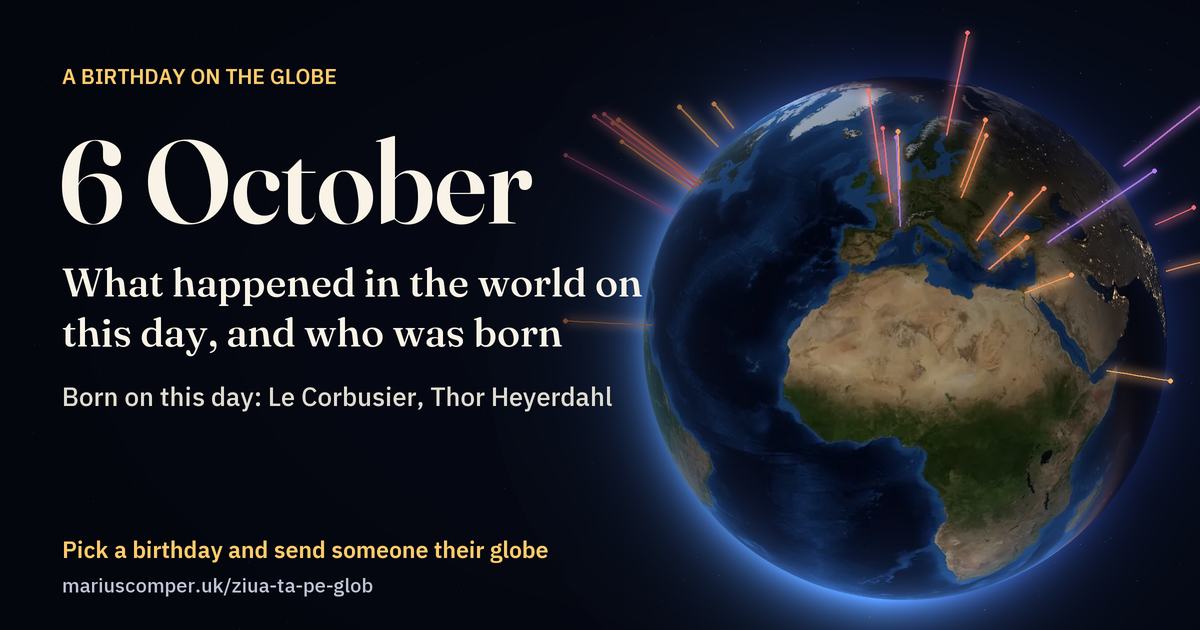
For 6 October, the English Wikipedia lists 53 events and 235 births. 26 of the events stand at their places as rays of light; four more are dashed circles, where the sentence links only to a country or a sea. The taller the ray, the longer ago it happened. The people born that day come further down, as blue points.
A birthday, yours or someone else’s:
Turn it into a greetingScroll: the globe turns to each place
The day you were born, on the globe.
Three things from your day
Scroll: your day first, then 6 October through the years
The Earth on 6 October
The picture on the globe was assembled by NASA from satellite photographs taken in October 2004: the snow, the ice and the green are those of the month.
On 6 October the Sun passes straight overhead at noon along the parallel of 5.1° south. In London, the day lasts about 11 hours 20 minutes.
Beyond 85° south the Sun no longer sets; beyond 85° north it no longer rises.
The line between day and night is tilted on the globe exactly as on this day of the year. On the dark side you can see the lights of towns.
Europe · Palace of Versailles
1789
French Revolution: King Louis XVI is forced to change his residence from Versailles to the Tuileries Palace.
On the map: Palace of Versailles.
Also on the day’s list of Wikipedia in Spanish.
Asia · Constantinople
1923
The Turkish National Movement enters Constantinople.
On the map: Constantinople.
North America · Anhaica
1539
Spain's DeSoto expedition takes over the Apalachee capital of Anhaica for their winter quarters.
On the map: Anhaica.
Also on the day’s list of Wikipedia in Spanish.
North America · Germantown, Philadelphia
1683
Immigrant families found Germantown, Pennsylvania in the first major immigration of German people to America.
On the map: Germantown, Philadelphia.
North America · White House
1979
Pope John Paul II becomes the first pontiff to visit the White House.
On the map: White House.
Also on the day’s list of Wikipedia in Spanish and Romanian.
6 October
What the other Wikipedias remember#
For these years the English list has nothing on this day. The events below come from the same day’s lists on Wikipedia in Chinese and were translated for this page.
From Wikipedia in Chinese · Cairo
1993
The Palestinian leader Arafat and the Israeli prime minister Rabin hold formal talks in Cairo.
On the map: Cairo.
Translated from the list on Wikipedia in Chinese.
6 October
Born on 6 October#
The English Wikipedia lists 235 births for this day. The blue points are the birthplaces of 60 of these people: those written about in the most Wikipedia editions, where Wikidata gives a place of birth.
Born on 6 October
1887
Le Corbusier, Swiss-French architect and painter, designed the Philips Pavilion and Saint-Pierre, Firminy (died 1965)
Place of birth: La Chaux-de-Fonds.
Born on 6 October
1914
Thor Heyerdahl, Norwegian ethnographer and explorer (died 2002)
Place of birth: Larvik.
Born on 6 October
1903
Ernest Walton, Irish physicist and academic, Nobel Prize laureate (died 1995)
Place of birth: Abbeyside.
Born on 6 October
1931
Riccardo Giacconi, Italian-American astrophysicist and astronomer, Nobel Prize laureate (died 2018)
Place of birth: Genoa.
Born on 6 October
1831
Richard Dedekind, German mathematician and philosopher (died 1916)
Place of birth: Brunswick.
Born in Britain and Ireland
1971
Emily Mortimer, English actress
Place of birth: Finsbury Park.
Born in Britain and Ireland
1973
Ioan Gruffudd, Welsh actor
Place of birth: Cardiff.
Born in Britain and Ireland
1966
Niall Quinn, Irish footballer and manager
Place of birth: Dublin.
6 October
Number one in the charts that week
At the cinema
An animal recorded that day
The record can be seen in GBIF, which brings together wildlife records from around the world.
All your birthdays
The weather that day
Data: Met Office Hadley Centre (HadCET); NOAA (GHCN-Daily, Mauna Loa).
Above the Earth
Sources: Jonathan McDowell, GCAT (launches); GFZ Potsdam (Kp index). Days are counted in Universal Time.
Football that day
International matches played that day:
Source: the “International football results” dataset kept by Mart Jürisoo (CC0).
Also that day
The earthquake’s page at the USGS
Source: the USGS catalogue. The day is counted in Universal Time (UTC).
In those days
Make a link for someone
Type the name, pick the day and the year of birth. The link opens straight on their day, with their name in the greeting.
The link carries the name, date and place typed here; anyone who gets it can see them.
Put another birthday beside it
Your mother’s, your child’s, a friend’s: the two days appear side by side.
Below: 6 October through the years.
The whole globe of the day
Drag the globe to turn it. Touch a ray or a point to read what happened there.
Everything Wikipedia lists for 6 October
The list is the English Wikipedia’s, in its own wording, as it stood in October 2026. 23 events have no place on the map: the sentence links to no place with coordinates, only to places too wide to mark, or to several countries.
- 105 BC
Cimbrian War: Defeat at the Battle of Arausio of the Roman army of the mid-Republic.
Europe · Battle of ArausioWikipedia: Battle of Arausio - 69 BC
Third Mithridatic War: The military of the Roman Republic subdues Armenia.
Asia · Battle of TigranocertaWikipedia: Battle of Tigranocerta - 23
Rebels decapitate Wang Mang, only Emperor of the Xin Dynasty, after his capital was sacked during a peasant rebellion.
no place on the mapWikipedia: Wang Mang - 404
Byzantine Empress Eudoxia dies from the miscarriage of her seventh pregnancy.
Asia · Byzantine EmpireWikipedia: Byzantine Empire - 618
Transition from Sui to Tang: Wang Shichong decisively defeats Li Mi at the Battle of Yanshi.
Asia · Battle of YanshiWikipedia: Battle of Yanshi - 891
Election of Pope Formosus following the death of pope Stephen V in the previous month.
no place on the mapWikipedia: Pope Formosus - 1539
Spain's DeSoto expedition takes over the Apalachee capital of Anhaica for their winter quarters.
North America · AnhaicaWikipedia: Hernando de Soto - 1600
Euridice, the earliest surviving opera, receives its première performance, beginning the Baroque period.
no place on the mapWikipedia: Baroque - 1620
The Polish–Lithuanian Commonwealth suffers a defeat against the Ottoman Empire in the battle of Cecora after a heroic defense over several days and the death of their commander Hetman Stanisław Żółkiewski.
no place on the mapWikipedia: Battle of Cecora - 1683
Immigrant families found Germantown, Pennsylvania in the first major immigration of German people to America.
North America · Germantown, PhiladelphiaWikipedia: Germantown, Philadelphia - 1762
Seven Years' War: The British capture Manila from Spain and occupy it.
Asia · Battle of ManilaWikipedia: Seven Years' War - 1777
American Revolutionary War: British forces capture Forts Clinton and Montgomery on the Hudson River.
North America · Battle of Forts Clinton and MontgomeryWikipedia: Battle of Forts Clinton and Montgomery - 1789
French Revolution: King Louis XVI is forced to change his residence from Versailles to the Tuileries Palace.
Europe · Palace of VersaillesWikipedia: French Revolution - 1810
A large fire destroys a third of all the buildings in the town of Raahe in the Grand Duchy of Finland.
Europe · RaaheWikipedia: Raahe - 1849
The execution of the 13 Martyrs of Arad after the Hungarian war of independence.
no place on the mapWikipedia: The 13 Martyrs of Arad - 1854
In England the great fire of Newcastle and Gateshead leads to 53 deaths and hundreds injured.
Britain & Ireland · Great fire of Newcastle and GatesheadWikipedia: Great fire of Newcastle and Gateshead - 1884
The Naval War College of the United States is founded in Rhode Island.
North America · Naval War CollegeWikipedia: Naval War College - 1898
Phi Mu Alpha Sinfonia, the largest American music fraternity, is founded at the New England Conservatory of Music.
North America · New England Conservatory of MusicWikipedia: Phi Mu Alpha Sinfonia - 1903
The High Court of Australia sits for the first time.
no place on the mapWikipedia: High Court of Australia - 1908
The Bosnian crisis erupts when Austria-Hungary formally annexes Bosnia and Herzegovina.
no place on the mapWikipedia: Bosnian Crisis - 1910
Eleftherios Venizelos is elected Prime Minister of Greece for the first of seven times.
no place on the mapWikipedia: Eleftherios Venizelos - 1915
World War I: Combined Austro-Hungarian and German Central Powers, reinforced by the recently joined Bulgaria, launch a new offensive against Serbia under command of August von Mackensen.
no place on the mapWikipedia: World War I - 1915
World War I: Entente forces land in Thessaloniki, to open the Macedonian front against the Central Powers.
Europe · ThessalonikiWikipedia: Macedonian front - 1920
Ukrainian War of Independence: The Starobilsk agreement is signed by representatives of the Ukrainian Soviet Socialist Republic and the Makhnovshchina.
no place on the mapWikipedia: Ukrainian War of Independence - 1923
The Turkish National Movement enters Constantinople.
Asia · ConstantinopleWikipedia: Turkish National Movement - 1927
Opening of The Jazz Singer, the first prominent "talkie" movie.
no place on the mapWikipedia: The Jazz Singer - 1934
Revolution of 1934: The President of the autonomous government of Catalonia, Lluís Companys, proclaims the Catalan State with the support of the Worker's Alliance.
Europe · CataloniaWikipedia: Events of 6 October - 1939
World War II: The Battle of Kock is the final combat of the September Campaign in Poland.
Europe · Battle of KockWikipedia: World War II - 1942
World War II: American troops force the Japanese from their positions east of the Matanikau River during the Battle of Guadalcanal.
Oceania · Actions along the MatanikauWikipedia: Actions along the Matanikau - 1943
World War II: Thirteen civilians are burnt alive by a paramilitary group in Crete during the Nazi occupation of Greece.
Europe · Burnings of Kali SykiaWikipedia: Burnings of Kali Sykia - 1944
World War II: Units of the 1st Czechoslovak Army Corps enter Czechoslovakia during the Battle of the Dukla Pass.
Europe · Battle of the Dukla PassWikipedia: Battle of the Dukla Pass - 1973
Egypt and Syria launch coordinated attacks against Israel, beginning the Yom Kippur War.
Africa · Sinai PeninsulaWikipedia: Operation Badr - 1976
Cubana de Aviación Flight 455 is destroyed by two bombs, placed on board by an anti-Castro militant group.
Latin America · Cubana de Aviación Flight 455Wikipedia: Cubana de Aviación Flight 455 - 1976
Dozens are killed by Thai police and right-wing paramilitaries in the Thammasat University massacre; afterwards, the Seni Pramoj government is toppled in a military coup led by Sangad Chaloryu.
Asia · 6 October 1976 massacreWikipedia: 6 October 1976 massacre - 1976
Premier Hua Guofeng arrests the Gang of Four, ending the Cultural Revolution in China.
no place on the mapWikipedia: Hua Guofeng - 1977
The first prototype of the Mikoyan MiG-29, designated 9-01, makes its maiden flight.
no place on the mapWikipedia: Mikoyan MiG-29 - 1979
Pope John Paul II becomes the first pontiff to visit the White House.
North America · White HouseWikipedia: White House - 1981
Egyptian President Anwar Sadat is murdered by Islamic extremists.
Africa · Assassination of Anwar SadatWikipedia: Assassination of Anwar Sadat - 1981
NLM CityHopper Flight 431 crashes in Moerdijk after taking off from Rotterdam The Hague Airport in the Netherlands, killing all 17 people on board.
Europe · NLM CityHopper Flight 431Wikipedia: NLM CityHopper Flight 431 - 1985
Police constable Keith Blakelock is murdered as riots erupt in the Broadwater Farm suburb of London.
no place on the mapWikipedia: Murder of Keith Blakelock - 1987
Fiji becomes a republic.
Oceania · FijiWikipedia: Fiji - 1989
About 200 members of the San Francisco Police Department instigated a police riot in the Castro following a peaceful protest held by the political group ACT UP.
North America · The CastroWikipedia: Castro Sweep - 1990
Space Shuttle Discovery is launched on STS-41, and deploys the Ulysses space probe to study the Sun's polar regions.
no place on the mapWikipedia: Space Shuttle Discovery - 1995
The first planet orbiting another sun, 51 Pegasi b, is discovered.
no place on the mapWikipedia: 51 Pegasi b - 1998
Matthew Shepard, a gay college student, was attacked and fatally wounded near Laramie, Wyoming, U.S., dying six days later.
North America · Laramie, WyomingWikipedia: Matthew Shepard - 2000
Denouncing corruption in Argentine president Fernando de la Rúa's administration and the Senate, Vice President Carlos Álvarez resigned.
no place on the mapWikipedia: Fernando de la Rúa - 2002
Al-Qaeda bombed the oil tanker Limburg, causing oil to leak into the Gulf of Aden.
Africa · Gulf of AdenWikipedia: Al-Qaeda - 2007
Jason Lewis completes the first human-powered circumnavigation of the Earth.
no place on the mapWikipedia: Jason Lewis - 2008
The MESSENGER probe discovered Mercury's Rembrandt – the second largest impact crater on the planet.
no place on the mapWikipedia: MESSENGER - 2010
Instagram, a mainstream photo-sharing application, is founded.
no place on the mapWikipedia: Instagram - 2018
The United States Senate confirms Brett Kavanaugh as a Supreme Court Associate Justice, ending a contentious confirmation process.
no place on the mapWikipedia: Brett Kavanaugh Supreme Court nomination - 2022
Annie Ernaux is awarded the Nobel Prize in Literature.
no place on the mapWikipedia: 2022 Nobel Prize in Literature - 2025
The 2025 Alberta teachers' strike begins, leaving approximately 51,000 teachers off-work, impacting about 730,000 Albertan students.
no place on the mapWikipedia: 2025 Alberta teachers' strike
What the other Wikipedias remember
For these years the English list has nothing on this day. The events below come from the same day’s lists on Wikipedia in Chinese and were translated for this page.
- 1993
The Palestinian leader Arafat and the Israeli prime minister Rabin hold formal talks in Cairo.
Who was born on 6 October
In order of how many Wikipedia editions have an article about each. The first 60 of 235 are shown.
- 1887
Le Corbusier, Swiss-French architect and painter, designed the Philips Pavilion and Saint-Pierre, Firminy (died 1965)
La Chaux-de-FondsWikipedia: Le Corbusier - 1930
Hafez al-Assad, Syrian general and politician, 20th President of Syria (died 2000)
QardahaWikipedia: Hafez al-Assad - 1914
Thor Heyerdahl, Norwegian ethnographer and explorer (died 2002)
- 1773
Louis Philippe I of France (died 1850)
- 1903
Ernest Walton, Irish physicist and academic, Nobel Prize laureate (died 1995)
AbbeysideWikipedia: Ernest Walton - 1931
Riccardo Giacconi, Italian-American astrophysicist and astronomer, Nobel Prize laureate (died 2018)
- 1831
Richard Dedekind, German mathematician and philosopher (died 1916)
BrunswickWikipedia: Richard Dedekind - 1906
Janet Gaynor, American actress (died 1984)
PhiladelphiaWikipedia: Janet Gaynor - 1963
Elisabeth Shue, American actress
WilmingtonWikipedia: Elisabeth Shue - 1552
Matteo Ricci, Italian priest and missionary (died 1610)
MacerataWikipedia: Matteo Ricci - 1908
Carole Lombard, American actress (died 1942)
Fort WayneWikipedia: Carole Lombard - 1820
Jenny Lind, Swedish soprano and actress (died 1887)
Klara Church ParishWikipedia: Jenny Lind - 1846
George Westinghouse, American engineer and businessman, founded the Westinghouse Air Brake Company (died 1914)
Central BridgeWikipedia: George Westinghouse - 1982
Levon Aronian, Armenian chess grandmaster
YerevanWikipedia: Levon Aronian - 1978
Liu Yang, Chinese astronaut
ZhengzhouWikipedia: Liu Yang - 1923
Yaşar Kemal, Turkish journalist and author (died 2015)
GökçedamWikipedia: Yaşar Kemal - 1972
Mark Schwarzer, Australian footballer
- 1965
Jürgen Kohler, German footballer and manager
LambsheimWikipedia: Jürgen Kohler - 1888
Roland Garros, French soldier and pilot (died 1918)
Saint-DenisWikipedia: Roland Garros - 1942
Britt Ekland, Swedish actress and singer
StockholmWikipedia: Britt Ekland - 1948
Gerry Adams, Irish republican politician
BelfastWikipedia: Gerry Adams - 1962
David Baker, American biologist and academic
SeattleWikipedia: David Baker - 1997
Kasper Dolberg, Danish footballer
SilkeborgWikipedia: Kasper Dolberg - 1289
Wenceslaus III of Bohemia (died 1306)
- 1882
Karol Szymanowski, Polish pianist and composer (died 1937)
TymoshivkaWikipedia: Karol Szymanowski - 1893
Meghnad Saha, Indian astrophysicist, astronomer, and academic (died 1956)
- 1971
Emily Mortimer, English actress
Finsbury ParkWikipedia: Emily Mortimer - 1946
Vinod Khanna, Indian actor, producer and politician (died 2017)
PeshawarWikipedia: Vinod Khanna - 1950
David Brin, American physicist and author
GlendaleWikipedia: David Brin - 1969
Muhammad V of Kelantan, Yang di-Pertuan Agong of Malaysia
Kota BharuWikipedia: Muhammad V of Kelantan - 2000
Addison Rae, American social media personality, dancer, and singer
LafayetteWikipedia: Addison Rae - 1931
Nikolai Chernykh, Russian astronomer (died 2004)
- 1459
Martin Behaim, German navigator and geographer (died 1507)
NurembergWikipedia: Martin Behaim - 1973
Ioan Gruffudd, Welsh actor
CardiffWikipedia: Ioan Gruffudd - 1767
Henri Christophe, Grenadian-Haitian king (died 1820)
Saint KittsWikipedia: Henri Christophe - 1967
Kennet Andersson, Swedish footballer
EskilstunaWikipedia: Kennet Andersson - 1905
Helen Wills, American tennis player and painter (died 1998)
FremontWikipedia: Helen Wills - 1965
Steve Scalise, American lawyer and politician
New OrleansWikipedia: Steve Scalise - 1738
Archduchess Maria Anna of Austria (died 1789)
- 1866
Reginald Fessenden, Canadian engineer and academic, invented radiotelephony (died 1932)
Bolton-EstWikipedia: Reginald Fessenden - 1913
Méret Oppenheim, German-Swiss painter and photographer (died 1985)
CharlottenburgWikipedia: Méret Oppenheim - 1974
Walter Centeno, Costa Rican footballer and manager
- 1934
Marshall Rosenberg, American psychologist and author (died 2015)
- 1565
Marie de Gournay, French writer (died 1645)
- 1957
Bruce Grobbelaar, Zimbabwean footballer and coach
- 1966
Niall Quinn, Irish footballer and manager
DublinWikipedia: Niall Quinn - 1978
Ricky Hatton, English boxer and promoter (died 2025)
StockportWikipedia: Ricky Hatton - 1986
Olivia Thirlby, American actress
New York CityWikipedia: Olivia Thirlby - 1989
Pizzi, Portuguese footballer
BragançaWikipedia: Pizzi - 1908
Sergei Sobolev, Russian mathematician and academic (died 1989)
Saint PetersburgWikipedia: Sergei Sobolev - 1917
Fannie Lou Hamer, American activist and philanthropist (died 1977)
Montgomery CountyWikipedia: Fannie Lou Hamer - 1935
Bruno Sammartino, Italian-American wrestler and trainer (died 2018)
PizzoferratoWikipedia: Bruno Sammartino - 1974
Jeremy Sisto, American actor, producer, and screenwriter
Grass ValleyWikipedia: Jeremy Sisto - 1974
Hoàng Xuân Vinh, Vietnamese shooter
- 1996
Kevin Diks, Indonesian footballer
ApeldoornWikipedia: Kevin Diks - 1944
Carlos Pace, Brazilian race car driver (died 1977)
São PauloWikipedia: Carlos Pace - 1976
Brett Gelman, American actor and comedian
Highland ParkWikipedia: Brett Gelman - 1981
Zurab Khizanishvili, Georgian footballer
- 1947
Klaus Dibiasi, Italian diver
Hall in TirolWikipedia: Klaus Dibiasi - 1948
Glenn Branca, American guitarist and composer (died 2018)
HarrisburgWikipedia: Glenn Branca
What is celebrated on 6 October
- Christian feast day: Bruno of Cologne
- Christian feast day: Faith
- Christian feast day: Blessed Isidore De Loor
- Christian feast day: Blessed Juan de Palafox y Mendoza
- Christian feast day: Blessed Marie Rose Durocher
- Christian feast day: Mary Frances of the Five Wounds
- Christian feast day: Pardulphus
- Christian feast day: Sagar of Laodicea
- Christian feast day: October 6 (Eastern Orthodox liturgics)
- Christian feast day: William Tyndale (commemoration, Anglicanism), with Myles Coverdale (Episcopal Church (USA))
- World Space Week (October 4–10)
- Day of Commemoration and National Mourning (Turkmenistan)
- Dukla Pass Victims Day (Slovakia)
- German-American Day (United States)
A greeting link for someone
Type a name and, if you like, the year of birth. The link opens with a greeting, and beside each event it says how old the person turned that day, or how many years before their birth it happened.
The name and the year go only into the link you send.
All 366 days
How the globe is made
Where the events come from
Each edition of this page uses the day’s list from Wikipedia in its own language: Romanian, English, Spanish, Chinese. The lists are written by volunteers and differ from one edition to the next; the text of each event is Wikipedia’s, with a link to the article. A row that appears twice in a list is shown once. The lists have not been checked event by event: they are Wikipedia’s, mistakes included.
For events before 1582, and for countries that moved to the Gregorian calendar later (Britain in 1752, Russia in 1918), the same day may be counted Old Style in one list and New Style in another.
The chapter “What the other Wikipedias remember” adds up to five events a day from the lists of the other three editions, only for years in which the English list has nothing on that day. They were translated for this page, passed the same filters as the tour, and are not counted among the events of the English list.
How an event gets onto the map
The place comes from Wikidata. If the sentence links to the article about the event itself (a battle, an opening, an earthquake), dated to the same year, the ray stands on its coordinates or on those of its location. Otherwise it stands on the first place the sentence links to: a town, a building, a mountain, an island. This second step can be wrong: sometimes the sentence only mentions the place. That is why the page says, under each event, which place the ray stands on.
When the sentence links to a single state or province, or to a single sea, lake or desert larger than 5,000 km², the globe shows a dashed circle, not a ray. The circle has the area Wikidata gives, with its radius kept between 1.2° and 16°, or a radius of 4.5° when Wikidata gives no area; it says only that the sentence links to that place. Organisations, ships, spacecraft, museum objects, rivers, mountain ranges, languages and continents are never used as places. When a sentence names several states and no exact place, the event stays in the list only.
What the height means
The height of a ray shows how many years have passed, on a logarithmic scale: 10 years, 100 years and 1,000 years are equal steps apart; anything older than about 2,600 years has the tallest ray. The colour runs from pale yellow for recent years to violet for antiquity.
Where the tour stops
In each region the tour stops at up to three events (five in Britain and Ireland), chosen mainly by three things: whether Wikipedia’s editors put the event in the “On this day” box of their main page (the English, Spanish and Chinese editions), how many Wikipedia editions have an article about it, and how many of the four lists include it. Events whose sentence or article is about a war, an attack, a crime or a disaster are left out of the tour; they stay in the whole list, in Wikipedia’s wording. The filter is a list of words and a list of Wikidata types, so it can miss some.
The tour of births names the people with articles in the most editions and leaves aside those whom the list or Wikidata describes as rulers, politicians, commanders, leaders of movements or criminals; they stay in the list.
The Earth and the Sun
The daytime images are NASA’s Blue Marble Next Generation mosaics, one for each month of 2004; the night side is Black Marble 2016. The tilt of the line between day and night is computed for the day; the hour is chosen so that the place being read is in daylight. The latitude where the Sun stands overhead is the average of the four years of the leap cycle; in a given year it can differ by up to 0.4°.
The day you were born
The number ones come from the weekly lists on Wikipedia: Billboard for the United States (from 1940; the Hot 100 from August 1958), the UK Singles Chart (from November 1952), Los 40 Principales for Spain (from July 1966) and, for Romania, the Romanian Top 100 and Airplay 100 (2001–2021, with missing weeks). The page shows the chart of the week in which the day of birth falls, with its date; Billboard and the UK chart are dated at the end of their week. For Romania before 2001 and for China these sources have no weekly chart.
The films are those that reached cinemas in the United States up to ten days before or three days after that day (some of them in a few cinemas at first), from the English Wikipedia’s yearly lists (from 1968), in order of how many editions have an article about them. The events “in those days” are the ones on the neighbouring days’ lists that carry the year of birth, passed through the same filter as the tour.
The day of birth, year included
The Moon, the star sign and the constellation are worked out by the page itself, for noon Universal Time on the day. The lit part of the Moon is rounded and can differ by a few per cent from that at the hour of birth. The sign follows the usual zodiac of twelve equal parts starting at the March equinox; the constellation is the one the Sun actually stood in front of, by the borders set by the International Astronomical Union, and within a day of a border the page does not name it. When the Sun changes sign while it is that day anywhere on Earth, the page gives the moment of crossing, rounded to ten minutes and accurate to within about a quarter of an hour, and the clock time in a few cities, with the time zone and summer time of that year.
The year in the Chinese calendar is the one your device’s own calendar gives for the date, checked against the Hong Kong Observatory’s tables. “All your birthdays” uses the same sources as the rest of the chapter for the same day in every year since the birth: the temperature, well-known launches that took place on that very day, matches of the teams the edition follows, snow deeper than 10 cm and strong geomagnetic storms. The three things at the top and the four on the picture are chosen in a fixed order (the song, the animal, a full Moon, a well-known launch before an ordinary earthquake); on the picture you can change them.
When the link carries a year of birth, the page adds a few things about that exact day. The weather is the Met Office’s Central England temperature record and the readings from New York’s Central Park; the “usual high” is the average of the daily highs of 1961–1990 for that date, with two days either side. The carbon dioxide figure is the monthly mean at the Mauna Loa observatory, where measurements begin in March 1958.
The earthquake is the one with the largest magnitude in the USGS catalogue for that day, counted in Universal Time. Before the 1960s the catalogue has gaps even above magnitude 5.5, so in the older years many days have no earthquake. The page gives only the magnitude and the place: the country the epicentre falls in or, when the epicentre is at sea within 300 km of a coast, the nearest country; farther out, only the ocean.
The launches are those that reached orbit or left for the Moon and the planets, from Jonathan McDowell’s GCAT catalogue. If nothing left that day, the page shows the nearest launch within three days before or after, and says how many days away it was. The geomagnetic storm appears only when the Kp index reached at least 5 in one of the day’s eight three-hour intervals.
The animal comes from GBIF: an observation made by a person (the animal seen or heard, or its tracks), dated to that exact day, with coordinates and a CC0 or CC BY licence. Only a few hundred well-known species are searched (mammals, birds, turtles, butterflies); of those noted that day, mammals and species with articles in many Wikipedia editions come first; birds noted almost every day, and species used recently, wait their turn. Observations dated 1 January are left out, because records without a day are often filed there. An observation shows that the animal was recorded there, not how many animals there were.
The matches are those between national teams. Only matches of England, Scotland, Wales, Northern Ireland, the Republic of Ireland, the United States, Canada and Australia are shown, along with those at the big final tournaments. The picture to send is drawn in the page from the day’s globe and the facts above, and stays on your device until you send it.
Sources
- Events, births and holidays: the day’s page on Wikipedia, text under CC BY-SA 4.0.
- Coordinates, places of birth and the number of editions: Wikidata (CC0).
- The Earth by day: NASA Blue Marble Next Generation. The Earth by night: NASA Black Marble 2016.
- Borders and regions: Natural Earth.
- World population and births per year: UN World Population Prospects 2024.
- Charts and films: Wikipedia’s lists for Billboard, the UK Singles Chart, Los 40 Principales, Romanian Top 100, Airplay 100 and American films by year (CC BY-SA 4.0).
- Weather: Met Office Hadley Centre, HadCET (Open Government Licence) and NOAA GHCN-Daily, New York Central Park. Carbon dioxide: NOAA Global Monitoring Laboratory, Mauna Loa.
- Earthquakes: the USGS catalogue. Launches: Jonathan McDowell, GCAT (CC BY). Kp index: GFZ Potsdam (CC BY 4.0). Matches: International football results, Mart Jürisoo (CC0).
- Animal observations: GBIF, with a link to each record; species names come from Wikidata.