A birthday on the globe
5 August on the globe: what happened in the world on this day, and who was born
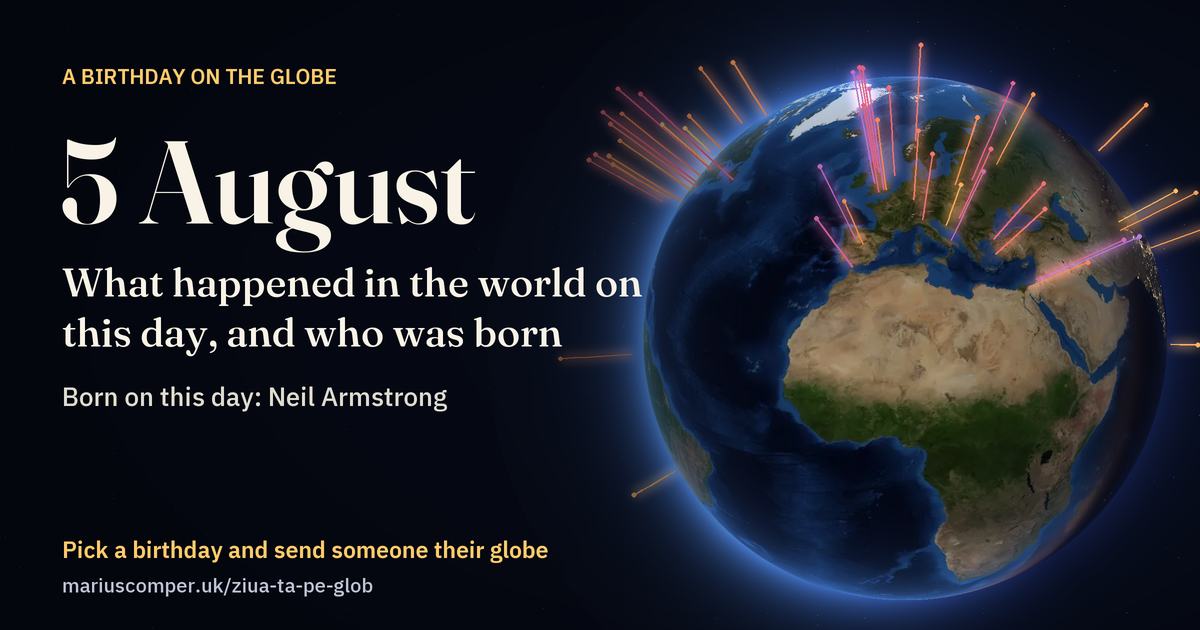
For 5 August, the English Wikipedia lists 82 events and 236 births. 52 of the events stand at their places as rays of light; one more is a dashed circle, where the sentence links only to a country or a sea. The taller the ray, the longer ago it happened. The people born that day come further down, as blue points.
A birthday, yours or someone else’s:
Turn it into a greetingScroll: the globe turns to each place
The day you were born, on the globe.
Three things from your day
Scroll: your day first, then 5 August through the years
The Earth on 5 August
The picture on the globe was assembled by NASA from satellite photographs taken in August 2004: the snow, the ice and the green are those of the month.
On 5 August the Sun passes straight overhead at noon along the parallel of 16.9° north. In London, the day lasts about 15 hours 10 minutes.
Beyond 73° north the Sun no longer sets; beyond 73° south it no longer rises.
The line between day and night is tilted on the globe exactly as on this day of the year. On the dark side you can see the lights of towns.
Britain & Ireland · Westminster Abbey
1100
Henry I is crowned King of England in Westminster Abbey.
On the map: Westminster Abbey.
Also on the day’s list of Wikipedia in Romanian and Chinese.
Britain & Ireland · Southampton
1620
The Mayflower departs from Southampton, England, carrying would-be settlers, on its first attempt to reach North America; it is forced to dock in Dartmouth when its companion ship, the Speedwell, springs a leak.
On the map: Southampton.
Europe · Trondheim
1860
Charles XV of Sweden–Norway is crowned king of Norway in Trondheim.
On the map: Trondheim.
Also on the day’s list of Wikipedia in Romanian.
Europe · Mannheim
1888
Bertha Benz drives from Mannheim to Pforzheim and back in the first long distance automobile trip, commemorated as the Bertha Benz Memorial Route since 2008.
On the map: Mannheim.
Also on the day’s list of Wikipedia in Romanian and Chinese.
Asia · Second Temple
70
Fires resulting from the destruction of the Second Temple in Jerusalem are extinguished.
On the map: Second Temple.
Oceania · Wellington
1971
The first Pacific Islands Forum (then known as the "South Pacific Forum") is held in Wellington, New Zealand, with the aim of enhancing cooperation between the independent countries of the Pacific Ocean.
On the map: Wellington.
North America · St. John's, Newfoundland and Labrador
1583
Sir Humphrey Gilbert establishes the first English colony in North America, at what is now St. John's, Newfoundland and Labrador.
On the map: St. John's, Newfoundland and Labrador.
Also on the day’s list of Wikipedia in Romanian and Chinese.
North America · Statue of Liberty
1884
The cornerstone for the Statue of Liberty is laid on Bedloe's Island (now Liberty Island) in New York Harbor.
On the map: Statue of Liberty.
North America · Cleveland
1914
In Cleveland, Ohio, the first electric traffic light is installed.
On the map: Cleveland.
5 August
What the other Wikipedias remember#
For these years the English list has nothing on this day. The events below come from the same day’s lists on Wikipedia in Romanian and were translated for this page.
From Wikipedia in Romanian · Rio de Janeiro
2016
The 31st Summer Olympic Games begin in Rio de Janeiro, Brazil. Romania takes part with 96 athletes and wins a total of 4 medals: 1 gold, 1 silver and 2 bronze, placing 47th in the medal table.
On the map: Rio de Janeiro.
Translated from the list on Wikipedia in Romanian.
The article on Wikipedia in Romanian: Jocurile Olimpice de vară din 2016
5 August
Born on 5 August#
The English Wikipedia lists 236 births for this day. The blue points are the birthplaces of 59 of these people: those written about in the most Wikipedia editions, where Wikidata gives a place of birth.
Born on 5 August
1930
Neil Armstrong, American pilot, engineer, and astronaut, first man to walk on the Moon (died 2012)
Place of birth: Wapakoneta.
Born on 5 August
1850
Guy de Maupassant, French short story writer, novelist, and poet (died 1893)
Place of birth: Tourville-sur-Arques.
Born on 5 August
1802
Niels Henrik Abel, Norwegian mathematician and theorist (died 1829)
Place of birth: Finnøy.
Born on 5 August
1844
Ilya Repin, Russian painter and sculptor (died 1930)
Place of birth: Chuhuiv.
Born on 5 August
1681
Vitus Bering, Danish-born Russian explorer (died 1741)
Place of birth: Horsens.
Born in Britain and Ireland
1963
Mark Strong, English actor
Place of birth: London.
Born in Britain and Ireland
1980
Wayne Bridge, English footballer
Place of birth: Southampton.
Born in Britain and Ireland
1862
Joseph Merrick, English man with severe deformities (died 1890)
Place of birth: Leicester.
5 August
Number one in the charts that week
At the cinema
An animal recorded that day
The record can be seen in GBIF, which brings together wildlife records from around the world.
All your birthdays
The weather that day
Data: Met Office Hadley Centre (HadCET); NOAA (GHCN-Daily, Mauna Loa).
Above the Earth
Sources: Jonathan McDowell, GCAT (launches); GFZ Potsdam (Kp index). Days are counted in Universal Time.
Football that day
International matches played that day:
Source: the “International football results” dataset kept by Mart Jürisoo (CC0).
Also that day
The earthquake’s page at the USGS
Source: the USGS catalogue. The day is counted in Universal Time (UTC).
In those days
Make a link for someone
Type the name, pick the day and the year of birth. The link opens straight on their day, with their name in the greeting.
The link carries the name, date and place typed here; anyone who gets it can see them.
Put another birthday beside it
Your mother’s, your child’s, a friend’s: the two days appear side by side.
Below: 5 August through the years.
The whole globe of the day
Drag the globe to turn it. Touch a ray or a point to read what happened there.
Everything Wikipedia lists for 5 August
The list is the English Wikipedia’s, in its own wording, as it stood in October 2026. 29 events have no place on the map: the sentence links to no place with coordinates, only to places too wide to mark, or to several countries.
- 25
Guangwu claims the throne as Emperor of China, restoring the Han dynasty after the collapse of the short-lived Xin dynasty.
Asia · Han dynastyWikipedia: Emperor Guangwu of Han - 70
Fires resulting from the destruction of the Second Temple in Jerusalem are extinguished.
Asia · Second TempleWikipedia: Second Temple - 642
Battle of Maserfield: Penda of Mercia defeats and kills Oswald of Northumbria.
Britain & Ireland · Battle of MaserfieldWikipedia: Battle of Maserfield - 910
The last major Danish army to raid England for nearly a century is defeated at the Battle of Tettenhall by the allied forces of Mercia and Wessex, led by King Edward the Elder and Æthelred, Lord of the Mercians.
Britain & Ireland · Battle of TettenhallWikipedia: Battle of Tettenhall - 939
The Battle of Alhandic is fought between Ramiro II of León and Abd-ar-Rahman III at Zamora in the context of the Spanish Reconquista. The battle resulted in a victory for the Emirate of Córdoba.
Europe · Battle of AlhandicWikipedia: Battle of Alhandic - 974
Abbasid Caliph al-Muti' is forced to abdicate by his Turkic general Sabuktakin and succeeded by his son al-Ta'i'.
no place on the mapWikipedia: Al-Muti' - 1068
Byzantine–Norman wars: Italo-Normans begin a nearly-three-year siege of Bari.
Europe · Siege of BariWikipedia: Byzantine–Norman wars - 1100
Henry I is crowned King of England in Westminster Abbey.
Britain & Ireland · Westminster AbbeyWikipedia: Henry I of England - 1192
Richard I of England defeats Saladin in the battle of Jaffa, which enables him to conclude a favourable treaty for the crusaders.
Asia · Battle of JaffaWikipedia: Battle of Jaffa - 1278
Spanish Reconquista: the forces of the Kingdom of Castile initiate the ultimately futile Siege of Algeciras against the Emirate of Granada.
Europe · Siege of AlgecirasWikipedia: Reconquista - 1305
First Scottish War of Independence: Sir John Stewart of Menteith, the pro-English Sheriff of Dumbarton, successfully manages to capture Sir William Wallace of Scotland, leading to Wallace's subsequent execution by hanging, evisceration, drawing and quartering, and beheading 18 days later.
no place on the mapWikipedia: First War of Scottish Independence - 1388
The Battle of Otterburn, a border skirmish between the Scottish and the English in Northern England, is fought near Otterburn.
Britain & Ireland · Battle of OtterburnWikipedia: Battle of Otterburn - 1460
The Kingdom of Scotland captures Roxburgh, one of the last English strongholds in Scotland, following a siege.
Britain & Ireland · Capture of RoxburghWikipedia: Capture of Roxburgh - 1506
The Grand Duchy of Lithuania defeats the Crimean Khanate in the Battle of Kletsk.
Europe · Battle of KletskWikipedia: Battle of Kletsk - 1583
Sir Humphrey Gilbert establishes the first English colony in North America, at what is now St. John's, Newfoundland and Labrador.
North America · St. John's, Newfoundland and LabradorWikipedia: Humphrey Gilbert - 1600
The Gowrie Conspiracy against King James VI of Scotland (later to become King James I of England) takes place at Gowrie House (Perth, Scotland).
Britain & Ireland · Gowrie HouseWikipedia: Gowrie House - 1620
The Mayflower departs from Southampton, England, carrying would-be settlers, on its first attempt to reach North America; it is forced to dock in Dartmouth when its companion ship, the Speedwell, springs a leak.
Britain & Ireland · SouthamptonWikipedia: Mayflower - 1689
Beaver Wars: Fifteen hundred Iroquois attack Lachine in New France.
North America · Lachine massacreWikipedia: Lachine massacre - 1716
Austro-Turkish War (1716–1718):The Austrians defeat the Ottomans in the Battle of Petrovaradin. One-fifth of a Turkish army and the Grand Vizier are killed.
Europe · Battle of PetrovaradinWikipedia: Battle of Petrovaradin - 1735
Freedom of the press: New York Weekly Journal writer John Peter Zenger is acquitted of seditious libel against the royal governor of New York, on the basis that what he had published was true.
no place on the mapWikipedia: Freedom of the press - 1763
Pontiac's War: Battle of Bushy Run: British forces led by Henry Bouquet defeat Chief Pontiac's Indians at Bushy Run.
North America · Battle of Bushy RunWikipedia: Battle of Bushy Run - 1766
An earthquake in the Sea of Marmara and Gallipoli (present-day Turkey) along the North Anatolian Fault kills at least 5,000 people.
Asia · 1766 Marmara earthquakeWikipedia: 1766 Marmara earthquake - 1772
First Partition of Poland: The representatives of Austria, Prussia, and Russia sign three bilateral conventions condemning the "anarchy" of the Polish–Lithuanian Commonwealth and imputing to the three powers "ancient and legitimate rights" to the territories of the Commonwealth. The conventions allow each of the three great powers to annex a part of the Commonwealth, which they proceed to do over the course of the following two months.
no place on the mapWikipedia: First Partition of Poland - 1781
British and Dutch ships engage in the second Battle of Dogger Bank.
Oceans · Battle of Dogger BankWikipedia: Battle of Dogger Bank - 1796
The Battle of Castiglione in Napoleon's first Italian campaigns of the French Revolutionary Wars results in a French victory.
Europe · Battle of CastiglioneWikipedia: Battle of Castiglione - 1816
The British Admiralty dismisses Francis Ronalds's new invention of the first working electric telegraph as "wholly unnecessary", preferring to continue using the semaphore.
no place on the mapWikipedia: Francis Ronalds - 1824
Greek War of Independence: Konstantinos Kanaris leads a Greek fleet to victory against Ottoman and Egyptian naval forces in the Battle of Samos.
Europe · SamosWikipedia: Battle of Samos - 1858
Cyrus West Field and others complete the first transatlantic telegraph cable after several unsuccessful attempts. It will operate for less than a month.
no place on the mapWikipedia: Cyrus W. Field - 1860
Charles XV of Sweden–Norway is crowned king of Norway in Trondheim.
Europe · TrondheimWikipedia: Charles XV - 1861
American Civil War: In order to help pay for the war effort, the United States government levies the first income tax as part of the Revenue Act of 1861 (3% of all incomes over US$800; rescinded in 1872).
no place on the mapWikipedia: American Civil War - 1861
The United States Army abolishes flogging.
no place on the mapWikipedia: United States Army - 1862
American Civil War: Battle of Baton Rouge: Along the Mississippi River near Baton Rouge, Louisiana, Confederate troops attempt to take the city, but are driven back by fire from Union gunboats.
North America · Battle of Baton RougeWikipedia: Battle of Baton Rouge - 1864
American Civil War: The Battle of Mobile Bay begins at Mobile Bay near Mobile, Alabama, Admiral David Farragut leads a Union flotilla through Confederate defenses and seals one of the last major Southern ports.
North America · Battle of Mobile BayWikipedia: Battle of Mobile Bay - 1874
Japan launches its postal savings system, modeled after a similar system in the United Kingdom.
no place on the mapWikipedia: Postal savings system - 1882
Standard Oil Company of New Jersey, today known as ExxonMobil, is established officially. The company would later grow to become the holder of all Standard Oil companies and the entity at the center of the breakup of Standard Oil.
no place on the mapWikipedia: Standard Oil - 1884
The cornerstone for the Statue of Liberty is laid on Bedloe's Island (now Liberty Island) in New York Harbor.
North America · Statue of LibertyWikipedia: Statue of Liberty - 1888
Bertha Benz drives from Mannheim to Pforzheim and back in the first long distance automobile trip, commemorated as the Bertha Benz Memorial Route since 2008.
Europe · MannheimWikipedia: Bertha Benz - 1901
Peter O'Connor sets the first World Athletics recognised long jump world record of 24 ft 11.75 in (7.6137 m), a record that would stand for 20 years.
no place on the mapWikipedia: Peter O'Connor - 1906
Persian Constitutional Revolution: Mozaffar ad-Din Shah Qajar, King of Iran, agrees to convert the government to a constitutional monarchy.
no place on the mapWikipedia: Persian Constitutional Revolution - 1914
In Cleveland, Ohio, the first electric traffic light is installed.
North America · ClevelandWikipedia: Cleveland - 1914
World War I: The German minelayer SS Königin Luise lays a minefield about 40 miles (64 km) off the Thames Estuary (Lowestoft). She is intercepted and sunk by the British light-cruiser HMS Amphion.
Britain & Ireland · Thames EstuaryWikipedia: World War I - 1914
World War I: The guns of Point Nepean fort at Port Phillip Heads in Victoria (Australia) fire across the bows of the Norddeutscher Lloyd steamer SS Pfalz which is attempting to leave the Port of Melbourne in ignorance of the declaration of war and she is detained; this is said to be the first Allied shot of the War.
no place on the mapWikipedia: SS Pfalz - 1916
World War I: Battle of Romani: Allied forces, under the command of Archibald Murray, defeat an attacking Ottoman army under the command of Friedrich Freiherr Kress von Kressenstein, securing the Suez Canal and beginning the Ottoman retreat from the Sinai Peninsula.
Africa · Battle of RomaniWikipedia: Battle of Romani - 1925
Plaid Cymru is formed with the aim of disseminating knowledge of the Welsh language that is at the time in danger of dying out.
no place on the mapWikipedia: Plaid Cymru - 1926
Harry Houdini performs his greatest feat, spending 91 minutes underwater in a sealed tank before escaping.
no place on the mapWikipedia: Harry Houdini - 1931
Judge and Nazi Party member Werner Best drafts the Boxheim Documents, which described a violent takeover of the government by the NSDAP.
no place on the mapWikipedia: Nazi Party - 1939
The Thirteen Roses: Thirteen female members of the Unified Socialist Youth are executed by Francoist forces in Madrid, Spain.
Europe · Las Trece RosasWikipedia: Las Trece Rosas - 1940
World War II: The Soviet Union formally annexes Latvia.
no place on the mapWikipedia: World War II - 1944
World War II: At least 1,104 Japanese POWs in Australia attempt to escape from a camp at Cowra, New South Wales; 545 temporarily succeed but are later either killed, commit suicide, or are recaptured.
Oceania · Cowra breakoutWikipedia: Cowra breakout - 1944
World War II: Polish insurgents liberate a German labor camp (Gęsiówka) in Warsaw, freeing 348 Jewish prisoners.
Europe · GęsiówkaWikipedia: Labor camp - 1944
World War II: The Nazis begin a week-long massacre of between 40,000 and 50,000 civilians and prisoners of war in Wola, Poland.
Europe · Wola massacreWikipedia: Wola massacre - 1949
In Ecuador, an earthquake destroys 50 towns and kills more than 6,000.
Latin America · 1949 Ambato earthquakeWikipedia: 1949 Ambato earthquake - 1949
In Montana, 12 smokejumper firefighters and a US Forest Service fire guard are killed in the Mann Gulch Fire.
North America · Mann Gulch fireWikipedia: Mann Gulch fire - 1957
American Bandstand, a show dedicated to the teenage "baby-boomers" by playing the songs and showing popular dances of the time, debuts on the ABC television network.
no place on the mapWikipedia: American Bandstand - 1960
Burkina Faso, then known as Upper Volta, becomes independent from France.
no place on the mapWikipedia: Burkina Faso - 1962
American actress Marilyn Monroe is found dead at her home from a drug overdose.
North America · Death of Marilyn MonroeWikipedia: Death of Marilyn Monroe - 1962
Apartheid: Nelson Mandela is jailed. He would not be released until 1990.
no place on the mapWikipedia: Apartheid - 1963
Cold War: The United States, the United Kingdom, and the Soviet Union sign the Partial Nuclear Test Ban Treaty.
Europe · MoscowWikipedia: Partial Nuclear Test Ban Treaty - 1964
Vietnam War: Operation Pierce Arrow: American aircraft from carriers USS Ticonderoga and USS Constellation bomb North Vietnam in retaliation for strikes against U.S. destroyers in the Gulf of Tonkin.
North America · USS ConstellationWikipedia: Vietnam War - 1965
The Indo-Pakistani war of 1965 begins as Pakistani soldiers cross the Line of Control dressed as locals.
no place on the mapWikipedia: India–Pakistan war of 1965 - 1966
A group of red guards at Experimental High in Beijing, including Deng Rong and Liu Pingping, daughters of Deng Xiaoping and Liu Shaoqi respectively, beat the deputy vice principal, Bian Zhongyun, to death with sticks after accusing her of counter-revolutionary revisionism, producing one of the first fatalities of the Cultural Revolution.
Asia · Experimental High School Attached to Beijing Normal UniversityWikipedia: Red Guards - 1969
The Lonesome Cowboys police raid occurs in Atlanta, Georgia, leading to the creation of the Georgia Gay Liberation Front.
North America · Lonesome Cowboys police raidWikipedia: Lonesome Cowboys police raid - 1971
The first Pacific Islands Forum (then known as the "South Pacific Forum") is held in Wellington, New Zealand, with the aim of enhancing cooperation between the independent countries of the Pacific Ocean.
Oceania · WellingtonWikipedia: Pacific Islands Forum - 1973
Due to an athletics scandal, the National Collegiate Athletic Association applied the death penalty to the basketball program at the University of Southwestern Louisiana.
North America · University of Louisiana at LafayetteWikipedia: University of Southwestern Louisiana basketball scandal - 1973
Mars 6 is launched from the USSR.
no place on the mapWikipedia: Mars 6 - 1974
Watergate scandal: President Richard Nixon, under orders of the US Supreme Court, releases the "Smoking Gun" tape, recorded on June 23, 1972, clearly revealing his actions in covering up and interfering investigations into the break-in. His political support vanishes completely.
North America · Supreme Court of the United StatesWikipedia: Supreme Court of the United States - 1979
In Afghanistan, Maoists undertake the Bala Hissar uprising against the Leninist government.
Asia · KabulWikipedia: Bala Hissar uprising - 1981
President Ronald Reagan fires 11,359 striking air-traffic controllers who ignored his order for them to return to work.
no place on the mapWikipedia: Ronald Reagan - 1984
A Biman Bangladesh Airlines Fokker F27 Friendship crashes on approach to Zia International Airport, in Dhaka, Bangladesh, killing all 49 people on board.
Asia · Biman Bangladesh Airlines Flight 426Wikipedia: Biman Bangladesh Airlines Flight 426 - 1993
Wizards of the Coast released Magic: The Gathering, the first trading card game.
no place on the mapWikipedia: Wizards of the Coast - 1995
Yugoslav Wars: The city of Knin, Croatia, a significant Serb stronghold, is taken by Croatian forces during Operation Storm. The date is celebrated in Croatia as Victory Day.
Europe · KninWikipedia: Yugoslav Wars - 2003
A car bomb explodes in the Indonesian capital of Jakarta outside the Marriott Hotel killing 12 and injuring 150.
Asia · 2003 Marriott Hotel bombingWikipedia: 2003 Marriott Hotel bombing - 2008
The New England Revolution win the 2008 North American SuperLiga final against the Houston Dynamo.
no place on the mapWikipedia: New England Revolution - 2010
Ten members of International Assistance Mission Nuristan Eye Camp team are killed by persons unknown in Kuran wa Munjan District of Badakhshan Province, Afghanistan.
Asia · Kuran wa Munjan DistrictWikipedia: 2010 Badakhshan massacre - 2010
The Copiapó mining accident occurs, trapping 33 Chilean miners approximately 2,300 ft (700 m) below the ground for 69 days.
Latin America · 2010 Copiapó mining accidentWikipedia: 2010 Copiapó mining accident - 2011
NASA launched the Juno probe to Jupiter as part of the New Frontiers program.
no place on the mapWikipedia: Juno - 2012
Radio Network House, damaged in the 2011 Christchurch earthquake, becomes the first building to be demolished by implosion in New Zealand.
Oceania · Implosion of Radio Network HouseWikipedia: 2011 Christchurch earthquake - 2012
The Wisconsin Sikh temple shooting took place in Oak Creek, Wisconsin, killing six victims; the perpetrator committed suicide after being wounded by police.
North America · Wisconsin Sikh temple shootingWikipedia: Wisconsin Sikh temple shooting - 2015
The Environmental Protection Agency at Gold King Mine waste water spill releases three million gallons of heavy metal toxin tailings and waste water into the Animas River in Colorado.
North America · 2015 Gold King Mine waste water spillWikipedia: 2015 Gold King Mine waste water spill - 2019
The revocation of the special status of Jammu and Kashmir (state) occurred and the state was bifurcated into two union territories (Jammu and Kashmir (union territory) and Ladakh).
no place on the mapWikipedia: Revocation of the special status of Jammu and Kashmir - 2021
Australia's second most populous state Victoria enters its sixth COVID-19 lockdown, enacting stage four restrictions statewide in reaction to six new COVID-19 cases recorded that morning.
no place on the mapWikipedia: Australia - 2024
Following the non-cooperation movement against the government of Bangladesh, Bangladeshi prime minister Sheikh Hasina resigns and flees the country, ending her rule of 15 consecutive years and a total of almost two decades. The date is also known as 36 July.
no place on the mapWikipedia: Resignation of Sheikh Hasina
What the other Wikipedias remember
For these years the English list has nothing on this day. The events below come from the same day’s lists on Wikipedia in Romanian and were translated for this page.
- 2016
The 31st Summer Olympic Games begin in Rio de Janeiro, Brazil. Romania takes part with 96 athletes and wins a total of 4 medals: 1 gold, 1 silver and 2 bronze, placing 47th in the medal table.
Latin America · Rio de JaneiroTranslated from the list on Wikipedia in RomanianWikipedia: Jocurile Olimpice de vară din 2016
Who was born on 5 August
In order of how many Wikipedia editions have an article about each. The first 60 of 236 are shown.
- 1930
Neil Armstrong, American pilot, engineer, and astronaut, first man to walk on the Moon (died 2012)
WapakonetaWikipedia: Neil Armstrong - 1850
Guy de Maupassant, French short story writer, novelist, and poet (died 1893)
Tourville-sur-ArquesWikipedia: Guy de Maupassant - 1968
Marine Le Pen, French lawyer and politician
Neuilly-sur-SeineWikipedia: Marine Le Pen - 1802
Niels Henrik Abel, Norwegian mathematician and theorist (died 1829)
- 1844
Ilya Repin, Russian painter and sculptor (died 1930)
ChuhuivWikipedia: Ilya Repin - 1681
Vitus Bering, Danish-born Russian explorer (died 1741)
HorsensWikipedia: Vitus Bering - 1974
Kajol, Indian film actress
MumbaiWikipedia: Kajol - 1906
John Huston, American actor, director, and screenwriter (died 1987)
NevadaWikipedia: John Huston - 1905
Wassily Leontief, German-American economist and academic, Nobel Prize laureate (died 1999)
- 2004
Gavi, Spanish footballer
Los Palacios y VillafrancaWikipedia: Gavi - 1813
Ivar Aasen, Norwegian poet and linguist (died 1896)
Ørsta MunicipalityWikipedia: Ivar Aasen - 1827
Deodoro da Fonseca, Brazilian field marshal and politician, 1st President of Brazil (died 1892)
Marechal DeodoroWikipedia: Deodoro da Fonseca - 1963
Mark Strong, English actor
LondonWikipedia: Mark Strong - 1397
Guillaume Du Fay, Belgian-Italian composer and theorist (died 1474)
BeerselWikipedia: Guillaume Du Fay - 1985
Salomon Kalou, Ivorian footballer
- 1971
Valdis Dombrovskis, Latvian academic and politician, 11th Prime Minister of Latvia
- 1908
Harold Holt, Australian lawyer and politician, 17th Prime Minister of Australia (died 1967)
StanmoreWikipedia: Harold Holt - 1980
Wayne Bridge, English footballer
SouthamptonWikipedia: Wayne Bridge - 1862
Joseph Merrick, English man with severe deformities (died 1890)
LeicesterWikipedia: Joseph Merrick - 1966
James Gunn, American filmmaker
St. LouisWikipedia: James Gunn - 1461
Alexander Jagiellon, Polish king (died 1506)
- 1995
Pierre-Emile Højbjerg, Danish footballer
CopenhagenWikipedia: Pierre-Emile Højbjerg - 1961
Janet McTeer, English actress
Newcastle upon TyneWikipedia: Janet McTeer - 1968
Colin McRae, Scottish race car driver (died 2007)
LanarkWikipedia: Colin McRae - 1912
Abbé Pierre, French priest and humanitarian (died 2007)
4th arrondissement of LyonWikipedia: Abbé Pierre - 1962
Patrick Ewing, Jamaican-American basketball player and coach
KingstonWikipedia: Patrick Ewing - 1989
Ryan Bertrand, English footballer
SouthwarkWikipedia: Ryan Bertrand - 1540
Joseph Justus Scaliger, French philologist and historian (died 1609)
- 1911
Robert Taylor, American actor and singer (died 1969)
FilleyWikipedia: Robert Taylor - 1945
Loni Anderson, American actress (died 2025)
Saint PaulWikipedia: Loni Anderson - 1948
Ray Clemence, English footballer and manager (died 2020)
SkegnessWikipedia: Ray Clemence - 1974
Alvin Ceccoli, Australian footballer
SydneyWikipedia: Alvin Ceccoli - 1889
Conrad Aiken, American novelist, short story writer, critic, and poet (died 1973)
SavannahWikipedia: Conrad Aiken - 1930
Michal Kováč, Slovak lawyer and politician, 1st President of Slovakia (died 2016)
ĽubišaWikipedia: Michal Kováč - 1991
Esteban Gutiérrez, Mexican race car driver
MonterreyWikipedia: Esteban Gutiérrez - 1997
Olivia Holt, American actress and singer
GermantownWikipedia: Olivia Holt - 1262
Ladislaus IV of Hungary (died 1290)
- 1936
John Saxon, American actor (died 2020)
BrooklynWikipedia: John Saxon - 1985
Laurent Ciman, Belgian footballer
FarciennesWikipedia: Laurent Ciman - 1988
Federica Pellegrini, Italian swimmer
- 1923
Devan Nair, Malaysian-Singaporean union leader and politician, 3rd President of Singapore (died 2005)
- 1828
Louise of the Netherlands (died 1871)
The HagueWikipedia: Louise of the Netherlands - 1980
Jesse Williams, American actor, director, producer, and political activist
ChicagoWikipedia: Jesse Williams - 1980
Jason Culina, Australian footballer
MelbourneWikipedia: Jason Culina - 1991
Andreas Weimann, Austrian footballer
- 1890
Naum Gabo, Russian-American sculptor (died 1977)
BryanskWikipedia: Naum Gabo - 1997
Yungblud, English musician and actor
DoncasterWikipedia: Yungblud - 1811
Ambroise Thomas, French composer (died 1896)
- 1960
David Baldacci, American lawyer and author
RichmondWikipedia: David Baldacci - 1901
Claude Autant-Lara, French director, screenwriter, and politician (died 2000)
LuzarchesWikipedia: Claude Autant-Lara - 1941
Leonid Kizim, Ukrainian general, pilot, and astronaut (died 2010)
- 1946
Shirley Ann Jackson, American physicist
Washington, D.C.Wikipedia: Shirley Ann Jackson - 1934
Wendell Berry, American novelist, short story writer, poet, and essayist (died 2026)
LouisvilleWikipedia: Wendell Berry - 1978
Kim Gevaert, Belgian sprinter
LeuvenWikipedia: Kim Gevaert - 1980
Salvador Cabañas, Paraguayan footballer
AsunciónWikipedia: Salvador Cabañas - 1694
Leonardo Leo, Italian composer (died 1744)
San Vito dei NormanniWikipedia: Leonardo Leo - 1979
David Healy, Irish footballer
DownpatrickWikipedia: David Healy - 1815
Edward John Eyre, English explorer and politician, Governor of Jamaica (died 1901)
WhipsnadeWikipedia: Edward John Eyre - 1959
Pat Smear, American guitarist and songwriter
Los AngelesWikipedia: Pat Smear - 1976
Marians Pahars, Latvian footballer and manager
ChornobaiWikipedia: Marians Pahars
What is celebrated on 5 August
- Christian feast day: Abel of Reims
- Christian feast day: Addai
- Christian feast day: Afra
- Christian feast day: Cassian of Autun
- Christian feast day: Dedication of the Basilica of St Mary Major (Catholic Church)
- Christian feast day: Emygdius
- Christian feast day: Margaret the Barefooted
- Christian feast day: Memnius
- Christian feast day: Nonna of Nazianzus
- Christian feast day: Oswald of Northumbria
- Christian feast day: August 5 (Eastern Orthodox liturgics)
- Independence Day (Burkina Faso)
- July Mass Uprising Day (Bangladesh)
- Victory and Homeland Thanksgiving Day and the Day of Croatian defenders (Croatia)
A greeting link for someone
Type a name and, if you like, the year of birth. The link opens with a greeting, and beside each event it says how old the person turned that day, or how many years before their birth it happened.
The name and the year go only into the link you send.
All 366 days
How the globe is made
Where the events come from
Each edition of this page uses the day’s list from Wikipedia in its own language: Romanian, English, Spanish, Chinese. The lists are written by volunteers and differ from one edition to the next; the text of each event is Wikipedia’s, with a link to the article. A row that appears twice in a list is shown once. The lists have not been checked event by event: they are Wikipedia’s, mistakes included.
For events before 1582, and for countries that moved to the Gregorian calendar later (Britain in 1752, Russia in 1918), the same day may be counted Old Style in one list and New Style in another.
The chapter “What the other Wikipedias remember” adds up to five events a day from the lists of the other three editions, only for years in which the English list has nothing on that day. They were translated for this page, passed the same filters as the tour, and are not counted among the events of the English list.
How an event gets onto the map
The place comes from Wikidata. If the sentence links to the article about the event itself (a battle, an opening, an earthquake), dated to the same year, the ray stands on its coordinates or on those of its location. Otherwise it stands on the first place the sentence links to: a town, a building, a mountain, an island. This second step can be wrong: sometimes the sentence only mentions the place. That is why the page says, under each event, which place the ray stands on.
When the sentence links to a single state or province, or to a single sea, lake or desert larger than 5,000 km², the globe shows a dashed circle, not a ray. The circle has the area Wikidata gives, with its radius kept between 1.2° and 16°, or a radius of 4.5° when Wikidata gives no area; it says only that the sentence links to that place. Organisations, ships, spacecraft, museum objects, rivers, mountain ranges, languages and continents are never used as places. When a sentence names several states and no exact place, the event stays in the list only.
What the height means
The height of a ray shows how many years have passed, on a logarithmic scale: 10 years, 100 years and 1,000 years are equal steps apart; anything older than about 2,600 years has the tallest ray. The colour runs from pale yellow for recent years to violet for antiquity.
Where the tour stops
In each region the tour stops at up to three events (five in Britain and Ireland), chosen mainly by three things: whether Wikipedia’s editors put the event in the “On this day” box of their main page (the English, Spanish and Chinese editions), how many Wikipedia editions have an article about it, and how many of the four lists include it. Events whose sentence or article is about a war, an attack, a crime or a disaster are left out of the tour; they stay in the whole list, in Wikipedia’s wording. The filter is a list of words and a list of Wikidata types, so it can miss some.
The tour of births names the people with articles in the most editions and leaves aside those whom the list or Wikidata describes as rulers, politicians, commanders, leaders of movements or criminals; they stay in the list.
The Earth and the Sun
The daytime images are NASA’s Blue Marble Next Generation mosaics, one for each month of 2004; the night side is Black Marble 2016. The tilt of the line between day and night is computed for the day; the hour is chosen so that the place being read is in daylight. The latitude where the Sun stands overhead is the average of the four years of the leap cycle; in a given year it can differ by up to 0.4°.
The day you were born
The number ones come from the weekly lists on Wikipedia: Billboard for the United States (from 1940; the Hot 100 from August 1958), the UK Singles Chart (from November 1952), Los 40 Principales for Spain (from July 1966) and, for Romania, the Romanian Top 100 and Airplay 100 (2001–2021, with missing weeks). The page shows the chart of the week in which the day of birth falls, with its date; Billboard and the UK chart are dated at the end of their week. For Romania before 2001 and for China these sources have no weekly chart.
The films are those that reached cinemas in the United States up to ten days before or three days after that day (some of them in a few cinemas at first), from the English Wikipedia’s yearly lists (from 1968), in order of how many editions have an article about them. The events “in those days” are the ones on the neighbouring days’ lists that carry the year of birth, passed through the same filter as the tour.
The day of birth, year included
The Moon, the star sign and the constellation are worked out by the page itself, for noon Universal Time on the day. The lit part of the Moon is rounded and can differ by a few per cent from that at the hour of birth. The sign follows the usual zodiac of twelve equal parts starting at the March equinox; the constellation is the one the Sun actually stood in front of, by the borders set by the International Astronomical Union, and within a day of a border the page does not name it. When the Sun changes sign while it is that day anywhere on Earth, the page gives the moment of crossing, rounded to ten minutes and accurate to within about a quarter of an hour, and the clock time in a few cities, with the time zone and summer time of that year.
The year in the Chinese calendar is the one your device’s own calendar gives for the date, checked against the Hong Kong Observatory’s tables. “All your birthdays” uses the same sources as the rest of the chapter for the same day in every year since the birth: the temperature, well-known launches that took place on that very day, matches of the teams the edition follows, snow deeper than 10 cm and strong geomagnetic storms. The three things at the top and the four on the picture are chosen in a fixed order (the song, the animal, a full Moon, a well-known launch before an ordinary earthquake); on the picture you can change them.
When the link carries a year of birth, the page adds a few things about that exact day. The weather is the Met Office’s Central England temperature record and the readings from New York’s Central Park; the “usual high” is the average of the daily highs of 1961–1990 for that date, with two days either side. The carbon dioxide figure is the monthly mean at the Mauna Loa observatory, where measurements begin in March 1958.
The earthquake is the one with the largest magnitude in the USGS catalogue for that day, counted in Universal Time. Before the 1960s the catalogue has gaps even above magnitude 5.5, so in the older years many days have no earthquake. The page gives only the magnitude and the place: the country the epicentre falls in or, when the epicentre is at sea within 300 km of a coast, the nearest country; farther out, only the ocean.
The launches are those that reached orbit or left for the Moon and the planets, from Jonathan McDowell’s GCAT catalogue. If nothing left that day, the page shows the nearest launch within three days before or after, and says how many days away it was. The geomagnetic storm appears only when the Kp index reached at least 5 in one of the day’s eight three-hour intervals.
The animal comes from GBIF: an observation made by a person (the animal seen or heard, or its tracks), dated to that exact day, with coordinates and a CC0 or CC BY licence. Only a few hundred well-known species are searched (mammals, birds, turtles, butterflies); of those noted that day, mammals and species with articles in many Wikipedia editions come first; birds noted almost every day, and species used recently, wait their turn. Observations dated 1 January are left out, because records without a day are often filed there. An observation shows that the animal was recorded there, not how many animals there were.
The matches are those between national teams. Only matches of England, Scotland, Wales, Northern Ireland, the Republic of Ireland, the United States, Canada and Australia are shown, along with those at the big final tournaments. The picture to send is drawn in the page from the day’s globe and the facts above, and stays on your device until you send it.
Sources
- Events, births and holidays: the day’s page on Wikipedia, text under CC BY-SA 4.0.
- Coordinates, places of birth and the number of editions: Wikidata (CC0).
- The Earth by day: NASA Blue Marble Next Generation. The Earth by night: NASA Black Marble 2016.
- Borders and regions: Natural Earth.
- World population and births per year: UN World Population Prospects 2024.
- Charts and films: Wikipedia’s lists for Billboard, the UK Singles Chart, Los 40 Principales, Romanian Top 100, Airplay 100 and American films by year (CC BY-SA 4.0).
- Weather: Met Office Hadley Centre, HadCET (Open Government Licence) and NOAA GHCN-Daily, New York Central Park. Carbon dioxide: NOAA Global Monitoring Laboratory, Mauna Loa.
- Earthquakes: the USGS catalogue. Launches: Jonathan McDowell, GCAT (CC BY). Kp index: GFZ Potsdam (CC BY 4.0). Matches: International football results, Mart Jürisoo (CC0).
- Animal observations: GBIF, with a link to each record; species names come from Wikidata.