A birthday on the globe
25 September on the globe: what happened in the world on this day, and who was born
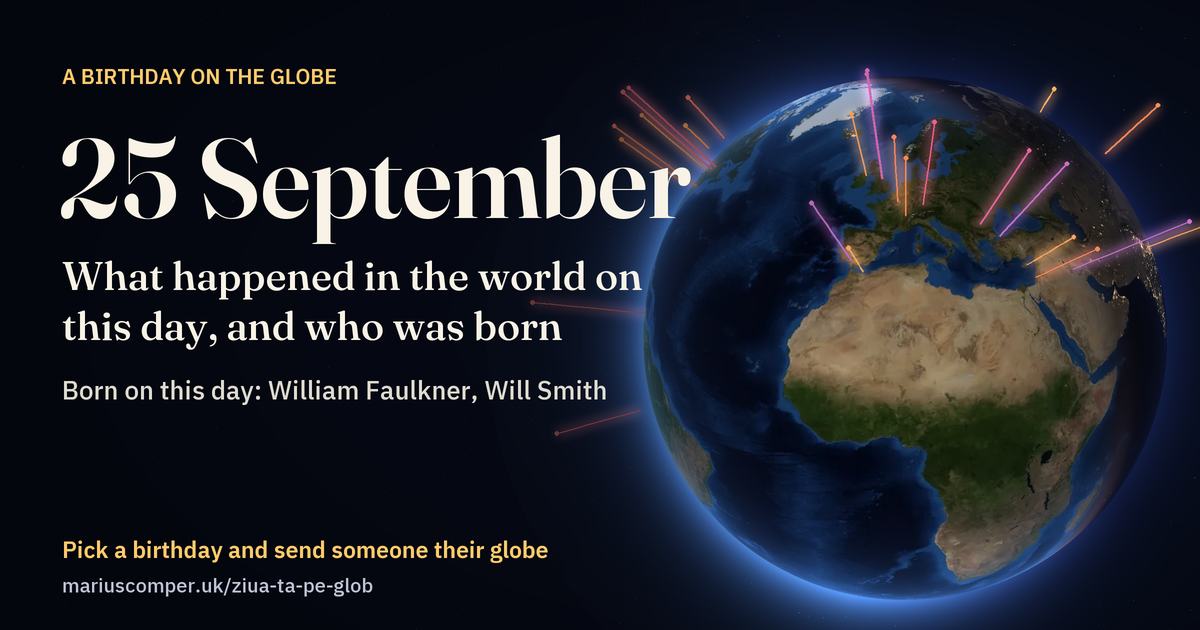
For 25 September, the English Wikipedia lists 52 events and 280 births. 25 of the events stand at their places as rays of light; three more are dashed circles, where the sentence links only to a country or a sea. The taller the ray, the longer ago it happened. The people born that day come further down, as blue points.
A birthday, yours or someone else’s:
Turn it into a greetingScroll: the globe turns to each place
The day you were born, on the globe.
Three things from your day
Scroll: your day first, then 25 September through the years
The Earth on 25 September
The picture on the globe was assembled by NASA from satellite photographs taken in September 2004: the snow, the ice and the green are those of the month.
On 25 September the Sun passes straight overhead at noon along the parallel of 0.8° south. In London, the day lasts about 12 hours.
The line between day and night is tilted on the globe exactly as on this day of the year. On the dark side you can see the lights of towns.
Britain & Ireland · York
1237
England and Scotland sign the Treaty of York, establishing the location of their common border.
On the map: York.
Europe · Augsburg
1555
The Peace of Augsburg is signed by Emperor Charles V and the princes of the Schmalkaldic League.
On the map: Augsburg.
Also on the day’s list of Wikipedia in Spanish and Romanian.
Asia · Babri Masjid
1990
The Ram Rath Yatra, a political–religious rally organised to erect a temple to the Hindu deity Rama on the site of the Babri Masjid in Ayodhya, began in the Indian state of Gujarat.
On the map: Babri Masjid.
North America · Sequoia National Park
1890
The United States Congress establishes Sequoia National Park.
On the map: Sequoia National Park.
North America · Columbia University Graduate School of Journalism
1912
Columbia University Graduate School of Journalism is founded in New York City.
On the map: Columbia University Graduate School of Journalism.
Wikipedia: Columbia University Graduate School of Journalism
North America · Chicago Marathon
1977
About 4,200 people take part in the first running of the Chicago Marathon.
On the map: Chicago Marathon.
25 September
Born on 25 September#
The English Wikipedia lists 280 births for this day. The blue points are the birthplaces of 60 of these people: those written about in the most Wikipedia editions, where Wikidata gives a place of birth.
Born on 25 September
1897
William Faulkner, American novelist and short story writer, Nobel Prize laureate (died 1962)
Place of birth: New Albany.
Born on 25 September
1968
Will Smith, American actor, producer, and rapper
Place of birth: Philadelphia.
Born on 25 September
1881
Lu Xun, Chinese author and critic (died 1936)
Place of birth: Shaoxing.
Born on 25 September
1906
Dmitri Shostakovich, Russian pianist and composer (died 1975)
Place of birth: Saint Petersburg.
Born on 25 September
1969
Catherine Zeta-Jones, Welsh actress
Place of birth: Swansea.
Born in Britain and Ireland
2003
Bella Ramsey, English actor
Place of birth: Nottingham.
Born in Britain and Ireland
1782
Charles Maturin, Irish author and playwright (died 1824)
Place of birth: Dublin.
Born in Britain and Ireland
1927
Colin Davis, English conductor and educator (died 2013)
Place of birth: Weybridge.
25 September
Number one in the charts that week
At the cinema
An animal recorded that day
The record can be seen in GBIF, which brings together wildlife records from around the world.
All your birthdays
The weather that day
Data: Met Office Hadley Centre (HadCET); NOAA (GHCN-Daily, Mauna Loa).
Above the Earth
Sources: Jonathan McDowell, GCAT (launches); GFZ Potsdam (Kp index). Days are counted in Universal Time.
Football that day
International matches played that day:
Source: the “International football results” dataset kept by Mart Jürisoo (CC0).
Also that day
The earthquake’s page at the USGS
Source: the USGS catalogue. The day is counted in Universal Time (UTC).
In those days
Make a link for someone
Type the name, pick the day and the year of birth. The link opens straight on their day, with their name in the greeting.
The link carries the name, date and place typed here; anyone who gets it can see them.
Put another birthday beside it
Your mother’s, your child’s, a friend’s: the two days appear side by side.
Below: 25 September through the years.
The whole globe of the day
Drag the globe to turn it. Touch a ray or a point to read what happened there.
Everything Wikipedia lists for 25 September
The list is the English Wikipedia’s, in its own wording, as it stood in October 2026. 24 events have no place on the map: the sentence links to no place with coordinates, only to places too wide to mark, or to several countries.
- 275
For the last time, the Roman Senate chooses an emperor; Marcus Claudius Tacitus is elected.
no place on the mapWikipedia: Tacitus - 762
Led by Muhammad al-Nafs al-Zakiyya, the Hasanid branch of the Alids begins the Alid Revolt against the Abbasid Caliphate.
Asia · Alid revolt of 762–763Wikipedia: Alid revolt of 762–763 - 844
Viking expansion: A Viking fleet arrived near Seville, then part of the Emirate of Córdoba, and began a raid of the city that was eventually repelled by Muslim defenders.
Europe · SevilleWikipedia: Seville - 867
Basil I is crowned Byzantine emperor in the Hagia Sophia after he murdered the previous emperor Michael III in the night before.
Asia · Hagia SophiaWikipedia: Hagia Sophia - 1066
In the Battle of Stamford Bridge, Harald Hardrada, the invading King of Norway, is defeated by King Harold II of England.
Britain & Ireland · Battle of Stamford BridgeWikipedia: Battle of Stamford Bridge - 1237
England and Scotland sign the Treaty of York, establishing the location of their common border.
Britain & Ireland · YorkWikipedia: Treaty of York - 1396
Ottoman Sultan Bayezid I defeats a Christian army at the Battle of Nicopolis.
Europe · Battle of NicopolisWikipedia: Battle of Nicopolis - 1513
Spanish explorer Vasco Núñez de Balboa reaches what would become known as the Pacific Ocean.
no place on the mapWikipedia: Vasco Núñez de Balboa - 1555
The Peace of Augsburg is signed by Emperor Charles V and the princes of the Schmalkaldic League.
Europe · AugsburgWikipedia: Peace of Augsburg - 1643
The House of Commons of England accepts the Solemn League and Covenant, which promises religious reforms in England and Ireland in exchange for support of Scottish troops against king Charles I in the First English Civil War.
no place on the mapWikipedia: House of Commons of England - 1690
Publick Occurrences Both Forreign and Domestick, the first newspaper to appear in the Americas, is published for the first and only time.
no place on the mapWikipedia: Publick Occurrences Both Forreign and Domestick - 1768
Unification of Nepal
no place on the mapWikipedia: Unification of Nepal - 1775
American Revolutionary War: Benedict Arnold's expedition to Quebec sets off to join the American invasion.
North America · Quebec CityWikipedia: Benedict Arnold's expedition to Quebec - 1775
American Revolutionary War: Ethan Allen surrenders to British forces after attempting to capture Montreal in the Battle of Longue-Pointe during the invasion of Quebec.
North America · Battle of Longue-PointeWikipedia: Battle of Longue-Pointe - 1786
The mine of Huancavelica in the Peruvian Andes collapses, killing more than two hundred people. The event was a major setback for mercury production in the Spanish Empire.
Latin America · HuancavelicaWikipedia: Huancavelica - 1789
The United States Congress passes twelve constitutional amendments: the ten known as the Bill of Rights, the (unratified) Congressional Apportionment Amendment, and the Congressional Compensation Amendment.
no place on the mapWikipedia: United States Bill of Rights - 1790
Four Great Anhui Troupes introduce Anhui opera to Beijing in honor of the Qianlong Emperor's eightieth birthday.
no place on the mapWikipedia: Hui opera - 1800
French Revolutionary Wars: After U.S. ships became involved, French forces abandoned their invasion of the Batavian island of Curaçao.
Latin America · Invasion of CuraçaoWikipedia: French Revolutionary Wars - 1804
The Teton Sioux (a subdivision of the Lakota) demand one of the boats from the Lewis and Clark Expedition as a toll for allowing the expedition to move further upriver.
no place on the mapWikipedia: Lewis and Clark Expedition - 1868
The Imperial Russian steam frigate Alexander Nevsky is shipwrecked off Jutland while carrying Grand Duke Alexei Alexandrovich of Russia.
no place on the mapWikipedia: Russian frigate Alexander Nevsky - 1890
The United States Congress establishes Sequoia National Park.
North America · Sequoia National ParkWikipedia: Sequoia National Park - 1906
Leonardo Torres Quevedo demonstrates the Telekino in the Bilbao Abra (Spain), guiding an electric boat from the shore with people on board, which was controlled at a distance over 2 km (1.2 mi), in what is considered to be the origin of modern wireless remote-control operation principles.
Europe · SpainWikipedia: Leonardo Torres Quevedo - 1911
An explosion of badly degraded propellant charges on board the French battleship Liberté detonates the forward ammunition magazines and destroys the ship.
no place on the mapWikipedia: French battleship Liberté - 1912
Columbia University Graduate School of Journalism is founded in New York City.
North America · Columbia University Graduate School of JournalismWikipedia: Columbia University Graduate School of Journalism - 1915
World War I: The Second Battle of Champagne begins.
Europe · Second Battle of ChampagneWikipedia: World War I - 1918
World War I: The end of the Battle of Megiddo, the climax of the British Army's Sinai and Palestine campaign under General Edmund Allenby.
Asia · Battle of MegiddoWikipedia: Battle of Megiddo - 1926
The international Convention to Suppress the Slave Trade and Slavery is first signed.
Europe · GenevaWikipedia: 1926 Slavery Convention - 1937
Second Sino-Japanese War: The Chinese Eighth Route Army gains a minor, but morale-boosting victory in the Battle of Pingxingguan.
Asia · Battle of PingxingguanWikipedia: Second Sino-Japanese War - 1944
World War II: Surviving elements of the British 1st Airborne Division withdraw from Arnhem via Oosterbeek.
no place on the mapWikipedia: World War II - 1955
The Royal Jordanian Air Force is founded.
no place on the mapWikipedia: Royal Jordanian Air Force - 1956
TAT-1, the first submarine transatlantic telephone cable system, is inaugurated.
no place on the mapWikipedia: TAT-1 - 1957
Central High School in Little Rock, Arkansas, is integrated by the use of United States Army troops.
North America · Little Rock Central High SchoolWikipedia: Little Rock Central High School - 1959
S. W. R. D. Bandaranaike, Prime Minister of Ceylon, is mortally shot by a Buddhist monk, Talduwe Somarama, and dies the next day.
no place on the mapWikipedia: S. W. R. D. Bandaranaike - 1962
The North Yemen Civil War begins when Abdullah al-Sallal dethrones the newly crowned Imam al-Badr and declares Yemen a republic under his presidency.
no place on the mapWikipedia: North Yemen civil war - 1962
The People's Democratic Republic of Algeria is formally proclaimed. Ferhat Abbas is elected President of the provisional government.
Africa · AlgeriaWikipedia: Algeria - 1963
Lord Denning releases the UK government's official report on the Profumo affair.
no place on the mapWikipedia: Profumo affair - 1964
The Mozambican War of Independence against Portugal begins.
no place on the mapWikipedia: Mozambican War of Independence - 1969
The charter establishing the Organisation of Islamic Cooperation is signed.
no place on the mapWikipedia: Organisation of Islamic Cooperation - 1974
Dr. Frank Jobe performs first ulnar collateral ligament replacement surgery (better known as Tommy John surgery) on baseball player Tommy John.
no place on the mapWikipedia: Frank Jobe - 1977
About 4,200 people take part in the first running of the Chicago Marathon.
North America · Chicago MarathonWikipedia: Chicago Marathon - 1978
PSA Flight 182, a Boeing 727, collides in mid-air with a Cessna 172 and crashes in San Diego, killing all 135 aboard Flight 182, both occupants of the Cessna, as well as seven people on the ground.
North America · Pacific Southwest Airlines Flight 182Wikipedia: Pacific Southwest Airlines Flight 182 - 1981
Belize joins the United Nations.
Latin America · BelizeWikipedia: Belize - 1981
Sandra Day O'Connor became the first female justice of the Supreme Court of the United States.
no place on the mapWikipedia: Sandra Day O'Connor - 1983
Thirty-eight IRA prisoners, armed with six handguns, hijack a prison meals lorry and smash their way out of the Maze Prison.
Britain & Ireland · Maze Prison escapeWikipedia: Maze Prison escape - 1985
Three civilians killed by alleged supporters of the Palestine Liberation Organization in Larnaca yacht killings.
Asia · LarnacaWikipedia: Larnaca yacht killings - 1987
Fijian Governor-General Penaia Ganilau is overthrown in a coup d'état led by Lieutenant colonel Sitiveni Rabuka.
no place on the mapWikipedia: 1987 Fijian coups d'état - 1990
The Ram Rath Yatra, a political–religious rally organised to erect a temple to the Hindu deity Rama on the site of the Babri Masjid in Ayodhya, began in the Indian state of Gujarat.
Asia · Babri MasjidWikipedia: Ram Rath Yatra - 1992
NASA launches the Mars Observer. Eleven months later, the probe would fail while preparing for orbital insertion.
no place on the mapWikipedia: NASA - 1997
NASA launches Space Shuttle Atlantis on STS-86 to the Mir space station.
no place on the mapWikipedia: Space Shuttle Atlantis - 1998
PauknAir Flight 4101, a British Aerospace 146, crashes near Melilla Airport in Melilla, Spain, killing 38 people.
Africa · PauknAir Flight 4101Wikipedia: PauknAir Flight 4101 - 2003
The 8.3 Mw Hokkaidō earthquake strikes just offshore Hokkaidō, Japan.
Asia · 2003 Tokachi earthquakeWikipedia: 2003 Tokachi earthquake - 2018
Bill Cosby is sentenced to three to ten years in prison for aggravated sexual assault.
no place on the mapWikipedia: Bill Cosby
Who was born on 25 September
In order of how many Wikipedia editions have an article about each. The first 60 of 280 are shown.
- 1897
William Faulkner, American novelist and short story writer, Nobel Prize laureate (died 1962)
New AlbanyWikipedia: William Faulkner - 1968
Will Smith, American actor, producer, and rapper
PhiladelphiaWikipedia: Will Smith - 1881
Lu Xun, Chinese author and critic (died 1936)
ShaoxingWikipedia: Lu Xun - 1906
Dmitri Shostakovich, Russian pianist and composer (died 1975)
Saint PetersburgWikipedia: Dmitri Shostakovich - 1969
Catherine Zeta-Jones, Welsh actress
- 1944
Michael Douglas, American actor and producer
New BrunswickWikipedia: Michael Douglas - 1949
Pedro Almodóvar, Spanish director, producer, and screenwriter
Calzada de CalatravaWikipedia: Pedro Almodóvar - 1644
Ole Rømer, Danish astronomer and instrument maker (died 1710)
AarhusWikipedia: Ole Rømer - 1866
Thomas Hunt Morgan, American biologist, geneticist, and embryologist, Nobel Prize laureate (died 1945)
LexingtonWikipedia: Thomas Hunt Morgan - 1952
Christopher Reeve, American actor, producer, and activist (died 2004)
New York CityWikipedia: Christopher Reeve - 1932
Adolfo Suárez, Spanish lawyer and politician, 1st Prime Minister of Spain (died 2014)
CebrerosWikipedia: Adolfo Suárez - 1951
Mark Hamill, American actor, singer, and producer
OaklandWikipedia: Mark Hamill - 1903
Mark Rothko, Latvian-American painter and educator (died 1970)
DaugavpilsWikipedia: Mark Rothko - 1683
Jean-Philippe Rameau, French composer and theorist (died 1764)
- 1896
Sandro Pertini, Italian journalist and politician, 7th President of Italy (died 1990)
San GiovanniWikipedia: Sandro Pertini - 1599
Francesco Borromini, Swiss-Italian architect, designed the San Carlo alle Quattro Fontane and Sant'Agnese in Agone (died 1667)
- 1711
Qianlong Emperor of China (died 1799)
BeijingWikipedia: Qianlong Emperor - 1955
Karl-Heinz Rummenigge, German footballer and manager
LippstadtWikipedia: Karl-Heinz Rummenigge - 1929
Barbara Walters, American journalist, producer, and author (died 2022)
- 1901
Robert Bresson, French director and screenwriter (died 1999)
- 1952
bell hooks, American author and activist (died 2021)
HopkinsvilleWikipedia: Bell hooks - 1957
Michael Madsen, American actor and producer (died 2025)
ChicagoWikipedia: Michael Madsen - 1920
Sergei Bondarchuk, Ukrainian-Russian actor, director, and screenwriter (died 1994)
BilozerkaWikipedia: Sergei Bondarchuk - 1983
Donald Glover (also known as Childish Gambino), American actor, rapper, producer, and screenwriter
Edwards Air Force BaseWikipedia: Donald Glover - 1992
Rosalía, Spanish singer-songwriter
Sant Esteve SesroviresWikipedia: Rosalía - 1694
Henry Pelham, English politician, Prime Minister of the United Kingdom (died 1754)
LaughtonWikipedia: Henry Pelham - 1744
Frederick William II of Prussia (died 1797)
- 1932
Glenn Gould, Canadian pianist and composer (died 1982)
TorontoWikipedia: Glenn Gould - 1943
Robert Gates, American lieutenant, academic, and politician, 22nd United States Secretary of Defense
WichitaWikipedia: Robert Gates - 1965
Scottie Pippen, American basketball player and sportscaster
HamburgWikipedia: Scottie Pippen - 1961
Heather Locklear, American actress
WestwoodWikipedia: Heather Locklear - 1980
T.I., American rapper, songwriter, producer, and actor
AtlantaWikipedia: T.I. - 1862
Billy Hughes, English-Australian carpenter and politician, 7th Prime Minister of Australia (died 1952)
LondonWikipedia: Billy Hughes - 1877
Plutarco Elías Calles, Mexican general and President (died 1945)
Heroica GuaymasWikipedia: Plutarco Elías Calles - 2003
Bella Ramsey, English actor
NottinghamWikipedia: Bella Ramsey - 1955
Zucchero Fornaciari, Italian singer-songwriter and guitarist
Reggio EmiliaWikipedia: Zucchero Fornaciari - 1960
Igor Belanov, Ukrainian footballer and manager
- 1936
Moussa Traoré, Malian general and politician 2nd President of Mali (died 2020)
- 1976
Chauncey Billups, American basketball player
- 1963
Tate Donovan, American actor
New York CityWikipedia: Tate Donovan - 1930
Shel Silverstein, American author, poet, illustrator, and songwriter (died 1999)
ChicagoWikipedia: Shel Silverstein - 1954
Juande Ramos, Spanish footballer and manager
Pedro MuñozWikipedia: Juande Ramos - 1982
Hyun Bin, South Korean actor
Gangdong DistrictWikipedia: Hyun Bin - 1990
Mao Asada, Japanese figure skater
NagoyaWikipedia: Mao Asada - 1987
Monica Niculescu, Romanian tennis player
SlatinaWikipedia: Monica Niculescu - 1992
Massimo Luongo, Australian footballer
- 1782
Charles Maturin, Irish author and playwright (died 1824)
- 1965
Rafael Martín Vázquez, Spanish footballer and coach
- 1977
Clea DuVall, American actress
Los AngelesWikipedia: Clea DuVall - 1927
Colin Davis, English conductor and educator (died 2013)
WeybridgeWikipedia: Colin Davis - 1966
Jason Flemyng, English actor
PutneyWikipedia: Jason Flemyng - 1766
Armand-Emmanuel de Vignerot du Plessis, Duc de Richelieu, French general and politician, 2nd Prime Minister of France (died 1822)
- 1956
Jamie Hyneman, American special effects designer and television host, founded M5 Industries
MarshallWikipedia: Jamie Hyneman - 1989
Cuco Martina, Curaçaoan footballer
RotterdamWikipedia: Cuco Martina - 1939
Feroz Khan, Indian actor, director, and producer (died 2009)
BengaluruWikipedia: Feroz Khan - 1951
Bob McAdoo, American basketball player and coach
GreensboroWikipedia: Bob McAdoo - 1973
Bridgette Wilson, American actress, singer, model, and beauty queen
Gold BeachWikipedia: Bridgette Wilson - 1974
Olivier Dacourt, French footballer
MontreuilWikipedia: Olivier Dacourt - 1977
Joel David Moore, American actor
PortlandWikipedia: Joel David Moore - 1403
Louis III of Anjou (died 1434)
What is celebrated on 25 September
- Armed Forces Day or Revolution Day (Mozambique)
- Bangladeshi Immigration Day (United States)
- Christian feast day: Abadir and Iraja and Companions (Coptic Church)
- Christian feast day: Aunarius (Aunacharius)
- Christian feast day: Anathalon (Archdiocese of Milan)
- Christian feast day: Cadoc
- Christian feast day: Ceolfrith
- Christian feast day: Cleopas
- Christian feast day: Euphrosyne of Alexandria
- Christian feast day: Finbarr
- Christian feast day: Fermin of Amiens
- Christian feast day: Lancelot Andrewes (Church of England)
- Christian feast day: Sergius of Radonezh (repose)
- Christian feast day: September 25 (Eastern Orthodox liturgics)
A greeting link for someone
Type a name and, if you like, the year of birth. The link opens with a greeting, and beside each event it says how old the person turned that day, or how many years before their birth it happened.
The name and the year go only into the link you send.
All 366 days
How the globe is made
Where the events come from
Each edition of this page uses the day’s list from Wikipedia in its own language: Romanian, English, Spanish, Chinese. The lists are written by volunteers and differ from one edition to the next; the text of each event is Wikipedia’s, with a link to the article. A row that appears twice in a list is shown once. The lists have not been checked event by event: they are Wikipedia’s, mistakes included.
For events before 1582, and for countries that moved to the Gregorian calendar later (Britain in 1752, Russia in 1918), the same day may be counted Old Style in one list and New Style in another.
The chapter “What the other Wikipedias remember” adds up to five events a day from the lists of the other three editions, only for years in which the English list has nothing on that day. They were translated for this page, passed the same filters as the tour, and are not counted among the events of the English list.
How an event gets onto the map
The place comes from Wikidata. If the sentence links to the article about the event itself (a battle, an opening, an earthquake), dated to the same year, the ray stands on its coordinates or on those of its location. Otherwise it stands on the first place the sentence links to: a town, a building, a mountain, an island. This second step can be wrong: sometimes the sentence only mentions the place. That is why the page says, under each event, which place the ray stands on.
When the sentence links to a single state or province, or to a single sea, lake or desert larger than 5,000 km², the globe shows a dashed circle, not a ray. The circle has the area Wikidata gives, with its radius kept between 1.2° and 16°, or a radius of 4.5° when Wikidata gives no area; it says only that the sentence links to that place. Organisations, ships, spacecraft, museum objects, rivers, mountain ranges, languages and continents are never used as places. When a sentence names several states and no exact place, the event stays in the list only.
What the height means
The height of a ray shows how many years have passed, on a logarithmic scale: 10 years, 100 years and 1,000 years are equal steps apart; anything older than about 2,600 years has the tallest ray. The colour runs from pale yellow for recent years to violet for antiquity.
Where the tour stops
In each region the tour stops at up to three events (five in Britain and Ireland), chosen mainly by three things: whether Wikipedia’s editors put the event in the “On this day” box of their main page (the English, Spanish and Chinese editions), how many Wikipedia editions have an article about it, and how many of the four lists include it. Events whose sentence or article is about a war, an attack, a crime or a disaster are left out of the tour; they stay in the whole list, in Wikipedia’s wording. The filter is a list of words and a list of Wikidata types, so it can miss some.
The tour of births names the people with articles in the most editions and leaves aside those whom the list or Wikidata describes as rulers, politicians, commanders, leaders of movements or criminals; they stay in the list.
The Earth and the Sun
The daytime images are NASA’s Blue Marble Next Generation mosaics, one for each month of 2004; the night side is Black Marble 2016. The tilt of the line between day and night is computed for the day; the hour is chosen so that the place being read is in daylight. The latitude where the Sun stands overhead is the average of the four years of the leap cycle; in a given year it can differ by up to 0.4°.
The day you were born
The number ones come from the weekly lists on Wikipedia: Billboard for the United States (from 1940; the Hot 100 from August 1958), the UK Singles Chart (from November 1952), Los 40 Principales for Spain (from July 1966) and, for Romania, the Romanian Top 100 and Airplay 100 (2001–2021, with missing weeks). The page shows the chart of the week in which the day of birth falls, with its date; Billboard and the UK chart are dated at the end of their week. For Romania before 2001 and for China these sources have no weekly chart.
The films are those that reached cinemas in the United States up to ten days before or three days after that day (some of them in a few cinemas at first), from the English Wikipedia’s yearly lists (from 1968), in order of how many editions have an article about them. The events “in those days” are the ones on the neighbouring days’ lists that carry the year of birth, passed through the same filter as the tour.
The day of birth, year included
The Moon, the star sign and the constellation are worked out by the page itself, for noon Universal Time on the day. The lit part of the Moon is rounded and can differ by a few per cent from that at the hour of birth. The sign follows the usual zodiac of twelve equal parts starting at the March equinox; the constellation is the one the Sun actually stood in front of, by the borders set by the International Astronomical Union, and within a day of a border the page does not name it. When the Sun changes sign while it is that day anywhere on Earth, the page gives the moment of crossing, rounded to ten minutes and accurate to within about a quarter of an hour, and the clock time in a few cities, with the time zone and summer time of that year.
The year in the Chinese calendar is the one your device’s own calendar gives for the date, checked against the Hong Kong Observatory’s tables. “All your birthdays” uses the same sources as the rest of the chapter for the same day in every year since the birth: the temperature, well-known launches that took place on that very day, matches of the teams the edition follows, snow deeper than 10 cm and strong geomagnetic storms. The three things at the top and the four on the picture are chosen in a fixed order (the song, the animal, a full Moon, a well-known launch before an ordinary earthquake); on the picture you can change them.
When the link carries a year of birth, the page adds a few things about that exact day. The weather is the Met Office’s Central England temperature record and the readings from New York’s Central Park; the “usual high” is the average of the daily highs of 1961–1990 for that date, with two days either side. The carbon dioxide figure is the monthly mean at the Mauna Loa observatory, where measurements begin in March 1958.
The earthquake is the one with the largest magnitude in the USGS catalogue for that day, counted in Universal Time. Before the 1960s the catalogue has gaps even above magnitude 5.5, so in the older years many days have no earthquake. The page gives only the magnitude and the place: the country the epicentre falls in or, when the epicentre is at sea within 300 km of a coast, the nearest country; farther out, only the ocean.
The launches are those that reached orbit or left for the Moon and the planets, from Jonathan McDowell’s GCAT catalogue. If nothing left that day, the page shows the nearest launch within three days before or after, and says how many days away it was. The geomagnetic storm appears only when the Kp index reached at least 5 in one of the day’s eight three-hour intervals.
The animal comes from GBIF: an observation made by a person (the animal seen or heard, or its tracks), dated to that exact day, with coordinates and a CC0 or CC BY licence. Only a few hundred well-known species are searched (mammals, birds, turtles, butterflies); of those noted that day, mammals and species with articles in many Wikipedia editions come first; birds noted almost every day, and species used recently, wait their turn. Observations dated 1 January are left out, because records without a day are often filed there. An observation shows that the animal was recorded there, not how many animals there were.
The matches are those between national teams. Only matches of England, Scotland, Wales, Northern Ireland, the Republic of Ireland, the United States, Canada and Australia are shown, along with those at the big final tournaments. The picture to send is drawn in the page from the day’s globe and the facts above, and stays on your device until you send it.
Sources
- Events, births and holidays: the day’s page on Wikipedia, text under CC BY-SA 4.0.
- Coordinates, places of birth and the number of editions: Wikidata (CC0).
- The Earth by day: NASA Blue Marble Next Generation. The Earth by night: NASA Black Marble 2016.
- Borders and regions: Natural Earth.
- World population and births per year: UN World Population Prospects 2024.
- Charts and films: Wikipedia’s lists for Billboard, the UK Singles Chart, Los 40 Principales, Romanian Top 100, Airplay 100 and American films by year (CC BY-SA 4.0).
- Weather: Met Office Hadley Centre, HadCET (Open Government Licence) and NOAA GHCN-Daily, New York Central Park. Carbon dioxide: NOAA Global Monitoring Laboratory, Mauna Loa.
- Earthquakes: the USGS catalogue. Launches: Jonathan McDowell, GCAT (CC BY). Kp index: GFZ Potsdam (CC BY 4.0). Matches: International football results, Mart Jürisoo (CC0).
- Animal observations: GBIF, with a link to each record; species names come from Wikidata.