A birthday on the globe
4 June on the globe: what happened in the world on this day, and who was born
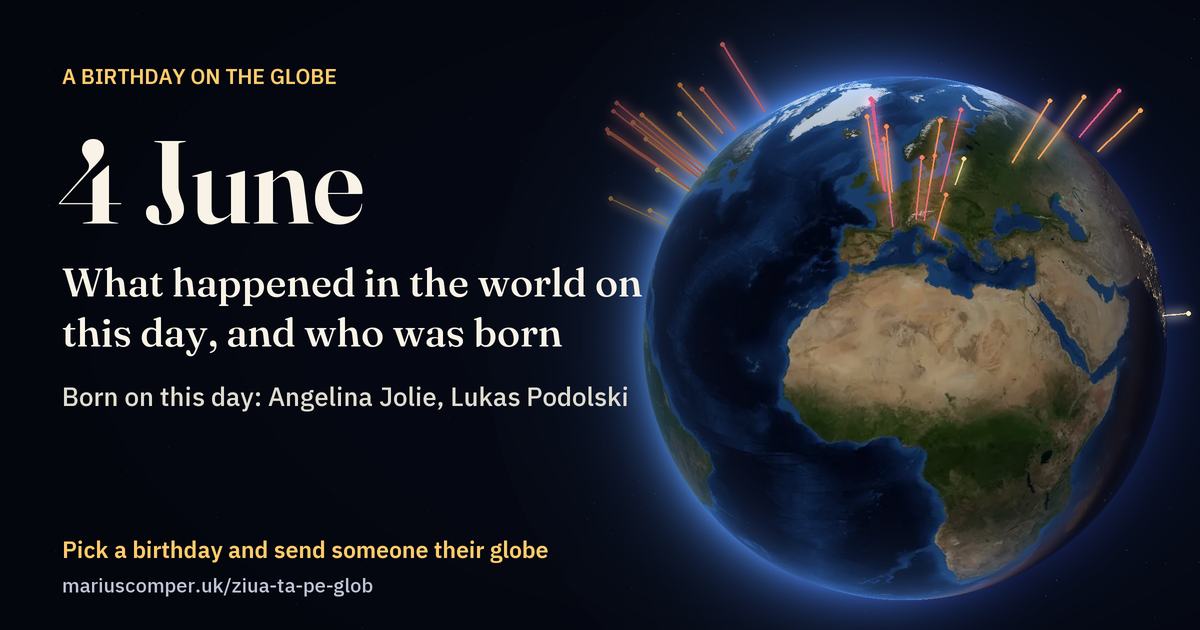
For 4 June, the English Wikipedia lists 62 events and 211 births. 33 of the events stand at their places as rays of light; six more are dashed circles, where the sentence links only to a country or a sea. The taller the ray, the longer ago it happened. The people born that day come further down, as blue points.
A birthday, yours or someone else’s:
Turn it into a greetingScroll: the globe turns to each place
The day you were born, on the globe.
Three things from your day
Scroll: your day first, then 4 June through the years
The Earth on 4 June
The picture on the globe was assembled by NASA from satellite photographs taken in June 2004: the snow, the ice and the green are those of the month.
On 4 June the Sun passes straight overhead at noon along the parallel of 22.5° north. In London, the day lasts about 16 hours 25 minutes.
Beyond 68° north the Sun no longer sets; beyond 68° south it no longer rises.
The line between day and night is tilted on the globe exactly as on this day of the year. On the dark side you can see the lights of towns.
Europe · Roquefort-sur-Soulzon
1411
King Charles VI grants a monopoly for the ripening of Roquefort cheese to the people of Roquefort-sur-Soulzon, as they had been doing for centuries.
On the map: Roquefort-sur-Soulzon.
Also on the day’s list of Wikipedia in Spanish.
Europe · Grand Trianon
1920
Hungary loses 71% of its territory and 63% of its population when the Treaty of Trianon is signed in Paris.
On the map: Grand Trianon.
Also on the day’s list of Wikipedia in Spanish, Romanian and Chinese.
North America · Puget Sound
1792
Captain George Vancouver claims Puget Sound for the Kingdom of Great Britain.
On the map: Puget Sound.
North America · San Francisco
1876
An express train called the Transcontinental Express arrives in San Francisco via the first transcontinental railroad, 83 hours and 39 minutes after leaving New York City.
On the map: San Francisco.
Also on the day’s list of Wikipedia in Spanish.
North America · United States Congress
1919
Women's rights: The U.S. Congress approves the Nineteenth Amendment to the United States Constitution, which guarantees suffrage to women, and sends it to the U.S. states for ratification.
On the map: United States Congress.
4 June
What the other Wikipedias remember#
For these years the English list has nothing on this day. The events below come from the same day’s lists on Wikipedia in Spanish and Chinese and were translated for this page.
From Wikipedia in Spanish · Louvre Museum
1902
In the Louvre Museum (Paris), the Museum of Decorative Arts opens.
On the map: Louvre Museum.
Translated from the list on Wikipedia in Spanish.
From Wikipedia in Spanish · French Open
1972
The Spanish tennis player Andrés Gimeno wins the Roland Garros title, beating the Frenchman Proisy in the final 4-6, 6-3, 6-1, 6-1.
On the map: French Open.
Translated from the list on Wikipedia in Spanish.
The article on Wikipedia in Spanish: Torneo de Roland Garros
From Wikipedia in Chinese · Busan Asiad Main Stadium
2002
The Chinese men's football team plays in the World Cup finals for the first time; their first opponent is Costa Rica, and in the end they lose all three group games without scoring a goal, becoming the "three-zero squad" knocked out.
On the map: Busan Asiad Main Stadium.
Translated from the list on Wikipedia in Chinese.
From Wikipedia in Spanish · French Open
2011
The Chinese tennis player Li Na wins the Roland Garros tournament and becomes the first Asian champion of a major title.
On the map: French Open.
Translated from the list on Wikipedia in Spanish.
The article on Wikipedia in Spanish: Torneo de Roland Garros
From Wikipedia in Spanish · French Open
2016
The Spanish-Venezuelan tennis player Garbiñe Muguruza wins the Roland Garros tournament, beating the American Serena Williams.
On the map: French Open.
Translated from the list on Wikipedia in Spanish.
The article on Wikipedia in Spanish: Torneo de Roland Garros
4 June
Born on 4 June#
The English Wikipedia lists 211 births for this day. The blue points are the birthplaces of 60 of these people: those written about in the most Wikipedia editions, where Wikidata gives a place of birth.
Born on 4 June
1975
Angelina Jolie, American actress, filmmaker, humanitarian, and activist
Place of birth: Los Angeles.
Born on 4 June
1985
Lukas Podolski, German footballer
Place of birth: Gliwice.
Born on 4 June
1694
François Quesnay, French economist and physician (died 1774)
Place of birth: Méré.
Born on 4 June
1877
Heinrich Otto Wieland, German chemist and academic, Nobel Prize laureate (died 1957)
Place of birth: Pforzheim.
Born on 4 June
1991
Lorenzo Insigne, Italian footballer
Place of birth: Frattamaggiore.
Born in Britain and Ireland
1975
Russell Brand, English comedian and actor
Place of birth: Orsett Hospital.
Born in Britain and Ireland
1998
Central Cee, British rapper and songwriter
Place of birth: Shepherd's Bush.
Born in Britain and Ireland
1910
Christopher Cockerell, English engineer, invented the hovercraft (died 1999)
Place of birth: Cambridge.
4 June
Number one in the charts that week
At the cinema
An animal recorded that day
The record can be seen in GBIF, which brings together wildlife records from around the world.
All your birthdays
The weather that day
Data: Met Office Hadley Centre (HadCET); NOAA (GHCN-Daily, Mauna Loa).
Above the Earth
Sources: Jonathan McDowell, GCAT (launches); GFZ Potsdam (Kp index). Days are counted in Universal Time.
Football that day
International matches played that day:
Source: the “International football results” dataset kept by Mart Jürisoo (CC0).
Also that day
The earthquake’s page at the USGS
Source: the USGS catalogue. The day is counted in Universal Time (UTC).
In those days
Make a link for someone
Type the name, pick the day and the year of birth. The link opens straight on their day, with their name in the greeting.
The link carries the name, date and place typed here; anyone who gets it can see them.
Put another birthday beside it
Your mother’s, your child’s, a friend’s: the two days appear side by side.
Below: 4 June through the years.
The whole globe of the day
Drag the globe to turn it. Touch a ray or a point to read what happened there.
Everything Wikipedia lists for 4 June
The list is the English Wikipedia’s, in its own wording, as it stood in October 2026. 23 events have no place on the map: the sentence links to no place with coordinates, only to places too wide to mark, or to several countries.
- 713
The imperial official Artemius is chosen as Byzantine emperor the day after the blinding of previous emperor Philippicus. Artemisius chooses the name of Anastasius II and announces his adherence to Chalcedonian Christianity.
no place on the mapWikipedia: List of Byzantine emperors - 1411
King Charles VI grants a monopoly for the ripening of Roquefort cheese to the people of Roquefort-sur-Soulzon, as they had been doing for centuries.
Europe · Roquefort-sur-SoulzonWikipedia: Charles VI of France - 1525
Bayham Abbey riot: Villagers from Kent and Sussex, England riot and occupy Bayham Old Abbey for a week in protest against Cardinal Thomas Wolsey's order to suppress the monastery in order to fund two colleges founded by him.
Britain & Ireland · Bayham Old AbbeyWikipedia: 1525 Bayham Abbey riot - 1561
The steeple of St Paul's, the medieval cathedral of London, is destroyed in a fire caused by lightning, and is never rebuilt.
Britain & Ireland · Old St Paul's CathedralWikipedia: Steeple - 1615
Siege of Osaka: Forces under Tokugawa Ieyasu take Osaka Castle in Japan.
Asia · Siege of OsakaWikipedia: Siege of Osaka - 1745
Battle of Hohenfriedberg: Frederick the Great's Prussian army decisively defeat an Austrian army under Prince Charles Alexander of Lorraine during the War of the Austrian Succession.
Europe · Battle of HohenfriedbergWikipedia: Battle of Hohenfriedberg - 1760
Great Upheaval: New England planters arrive to claim land in Nova Scotia, Canada, taken from the Acadians.
no place on the mapWikipedia: Expulsion of the Acadians - 1783
The Montgolfier brothers publicly demonstrate their montgolfière (hot air balloon).
no place on the mapWikipedia: Montgolfier brothers - 1784
Élisabeth Thible becomes the first woman to fly in an untethered hot air balloon. Her flight covers four kilometres (2.5 mi) in 45 minutes, and reaches an estimated 1,500 metres (4,900 ft) in altitude.
no place on the mapWikipedia: Élisabeth Thible - 1792
Captain George Vancouver claims Puget Sound for the Kingdom of Great Britain.
North America · Puget SoundWikipedia: Captain - 1796
The siege of Mantua begins when Napoleon Bonaparte lays siege to the fortress of Mantua, the last Austrian stronghold in Northern Italy. It will become the main focus of Napoleon's army for eight months during the Italian campaign of 1796-1797.
Europe · Siege of MantuaWikipedia: Siege of Mantua - 1802
King Charles Emmanuel IV of Sardinia abdicates his throne in favor of his brother, Victor Emmanuel.
no place on the mapWikipedia: Charles Emmanuel IV - 1812
Following Louisiana's admittance as a U.S. state, the Louisiana Territory is renamed the Missouri Territory.
North America · Louisiana TerritoryWikipedia: Louisiana - 1825
General Lafayette, a French officer in the American Revolutionary War, speaks at what would become Lafayette Square in Buffalo, New York, during his visit to the United States.
North America · Lafayette SquareWikipedia: American Revolutionary War - 1855
Major Henry C. Wayne departs New York aboard the USS Supply to procure camels to establish the U.S. Camel Corps.
no place on the mapWikipedia: Henry C. Wayne - 1859
Italian Independence wars: In the Battle of Magenta, the French army, under Louis-Napoleon, defeat the Austrian army.
Europe · Battle of MagentaWikipedia: Battle of Magenta - 1862
American Civil War: Confederate troops evacuate Fort Pillow on the Mississippi River, leaving the way clear for Union troops to take Memphis, Tennessee.
North America · Fort Pillow State Historic ParkWikipedia: American Civil War - 1876
An express train called the Transcontinental Express arrives in San Francisco via the first transcontinental railroad, 83 hours and 39 minutes after leaving New York City.
North America · San FranciscoWikipedia: Express train - 1878
Cyprus Convention: The Ottoman Empire cedes Cyprus to the United Kingdom but retains nominal title.
no place on the mapWikipedia: Cyprus Convention - 1896
Henry Ford completes the Ford Quadricycle, his first gasoline-powered automobile, and also gives it a successful test run.
no place on the mapWikipedia: Henry Ford - 1912
Massachusetts becomes the first state of the United States to set a minimum wage.
North America · MassachusettsWikipedia: Massachusetts - 1913
Emily Davison, a suffragette, runs out in front of King George V's horse at The Derby. She is trampled, never regains consciousness, and dies four days later.
no place on the mapWikipedia: Emily Davison - 1916
World War I: Russia opens the Brusilov Offensive with an artillery barrage of Austro-Hungarian lines in Galicia.
no place on the mapWikipedia: World War I - 1917
The first Pulitzer Prizes are awarded: Laura E. Richards, Maude H. Elliott, and Florence Hall receive the first Pulitzer for biography (for Julia Ward Howe). Jean Jules Jusserand receives the first Pulitzer for history for his work With Americans of Past and Present Days. Herbert B. Swope receives the first Pulitzer for journalism for his work for the New York World.
no place on the mapWikipedia: Pulitzer Prize - 1919
Leon Trotsky bans the planned Fourth Regional Congress of Peasants, Workers and Insurgents.
no place on the mapWikipedia: Leon Trotsky - 1919
Women's rights: The U.S. Congress approves the Nineteenth Amendment to the United States Constitution, which guarantees suffrage to women, and sends it to the U.S. states for ratification.
North America · United States CongressWikipedia: United States Congress - 1920
Hungary loses 71% of its territory and 63% of its population when the Treaty of Trianon is signed in Paris.
Europe · Grand TrianonWikipedia: Treaty of Trianon - 1928
The President of the Republic of China, Zhang Zuolin, is assassinated by Japanese agents.
no place on the mapWikipedia: President of the Republic of China - 1932
Marmaduke Grove and other Chilean military officers lead a coup d'état establishing the short-lived Socialist Republic of Chile.
no place on the mapWikipedia: Marmaduke Grove - 1939
The Holocaust: The MS St. Louis, a ship carrying 973 German Jewish refugees, is denied permission to land in Florida, in the United States, after already being turned away from Cuba. Forced to return to Europe, more than 200 of its passengers later die in Nazi concentration camps.
no place on the mapWikipedia: The Holocaust - 1940
World War II: The Dunkirk evacuation ends: The British Armed Forces completes evacuation of 338,000 troops from Dunkirk in France. To rally the morale of the country, Winston Churchill delivers, only to the House of Commons, his famous "We shall fight on the beaches" speech.
Europe · Dunkirk evacuationWikipedia: Dunkirk evacuation - 1942
World War II: Gustaf Mannerheim, the Commander-in-Chief of the Finnish Army, is granted the title of Marshal of Finland by the government on his 75th birthday. On the same day, Adolf Hitler arrives in Finland for a surprise visit to meet Mannerheim.
Europe · FinlandWikipedia: Carl Gustaf Emil Mannerheim - 1942
World War II: The Battle of Midway begins. Japanese Admiral Chūichi Nagumo orders a strike on Midway Island by much of the Imperial Japanese Navy.
Oceans · Battle of MidwayWikipedia: Battle of Midway - 1943
A military coup in Argentina ousts Ramón Castillo.
Latin America · ArgentinaWikipedia: 1943 Argentine Revolution - 1944
World War II: A hunter-killer group of the United States Navy captures the German Kriegsmarine submarine U-505, the first time a U.S. Navy vessel had captured an enemy vessel at sea since the 19th century.
no place on the mapWikipedia: United States Navy - 1944
World War II: The United States Fifth Army captures Rome, although much of the German Fourteenth Army is able to withdraw to the north.
Europe · Battle of AnzioWikipedia: United States Army North - 1946
in Argentina assumes its first presidency Juan Domingo Perón.
Latin America · ArgentinaWikipedia: Argentina - 1961
Cold War: In the Vienna summit, the Soviet premier Nikita Khrushchev sparks the Berlin Crisis by threatening to sign a separate peace treaty with East Germany and ending American, British and French access to East Berlin.
Europe · Berlin Crisis of 1961Wikipedia: Cold War - 1967
Seventy-two people are killed when a Canadair C-4 Argonaut crashes at Stockport in England.
Britain & Ireland · Stockport air disasterWikipedia: Stockport air disaster - 1970
Tonga gains independence from the British Empire.
no place on the mapWikipedia: Tonga - 1974
Major League Baseball's Cleveland Indians hosted Ten-Cent Beer Night, but had to forfeit the game to the Texas Rangers due to rioting by drunken fans.
North America · Ten-Cent Beer NightWikipedia: Ten-Cent Beer Night - 1975
Governor of California Jerry Brown signs the California Agricultural Labor Relations Act into law, the first law in the United States giving farmworkers collective bargaining rights.
no place on the mapWikipedia: California Agricultural Labor Relations Act of 1975 - 1977
JVC introduces its VHS videotape at the Consumer Electronics Show in Chicago. It will eventually prevail against Sony's rival Betamax system in a format war to become the predominant home video medium.
North America · ChicagoWikipedia: Consumer Electronics Show - 1977
The Humboldt Park riot began in Chicago, resulting in three deaths, three cars in the Humboldt Park lagoon, and increased tension between the Chicago Police Department and the Puerto Rican community.
North America · Humboldt ParkWikipedia: Humboldt Park riot - 1979
Flight Lieutenant Jerry Rawlings takes power in Ghana after a military coup in which General Fred Akuffo is overthrown.
Africa · GhanaWikipedia: June 4th revolution in Ghana - 1983
Gordon Kahl, who killed two US Marshals in Medina, North Dakota on February 13, is killed in a shootout in Smithville, Arkansas, along with a local sheriff, after a four-month manhunt.
North America · Medina, North DakotaWikipedia: Gordon Kahl - 1986
Jonathan Pollard pleads guilty to espionage for selling top secret United States military intelligence to Israel.
Asia · IsraelWikipedia: Israel - 1987
American intelligence analyst Jonathan Pollard pleaded guilty to charges of spying for Israel.
no place on the mapWikipedia: Intelligence assessment - 1988
Three cars on a train carrying hexogen to Kazakhstan explode in Arzamas, Gorky Oblast, USSR, killing 91 and injuring about 1,500.
Europe · ArzamasWikipedia: Arzamas train disaster - 1989
In the 1989 Iranian supreme leader election, Ali Khamenei is elected as the new Supreme Leader of Iran after the death and funeral of Ruhollah Khomeini.
no place on the mapWikipedia: 1989 Iranian supreme leader election - 1989
Solidarity's victory in the 1989 Polish legislative election occurs, the first election since the Communist Polish United Workers' Party abandoned its monopoly of power. It sparks off the Revolutions of 1989 in Eastern Europe.
no place on the mapWikipedia: 1989 Polish parliamentary election - 1989
The 1989 Tiananmen Square protests are suppressed in Beijing by the People's Liberation Army, with between 241 and 10,000 dead (an unofficial estimate).
Asia · 1989 Tiananmen Square protests and massacreWikipedia: 1989 Tiananmen Square protests and massacre - 1989
Ufa train disaster: A natural gas explosion near Ufa, Russia, kills 575 as two trains passing each other throw sparks near a leaky pipeline.
Europe · UfaWikipedia: Ufa train disaster - 1996
The first flight of Ariane 5 explodes after roughly 37 seconds. It was a Cluster mission.
no place on the mapWikipedia: Ariane 5 - 1998
Terry Nichols was sentenced to life in prison for his role in the Oklahoma City bombing.
North America · Oklahoma City bombingWikipedia: Oklahoma City bombing - 2004
In Granby, Colorado, U.S., Marvin Heemeyer went on a rampage with a modified bulldozer over a zoning dispute, destroying several buildings before dying by suicide.
North America · Granby, ColoradoWikipedia: Granby, Colorado - 2005
The Civic Forum of the Romanians of Covasna, Harghita and Mureș is founded.
no place on the mapWikipedia: Civic Forum of the Romanians of Covasna, Harghita and Mureș - 2010
Falcon 9 Flight 1 is the maiden flight of the SpaceX Falcon 9 rocket, which launches from Cape Canaveral Air Force Station Space Launch Complex 40.
North America · Cape Canaveral Space Launch Complex 40Wikipedia: Dragon Spacecraft Qualification Unit - 2020
Death of Giovanni López: Protests over the death of Giovanni López Ramírez, who had died on 4 May while in custody, begin in Jalisco following the release of a video of his arrest going viral on social media, and inspired by the George Floyd protests. Later, these spread across Mexico.
Latin America · Ixtlahuacán de los MembrillosWikipedia: Death of Giovanni López - 2023
Four people are killed when a Cessna Citation V crashes into Mine Bank Mountain in Augusta County, Virginia.
North America · 2023 Virginia Cessna Citation crashWikipedia: 2023 Virginia Cessna Citation crash - 2023
Protests begin in Poland against the PiS government.
Europe · 2023 Polish protestsWikipedia: 2023 Polish protests - 2025
Eleven people are killed and 56 people are injured during a crowd crush incident outside M. Chinnaswamy Stadium in Bengaluru, India for the celebration of Royal Challengers Bengaluru's Indian Premier League victory.
Asia · M. Chinnaswamy StadiumWikipedia: 2025 Bengaluru crowd crush
What the other Wikipedias remember
For these years the English list has nothing on this day. The events below come from the same day’s lists on Wikipedia in Spanish and Chinese and were translated for this page.
- 1902
In the Louvre Museum (Paris), the Museum of Decorative Arts opens.
- 1972
The Spanish tennis player Andrés Gimeno wins the Roland Garros title, beating the Frenchman Proisy in the final 4-6, 6-3, 6-1, 6-1.
Europe · French OpenTranslated from the list on Wikipedia in SpanishWikipedia: Torneo de Roland Garros - 2002
The Chinese men's football team plays in the World Cup finals for the first time; their first opponent is Costa Rica, and in the end they lose all three group games without scoring a goal, becoming the "three-zero squad" knocked out.
Asia · Busan Asiad Main StadiumTranslated from the list on Wikipedia in ChineseWikipedia: 2002年国际足联世界杯 - 2011
The Chinese tennis player Li Na wins the Roland Garros tournament and becomes the first Asian champion of a major title.
Europe · French OpenTranslated from the list on Wikipedia in SpanishWikipedia: Torneo de Roland Garros - 2016
The Spanish-Venezuelan tennis player Garbiñe Muguruza wins the Roland Garros tournament, beating the American Serena Williams.
Europe · French OpenTranslated from the list on Wikipedia in SpanishWikipedia: Torneo de Roland Garros
Who was born on 4 June
In order of how many Wikipedia editions have an article about each. The first 60 of 211 are shown.
- 1975
Angelina Jolie, American actress, filmmaker, humanitarian, and activist
Los AngelesWikipedia: Angelina Jolie - 1976
Alexei Navalny, Russian lawyer and politician (died 2024)
- 1738
George III of the United Kingdom (died 1820)
Norfolk HouseWikipedia: George III - 1985
Lukas Podolski, German footballer
GliwiceWikipedia: Lukas Podolski - 1867
Carl Gustaf Emil Mannerheim, Finnish general and politician, 6th President of Finland (died 1951)
Louhisaari ManorWikipedia: Carl Gustaf Emil Mannerheim - 1952
Bronisław Komorowski, Polish historian and politician, 5th President of Poland
Oborniki ŚląskieWikipedia: Bronisław Komorowski - 1971
Joseph Kabila, Congolese soldier and politician, President of the Democratic Republic of the Congo
Fizi TerritoryWikipedia: Joseph Kabila - 1929
Karolos Papoulias, Greek lawyer and politician, 5th President of Greece (died 2021)
IoanninaWikipedia: Karolos Papoulias - 1694
François Quesnay, French economist and physician (died 1774)
- 1877
Heinrich Otto Wieland, German chemist and academic, Nobel Prize laureate (died 1957)
PforzheimWikipedia: Heinrich Otto Wieland - 1991
Lorenzo Insigne, Italian footballer
FrattamaggioreWikipedia: Lorenzo Insigne - 2001
Takefusa Kubo, Japanese footballer
KawasakiWikipedia: Takefusa Kubo - 1961
Ferenc Gyurcsány, Hungarian businessman and politician, 6th Prime Minister of Hungary
- 1907
Rosalind Russell, American actress (died 1976)
WaterburyWikipedia: Rosalind Russell - 1916
Robert F. Furchgott, American biochemist and pharmacologist, Nobel Prize laureate (died 2009)
CharlestonWikipedia: Robert F. Furchgott - 1979
Naohiro Takahara, Japanese footballer
MishimaWikipedia: Naohiro Takahara - 1985
Bar Refaeli, Israeli model and actress
- 590
Harsha, Maharajadhiraja of Kannauj (died 647)
ThanesarWikipedia: Harsha - 1915
Modibo Keïta, Malian educator and politician, 1st President of Mali (died 1977)
BamakoWikipedia: Modibo Keïta - 1936
Bruce Dern, American actor
ChicagoWikipedia: Bruce Dern - 1975
Russell Brand, English comedian and actor
Orsett HospitalWikipedia: Russell Brand - 1928
Ruth Westheimer, German-American sex therapist, talk show host, professor, author, and Holocaust survivor (died 2024)
WiesenfeldWikipedia: Ruth Westheimer - 1970
Izabella Scorupco, Polish-Swedish actress and model
BiałystokWikipedia: Izabella Scorupco - 1983
Emmanuel Eboué, Ivorian footballer
AbidjanWikipedia: Emmanuel Eboué - 1966
Cecilia Bartoli, Italian soprano and actress
- 1971
Noah Wyle, American actor and producer
HollywoodWikipedia: Noah Wyle - 1977
Alex Manninger, Austrian footballer (died 2026)
SalzburgWikipedia: Alex Manninger - 1944
Michelle Phillips, American singer-songwriter and actress
Long BeachWikipedia: Michelle Phillips - 1956
Keith David, American actor
- 1981
Giourkas Seitaridis, Greek footballer
- 1923
Masutatsu Ōyama, Korean-Japanese karateka (died 1994)
GimjeWikipedia: Mas Oyama - 1966
Vladimir Voevodsky, Russian mathematician and academic (died 2017)
- 1998
Central Cee, British rapper and songwriter
Shepherd's BushWikipedia: Central Cee - 2021
Princess Lilibet of Sussex
Santa Barbara Cottage HospitalWikipedia: Princess Lilibet of Sussex - 1959
Anil Ambani, Indian businessman and Chairman of Reliance Infrastructure
MumbaiWikipedia: Anil Ambani - 1903
Yevgeny Mravinsky, Russian conductor (died 1988)
Saint PetersburgWikipedia: Yevgeny Mravinsky - 1983
Romaric, Ivorian footballer
AbidjanWikipedia: Romaric - 1983
Olha Saladuha, Ukrainian triple jumper
DonetskWikipedia: Olha Saladukha - 1394
Philippa of England, Queen of Denmark, Norway and Sweden (died 1430)
Peterborough CastleWikipedia: Philippa of England - 1821
Apollon Maykov, Russian poet and playwright (died 1897)
- 1976
Nenad Zimonjić, Serbian tennis player
BelgradeWikipedia: Nenad Zimonjić - 1947
Viktor Klima, Austrian businessman and politician, 25th Chancellor of Austria
SchwechatWikipedia: Viktor Klima - 1971
Mike Lee, American lawyer and politician
- 1999
Kim So-hyun, South Korean actress
AustraliaWikipedia: Kim So-hyun - 1910
Christopher Cockerell, English engineer, invented the hovercraft (died 1999)
CambridgeWikipedia: Christopher Cockerell - 1924
Dennis Weaver, American actor and director (died 2006)
JoplinWikipedia: Dennis Weaver - 1993
Juan Iturbe, Paraguayan footballer
Buenos AiresWikipedia: Juan Iturbe - 1889
Beno Gutenberg, German-American seismologist (died 1960)
DarmstadtWikipedia: Beno Gutenberg - 1923
Yuriko, Princess Mikasa, Japanese princess (died 2024)
Tokyo CityWikipedia: Yuriko, Princess Mikasa - 1955
Val McDermid, Scottish author
KirkcaldyWikipedia: Val McDermid - 1981
T.J. Miller, American actor and comedian
DenverWikipedia: T.J. Miller - 1989
Paweł Fajdek, Polish hammer thrower
ŚwiebodziceWikipedia: Paweł Fajdek - 1930
Viktor Tikhonov, Russian ice hockey player and coach (died 2014)
- 1948
Jürgen Sparwasser, German footballer and manager
HalberstadtWikipedia: Jürgen Sparwasser - 1953
Linda Lingle, American journalist and politician, 6th Governor of Hawaii
St. LouisWikipedia: Linda Lingle - 1967
Robert S. Kimbrough, American colonel and astronaut
KilleenWikipedia: Shane Kimbrough - 1982
Abel Kirui, Kenyan runner
- 1985
Anna-Lena Grönefeld, German tennis player
NordhornWikipedia: Anna-Lena Grönefeld - 1964
Sean Pertwee, English actor
LondonWikipedia: Sean Pertwee - 1970
Deborah Compagnoni, Italian skier
What is celebrated on 4 June
- Christian feast day: Blessed Antoni Zawistowski
- Christian feast day: Filippo Smaldone
- Christian feast day: Francis Caracciolo
- Christian feast day: Optatus
- Christian feast day: Petroc of Cornwall
- Christian feast day: Quirinus of Sescia
- Christian feast day: Saturnina
- Christian feast day: June 4 (Eastern Orthodox liturgics)
- The Flag Day of the Finnish Defence Forces, also known as the birthday of C. G. E. Mannerheim, Marshal of Finland (Finland)
- Emancipation Day or Independence Day, commemorates the abolition of serfdom in Tonga by King George Tupou in 1862, and the independence of Tonga from the British protectorate in 1970. (Tonga)
- International Day of Innocent Children Victims of Aggression (International)
- Trianon Treaty Day (Romania)
- Memorials for the 1989 Tiananmen Square protests and massacre (International)
A greeting link for someone
Type a name and, if you like, the year of birth. The link opens with a greeting, and beside each event it says how old the person turned that day, or how many years before their birth it happened.
The name and the year go only into the link you send.
All 366 days
How the globe is made
Where the events come from
Each edition of this page uses the day’s list from Wikipedia in its own language: Romanian, English, Spanish, Chinese. The lists are written by volunteers and differ from one edition to the next; the text of each event is Wikipedia’s, with a link to the article. A row that appears twice in a list is shown once. The lists have not been checked event by event: they are Wikipedia’s, mistakes included.
For events before 1582, and for countries that moved to the Gregorian calendar later (Britain in 1752, Russia in 1918), the same day may be counted Old Style in one list and New Style in another.
The chapter “What the other Wikipedias remember” adds up to five events a day from the lists of the other three editions, only for years in which the English list has nothing on that day. They were translated for this page, passed the same filters as the tour, and are not counted among the events of the English list.
How an event gets onto the map
The place comes from Wikidata. If the sentence links to the article about the event itself (a battle, an opening, an earthquake), dated to the same year, the ray stands on its coordinates or on those of its location. Otherwise it stands on the first place the sentence links to: a town, a building, a mountain, an island. This second step can be wrong: sometimes the sentence only mentions the place. That is why the page says, under each event, which place the ray stands on.
When the sentence links to a single state or province, or to a single sea, lake or desert larger than 5,000 km², the globe shows a dashed circle, not a ray. The circle has the area Wikidata gives, with its radius kept between 1.2° and 16°, or a radius of 4.5° when Wikidata gives no area; it says only that the sentence links to that place. Organisations, ships, spacecraft, museum objects, rivers, mountain ranges, languages and continents are never used as places. When a sentence names several states and no exact place, the event stays in the list only.
What the height means
The height of a ray shows how many years have passed, on a logarithmic scale: 10 years, 100 years and 1,000 years are equal steps apart; anything older than about 2,600 years has the tallest ray. The colour runs from pale yellow for recent years to violet for antiquity.
Where the tour stops
In each region the tour stops at up to three events (five in Britain and Ireland), chosen mainly by three things: whether Wikipedia’s editors put the event in the “On this day” box of their main page (the English, Spanish and Chinese editions), how many Wikipedia editions have an article about it, and how many of the four lists include it. Events whose sentence or article is about a war, an attack, a crime or a disaster are left out of the tour; they stay in the whole list, in Wikipedia’s wording. The filter is a list of words and a list of Wikidata types, so it can miss some.
The tour of births names the people with articles in the most editions and leaves aside those whom the list or Wikidata describes as rulers, politicians, commanders, leaders of movements or criminals; they stay in the list.
The Earth and the Sun
The daytime images are NASA’s Blue Marble Next Generation mosaics, one for each month of 2004; the night side is Black Marble 2016. The tilt of the line between day and night is computed for the day; the hour is chosen so that the place being read is in daylight. The latitude where the Sun stands overhead is the average of the four years of the leap cycle; in a given year it can differ by up to 0.4°.
The day you were born
The number ones come from the weekly lists on Wikipedia: Billboard for the United States (from 1940; the Hot 100 from August 1958), the UK Singles Chart (from November 1952), Los 40 Principales for Spain (from July 1966) and, for Romania, the Romanian Top 100 and Airplay 100 (2001–2021, with missing weeks). The page shows the chart of the week in which the day of birth falls, with its date; Billboard and the UK chart are dated at the end of their week. For Romania before 2001 and for China these sources have no weekly chart.
The films are those that reached cinemas in the United States up to ten days before or three days after that day (some of them in a few cinemas at first), from the English Wikipedia’s yearly lists (from 1968), in order of how many editions have an article about them. The events “in those days” are the ones on the neighbouring days’ lists that carry the year of birth, passed through the same filter as the tour.
The day of birth, year included
The Moon, the star sign and the constellation are worked out by the page itself, for noon Universal Time on the day. The lit part of the Moon is rounded and can differ by a few per cent from that at the hour of birth. The sign follows the usual zodiac of twelve equal parts starting at the March equinox; the constellation is the one the Sun actually stood in front of, by the borders set by the International Astronomical Union, and within a day of a border the page does not name it. When the Sun changes sign while it is that day anywhere on Earth, the page gives the moment of crossing, rounded to ten minutes and accurate to within about a quarter of an hour, and the clock time in a few cities, with the time zone and summer time of that year.
The year in the Chinese calendar is the one your device’s own calendar gives for the date, checked against the Hong Kong Observatory’s tables. “All your birthdays” uses the same sources as the rest of the chapter for the same day in every year since the birth: the temperature, well-known launches that took place on that very day, matches of the teams the edition follows, snow deeper than 10 cm and strong geomagnetic storms. The three things at the top and the four on the picture are chosen in a fixed order (the song, the animal, a full Moon, a well-known launch before an ordinary earthquake); on the picture you can change them.
When the link carries a year of birth, the page adds a few things about that exact day. The weather is the Met Office’s Central England temperature record and the readings from New York’s Central Park; the “usual high” is the average of the daily highs of 1961–1990 for that date, with two days either side. The carbon dioxide figure is the monthly mean at the Mauna Loa observatory, where measurements begin in March 1958.
The earthquake is the one with the largest magnitude in the USGS catalogue for that day, counted in Universal Time. Before the 1960s the catalogue has gaps even above magnitude 5.5, so in the older years many days have no earthquake. The page gives only the magnitude and the place: the country the epicentre falls in or, when the epicentre is at sea within 300 km of a coast, the nearest country; farther out, only the ocean.
The launches are those that reached orbit or left for the Moon and the planets, from Jonathan McDowell’s GCAT catalogue. If nothing left that day, the page shows the nearest launch within three days before or after, and says how many days away it was. The geomagnetic storm appears only when the Kp index reached at least 5 in one of the day’s eight three-hour intervals.
The animal comes from GBIF: an observation made by a person (the animal seen or heard, or its tracks), dated to that exact day, with coordinates and a CC0 or CC BY licence. Only a few hundred well-known species are searched (mammals, birds, turtles, butterflies); of those noted that day, mammals and species with articles in many Wikipedia editions come first; birds noted almost every day, and species used recently, wait their turn. Observations dated 1 January are left out, because records without a day are often filed there. An observation shows that the animal was recorded there, not how many animals there were.
The matches are those between national teams. Only matches of England, Scotland, Wales, Northern Ireland, the Republic of Ireland, the United States, Canada and Australia are shown, along with those at the big final tournaments. The picture to send is drawn in the page from the day’s globe and the facts above, and stays on your device until you send it.
Sources
- Events, births and holidays: the day’s page on Wikipedia, text under CC BY-SA 4.0.
- Coordinates, places of birth and the number of editions: Wikidata (CC0).
- The Earth by day: NASA Blue Marble Next Generation. The Earth by night: NASA Black Marble 2016.
- Borders and regions: Natural Earth.
- World population and births per year: UN World Population Prospects 2024.
- Charts and films: Wikipedia’s lists for Billboard, the UK Singles Chart, Los 40 Principales, Romanian Top 100, Airplay 100 and American films by year (CC BY-SA 4.0).
- Weather: Met Office Hadley Centre, HadCET (Open Government Licence) and NOAA GHCN-Daily, New York Central Park. Carbon dioxide: NOAA Global Monitoring Laboratory, Mauna Loa.
- Earthquakes: the USGS catalogue. Launches: Jonathan McDowell, GCAT (CC BY). Kp index: GFZ Potsdam (CC BY 4.0). Matches: International football results, Mart Jürisoo (CC0).
- Animal observations: GBIF, with a link to each record; species names come from Wikidata.