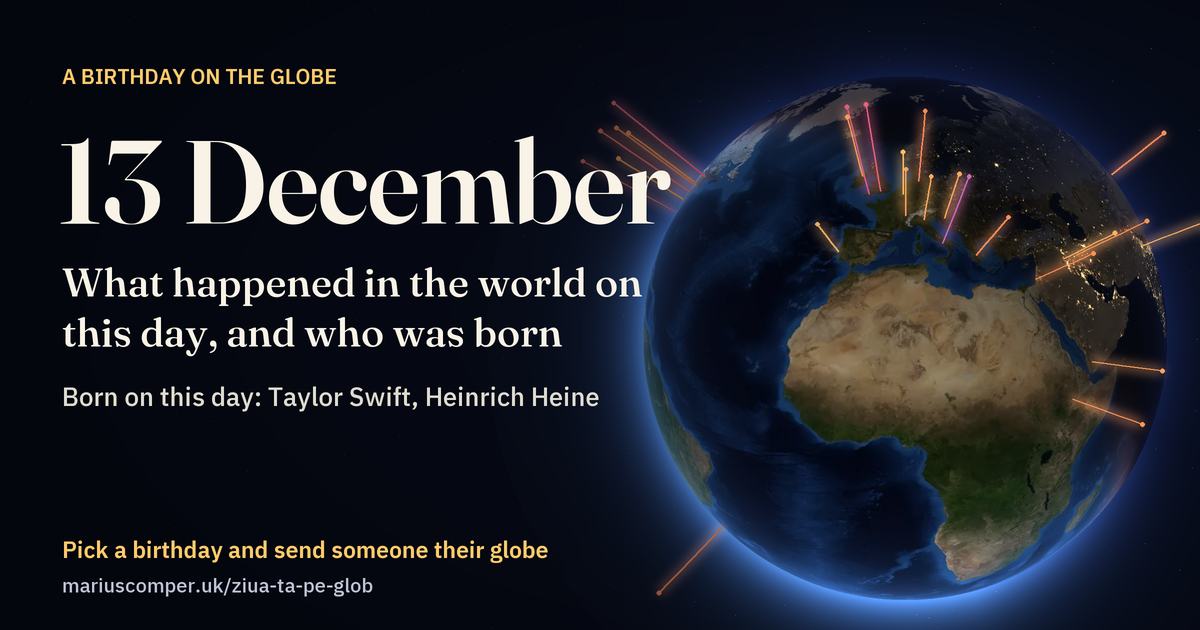
A birthday on the globe
13 December on the globe: what happened in the world on this day, and who was born
For 13 December, the English Wikipedia lists 44 events and 135 births. 25 of the events stand at their places as rays of light; four more are dashed circles, where the sentence links only to a country or a sea. The taller the ray, the longer ago it happened. The people born that day come further down, as blue points.
A birthday, yours or someone else’s:
Turn it into a greetingScroll: the globe turns to each place
The day you were born, on the globe.
Three things from your day
Scroll: your day first, then 13 December through the years
The Earth on 13 December
The picture on the globe was assembled by NASA from satellite photographs taken in December 2004: the snow, the ice and the green are those of the month.
On 13 December the Sun passes straight overhead at noon along the parallel of 23.1° south. In London, the day lasts about 7 hours 55 minutes.
Beyond 67° south the Sun no longer sets; beyond 67° north it no longer rises.
The line between day and night is tilted on the globe exactly as on this day of the year. On the dark side you can see the lights of towns.
Britain & Ireland · Plymouth
1577
Sir Francis Drake sets sail from Plymouth, England, on his round-the-world voyage.
On the map: Plymouth.
Also on the day’s list of Wikipedia in Spanish.
Europe · Geneva
1988
PLO Chairman Yasser Arafat gives a speech at a UN General Assembly meeting in Geneva, Switzerland, after United States authorities refused to grant him a visa to visit UN headquarters in New York.
On the map: Geneva.
Wikipedia: Chairman of the Palestine Liberation Organization
Europe · Lisbon
2007
The Treaty of Lisbon is signed by the EU member states to amend both the Treaty of Rome and the Maastricht Treaty which together form the constitutional basis of the EU. The Treaty of Lisbon is effective from 1 December 2009.
On the map: Lisbon.
Also on the day’s list of Wikipedia in Spanish and Chinese.
Asia · Tel Aviv
1949
The Knesset votes to move the capital of Israel from Tel Aviv to Jerusalem.
On the map: Tel Aviv.
Also on the day’s list of Wikipedia in Spanish and Chinese.
North America · Dartmouth College
1769
Dartmouth College is founded by the Reverend Eleazar Wheelock, with a royal charter from King George III, on land donated by Royal governor John Wentworth.
On the map: Dartmouth College.
Also on the day’s list of Wikipedia in Spanish and Chinese.
North America · Carnegie Hall
1928
An American in Paris, a jazz-influenced orchestral piece by George Gershwin, premiered at Carnegie Hall in New York.
On the map: Carnegie Hall.
13 December
What the other Wikipedias remember#
For these years the English list has nothing on this day. The events below come from the same day’s lists on Wikipedia in Chinese and were translated for this page.
From Wikipedia in Chinese · East Jerusalem
2017
The Organisation of Islamic Cooperation announces its recognition of East Jerusalem as the capital of the State of Palestine.
On the map: East Jerusalem.
Translated from the list on Wikipedia in Chinese.
13 December
Born on 13 December#
The English Wikipedia lists 135 births for this day. The blue points are the birthplaces of 60 of these people: those written about in the most Wikipedia editions, where Wikidata gives a place of birth.
Born on 13 December
1989
Taylor Swift, American singer-songwriter
Place of birth: Reading Hospital.
Born on 13 December
1797
Heinrich Heine, German journalist, poet, and critic (died 1856)
Place of birth: Düsseldorf.
Born on 13 December
1929
Christopher Plummer, Canadian actor and producer (died 2021)
Place of birth: Toronto.
Born on 13 December
1521
Pope Sixtus V (died 1590)
Place of birth: Grottammare.
Born on 13 December
1967
Jamie Foxx, American actor, singer, songwriter, producer, and comedian
Place of birth: Terrell.
Born in Britain and Ireland
1995
Emma Corrin, English actor
Place of birth: Royal Tunbridge Wells.
Born in Britain and Ireland
1914
Alan Bullock, English historian and author (died 2004)
Place of birth: Trowbridge.
Born in Britain and Ireland
1908
Elizabeth Alexander, English geologist, academic, and physicist (died 1958)
Place of birth: Merton.
13 December
Number one in the charts that week
At the cinema
An animal recorded that day
The record can be seen in GBIF, which brings together wildlife records from around the world.
All your birthdays
The weather that day
Data: Met Office Hadley Centre (HadCET); NOAA (GHCN-Daily, Mauna Loa).
Above the Earth
Sources: Jonathan McDowell, GCAT (launches); GFZ Potsdam (Kp index). Days are counted in Universal Time.
Football that day
International matches played that day:
Source: the “International football results” dataset kept by Mart Jürisoo (CC0).
Also that day
The earthquake’s page at the USGS
Source: the USGS catalogue. The day is counted in Universal Time (UTC).
In those days
Make a link for someone
Type the name, pick the day and the year of birth. The link opens straight on their day, with their name in the greeting.
The link carries the name, date and place typed here; anyone who gets it can see them.
Put another birthday beside it
Your mother’s, your child’s, a friend’s: the two days appear side by side.
Below: 13 December through the years.
The whole globe of the day
Drag the globe to turn it. Touch a ray or a point to read what happened there.
Everything Wikipedia lists for 13 December
The list is the English Wikipedia’s, in its own wording, as it stood in October 2026. 15 events have no place on the map: the sentence links to no place with coordinates, only to places too wide to mark, or to several countries.
- 1076
The city of Salerno surrenders to Robert Guiscard. Duke Gisulf continues his resistance in the citadel until May of the following year.
Europe · SalernoWikipedia: Salerno - 1294
Saint Celestine V resigns the papacy after only five months to return to his previous life as an ascetic hermit.
no place on the mapWikipedia: Pope Celestine V - 1545
The Council of Trent begins as the embodiment of the Counter-Reformation.
no place on the mapWikipedia: Council of Trent - 1577
Sir Francis Drake sets sail from Plymouth, England, on his round-the-world voyage.
Britain & Ireland · PlymouthWikipedia: Francis Drake - 1623
The Plymouth Colony establishes the system of trial by 12-men jury in the American colonies.
no place on the mapWikipedia: Plymouth Colony - 1636
The Massachusetts Bay Colony organizes three militia regiments to defend the colony against the Pequot Indians, a date now considered the founding of the National Guard of the United States.
no place on the mapWikipedia: Native Americans in the United States - 1642
Abel Tasman is the first recorded European to sight New Zealand.
Oceania · New ZealandWikipedia: Abel Tasman - 1643
English Civil War: The Battle of Alton takes place in Hampshire.
Britain & Ireland · Battle of AltonWikipedia: Battle of Alton - 1758
The English transport ship Duke William sinks in the North Atlantic, killing over 360 people.
no place on the mapWikipedia: Duke William - 1769
Dartmouth College is founded by the Reverend Eleazar Wheelock, with a royal charter from King George III, on land donated by Royal governor John Wentworth.
North America · Dartmouth CollegeWikipedia: Dartmouth College - 1809
Napoleonic Wars: While transporting supplies to Guadeloupe, French commodore François
Europe · GuadeloupeWikipedia: Roquebert's expedition to the Caribbean - 1818
Cyril VI of Constantinople resigns from his position as Ecumenical Patriarch under pressure from the Ottoman Empire.
Asia · Ottoman EmpireWikipedia: Cyril VI of Constantinople - 1862
American Civil War: At the Battle of Fredericksburg, Confederate General Robert E. Lee repulses attacks by Union Major General Ambrose Burnside on Marye's Heights, inflicting heavy casualties.
North America · Battle of FredericksburgWikipedia: American Civil War - 1864
American Civil War: Sherman's March to the Sea: The Second Battle of Fort McAllister ends with the fort being seized by Union forces under General William B. Hazen, threatening the city of Savannah with investment.
North America · Second Battle of Fort McAllisterWikipedia: Second Battle of Fort McAllister - 1928
An American in Paris, a jazz-influenced orchestral piece by George Gershwin, premiered at Carnegie Hall in New York.
North America · Carnegie HallWikipedia: An American in Paris - 1937
Second Sino-Japanese War: Battle of Nanking: The city of Nanjing, defended by the National Revolutionary Army under the command of General Tang Shengzhi, falls to the Japanese. This is followed by the Nanking Massacre, in which Japanese troops rape and slaughter hundreds of thousands of civilians.
Asia · Battle of NankingWikipedia: Battle of Nanking - 1938
The Holocaust: The Neuengamme concentration camp opens in the Bergedorf district of Hamburg, Germany.
Europe · Neuengamme concentration campWikipedia: The Holocaust - 1939
The Battle of the River Plate is fought off the coast of Uruguay; the first naval battle of World War II. The Kriegsmarine's Deutschland-class cruiser (pocket battleship) Admiral Graf Spee engages with three Royal Navy cruisers: HMS Ajax, HMNZS Achilles and HMS Exeter.
Oceans · Battle of the River PlateWikipedia: Battle of the River Plate - 1943
World War II: The Massacre of Kalavryta by German occupying forces in Greece.
Europe · Kalavryta massacreWikipedia: Kalavryta massacre - 1949
The Knesset votes to move the capital of Israel from Tel Aviv to Jerusalem.
Asia · Tel AvivWikipedia: Israel - 1957
The Mw 6.5 Farsinaj earthquake strikes Iran with a maximum Mercalli intensity of VII, causing at least 1,119 deaths and damaging over 5,000 homes.
Asia · 1957 Farsinaj earthquakeWikipedia: 1957 Farsinaj earthquake - 1959
Archbishop Makarios III becomes the first President of Cyprus.
no place on the mapWikipedia: List of archbishops of Cyprus - 1960
While Emperor Haile Selassie of Ethiopia visits Brazil, his Imperial Bodyguard seizes the capital and proclaims him deposed and his son, Crown Prince Asfa Wossen, Emperor.
Africa · Addis AbabaWikipedia: 1960 Ethiopian coup attempt - 1962
NASA launches Relay 1, the first active repeater communications satellite in orbit.
no place on the mapWikipedia: NASA - 1967
Constantine II of Greece attempts an unsuccessful counter-coup against the Regime of the Colonels.
no place on the mapWikipedia: Greek junta - 1968
Brazilian President Artur da Costa e Silva issues AI-5 (Institutional Act No. 5), enabling government by decree and suspending habeas corpus.
no place on the mapWikipedia: Artur da Costa e Silva - 1972
Apollo program: Eugene Cernan and Harrison Schmitt begin the third and final extra-vehicular activity (EVA) or "Moonwalk" of Apollo 17. To date they are the last humans to set foot on the Moon.
no place on the mapWikipedia: Apollo program - 1974
In the Vietnam War, the North Vietnamese forces launch their 1975 Spring Offensive (to 30 April 1975), which results in the final capitulation of South Vietnam.
no place on the mapWikipedia: Vietnam War - 1974
Malta becomes a republic within the Commonwealth of Nations.
Europe · MaltaWikipedia: Malta - 1977
Air Indiana Flight 216 crashes near Evansville Regional Airport, killing 29, including the University of Evansville basketball team, support staff, and boosters of the team.
North America · Air Indiana Flight 216Wikipedia: Air Indiana Flight 216 - 1981
General Wojciech Jaruzelski declares martial law in Poland, largely due to the actions by Solidarity.
no place on the mapWikipedia: Martial law in Poland - 1982
The 6.0 Ms North Yemen earthquake shakes southwestern Yemen with a maximum Mercalli intensity of VIII (Severe), killing 2,800, and injuring 1,500.
Asia · 1982 North Yemen earthquakeWikipedia: 1982 North Yemen earthquake - 1988
PLO Chairman Yasser Arafat gives a speech at a UN General Assembly meeting in Geneva, Switzerland, after United States authorities refused to grant him a visa to visit UN headquarters in New York.
Europe · GenevaWikipedia: Chairman of the Palestine Liberation Organization - 1989
The Troubles: Attack on Derryard checkpoint: The Provisional Irish Republican Army launches an attack on a British Army temporary vehicle checkpoint near Rosslea, Northern Ireland. Two British soldiers are killed and two others are wounded.
Britain & Ireland · Attack on Derryard checkpointWikipedia: The Troubles - 1991
Croatian War of Independence: The Croatian Army retreated after the failure of Operation Whirlwind, destroying their tanks to avoid their capture.
Europe · Operation WhirlwindWikipedia: Croatian War of Independence - 1994
Flagship Airlines Flight 3379 crashes in Morrisville, North Carolina, near Raleigh–Durham International Airport, killing 15.
North America · Flagship Airlines Flight 3379Wikipedia: Flagship Airlines Flight 3379 - 1995
Banat Air Flight 166 crashes in Sommacampagna near Verona Villafranca Airport in Verona, Italy, killing 49.
Europe · Banat Air Flight 166Wikipedia: Banat Air Flight 166 - 2001
Indian Parliament attack: Sansad Bhavan, the building housing the Indian Parliament, is attacked by five Jaish-e-Mohammed terrorists. Twelve people are killed, including the terrorists.
Asia · 2001 Indian Parliament attackWikipedia: 2001 Indian Parliament attack - 2002
European Union enlargement: The EU announces that Cyprus, the Czech Republic, Estonia, Hungary, Latvia, Lithuania, Malta, Poland, Slovakia, and Slovenia will become members on May 1, 2004.
no place on the mapWikipedia: 2004 enlargement of the European Union - 2003
Iraq War: Operation Red Dawn: Former Iraqi President Saddam Hussein is captured near his home town of Tikrit.
Asia · Capture of Saddam HusseinWikipedia: Capture of Saddam Hussein - 2007
The Treaty of Lisbon is signed by the EU member states to amend both the Treaty of Rome and the Maastricht Treaty which together form the constitutional basis of the EU. The Treaty of Lisbon is effective from 1 December 2009.
Europe · LisbonWikipedia: Treaty of Lisbon - 2011
A man threw grenades and fired a rifle at crowds in Liège, Belgium, causing 6 deaths and injuring more than 120 others, before killing himself.
Europe · 2011 Liège attackWikipedia: 2011 Liège attack - 2013
Beyoncé released her fifth studio album without any prior announcement or promotion; it sold 2.3 million copies before the end of the year.
no place on the mapWikipedia: Beyoncé - 2019
Jo Swinson steps down as Leader of the Liberal Democrats after losing her seat in the 2019 general election making her tenure the shortest in the party's history.
no place on the mapWikipedia: 2019 United Kingdom general election
What the other Wikipedias remember
For these years the English list has nothing on this day. The events below come from the same day’s lists on Wikipedia in Chinese and were translated for this page.
- 2017
The Organisation of Islamic Cooperation announces its recognition of East Jerusalem as the capital of the State of Palestine.
Who was born on 13 December
In order of how many Wikipedia editions have an article about each. The first 60 of 135 are shown.
- 1989
Taylor Swift, American singer-songwriter
Reading HospitalWikipedia: Taylor Swift - 1797
Heinrich Heine, German journalist, poet, and critic (died 1856)
DüsseldorfWikipedia: Heinrich Heine - 1553
Henry IV of France (died 1610)
Château de PauWikipedia: Henry IV of France - 1929
Christopher Plummer, Canadian actor and producer (died 2021)
- 1521
Pope Sixtus V (died 1590)
GrottammareWikipedia: Pope Sixtus V - 1967
Jamie Foxx, American actor, singer, songwriter, producer, and comedian
TerrellWikipedia: Jamie Foxx - 1953
Ben Bernanke, American economist
AugustaWikipedia: Ben Bernanke - 1957
Steve Buscemi, American actor and director
BrooklynWikipedia: Steve Buscemi - 1923
Philip Warren Anderson, American physicist and academic, Nobel Prize laureate (died 2020)
IndianapolisWikipedia: Philip W. Anderson - 1981
Amy Lee, American singer, songwriter and pianist
RiversideWikipedia: Amy Lee - 1816
Werner von Siemens, German engineer and businessman, founded Siemens (died 1892)
- 1984
Santi Cazorla, Spanish footballer
- 1902
Talcott Parsons, American sociologist and academic (died 1979)
Colorado SpringsWikipedia: Talcott Parsons - 1818
Mary Todd Lincoln, 16th First Lady of the United States (died 1882)
LexingtonWikipedia: Mary Todd Lincoln - 1887
George Pólya, Hungarian-American mathematician and academic (died 1985)
BudapestWikipedia: George Pólya - 1911
Trygve Haavelmo, Norwegian economist and mathematician, Nobel Prize laureate (died 1999)
Skedsmo MunicipalityWikipedia: Trygve Haavelmo - 1533
Eric XIV of Sweden (died 1577)
Tre Kronor CastleWikipedia: Erik XIV - 1925
Dick Van Dyke, American actor, singer, and dancer
West PlainsWikipedia: Dick Van Dyke - 1920
George P. Shultz, American economist and politician, 60th United States Secretary of State (died 2021)
New York CityWikipedia: George Shultz - 1995
Emma Corrin, English actor
Royal Tunbridge WellsWikipedia: Emma Corrin - 1678
Yongzheng Emperor of China (died 1735)
Forbidden CityWikipedia: Yongzheng Emperor - 1780
Johann Wolfgang Döbereiner, German chemist, invented the Döbereiner's lamp (died 1849)
- 1964
Krišjānis Kariņš, American-Latvian politician, 23rd Prime Minister of Latvia
WilmingtonWikipedia: Krišjānis Kariņš - 1975
Tom DeLonge, American singer-songwriter, guitarist, author, and filmmaker
- 1720
Carlo Gozzi, Italian playwright (died 1804)
VeniceWikipedia: Carlo Gozzi - 1908
Van Heflin, American film actor (died 1971)
WaltersWikipedia: Van Heflin - 1945
Herman Cain, American businessman, politician, and activist (died 2020)
MemphisWikipedia: Herman Cain - 1363
Jean Gerson, chancellor of the University of Paris (died 1429)
GersonWikipedia: Jean Gerson - 1906
Princess Marina of Greece and Denmark (died 1968)
- 1915
B. J. Vorster, South African lawyer and politician, 4th State President of South Africa (died 1983)
UitenhageWikipedia: John Vorster - 1272
King Frederick III of Sicily (died 1337)
BarcelonaWikipedia: Frederick III of Sicily - 1871
Emily Carr, Canadian painter and author (died 1945)
VictoriaWikipedia: Emily Carr - 1989
Hellen Obiri, Kenyan runner
- 1950
Wendie Malick, American actress
BuffaloWikipedia: Wendie Malick - 1903
Ella Baker, American activist (died 1986)
NorfolkWikipedia: Ella Baker - 1919
Hans-Joachim Marseille, German captain and pilot (died 1942)
CharlottenburgWikipedia: Hans-Joachim Marseille - 1560
Maximilien de Béthune, Duke of Sully, 2nd Prime Minister of France (died 1641)
Rosny-sur-SeineWikipedia: Maximilien de Béthune, Duke of Sully - 1948
Ted Nugent, American musician
DetroitWikipedia: Ted Nugent - 1867
Kristian Birkeland, Norwegian physicist and author (died 1917)
- 1836
Franz von Lenbach, German painter and academic (died 1904)
SchrobenhausenWikipedia: Franz von Lenbach - 1887
Alvin C. York, American colonel, Medal of Honor recipient (died 1964)
Fentress CountyWikipedia: Alvin York - 1993
Danielle Collins, American tennis player
St. PetersburgWikipedia: Danielle Collins - 1856
Svetozar Boroević, Croatian-Austrian field marshal (died 1920)
MečenčaniWikipedia: Svetozar Boroević - 1724
Franz Aepinus, German astronomer and philosopher (died 1802)
RostockWikipedia: Franz Aepinus - 1895
Lucía Sánchez Saornil, Spanish anarchist feminist (died 1970)
- 1990
Arantxa Rus, Dutch tennis player
- 1913
Archie Moore, American boxer and actor (died 1998)
BenoitWikipedia: Archie Moore - 1914
Alan Bullock, English historian and author (died 2004)
TrowbridgeWikipedia: Alan Bullock - 1912
Luiz Gonzaga, Brazilian singer-songwriter and accordion player (died 1989)
- 1935
Türkan Saylan, Turkish physician and academic (died 2009)
IstanbulWikipedia: Türkan Saylan - 1969
Sergei Fedorov, Russian ice hockey player and coach
- 1975
James Kyson, American actor
- 1902
Panagiotis Kanellopoulos, Greek philosopher and politician, 138th Prime Minister of Greece (died 1986)
- 1934
Richard D. Zanuck, American film producer (died 2012)
Los AngelesWikipedia: Richard D. Zanuck - 1906
Laurens van der Post, South African-English soldier and author (died 1996)
PhilippolisWikipedia: Laurens van der Post - 1989
Katherine Schwarzenegger, American author
Los AngelesWikipedia: Katherine Schwarzenegger - 1908
Elizabeth Alexander, English geologist, academic, and physicist (died 1958)
- 1784
Archduke Louis of Austria (died 1864)
- 1982
Dan Hamhuis, Canadian ice hockey player
SmithersWikipedia: Dan Hamhuis - 1491
Martín de Azpilcueta, Spanish theologian and economist (died 1586)
BarásoainWikipedia: Martín de Azpilcueta
What is celebrated on 13 December
- Christian feast day: St Antiochus of Sulcis
- Christian feast day: Blessed Francesco Marinoni
- Christian feast day: St Judoc aka St Joyce
- Christian feast day: St Lucy
- Christian feast day: St Odile of Alsace
- Acadian Remembrance Day (Acadians)
- National Day (Saint Lucia)
- Martial Law Victims Remembrance Day (Poland)
- Nanjing Massacre Memorial Day (China)
- Nusantara Day (Indonesia)
- Republic Day (Malta)
- Sailor's Day (Brazil)
- Saint Lucia Day (mainly in Scandinavia)
A greeting link for someone
Type a name and, if you like, the year of birth. The link opens with a greeting, and beside each event it says how old the person turned that day, or how many years before their birth it happened.
The name and the year go only into the link you send.
All 366 days
How the globe is made
Where the events come from
Each edition of this page uses the day’s list from Wikipedia in its own language: Romanian, English, Spanish, Chinese. The lists are written by volunteers and differ from one edition to the next; the text of each event is Wikipedia’s, with a link to the article. A row that appears twice in a list is shown once. The lists have not been checked event by event: they are Wikipedia’s, mistakes included.
For events before 1582, and for countries that moved to the Gregorian calendar later (Britain in 1752, Russia in 1918), the same day may be counted Old Style in one list and New Style in another.
The chapter “What the other Wikipedias remember” adds up to five events a day from the lists of the other three editions, only for years in which the English list has nothing on that day. They were translated for this page, passed the same filters as the tour, and are not counted among the events of the English list.
How an event gets onto the map
The place comes from Wikidata. If the sentence links to the article about the event itself (a battle, an opening, an earthquake), dated to the same year, the ray stands on its coordinates or on those of its location. Otherwise it stands on the first place the sentence links to: a town, a building, a mountain, an island. This second step can be wrong: sometimes the sentence only mentions the place. That is why the page says, under each event, which place the ray stands on.
When the sentence links to a single state or province, or to a single sea, lake or desert larger than 5,000 km², the globe shows a dashed circle, not a ray. The circle has the area Wikidata gives, with its radius kept between 1.2° and 16°, or a radius of 4.5° when Wikidata gives no area; it says only that the sentence links to that place. Organisations, ships, spacecraft, museum objects, rivers, mountain ranges, languages and continents are never used as places. When a sentence names several states and no exact place, the event stays in the list only.
What the height means
The height of a ray shows how many years have passed, on a logarithmic scale: 10 years, 100 years and 1,000 years are equal steps apart; anything older than about 2,600 years has the tallest ray. The colour runs from pale yellow for recent years to violet for antiquity.
Where the tour stops
In each region the tour stops at up to three events (five in Britain and Ireland), chosen mainly by three things: whether Wikipedia’s editors put the event in the “On this day” box of their main page (the English, Spanish and Chinese editions), how many Wikipedia editions have an article about it, and how many of the four lists include it. Events whose sentence or article is about a war, an attack, a crime or a disaster are left out of the tour; they stay in the whole list, in Wikipedia’s wording. The filter is a list of words and a list of Wikidata types, so it can miss some.
The tour of births names the people with articles in the most editions and leaves aside those whom the list or Wikidata describes as rulers, politicians, commanders, leaders of movements or criminals; they stay in the list.
The Earth and the Sun
The daytime images are NASA’s Blue Marble Next Generation mosaics, one for each month of 2004; the night side is Black Marble 2016. The tilt of the line between day and night is computed for the day; the hour is chosen so that the place being read is in daylight. The latitude where the Sun stands overhead is the average of the four years of the leap cycle; in a given year it can differ by up to 0.4°.
The day you were born
The number ones come from the weekly lists on Wikipedia: Billboard for the United States (from 1940; the Hot 100 from August 1958), the UK Singles Chart (from November 1952), Los 40 Principales for Spain (from July 1966) and, for Romania, the Romanian Top 100 and Airplay 100 (2001–2021, with missing weeks). The page shows the chart of the week in which the day of birth falls, with its date; Billboard and the UK chart are dated at the end of their week. For Romania before 2001 and for China these sources have no weekly chart.
The films are those that reached cinemas in the United States up to ten days before or three days after that day (some of them in a few cinemas at first), from the English Wikipedia’s yearly lists (from 1968), in order of how many editions have an article about them. The events “in those days” are the ones on the neighbouring days’ lists that carry the year of birth, passed through the same filter as the tour.
The day of birth, year included
The Moon, the star sign and the constellation are worked out by the page itself, for noon Universal Time on the day. The lit part of the Moon is rounded and can differ by a few per cent from that at the hour of birth. The sign follows the usual zodiac of twelve equal parts starting at the March equinox; the constellation is the one the Sun actually stood in front of, by the borders set by the International Astronomical Union, and within a day of a border the page does not name it. When the Sun changes sign while it is that day anywhere on Earth, the page gives the moment of crossing, rounded to ten minutes and accurate to within about a quarter of an hour, and the clock time in a few cities, with the time zone and summer time of that year.
The year in the Chinese calendar is the one your device’s own calendar gives for the date, checked against the Hong Kong Observatory’s tables. “All your birthdays” uses the same sources as the rest of the chapter for the same day in every year since the birth: the temperature, well-known launches that took place on that very day, matches of the teams the edition follows, snow deeper than 10 cm and strong geomagnetic storms. The three things at the top and the four on the picture are chosen in a fixed order (the song, the animal, a full Moon, a well-known launch before an ordinary earthquake); on the picture you can change them.
When the link carries a year of birth, the page adds a few things about that exact day. The weather is the Met Office’s Central England temperature record and the readings from New York’s Central Park; the “usual high” is the average of the daily highs of 1961–1990 for that date, with two days either side. The carbon dioxide figure is the monthly mean at the Mauna Loa observatory, where measurements begin in March 1958.
The earthquake is the one with the largest magnitude in the USGS catalogue for that day, counted in Universal Time. Before the 1960s the catalogue has gaps even above magnitude 5.5, so in the older years many days have no earthquake. The page gives only the magnitude and the place: the country the epicentre falls in or, when the epicentre is at sea within 300 km of a coast, the nearest country; farther out, only the ocean.
The launches are those that reached orbit or left for the Moon and the planets, from Jonathan McDowell’s GCAT catalogue. If nothing left that day, the page shows the nearest launch within three days before or after, and says how many days away it was. The geomagnetic storm appears only when the Kp index reached at least 5 in one of the day’s eight three-hour intervals.
The animal comes from GBIF: an observation made by a person (the animal seen or heard, or its tracks), dated to that exact day, with coordinates and a CC0 or CC BY licence. Only a few hundred well-known species are searched (mammals, birds, turtles, butterflies); of those noted that day, mammals and species with articles in many Wikipedia editions come first; birds noted almost every day, and species used recently, wait their turn. Observations dated 1 January are left out, because records without a day are often filed there. An observation shows that the animal was recorded there, not how many animals there were.
The matches are those between national teams. Only matches of England, Scotland, Wales, Northern Ireland, the Republic of Ireland, the United States, Canada and Australia are shown, along with those at the big final tournaments. The picture to send is drawn in the page from the day’s globe and the facts above, and stays on your device until you send it.
Sources
- Events, births and holidays: the day’s page on Wikipedia, text under CC BY-SA 4.0.
- Coordinates, places of birth and the number of editions: Wikidata (CC0).
- The Earth by day: NASA Blue Marble Next Generation. The Earth by night: NASA Black Marble 2016.
- Borders and regions: Natural Earth.
- World population and births per year: UN World Population Prospects 2024.
- Charts and films: Wikipedia’s lists for Billboard, the UK Singles Chart, Los 40 Principales, Romanian Top 100, Airplay 100 and American films by year (CC BY-SA 4.0).
- Weather: Met Office Hadley Centre, HadCET (Open Government Licence) and NOAA GHCN-Daily, New York Central Park. Carbon dioxide: NOAA Global Monitoring Laboratory, Mauna Loa.
- Earthquakes: the USGS catalogue. Launches: Jonathan McDowell, GCAT (CC BY). Kp index: GFZ Potsdam (CC BY 4.0). Matches: International football results, Mart Jürisoo (CC0).
- Animal observations: GBIF, with a link to each record; species names come from Wikidata.