A birthday on the globe
18 June on the globe: what happened in the world on this day, and who was born
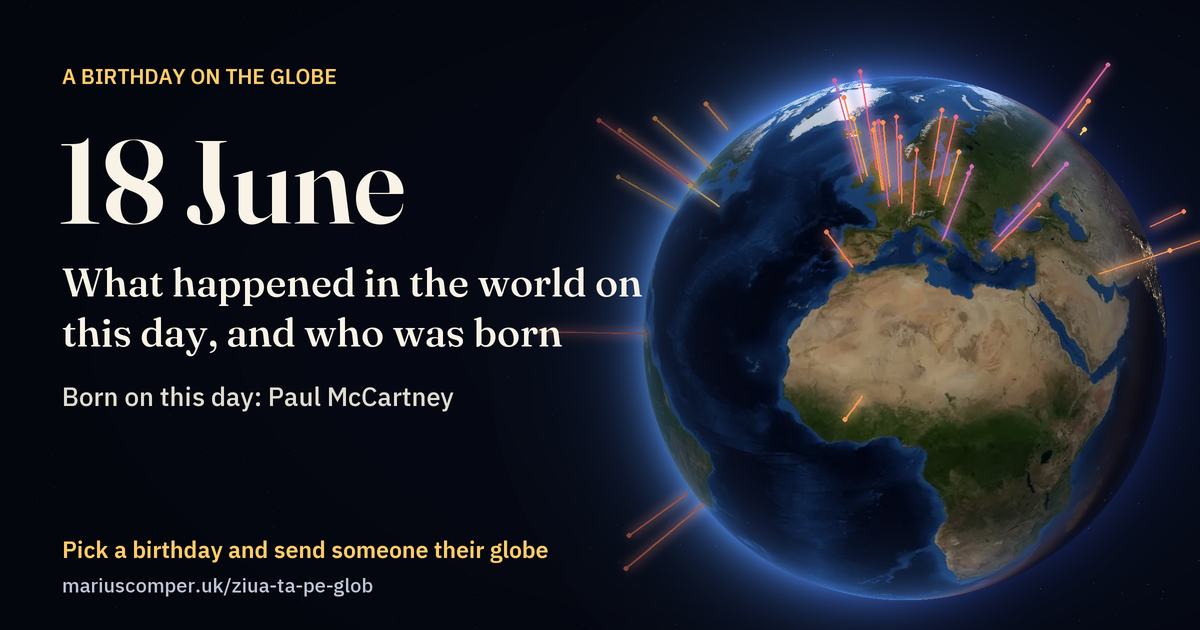
For 18 June, the English Wikipedia lists 59 events and 250 births. 36 of the events stand at their places as rays of light; four more are dashed circles, where the sentence links only to a country or a sea. The taller the ray, the longer ago it happened. The people born that day come further down, as blue points.
A birthday, yours or someone else’s:
Turn it into a greetingScroll: the globe turns to each place
The day you were born, on the globe.
Three things from your day
Scroll: your day first, then 18 June through the years
The Earth on 18 June
The picture on the globe was assembled by NASA from satellite photographs taken in June 2004: the snow, the ice and the green are those of the month.
On 18 June the Sun passes straight overhead at noon along the parallel of 23.4° north. In London, the day lasts about 16 hours 40 minutes.
Beyond 67° north the Sun no longer sets; beyond 67° south it no longer rises.
The line between day and night is tilted on the globe exactly as on this day of the year. On the dark side you can see the lights of towns.
Britain & Ireland · Castledermot
1264
The Parliament of Ireland meets at Castledermot in County Kildare, the first definitively known meeting of this Irish legislature.
On the map: Castledermot.
Also on the day’s list of Wikipedia in Spanish.
Britain & Ireland · St Giles' Cathedral
1633
Charles I is crowned King of Scots at St Giles' Cathedral, Edinburgh.
On the map: St Giles' Cathedral.
Britain & Ireland · Aldeburgh Festival
1958
Benjamin Britten's one-act opera Noye's Fludde premieres at the Aldeburgh Festival.
On the map: Aldeburgh Festival.
Europe · Berlin
1887
The Reinsurance Treaty between Germany and Russia is signed.
On the map: Berlin.
Also on the day’s list of Wikipedia in Spanish.
Europe · Cadaver Tomb of René of Chalon
1898
The Cadaver Tomb of René of Chalon in Bar-le-Duc, France, was designated a monument historique.
On the map: Cadaver Tomb of René of Chalon.
Also on the day’s list of Wikipedia in Chinese.
Europe · Strategic Arms Limitation Talks
1979
SALT II is signed by the United States and the Soviet Union.
On the map: the coordinates Wikidata gives for the article “Strategic Arms Limitation Talks”.
Also on the day’s list of Wikipedia in Spanish and Chinese.
Asia · University of the Philippines
1908
The University of the Philippines is established.
On the map: University of the Philippines.
Latin America · Santos, São Paulo
1908
Japanese immigration to Brazil begins when 781 people arrive in Santos aboard the ship Kasato-Maru.
On the map: Santos, São Paulo.
Also on the day’s list of Wikipedia in Spanish.
North America · Waldorf Astoria New York
1948
Columbia Records introduces the long-playing record album in a public demonstration at the Waldorf-Astoria Hotel in New York City.
On the map: Waldorf Astoria New York.
18 June
What the other Wikipedias remember#
For these years the English list has nothing on this day. The events below come from the same day’s lists on Wikipedia in Spanish and were translated for this page.
From Wikipedia in Spanish · Maastricht
1992
The Irish approve in a referendum the ratification of the Maastricht Treaty, with 69% of the votes.
On the map: Maastricht.
Translated from the list on Wikipedia in Spanish.
18 June
Born on 18 June#
The English Wikipedia lists 250 births for this day. The blue points are the birthplaces of 59 of these people: those written about in the most Wikipedia editions, where Wikidata gives a place of birth.
Born on 18 June
1942
Paul McCartney, English singer-songwriter and guitarist
Place of birth: Walton Hospital.
Born on 18 June
1929
Jürgen Habermas, German sociologist and philosopher (died 2026)
Place of birth: Düsseldorf.
Born on 18 June
1942
Roger Ebert, American journalist, critic, and screenwriter (died 2013)
Place of birth: Urbana.
Born on 18 June
1812
Ivan Goncharov, Russian journalist and author (died 1891)
Place of birth: Ulyanovsk.
Born on 18 June
1845
Charles Louis Alphonse Laveran, French physician and parasitologist, Nobel Prize laureate (died 1922)
Place of birth: Paris.
Born in Britain and Ireland
1799
William Lassell, English astronomer and merchant (died 1880)
Place of birth: Bolton.
Born in Britain and Ireland
1986
Richard Madden, Scottish actor
Place of birth: Elderslie.
Born in Britain and Ireland
1886
George Mallory, English lieutenant and mountaineer (died 1924)
Place of birth: Mobberley.
18 June
Number one in the charts that week
At the cinema
An animal recorded that day
The record can be seen in GBIF, which brings together wildlife records from around the world.
All your birthdays
The weather that day
Data: Met Office Hadley Centre (HadCET); NOAA (GHCN-Daily, Mauna Loa).
Above the Earth
Sources: Jonathan McDowell, GCAT (launches); GFZ Potsdam (Kp index). Days are counted in Universal Time.
Football that day
International matches played that day:
Source: the “International football results” dataset kept by Mart Jürisoo (CC0).
Also that day
The earthquake’s page at the USGS
Source: the USGS catalogue. The day is counted in Universal Time (UTC).
In those days
Make a link for someone
Type the name, pick the day and the year of birth. The link opens straight on their day, with their name in the greeting.
The link carries the name, date and place typed here; anyone who gets it can see them.
Put another birthday beside it
Your mother’s, your child’s, a friend’s: the two days appear side by side.
Below: 18 June through the years.
The whole globe of the day
Drag the globe to turn it. Touch a ray or a point to read what happened there.
Everything Wikipedia lists for 18 June
The list is the English Wikipedia’s, in its own wording, as it stood in October 2026. 19 events have no place on the map: the sentence links to no place with coordinates, only to places too wide to mark, or to several countries.
- 618
Li Yuan becomes Emperor Gaozu of Tang, initiating three centuries of Tang dynasty rule over China.
no place on the mapWikipedia: Emperor Gaozu of Tang - 656
Ali becomes Caliph of the Rashidun Caliphate.
no place on the mapWikipedia: Ali - 860
Byzantine–Rus' War: A fleet of about 200 Rus' vessels sails into the Bosphorus and starts pillaging the suburbs of the Byzantine capital Constantinople.
Asia · Siege of ConstantinopleWikipedia: Siege of Constantinople - 1053
Battle of Civitate: Three thousand Norman horsemen of Count Humphrey rout the troops of Pope Leo IX.
Europe · Battle of CivitateWikipedia: Battle of Civitate - 1155
Pope Adrian IV crowns Frederick Barbarossa as Holy Roman Emperor.
no place on the mapWikipedia: Pope Adrian IV - 1156
The treaty of Benevento between Pope Adrian IV and William I of Sicily is concluded.
Europe · BeneventoWikipedia: Treaty of Benevento - 1264
The Parliament of Ireland meets at Castledermot in County Kildare, the first definitively known meeting of this Irish legislature.
Britain & Ireland · CastledermotWikipedia: Parliament of Ireland - 1265
A draft Byzantine–Venetian treaty is concluded between Venetian envoys and Emperor Michael VIII Palaiologos, but is not ratified by Doge Reniero Zeno.
no place on the mapWikipedia: Byzantine–Venetian treaty of 1268 - 1391
Tokhtamysh–Timur war: Battle of the Kondurcha River: Timur defeats Tokhtamysh of the Golden Horde in present-day southeast Russia.
Europe · Battle of the Kondurcha RiverWikipedia: Battle of the Kondurcha River - 1429
Charles VII's army defeats an English army under John Talbot at the Battle of Patay during the Hundred Years' War. The English lost 2,200 men, over half their army, crippling their efforts during this segment of the war.
Europe · Battle of PatayWikipedia: Battle of Patay - 1633
Charles I is crowned King of Scots at St Giles' Cathedral, Edinburgh.
Britain & Ireland · St Giles' CathedralWikipedia: St Giles' Cathedral - 1684
The charter of the Massachusetts Bay Colony is revoked via a scire facias writ issued by an English court.
no place on the mapWikipedia: Massachusetts Bay Colony - 1757
Battle of Kolín between Prussian forces under Frederick the Great and an Austrian army under the command of Field Marshal Count Leopold Joseph von Daun in the Seven Years' War.
Europe · Battle of KolínWikipedia: Battle of Kolín - 1778
American Revolutionary War: The British Army abandons Philadelphia.
North America · PhiladelphiaWikipedia: American Revolutionary War - 1799
Action of 18 June 1799: A frigate squadron under Rear-admiral Jean-Baptiste Perrée is captured by the British fleet under Lord Keith.
no place on the mapWikipedia: Action of 18 June 1799 - 1803
Haitian Revolution: The Royal Navy led by Rear-Admiral John Thomas Duckworth commence the blockade of Saint-Domingue against French forces.
no place on the mapWikipedia: Haitian Revolution - 1812
The United States declaration of war upon the United Kingdom is signed by President James Madison, beginning the War of 1812.
no place on the mapWikipedia: United States declaration of war on the United Kingdom - 1815
Napoleonic Wars: The Battle of Waterloo results in the defeat of Napoleon Bonaparte by the Duke of Wellington and Gebhard Leberecht von Blücher, forcing Napoleon to abdicate the throne of France for the second and last time.
Europe · Battle of WaterlooWikipedia: Battle of Waterloo - 1822
Konstantinos Kanaris blows up the Ottoman navy's flagship at Chios, killing the Kapudan Pasha Nasuhzade Ali Pasha.
Europe · ChiosWikipedia: Chios - 1837
St. Joseph Mutiny: African soldiers in the 1st West India Regiment – led by former slave trader Daaga – launch a rebellion in the British colony of Trinidad in an attempt to escape to Africa.
Latin America · Saint JosephWikipedia: St. Joseph Mutiny - 1858
Charles Darwin receives a paper from Alfred Russel Wallace that includes nearly identical conclusions about evolution as Darwin's own, prompting Darwin to publish his theory.
no place on the mapWikipedia: Charles Darwin - 1859
First ascent of Aletschhorn, second summit of the Bernese Alps.
Europe · AletschhornWikipedia: Aletschhorn - 1873
Susan B. Anthony is fined $100 for attempting to vote in the 1872 presidential election.
no place on the mapWikipedia: 1872 United States presidential election - 1887
The Reinsurance Treaty between Germany and Russia is signed.
Europe · BerlinWikipedia: Reinsurance Treaty - 1898
The Cadaver Tomb of René of Chalon in Bar-le-Duc, France, was designated a monument historique.
Europe · Cadaver Tomb of René of ChalonWikipedia: Cadaver Tomb of René of Chalon - 1906
Sultan Abdelaziz of Morocco ratifies the agreement reached in the Algeciras Conference in a personal decree.
Europe · Algeciras ConferenceWikipedia: Algeciras Conference - 1907
Most resistance societies in Santiago return to work, bringing an end to the 1907 Chilean general strike.
Latin America · SantiagoWikipedia: General union - 1908
Japanese immigration to Brazil begins when 781 people arrive in Santos aboard the ship Kasato-Maru.
Latin America · Santos, São PauloWikipedia: Japanese Brazilians - 1908
The University of the Philippines is established.
Asia · University of the PhilippinesWikipedia: University of the Philippines - 1920
The Troubles in Ulster (1920–1922) begin with a week of sectarian violence in Derry.
Britain & Ireland · DerryWikipedia: The Troubles in Ulster - 1928
Aviator Amelia Earhart becomes the first woman to fly in an aircraft across the Atlantic Ocean (she is a passenger; Wilmer Stultz is the pilot and Lou Gordon the mechanic).
no place on the mapWikipedia: Aircraft pilot - 1935
Police in Vancouver, British Columbia, Canada, clash with striking longshoremen, resulting in a total of 60 injuries and 24 arrests.
no place on the mapWikipedia: Battle of Ballantyne Pier - 1940
World War II: Appeal of 18 June by Charles de Gaulle.
Britain & Ireland · Appeal of 18 JuneWikipedia: Appeal of 18 June - 1940
World War II: The "Finest Hour" speech is delivered by Winston Churchill.
Britain & Ireland · House of CommonsWikipedia: This was their finest hour - 1945
William Joyce ("Lord Haw-Haw") is charged with treason for his pro-German propaganda broadcasting during World War II.
no place on the mapWikipedia: World War II - 1946
Dr. Ram Manohar Lohia, a Socialist, calls for a Direct Action Day against the Portuguese in Goa.
Asia · Direct Action DayWikipedia: Direct Action Day - 1948
Britain, France and the United States announce that on June 21, the Deutsche Mark will be introduced in western Germany and West Berlin. Over the next six days, Communists increasingly restrict access to Berlin.
no place on the mapWikipedia: Deutsche Mark - 1948
Columbia Records introduces the long-playing record album in a public demonstration at the Waldorf-Astoria Hotel in New York City.
North America · Waldorf Astoria New YorkWikipedia: Columbia Records - 1953
A United States Air Force C-124 crashes and burns near Tachikawa, Japan, killing 129.
Asia · Tachikawa air disasterWikipedia: Tachikawa air disaster - 1953
The Egyptian revolution of 1952 ends with the overthrow of the Muhammad Ali dynasty and the declaration of the Republic of Egypt.
Africa · EgyptWikipedia: Egyptian revolution of 1952 - 1954
Carlos Castillo Armas leads an invasion force across the Guatemalan border, setting in motion the 1954 Guatemalan coup d'état.
Latin America · GuatemalaWikipedia: 1954 Guatemalan coup d'état - 1958
Benjamin Britten's one-act opera Noye's Fludde premieres at the Aldeburgh Festival.
Britain & Ireland · Aldeburgh FestivalWikipedia: Aldeburgh Festival - 1965
Vietnam War: The United States Air Force uses B-52 bombers to attack guerrilla fighters in South Vietnam.
Asia · South VietnamWikipedia: Vietnam War - 1967
American musician Jimi Hendrix burned his guitar on stage at the end of a performance at the Monterey International Pop Festival in California.
North America · Monterey International Pop FestivalWikipedia: Monterey International Pop Festival - 1972
Staines air disaster: One hundred eighteen people are killed when a BEA H.S. Trident crashes minutes after takeoff from London's Heathrow Airport.
Britain & Ireland · British European Airways Flight 548Wikipedia: British European Airways Flight 548 - 1979
SALT II is signed by the United States and the Soviet Union.
Europe · Strategic Arms Limitation TalksWikipedia: Strategic Arms Limitation Talks - 1981
The Lockheed F-117 Nighthawk, the first operational aircraft initially designed around stealth technology, makes its first flight.
no place on the mapWikipedia: Lockheed F-117 Nighthawk - 1982
Italian banker Roberto Calvi's body is discovered hanging beneath Blackfriars Bridge in London, England.
no place on the mapWikipedia: Blackfriars Bridge - 1983
Mona Mahmudnizhad, together with nine other women of the Baháʼí Faith, is sentenced to death and hanged in Shiraz, Iran, over her religious beliefs.
Asia · ShirazWikipedia: Mona Mahmudnizhad - 1983
Space Shuttle program: STS-7, astronaut Sally Ride becomes the first American woman in space.
no place on the mapWikipedia: Space Shuttle program - 1984
A major clash between about 5,000 police and a similar number of striking miners takes place at Orgreave, South Yorkshire, during the 1984–85 UK miners' strike.
Africa · Battle of OrgreaveWikipedia: Battle of Orgreave - 1994
The Troubles: Members of the Ulster Volunteer Force (UVF) attack a crowded pub with assault rifles in Loughinisland, Northern Ireland. Six Catholic civilians are killed and five wounded. It was crowded with people watching the 1994 FIFA World Cup.
Britain & Ireland · Loughinisland massacreWikipedia: The Troubles - 1998
Propair Flight 420 crashes near Montréal–Mirabel International Airport in Quebec, Canada, killing 11.
North America · Montréal–Mirabel International AirportWikipedia: Propair Flight 420 - 2006
The first Kazakh space satellite, KazSat-1, is launched.
Asia · KazakhstanWikipedia: Kazakhstan - 2007
The Charleston Sofa Super Store fire kills nine firefighters in Charleston, South Carolina.
North America · Charleston Sofa Super Store fireWikipedia: Charleston Sofa Super Store fire - 2009
The Lunar Reconnaissance Orbiter (LRO), a NASA robotic spacecraft is launched.
no place on the mapWikipedia: Lunar Reconnaissance Orbiter - 2012
Salman bin Abdulaziz Al Saud was appointed the crown prince of Saudi Arabia.
no place on the mapWikipedia: Salman of Saudi Arabia - 2018
An earthquake of magnitude 6.1 strikes northern Osaka.
Asia · 2018 Osaka earthquakeWikipedia: 2018 Osaka earthquake - 2023
Titan, a submersible operated by OceanGate Expeditions, implodes in the North Atlantic Ocean while attempting to view the wreck of the Titanic, killing all five people on board, including OceanGate co-founder and CEO Stockton Rush.
Oceans · Titan submersible implosionWikipedia: Titan submersible implosion
What the other Wikipedias remember
For these years the English list has nothing on this day. The events below come from the same day’s lists on Wikipedia in Spanish and were translated for this page.
- 1992
The Irish approve in a referendum the ratification of the Maastricht Treaty, with 69% of the votes.
Who was born on 18 June
In order of how many Wikipedia editions have an article about each. The first 60 of 250 are shown.
- 1942
Paul McCartney, English singer-songwriter and guitarist
Walton HospitalWikipedia: Paul McCartney - 1949
Lech Kaczyński, Polish lawyer and politician, 4th President of Poland (died 2010)
- 1942
Thabo Mbeki, South African politician and 2nd President of South Africa
MbewuleniWikipedia: Thabo Mbeki - 1929
Jürgen Habermas, German sociologist and philosopher (died 2026)
DüsseldorfWikipedia: Jürgen Habermas - 1942
Roger Ebert, American journalist, critic, and screenwriter (died 2013)
UrbanaWikipedia: Roger Ebert - 1812
Ivan Goncharov, Russian journalist and author (died 1891)
UlyanovskWikipedia: Ivan Goncharov - 1949
Jarosław Kaczyński, Polish lawyer and politician, 13th Prime Minister of Poland
- 1845
Charles Louis Alphonse Laveran, French physician and parasitologist, Nobel Prize laureate (died 1922)
- 1882
Georgi Dimitrov, Bulgarian compositor and politician, 32nd Prime Minister of Bulgaria (died 1949)
KovachevtsiWikipedia: Georgi Dimitrov - 1989
Pierre-Emerick Aubameyang, French-born Gabonese footballer
- 1868
Miklós Horthy, Hungarian admiral and politician, Regent of Hungary (died 1957)
KenderesWikipedia: Miklós Horthy - 1952
Isabella Rossellini, Italian actress, director, producer, and screenwriter
- 1884
Édouard Daladier, French captain and politician, Prime Minister of France (died 1970)
CarpentrasWikipedia: Édouard Daladier - 1901
Grand Duchess Anastasia Nikolaevna of Russia (died 1918)
- 1931
Fernando Henrique Cardoso, Brazilian sociologist, academic, and politician, 34th President of Brazil
Rio de JaneiroWikipedia: Fernando Henrique Cardoso - 1918
Franco Modigliani, Italian-American economist and academic, Nobel Prize laureate (died 2003)
- 1799
William Lassell, English astronomer and merchant (died 1880)
- 1946
Fabio Capello, Italian footballer and manager
San Canzian d'IsonzoWikipedia: Fabio Capello - 1918
Jerome Karle, American chemist and academic, Nobel Prize laureate (died 2013)
New York CityWikipedia: Jerome Karle - 1332
John V Palaiologos, Byzantine Emperor (died 1391)
DidymoteichoWikipedia: John V Palaiologos - 1986
Richard Madden, Scottish actor
ElderslieWikipedia: Richard Madden - 1932
Dudley R. Herschbach, American chemist and academic, Nobel Prize laureate
San JoseWikipedia: Dudley R. Herschbach - 1974
Vincenzo Montella, Italian footballer and manager
Pomigliano d'ArcoWikipedia: Vincenzo Montella - 1886
George Mallory, English lieutenant and mountaineer (died 1924)
MobberleyWikipedia: George Mallory - 1982
Marco Borriello, Italian footballer
- 1903
Raymond Radiguet, French author and poet (died 1923)
Saint-Maur-des-FossésWikipedia: Raymond Radiguet - 1936
Denny Hulme, New Zealand race car driver (died 1992)
MotuekaWikipedia: Denny Hulme - 1986
Richard Gasquet, French tennis player
BéziersWikipedia: Richard Gasquet - 1943
Raffaella Carrà, Italian singer, dancer, and actress (died 2021)
BolognaWikipedia: Raffaella Carrà - 1936
Ronald Venetiaan, Surinamese politician, 6th President of Suriname (died 2025)
ParamariboWikipedia: Ronald Venetiaan - 1996
Alen Halilović, Croatian footballer
DubrovnikWikipedia: Alen Halilović - 1952
Carol Kane, American actress
ClevelandWikipedia: Carol Kane - 1976
Blake Shelton, American singer-songwriter and guitarist
- 1962
Lisa Randall, American physicist and academic
QueensWikipedia: Lisa Randall - 1717
Johann Stamitz, Czech violinist and composer (died 1757)
Havlíčkův BrodWikipedia: Johann Stamitz - 1924
George Mikan, American basketball player and coach (died 2005)
JolietWikipedia: George Mikan - 1981
Marco Streller, Swiss footballer
- 1964
Uday Hussein, Iraqi commander (died 2003)
TikritWikipedia: Uday Hussein - 1517
Emperor Ōgimachi of Japan (died 1593)
- 1903
Jeanette MacDonald, American actress and singer (died 1965)
PhiladelphiaWikipedia: Jeanette MacDonald - 1957
Miguel Ángel Lotina, Spanish footballer and manager
- 1988
Josh Dun, American musician
ColumbusWikipedia: Josh Dun - 1769
Robert Stewart, Viscount Castlereagh, Irish-English politician, Secretary of State for Foreign and Commonwealth Affairs (died 1822)
- 1907
Frithjof Schuon, Swiss-American metaphysicist, philosopher, and author (died 1998)
- 1946
Maria Bethânia, Brazilian singer
Santo AmaroWikipedia: Maria Bethânia - 1994
Takeoff, American rapper (died 2022)
LawrencevilleWikipedia: Takeoff - 1511
Bartolomeo Ammannati, Italian architect and sculptor, designed the Ponte Santa Trinita (died 1592)
SettignanoWikipedia: Bartolomeo Ammannati - 1941
Roger Lemerre, French footballer and manager
BricquebecWikipedia: Roger Lemerre - 1957
Richard Powers, American novelist
EvanstonWikipedia: Richard Powers - 1975
Marie Gillain, Belgian actress
- 1985
Alex Hirsch, American animator and television producer
PiedmontWikipedia: Alex Hirsch - 1990
Sandra Izbașa, Romanian gymnast
BucharestWikipedia: Sandra Izbașa - 1973
Julie Depardieu, French actress
Boulogne-BillancourtWikipedia: Julie Depardieu - 1833
Manuel González Flores, Mexican general and President (1880-1884) (died 1893)
Heroica MatamorosWikipedia: Manuel González Flores - 1912
Glenn Morris, American decathlete (died 1974)
- 1916
Julio César Turbay Ayala, Colombian lawyer and politician, 25th President of Colombia (died 2005)
- 1934
Barack Obama Sr., Kenyan economist (died 1982)
Nyang'oma KogeloWikipedia: Barack Obama Sr. - 1937
Jay Rockefeller, American lawyer and politician, 29th Governor of West Virginia
New York CityWikipedia: Jay Rockefeller - 1937
Vitaly Zholobov, Ukrainian colonel, engineer, and astronaut
Stara ZburivkaWikipedia: Vitaly Zholobov - 1952
Lee Soo-man, South Korean singer and businessman, founded S.M. Entertainment
What is celebrated on 18 June
- Autistic Pride Day (International)
- Christian feast day: Bernard Mizeki (Anglican and Episcopal Church)
- Christian feast day: Elisabeth of Schönau
- Christian feast day: Gregorio Barbarigo
- Christian feast day: Leontius, Hypatius and Theodulus
- Christian feast day: Marina the Monk (Maronite Church, Coptic Orthodox Church of Alexandria)
- Christian feast day: Mark and Marcellian
- Christian feast day: Blessed Osanna of Mantua
- Christian feast day: June 18 (Eastern Orthodox liturgics)
- Foundation Day (Benguet)
- Human Rights Day (Azerbaijan)
- National Day (Seychelles)
- Queen Mother's Birthday (Cambodia)
- Waterloo Day (United Kingdom)
A greeting link for someone
Type a name and, if you like, the year of birth. The link opens with a greeting, and beside each event it says how old the person turned that day, or how many years before their birth it happened.
The name and the year go only into the link you send.
All 366 days
How the globe is made
Where the events come from
Each edition of this page uses the day’s list from Wikipedia in its own language: Romanian, English, Spanish, Chinese. The lists are written by volunteers and differ from one edition to the next; the text of each event is Wikipedia’s, with a link to the article. A row that appears twice in a list is shown once. The lists have not been checked event by event: they are Wikipedia’s, mistakes included.
For events before 1582, and for countries that moved to the Gregorian calendar later (Britain in 1752, Russia in 1918), the same day may be counted Old Style in one list and New Style in another.
The chapter “What the other Wikipedias remember” adds up to five events a day from the lists of the other three editions, only for years in which the English list has nothing on that day. They were translated for this page, passed the same filters as the tour, and are not counted among the events of the English list.
How an event gets onto the map
The place comes from Wikidata. If the sentence links to the article about the event itself (a battle, an opening, an earthquake), dated to the same year, the ray stands on its coordinates or on those of its location. Otherwise it stands on the first place the sentence links to: a town, a building, a mountain, an island. This second step can be wrong: sometimes the sentence only mentions the place. That is why the page says, under each event, which place the ray stands on.
When the sentence links to a single state or province, or to a single sea, lake or desert larger than 5,000 km², the globe shows a dashed circle, not a ray. The circle has the area Wikidata gives, with its radius kept between 1.2° and 16°, or a radius of 4.5° when Wikidata gives no area; it says only that the sentence links to that place. Organisations, ships, spacecraft, museum objects, rivers, mountain ranges, languages and continents are never used as places. When a sentence names several states and no exact place, the event stays in the list only.
What the height means
The height of a ray shows how many years have passed, on a logarithmic scale: 10 years, 100 years and 1,000 years are equal steps apart; anything older than about 2,600 years has the tallest ray. The colour runs from pale yellow for recent years to violet for antiquity.
Where the tour stops
In each region the tour stops at up to three events (five in Britain and Ireland), chosen mainly by three things: whether Wikipedia’s editors put the event in the “On this day” box of their main page (the English, Spanish and Chinese editions), how many Wikipedia editions have an article about it, and how many of the four lists include it. Events whose sentence or article is about a war, an attack, a crime or a disaster are left out of the tour; they stay in the whole list, in Wikipedia’s wording. The filter is a list of words and a list of Wikidata types, so it can miss some.
The tour of births names the people with articles in the most editions and leaves aside those whom the list or Wikidata describes as rulers, politicians, commanders, leaders of movements or criminals; they stay in the list.
The Earth and the Sun
The daytime images are NASA’s Blue Marble Next Generation mosaics, one for each month of 2004; the night side is Black Marble 2016. The tilt of the line between day and night is computed for the day; the hour is chosen so that the place being read is in daylight. The latitude where the Sun stands overhead is the average of the four years of the leap cycle; in a given year it can differ by up to 0.4°.
The day you were born
The number ones come from the weekly lists on Wikipedia: Billboard for the United States (from 1940; the Hot 100 from August 1958), the UK Singles Chart (from November 1952), Los 40 Principales for Spain (from July 1966) and, for Romania, the Romanian Top 100 and Airplay 100 (2001–2021, with missing weeks). The page shows the chart of the week in which the day of birth falls, with its date; Billboard and the UK chart are dated at the end of their week. For Romania before 2001 and for China these sources have no weekly chart.
The films are those that reached cinemas in the United States up to ten days before or three days after that day (some of them in a few cinemas at first), from the English Wikipedia’s yearly lists (from 1968), in order of how many editions have an article about them. The events “in those days” are the ones on the neighbouring days’ lists that carry the year of birth, passed through the same filter as the tour.
The day of birth, year included
The Moon, the star sign and the constellation are worked out by the page itself, for noon Universal Time on the day. The lit part of the Moon is rounded and can differ by a few per cent from that at the hour of birth. The sign follows the usual zodiac of twelve equal parts starting at the March equinox; the constellation is the one the Sun actually stood in front of, by the borders set by the International Astronomical Union, and within a day of a border the page does not name it. When the Sun changes sign while it is that day anywhere on Earth, the page gives the moment of crossing, rounded to ten minutes and accurate to within about a quarter of an hour, and the clock time in a few cities, with the time zone and summer time of that year.
The year in the Chinese calendar is the one your device’s own calendar gives for the date, checked against the Hong Kong Observatory’s tables. “All your birthdays” uses the same sources as the rest of the chapter for the same day in every year since the birth: the temperature, well-known launches that took place on that very day, matches of the teams the edition follows, snow deeper than 10 cm and strong geomagnetic storms. The three things at the top and the four on the picture are chosen in a fixed order (the song, the animal, a full Moon, a well-known launch before an ordinary earthquake); on the picture you can change them.
When the link carries a year of birth, the page adds a few things about that exact day. The weather is the Met Office’s Central England temperature record and the readings from New York’s Central Park; the “usual high” is the average of the daily highs of 1961–1990 for that date, with two days either side. The carbon dioxide figure is the monthly mean at the Mauna Loa observatory, where measurements begin in March 1958.
The earthquake is the one with the largest magnitude in the USGS catalogue for that day, counted in Universal Time. Before the 1960s the catalogue has gaps even above magnitude 5.5, so in the older years many days have no earthquake. The page gives only the magnitude and the place: the country the epicentre falls in or, when the epicentre is at sea within 300 km of a coast, the nearest country; farther out, only the ocean.
The launches are those that reached orbit or left for the Moon and the planets, from Jonathan McDowell’s GCAT catalogue. If nothing left that day, the page shows the nearest launch within three days before or after, and says how many days away it was. The geomagnetic storm appears only when the Kp index reached at least 5 in one of the day’s eight three-hour intervals.
The animal comes from GBIF: an observation made by a person (the animal seen or heard, or its tracks), dated to that exact day, with coordinates and a CC0 or CC BY licence. Only a few hundred well-known species are searched (mammals, birds, turtles, butterflies); of those noted that day, mammals and species with articles in many Wikipedia editions come first; birds noted almost every day, and species used recently, wait their turn. Observations dated 1 January are left out, because records without a day are often filed there. An observation shows that the animal was recorded there, not how many animals there were.
The matches are those between national teams. Only matches of England, Scotland, Wales, Northern Ireland, the Republic of Ireland, the United States, Canada and Australia are shown, along with those at the big final tournaments. The picture to send is drawn in the page from the day’s globe and the facts above, and stays on your device until you send it.
Sources
- Events, births and holidays: the day’s page on Wikipedia, text under CC BY-SA 4.0.
- Coordinates, places of birth and the number of editions: Wikidata (CC0).
- The Earth by day: NASA Blue Marble Next Generation. The Earth by night: NASA Black Marble 2016.
- Borders and regions: Natural Earth.
- World population and births per year: UN World Population Prospects 2024.
- Charts and films: Wikipedia’s lists for Billboard, the UK Singles Chart, Los 40 Principales, Romanian Top 100, Airplay 100 and American films by year (CC BY-SA 4.0).
- Weather: Met Office Hadley Centre, HadCET (Open Government Licence) and NOAA GHCN-Daily, New York Central Park. Carbon dioxide: NOAA Global Monitoring Laboratory, Mauna Loa.
- Earthquakes: the USGS catalogue. Launches: Jonathan McDowell, GCAT (CC BY). Kp index: GFZ Potsdam (CC BY 4.0). Matches: International football results, Mart Jürisoo (CC0).
- Animal observations: GBIF, with a link to each record; species names come from Wikidata.