A birthday on the globe
18 January on the globe: what happened in the world on this day, and who was born
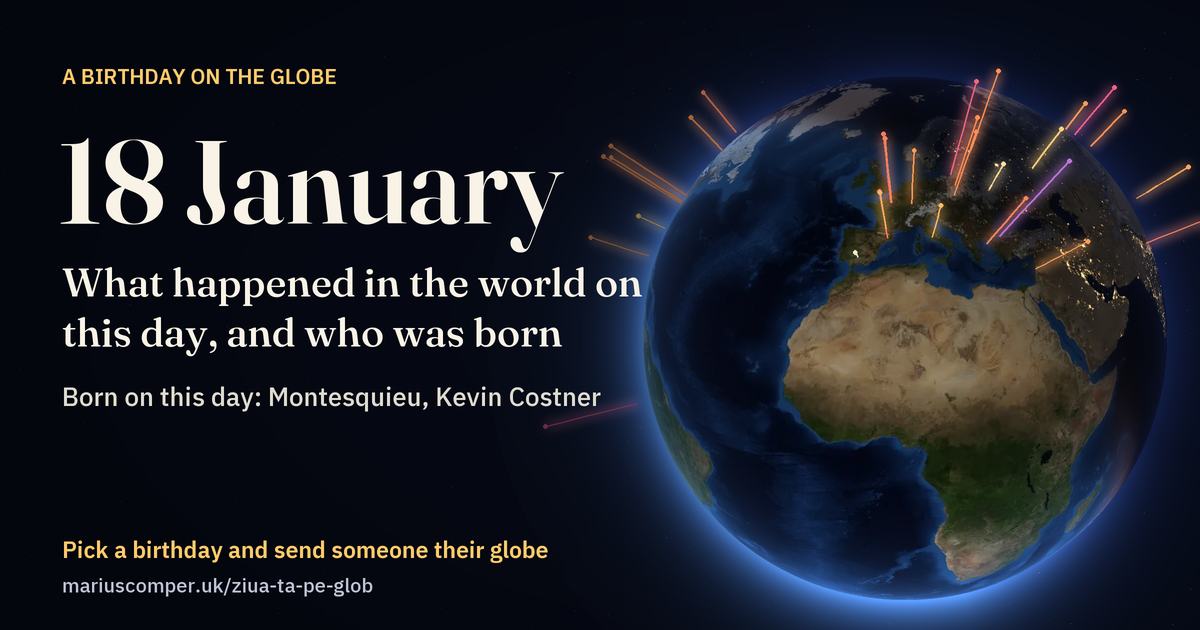
For 18 January, the English Wikipedia lists 61 events and 258 births. 33 of the events stand at their places as rays of light; six more are dashed circles, where the sentence links only to a country or a sea. The taller the ray, the longer ago it happened. The people born that day come further down, as blue points.
A birthday, yours or someone else’s:
Turn it into a greetingScroll: the globe turns to each place
The day you were born, on the globe.
Three things from your day
Scroll: your day first, then 18 January through the years
The Earth on 18 January
The picture on the globe was assembled by NASA from satellite photographs taken in January 2004: the snow, the ice and the green are those of the month.
On 18 January the Sun passes straight overhead at noon along the parallel of 20.6° south. In London, the day lasts about 8 hours 25 minutes.
Beyond 69° south the Sun no longer sets; beyond 69° north it no longer rises.
The line between day and night is tilted on the globe exactly as on this day of the year. On the dark side you can see the lights of towns.
Europe · Catalunya Central
1932
Alt Llobregat insurrection breaks out in Central Catalonia, Spain.
On the map: Catalunya Central.
Europe · Toulouse
2005
The Airbus A380, the world's largest commercial jet, is unveiled at a ceremony in Toulouse, France
On the map: Toulouse.
Also on the day’s list of Wikipedia in Romanian.
Europe · Rome
2008
The Euphronios Krater is unveiled in Rome after being returned to Italy by the Metropolitan Museum of Art.
On the map: Rome.
Asia · Piprahwa
1898
British colonial engineer and estate manager William Claxton Peppé discovered the Buddha's remains in Piprahwa, Uttar Pradesh, India.
On the map: Piprahwa.
Also on the day’s list of Wikipedia in Chinese.
Oceania · Wesley College, Melbourne
1866
Wesley College is established in Melbourne, Australia.
On the map: Wesley College, Melbourne.
North America · San Francisco Bay
1911
Eugene B. Ely lands on the deck of the USS Pennsylvania anchored in San Francisco Bay, the first time an aircraft landed on a ship.
On the map: San Francisco Bay.
North America · Centers for Disease Control and Prevention
1977
Scientists at the Centers for Disease Control and Prevention announce they have identified a previously unknown bacterium as the cause of the mysterious Legionnaires' disease.
On the map: Centers for Disease Control and Prevention.
18 January
What the other Wikipedias remember#
For these years the English list has nothing on this day. The events below come from the same day’s lists on Wikipedia in Romanian and were translated for this page.
From Wikipedia in Romanian · Humboldt-Universität zu Berlin
1887
Lazăr Edeleanu achieves the first synthesis of amphetamine at the Friedrich Wilhelm University.
On the map: Humboldt-Universität zu Berlin.
Translated from the list on Wikipedia in Romanian.
The article on Wikipedia in Romanian: Universitatea Humboldt din Berlin
18 January
Born on 18 January#
The English Wikipedia lists 258 births for this day. The blue points are the birthplaces of 60 of these people: those written about in the most Wikipedia editions, where Wikidata gives a place of birth.
Born on 18 January
1689
Montesquieu, French lawyer and philosopher (died 1755)
Place of birth: Château de la Brède.
Born on 18 January
1955
Kevin Costner, American actor, director, and producer
Place of birth: Lynwood.
Born on 18 January
1904
Cary Grant, English-American actor (died 1986)
Place of birth: Bristol.
Born on 18 January
1971
Pep Guardiola, Spanish footballer and manager
Place of birth: Santpedor.
Born on 18 January
1925
Gilles Deleuze, French metaphysician and philosopher (died 1995)
Place of birth: 17th arrondissement of Paris.
Born in Britain and Ireland
1882
A. A. Milne, English author, poet, and playwright (died 1956)
Place of birth: Henley House.
Born in Britain and Ireland
1938
Anthony Giddens, English sociologist and academic
Place of birth: Edmonton.
Born in Britain and Ireland
1980
Robert Green, English footballer
Place of birth: Chertsey.
18 January
Number one in the charts that week
At the cinema
An animal recorded that day
The record can be seen in GBIF, which brings together wildlife records from around the world.
All your birthdays
The weather that day
Data: Met Office Hadley Centre (HadCET); NOAA (GHCN-Daily, Mauna Loa).
Above the Earth
Sources: Jonathan McDowell, GCAT (launches); GFZ Potsdam (Kp index). Days are counted in Universal Time.
Football that day
International matches played that day:
Source: the “International football results” dataset kept by Mart Jürisoo (CC0).
Also that day
The earthquake’s page at the USGS
Source: the USGS catalogue. The day is counted in Universal Time (UTC).
In those days
Make a link for someone
Type the name, pick the day and the year of birth. The link opens straight on their day, with their name in the greeting.
The link carries the name, date and place typed here; anyone who gets it can see them.
Put another birthday beside it
Your mother’s, your child’s, a friend’s: the two days appear side by side.
Below: 18 January through the years.
The whole globe of the day
Drag the globe to turn it. Touch a ray or a point to read what happened there.
Everything Wikipedia lists for 18 January
The list is the English Wikipedia’s, in its own wording, as it stood in October 2026. 22 events have no place on the map: the sentence links to no place with coordinates, only to places too wide to mark, or to several countries.
- 350
General Magnentius is proclaimed emperor by Roman aristocrats discontent with the rule of emperor Constans.
no place on the mapWikipedia: Magnentius - 474
Seven-year-old Leo II succeeds his maternal grandfather Leo I as Byzantine emperor. He dies ten months later.
no place on the mapWikipedia: Leo II - 532
Nika riots in Constantinople fail.
Asia · ConstantinopleWikipedia: Nika riots - 1126
Emperor Huizong abdicates the Chinese throne in favour of his son Emperor Qinzong.
no place on the mapWikipedia: Emperor Huizong of Song - 1486
King Henry VII of England marries Elizabeth of York, daughter of Edward IV, uniting the House of Lancaster and the House of York.
no place on the mapWikipedia: Henry VII of England - 1535
Francisco Pizarro founded Ciudad de los Reyes (present-day Lima, Peru) as the capital of the lands he conquered for the Spanish crown.
Latin America · LimaWikipedia: Francisco Pizarro - 1562
Pope Pius IV reopens the Council of Trent for its third and final session.
no place on the mapWikipedia: Council of Trent - 1586
The magnitude 7.9 Tenshō earthquake strikes Honshu, Japan, killing 8,000 people and triggering a tsunami.
Asia · 1586 Tenshō earthquakeWikipedia: 1586 Tenshō earthquake - 1670
Henry Morgan captures Panama.
Latin America · PanamaWikipedia: Henry Morgan's Panama expedition - 1701
Frederick I crowns himself King in Prussia in Königsberg.
Europe · KönigsbergWikipedia: Frederick I of Prussia - 1778
James Cook is the first known European to discover the Hawaiian Islands, which he names the "Sandwich Islands".
no place on the mapWikipedia: James Cook - 1788
The first elements of the First Fleet carrying 736 convicts from Great Britain to Australia arrive at Botany Bay.
Oceania · Botany BayWikipedia: First Fleet - 1806
Jan Willem Janssens surrenders the Dutch Cape Colony to the British.
Africa · Dutch Cape ColonyWikipedia: Jan Willem Janssens - 1866
Wesley College is established in Melbourne, Australia.
Oceania · Wesley College, MelbourneWikipedia: Wesley College, Melbourne - 1871
Wilhelm I of Germany is proclaimed Kaiser Wilhelm in the Hall of Mirrors of the Palace of Versailles (France) towards the end of the Franco-Prussian War. Wilhelm already had the title of German Emperor since the constitution of 1 January 1871, but he had hesitated to accept the title.
Europe · Proclamation of the German EmpireWikipedia: Proclamation of the German Empire - 1886
Modern field hockey is born with the formation of The Hockey Association in England.
no place on the mapWikipedia: Field hockey - 1896
An X-ray generating machine is exhibited for the first time by H. L. Smith.
no place on the mapWikipedia: X-ray - 1898
British colonial engineer and estate manager William Claxton Peppé discovered the Buddha's remains in Piprahwa, Uttar Pradesh, India.
Asia · PiprahwaWikipedia: Piprahwa - 1911
Eugene B. Ely lands on the deck of the USS Pennsylvania anchored in San Francisco Bay, the first time an aircraft landed on a ship.
North America · San Francisco BayWikipedia: Eugene Burton Ely - 1913
First Balkan War: A Greek flotilla defeats the Ottoman Navy in the Naval Battle of Lemnos, securing the islands of the Northern Aegean Sea for Greece.
Europe · LemnosWikipedia: Battle of Lemnos - 1915
Japan issues the "Twenty-One Demands" to the Republic of China in a bid to increase its power in East Asia.
Asia · Republic of ChinaWikipedia: Twenty-One Demands - 1919
Ignacy Jan Paderewski becomes Prime Minister of the newly independent Poland.
no place on the mapWikipedia: Ignacy Jan Paderewski - 1919
World War I: The Paris Peace Conference opens in Versailles, France.
Europe · Paris Peace ConferenceWikipedia: World War I - 1932
Alt Llobregat insurrection breaks out in Central Catalonia, Spain.
Europe · Catalunya CentralWikipedia: Alt Llobregat insurrection - 1941
World War II: British troops launch a general counter-offensive against Italian East Africa.
Africa · Italian East AfricaWikipedia: World War II - 1943
Warsaw Ghetto Uprising: The first uprising of Jews in the Warsaw Ghetto.
Europe · Warsaw Ghetto UprisingWikipedia: Warsaw Ghetto Uprising - 1943
World War II: In Operation Iskra, the Red Army established a narrow land corridor to Leningrad, partially easing the protracted German siege of the city.
Europe · Operation IskraWikipedia: World War II - 1945
World War II: Liberation of Kraków, Poland by the Red Army.
Europe · KrakówWikipedia: Kraków - 1951
Construction of the United Nations Military Cemetery began in Busan, South Korea.
Asia · United Nations Memorial CemeteryWikipedia: United Nations Memorial Cemetery - 1956
Iranian Shia cleric Navvab Safavi, founder of the fundamentalist group Fada'iyan-e Islam, was executed for attempting to assassinate Prime Minister Hossein Ala'.
no place on the mapWikipedia: Shia Islam - 1958
Members of the Lumbee tribe arrived to protest at a Ku Klux Klan rally near Maxton, North Carolina, which turned into an armed confrontation between the two groups.
North America · Battle of Hayes PondWikipedia: Battle of Hayes Pond - 1958
Willie O'Ree, the first Black Canadian National Hockey League player, makes his NHL debut with the Boston Bruins.
no place on the mapWikipedia: Boston Bruins - 1960
Capital Airlines Flight 20 crashes into a farm in Charles City County, Virginia, killing all 50 aboard, the third fatal Capital Airlines crash in as many years.
North America · Capital Airlines Flight 20Wikipedia: Capital Airlines Flight 20 - 1967
Albert DeSalvo, the "Boston Strangler", is convicted of numerous crimes and is sentenced to life imprisonment.
no place on the mapWikipedia: Albert DeSalvo - 1969
In response to months of nationwide student protests, thousands of Japanese police stormed the University of Tokyo.
Asia · University of TokyoWikipedia: 1968–1969 Japanese university protests - 1969
United Airlines Flight 266 crashes into Santa Monica Bay killing all 32 passengers and six crew members.
North America · United Air Lines Flight 266Wikipedia: United Air Lines Flight 266 - 1972
Members of the Mukti Bahini lay down their arms to the government of the newly independent Bangladesh, a month after winning the war against the occupying Pakistan Army.
Asia · BangladeshWikipedia: Mukti Bahini - 1974
A Disengagement of Forces agreement is signed between the Israeli and Egyptian governments, ending conflict on the Egyptian front of the Yom Kippur War.
no place on the mapWikipedia: Israel - 1976
Lebanese Christian militias kill at least 1,000 in Karantina, Beirut.
Asia · Karantina massacreWikipedia: Karantina massacre - 1977
Australia's worst rail disaster occurs at Granville, Sydney, killing 83.
Oceania · Granville, New South WalesWikipedia: Granville rail disaster - 1977
SFR Yugoslavia's Prime minister, Džemal Bijedić, his wife and six others are killed in a plane crash in Bosnia and Herzegovina.
no place on the mapWikipedia: Socialist Federal Republic of Yugoslavia - 1977
Scientists at the Centers for Disease Control and Prevention announce they have identified a previously unknown bacterium as the cause of the mysterious Legionnaires' disease.
North America · Centers for Disease Control and PreventionWikipedia: Centers for Disease Control and Prevention - 1978
The European Court of Human Rights finds the United Kingdom's government guilty of mistreating prisoners in Northern Ireland, but not guilty of torture.
Europe · European Court of Human RightsWikipedia: European Court of Human Rights - 1981
Phil Smith and Phil Mayfield parachute off a Houston skyscraper, becoming the first two people to BASE jump from objects in all four categories: buildings, antennae, spans (bridges), and earth (cliffs).
no place on the mapWikipedia: BASE jumping - 1983
Singaporean communist activist Tan Chay Wa was executed, leading to a much-publicised trial of his brother for engraving "subversive" material on the gravestone.
no place on the mapWikipedia: Malayan Communist Party - 1983
The International Olympic Committee restores Jim Thorpe's Olympic medals to his family.
no place on the mapWikipedia: International Olympic Committee - 1986
An Aerovías Sud Aviation Caravelle crashes on approach to Mundo Maya International Airport in Flores, Petén, Guatemala, killing all 94 people on board.
Latin America · 1986 Aerovías Guatemala Caravelle crashWikipedia: 1986 Aerovías Guatemala Caravelle crash - 1988
China Southwest Airlines Flight 4146 crashes near Chongqing Baishiyi Airport, killing all 98 passengers and 10 crew members.
Asia · China Southwest Airlines Flight 4146Wikipedia: China Southwest Airlines Flight 4146 - 1990
Washington, D.C., Mayor Marion Barry is arrested for drug possession in an FBI sting.
no place on the mapWikipedia: Marion Barry - 1993
Martin Luther King, Jr. Day is officially observed for the first time in all 50 US states.
no place on the mapWikipedia: Martin Luther King Jr. Day - 2002
The Sierra Leone Civil War is declared over.
no place on the mapWikipedia: Sierra Leone Civil War - 2003
A bushfire kills four people and destroys more than 500 homes in Canberra, Australia.
Oceania · CanberraWikipedia: 2003 Canberra bushfires - 2005
The Airbus A380, the world's largest commercial jet, is unveiled at a ceremony in Toulouse, France
Europe · ToulouseWikipedia: Toulouse - 2007
The strongest storm in the United Kingdom in 17 years kills 14 people and Germany sees the worst storm since 1999 with 13 deaths. Cyclone Kyrill causes at least 44 deaths across 20 countries in Western Europe.
no place on the mapWikipedia: Cyclone Kyrill - 2008
The Euphronios Krater is unveiled in Rome after being returned to Italy by the Metropolitan Museum of Art.
Europe · RomeWikipedia: Euphronios Krater - 2012
More than 115,000 websites engage in an online protest against the Stop Online Piracy Act and the Protect IP Act in the US. The websites involved viewed the laws as infringing on the right to free speech and many of them temporarily shut down in protest.
North America · United StatesWikipedia: Protests against SOPA and PIPA - 2018
A bus catches fire on the Samara–Shymkent road in Yrgyz District, Aktobe, Kazakhstan. The fire kills 52 passengers, with three passengers and two drivers escaping.
Europe · SamaraWikipedia: Samara - 2019
An oil pipeline explosion near Tlahuelilpan, Hidalgo, Mexico, kills 137 people.
Latin America · Tlahuelilpan pipeline explosionWikipedia: Tlahuelilpan pipeline explosion - 2023
A helicopter crash in Ukraine leaves 14 people dead, including the country's Interior Minister, Denys Monastyrsky.
Europe · 2023 Brovary helicopter crashWikipedia: 2023 Brovary helicopter crash - 2025
The popular social media app, TikTok, is banned in the United States, after the passing of PAFACA.
no place on the mapWikipedia: TikTok - 2026
At least 45 people are killed and 292 others injured after two trains collide in Adamuz in the worst railway disaster in over a decade in Spain.
Europe · AdamuzWikipedia: 2026 Adamuz rail disaster
What the other Wikipedias remember
For these years the English list has nothing on this day. The events below come from the same day’s lists on Wikipedia in Romanian and were translated for this page.
- 1887
Lazăr Edeleanu achieves the first synthesis of amphetamine at the Friedrich Wilhelm University.
Europe · Humboldt-Universität zu BerlinTranslated from the list on Wikipedia in RomanianWikipedia: Universitatea Humboldt din Berlin
Who was born on 18 January
In order of how many Wikipedia editions have an article about each. The first 60 of 258 are shown.
- 1689
Montesquieu, French lawyer and philosopher (died 1755)
Château de la BrèdeWikipedia: Montesquieu - 1955
Kevin Costner, American actor, director, and producer
LynwoodWikipedia: Kevin Costner - 1904
Cary Grant, English-American actor (died 1986)
BristolWikipedia: Cary Grant - 1971
Pep Guardiola, Spanish footballer and manager
SantpedorWikipedia: Pep Guardiola - 1944
Alexander Van der Bellen, President of Austria
- 1925
Gilles Deleuze, French metaphysician and philosopher (died 1995)
17th arrondissement of ParisWikipedia: Gilles Deleuze - 1882
A. A. Milne, English author, poet, and playwright (died 1956)
Henley HouseWikipedia: A. A. Milne - 1867
Rubén Darío, Nicaraguan poet, journalist, and diplomat (died 1916)
Ciudad DarioWikipedia: Rubén Darío - 1947
Takeshi Kitano, Japanese actor and director
- 1921
Yoichiro Nambu, Japanese-American physicist and academic, Nobel Prize laureate (died 2015)
- 1988
Angelique Kerber, German tennis player
- 1969
Dave Bautista, American wrestler, mixed martial artist, and actor
Washington, D.C.Wikipedia: Dave Bautista - 1984
Makoto Hasebe, Japanese footballer
FujiedaWikipedia: Makoto Hasebe - 1931
Chun Doo-hwan, South Korean general and politician, 5th President of South Korea (died 2021)
Hapcheon CountyWikipedia: Chun Doo-hwan - 1990
Nacho, Spanish footballer
Alcalá de HenaresWikipedia: Nacho - 1938
Anthony Giddens, English sociologist and academic
EdmontonWikipedia: Anthony Giddens - 1937
John Hume, Northern Irish educator and politician, Nobel Prize laureate (died 2020)
DerryWikipedia: John Hume - 1849
Edmund Barton, Australian judge and politician, 1st Prime Minister of Australia (died 1920)
- 1892
Oliver Hardy, American actor and comedian (died 1957)
HarlemWikipedia: Oliver Hardy - 1911
Danny Kaye, American actor, singer, and dancer (died 1987)
BrooklynWikipedia: Danny Kaye - 1944
Paul Keating, Australian economist and politician, 24th Prime Minister of Australia
BankstownWikipedia: Paul Keating - 1979
Paulo Ferreira, Portuguese footballer
CascaisWikipedia: Paulo Ferreira - 1980
Jason Segel, American actor and screenwriter
Los AngelesWikipedia: Jason Segel - 1998
Éder Militão, Brazilian footballer
SertãozinhoWikipedia: Éder Militão - 1835
César Cui, Russian general, composer, and critic (died 1918)
VilniusWikipedia: César Cui - 1985
Riccardo Montolivo, Italian footballer
- 1998
Aitana Bonmatí, Spanish footballer
Sant Pere de RibesWikipedia: Aitana Bonmatí - 1966
Alexander Khalifman, Russian chess player and author
Saint PetersburgWikipedia: Alexander Khalifman - 1998
Lisandro Martínez, Argentinian footballer
GualeguayWikipedia: Lisandro Martínez - 1980
Robert Green, English footballer
ChertseyWikipedia: Robert Green - 1782
Daniel Webster, American lawyer and politician, 14th United States Secretary of State (died 1852)
SalisburyWikipedia: Daniel Webster - 1967
Iván Zamorano, Chilean footballer
SantiagoWikipedia: Iván Zamorano - 1880
Paul Ehrenfest, Austrian-Dutch physicist and academic (died 1933)
- 2002
Karim Adeyemi, German footballer
MunichWikipedia: Karim Adeyemi - 1950
Gilles Villeneuve, Canadian race car driver (died 1982)
Saint-Jean-sur-RichelieuWikipedia: Gilles Villeneuve - 1993
Juan Fernando Quintero, Colombian footballer
- 1978
Bogdan Lobonț, Romanian footballer
HunedoaraWikipedia: Bogdan Lobonț - 1960
Mark Rylance, English actor, director, and playwright
AshfordWikipedia: Mark Rylance - 1987
Johan Djourou, Swiss footballer
AbidjanWikipedia: Johan Djourou - 1979
Jay Chou, a Taiwanese singer-songwriter, businessman, director, and actor
Linkou DistrictWikipedia: Jay Chou - 1933
John Boorman, English director, producer, and screenwriter
SheppertonWikipedia: John Boorman - 1971
Jonathan Davis, American singer-songwriter
BakersfieldWikipedia: Jonathan Davis - 1932
Robert Anton Wilson, American psychologist, author, poet, and playwright (died 2007)
FlatbushWikipedia: Robert Anton Wilson - 1868
Kantarō Suzuki, Japanese admiral and politician, 42nd Prime Minister of Japan (died 1948)
- 1893
Jorge Guillén, Spanish poet, critic, and academic (died 1984)
ValladolidWikipedia: Jorge Guillén - 1911
José María Arguedas, Peruvian anthropologist, author, and poet (died 1969)
AndahuaylasWikipedia: José María Arguedas - 1978
Thor Hushovd, Norwegian cyclist
GrimstadWikipedia: Thor Hushovd - 1879
Henri Giraud, French general and politician (died 1949)
- 1908
Jacob Bronowski, Polish-English mathematician, historian, and television host (died 1974)
- 1933
Ray Dolby, American engineer and businessman, founded Dolby Laboratories (died 2013)
PortlandWikipedia: Ray Dolby - 1949
Philippe Starck, French interior designer
- 1963
Martin O'Malley, American soldier, lawyer, and politician, 61st Governor of Maryland
Washington, D.C.Wikipedia: Martin O'Malley - 1752
John Nash, English architect (died 1835)
LambethWikipedia: John Nash - 1841
Emmanuel Chabrier, French pianist and composer (died 1894)
- 1961
Peter Beardsley, English footballer and manager
- 1995
Samu Castillejo, Spanish footballer
- 1999
Karan Brar, American actor
RedmondWikipedia: Karan Brar - 1915
Santiago Carrillo, Spanish soldier and politician (died 2012)
- 1896
Ville Ritola, Finnish-American runner (died 1982)
PeräseinäjokiWikipedia: Ville Ritola - 1919
Toni Turek, German footballer (died 1984)
DuisburgWikipedia: Toni Turek
What is celebrated on 18 January
- Christian feast day: Amy Carmichael (Church of England)
- Christian feast day: Athanasius of Alexandria (Eastern Orthodox Church)
- Christian feast day: Confession of Peter (Eastern Orthodox, some Anglican and Lutheran Churches)
- Christian feast day: Deicolus
- Christian feast day: Margaret of Hungary
- Christian feast day: Prisca
- Christian feast day: Blessed Regina Protmann
- Christian feast day: Volusianus of Tours
- Christian feast day: January 18 (Eastern Orthodox liturgics)
- Royal Thai Armed Forces Day (Thailand)
A greeting link for someone
Type a name and, if you like, the year of birth. The link opens with a greeting, and beside each event it says how old the person turned that day, or how many years before their birth it happened.
The name and the year go only into the link you send.
All 366 days
How the globe is made
Where the events come from
Each edition of this page uses the day’s list from Wikipedia in its own language: Romanian, English, Spanish, Chinese. The lists are written by volunteers and differ from one edition to the next; the text of each event is Wikipedia’s, with a link to the article. A row that appears twice in a list is shown once. The lists have not been checked event by event: they are Wikipedia’s, mistakes included.
For events before 1582, and for countries that moved to the Gregorian calendar later (Britain in 1752, Russia in 1918), the same day may be counted Old Style in one list and New Style in another.
The chapter “What the other Wikipedias remember” adds up to five events a day from the lists of the other three editions, only for years in which the English list has nothing on that day. They were translated for this page, passed the same filters as the tour, and are not counted among the events of the English list.
How an event gets onto the map
The place comes from Wikidata. If the sentence links to the article about the event itself (a battle, an opening, an earthquake), dated to the same year, the ray stands on its coordinates or on those of its location. Otherwise it stands on the first place the sentence links to: a town, a building, a mountain, an island. This second step can be wrong: sometimes the sentence only mentions the place. That is why the page says, under each event, which place the ray stands on.
When the sentence links to a single state or province, or to a single sea, lake or desert larger than 5,000 km², the globe shows a dashed circle, not a ray. The circle has the area Wikidata gives, with its radius kept between 1.2° and 16°, or a radius of 4.5° when Wikidata gives no area; it says only that the sentence links to that place. Organisations, ships, spacecraft, museum objects, rivers, mountain ranges, languages and continents are never used as places. When a sentence names several states and no exact place, the event stays in the list only.
What the height means
The height of a ray shows how many years have passed, on a logarithmic scale: 10 years, 100 years and 1,000 years are equal steps apart; anything older than about 2,600 years has the tallest ray. The colour runs from pale yellow for recent years to violet for antiquity.
Where the tour stops
In each region the tour stops at up to three events (five in Britain and Ireland), chosen mainly by three things: whether Wikipedia’s editors put the event in the “On this day” box of their main page (the English, Spanish and Chinese editions), how many Wikipedia editions have an article about it, and how many of the four lists include it. Events whose sentence or article is about a war, an attack, a crime or a disaster are left out of the tour; they stay in the whole list, in Wikipedia’s wording. The filter is a list of words and a list of Wikidata types, so it can miss some.
The tour of births names the people with articles in the most editions and leaves aside those whom the list or Wikidata describes as rulers, politicians, commanders, leaders of movements or criminals; they stay in the list.
The Earth and the Sun
The daytime images are NASA’s Blue Marble Next Generation mosaics, one for each month of 2004; the night side is Black Marble 2016. The tilt of the line between day and night is computed for the day; the hour is chosen so that the place being read is in daylight. The latitude where the Sun stands overhead is the average of the four years of the leap cycle; in a given year it can differ by up to 0.4°.
The day you were born
The number ones come from the weekly lists on Wikipedia: Billboard for the United States (from 1940; the Hot 100 from August 1958), the UK Singles Chart (from November 1952), Los 40 Principales for Spain (from July 1966) and, for Romania, the Romanian Top 100 and Airplay 100 (2001–2021, with missing weeks). The page shows the chart of the week in which the day of birth falls, with its date; Billboard and the UK chart are dated at the end of their week. For Romania before 2001 and for China these sources have no weekly chart.
The films are those that reached cinemas in the United States up to ten days before or three days after that day (some of them in a few cinemas at first), from the English Wikipedia’s yearly lists (from 1968), in order of how many editions have an article about them. The events “in those days” are the ones on the neighbouring days’ lists that carry the year of birth, passed through the same filter as the tour.
The day of birth, year included
The Moon, the star sign and the constellation are worked out by the page itself, for noon Universal Time on the day. The lit part of the Moon is rounded and can differ by a few per cent from that at the hour of birth. The sign follows the usual zodiac of twelve equal parts starting at the March equinox; the constellation is the one the Sun actually stood in front of, by the borders set by the International Astronomical Union, and within a day of a border the page does not name it. When the Sun changes sign while it is that day anywhere on Earth, the page gives the moment of crossing, rounded to ten minutes and accurate to within about a quarter of an hour, and the clock time in a few cities, with the time zone and summer time of that year.
The year in the Chinese calendar is the one your device’s own calendar gives for the date, checked against the Hong Kong Observatory’s tables. “All your birthdays” uses the same sources as the rest of the chapter for the same day in every year since the birth: the temperature, well-known launches that took place on that very day, matches of the teams the edition follows, snow deeper than 10 cm and strong geomagnetic storms. The three things at the top and the four on the picture are chosen in a fixed order (the song, the animal, a full Moon, a well-known launch before an ordinary earthquake); on the picture you can change them.
When the link carries a year of birth, the page adds a few things about that exact day. The weather is the Met Office’s Central England temperature record and the readings from New York’s Central Park; the “usual high” is the average of the daily highs of 1961–1990 for that date, with two days either side. The carbon dioxide figure is the monthly mean at the Mauna Loa observatory, where measurements begin in March 1958.
The earthquake is the one with the largest magnitude in the USGS catalogue for that day, counted in Universal Time. Before the 1960s the catalogue has gaps even above magnitude 5.5, so in the older years many days have no earthquake. The page gives only the magnitude and the place: the country the epicentre falls in or, when the epicentre is at sea within 300 km of a coast, the nearest country; farther out, only the ocean.
The launches are those that reached orbit or left for the Moon and the planets, from Jonathan McDowell’s GCAT catalogue. If nothing left that day, the page shows the nearest launch within three days before or after, and says how many days away it was. The geomagnetic storm appears only when the Kp index reached at least 5 in one of the day’s eight three-hour intervals.
The animal comes from GBIF: an observation made by a person (the animal seen or heard, or its tracks), dated to that exact day, with coordinates and a CC0 or CC BY licence. Only a few hundred well-known species are searched (mammals, birds, turtles, butterflies); of those noted that day, mammals and species with articles in many Wikipedia editions come first; birds noted almost every day, and species used recently, wait their turn. Observations dated 1 January are left out, because records without a day are often filed there. An observation shows that the animal was recorded there, not how many animals there were.
The matches are those between national teams. Only matches of England, Scotland, Wales, Northern Ireland, the Republic of Ireland, the United States, Canada and Australia are shown, along with those at the big final tournaments. The picture to send is drawn in the page from the day’s globe and the facts above, and stays on your device until you send it.
Sources
- Events, births and holidays: the day’s page on Wikipedia, text under CC BY-SA 4.0.
- Coordinates, places of birth and the number of editions: Wikidata (CC0).
- The Earth by day: NASA Blue Marble Next Generation. The Earth by night: NASA Black Marble 2016.
- Borders and regions: Natural Earth.
- World population and births per year: UN World Population Prospects 2024.
- Charts and films: Wikipedia’s lists for Billboard, the UK Singles Chart, Los 40 Principales, Romanian Top 100, Airplay 100 and American films by year (CC BY-SA 4.0).
- Weather: Met Office Hadley Centre, HadCET (Open Government Licence) and NOAA GHCN-Daily, New York Central Park. Carbon dioxide: NOAA Global Monitoring Laboratory, Mauna Loa.
- Earthquakes: the USGS catalogue. Launches: Jonathan McDowell, GCAT (CC BY). Kp index: GFZ Potsdam (CC BY 4.0). Matches: International football results, Mart Jürisoo (CC0).
- Animal observations: GBIF, with a link to each record; species names come from Wikidata.