A birthday on the globe
6 March on the globe: what happened in the world on this day, and who was born
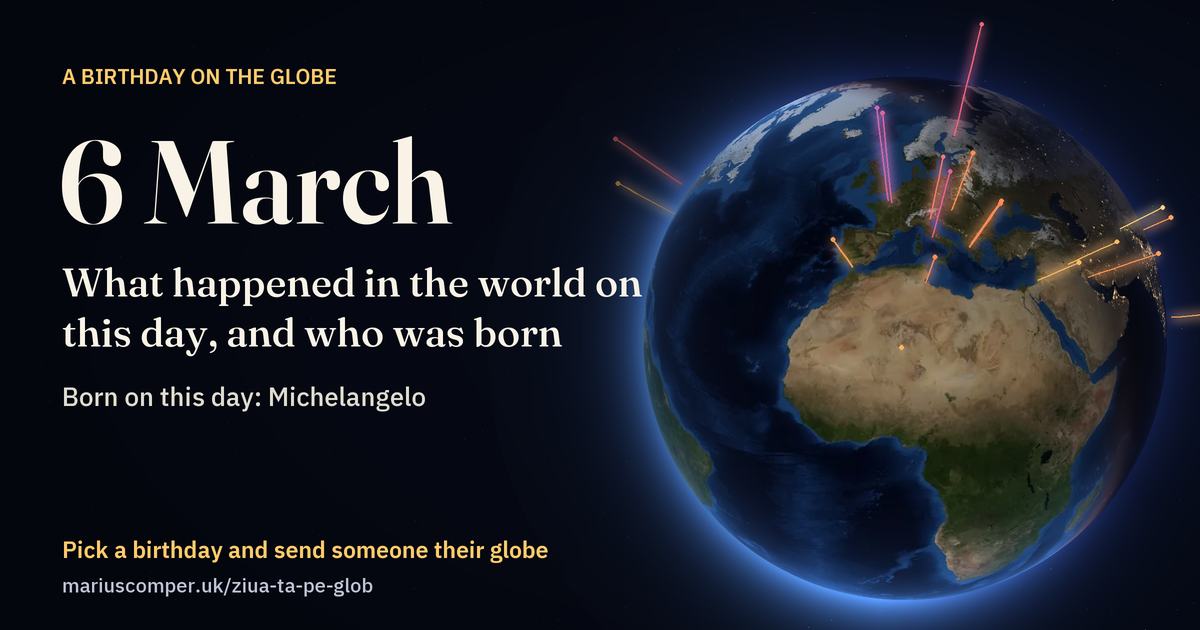
For 6 March, the English Wikipedia lists 32 events and 169 births. 20 of the events stand at their places as rays of light; two more are dashed circles, where the sentence links only to a country or a sea. The taller the ray, the longer ago it happened. The people born that day come further down, as blue points.
A birthday, yours or someone else’s:
Turn it into a greetingScroll: the globe turns to each place
The day you were born, on the globe.
Three things from your day
Scroll: your day first, then 6 March through the years
The Earth on 6 March
The picture on the globe was assembled by NASA from satellite photographs taken in March 2004: the snow, the ice and the green are those of the month.
On 6 March the Sun passes straight overhead at noon along the parallel of 5.4° south. In London, the day lasts about 11 hours 15 minutes.
Beyond 85° south the Sun no longer sets; beyond 85° north it no longer rises.
The line between day and night is tilted on the globe exactly as on this day of the year. On the dark side you can see the lights of towns.
Europe · Kajaani
1651
The town of Kajaani, known at the time as Cajanaburg, is founded by Count Per Brahe, the Governor-General of Finland.
On the map: Kajaani.
Also on the day’s list of Wikipedia in Spanish.
Europe · La Fenice
1853
Giuseppe Verdi's La traviata premiered at La Fenice in Venice, but the performance was considered so bad that it caused him to revise portions of the opera.
On the map: La Fenice.
Asia · 1975 Algiers Agreement
1975
Algiers Accord: Iran and Iraq announce a settlement of their border dispute.
On the map: the coordinates Wikidata gives for the article “1975 Algiers Agreement”.
Also on the day’s list of Wikipedia in Spanish.
Asia · Christ's Commission Fellowship
1985
Registration of the Filipino megachurch Christ's Commission Fellowship with the Philippine government, months after its first worship service in August 1984.
On the map: Christ's Commission Fellowship.
Asia · Marine Parade Community Building
2000
The Marine Parade Community Building, the mural cladding of which is the largest installation art in Singapore, was opened.
On the map: Marine Parade Community Building.
6 March
What the other Wikipedias remember#
For these years the English list has nothing on this day. The events below come from the same day’s lists on Wikipedia in Spanish and Chinese and were translated for this page.
From Wikipedia in Spanish · Treaty of Alcáçovas
1479
The Treaty of Alcáçovas is signed, in which Portugal cedes the Canary Islands to Castile in exchange for possessions in West Africa.
On the map: Treaty of Alcáçovas.
Translated from the list on Wikipedia in Spanish.
From Wikipedia in Chinese · Mariana Islands
1521
While circumnavigating the globe with his fleet, the Portuguese explorer Ferdinand Magellan discovers Guam, at the southern end of the Mariana Islands.
On the map: Mariana Islands.
Translated from the list on Wikipedia in Chinese.
6 March
Born on 6 March#
The English Wikipedia lists 169 births for this day. The blue points are the birthplaces of 60 of these people: those written about in the most Wikipedia editions, where Wikidata gives a place of birth.
Born on 6 March
1475
Michelangelo, Italian painter and sculptor (died 1564)
Place of birth: Caprese Michelangelo.
Born on 6 March
1927
Gabriel García Márquez, Colombian journalist and author, Nobel Prize laureate (died 2014)
Place of birth: Aracataca.
Born on 6 March
1806
Elizabeth Barrett Browning, English-Italian poet and translator (died 1861)
Place of birth: Coxhoe Hall.
Born on 6 March
1972
Shaquille O'Neal, American basketball player
Place of birth: Newark.
Born on 6 March
1926
Andrzej Wajda, Polish director, producer, and screenwriter (died 2016)
Place of birth: Suwałki.
Born in Britain and Ireland
1946
David Gilmour, English guitarist and singer-songwriter
Place of birth: Cambridge.
Born in Britain and Ireland
1920
Lewis Gilbert, English director, producer, and screenwriter (died 2018)
Place of birth: London.
Born in Britain and Ireland
1979
Garry Monk, English footballer and manager
Place of birth: Bedford.
6 March
Number one in the charts that week
At the cinema
An animal recorded that day
The record can be seen in GBIF, which brings together wildlife records from around the world.
All your birthdays
The weather that day
Data: Met Office Hadley Centre (HadCET); NOAA (GHCN-Daily, Mauna Loa).
Above the Earth
Sources: Jonathan McDowell, GCAT (launches); GFZ Potsdam (Kp index). Days are counted in Universal Time.
Football that day
International matches played that day:
Source: the “International football results” dataset kept by Mart Jürisoo (CC0).
Also that day
The earthquake’s page at the USGS
Source: the USGS catalogue. The day is counted in Universal Time (UTC).
In those days
Make a link for someone
Type the name, pick the day and the year of birth. The link opens straight on their day, with their name in the greeting.
The link carries the name, date and place typed here; anyone who gets it can see them.
Put another birthday beside it
Your mother’s, your child’s, a friend’s: the two days appear side by side.
Below: 6 March through the years.
The whole globe of the day
Drag the globe to turn it. Touch a ray or a point to read what happened there.
Everything Wikipedia lists for 6 March
The list is the English Wikipedia’s, in its own wording, as it stood in October 2026. 10 events have no place on the map: the sentence links to no place with coordinates, only to places too wide to mark, or to several countries.
- 12 BC
The Roman emperor Augustus is named Pontifex Maximus, incorporating the position into that of the emperor.
no place on the mapWikipedia: Roman emperor - 845
The 42 Martyrs of Amorium are killed after refusing to convert to Islam.
no place on the mapWikipedia: 42 Martyrs of Amorium - 1204
The Siege of Château Gaillard ends in a French victory over King John of England, who loses control of Normandy to King Philip II Augustus.
Europe · Siege of Château GaillardWikipedia: Siege of Château Gaillard - 1323
Treaty of Paris of 1323 is signed.
Europe · ParisWikipedia: Treaty of Paris - 1447
Election of Pope Nicholas V following the death of Pope Eugene IV on 23 February 1447.
Europe · 1447 conclaveWikipedia: 1447 conclave - 1651
The town of Kajaani, known at the time as Cajanaburg, is founded by Count Per Brahe, the Governor-General of Finland.
Europe · KajaaniWikipedia: Kajaani - 1788
The First Fleet arrives at Norfolk Island in order to found a convict settlement.
Oceania · Norfolk IslandWikipedia: First Fleet - 1820
The Missouri Compromise is signed into law by United States President James Monroe. The compromise allows Missouri to enter the Union as a slave state, brings Maine into the Union as a free state, and makes the rest of the northern part of the Louisiana Purchase territory slavery-free.
no place on the mapWikipedia: Missouri Compromise - 1836
Texas Revolution: Battle of the Alamo: After a thirteen-day siege by an army of over 1,800 Mexican troops, the 257 Texas volunteers, including frontiersman Davy Crockett and colonel Jim Bowie, defending the Alamo are killed and the fort is captured.
North America · Texas RevolutionWikipedia: Battle of the Alamo - 1853
Giuseppe Verdi's La traviata premiered at La Fenice in Venice, but the performance was considered so bad that it caused him to revise portions of the opera.
Europe · La FeniceWikipedia: La Fenice - 1857
The Supreme Court of the United States rules 7–2 in the Dred Scott v. Sandford case that the Constitution does not confer citizenship on black people.
no place on the map - 1901
An anarchist assassin tries to kill German Emperor Wilhelm II.
no place on the mapWikipedia: Wilhelm II - 1904
Scottish National Antarctic Expedition: Led by William Speirs Bruce, the Antarctic region of Coats Land is discovered from the Scotia.
Oceans · AntarcticaWikipedia: Scottish National Antarctic Expedition - 1913
First Balkan War: The Greek army captured Bizani Fortress, near Ioannina, from the Ottomans.
Europe · Battle of BizaniWikipedia: Battle of Bizani - 1930
International Unemployment Day demonstrations globally initiated by the Communist Party USA.
no place on the mapWikipedia: International Unemployment Day - 1943
World War II: Generalfeldmarschall Erwin Rommel launches the Battle of Medenine in an attempt to slow down the British Eighth Army. It fails, and he leaves Africa three days later.
Africa · Battle of MedenineWikipedia: Battle of Medenine - 1943
World War II: The Battle of Fardykambos, one of the first major battles between the Greek Resistance and the occupying Royal Italian Army, ends with the surrender of an entire Italian battalion, the bulk of the garrison of the town of Grevena, leading to its liberation a fortnight later.
Europe · Battle of FardykambosWikipedia: Battle of Fardykambos - 1945
Petru Groza of the Ploughmen's Front became the first prime minister of the Communist Party-dominated government of Romania.
no place on the mapWikipedia: Petru Groza - 1945
World War II: Cologne is captured by American troops. On the same day, Operation Spring Awakening, the last major German offensive of the war, begins.
Europe · Operation Spring AwakeningWikipedia: Operation Spring Awakening - 1953
Following Joseph Stalin's death, Georgy Malenkov succeeded him as Premier of the Soviet Union.
no place on the mapWikipedia: Joseph Stalin - 1957
the Ghana Independence Act 1957 is passed in the United Kingdom resulting in Ghana gaining independence from the British.
Africa · GhanaWikipedia: Ghana Independence Act 1957 - 1964
In a radio broadcast, Nation of Islam leader Elijah Muhammad announced that American boxer Cassius Clay would change his name to Muhammad Ali.
no place on the mapWikipedia: Nation of Islam - 1975
Algiers Accord: Iran and Iraq announce a settlement of their border dispute.
Asia · 1975 Algiers AgreementWikipedia: 1975 Algiers Agreement - 1985
Registration of the Filipino megachurch Christ's Commission Fellowship with the Philippine government, months after its first worship service in August 1984.
Asia · Christ's Commission FellowshipWikipedia: Christ's Commission Fellowship - 1987
The British ferry MS Herald of Free Enterprise capsizes in about 90 seconds, killing 193.
no place on the mapWikipedia: MS Herald of Free Enterprise - 1988
Operation Flavius: Three Provisional Irish Republican Army volunteers are shot dead by the SAS in Gibraltar.
Europe · Operation FlaviusWikipedia: Operation Flavius - 2000
The Marine Parade Community Building, the mural cladding of which is the largest installation art in Singapore, was opened.
Asia · Marine Parade Community BuildingWikipedia: Marine Parade Community Building - 2003
Air Algérie Flight 6289 crashes at the Aguenar – Hadj Bey Akhamok Airport in Tamanrasset, Algeria, killing 102 out of the 103 people on board.
Africa · Air Algérie Flight 6289Wikipedia: Air Algérie Flight 6289 - 2008
A gunman kills eight students in Jerusalem.
Asia · 2008 Jerusalem yeshiva attackWikipedia: 2008 Jerusalem yeshiva attack - 2008
A suicide bomber kills 68 people in the Karrada district of Karrada in Baghdad
Asia · BaghdadWikipedia: 6 March 2008 Baghdad bombing - 2009
As part of their investigation into an athletic scandal at Florida State University, the National Collegiate Athletic Association released a report alleging that 61 student athletes had engaged in academic fraud.
North America · Florida State UniversityWikipedia: Florida State University academic-athletic scandal - 2020
32 people are killed and 82 are injured when gunmen open fire on a ceremony in Kabul, Afghanistan. The Islamic State claims responsibility for the attack.
Asia · 6 March 2020 Kabul shootingWikipedia: 6 March 2020 Kabul shooting
What the other Wikipedias remember
For these years the English list has nothing on this day. The events below come from the same day’s lists on Wikipedia in Spanish and Chinese and were translated for this page.
- 1479
The Treaty of Alcáçovas is signed, in which Portugal cedes the Canary Islands to Castile in exchange for possessions in West Africa.
Europe · Treaty of AlcáçovasTranslated from the list on Wikipedia in SpanishWikipedia: Tratado de Alcazobas - 1521
While circumnavigating the globe with his fleet, the Portuguese explorer Ferdinand Magellan discovers Guam, at the southern end of the Mariana Islands.
Who was born on 6 March
In order of how many Wikipedia editions have an article about each. The first 60 of 169 are shown.
- 1475
Michelangelo, Italian painter and sculptor (died 1564)
Caprese MichelangeloWikipedia: Michelangelo - 1927
Gabriel García Márquez, Colombian journalist and author, Nobel Prize laureate (died 2014)
AracatacaWikipedia: Gabriel García Márquez - 1937
Valentina Tereshkova, Russian general, pilot, and astronaut
Bolshoye MaslennikovoWikipedia: Valentina Tereshkova - 1806
Elizabeth Barrett Browning, English-Italian poet and translator (died 1861)
Coxhoe HallWikipedia: Elizabeth Barrett Browning - 1972
Shaquille O'Neal, American basketball player
- 1926
Andrzej Wajda, Polish director, producer, and screenwriter (died 2016)
SuwałkiWikipedia: Andrzej Wajda - 1946
David Gilmour, English guitarist and singer-songwriter
CambridgeWikipedia: David Gilmour - 1947
Rob Reiner, American actor, director, producer, and activist (died 2025)
The BronxWikipedia: Rob Reiner - 1787
Joseph von Fraunhofer, German physicist and astronomer (died 1826)
StraubingWikipedia: Joseph von Fraunhofer - 1619
Cyrano de Bergerac, French author and playwright (died 1655)
- 1926
Alan Greenspan, American economist and politician (died 2026)
New York CityWikipedia: Alan Greenspan - 1987
Kevin-Prince Boateng, Ghanaian-German footballer
West BerlinWikipedia: Kevin-Prince Boateng - 1996
Timo Werner, German footballer
StuttgartWikipedia: Timo Werner - 1909
Stanisław Jerzy Lec, Polish poet and author (died 1966)
- 1979
Tim Howard, American soccer player
North BrunswickWikipedia: Tim Howard - 1483
Francesco Guicciardini, Italian historian and politician (died 1540)
- 1988
Simon Mignolet, Belgian footballer
Sint-TruidenWikipedia: Simon Mignolet - 1991
Tyler, the Creator, American rapper
HawthorneWikipedia: Tyler, the Creator - 1340
John of Gaunt (probable; d. 1399)
- 1977
Giorgos Karagounis, Greek footballer
- 1989
Agnieszka Radwańska, Polish tennis player
- 1936
Choummaly Sayasone, Laotian politician, 5th President of Laos
- 1405
John II of Castile (died 1454)
- 1944
Kiri Te Kanawa, New Zealand soprano and actress
GisborneWikipedia: Kiri Te Kanawa - 1831
Philip Sheridan, Irish-American general (died 1888)
- 1947
Dick Fosbury, American high jumper (died 2023)
PortlandWikipedia: Dick Fosbury - 1954
Harald Schumacher, German footballer and manager
- 1927
Gordon Cooper, American engineer, pilot, and astronaut (died 2004)
ShawneeWikipedia: Gordon Cooper - 1930
Lorin Maazel, French-American violinist, composer, and conductor (died 2014)
Neuilly-sur-SeineWikipedia: Lorin Maazel - 1949
Shaukat Aziz, Pakistani economist and politician, 15th Prime Minister of Pakistan
KarachiWikipedia: Shaukat Aziz - 1967
Connie Britton, American actress
- 1953
Carolyn Porco, American astronomer and academic
The BronxWikipedia: Carolyn Porco - 1924
Ottmar Walter, German footballer (died 2013)
KaiserslauternWikipedia: Ottmar Walter - 1932
Bronisław Geremek, Polish historian and politician, Polish Minister of Foreign Affairs (died 2008)
- 1967
Glenn Greenwald, American journalist and author
- 1917
Will Eisner, American illustrator and publisher (died 2005)
BrooklynWikipedia: Will Eisner - 1823
Charles I of Württemberg (died 1891)
StuttgartWikipedia: Charles I of Württemberg - 1917
Donald Davidson, American philosopher and academic (died 2003)
SpringfieldWikipedia: Donald Davidson - 1953
Madhav Kumar Nepal, Nepali banker and politician, 34th Prime Minister of Nepal
Rautahat DistrictWikipedia: Madhav Kumar Nepal - 1959
Tom Arnold, American actor and comedian
OttumwaWikipedia: Tom Arnold - 1983
Andranik Teymourian, Armenian-Iranian footballer
- 1903
Empress Nagako of Japan (died 2000)
RoppongiWikipedia: Empress Nagako - 1923
Wes Montgomery, American guitarist and songwriter (died 1968)
IndianapolisWikipedia: Wes Montgomery - 1977
Shabani Nonda, Congolese footballer
BujumburaWikipedia: Shabani Nonda - 1920
Lewis Gilbert, English director, producer, and screenwriter (died 2018)
LondonWikipedia: Lewis Gilbert - 1955
Cyprien Ntaryamira, Burundian politician, 5th President of Burundi (died 1994)
Mubimbi CommuneWikipedia: Cyprien Ntaryamira - 1988
Agnes, Swedish singer
VänersborgWikipedia: Agnes - 1988
Marina Erakovic, New Zealand tennis player
- 1997
Alisha Boe, Norwegian actress
- 1865
Duan Qirui, Chinese warlord and politician (died 1936)
Feixi CountyWikipedia: Duan Qirui - 1906
Lou Costello, American actor and comedian (died 1959)
PatersonWikipedia: Lou Costello - 1909
Obafemi Awolowo, Nigerian lawyer and politician (died 1987)
- 1976
Ken Anderson, American wrestler and actor
MinneapolisWikipedia: Ken Anderson - 1779
Antoine-Henri Jomini, Swiss-French general (died 1869)
- 1994
Marcus Smart, American basketball player
Flower MoundWikipedia: Marcus Smart - 1904
José Antonio Aguirre, Spanish lawyer and politician, 1st President of the Basque Country (died 1960)
- 1946
Martin Kove, American actor
BrooklynWikipedia: Martin Kove - 1948
Stephen Schwartz, American composer and producer
New York CityWikipedia: Stephen Schwartz - 1979
Garry Monk, English footballer and manager
BedfordWikipedia: Garry Monk - 1990
Derek Drouin, Canadian high jumper
SarniaWikipedia: Derek Drouin
What is celebrated on 6 March
- Christian feast day: Chrodegang
- Christian feast day: Colette of Corbie
- Christian feast day: Fridolin of Säckingen
- Christian feast day: Kyneburga, Kyneswide and Tibba
- Christian feast day: Marcian of Tortona
- Christian feast day: March 6 (Eastern Orthodox liturgics)
- European Day of the Righteous, commemorates those who have stood up against crimes against humanity and totalitarianism with their own moral responsibility. (Europe)
- Norfolk Island Foundation Day, the founding of Norfolk Island in 1788.
- Independence Day (Ghana), celebrates the independence of Ghana from the UK in 1957.
A greeting link for someone
Type a name and, if you like, the year of birth. The link opens with a greeting, and beside each event it says how old the person turned that day, or how many years before their birth it happened.
The name and the year go only into the link you send.
All 366 days
How the globe is made
Where the events come from
Each edition of this page uses the day’s list from Wikipedia in its own language: Romanian, English, Spanish, Chinese. The lists are written by volunteers and differ from one edition to the next; the text of each event is Wikipedia’s, with a link to the article. A row that appears twice in a list is shown once. The lists have not been checked event by event: they are Wikipedia’s, mistakes included.
For events before 1582, and for countries that moved to the Gregorian calendar later (Britain in 1752, Russia in 1918), the same day may be counted Old Style in one list and New Style in another.
The chapter “What the other Wikipedias remember” adds up to five events a day from the lists of the other three editions, only for years in which the English list has nothing on that day. They were translated for this page, passed the same filters as the tour, and are not counted among the events of the English list.
How an event gets onto the map
The place comes from Wikidata. If the sentence links to the article about the event itself (a battle, an opening, an earthquake), dated to the same year, the ray stands on its coordinates or on those of its location. Otherwise it stands on the first place the sentence links to: a town, a building, a mountain, an island. This second step can be wrong: sometimes the sentence only mentions the place. That is why the page says, under each event, which place the ray stands on.
When the sentence links to a single state or province, or to a single sea, lake or desert larger than 5,000 km², the globe shows a dashed circle, not a ray. The circle has the area Wikidata gives, with its radius kept between 1.2° and 16°, or a radius of 4.5° when Wikidata gives no area; it says only that the sentence links to that place. Organisations, ships, spacecraft, museum objects, rivers, mountain ranges, languages and continents are never used as places. When a sentence names several states and no exact place, the event stays in the list only.
What the height means
The height of a ray shows how many years have passed, on a logarithmic scale: 10 years, 100 years and 1,000 years are equal steps apart; anything older than about 2,600 years has the tallest ray. The colour runs from pale yellow for recent years to violet for antiquity.
Where the tour stops
In each region the tour stops at up to three events (five in Britain and Ireland), chosen mainly by three things: whether Wikipedia’s editors put the event in the “On this day” box of their main page (the English, Spanish and Chinese editions), how many Wikipedia editions have an article about it, and how many of the four lists include it. Events whose sentence or article is about a war, an attack, a crime or a disaster are left out of the tour; they stay in the whole list, in Wikipedia’s wording. The filter is a list of words and a list of Wikidata types, so it can miss some.
The tour of births names the people with articles in the most editions and leaves aside those whom the list or Wikidata describes as rulers, politicians, commanders, leaders of movements or criminals; they stay in the list.
The Earth and the Sun
The daytime images are NASA’s Blue Marble Next Generation mosaics, one for each month of 2004; the night side is Black Marble 2016. The tilt of the line between day and night is computed for the day; the hour is chosen so that the place being read is in daylight. The latitude where the Sun stands overhead is the average of the four years of the leap cycle; in a given year it can differ by up to 0.4°.
The day you were born
The number ones come from the weekly lists on Wikipedia: Billboard for the United States (from 1940; the Hot 100 from August 1958), the UK Singles Chart (from November 1952), Los 40 Principales for Spain (from July 1966) and, for Romania, the Romanian Top 100 and Airplay 100 (2001–2021, with missing weeks). The page shows the chart of the week in which the day of birth falls, with its date; Billboard and the UK chart are dated at the end of their week. For Romania before 2001 and for China these sources have no weekly chart.
The films are those that reached cinemas in the United States up to ten days before or three days after that day (some of them in a few cinemas at first), from the English Wikipedia’s yearly lists (from 1968), in order of how many editions have an article about them. The events “in those days” are the ones on the neighbouring days’ lists that carry the year of birth, passed through the same filter as the tour.
The day of birth, year included
The Moon, the star sign and the constellation are worked out by the page itself, for noon Universal Time on the day. The lit part of the Moon is rounded and can differ by a few per cent from that at the hour of birth. The sign follows the usual zodiac of twelve equal parts starting at the March equinox; the constellation is the one the Sun actually stood in front of, by the borders set by the International Astronomical Union, and within a day of a border the page does not name it. When the Sun changes sign while it is that day anywhere on Earth, the page gives the moment of crossing, rounded to ten minutes and accurate to within about a quarter of an hour, and the clock time in a few cities, with the time zone and summer time of that year.
The year in the Chinese calendar is the one your device’s own calendar gives for the date, checked against the Hong Kong Observatory’s tables. “All your birthdays” uses the same sources as the rest of the chapter for the same day in every year since the birth: the temperature, well-known launches that took place on that very day, matches of the teams the edition follows, snow deeper than 10 cm and strong geomagnetic storms. The three things at the top and the four on the picture are chosen in a fixed order (the song, the animal, a full Moon, a well-known launch before an ordinary earthquake); on the picture you can change them.
When the link carries a year of birth, the page adds a few things about that exact day. The weather is the Met Office’s Central England temperature record and the readings from New York’s Central Park; the “usual high” is the average of the daily highs of 1961–1990 for that date, with two days either side. The carbon dioxide figure is the monthly mean at the Mauna Loa observatory, where measurements begin in March 1958.
The earthquake is the one with the largest magnitude in the USGS catalogue for that day, counted in Universal Time. Before the 1960s the catalogue has gaps even above magnitude 5.5, so in the older years many days have no earthquake. The page gives only the magnitude and the place: the country the epicentre falls in or, when the epicentre is at sea within 300 km of a coast, the nearest country; farther out, only the ocean.
The launches are those that reached orbit or left for the Moon and the planets, from Jonathan McDowell’s GCAT catalogue. If nothing left that day, the page shows the nearest launch within three days before or after, and says how many days away it was. The geomagnetic storm appears only when the Kp index reached at least 5 in one of the day’s eight three-hour intervals.
The animal comes from GBIF: an observation made by a person (the animal seen or heard, or its tracks), dated to that exact day, with coordinates and a CC0 or CC BY licence. Only a few hundred well-known species are searched (mammals, birds, turtles, butterflies); of those noted that day, mammals and species with articles in many Wikipedia editions come first; birds noted almost every day, and species used recently, wait their turn. Observations dated 1 January are left out, because records without a day are often filed there. An observation shows that the animal was recorded there, not how many animals there were.
The matches are those between national teams. Only matches of England, Scotland, Wales, Northern Ireland, the Republic of Ireland, the United States, Canada and Australia are shown, along with those at the big final tournaments. The picture to send is drawn in the page from the day’s globe and the facts above, and stays on your device until you send it.
Sources
- Events, births and holidays: the day’s page on Wikipedia, text under CC BY-SA 4.0.
- Coordinates, places of birth and the number of editions: Wikidata (CC0).
- The Earth by day: NASA Blue Marble Next Generation. The Earth by night: NASA Black Marble 2016.
- Borders and regions: Natural Earth.
- World population and births per year: UN World Population Prospects 2024.
- Charts and films: Wikipedia’s lists for Billboard, the UK Singles Chart, Los 40 Principales, Romanian Top 100, Airplay 100 and American films by year (CC BY-SA 4.0).
- Weather: Met Office Hadley Centre, HadCET (Open Government Licence) and NOAA GHCN-Daily, New York Central Park. Carbon dioxide: NOAA Global Monitoring Laboratory, Mauna Loa.
- Earthquakes: the USGS catalogue. Launches: Jonathan McDowell, GCAT (CC BY). Kp index: GFZ Potsdam (CC BY 4.0). Matches: International football results, Mart Jürisoo (CC0).
- Animal observations: GBIF, with a link to each record; species names come from Wikidata.