A birthday on the globe
13 March on the globe: what happened in the world on this day, and who was born
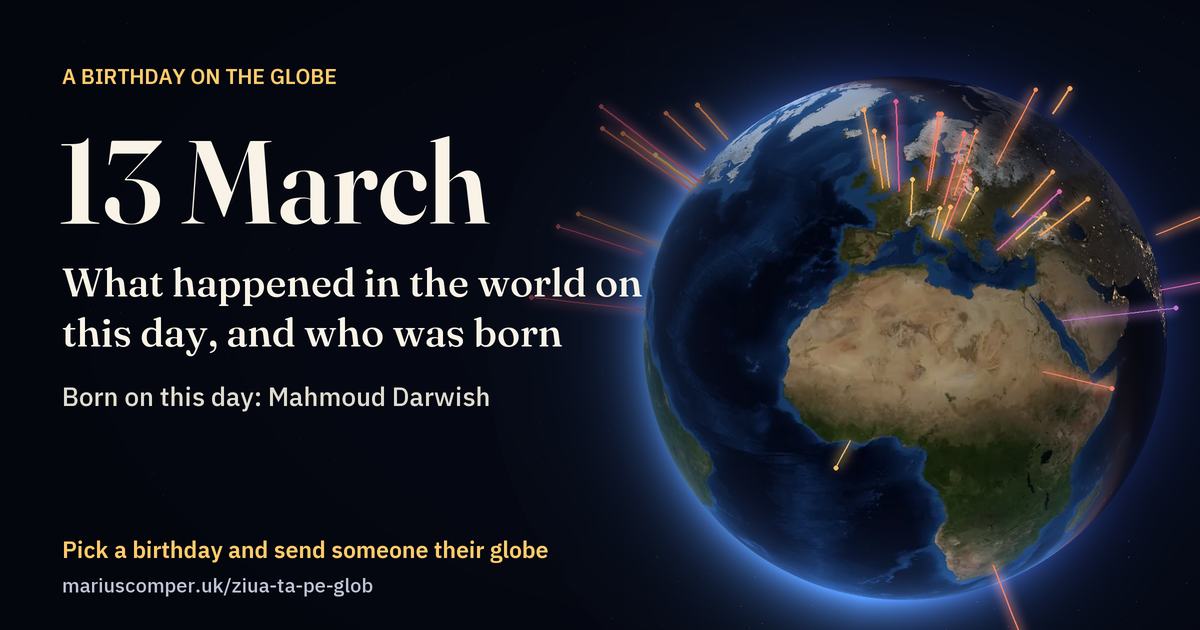
For 13 March, the English Wikipedia lists 51 events and 175 births. 36 of the events stand at their places as rays of light; one more is a dashed circle, where the sentence links only to a country or a sea. The taller the ray, the longer ago it happened. The people born that day come further down, as blue points.
A birthday, yours or someone else’s:
Turn it into a greetingScroll: the globe turns to each place
The day you were born, on the globe.
Three things from your day
Scroll: your day first, then 13 March through the years
The Earth on 13 March
The picture on the globe was assembled by NASA from satellite photographs taken in March 2004: the snow, the ice and the green are those of the month.
On 13 March the Sun passes straight overhead at noon along the parallel of 2.7° south. In London, the day lasts about 11 hours 45 minutes.
Beyond 87° south the Sun no longer sets; beyond 87° north it no longer rises.
The line between day and night is tilted on the globe exactly as on this day of the year. On the dark side you can see the lights of towns.
Britain & Ireland · Sutton Hoo
2002
The Sutton Hoo visitor centre, featuring Rick Kirby's sculpture Sutton Hoo Helmet was unveiled by Nobel laureate Seamus Heaney.
On the map: Sutton Hoo.
Europe · Leipzig
1845
Felix Mendelssohn's Violin Concerto receives its première performance in Leipzig with Ferdinand David as soloist.
On the map: Leipzig.
Also on the day’s list of Wikipedia in Spanish.
Europe · 1986 Black Sea incident
1986
Claiming the right of innocent passage, the American warships Yorktown and Caron entered Soviet territorial waters in the Black Sea.
On the map: the coordinates Wikidata gives for the article “1986 Black Sea incident”.
Europe · 2013 conclave
2013
The 2013 papal conclave elects Cardinal Jorge Mario Bergoglio taking the name Pope Francis as the 266th Pope of the Catholic Church.
On the map: the coordinates Wikidata gives for the article “2013 conclave”.
Also on the day’s list of Wikipedia in Spanish, Romanian and Chinese.
Asia · Kemalpaşa
1261
The Byzantine Empire and the Republic of Genoa sign a permanent treaty against the Venetians at Nymphaeum.
On the map: Kemalpaşa.
Asia · Aomori
1988
The Seikan Tunnel, the longest tunnel in the world with an undersea segment, opens between Aomori and Hakodate, Japan.
On the map: Aomori.
Also on the day’s list of Wikipedia in Spanish, Romanian and Chinese.
Latin America · Museum of the Revolution
1957
Cuban student revolutionaries storm the presidential palace in Havana in a failed attempt on the life of President Fulgencio Batista.
On the map: Museum of the Revolution.
Also on the day’s list of Wikipedia in Spanish.
North America · Harvard College
1639
Harvard College is named after clergyman John Harvard.
On the map: Harvard College.
Also on the day’s list of Wikipedia in Spanish.
North America · Lowell Observatory
1930
The news of the discovery of Pluto is announced by Lowell Observatory.
On the map: Lowell Observatory.
13 March
What the other Wikipedias remember#
For these years the English list has nothing on this day. The events below come from the same day’s lists on Wikipedia in Spanish and were translated for this page.
From Wikipedia in Spanish · Seville
1841
In Spain, the Seville to Cádiz railway is inaugurated.
On the map: Seville.
Translated from the list on Wikipedia in Spanish.
13 March
Born on 13 March#
The English Wikipedia lists 175 births for this day. The blue points are the birthplaces of 60 of these people: those written about in the most Wikipedia editions, where Wikidata gives a place of birth.
Born on 13 March
1942
Mahmoud Darwish, Palestinian poet and author (died 2008)
Place of birth: Al-Birwa.
Born on 13 March
1899
John Hasbrouck Van Vleck, American physicist and mathematician, Nobel Prize laureate (died 1980)
Place of birth: Middletown.
Born on 13 March
1781
Karl Friedrich Schinkel, German painter and architect, designed the Konzerthaus Berlin (died 1841)
Place of birth: Neuruppin.
Born on 13 March
1855
Percival Lowell, American astronomer and mathematician (died 1916)
Born on 13 March
1950
William H. Macy, American actor, director, and screenwriter
Place of birth: Miami.
Born in Britain and Ireland
1993
Tyrone Mings, English footballer
Place of birth: Bath.
Born in Britain and Ireland
1960
Adam Clayton, English-Irish musician and songwriter
Place of birth: Chinnor.
Born in Britain and Ireland
1975
Mark Clattenburg, English football referee
Place of birth: Consett.
13 March
Number one in the charts that week
At the cinema
An animal recorded that day
The record can be seen in GBIF, which brings together wildlife records from around the world.
All your birthdays
The weather that day
Data: Met Office Hadley Centre (HadCET); NOAA (GHCN-Daily, Mauna Loa).
Above the Earth
Sources: Jonathan McDowell, GCAT (launches); GFZ Potsdam (Kp index). Days are counted in Universal Time.
Football that day
International matches played that day:
Source: the “International football results” dataset kept by Mart Jürisoo (CC0).
Also that day
The earthquake’s page at the USGS
Source: the USGS catalogue. The day is counted in Universal Time (UTC).
In those days
Make a link for someone
Type the name, pick the day and the year of birth. The link opens straight on their day, with their name in the greeting.
The link carries the name, date and place typed here; anyone who gets it can see them.
Put another birthday beside it
Your mother’s, your child’s, a friend’s: the two days appear side by side.
Below: 13 March through the years.
The whole globe of the day
Drag the globe to turn it. Touch a ray or a point to read what happened there.
Everything Wikipedia lists for 13 March
The list is the English Wikipedia’s, in its own wording, as it stood in October 2026. 14 events have no place on the map: the sentence links to no place with coordinates, only to places too wide to mark, or to several countries.
- 222
Roman emperor Elagabalus is murdered alongside his mother, Julia Soaemias. He is replaced by his 14-year old cousin, Severus Alexander.
no place on the mapWikipedia: Elagabalus - 483
Election of Pope Felix III following the death of Pope Simplicius earlier that month.
no place on the mapWikipedia: Pope Felix III - 624
The Battle of Badr, the first major battle between the Muslims and Quraysh.
Asia · Battle of BadrWikipedia: Battle of Badr - 1261
The Byzantine Empire and the Republic of Genoa sign a permanent treaty against the Venetians at Nymphaeum.
Asia · KemalpaşaWikipedia: Treaty of Nymphaeum - 1323
Siege of Warangal: Sultan Ghiyath al-Din Tughluq sends an expeditionary army led by his son, Muhammad bin Tughluq, to the Kakatiya capital Warangal – after ruler Prataparudra has refused to make tribute payments. He besieges the city and finally, after a campaign of 8 months, Prataparudra surrenders on November 9.
Asia · Siege of WarangalWikipedia: Siege of Warangal - 1567
The Battle of Oosterweel, traditionally regarded as the start of the Eighty Years' War.
Europe · Battle of OosterweelWikipedia: Battle of Oosterweel - 1591
At the Battle of Tondibi in Mali, Moroccan forces of the Saadi dynasty, led by Judar Pasha, defeat the Songhai Empire, despite being outnumbered by at least five to one.
no place on the mapWikipedia: Battle of Tondibi - 1639
Harvard College is named after clergyman John Harvard.
North America · Harvard CollegeWikipedia: Harvard College - 1697
Nojpetén, capital of the last independent Maya kingdom, falls to Spanish conquistadors, the final step in the Spanish conquest of Guatemala.
Latin America · NojpeténWikipedia: Spanish conquest of Guatemala - 1741
The Battle of Cartagena de Indias (part of the War of Jenkins' Ear) begins.
Latin America · Battle of Cartagena de IndiasWikipedia: Battle of Cartagena de Indias - 1781
William Herschel discovers Uranus.
no place on the mapWikipedia: William Herschel - 1809
Gustav IV Adolf of Sweden is deposed in the Coup of 1809.
no place on the mapWikipedia: Gustav IV Adolf - 1811
A French and Italian fleet is defeated by a British squadron off the island of Vis in the Adriatic during the Napoleonic Wars.
Europe · Battle of LissaWikipedia: Battle of Lissa - 1815
Participants at the Congress of Vienna declare Napoleon an outlaw following his escape from Elba.
Europe · Congress of ViennaWikipedia: Congress of Vienna - 1825
Pope Leo XII publishes the apostolic constitution Quo Graviora in which he renewed the prohibition on Catholics joining freemasonry.
no place on the mapWikipedia: Pope Leo XII - 1845
Felix Mendelssohn's Violin Concerto receives its première performance in Leipzig with Ferdinand David as soloist.
Europe · LeipzigWikipedia: Felix Mendelssohn - 1848
Klemens von Metternich was forced to resign as the foreign minister of Austria following student demonstrations in Vienna.
Europe · ViennaWikipedia: Klemens von Metternich - 1848
The German revolutions of 1848–1849 begin in Vienna.
Europe · German ConfederationWikipedia: German revolutions of 1848–1849 - 1862
The Act Prohibiting the Return of Slaves is passed by the United States Congress, effectively annulling the Fugitive Slave Act of 1850 and setting the stage for the Emancipation Proclamation.
North America · United States CongressWikipedia: Emancipation Proclamation - 1884
The Siege of Khartoum begins. It lasts until January 26, 1885.
Africa · Siege of KhartoumWikipedia: Siege of Khartoum - 1888
The eruption of Ritter Island triggers tsunamis that kill up to 3,000 people on nearby islands.
Oceania · 1888 Ritter Island eruption and tsunamiWikipedia: 1888 Ritter Island eruption and tsunami - 1900
British forces occupy Bloemfontein, Orange Free State, during the Second Boer War.
Africa · BloemfonteinWikipedia: Second Boer War - 1920
The Kapp Putsch briefly ousts the Weimar Republic government from Berlin.
Europe · BerlinWikipedia: Kapp Putsch - 1930
The news of the discovery of Pluto is announced by Lowell Observatory.
North America · Lowell ObservatoryWikipedia: Pluto - 1940
The Winter War between Finland and the Soviet Union officially ends after the signing of the Moscow Peace Treaty.
Europe · Moscow Peace TreatyWikipedia: Moscow Peace Treaty - 1943
The Holocaust: German forces liquidate the Jewish ghetto in Kraków.
Europe · Kraków GhettoWikipedia: The Holocaust - 1954
The Battle of Điện Biên Phủ begins with an artillery barrage by Viet Minh forces under Võ Nguyên Giáp; Viet Minh victory led to the end of the First Indochina War and French withdrawal from Vietnam.
Asia · Battle of Dien Bien PhuWikipedia: Battle of Dien Bien Phu - 1957
Cuban student revolutionaries storm the presidential palace in Havana in a failed attempt on the life of President Fulgencio Batista.
Latin America · Museum of the RevolutionWikipedia: Cuba - 1964
Kitty Genovese is murdered in New York City, prompting research into the bystander effect due to the false story that neighbors witnessed the killing and did nothing to help her.
North America · Murder of Kitty GenoveseWikipedia: Murder of Kitty Genovese - 1969
Apollo 9 returns safely to Earth after testing the Lunar Module.
no place on the mapWikipedia: Apollo 9 - 1974
Sierra Pacific Airlines Flight 802 crashes into the White Mountains near Bishop, California, killing 36.
North America · Sierra Pacific Airlines Flight 802Wikipedia: Sierra Pacific Airlines Flight 802 - 1979
The New Jewel Movement, headed by Maurice Bishop, ousts the Prime Minister of Grenada, Eric Gairy, in a coup d'état.
no place on the mapWikipedia: New JEWEL Movement - 1985
One of England's worst incidents of football hooliganism occurred when supporters of Luton Town and Millwall rioted before a match at Kenilworth Road stadium.
Britain & Ireland · Kenilworth RoadWikipedia: 1985 Luton riot - 1986
Claiming the right of innocent passage, the American warships Yorktown and Caron entered Soviet territorial waters in the Black Sea.
Europe · 1986 Black Sea incidentWikipedia: 1986 Black Sea incident - 1988
The Seikan Tunnel, the longest tunnel in the world with an undersea segment, opens between Aomori and Hakodate, Japan.
Asia · AomoriWikipedia: Aomori - 1989
Space Shuttle Discovery launches on STS-29 carrying the TDRS-4 satellite.
no place on the mapWikipedia: Space Shuttle Discovery - 1992
The Mw 6.6 Erzincan earthquake strikes eastern Turkey with a maximum Mercalli intensity of VIII (Severe).
Asia · 1992 Erzincan earthquakeWikipedia: 1992 Erzincan earthquake - 1993
The 1993 Storm of the Century affects the eastern United States, dropping feet of snow in many areas.
no place on the mapWikipedia: 1993 Storm of the Century - 1996
The Dunblane massacre leads to the death of sixteen primary school children and one teacher in Dunblane, Scotland.
Britain & Ireland · Dunblane massacreWikipedia: Dunblane massacre - 1997
The Missionaries of Charity choose Sister Nirmala to succeed Mother Teresa as their leader.
no place on the mapWikipedia: Missionaries of Charity - 2002
The Sutton Hoo visitor centre, featuring Rick Kirby's sculpture Sutton Hoo Helmet was unveiled by Nobel laureate Seamus Heaney.
Britain & Ireland · Sutton HooWikipedia: Sutton Hoo Helmet - 2003
An article in Nature identifies the Ciampate del Diavolo as 350,000-year-old hominid footprints.
Europe · Ciampate del DiavoloWikipedia: Nature - 2004
The Filipino singer Rachelle Ann Go won the reality talent show Search for a Star, performing a cover of Mariah Carey's "Through the Rain" in the grand final.
no place on the mapWikipedia: Rachelle Ann Go - 2012
The Sierre coach crash kills 28 people, including 22 children.
Europe · Sierre coach crashWikipedia: Sierre coach crash - 2013
The 2013 papal conclave elects Cardinal Jorge Mario Bergoglio taking the name Pope Francis as the 266th Pope of the Catholic Church.
Europe · 2013 conclaveWikipedia: 2013 conclave - 2015
Serbian Army Mi-17 helicopter crashes near Belgrade airport while transporting a 5-day-old baby with respiratory problems to hospital, killing all 7 on board.
Europe · SurčinWikipedia: 2015 Belgrade helicopter crash - 2016
The Ankara bombing kills at least 37 people.
Asia · March 2016 Ankara bombingWikipedia: March 2016 Ankara bombing - 2016
Three gunmen attack two hotels in the Ivory Coast town of Grand-Bassam, killing at least 19 people.
Africa · Grand-Bassam shootingsWikipedia: Grand-Bassam shootings - 2020
Breonna Taylor is killed by police officers who were forcibly entering her home in Louisville, Kentucky; her death sparked extensive protests against racism and police brutality.
North America · Killing of Breonna TaylorWikipedia: Killing of Breonna Taylor - 2020
Katerina Sakellaropoulou is sworn in as the first female President of Greece amid strict COVID-19 measures.
no place on the mapWikipedia: COVID-19 pandemic in Greece - 2020
President Donald Trump declares the COVID-19 pandemic to be a national emergency in the United States.
no place on the mapWikipedia: COVID-19 pandemic in the United States
What the other Wikipedias remember
For these years the English list has nothing on this day. The events below come from the same day’s lists on Wikipedia in Spanish and were translated for this page.
- 1841
In Spain, the Seville to Cádiz railway is inaugurated.
Who was born on 13 March
In order of how many Wikipedia editions have an article about each. The first 60 of 175 are shown.
- 1900
Giorgos Seferis, Greek poet and diplomat, Nobel Prize laureate (died 1971)
- 1741
Joseph II, Holy Roman Emperor (died 1790)
- 1615
Innocent XII, pope of the Catholic Church (died 1700)
SpinazzolaWikipedia: Pope Innocent XII - 1942
Mahmoud Darwish, Palestinian poet and author (died 2008)
Al-BirwaWikipedia: Mahmoud Darwish - 1899
John Hasbrouck Van Vleck, American physicist and mathematician, Nobel Prize laureate (died 1980)
MiddletownWikipedia: John Hasbrouck Van Vleck - 1781
Karl Friedrich Schinkel, German painter and architect, designed the Konzerthaus Berlin (died 1841)
NeuruppinWikipedia: Karl Friedrich Schinkel - 1855
Percival Lowell, American astronomer and mathematician (died 1916)
- 1950
William H. Macy, American actor, director, and screenwriter
- 1897
Yeghishe Charents, Armenian poet and activist (died 1937)
- 1911
L. Ron Hubbard, American author, founder of Scientology (died 1986)
- 1913
Sergey Mikhalkov, Russian author and playwright (died 2009)
- 1973
Edgar Davids, Surinamese-Dutch footballer and manager
ParamariboWikipedia: Edgar Davids - 1989
Holger Badstuber, German footballer
MemmingenWikipedia: Holger Badstuber - 1989
Marko Marin, German footballer
GradiškaWikipedia: Marko Marin - 1593
Georges de La Tour, French painter (probable; (died 1652)
Vic-sur-SeilleWikipedia: Georges de La Tour - 1956
Dana Delany, American actress and producer
New York CityWikipedia: Dana Delany - 1764
Charles Grey, 2nd Earl Grey, English politician, Prime Minister of the United Kingdom (died 1845)
- 2004
Coco Gauff, American tennis player
Delray BeachWikipedia: Coco Gauff - 1942
Scatman John, American singer-songwriter (died 1999)
El MonteWikipedia: Scatman John - 1967
Andrés Escobar, Colombian footballer (died 1994)
Gilan ProvinceWikipedia: Andrés Escobar - 1995
Mikaela Shiffrin, American skier
- 1860
Hugo Wolf, Slovene-Austrian composer (died 1903)
Slovenj GradecWikipedia: Hugo Wolf - 1994
Gerard Deulofeu, Spanish footballer
RiudarenesWikipedia: Gerard Deulofeu - 1864
Alexej von Jawlensky, Russian-German painter (died 1941)
- 1985
Emile Hirsch, American actor
TopangaWikipedia: Emile Hirsch - 1888
Paul Morand, French author and diplomat (died 1976)
8th arrondissement of ParisWikipedia: Paul Morand - 1945
Anatoly Fomenko, Russian mathematician and academic
DonetskWikipedia: Anatoly Fomenko - 1916
Jacque Fresco, American engineer and academic (died 2017)
BrooklynWikipedia: Jacque Fresco - 1798
Abigail Fillmore, American wife of Millard Fillmore, 14th First Lady of the United States (died 1853)
Saratoga CountyWikipedia: Abigail Fillmore - 1939
Neil Sedaka, American singer-songwriter and pianist (died 2026)
BrooklynWikipedia: Neil Sedaka - 1993
Tyrone Mings, English footballer
- 1898
Henry Hathaway, American director and producer (died 1985)
SacramentoWikipedia: Henry Hathaway - 1955
Bruno Conti, Italian footballer and manager
NettunoWikipedia: Bruno Conti - 1960
Adam Clayton, English-Irish musician and songwriter
ChinnorWikipedia: Adam Clayton - 1720
Charles Bonnet, Swiss historian and author (died 1793)
- 1372
Louis I, Duke of Orléans (died 1407)
Hôtel Saint-PolWikipedia: Louis I, Duke of Orléans - 1899
Pancho Vladigerov, Bulgarian pianist and composer (died 1978)
- 1972
Common, American rapper and actor
ChicagoWikipedia: Common - 1946
Yonatan Netanyahu, American-Israeli colonel (died 1976)
New York CityWikipedia: Yonatan Netanyahu - 1874
Ellery Harding Clark, American jumper, coach, and lawyer (died 1949)
West RoxburyWikipedia: Ellery Harding Clark - 1884
Hugh Walpole, New Zealand-English author and educator (died 1941)
AucklandWikipedia: Hugh Walpole - 1971
Annabeth Gish, American actress
AlbuquerqueWikipedia: Annabeth Gish - 1976
Danny Masterson, American actor and producer
AlbertsonWikipedia: Danny Masterson - 1987
Andreas Beck, German footballer
KemerovoWikipedia: Andreas Beck - 1815
James Curtis Hepburn, American physician, linguist, and missionary (died 1911)
- 1956
Jamie Dimon, North-American businessman and banker
New York CityWikipedia: Jamie Dimon - 1975
Mark Clattenburg, English football referee
ConsettWikipedia: Mark Clattenburg - 1763
Guillaume Brune, French general and diplomat (died 1815)
Brive-la-GaillardeWikipedia: Guillaume Brune - 1992
George MacKay, English actor
HammersmithWikipedia: George MacKay - 1992
Ozuna, Puerto Rican singer-songwriter and rapper
San JuanWikipedia: Ozuna - 1825
Hans Gude, Norwegian-German painter and academic (died 1903)
NorwayWikipedia: Hans Gude - 1957
John Hoeven, American banker and politician, 31st Governor of North Dakota
BismarckWikipedia: John Hoeven - 1992
Lucy Fry, Australian actress
WooloowinWikipedia: Lucy Fry - 1800
Mustafa Reşid Pasha, Ottoman politician, 212th Grand Vizier of the Ottoman Empire (died 1858)
IstanbulWikipedia: Mustafa Reşid Pasha - 1973
David Draiman, American singer-songwriter
BrooklynWikipedia: David Draiman - 1998
Jack Harlow, American rapper, singer-songwriter, and actor
LouisvilleWikipedia: Jack Harlow - 1950
Charles Krauthammer, American physician, journalist, and author (died 2018)
ManhattanWikipedia: Charles Krauthammer - 1974
Thomas Enqvist, Swedish tennis player and sportscaster
StockholmWikipedia: Thomas Enqvist - 1980
Caron Butler, American basketball player
RacineWikipedia: Caron Butler - 1925
Roy Haynes, American drummer and composer (died 2024)
What is celebrated on 13 March
- Christian feast days: Ansovinus
- Christian feast days: Christina of Persia
- Christian feast days: Gerald of Mayo
- Christian feast days: James Theodore Holly (Episcopal Church (USA))
- Christian feast days: Nicephorus
- Christian feast days: Roderick
- Christian feast days: March 13 (Eastern Orthodox liturgics)
- Kasuga Matsuri (Kasuga Grand Shrine, Nara, Japan)
- National Elephant Day (Thailand)
- Africa Scout Day
A greeting link for someone
Type a name and, if you like, the year of birth. The link opens with a greeting, and beside each event it says how old the person turned that day, or how many years before their birth it happened.
The name and the year go only into the link you send.
All 366 days
How the globe is made
Where the events come from
Each edition of this page uses the day’s list from Wikipedia in its own language: Romanian, English, Spanish, Chinese. The lists are written by volunteers and differ from one edition to the next; the text of each event is Wikipedia’s, with a link to the article. A row that appears twice in a list is shown once. The lists have not been checked event by event: they are Wikipedia’s, mistakes included.
For events before 1582, and for countries that moved to the Gregorian calendar later (Britain in 1752, Russia in 1918), the same day may be counted Old Style in one list and New Style in another.
The chapter “What the other Wikipedias remember” adds up to five events a day from the lists of the other three editions, only for years in which the English list has nothing on that day. They were translated for this page, passed the same filters as the tour, and are not counted among the events of the English list.
How an event gets onto the map
The place comes from Wikidata. If the sentence links to the article about the event itself (a battle, an opening, an earthquake), dated to the same year, the ray stands on its coordinates or on those of its location. Otherwise it stands on the first place the sentence links to: a town, a building, a mountain, an island. This second step can be wrong: sometimes the sentence only mentions the place. That is why the page says, under each event, which place the ray stands on.
When the sentence links to a single state or province, or to a single sea, lake or desert larger than 5,000 km², the globe shows a dashed circle, not a ray. The circle has the area Wikidata gives, with its radius kept between 1.2° and 16°, or a radius of 4.5° when Wikidata gives no area; it says only that the sentence links to that place. Organisations, ships, spacecraft, museum objects, rivers, mountain ranges, languages and continents are never used as places. When a sentence names several states and no exact place, the event stays in the list only.
What the height means
The height of a ray shows how many years have passed, on a logarithmic scale: 10 years, 100 years and 1,000 years are equal steps apart; anything older than about 2,600 years has the tallest ray. The colour runs from pale yellow for recent years to violet for antiquity.
Where the tour stops
In each region the tour stops at up to three events (five in Britain and Ireland), chosen mainly by three things: whether Wikipedia’s editors put the event in the “On this day” box of their main page (the English, Spanish and Chinese editions), how many Wikipedia editions have an article about it, and how many of the four lists include it. Events whose sentence or article is about a war, an attack, a crime or a disaster are left out of the tour; they stay in the whole list, in Wikipedia’s wording. The filter is a list of words and a list of Wikidata types, so it can miss some.
The tour of births names the people with articles in the most editions and leaves aside those whom the list or Wikidata describes as rulers, politicians, commanders, leaders of movements or criminals; they stay in the list.
The Earth and the Sun
The daytime images are NASA’s Blue Marble Next Generation mosaics, one for each month of 2004; the night side is Black Marble 2016. The tilt of the line between day and night is computed for the day; the hour is chosen so that the place being read is in daylight. The latitude where the Sun stands overhead is the average of the four years of the leap cycle; in a given year it can differ by up to 0.4°.
The day you were born
The number ones come from the weekly lists on Wikipedia: Billboard for the United States (from 1940; the Hot 100 from August 1958), the UK Singles Chart (from November 1952), Los 40 Principales for Spain (from July 1966) and, for Romania, the Romanian Top 100 and Airplay 100 (2001–2021, with missing weeks). The page shows the chart of the week in which the day of birth falls, with its date; Billboard and the UK chart are dated at the end of their week. For Romania before 2001 and for China these sources have no weekly chart.
The films are those that reached cinemas in the United States up to ten days before or three days after that day (some of them in a few cinemas at first), from the English Wikipedia’s yearly lists (from 1968), in order of how many editions have an article about them. The events “in those days” are the ones on the neighbouring days’ lists that carry the year of birth, passed through the same filter as the tour.
The day of birth, year included
The Moon, the star sign and the constellation are worked out by the page itself, for noon Universal Time on the day. The lit part of the Moon is rounded and can differ by a few per cent from that at the hour of birth. The sign follows the usual zodiac of twelve equal parts starting at the March equinox; the constellation is the one the Sun actually stood in front of, by the borders set by the International Astronomical Union, and within a day of a border the page does not name it. When the Sun changes sign while it is that day anywhere on Earth, the page gives the moment of crossing, rounded to ten minutes and accurate to within about a quarter of an hour, and the clock time in a few cities, with the time zone and summer time of that year.
The year in the Chinese calendar is the one your device’s own calendar gives for the date, checked against the Hong Kong Observatory’s tables. “All your birthdays” uses the same sources as the rest of the chapter for the same day in every year since the birth: the temperature, well-known launches that took place on that very day, matches of the teams the edition follows, snow deeper than 10 cm and strong geomagnetic storms. The three things at the top and the four on the picture are chosen in a fixed order (the song, the animal, a full Moon, a well-known launch before an ordinary earthquake); on the picture you can change them.
When the link carries a year of birth, the page adds a few things about that exact day. The weather is the Met Office’s Central England temperature record and the readings from New York’s Central Park; the “usual high” is the average of the daily highs of 1961–1990 for that date, with two days either side. The carbon dioxide figure is the monthly mean at the Mauna Loa observatory, where measurements begin in March 1958.
The earthquake is the one with the largest magnitude in the USGS catalogue for that day, counted in Universal Time. Before the 1960s the catalogue has gaps even above magnitude 5.5, so in the older years many days have no earthquake. The page gives only the magnitude and the place: the country the epicentre falls in or, when the epicentre is at sea within 300 km of a coast, the nearest country; farther out, only the ocean.
The launches are those that reached orbit or left for the Moon and the planets, from Jonathan McDowell’s GCAT catalogue. If nothing left that day, the page shows the nearest launch within three days before or after, and says how many days away it was. The geomagnetic storm appears only when the Kp index reached at least 5 in one of the day’s eight three-hour intervals.
The animal comes from GBIF: an observation made by a person (the animal seen or heard, or its tracks), dated to that exact day, with coordinates and a CC0 or CC BY licence. Only a few hundred well-known species are searched (mammals, birds, turtles, butterflies); of those noted that day, mammals and species with articles in many Wikipedia editions come first; birds noted almost every day, and species used recently, wait their turn. Observations dated 1 January are left out, because records without a day are often filed there. An observation shows that the animal was recorded there, not how many animals there were.
The matches are those between national teams. Only matches of England, Scotland, Wales, Northern Ireland, the Republic of Ireland, the United States, Canada and Australia are shown, along with those at the big final tournaments. The picture to send is drawn in the page from the day’s globe and the facts above, and stays on your device until you send it.
Sources
- Events, births and holidays: the day’s page on Wikipedia, text under CC BY-SA 4.0.
- Coordinates, places of birth and the number of editions: Wikidata (CC0).
- The Earth by day: NASA Blue Marble Next Generation. The Earth by night: NASA Black Marble 2016.
- Borders and regions: Natural Earth.
- World population and births per year: UN World Population Prospects 2024.
- Charts and films: Wikipedia’s lists for Billboard, the UK Singles Chart, Los 40 Principales, Romanian Top 100, Airplay 100 and American films by year (CC BY-SA 4.0).
- Weather: Met Office Hadley Centre, HadCET (Open Government Licence) and NOAA GHCN-Daily, New York Central Park. Carbon dioxide: NOAA Global Monitoring Laboratory, Mauna Loa.
- Earthquakes: the USGS catalogue. Launches: Jonathan McDowell, GCAT (CC BY). Kp index: GFZ Potsdam (CC BY 4.0). Matches: International football results, Mart Jürisoo (CC0).
- Animal observations: GBIF, with a link to each record; species names come from Wikidata.