A birthday on the globe
27 March on the globe: what happened in the world on this day, and who was born
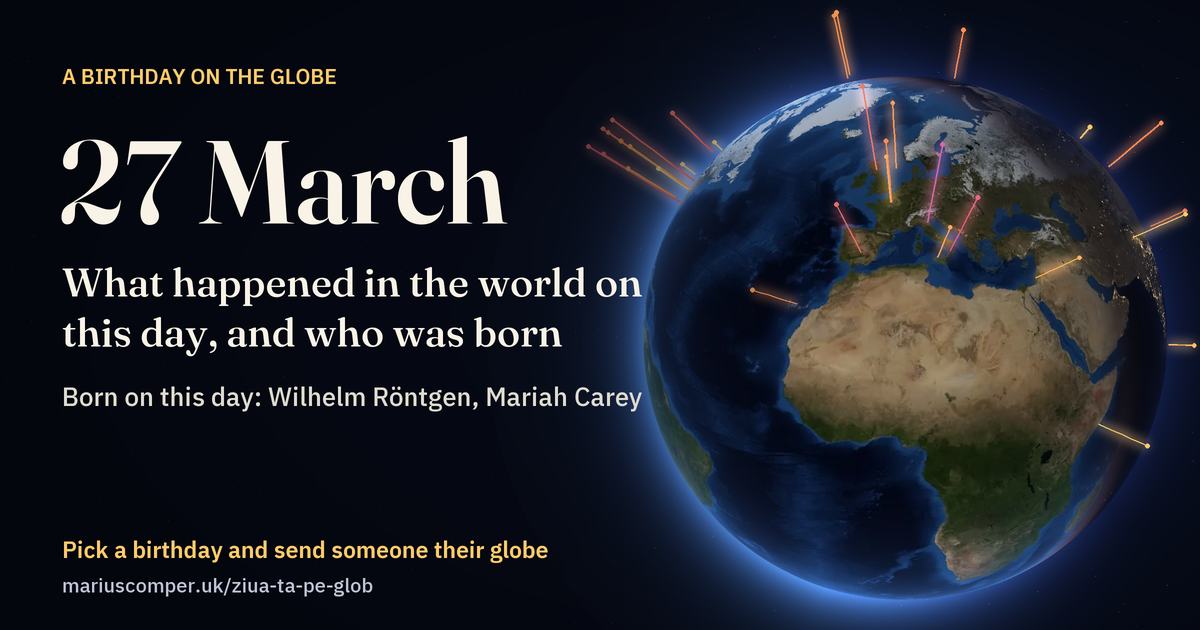
For 27 March, the English Wikipedia lists 53 events and 284 births. 32 of the events stand at their places as rays of light; six more are dashed circles, where the sentence links only to a country or a sea. The taller the ray, the longer ago it happened. The people born that day come further down, as blue points.
A birthday, yours or someone else’s:
Turn it into a greetingScroll: the globe turns to each place
The day you were born, on the globe.
Three things from your day
Scroll: your day first, then 27 March through the years
The Earth on 27 March
The picture on the globe was assembled by NASA from satellite photographs taken in March 2004: the snow, the ice and the green are those of the month.
On 27 March the Sun passes straight overhead at noon along the parallel of 2.8° north. In London, the day lasts about 12 hours 40 minutes.
Beyond 87° north the Sun no longer sets; beyond 87° south it no longer rises.
The line between day and night is tilted on the globe exactly as on this day of the year. On the dark side you can see the lights of towns.
Europe · Ferrara
1309
Pope Clement V imposes excommunication and interdiction on Venice, and a general prohibition of all commercial intercourse with Venice, which had seized Ferrara, a papal fiefdom.
On the map: Ferrara.
Also on the day’s list of Wikipedia in Spanish.
Europe · Palermo
1993
Italian former minister and Christian Democracy leader Giulio Andreotti is accused of mafia allegiance by the tribunal of Palermo.
On the map: Palermo.
Also on the day’s list of Wikipedia in Spanish.
Asia · Himeji Castle
2015
Himeji Castle, the largest and most visited Japanese castle, re-opened after five years of restoration work.
On the map: Himeji Castle.
Also on the day’s list of Wikipedia in Chinese.
North America · Trans-Alaska Pipeline System
1975
Construction of the Trans-Alaska Pipeline System begins.
On the map: Trans-Alaska Pipeline System.
Also on the day’s list of Wikipedia in Spanish.
North America · Washington Metro
1976
The first section of the Washington Metro opens to the public.
On the map: Washington Metro.
Also on the day’s list of Wikipedia in Chinese.
North America · Food and Drug Administration
1998
The Food and Drug Administration approves Viagra for use as a treatment for erectile dysfunction, the first pill to be approved for this condition in the United States.
On the map: Food and Drug Administration.
Also on the day’s list of Wikipedia in Chinese.
27 March
Born on 27 March#
The English Wikipedia lists 284 births for this day. The blue points are the birthplaces of 60 of these people: those written about in the most Wikipedia editions, where Wikidata gives a place of birth.
Born on 27 March
1845
Wilhelm Röntgen, German physicist and academic, Nobel Prize laureate (died 1923)
Place of birth: Lennep.
Born on 27 March
1969
Mariah Carey, American singer-songwriter, producer, and actress
Place of birth: Huntington.
Born on 27 March
1963
Quentin Tarantino, American director, producer, screenwriter and actor
Place of birth: Knoxville.
Born on 27 March
1986
Manuel Neuer, German footballer
Place of birth: Gelsenkirchen.
Born on 27 March
1899
Gloria Swanson, American actress and producer (died 1983)
Place of birth: Chicago.
Born in Britain and Ireland
1988
Jessie J, English singer-songwriter
Place of birth: Chadwell Heath.
Born in Britain and Ireland
1971
David Coulthard, Scottish race car driver and sportscaster
Place of birth: Twynholm.
Born in Britain and Ireland
1857
Karl Pearson, English mathematician, eugenicist, and academic (died 1936)
Place of birth: London.
27 March
Number one in the charts that week
At the cinema
An animal recorded that day
The record can be seen in GBIF, which brings together wildlife records from around the world.
All your birthdays
The weather that day
Data: Met Office Hadley Centre (HadCET); NOAA (GHCN-Daily, Mauna Loa).
Above the Earth
Sources: Jonathan McDowell, GCAT (launches); GFZ Potsdam (Kp index). Days are counted in Universal Time.
Football that day
International matches played that day:
Source: the “International football results” dataset kept by Mart Jürisoo (CC0).
Also that day
The earthquake’s page at the USGS
Source: the USGS catalogue. The day is counted in Universal Time (UTC).
In those days
Make a link for someone
Type the name, pick the day and the year of birth. The link opens straight on their day, with their name in the greeting.
The link carries the name, date and place typed here; anyone who gets it can see them.
Put another birthday beside it
Your mother’s, your child’s, a friend’s: the two days appear side by side.
Below: 27 March through the years.
The whole globe of the day
Drag the globe to turn it. Touch a ray or a point to read what happened there.
Everything Wikipedia lists for 27 March
The list is the English Wikipedia’s, in its own wording, as it stood in October 2026. 15 events have no place on the map: the sentence links to no place with coordinates, only to places too wide to mark, or to several countries.
- 1309
Pope Clement V imposes excommunication and interdiction on Venice, and a general prohibition of all commercial intercourse with Venice, which had seized Ferrara, a papal fiefdom.
Europe · FerraraWikipedia: Pope Clement V - 1329
Pope John XXII issues his In Agro Dominico condemning some writings of Meister Eckhart as heretical.
no place on the mapWikipedia: Pope John XXII - 1513
Spanish explorer Juan Ponce de León reaches the northern end of The Bahamas on his first voyage to Florida.
no place on the mapWikipedia: Juan Ponce de León - 1625
Charles I becomes King of England, Scotland and Ireland as well as claiming the title King of France.
no place on the mapWikipedia: Charles I of England - 1638
The first of four destructive Calabrian earthquakes strikes southern Italy. Measuring magnitude 6.8 and assigned a Mercalli intensity of XI, it kills 10,000–30,000 people.
Europe · 1638 Calabrian earthquakesWikipedia: 1638 Calabrian earthquakes - 1782
The Second Rockingham ministry assumes office in Great Britain and begins negotiations to end the American War of Independence.
Britain & Ireland · Kingdom of Great BritainWikipedia: American Revolutionary War - 1794
The United States Government establishes a permanent navy and authorizes the building of six frigates.
no place on the mapWikipedia: United States Navy - 1809
Peninsular War: A combined Franco-Polish force defeats the Spanish in the Battle of Ciudad Real.
Europe · Battle of Ciudad RealWikipedia: Battle of Ciudad Real - 1814
War of 1812: In central Alabama, U.S. forces under General Andrew Jackson defeat the Creek at the Battle of Horseshoe Bend.
North America · Battle of Horseshoe BendWikipedia: Battle of Horseshoe Bend - 1836
Texas Revolution: On the orders of General Antonio López de Santa Anna, the Mexican Army massacres 342 Texian Army POWs at Goliad, Texas.
North America · Goliad massacreWikipedia: Goliad massacre - 1850
San Diego, the first European settlement in present-day California, was incorporated as a city.
North America · San DiegoWikipedia: San Diego - 1866
President of the United States of America Andrew Johnson vetoes the Civil Rights Act of 1866. His veto is overridden by Congress and the bill passes into law on April 9.
North America · United States CongressWikipedia: United States Congress - 1871
The first international rugby football match, when Scotland defeats England in Edinburgh at Raeburn Place.
Britain & Ireland · Raeburn PlaceWikipedia: 1871 Scotland versus England rugby union match - 1884
A mob in Cincinnati, Ohio, United States attacks members of a jury which had returned a verdict of manslaughter in what was seen as a clear case of murder; over the next few days the mob would riot and burn down the courthouse.
North America · CincinnatiWikipedia: Cincinnati riots of 1884 - 1886
Geronimo, Apache warrior, surrenders to the U.S. Army, ending the main phase of the Apache Wars.
no place on the mapWikipedia: Apache Wars - 1899
Emilio Aguinaldo leads Filipino forces for the only time during the Philippine–American War at the Battle of Marilao River.
Asia · Battle of Marilao RiverWikipedia: Battle of Marilao River - 1901
Philippine–American War: Emilio Aguinaldo, leader of the First Philippine Republic, is captured by the Americans.
no place on the mapWikipedia: Philippine–American War - 1912
First Lady Helen Taft and the Viscountess Chinda, wife of the Japanese ambassador, plant two Yoshino cherry trees on the northern bank of the Potomac River in Washington, D.C., the origin of the National Cherry Blossom Festival.
North America · Washington, D.C.Wikipedia: National Cherry Blossom Festival - 1915
Typhoid Mary, the first healthy carrier of disease ever identified in the United States, is put in quarantine for the second time, where she would remain for the rest of her life.
no place on the mapWikipedia: Mary Mallon - 1918
The National Council of Bessarabia proclaims union with the Kingdom of Romania.
Europe · Kingdom of RomaniaWikipedia: Union of Bessarabia with Romania - 1933
Japanese invasion of Manchuria: Japan leaves the League of Nations after it approves the Lytton Report that ruled in favour of China.
no place on the mapWikipedia: Japanese invasion of Manchuria - 1938
Second Sino-Japanese War: The Battle of Taierzhuang begins, resulting several weeks later in the war's first major Chinese victory over Japan.
Asia · Battle of TaierzhuangWikipedia: Second Sino-Japanese War - 1941
World War II: Yugoslav Air Force officers topple the pro-Axis government in a bloodless coup.
no place on the mapWikipedia: Yugoslav coup d'état - 1942
The Holocaust: Nazi Germany and Vichy France begin the deportation of 65,000 Jews from Drancy internment camp to German extermination camps.
Europe · Drancy internment campWikipedia: The Holocaust - 1943
World War II: Battle of the Komandorski Islands: In the Aleutian Islands the battle begins when United States Navy forces intercept Japanese attempting to reinforce a garrison at Kiska.
Asia · Battle of the Komandorski IslandsWikipedia: Battle of the Komandorski Islands - 1945
World War II: Operation Starvation, the aerial mining of Japan's ports and waterways begins. Argentina declares war on the Axis Powers.
Asia · JapanWikipedia: Operation Starvation - 1958
Nikita Khrushchev becomes Chairman of the Council of Ministers of the Soviet Union.
no place on the mapWikipedia: Nikita Khrushchev - 1964
The Good Friday earthquake, the most powerful earthquake recorded in North American history at a magnitude of 9.2 strikes Southcentral Alaska, killing 125 people and inflicting massive damage to the city of Anchorage.
North America · 1964 Alaska earthquakeWikipedia: 1964 Alaska earthquake - 1975
Construction of the Trans-Alaska Pipeline System begins.
North America · Trans-Alaska Pipeline SystemWikipedia: Trans-Alaska Pipeline System - 1976
The first section of the Washington Metro opens to the public.
North America · Washington MetroWikipedia: Washington Metro - 1977
Tenerife airport disaster: Two Boeing 747 airliners collide on a foggy runway on Tenerife in the Canary Islands, killing 583 (all 248 on KLM and 335 on Pan Am). Sixty-one survived on the Pan Am flight. This is the deadliest aviation accident in history.
Europe · Tenerife airport disasterWikipedia: Tenerife airport disaster - 1980
Brothers Nelson Bunker Hunt and William Herbert Hunt failed in their attempt to corner the world silver market, causing panic in commodity and futures exchanges.
no place on the mapWikipedia: Nelson Bunker Hunt - 1980
The Norwegian oil platform Alexander L. Kielland collapses in the North Sea, killing 123 of its crew of 212.
Oceans · Alexander L. KiellandWikipedia: Alexander L. Kielland - 1981
The Solidarity movement in Poland stages a warning strike, in which at least 12 million Poles walk off their jobs for four hours.
no place on the mapWikipedia: 1981 warning strike in Poland - 1986
A car bomb explodes outside Russell Street Police HQ in Melbourne, Australia, killing one police officer and injuring 21 people.
Oceania · Russell Street bombingWikipedia: Russell Street bombing - 1990
The United States begins broadcasting anti-Castro propaganda to Cuba on TV Martí.
Latin America · CubaWikipedia: Cuban dissident movement - 1993
Italian former minister and Christian Democracy leader Giulio Andreotti is accused of mafia allegiance by the tribunal of Palermo.
Europe · PalermoWikipedia: Christian Democracy - 1993
Jiang Zemin is appointed President of China.
no place on the mapWikipedia: Jiang Zemin - 1998
The Food and Drug Administration approves Viagra for use as a treatment for erectile dysfunction, the first pill to be approved for this condition in the United States.
North America · Food and Drug AdministrationWikipedia: Food and Drug Administration - 1999
Kosovo War: An American Lockheed F-117A Nighthawk is shot down by a Yugoslav Army SAM, the first and only Nighthawk to be lost in combat.
no place on the mapWikipedia: Kosovo War - 2000
A Phillips Petroleum plant explosion in Pasadena, Texas kills one person and injures 71 others.
North America · 2000 Phillips explosionWikipedia: 2000 Phillips explosion - 2002
Nanterre massacre: In Nanterre, France, a gunman opens fire at the end of a town council meeting, resulting in the deaths of eight councilors; 19 other people are injured.
Europe · Nanterre massacreWikipedia: Nanterre massacre - 2002
Passover massacre: A Palestinian suicide bomber kills 29 people at a Passover seder in Netanya, Israel.
Asia · Passover massacreWikipedia: Passover massacre - 2004
HMS Scylla, a decommissioned Leander-class frigate, is sunk as an artificial reef off Cornwall, the first of its kind in Europe.
Britain & Ireland · CornwallWikipedia: HMS Scylla - 2009
The dam forming Situ Gintung, an artificial lake in Indonesia, fails, killing at least 99 people.
Asia · Situ GintungWikipedia: Situ Gintung - 2014
Philippines signs a peace accord with the largest Muslim rebel group, the Moro Islamic Liberation Front, ending decades of conflict.
no place on the mapWikipedia: Moro conflict - 2015
Al-Shabab militants attack and temporarily occupy a Mogadishu hotel leaving at least 20 people dead.
Africa · 2015 Makka al-Mukarama hotel attackWikipedia: 2015 Makka al-Mukarama hotel attack - 2015
Himeji Castle, the largest and most visited Japanese castle, re-opened after five years of restoration work.
Asia · Himeji CastleWikipedia: Himeji Castle - 2016
A suicide blast in Gulshan-e-Iqbal Park, Lahore claims over 70 lives and leaves almost 300 others injured. The target of the bombing are Christians celebrating Easter.
Asia · 2016 Lahore suicide bombingWikipedia: 2016 Lahore suicide bombing - 2020
North Macedonia becomes the 30th member of NATO.
Europe · North MacedoniaWikipedia: NATO - 2022
At the 94th Academy Awards, Will Smith slapped Chris Rock onstage resulting in Smith being expelled from the Academy of Motion Picture Arts and Sciences and banned from its events for ten years.
North America · Dolby TheatreWikipedia: 94th Academy Awards - 2023
Forty people are killed in a fire at a migrant detention facility in Ciudad Juárez, Mexico.
Latin America · Ciudad Juárez migrant center fireWikipedia: Ciudad Juárez migrant center fire - 2023
Seven people, including the perpetrator, are killed in a mass shooting at the Covenant School in Nashville, Tennessee.
North America · 2023 Nashville school shootingWikipedia: 2023 Nashville school shooting
Who was born on 27 March
In order of how many Wikipedia editions have an article about each. The first 60 of 284 are shown.
- 1845
Wilhelm Röntgen, German physicist and academic, Nobel Prize laureate (died 1923)
- 1969
Mariah Carey, American singer-songwriter, producer, and actress
HuntingtonWikipedia: Mariah Carey - 1963
Quentin Tarantino, American director, producer, screenwriter and actor
KnoxvilleWikipedia: Quentin Tarantino - 1955
Mariano Rajoy, Spanish lawyer and politician, Prime Minister of Spain
Santiago de CompostelaWikipedia: Mariano Rajoy - 1986
Manuel Neuer, German footballer
GelsenkirchenWikipedia: Manuel Neuer - 1912
James Callaghan, English lieutenant and politician, Prime Minister of the United Kingdom (died 2005)
- 1899
Gloria Swanson, American actress and producer (died 1983)
ChicagoWikipedia: Gloria Swanson - 1886
Ludwig Mies van der Rohe, German-American architect, designed IBM Plaza and Seagram Building (died 1969)
- 1871
Heinrich Mann, German author and poet (died 1950)
LübeckWikipedia: Heinrich Mann - 1901
Eisaku Satō, Japanese politician, Prime Minister of Japan, Nobel Prize laureate (died 1975)
TabuseWikipedia: Eisaku Satō - 1997
Lisa, Thai rapper and dancer
Buri RamWikipedia: Lisa - 1797
Alfred de Vigny, French author, poet, and playwright (died 1863)
- 1975
Fergie, American singer-songwriter, dancer, and actress
WhittierWikipedia: Fergie - 1847
Otto Wallach, German chemist and academic, Nobel Prize laureate (died 1931)
KönigsbergWikipedia: Otto Wallach - 1886
Sergey Kirov, Russian politician (died 1934)
UrzhumWikipedia: Sergei Kirov - 1927
Mstislav Rostropovich, Russian cellist and conductor (died 2007)
- 1988
Jessie J, English singer-songwriter
Chadwell HeathWikipedia: Jessie J - 1941
Ivan Gašparovič, Slovak lawyer and politician, 3rd President of Slovakia
- 1988
Atsuto Uchida, Japanese footballer
KannamiWikipedia: Atsuto Uchida - 1785
Louis XVII of France (died 1795)
VersaillesWikipedia: Louis XVII - 1981
Cacau, Brazilian-German footballer
São PauloWikipedia: Cacau - 1971
David Coulthard, Scottish race car driver and sportscaster
TwynholmWikipedia: David Coulthard - 1987
Polina Gagarina, Russian singer-songwriter
- 1988
Brenda Song, American actress
CarmichaelWikipedia: Brenda Song - 1809
Georges-Eugène Haussmann, French engineer, urban planner, and politician (died 1891)
- 1971
Nathan Fillion, Canadian actor
EdmontonWikipedia: Nathan Fillion - 1857
Karl Pearson, English mathematician, eugenicist, and academic (died 1936)
LondonWikipedia: Karl Pearson - 1942
John Sulston, English biologist and academic, Nobel Prize laureate (died 2018)
FulmerWikipedia: John Sulston - 1952
Maria Schneider, French actress (died 2011)
15th arrondissement of ParisWikipedia: Maria Schneider - 1970
Elizabeth Mitchell, American actress
Los AngelesWikipedia: Elizabeth Mitchell - 1893
Karl Mannheim, Hungarian-English sociologist and academic (died 1947)
BudapestWikipedia: Karl Mannheim - 1746
Carlo Buonaparte, Corsican-French lawyer and politician (died 1785)
AjaccioWikipedia: Carlo Buonaparte - 1883
Marie Under, Estonian author and poet (died 1980)
TallinnWikipedia: Marie Under - 1924
Sarah Vaughan, American singer (died 1990)
NewarkWikipedia: Sarah Vaughan - 1901
Carl Barks, American illustrator and screenwriter (died 2000)
OregonWikipedia: Carl Barks - 1923
Shūsaku Endō, Japanese author (died 1996)
NishisugamoWikipedia: Shūsaku Endō - 1974
Gaizka Mendieta, Spanish footballer
- 1972
Jimmy Floyd Hasselbaink, Surinamese-Dutch footballer, coach, and manager
ParamariboWikipedia: Jimmy Floyd Hasselbaink - 1676
Francis II Rákóczi, Hungarian prince (died 1735)
- 1942
Michael York, English actor
FulmerWikipedia: Michael York - 1863
Henry Royce, English engineer and businessman, founded Rolls-Royce Limited (died 1933)
HuntingdonshireWikipedia: Henry Royce - 1957
Stephen Dillane, English actor
KensingtonWikipedia: Stephen Dillane - 1963
Xuxa, Brazilian actress, singer, businesswoman and television presenter
Santa RosaWikipedia: Xuxa - 1985
Ram Charan, Indian actor
ChennaiWikipedia: Ram Charan - 1917
Cyrus Vance, American lawyer and politician, 57th United States Secretary of State (died 2002)
ClarksburgWikipedia: Cyrus Vance - 1990
Nicolas Nkoulou, Cameroonian footballer
YaoundéWikipedia: Nicolas Nkoulou - 1909
Golo Mann, German historian and author (died 1994)
MunichWikipedia: Golo Mann - 1952
Annemarie Moser-Pröll, Austrian skier
KleinarlWikipedia: Annemarie Moser-Pröll - 2000
Halle Bailey, American singer-songwriter and actress
AtlantaWikipedia: Halle Bailey - 1416
Francis of Paola, Italian friar and saint, founded Order of the Minims (died 1507)
- 1985
Danny Vukovic, Australian footballer
SydneyWikipedia: Danny Vukovic - 1851
Vincent d'Indy, French composer and educator (died 1931)
10ᵗʰ arrondissement of ParisWikipedia: Vincent d'Indy - 1984
Brett Holman, Australian footballer
BankstownWikipedia: Brett Holman - 1929
Anne Ramsey, American actress (died 1988)
- 1784
Sándor Kőrösi Csoma, Hungarian philologist, orientalist, and author (died 1842)
- 1822
Henri Murger, French novelist and poet (died 1861)
former 2nd arrondissement of ParisWikipedia: Henri Murger - 1879
Edward Steichen, Luxembourger-American painter and photographer (died 1973)
BivangeWikipedia: Edward Steichen - 1935
Julian Glover, English actor
HampsteadWikipedia: Julian Glover - 1969
Pauley Perrette, American actress
New OrleansWikipedia: Pauley Perrette - 1970
Leila Pahlavi, Princess of Iran (died 2001)
TehranWikipedia: Leila Pahlavi
What is celebrated on 27 March
- Christian feast day: Easter (Palmarian Church)
- Christian feast day: Alexander, a Pannonian soldier, martyred in 3rd century.
- Christian feast day: Amador of Portugal
- Christian feast day: Augusta of Treviso
- Christian feast day: Charles Henry Brent (Episcopal Church (USA))
- Christian feast day: Gelasius, Archbishop of Armagh
- Christian feast day: John of Egypt
- Christian feast day: Panacea De' Muzzi
- Christian feast day: Philetus
- Christian feast day: Romulus of Nîmes, a Benedictine abbot, martyred c. 730.
- Christian feast day: Rupert of Salzburg
- Christian feast day: Zanitas and Lazarus of Persia
- Christian feast day: March 27 (Eastern Orthodox liturgics)
- Armed Forces Day (Myanmar)
A greeting link for someone
Type a name and, if you like, the year of birth. The link opens with a greeting, and beside each event it says how old the person turned that day, or how many years before their birth it happened.
The name and the year go only into the link you send.
All 366 days
How the globe is made
Where the events come from
Each edition of this page uses the day’s list from Wikipedia in its own language: Romanian, English, Spanish, Chinese. The lists are written by volunteers and differ from one edition to the next; the text of each event is Wikipedia’s, with a link to the article. A row that appears twice in a list is shown once. The lists have not been checked event by event: they are Wikipedia’s, mistakes included.
For events before 1582, and for countries that moved to the Gregorian calendar later (Britain in 1752, Russia in 1918), the same day may be counted Old Style in one list and New Style in another.
The chapter “What the other Wikipedias remember” adds up to five events a day from the lists of the other three editions, only for years in which the English list has nothing on that day. They were translated for this page, passed the same filters as the tour, and are not counted among the events of the English list.
How an event gets onto the map
The place comes from Wikidata. If the sentence links to the article about the event itself (a battle, an opening, an earthquake), dated to the same year, the ray stands on its coordinates or on those of its location. Otherwise it stands on the first place the sentence links to: a town, a building, a mountain, an island. This second step can be wrong: sometimes the sentence only mentions the place. That is why the page says, under each event, which place the ray stands on.
When the sentence links to a single state or province, or to a single sea, lake or desert larger than 5,000 km², the globe shows a dashed circle, not a ray. The circle has the area Wikidata gives, with its radius kept between 1.2° and 16°, or a radius of 4.5° when Wikidata gives no area; it says only that the sentence links to that place. Organisations, ships, spacecraft, museum objects, rivers, mountain ranges, languages and continents are never used as places. When a sentence names several states and no exact place, the event stays in the list only.
What the height means
The height of a ray shows how many years have passed, on a logarithmic scale: 10 years, 100 years and 1,000 years are equal steps apart; anything older than about 2,600 years has the tallest ray. The colour runs from pale yellow for recent years to violet for antiquity.
Where the tour stops
In each region the tour stops at up to three events (five in Britain and Ireland), chosen mainly by three things: whether Wikipedia’s editors put the event in the “On this day” box of their main page (the English, Spanish and Chinese editions), how many Wikipedia editions have an article about it, and how many of the four lists include it. Events whose sentence or article is about a war, an attack, a crime or a disaster are left out of the tour; they stay in the whole list, in Wikipedia’s wording. The filter is a list of words and a list of Wikidata types, so it can miss some.
The tour of births names the people with articles in the most editions and leaves aside those whom the list or Wikidata describes as rulers, politicians, commanders, leaders of movements or criminals; they stay in the list.
The Earth and the Sun
The daytime images are NASA’s Blue Marble Next Generation mosaics, one for each month of 2004; the night side is Black Marble 2016. The tilt of the line between day and night is computed for the day; the hour is chosen so that the place being read is in daylight. The latitude where the Sun stands overhead is the average of the four years of the leap cycle; in a given year it can differ by up to 0.4°.
The day you were born
The number ones come from the weekly lists on Wikipedia: Billboard for the United States (from 1940; the Hot 100 from August 1958), the UK Singles Chart (from November 1952), Los 40 Principales for Spain (from July 1966) and, for Romania, the Romanian Top 100 and Airplay 100 (2001–2021, with missing weeks). The page shows the chart of the week in which the day of birth falls, with its date; Billboard and the UK chart are dated at the end of their week. For Romania before 2001 and for China these sources have no weekly chart.
The films are those that reached cinemas in the United States up to ten days before or three days after that day (some of them in a few cinemas at first), from the English Wikipedia’s yearly lists (from 1968), in order of how many editions have an article about them. The events “in those days” are the ones on the neighbouring days’ lists that carry the year of birth, passed through the same filter as the tour.
The day of birth, year included
The Moon, the star sign and the constellation are worked out by the page itself, for noon Universal Time on the day. The lit part of the Moon is rounded and can differ by a few per cent from that at the hour of birth. The sign follows the usual zodiac of twelve equal parts starting at the March equinox; the constellation is the one the Sun actually stood in front of, by the borders set by the International Astronomical Union, and within a day of a border the page does not name it. When the Sun changes sign while it is that day anywhere on Earth, the page gives the moment of crossing, rounded to ten minutes and accurate to within about a quarter of an hour, and the clock time in a few cities, with the time zone and summer time of that year.
The year in the Chinese calendar is the one your device’s own calendar gives for the date, checked against the Hong Kong Observatory’s tables. “All your birthdays” uses the same sources as the rest of the chapter for the same day in every year since the birth: the temperature, well-known launches that took place on that very day, matches of the teams the edition follows, snow deeper than 10 cm and strong geomagnetic storms. The three things at the top and the four on the picture are chosen in a fixed order (the song, the animal, a full Moon, a well-known launch before an ordinary earthquake); on the picture you can change them.
When the link carries a year of birth, the page adds a few things about that exact day. The weather is the Met Office’s Central England temperature record and the readings from New York’s Central Park; the “usual high” is the average of the daily highs of 1961–1990 for that date, with two days either side. The carbon dioxide figure is the monthly mean at the Mauna Loa observatory, where measurements begin in March 1958.
The earthquake is the one with the largest magnitude in the USGS catalogue for that day, counted in Universal Time. Before the 1960s the catalogue has gaps even above magnitude 5.5, so in the older years many days have no earthquake. The page gives only the magnitude and the place: the country the epicentre falls in or, when the epicentre is at sea within 300 km of a coast, the nearest country; farther out, only the ocean.
The launches are those that reached orbit or left for the Moon and the planets, from Jonathan McDowell’s GCAT catalogue. If nothing left that day, the page shows the nearest launch within three days before or after, and says how many days away it was. The geomagnetic storm appears only when the Kp index reached at least 5 in one of the day’s eight three-hour intervals.
The animal comes from GBIF: an observation made by a person (the animal seen or heard, or its tracks), dated to that exact day, with coordinates and a CC0 or CC BY licence. Only a few hundred well-known species are searched (mammals, birds, turtles, butterflies); of those noted that day, mammals and species with articles in many Wikipedia editions come first; birds noted almost every day, and species used recently, wait their turn. Observations dated 1 January are left out, because records without a day are often filed there. An observation shows that the animal was recorded there, not how many animals there were.
The matches are those between national teams. Only matches of England, Scotland, Wales, Northern Ireland, the Republic of Ireland, the United States, Canada and Australia are shown, along with those at the big final tournaments. The picture to send is drawn in the page from the day’s globe and the facts above, and stays on your device until you send it.
Sources
- Events, births and holidays: the day’s page on Wikipedia, text under CC BY-SA 4.0.
- Coordinates, places of birth and the number of editions: Wikidata (CC0).
- The Earth by day: NASA Blue Marble Next Generation. The Earth by night: NASA Black Marble 2016.
- Borders and regions: Natural Earth.
- World population and births per year: UN World Population Prospects 2024.
- Charts and films: Wikipedia’s lists for Billboard, the UK Singles Chart, Los 40 Principales, Romanian Top 100, Airplay 100 and American films by year (CC BY-SA 4.0).
- Weather: Met Office Hadley Centre, HadCET (Open Government Licence) and NOAA GHCN-Daily, New York Central Park. Carbon dioxide: NOAA Global Monitoring Laboratory, Mauna Loa.
- Earthquakes: the USGS catalogue. Launches: Jonathan McDowell, GCAT (CC BY). Kp index: GFZ Potsdam (CC BY 4.0). Matches: International football results, Mart Jürisoo (CC0).
- Animal observations: GBIF, with a link to each record; species names come from Wikidata.