A birthday on the globe
17 February on the globe: what happened in the world on this day, and who was born
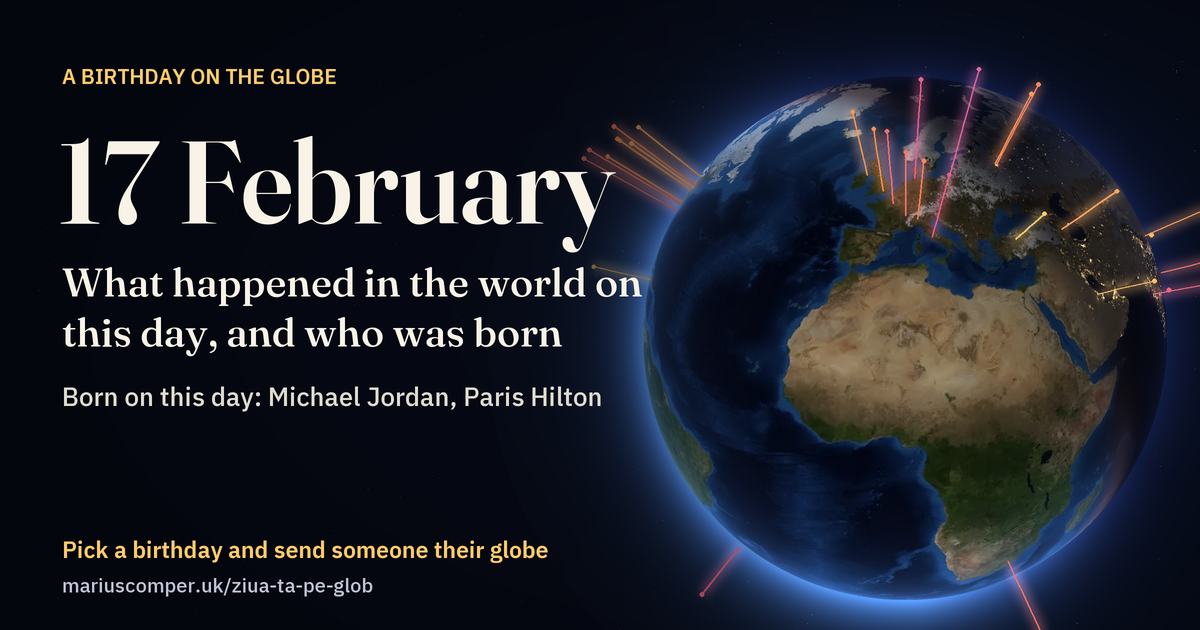
For 17 February, the English Wikipedia lists 54 events and 176 births. 32 of the events stand at their places as rays of light; four more are dashed circles, where the sentence links only to a country or a sea. The taller the ray, the longer ago it happened. The people born that day come further down, as blue points.
A birthday, yours or someone else’s:
Turn it into a greetingScroll: the globe turns to each place
The day you were born, on the globe.
Three things from your day
Scroll: your day first, then 17 February through the years
The Earth on 17 February
The picture on the globe was assembled by NASA from satellite photographs taken in February 2004: the snow, the ice and the green are those of the month.
On 17 February the Sun passes straight overhead at noon along the parallel of 12.1° south. In London, the day lasts about 10 hours 5 minutes.
Beyond 78° south the Sun no longer sets; beyond 78° north it no longer rises.
The line between day and night is tilted on the globe exactly as on this day of the year. On the dark side you can see the lights of towns.
Europe · La Scala
1904
Italian composer Giacomo Puccini's Madama Butterfly premiered at La Scala in Milan to poor reviews, forcing him to revise the opera.
On the map: La Scala.
Also on the day’s list of Wikipedia in Spanish and Chinese.
Asia · Mount Everest
1980
First winter ascent of Mount Everest by Krzysztof Wielicki and Leszek Cichy.
On the map: Mount Everest.
Also on the day’s list of Wikipedia in Romanian.
Latin America · Evangelistas Islets
1676
Sixteen men of Pascual de Iriate's expedition are lost at Evangelistas Islets at the western end of the Strait of Magellan.
On the map: Evangelistas Islets.
North America · Armory Show
1913
The Armory Show opens in New York City, displaying works of artists who subsequently become some of the most influential painters of the early 20th century.
On the map: Armory Show.
North America · Supreme Court of the United States
1964
In Wesberry v. Sanders the Supreme Court of the United States rules that congressional districts have to be approximately equal in population.
On the map: Supreme Court of the United States.
North America · Philadelphia
1996
In Philadelphia, world champion Garry Kasparov beats the Deep Blue supercomputer in a chess match.
On the map: Philadelphia.
17 February
What the other Wikipedias remember#
For these years the English list has nothing on this day. The events below come from the same day’s lists on Wikipedia in Romanian and were translated for this page.
From Wikipedia in Romanian · Brussels metropolitan area
1993
The President of Romania, Ion Iliescu, pays an official visit to NATO headquarters in Brussels.
On the map: Brussels metropolitan area.
Translated from the list on Wikipedia in Romanian.
17 February
Born on 17 February#
The English Wikipedia lists 176 births for this day. The blue points are the birthplaces of 60 of these people: those written about in the most Wikipedia editions, where Wikidata gives a place of birth.
Born on 17 February
1963
Michael Jordan, American basketball player, executive, and businessman
Place of birth: Brooklyn.
Born on 17 February
1981
Paris Hilton, American model, media personality, actress, singer, DJ, author and businesswoman
Place of birth: New York City.
Born on 17 February
1955
Mo Yan, Chinese author and academic, Nobel Prize laureate
Place of birth: Gaomi.
Born on 17 February
1991
Ed Sheeran, English singer-songwriter, guitarist, and producer
Place of birth: Royal Halifax Infirmary.
Born on 17 February
1925
Hal Holbrook, American actor and director (died 2021)
Place of birth: Cleveland.
Born in Britain and Ireland
1890
Ronald Fisher, English-Australian statistician, biologist, and geneticist (died 1962)
Place of birth: East Finchley.
Born in Britain and Ireland
1991
Bonnie Wright, English actress, filmmaker, and activist
Place of birth: London.
Born in Britain and Ireland
1970
Dominic Purcell, English-Australian actor and producer
Place of birth: Wallasey.
17 February
Number one in the charts that week
At the cinema
An animal recorded that day
The record can be seen in GBIF, which brings together wildlife records from around the world.
All your birthdays
The weather that day
Data: Met Office Hadley Centre (HadCET); NOAA (GHCN-Daily, Mauna Loa).
Above the Earth
Sources: Jonathan McDowell, GCAT (launches); GFZ Potsdam (Kp index). Days are counted in Universal Time.
Football that day
International matches played that day:
Source: the “International football results” dataset kept by Mart Jürisoo (CC0).
Also that day
The earthquake’s page at the USGS
Source: the USGS catalogue. The day is counted in Universal Time (UTC).
In those days
Make a link for someone
Type the name, pick the day and the year of birth. The link opens straight on their day, with their name in the greeting.
The link carries the name, date and place typed here; anyone who gets it can see them.
Put another birthday beside it
Your mother’s, your child’s, a friend’s: the two days appear side by side.
Below: 17 February through the years.
The whole globe of the day
Drag the globe to turn it. Touch a ray or a point to read what happened there.
Everything Wikipedia lists for 17 February
The list is the English Wikipedia’s, in its own wording, as it stood in October 2026. 18 events have no place on the map: the sentence links to no place with coordinates, only to places too wide to mark, or to several countries.
- 1370
Northern Crusades: Grand Duchy of Lithuania and the Teutonic Knights meet in the Battle of Rudau.
Europe · Battle of RudauWikipedia: Battle of Rudau - 1411
Following the successful campaigns during the Ottoman Interregnum, Musa Çelebi, one of the sons of Bayezid I, becomes Sultan of the Ottoman Empire with the support of Mircea I of Wallachia.
Asia · Ottoman EmpireWikipedia: Ottoman Interregnum - 1500
Duke Frederick of Schleswig-Holstein and King John of Denmark attempt to subdue the peasantry of Dithmarschen, Denmark, in the Battle of Hemmingstedt.
Europe · Battle of HemmingstedtWikipedia: Battle of Hemmingstedt - 1600
On his way to be burned at the stake for heresy, at Campo de' Fiori in Rome, the philosopher Giordano Bruno has a wooden vise put on his tongue to prevent him continuing to speak.
Europe · Campo de' FioriWikipedia: Campo de' Fiori - 1616
Nurhaci proclaims himself Khan of the Later Jin, precursor to the Qing Dynasty.
no place on the mapWikipedia: Nurhaci - 1621
Myles Standish is appointed as first military commander of the English Plymouth Colony in North America.
no place on the mapWikipedia: Myles Standish - 1674
An earthquake strikes the Indonesian island of Ambon. It triggers a 100 m (330 ft) megatsunami which drowns over 2,300 people.
Asia · 1674 Ambon earthquake and megatsunamiWikipedia: 1674 Ambon earthquake and megatsunami - 1676
Sixteen men of Pascual de Iriate's expedition are lost at Evangelistas Islets at the western end of the Strait of Magellan.
Latin America · Evangelistas IsletsWikipedia: Antonio de Vea expedition - 1739
The Battle of Vasai commences as the Marathas move to invade Portuguese-occupied territory.
Asia · Battle of VasaiWikipedia: Battle of Vasai - 1753
In Sweden, February 17 is followed by March 1 as the country moves from the Julian calendar to the Gregorian calendar.
no place on the mapWikipedia: Julian calendar - 1801
United States presidential election: A tie in the Electoral College between Thomas Jefferson and Aaron Burr is resolved when Jefferson is elected President of the United States and Burr Vice President by the United States House of Representatives.
no place on the mapWikipedia: 1800 United States presidential election - 1814
War of the Sixth Coalition: The Battle of Mormant.
Europe · Battle of MormantWikipedia: War of the Sixth Coalition - 1815
The United States ratifies the Treaty of Ghent – signed in late 1814 – formally ending the War of 1812.
no place on the mapWikipedia: Treaty of Ghent - 1819
The United States House of Representatives passes the Missouri Compromise for the first time.
no place on the mapWikipedia: Missouri Compromise - 1838
In the Weenen massacre, hundreds of Voortrekkers along the Blaukraans River, Natal are killed by Zulus.
Africa · Weenen massacreWikipedia: Weenen massacre - 1854
The United Kingdom recognizes the independence of the Orange Free State.
Africa · Orange Free StateWikipedia: Orange Free State - 1859
Cochinchina Campaign: The French Navy captures the Citadel of Saigon, a fortress manned by 1,000 Nguyễn dynasty soldiers, en route to conquering Saigon and other regions of southern Viet Nam.
Asia · Citadel of SaigonWikipedia: Cochinchina campaign - 1863
A group of citizens of Geneva found an International Committee for Relief to the Wounded, which later became known as the International Committee of the Red Cross.
Europe · GenevaWikipedia: International Committee of the Red Cross - 1864
American Civil War: The H. L. Hunley becomes the first submarine to engage and sink a warship, the USS Housatonic.
North America · Sinking of USS HousatonicWikipedia: American Civil War - 1865
American Civil War: Columbia, South Carolina, is burned as Confederate forces flee from advancing Union forces.
North America · Capture of ColumbiaWikipedia: Capture of Columbia - 1894
Rudolf Diesel's first working diesel engine ran for one minute.
no place on the mapWikipedia: Rudolf Diesel - 1904
Italian composer Giacomo Puccini's Madama Butterfly premiered at La Scala in Milan to poor reviews, forcing him to revise the opera.
Europe · La ScalaWikipedia: Giacomo Puccini - 1905
Russian Revolution of 1905: Grand Duke Sergei Alexandrovich of Russia is assassinated in the Moscow Kremlin by Socialist Revolutionary Ivan Kalyayev.
Europe · KremlinWikipedia: Russian Revolution of 1905 - 1913
The Armory Show opens in New York City, displaying works of artists who subsequently become some of the most influential painters of the early 20th century.
North America · Armory ShowWikipedia: Armory Show - 1919
The Ukrainian People's Republic asks the Entente and the United States for help fighting the Bolsheviks.
Europe · Ukrainian People's RepublicWikipedia: Triple Entente - 1944
World War II: Operation Hailstone begins: U.S. naval air, surface and submarine attack against Truk Lagoon, Japan's main base in the central Pacific, in support of the Eniwetok invasion.
Oceania · Operation HailstoneWikipedia: Operation Hailstone - 1944
World War II: The Battle of Eniwetok begins. The battle ends in an American victory on February 22.
Oceans · Battle of EniwetokWikipedia: World War II - 1948
The Al-Waziri coup briefly ousts the ruling Hamidaddin dynasty of Yemen; Imam Yahya Muhammad Hamid ed-Din is killed.
no place on the mapWikipedia: Al-Waziri coup - 1949
Chaim Weizmann begins his term as the first President of Israel.
no place on the mapWikipedia: Chaim Weizmann - 1959
A Turkish Airlines Vickers Viscount crashes near Gatwick Airport, killing 14; Turkish prime minister Adnan Menderes survives the crash.
Britain & Ireland · 1959 Gatwick Turkish Airlines Viscount crashWikipedia: 1959 Gatwick Turkish Airlines Viscount crash - 1959
Project Vanguard: Vanguard 2: The first weather satellite is launched to measure cloud-cover distribution.
no place on the mapWikipedia: Project Vanguard - 1964
Gabonese president Léon M'ba is toppled by a coup and his rival, Jean-Hilaire Aubame, is installed in his place.
Africa · GabonWikipedia: 1964 Gabonese coup d'état - 1964
In Wesberry v. Sanders the Supreme Court of the United States rules that congressional districts have to be approximately equal in population.
North America · Supreme Court of the United StatesWikipedia: Supreme Court of the United States - 1965
Project Ranger: The Ranger 8 probe launches on its mission to photograph the Mare Tranquillitatis region of the Moon in preparation for the crewed Apollo missions. Mare Tranquillitatis or the "Sea of Tranquility" would become the site chosen for the Apollo 11 lunar landing.
no place on the mapWikipedia: Ranger program - 1966
Aeroflot Flight 065 crashes during take-off from Sheremetyevo International Airport, killing 21.
Europe · Aeroflot Flight 065Wikipedia: Aeroflot Flight 065 - 1969
American aquanaut Berry L. Cannon dies of carbon dioxide poisoning while attempting to repair a leak in the SEALAB III underwater habitat. The SEALAB project was subsequently abandoned.
no place on the mapWikipedia: Berry L. Cannon - 1970
The family of Jeffrey R. MacDonald, United States Army captain, is found murdered in their home in Fort Bragg, North Carolina, US. Eventually, MacDonald was charged with and convicted of the murder of his pregnant wife and two daughters.
North America · Fort BraggWikipedia: Jeffrey R. MacDonald - 1972
Cumulative sales of the Volkswagen Beetle exceed those of the Ford Model T.
no place on the mapWikipedia: Volkswagen Beetle - 1974
Robert K. Preston, a disgruntled U.S. Army private, buzzes the White House in a stolen helicopter.
North America · 1974 White House helicopter incidentWikipedia: 1974 White House helicopter incident - 1978
The Troubles: The Provisional IRA detonates an incendiary bomb at the La Mon restaurant, near Belfast, killing 12 and seriously injuring 30 others, all Protestants.
Britain & Ireland · La Mon restaurant bombingWikipedia: The Troubles - 1979
The Sino-Vietnamese War begins.
no place on the mapWikipedia: Sino-Vietnamese War - 1980
First winter ascent of Mount Everest by Krzysztof Wielicki and Leszek Cichy.
Asia · Mount EverestWikipedia: Mount Everest - 1991
Ryan International Airlines Flight 590 crashes during takeoff from Cleveland Hopkins International Airport, killing both pilots, the aircraft's only occupants.
North America · Ryan International Airlines Flight 590Wikipedia: Ryan International Airlines Flight 590 - 1992
First Nagorno-Karabakh War: Armenian troops massacre more than 20 Azerbaijani civilians during the Capture of Garadaghly.
Asia · Capture of GaradaghlyWikipedia: Capture of Garadaghly - 1995
The Cenepa War between Peru and Ecuador ends on a ceasefire brokered by the UN.
no place on the mapWikipedia: Cenepa War - 1996
In Philadelphia, world champion Garry Kasparov beats the Deep Blue supercomputer in a chess match.
North America · PhiladelphiaWikipedia: Philadelphia - 1996
NASA's Discovery Program begins as the NEAR Shoemaker spacecraft lifts off on the first mission ever to orbit and land on an asteroid, 433 Eros.
no place on the mapWikipedia: NASA - 1996
The 8.2 Mw Biak earthquake shakes the Papua province of eastern Indonesia with a maximum Mercalli intensity of VIII (Severe). A large tsunami followed, leaving 166 people dead or missing and 423 injured.
Asia · 1996 Biak earthquakeWikipedia: 1996 Biak earthquake - 2006
A massive mudslide occurs in Southern Leyte, Philippines; the official death toll is set at 1,126.
Asia · 2006 Southern Leyte mudslideWikipedia: 2006 Southern Leyte mudslide - 2008
Kosovo declares independence from Serbia.
no place on the mapWikipedia: 2008 Kosovo declaration of independence - 2011
Arab Spring: In Bahrain, security forces launch a deadly pre-dawn raid on protesters in Pearl Roundabout in Manama; the day is locally known as Bloody Thursday.
Asia · Bloody ThursdayWikipedia: Bloody Thursday - 2011
Arab Spring: Libyan protests against Muammar Gaddafi's regime begin.
no place on the mapWikipedia: Arab Spring - 2015
Eighteen people are killed and 78 injured in a stampede at a Mardi Gras parade in Haiti.
Latin America · Port-au-PrinceWikipedia: 2015 Haiti Carnival stampede - 2016
Military vehicles explode outside a Turkish Armed Forces barracks in Ankara, Turkey, killing at least 29 people and injuring 61 others.
Asia · February 2016 Ankara bombingWikipedia: February 2016 Ankara bombing
What the other Wikipedias remember
For these years the English list has nothing on this day. The events below come from the same day’s lists on Wikipedia in Romanian and were translated for this page.
- 1993
The President of Romania, Ion Iliescu, pays an official visit to NATO headquarters in Brussels.
Who was born on 17 February
In order of how many Wikipedia editions have an article about each. The first 60 of 176 are shown.
- 1963
Michael Jordan, American basketball player, executive, and businessman
BrooklynWikipedia: Michael Jordan - 1981
Paris Hilton, American model, media personality, actress, singer, DJ, author and businesswoman
New York CityWikipedia: Paris Hilton - 1955
Mo Yan, Chinese author and academic, Nobel Prize laureate
GaomiWikipedia: Mo Yan - 1991
Ed Sheeran, English singer-songwriter, guitarist, and producer
Royal Halifax InfirmaryWikipedia: Ed Sheeran - 1925
Hal Holbrook, American actor and director (died 2021)
ClevelandWikipedia: Hal Holbrook - 1888
Otto Stern, German-American physicist and academic, Nobel Prize laureate (died 1969)
- 1836
Gustavo Adolfo Bécquer, Spanish author, poet, and playwright (died 1870)
- 624
Wu Zetian, Chinese empress consort (died 705)
GuangyuanWikipedia: Wu Zetian - 1972
Billie Joe Armstrong, American singer-songwriter, guitarist, actor, and producer
- 1981
Joseph Gordon-Levitt, American actor, director, and producer
Los AngelesWikipedia: Joseph Gordon-Levitt - 1653
Arcangelo Corelli, Italian violinist and composer (died 1713)
FusignanoWikipedia: Arcangelo Corelli - 1890
Ronald Fisher, English-Australian statistician, biologist, and geneticist (died 1962)
East FinchleyWikipedia: Ronald Fisher - 1965
Michael Bay, American director and producer
Los AngelesWikipedia: Michael Bay - 1991
Bonnie Wright, English actress, filmmaker, and activist
LondonWikipedia: Bonnie Wright - 1971
Denise Richards, American model and actress
Downers GroveWikipedia: Denise Richards - 1929
Alejandro Jodorowsky, Chilean-French director and screenwriter
TocopillaWikipedia: Alejandro Jodorowsky - 1963
Larry the Cable Guy, American comedian and voice actor
Pawnee CityWikipedia: Larry the Cable Guy - 1982
Adriano, Brazilian footballer
Rio de JaneiroWikipedia: Adriano - 1904
Hans Morgenthau, German-American political scientist, philosopher, and academic (died 1980)
- 1781
René Laennec, French physician, invented the stethoscope (died 1826)
QuimperWikipedia: René Laennec - 1954
Rene Russo, American actress
BurbankWikipedia: Rene Russo - 1903
Sadegh Hedayat, Iranian-French author and translator (died 1951)
- 1963
Jen-Hsun Huang, Taiwanese-American businessman, co-founded Nvidia
TainanWikipedia: Jensen Huang - 1970
Dominic Purcell, English-Australian actor and producer
WallaseyWikipedia: Dominic Purcell - 1961
Andrey Korotayev, Russian anthropologist, historian, and sociologist
- 1993
Marc Márquez, Spanish motorcycle racer
CerveraWikipedia: Marc Márquez - 1930
Ruth Rendell, English author (died 2015)
LondonWikipedia: Ruth Rendell - 1945
Brenda Fricker, Irish actress (died 2026)
- 1957
Loreena McKennitt, Canadian singer-songwriter, accordion player, and pianist
- 1995
Madison Keys, American tennis player
Rock IslandWikipedia: Madison Keys - 1996
Sasha Pieterse, South African-American actress and singer-songwriter
JohannesburgWikipedia: Sasha Pieterse - 1972
Taylor Hawkins, American singer-songwriter and musician (died 2022)
Fort WorthWikipedia: Taylor Hawkins - 1936
Jim Brown, American football player and actor (died 2023)
St. SimonsWikipedia: Jim Brown - 1821
Lola Montez, Irish-American actress and dancer (died 1861)
GrangeWikipedia: Lola Montez - 1862
Mori Ōgai, Japanese general, author, and poet (died 1922)
TsuwanoWikipedia: Mori Ōgai - 1874
Thomas J. Watson, American businessman (died 1956)
CampbellWikipedia: Thomas J. Watson - 1740
Horace-Bénédict de Saussure, Swiss physicist and meteorologist (died 1799)
- 1752
Friedrich Maximilian Klinger, German author and playwright (died 1831)
- 1914
Arthur Kennedy, American actor (died 1990)
WorcesterWikipedia: Arthur Kennedy - 1934
Alan Bates, English actor (died 2003)
AllestreeWikipedia: Alan Bates - 1974
Jerry O'Connell, American actor, director, and producer
ManhattanWikipedia: Jerry O'Connell - 1991
Jeremy Allen White, American actor
BrooklynWikipedia: Jeremy Allen White - 1988
Vasyl Lomachenko, Ukrainian boxer
Bilhorod-DnistrovskyiWikipedia: Vasiliy Lomachenko - 1992
Meaghan Martin, American actress and singer
Las VegasWikipedia: Meaghan Martin - 1820
Henri Vieuxtemps, Belgian violinist and composer (died 1881)
VerviersWikipedia: Henri Vieuxtemps - 1968
Giuseppe Signori, Italian footballer
Alzano LombardoWikipedia: Giuseppe Signori - 1962
Lou Diamond Phillips, American actor and director
Naval Base Subic BayWikipedia: Lou Diamond Phillips - 1984
Marcin Gortat, Polish basketball player
- 1796
Philipp Franz von Siebold, German physician and botanist (died 1866)
- 1877
André Maginot, French sergeant and politician (died 1932)
9th arrondissement of ParisWikipedia: André Maginot - 1942
Huey P. Newton, American activist, co-founded the Black Panther Party (died 1989)
- 1877
Isabelle Eberhardt, Swiss explorer and author (died 1904)
- 1916
Raf Vallone, Italian footballer and actor (died 2002)
TropeaWikipedia: Raf Vallone - 1940
Vicente Fernández, Mexican singer-songwriter, actor, and producer (died 2021)
GuadalajaraWikipedia: Vicente Fernández - 1989
Chord Overstreet, American actor and singer
NashvilleWikipedia: Chord Overstreet - 1944
Karl Jenkins, Welsh saxophonist, keyboard player, and composer
PenclawddWikipedia: Karl Jenkins - 1490
Charles III, duke of Bourbon (died 1527)
MontpensierWikipedia: Charles III, Duke of Bourbon - 1912
Andre Norton, American author (died 2005)
ClevelandWikipedia: Andre Norton - 1929
Patricia Routledge, English actress and singer (died 2025)
TranmereWikipedia: Patricia Routledge - 1934
Barry Humphries, Australian comedian, actor, and author (died 2023)
What is celebrated on 17 February
- Christian feast day: Seven Founders of the Servite Order Alexis Falconieri
- Christian feast day: Constabilis
- Christian feast day: Donatus, Romulus, Secundian, and Companions
- Christian feast day: Evermode of Ratzeburg
- Christian feast day: Fintan of Clonenagh
- Christian feast day: Janani Luwum (Anglican Communion)
- Christian feast day: Lommán of Trim
- Christian feast day: Mesrop Mashtots
- Christian feast day: February 17 (Eastern Orthodox liturgics)
- Independence Day, celebrates the independence declaration of Kosovo in 2008, still partially recognized.
- Revolution Day (Libya)
A greeting link for someone
Type a name and, if you like, the year of birth. The link opens with a greeting, and beside each event it says how old the person turned that day, or how many years before their birth it happened.
The name and the year go only into the link you send.
All 366 days
How the globe is made
Where the events come from
Each edition of this page uses the day’s list from Wikipedia in its own language: Romanian, English, Spanish, Chinese. The lists are written by volunteers and differ from one edition to the next; the text of each event is Wikipedia’s, with a link to the article. A row that appears twice in a list is shown once. The lists have not been checked event by event: they are Wikipedia’s, mistakes included.
For events before 1582, and for countries that moved to the Gregorian calendar later (Britain in 1752, Russia in 1918), the same day may be counted Old Style in one list and New Style in another.
The chapter “What the other Wikipedias remember” adds up to five events a day from the lists of the other three editions, only for years in which the English list has nothing on that day. They were translated for this page, passed the same filters as the tour, and are not counted among the events of the English list.
How an event gets onto the map
The place comes from Wikidata. If the sentence links to the article about the event itself (a battle, an opening, an earthquake), dated to the same year, the ray stands on its coordinates or on those of its location. Otherwise it stands on the first place the sentence links to: a town, a building, a mountain, an island. This second step can be wrong: sometimes the sentence only mentions the place. That is why the page says, under each event, which place the ray stands on.
When the sentence links to a single state or province, or to a single sea, lake or desert larger than 5,000 km², the globe shows a dashed circle, not a ray. The circle has the area Wikidata gives, with its radius kept between 1.2° and 16°, or a radius of 4.5° when Wikidata gives no area; it says only that the sentence links to that place. Organisations, ships, spacecraft, museum objects, rivers, mountain ranges, languages and continents are never used as places. When a sentence names several states and no exact place, the event stays in the list only.
What the height means
The height of a ray shows how many years have passed, on a logarithmic scale: 10 years, 100 years and 1,000 years are equal steps apart; anything older than about 2,600 years has the tallest ray. The colour runs from pale yellow for recent years to violet for antiquity.
Where the tour stops
In each region the tour stops at up to three events (five in Britain and Ireland), chosen mainly by three things: whether Wikipedia’s editors put the event in the “On this day” box of their main page (the English, Spanish and Chinese editions), how many Wikipedia editions have an article about it, and how many of the four lists include it. Events whose sentence or article is about a war, an attack, a crime or a disaster are left out of the tour; they stay in the whole list, in Wikipedia’s wording. The filter is a list of words and a list of Wikidata types, so it can miss some.
The tour of births names the people with articles in the most editions and leaves aside those whom the list or Wikidata describes as rulers, politicians, commanders, leaders of movements or criminals; they stay in the list.
The Earth and the Sun
The daytime images are NASA’s Blue Marble Next Generation mosaics, one for each month of 2004; the night side is Black Marble 2016. The tilt of the line between day and night is computed for the day; the hour is chosen so that the place being read is in daylight. The latitude where the Sun stands overhead is the average of the four years of the leap cycle; in a given year it can differ by up to 0.4°.
The day you were born
The number ones come from the weekly lists on Wikipedia: Billboard for the United States (from 1940; the Hot 100 from August 1958), the UK Singles Chart (from November 1952), Los 40 Principales for Spain (from July 1966) and, for Romania, the Romanian Top 100 and Airplay 100 (2001–2021, with missing weeks). The page shows the chart of the week in which the day of birth falls, with its date; Billboard and the UK chart are dated at the end of their week. For Romania before 2001 and for China these sources have no weekly chart.
The films are those that reached cinemas in the United States up to ten days before or three days after that day (some of them in a few cinemas at first), from the English Wikipedia’s yearly lists (from 1968), in order of how many editions have an article about them. The events “in those days” are the ones on the neighbouring days’ lists that carry the year of birth, passed through the same filter as the tour.
The day of birth, year included
The Moon, the star sign and the constellation are worked out by the page itself, for noon Universal Time on the day. The lit part of the Moon is rounded and can differ by a few per cent from that at the hour of birth. The sign follows the usual zodiac of twelve equal parts starting at the March equinox; the constellation is the one the Sun actually stood in front of, by the borders set by the International Astronomical Union, and within a day of a border the page does not name it. When the Sun changes sign while it is that day anywhere on Earth, the page gives the moment of crossing, rounded to ten minutes and accurate to within about a quarter of an hour, and the clock time in a few cities, with the time zone and summer time of that year.
The year in the Chinese calendar is the one your device’s own calendar gives for the date, checked against the Hong Kong Observatory’s tables. “All your birthdays” uses the same sources as the rest of the chapter for the same day in every year since the birth: the temperature, well-known launches that took place on that very day, matches of the teams the edition follows, snow deeper than 10 cm and strong geomagnetic storms. The three things at the top and the four on the picture are chosen in a fixed order (the song, the animal, a full Moon, a well-known launch before an ordinary earthquake); on the picture you can change them.
When the link carries a year of birth, the page adds a few things about that exact day. The weather is the Met Office’s Central England temperature record and the readings from New York’s Central Park; the “usual high” is the average of the daily highs of 1961–1990 for that date, with two days either side. The carbon dioxide figure is the monthly mean at the Mauna Loa observatory, where measurements begin in March 1958.
The earthquake is the one with the largest magnitude in the USGS catalogue for that day, counted in Universal Time. Before the 1960s the catalogue has gaps even above magnitude 5.5, so in the older years many days have no earthquake. The page gives only the magnitude and the place: the country the epicentre falls in or, when the epicentre is at sea within 300 km of a coast, the nearest country; farther out, only the ocean.
The launches are those that reached orbit or left for the Moon and the planets, from Jonathan McDowell’s GCAT catalogue. If nothing left that day, the page shows the nearest launch within three days before or after, and says how many days away it was. The geomagnetic storm appears only when the Kp index reached at least 5 in one of the day’s eight three-hour intervals.
The animal comes from GBIF: an observation made by a person (the animal seen or heard, or its tracks), dated to that exact day, with coordinates and a CC0 or CC BY licence. Only a few hundred well-known species are searched (mammals, birds, turtles, butterflies); of those noted that day, mammals and species with articles in many Wikipedia editions come first; birds noted almost every day, and species used recently, wait their turn. Observations dated 1 January are left out, because records without a day are often filed there. An observation shows that the animal was recorded there, not how many animals there were.
The matches are those between national teams. Only matches of England, Scotland, Wales, Northern Ireland, the Republic of Ireland, the United States, Canada and Australia are shown, along with those at the big final tournaments. The picture to send is drawn in the page from the day’s globe and the facts above, and stays on your device until you send it.
Sources
- Events, births and holidays: the day’s page on Wikipedia, text under CC BY-SA 4.0.
- Coordinates, places of birth and the number of editions: Wikidata (CC0).
- The Earth by day: NASA Blue Marble Next Generation. The Earth by night: NASA Black Marble 2016.
- Borders and regions: Natural Earth.
- World population and births per year: UN World Population Prospects 2024.
- Charts and films: Wikipedia’s lists for Billboard, the UK Singles Chart, Los 40 Principales, Romanian Top 100, Airplay 100 and American films by year (CC BY-SA 4.0).
- Weather: Met Office Hadley Centre, HadCET (Open Government Licence) and NOAA GHCN-Daily, New York Central Park. Carbon dioxide: NOAA Global Monitoring Laboratory, Mauna Loa.
- Earthquakes: the USGS catalogue. Launches: Jonathan McDowell, GCAT (CC BY). Kp index: GFZ Potsdam (CC BY 4.0). Matches: International football results, Mart Jürisoo (CC0).
- Animal observations: GBIF, with a link to each record; species names come from Wikidata.