A birthday on the globe
18 July on the globe: what happened in the world on this day, and who was born
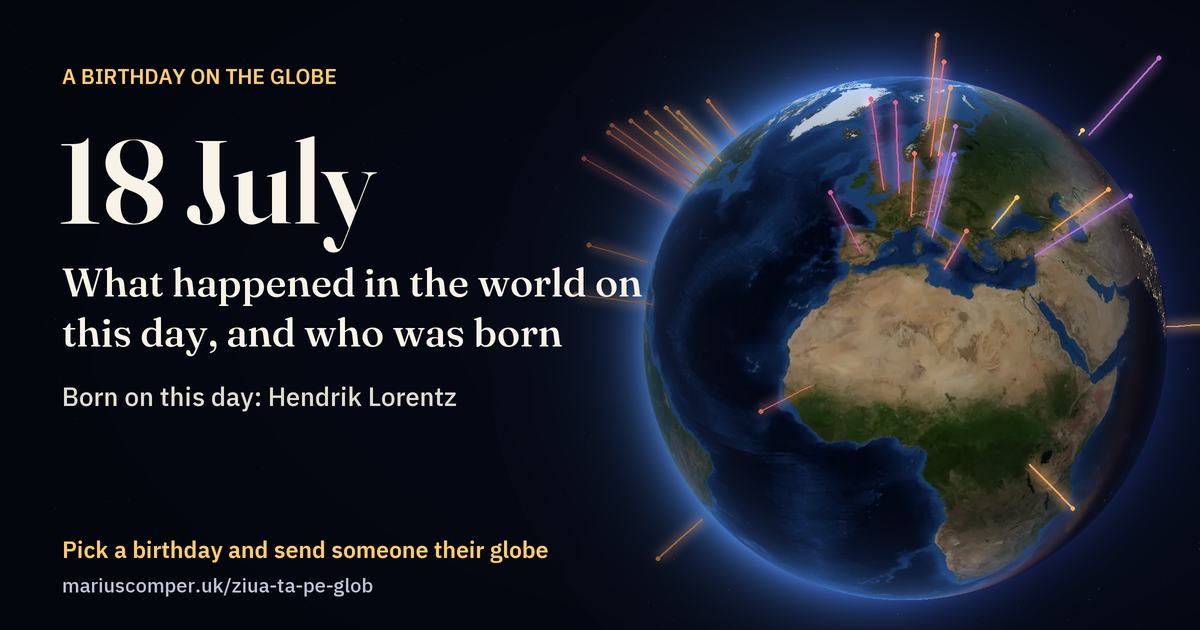
For 18 July, the English Wikipedia lists 52 events and 220 births. 33 of the events stand at their places as rays of light; one more is a dashed circle, where the sentence links only to a country or a sea. The taller the ray, the longer ago it happened. The people born that day come further down, as blue points.
A birthday, yours or someone else’s:
Turn it into a greetingScroll: the globe turns to each place
The day you were born, on the globe.
Three things from your day
Scroll: your day first, then 18 July through the years
The Earth on 18 July
The picture on the globe was assembled by NASA from satellite photographs taken in July 2004: the snow, the ice and the green are those of the month.
On 18 July the Sun passes straight overhead at noon along the parallel of 21.0° north. In London, the day lasts about 16 hours 5 minutes.
Beyond 69° north the Sun no longer sets; beyond 69° south it no longer rises.
The line between day and night is tilted on the globe exactly as on this day of the year. On the dark side you can see the lights of towns.
Britain & Ireland · College of Arms
1555
The College of Arms is reincorporated by Royal charter signed by Queen Mary I of England and King Philip II of Spain.
On the map: College of Arms.
Also on the day’s list of Wikipedia in Chinese.
Europe · Florence
1334
The bishop of Florence blesses the first foundation stone for the new campanile (bell tower) of the Florence Cathedral, designed by the artist Giotto di Bondone.
On the map: Florence.
Also on the day’s list of Wikipedia in Spanish and Chinese.
Europe · Brussels
1507
In Brussels, Prince Charles I is crowned Duke of Burgundy and Count of Flanders, a year after inheriting the title.
On the map: Brussels.
Europe · Dent Blanche
1862
First ascent of Dent Blanche, one of the highest summits in the Alps.
On the map: Dent Blanche.
Also on the day’s list of Wikipedia in Chinese.
North America · Mountain View, California
1968
Intel is founded in Mountain View, California.
On the map: Mountain View, California.
Also on the day’s list of Wikipedia in Chinese.
North America · Olympic Stadium
1976
Nadia Comăneci becomes the first person in Olympic Games history to score a perfect 10 in gymnastics at the 1976 Summer Olympics.
On the map: Olympic Stadium.
Also on the day’s list of Wikipedia in Chinese.
North America · Detroit
2013
The Government of Detroit, with up to $20 billion in debt, files for the largest municipal bankruptcy in U.S. history.
On the map: Detroit.
18 July
What the other Wikipedias remember#
For these years the English list has nothing on this day. The events below come from the same day’s lists on Wikipedia in Spanish and were translated for this page.
From Wikipedia in Spanish · Madrid
1927
In Spain, King Alfonso XIII decrees the creation of aerodromes in Madrid, Barcelona, Valencia, Seville, Alicante, Málaga and Burgos.
On the map: Madrid.
Translated from the list on Wikipedia in Spanish.
From Wikipedia in Spanish · Rome Statute of the International Criminal Court
1998
In Rome (Italy), the signing of the Rome Statute inaugurates the International Criminal Court.
On the map: Rome Statute of the International Criminal Court.
Translated from the list on Wikipedia in Spanish.
From Wikipedia in Spanish · Gaza City
2004
In Gaza (Palestine), radical Palestinian militias defy the authority of the Palestinian leader Yasser Arafat.
On the map: Gaza City.
Translated from the list on Wikipedia in Spanish.
18 July
Born on 18 July#
The English Wikipedia lists 220 births for this day. The blue points are the birthplaces of 60 of these people: those written about in the most Wikipedia editions, where Wikidata gives a place of birth.
Born on 18 July
1853
Hendrik Lorentz, Dutch physicist and academic, Nobel Prize laureate (died 1928)
Place of birth: Arnhem.
Born on 18 July
1982
Priyanka Chopra, Indian actress, singer, and film producer
Place of birth: Jamshedpur.
Born on 18 July
1967
Vin Diesel, American actor, director, producer, and screenwriter
Place of birth: Alameda County.
Born on 18 July
1811
William Makepeace Thackeray, English author and poet (died 1863)
Place of birth: Kolkata.
Born on 18 July
1980
Kristen Bell, American actress
Place of birth: Huntington Woods.
Born in Britain and Ireland
1975
M.I.A., English rapper and producer
Place of birth: Hounslow.
Born in Britain and Ireland
1848
W. G. Grace, English cricketer and physician (died 1915)
Place of birth: Downend.
Born in Britain and Ireland
1961
Alan Pardew, English footballer and manager
Place of birth: Wimbledon.
18 July
Number one in the charts that week
At the cinema
An animal recorded that day
The record can be seen in GBIF, which brings together wildlife records from around the world.
All your birthdays
The weather that day
Data: Met Office Hadley Centre (HadCET); NOAA (GHCN-Daily, Mauna Loa).
Above the Earth
Sources: Jonathan McDowell, GCAT (launches); GFZ Potsdam (Kp index). Days are counted in Universal Time.
Football that day
International matches played that day:
Source: the “International football results” dataset kept by Mart Jürisoo (CC0).
Also that day
The earthquake’s page at the USGS
Source: the USGS catalogue. The day is counted in Universal Time (UTC).
In those days
Make a link for someone
Type the name, pick the day and the year of birth. The link opens straight on their day, with their name in the greeting.
The link carries the name, date and place typed here; anyone who gets it can see them.
Put another birthday beside it
Your mother’s, your child’s, a friend’s: the two days appear side by side.
Below: 18 July through the years.
The whole globe of the day
Drag the globe to turn it. Touch a ray or a point to read what happened there.
Everything Wikipedia lists for 18 July
The list is the English Wikipedia’s, in its own wording, as it stood in October 2026. 18 events have no place on the map: the sentence links to no place with coordinates, only to places too wide to mark, or to several countries.
- 477 BC
Battle of the Cremera as part of the Roman–Etruscan Wars. Veii ambushes and defeats the Roman army.
Europe · Battle of the CremeraWikipedia: Battle of the Cremera - 362
Roman–Persian Wars: Emperor Julian arrives at Antioch with a Roman expeditionary force (60,000 men) and stays there for nine months to launch a campaign against the Persian Empire.
Asia · AntiochWikipedia: Roman–Persian wars - 452
Sack of Aquileia: After an earlier defeat on the Catalaunian Plains, Attila lays siege to the metropolis of Aquileia and eventually destroys it.
Europe · AquileiaWikipedia: Sack of Aquileia - 645
Chinese forces under general Li Shiji besiege the strategic fortress city of Anshi (Liaoning) during the Goguryeo–Tang War.
Asia · AnshanWikipedia: Goguryeo–Tang War - 1195
Battle of Alarcos: Almohad forces defeat the Castilian army of Alfonso VIII and force its retreat to Toledo.
Europe · Battle of AlarcosWikipedia: Battle of Alarcos - 1216
Election of pope Honorius III following the death of pope Innocent III two days prior.
no place on the map - 1290
King Edward I of England issues the Edict of Expulsion, banishing all Jews (numbering about 16,000) from England.
no place on the mapWikipedia: Edict of Expulsion - 1334
The bishop of Florence blesses the first foundation stone for the new campanile (bell tower) of the Florence Cathedral, designed by the artist Giotto di Bondone.
Europe · FlorenceWikipedia: Florence Cathedral - 1389
France and England agree to the Truce of Leulinghem, inaugurating a 13-year peace, the longest period of sustained peace during the Hundred Years' War.
no place on the mapWikipedia: Hundred Years' War - 1507
In Brussels, Prince Charles I is crowned Duke of Burgundy and Count of Flanders, a year after inheriting the title.
Europe · BrusselsWikipedia: Burgundian Netherlands - 1555
The College of Arms is reincorporated by Royal charter signed by Queen Mary I of England and King Philip II of Spain.
Britain & Ireland · College of ArmsWikipedia: College of Arms - 1723
Johann Sebastian Bach leads the first performance of his cantata Erforsche mich, Gott, und erfahre mein Herz, BWV 136, in Leipzig on the eighth Sunday after Trinity.
no place on the mapWikipedia: Johann Sebastian Bach - 1806
A gunpowder magazine explosion in Birgu, Malta, kills around 200 people.
Europe · 1806 Birgu polverista explosionWikipedia: 1806 Birgu polverista explosion - 1812
The Treaties of Orebro end both the Anglo-Russian and Anglo-Swedish Wars.
Europe · ÖrebroWikipedia: Treaties of Örebro - 1841
Coronation of Emperor Pedro II of Brazil.
no place on the mapWikipedia: Pedro II of Brazil - 1857
Louis Faidherbe, French governor of Senegal, arrives to relieve French forces at Kayes, effectively ending El Hajj Umar Tall's war against the French.
Africa · KayesWikipedia: Louis Faidherbe - 1862
First ascent of Dent Blanche, one of the highest summits in the Alps.
Europe · Dent BlancheWikipedia: Dent Blanche - 1863
American Civil War: Second Battle of Fort Wagner: One of the first formal African American military units, the 54th Massachusetts Volunteer Infantry, supported by several white regiments, attempts an unsuccessful assault on Confederate-held Battery Wagner.
North America · Second Battle of Fort WagnerWikipedia: American Civil War - 1870
The First Vatican Council decrees the dogma of papal infallibility.
no place on the mapWikipedia: First Vatican Council - 1872
The Ballot Act 1872 in the United Kingdom introduced the requirement that parliamentary and local government elections be held by secret ballot.
no place on the mapWikipedia: Ballot Act 1872 - 1899
Newsboys from Long Island City turned over a distribution wagon for the New York Journal, marking the start of the Newsboys' strike of 1899.
North America · New York CityWikipedia: Newsboys' strike of 1899 - 1914
The U.S. Congress forms the Aviation Section, U.S. Signal Corps, giving official status to aircraft within the U.S. Army for the first time.
North America · United States CongressWikipedia: United States Congress - 1925
Adolf Hitler publishes Mein Kampf.
no place on the mapWikipedia: Adolf Hitler - 1936
Nationalist rebels attempted a coup against the Second Spanish Republic, sparking the Spanish Civil War.
Europe · Second Spanish RepublicWikipedia: Spanish Civil War - 1942
The Germans test fly the Messerschmitt Me 262 using its jet engines for the first time.
no place on the mapWikipedia: Messerschmitt Me 262 - 1942
World War II: During the Beisfjord massacre in Norway, 15 Norwegian paramilitary guards help members of the SS to kill 288 political prisoners from Yugoslavia.
Europe · Beisfjord massacreWikipedia: Beisfjord massacre - 1944
World War II: Hideki Tōjō resigns as Prime Minister of Japan because of numerous setbacks in the war effort.
no place on the mapWikipedia: Hideki Tojo - 1949
Francisco Javier Arana, the chief of the Guatemalan armed forces, was killed in a shootout with supporters of President Juan José Arévalo.
no place on the mapWikipedia: Francisco Javier Arana - 1966
A racially charged incident in a bar sparks the six-day Hough riots in Cleveland, Ohio; 1,700 Ohio National Guard troops intervene to restore order.
North America · HoughWikipedia: Hough riots - 1966
Human spaceflight: Gemini 10 is launched from Cape Kennedy on a 70-hour mission that includes docking with an orbiting Agena target vehicle.
no place on the mapWikipedia: Human spaceflight - 1968
Intel is founded in Mountain View, California.
North America · Mountain View, CaliforniaWikipedia: Intel - 1970
An Antonov An-22 of the Soviet Air Forces crashes into the Atlantic Ocean, killing all 23 aboard.
no place on the mapWikipedia: 1970 Atlantic Ocean Antonov An-22 crash - 1976
Nadia Comăneci becomes the first person in Olympic Games history to score a perfect 10 in gymnastics at the 1976 Summer Olympics.
North America · Olympic StadiumWikipedia: 1976 Summer Olympics - 1979
A landslide occurs on the Iliwerung volcano in Indonesia, triggering a tsunami that kills over 530 and leaves 700 missing.
Asia · IliwerungWikipedia: Iliwerung - 1981
A Canadair CL-44 and Sukhoi Su-15 collide in mid-air near Yerevan, Armenia, killing four.
Asia · 1981 Armenia mid-air collisionWikipedia: 1981 Armenia mid-air collision - 1982
Two hundred sixty-eight Guatemalan campesinos ("peasants" or "country people") are slain in the Plan de Sánchez massacre.
Latin America · Plan de Sánchez massacreWikipedia: Plan de Sánchez massacre - 1984
McDonald's massacre in San Ysidro, California: James Oliver Huberty kills 21 people and injures 19 others before being shot dead by police.
North America · San Ysidro McDonald's massacreWikipedia: San Ysidro McDonald's massacre - 1984
Parts of the dismembered body of Swedish prostitute Catrine da Costa were found in Stockholm.
Europe · SolnaWikipedia: Murder of Catrine da Costa - 1989
American actress Rebecca Schaeffer was shot and killed by Robert John Bardo, eventually prompting the passage of anti-stalking laws in California.
no place on the mapWikipedia: Rebecca Schaeffer - 1992
A picture of Les Horribles Cernettes was taken, which became the first ever photo posted to the World Wide Web.
no place on the mapWikipedia: Les Horribles Cernettes - 1994
Rwandan genocide: The Rwandan Patriotic Front takes control of Gisenyi and north western Rwanda, forcing the interim government into Zaire and ending the genocide.
Africa · GisenyiWikipedia: Rwandan genocide - 1994
The bombing of the Asociación Mutual Israelita Argentina (Argentine Jewish Community Center) in Buenos Aires kills 85 people (mostly Jewish) and injures 300.
Latin America · AMIA bombingWikipedia: AMIA bombing - 1995
On the Caribbean island of Montserrat, the Soufrière Hills volcano erupts. Over the course of several years, it devastates the island, destroying the capital, forcing most of the population to flee.
Latin America · Soufrière HillsWikipedia: Montserrat - 1995
Selena's album Dreaming of You, instrumental in popularizing Tejano music, was posthumously released.
no place on the mapWikipedia: Selena - 1996
Battle of Mullaitivu: The Liberation Tigers of Tamil Eelam capture the Sri Lanka Army's base, killing over 1,200 soldiers.
Asia · Battle of MullaitivuWikipedia: Battle of Mullaitivu - 1996
Storms provoke severe flooding on the Saguenay River, beginning one of Quebec's costliest natural disasters ever.
North America · Saguenay floodWikipedia: Saguenay flood - 2002
A Consolidated PB4Y-2 Privateer crashes near Estes Park, Colorado, killing both crew members.
North America · Estes Park, ColoradoWikipedia: 2002 United States airtanker crashes - 2012
At least seven people are killed and 32 others are injured after a bomb explodes on an Israeli tour bus at Burgas Airport, Bulgaria.
Europe · 2012 Burgas bus bombingWikipedia: 2012 Burgas bus bombing - 2013
The Government of Detroit, with up to $20 billion in debt, files for the largest municipal bankruptcy in U.S. history.
North America · DetroitWikipedia: Detroit bankruptcy - 2014
The Islamic State of Iraq and the Levant requires Christians to either accept dhimmi status, emigrate from ISIL lands, or be killed.
no place on the mapWikipedia: Islamic State - 2014
The conviction of former Italian prime minister Silvio Berlusconi, who had been found guilty of paying for an underage prostitute, was overturned on appeal.
no place on the mapWikipedia: Silvio Berlusconi - 2019
A man sets fire to an anime studio in Fushimi-ku, Kyoto, Japan, killing 36 people and injuring dozens of others.
Asia · Kyoto Animation arson attackWikipedia: Kyoto Animation arson attack
What the other Wikipedias remember
For these years the English list has nothing on this day. The events below come from the same day’s lists on Wikipedia in Spanish and were translated for this page.
- 1927
In Spain, King Alfonso XIII decrees the creation of aerodromes in Madrid, Barcelona, Valencia, Seville, Alicante, Málaga and Burgos.
- 1998
In Rome (Italy), the signing of the Rome Statute inaugurates the International Criminal Court.
Europe · Rome Statute of the International Criminal CourtTranslated from the list on Wikipedia in SpanishWikipedia: Estatuto de Roma - 2004
In Gaza (Palestine), radical Palestinian militias defy the authority of the Palestinian leader Yasser Arafat.
Who was born on 18 July
In order of how many Wikipedia editions have an article about each. The first 60 of 220 are shown.
- 1918
Nelson Mandela, South African lawyer and politician, 1st President of South Africa, Nobel Prize laureate (died 2013)
- 1853
Hendrik Lorentz, Dutch physicist and academic, Nobel Prize laureate (died 1928)
- 1982
Priyanka Chopra, Indian actress, singer, and film producer
JamshedpurWikipedia: Priyanka Chopra - 1967
Vin Diesel, American actor, director, producer, and screenwriter
Alameda CountyWikipedia: Vin Diesel - 1811
William Makepeace Thackeray, English author and poet (died 1863)
- 1980
Kristen Bell, American actress
Huntington WoodsWikipedia: Kristen Bell - 1921
John Glenn, American colonel, astronaut, and politician (died 2016)
CambridgeWikipedia: John Glenn - 1950
Richard Branson, English businessman, founded Virgin Group
BlackheathWikipedia: Richard Branson - 1922
Thomas Kuhn, American physicist, historian, and philosopher (died 1996)
CincinnatiWikipedia: Thomas Kuhn - 1909
Andrei Gromyko, Belarusian-Russian economist and politician, Soviet Minister of Foreign Affairs (died 1989)
Staryja HramykіWikipedia: Andrei Gromyko - 1933
Yevgeny Yevtushenko, Russian poet and playwright (died 2017)
- 1937
Hunter S. Thompson, American journalist and author (died 2005)
LouisvilleWikipedia: Hunter S. Thompson - 1552
Rudolf II, Holy Roman Emperor (died 1612)
- 1887
Vidkun Quisling, Norwegian military officer and politician, Minister President of Norway (died 1945)
Fyresdal MunicipalityWikipedia: Vidkun Quisling - 1951
Elio Di Rupo, Belgian chemist, academic, and politician, 68th Prime Minister of Belgium
MorlanwelzWikipedia: Elio Di Rupo - 1938
Paul Verhoeven, Dutch director, producer, and screenwriter
AmsterdamWikipedia: Paul Verhoeven - 1937
Roald Hoffmann, Polish chemist and academic, Nobel Prize laureate
ZolochivWikipedia: Roald Hoffmann - 1837
Vasil Levski, Bulgarian priest and activist (died 1873)
KarlovoWikipedia: Vasil Levski - 1975
M.I.A., English rapper and producer
HounslowWikipedia: M.I.A. - 1942
Giacinto Facchetti, Italian footballer (died 2006)
TreviglioWikipedia: Giacinto Facchetti - 1900
Nathalie Sarraute, French lawyer and author (died 1999)
IvanovoWikipedia: Nathalie Sarraute - 1909
Mohammed Daoud Khan, Afghan commander and politician, 1st President of Afghanistan (died 1978)
- 1948
Hartmut Michel, German biochemist and academic, Nobel Prize laureate
LudwigsburgWikipedia: Hartmut Michel - 1975
Daron Malakian, American singer-songwriter, guitarist, and producer
HollywoodWikipedia: Daron Malakian - 1867
Margaret Brown, American philanthropist and activist (died 1932)
HannibalWikipedia: Margaret Brown - 1914
Gino Bartali, Italian cyclist (died 2000)
Ponte a EmaWikipedia: Gino Bartali - 1969
Elizabeth Gilbert, American author
WaterburyWikipedia: Elizabeth Gilbert - 1501
Isabella of Austria, queen of Denmark (died 1526)
BrusselsWikipedia: Isabella of Austria - 1985
Chace Crawford, American actor
LubbockWikipedia: Chace Crawford - 1976
Elsa Pataky, Spanish actress
MadridWikipedia: Elsa Pataky - 1997
Noah Lyles, American sprinter
GainesvilleWikipedia: Noah Lyles - 1659
Hyacinthe Rigaud, French painter (died 1743)
PerpignanWikipedia: Hyacinthe Rigaud - 1871
Giacomo Balla, Italian painter (died 1958)
- 1921
Aaron Beck, American psychiatrist and academic (died 2021)
ProvidenceWikipedia: Aaron Beck - 1013
Hermann of Reichenau, German composer, mathematician, and astronomer (died 1054)
AltshausenWikipedia: Hermann of Reichenau - 1940
James Brolin, American actor
Los AngelesWikipedia: James Brolin - 1977
Alexander Morozevich, Russian chess player and author
- 1845
Tristan Corbière, French poet (died 1875)
MorlaixWikipedia: Tristan Corbière - 1848
W. G. Grace, English cricketer and physician (died 1915)
DownendWikipedia: W. G. Grace - 1961
Elizabeth McGovern, American actress
EvanstonWikipedia: Elizabeth McGovern - 1861
Kadambini Ganguly, Indian physician, one of the first Indian women to obtain a degree (died 1923)
BhagalpurWikipedia: Kadambini Ganguly - 1504
Heinrich Bullinger, Swiss pastor and reformer (died 1575)
BremgartenWikipedia: Heinrich Bullinger - 1821
Pauline Viardot, French soprano and composer (died 1910)
- 1963
Martín Torrijos, Panamanian economist and politician, 35th President of Panama
- 1818
Louis Gerhard De Geer, Swedish lawyer and politician, 1st Prime Minister of Sweden (died 1896)
Risinge church parishWikipedia: Louis Gerhard De Geer - 1892
Arthur Friedenreich, Brazilian footballer (died 1969)
São PauloWikipedia: Arthur Friedenreich - 1941
Frank Farian, German songwriter and producer (died 2024)
- 1961
Alan Pardew, English footballer and manager
WimbledonWikipedia: Alan Pardew - 1977
Kelly Reilly, English actress
ChessingtonWikipedia: Kelly Reilly - 1927
Kurt Masur, German conductor and educator (died 2015)
- 1981
Michiel Huisman, Dutch actor
AmstelveenWikipedia: Michiel Huisman - 1997
Bam Adebayo, American basketball player
PinetownWikipedia: Bam Adebayo - 1724
Maria Antonia of Bavaria, Electress of Saxony (died 1780)
- 1890
Frank Forde, Australian educator and politician, 15th Prime Minister of Australia (died 1983)
MitchellWikipedia: Frank Forde - 1908
Lupe Vélez, Mexican-American actress and dancer (died 1944)
San Luis PotosíWikipedia: Lupe Vélez - 1917
Henri Salvador, French singer and guitarist (died 2008)
CayenneWikipedia: Henri Salvador - 1951
Margo Martindale, American actress
JacksonvilleWikipedia: Margo Martindale - 1964
Wendy Williams, American talk show host
Asbury ParkWikipedia: Wendy Williams - 1971
Penny Hardaway, American basketball player and coach
MemphisWikipedia: Penny Hardaway - 1929
Dick Button, American figure skater and actor (died 2025)
EnglewoodWikipedia: Dick Button
What is celebrated on 18 July
- Christian feast day: Arnulf of Metz
- Christian feast day: Bruno of Segni
- Christian feast day: Camillus de Lellis (optional memorial, United States only)
- Christian feast day: Eadburh (or Edburga) of Bicester
- Christian feast day: Elizabeth Ferard (Church of England)
- Christian feast day: Frederick of Utrecht
- Christian feast day: Maternus of Milan
- Christian feast day: Pambo
- Christian feast day: Philastrius
- Christian feast day: Symphorosa
- Christian feast day: Theodosia of Constantinople
- Christian feast day: July 18 (Eastern Orthodox liturgics)
- Constitution Day (Uruguay)
- Nelson Mandela International Day
A greeting link for someone
Type a name and, if you like, the year of birth. The link opens with a greeting, and beside each event it says how old the person turned that day, or how many years before their birth it happened.
The name and the year go only into the link you send.
All 366 days
How the globe is made
Where the events come from
Each edition of this page uses the day’s list from Wikipedia in its own language: Romanian, English, Spanish, Chinese. The lists are written by volunteers and differ from one edition to the next; the text of each event is Wikipedia’s, with a link to the article. A row that appears twice in a list is shown once. The lists have not been checked event by event: they are Wikipedia’s, mistakes included.
For events before 1582, and for countries that moved to the Gregorian calendar later (Britain in 1752, Russia in 1918), the same day may be counted Old Style in one list and New Style in another.
The chapter “What the other Wikipedias remember” adds up to five events a day from the lists of the other three editions, only for years in which the English list has nothing on that day. They were translated for this page, passed the same filters as the tour, and are not counted among the events of the English list.
How an event gets onto the map
The place comes from Wikidata. If the sentence links to the article about the event itself (a battle, an opening, an earthquake), dated to the same year, the ray stands on its coordinates or on those of its location. Otherwise it stands on the first place the sentence links to: a town, a building, a mountain, an island. This second step can be wrong: sometimes the sentence only mentions the place. That is why the page says, under each event, which place the ray stands on.
When the sentence links to a single state or province, or to a single sea, lake or desert larger than 5,000 km², the globe shows a dashed circle, not a ray. The circle has the area Wikidata gives, with its radius kept between 1.2° and 16°, or a radius of 4.5° when Wikidata gives no area; it says only that the sentence links to that place. Organisations, ships, spacecraft, museum objects, rivers, mountain ranges, languages and continents are never used as places. When a sentence names several states and no exact place, the event stays in the list only.
What the height means
The height of a ray shows how many years have passed, on a logarithmic scale: 10 years, 100 years and 1,000 years are equal steps apart; anything older than about 2,600 years has the tallest ray. The colour runs from pale yellow for recent years to violet for antiquity.
Where the tour stops
In each region the tour stops at up to three events (five in Britain and Ireland), chosen mainly by three things: whether Wikipedia’s editors put the event in the “On this day” box of their main page (the English, Spanish and Chinese editions), how many Wikipedia editions have an article about it, and how many of the four lists include it. Events whose sentence or article is about a war, an attack, a crime or a disaster are left out of the tour; they stay in the whole list, in Wikipedia’s wording. The filter is a list of words and a list of Wikidata types, so it can miss some.
The tour of births names the people with articles in the most editions and leaves aside those whom the list or Wikidata describes as rulers, politicians, commanders, leaders of movements or criminals; they stay in the list.
The Earth and the Sun
The daytime images are NASA’s Blue Marble Next Generation mosaics, one for each month of 2004; the night side is Black Marble 2016. The tilt of the line between day and night is computed for the day; the hour is chosen so that the place being read is in daylight. The latitude where the Sun stands overhead is the average of the four years of the leap cycle; in a given year it can differ by up to 0.4°.
The day you were born
The number ones come from the weekly lists on Wikipedia: Billboard for the United States (from 1940; the Hot 100 from August 1958), the UK Singles Chart (from November 1952), Los 40 Principales for Spain (from July 1966) and, for Romania, the Romanian Top 100 and Airplay 100 (2001–2021, with missing weeks). The page shows the chart of the week in which the day of birth falls, with its date; Billboard and the UK chart are dated at the end of their week. For Romania before 2001 and for China these sources have no weekly chart.
The films are those that reached cinemas in the United States up to ten days before or three days after that day (some of them in a few cinemas at first), from the English Wikipedia’s yearly lists (from 1968), in order of how many editions have an article about them. The events “in those days” are the ones on the neighbouring days’ lists that carry the year of birth, passed through the same filter as the tour.
The day of birth, year included
The Moon, the star sign and the constellation are worked out by the page itself, for noon Universal Time on the day. The lit part of the Moon is rounded and can differ by a few per cent from that at the hour of birth. The sign follows the usual zodiac of twelve equal parts starting at the March equinox; the constellation is the one the Sun actually stood in front of, by the borders set by the International Astronomical Union, and within a day of a border the page does not name it. When the Sun changes sign while it is that day anywhere on Earth, the page gives the moment of crossing, rounded to ten minutes and accurate to within about a quarter of an hour, and the clock time in a few cities, with the time zone and summer time of that year.
The year in the Chinese calendar is the one your device’s own calendar gives for the date, checked against the Hong Kong Observatory’s tables. “All your birthdays” uses the same sources as the rest of the chapter for the same day in every year since the birth: the temperature, well-known launches that took place on that very day, matches of the teams the edition follows, snow deeper than 10 cm and strong geomagnetic storms. The three things at the top and the four on the picture are chosen in a fixed order (the song, the animal, a full Moon, a well-known launch before an ordinary earthquake); on the picture you can change them.
When the link carries a year of birth, the page adds a few things about that exact day. The weather is the Met Office’s Central England temperature record and the readings from New York’s Central Park; the “usual high” is the average of the daily highs of 1961–1990 for that date, with two days either side. The carbon dioxide figure is the monthly mean at the Mauna Loa observatory, where measurements begin in March 1958.
The earthquake is the one with the largest magnitude in the USGS catalogue for that day, counted in Universal Time. Before the 1960s the catalogue has gaps even above magnitude 5.5, so in the older years many days have no earthquake. The page gives only the magnitude and the place: the country the epicentre falls in or, when the epicentre is at sea within 300 km of a coast, the nearest country; farther out, only the ocean.
The launches are those that reached orbit or left for the Moon and the planets, from Jonathan McDowell’s GCAT catalogue. If nothing left that day, the page shows the nearest launch within three days before or after, and says how many days away it was. The geomagnetic storm appears only when the Kp index reached at least 5 in one of the day’s eight three-hour intervals.
The animal comes from GBIF: an observation made by a person (the animal seen or heard, or its tracks), dated to that exact day, with coordinates and a CC0 or CC BY licence. Only a few hundred well-known species are searched (mammals, birds, turtles, butterflies); of those noted that day, mammals and species with articles in many Wikipedia editions come first; birds noted almost every day, and species used recently, wait their turn. Observations dated 1 January are left out, because records without a day are often filed there. An observation shows that the animal was recorded there, not how many animals there were.
The matches are those between national teams. Only matches of England, Scotland, Wales, Northern Ireland, the Republic of Ireland, the United States, Canada and Australia are shown, along with those at the big final tournaments. The picture to send is drawn in the page from the day’s globe and the facts above, and stays on your device until you send it.
Sources
- Events, births and holidays: the day’s page on Wikipedia, text under CC BY-SA 4.0.
- Coordinates, places of birth and the number of editions: Wikidata (CC0).
- The Earth by day: NASA Blue Marble Next Generation. The Earth by night: NASA Black Marble 2016.
- Borders and regions: Natural Earth.
- World population and births per year: UN World Population Prospects 2024.
- Charts and films: Wikipedia’s lists for Billboard, the UK Singles Chart, Los 40 Principales, Romanian Top 100, Airplay 100 and American films by year (CC BY-SA 4.0).
- Weather: Met Office Hadley Centre, HadCET (Open Government Licence) and NOAA GHCN-Daily, New York Central Park. Carbon dioxide: NOAA Global Monitoring Laboratory, Mauna Loa.
- Earthquakes: the USGS catalogue. Launches: Jonathan McDowell, GCAT (CC BY). Kp index: GFZ Potsdam (CC BY 4.0). Matches: International football results, Mart Jürisoo (CC0).
- Animal observations: GBIF, with a link to each record; species names come from Wikidata.