A birthday on the globe
23 January on the globe: what happened in the world on this day, and who was born
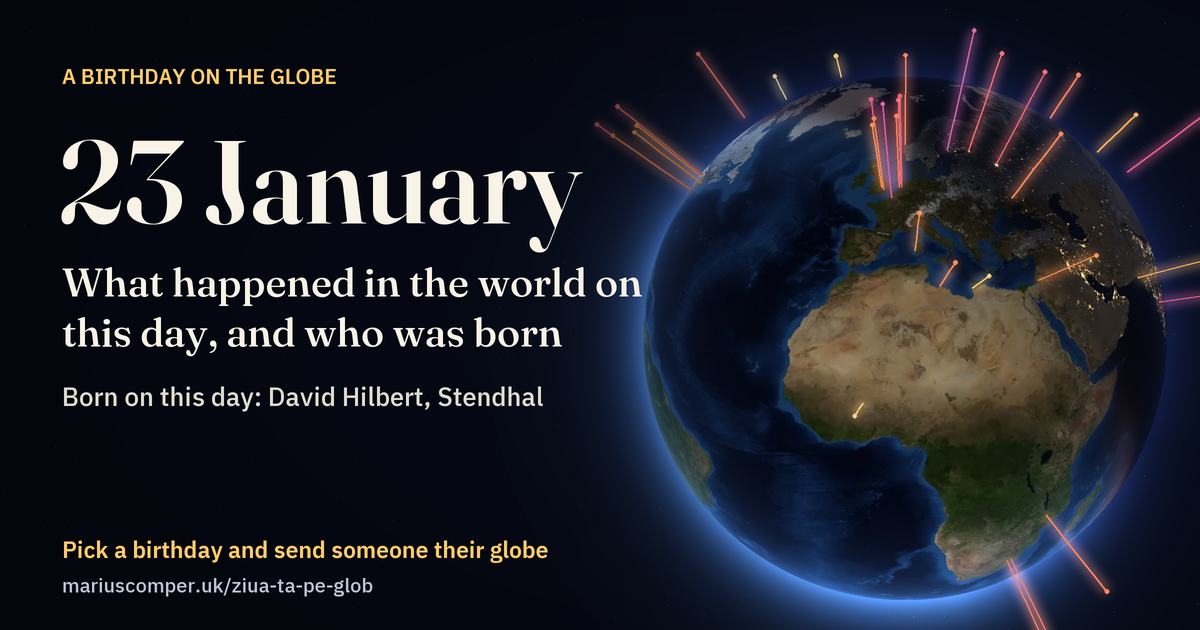
For 23 January, the English Wikipedia lists 60 events and 208 births. 34 of the events stand at their places as rays of light; two more are dashed circles, where the sentence links only to a country or a sea. The taller the ray, the longer ago it happened. The people born that day come further down, as blue points.
A birthday, yours or someone else’s:
Turn it into a greetingScroll: the globe turns to each place
The day you were born, on the globe.
Three things from your day
Scroll: your day first, then 23 January through the years
The Earth on 23 January
The picture on the globe was assembled by NASA from satellite photographs taken in January 2004: the snow, the ice and the green are those of the month.
On 23 January the Sun passes straight overhead at noon along the parallel of 19.5° south. In London, the day lasts about 8 hours 40 minutes.
Beyond 70° south the Sun no longer sets; beyond 70° north it no longer rises.
The line between day and night is tilted on the globe exactly as on this day of the year. On the dark side you can see the lights of towns.
Britain & Ireland · Royal Exchange, London
1571
The Royal Exchange opens in London.
On the map: Royal Exchange, London.
Also on the day’s list of Wikipedia in Spanish.
Britain & Ireland · Milton Keynes
1967
Milton Keynes (England) is founded as a new town by Order in Council, with a planning brief to become a city of 250,000 people. Its initial designated area enclosed three existing towns and twenty-one villages. The area to be developed was largely farmland, with evidence of continuous settlement dating back to the Bronze Age.
On the map: Milton Keynes.
Also on the day’s list of Wikipedia in Spanish.
Europe · Moscow State University
1755
Moscow University is established (12 January 1755 O.S.).
On the map: Moscow State University.
Also on the day’s list of Wikipedia in Spanish.
Europe · Saint Petersburg
1793
Second Partition of Poland.
On the map: Saint Petersburg.
Also on the day’s list of Wikipedia in Spanish and Romanian.
Europe · First International Opium Convention
1912
The First International Opium Convention is signed at The Hague.
On the map: the coordinates Wikidata gives for the article “First International Opium Convention”.
Also on the day’s list of Wikipedia in Spanish.
Asia · Jerusalem
1950
The Knesset resolves that Jerusalem is the capital of Israel.
On the map: Jerusalem.
North America · Georgetown University
1789
Georgetown College, the first Catholic university in the United States, is founded in Georgetown, Maryland (now a part of Washington, D.C.) when Bishop John Carroll, Rev. Robert Molyneux, and Rev. John Ashton purchase land for the proposed academy for the education of youth.
On the map: Georgetown University.
Also on the day’s list of Wikipedia in Spanish and Chinese.
North America · Geneva, New York
1849
Elizabeth Blackwell is awarded her M.D. by the Geneva Medical College of Geneva, New York, becoming the United States' first female doctor.
On the map: Geneva, New York.
North America · Rock and Roll Hall of Fame
1986
The Rock and Roll Hall of Fame inducts its first members: Little Richard, Chuck Berry, James Brown, Ray Charles, Sam Cooke, Fats Domino, The Everly Brothers, Buddy Holly, Jerry Lee Lewis and Elvis Presley.
On the map: Rock and Roll Hall of Fame.
Also on the day’s list of Wikipedia in Spanish and Romanian.
23 January
What the other Wikipedias remember#
For these years the English list has nothing on this day. The events below come from the same day’s lists on Wikipedia in Spanish and were translated for this page.
From Wikipedia in Spanish · Wimbledon Championships
1983
The Swedish tennis player Björn Borg (26), five-time Wimbledon champion, explains the reasons for his withdrawal from top-level competition.
On the map: Wimbledon Championships.
Translated from the list on Wikipedia in Spanish.
The article on Wikipedia in Spanish: Campeonato de Wimbledon
23 January
Born on 23 January#
The English Wikipedia lists 208 births for this day. The blue points are the birthplaces of 60 of these people: those written about in the most Wikipedia editions, where Wikidata gives a place of birth.
Born on 23 January
1862
David Hilbert, German mathematician and academic (died 1943)
Place of birth: Kaliningrad.
Born on 23 January
1783
Stendhal, French novelist (died 1842)
Place of birth: Grenoble.
Born on 23 January
1832
Édouard Manet, French painter (died 1883)
Place of birth: former 10th arrondissement of Paris.
Born on 23 January
1930
Derek Walcott, Saint Lucian poet and playwright, Nobel Prize laureate (died 2017)
Place of birth: Castries.
Born on 23 January
1907
Hideki Yukawa, Japanese physicist and academic, Nobel Prize laureate (died 1981)
Place of birth: Azabu.
Born in Britain and Ireland
1919
Bob Paisley, English footballer and manager (died 1996)
Place of birth: Hetton-le-Hole.
Born in Britain and Ireland
1996
Ruben Loftus-Cheek, English footballer
Place of birth: Lewisham.
Born in Britain and Ireland
1986
Steven Taylor, English footballer
Place of birth: Greenwich.
23 January
Number one in the charts that week
At the cinema
An animal recorded that day
The record can be seen in GBIF, which brings together wildlife records from around the world.
All your birthdays
The weather that day
Data: Met Office Hadley Centre (HadCET); NOAA (GHCN-Daily, Mauna Loa).
Above the Earth
Sources: Jonathan McDowell, GCAT (launches); GFZ Potsdam (Kp index). Days are counted in Universal Time.
Football that day
International matches played that day:
Source: the “International football results” dataset kept by Mart Jürisoo (CC0).
Also that day
The earthquake’s page at the USGS
Source: the USGS catalogue. The day is counted in Universal Time (UTC).
In those days
Make a link for someone
Type the name, pick the day and the year of birth. The link opens straight on their day, with their name in the greeting.
The link carries the name, date and place typed here; anyone who gets it can see them.
Put another birthday beside it
Your mother’s, your child’s, a friend’s: the two days appear side by side.
Below: 23 January through the years.
The whole globe of the day
Drag the globe to turn it. Touch a ray or a point to read what happened there.
Everything Wikipedia lists for 23 January
The list is the English Wikipedia’s, in its own wording, as it stood in October 2026. 24 events have no place on the map: the sentence links to no place with coordinates, only to places too wide to mark, or to several countries.
- 393
Roman emperor Theodosius I proclaims his eight-year-old son Honorius co-emperor.
no place on the mapWikipedia: Roman emperor - 971
Using crossbows, Song dynasty troops soundly defeat a war elephant corps of the Southern Han at Shao.
no place on the mapWikipedia: Crossbow - 1229
The episcopal seat is moved from Nousiainen to Koroinen (located near the current centre of Turku) by the permission of Pope Gregory IX. The date is starting to be considered as the founding of Turku.
Europe · NousiainenWikipedia: Nousiainen - 1264
In the conflict between King Henry III of England and his rebellious barons led by Simon de Montfort, King Louis IX of France issues the Mise of Amiens, a one-sided decision in favour of Henry that later leads to the Second Barons' War.
Europe · AmiensWikipedia: Mise of Amiens - 1368
Zhu Yuanzhang proclaims himself the Hongwu Emperor, beginning the Ming dynasty.
Asia · Ming dynastyWikipedia: Hongwu Emperor - 1546
Having published nothing for eleven years, François Rabelais publishes the Tiers Livre, his sequel to Gargantua and Pantagruel.
no place on the mapWikipedia: François Rabelais - 1556
The deadliest earthquake in history, the Shaanxi earthquake, hits Shaanxi province, China. The death toll may have been as high as 830,000.
Asia · 1556 Shaanxi earthquakeWikipedia: 1556 Shaanxi earthquake - 1565
The Deccan Sultanates defeat Rama Raya of the Vijayanagara Empire at the Battle of Talikota, resulting in over 100,000 casualties and the destruction of the capital Vijayanagara.
Asia · Battle of TalikotaWikipedia: Battle of Talikota - 1570
James Stewart, 1st Earl of Moray, regent for the infant King James VI of Scotland, is assassinated by firearm, the first recorded instance of such.
no place on the mapWikipedia: James Stewart, 1st Earl of Moray - 1571
The Royal Exchange opens in London.
Britain & Ireland · Royal Exchange, LondonWikipedia: Royal Exchange, London - 1579
The Union of Utrecht forms a Protestant republic in the Netherlands.
Europe · Lordship of UtrechtWikipedia: Union of Utrecht - 1656
Blaise Pascal publishes the first of his Lettres provinciales.
no place on the mapWikipedia: Blaise Pascal - 1719
The Principality of Liechtenstein is created within the Holy Roman Empire.
no place on the mapWikipedia: Principality - 1755
Moscow University is established (12 January 1755 O.S.).
Europe · Moscow State UniversityWikipedia: Moscow State University - 1789
Georgetown College, the first Catholic university in the United States, is founded in Georgetown, Maryland (now a part of Washington, D.C.) when Bishop John Carroll, Rev. Robert Molyneux, and Rev. John Ashton purchase land for the proposed academy for the education of youth.
North America · Georgetown UniversityWikipedia: Georgetown University - 1793
Second Partition of Poland.
Europe · Saint PetersburgWikipedia: Second Partition of Poland - 1795
After crossing the frozen Zuiderzee, the French cavalry capture 14 Dutch ships and 850 guns, in a rare occurrence of surrender of naval vessels to land forces.
Europe · Capture of the Dutch fleet at Den HelderWikipedia: Capture of the Dutch fleet at Den Helder - 1846
Slavery in Tunisia is abolished.
no place on the mapWikipedia: Slavery in Tunisia - 1849
Elizabeth Blackwell is awarded her M.D. by the Geneva Medical College of Geneva, New York, becoming the United States' first female doctor.
North America · Geneva, New YorkWikipedia: Elizabeth Blackwell - 1870
In Montana, U.S. cavalrymen kill 173 Native Americans, mostly women and children, in what becomes known as the Marias Massacre.
North America · Marias MassacreWikipedia: Marias Massacre - 1879
Anglo-Zulu War: The Battle of Rorke's Drift ends.
Africa · Battle of Rorke's DriftWikipedia: Anglo-Zulu War - 1899
The Malolos Constitution is inaugurated, establishing the First Philippine Republic. Emilio Aguinaldo is sworn in as its first president.
no place on the mapWikipedia: Malolos Constitution - 1900
Second Boer War: The Battle of Spion Kop between the forces of the South African Republic and the Orange Free State and British forces ends in a British defeat.
Africa · Battle of Spion KopWikipedia: Second Boer War - 1902
In the most fatal recorded mountaineering accident, 199 of the 210 members of an Imperial Japanese Army unit perished in a blizzard on the Hakkōda Mountains.
Asia · Hakkōda Mountains disasterWikipedia: Hakkōda Mountains disaster - 1904
Ålesund Fire: The Norwegian coastal town Ålesund is devastated by fire, leaving 10,000 people homeless and one person dead. Kaiser Wilhelm II funds the rebuilding of the town in Jugendstil style.
Europe · Ålesund fireWikipedia: Ålesund fire - 1909
RMS Republic, a passenger ship of the White Star Line, becomes the first ship to use the CQD distress signal after colliding with another ship, the SS Florida, off the Massachusetts coastline, an event that kills six people. The Republic sinks the next day.
no place on the mapWikipedia: RMS Republic - 1909
Two men committed an armed robbery in Tottenham, London, and led police on a two-hour chase, partially by tram, that ended in the perpetrators' suicides.
Britain & Ireland · Tottenham OutrageWikipedia: Tottenham Outrage - 1912
The First International Opium Convention is signed at The Hague.
Europe · First International Opium ConventionWikipedia: First International Opium Convention - 1915
Rebels led by John Chilembwe attacked local plantation owners, beginning an uprising regarded as a key moment in the history of Malawi.
Africa · Chilembwe uprisingWikipedia: Chilembwe uprising - 1919
The First Regional Congress of Peasants, Workers and Insurgents is held by the Makhnovshchina at Velykomykhailivka.
Europe · VelykomykhailivkaWikipedia: Regional Congress of Peasants, Workers and Insurgents - 1920
The Netherlands refuses to surrender the exiled Kaiser Wilhelm II of Germany to the Allies.
no place on the mapWikipedia: Wilhelm II - 1922
The first successful treatment with insulin is given to 14-year-old diabetic Leonard Thompson.
no place on the mapWikipedia: Insulin - 1937
The trial of the anti-Soviet Trotskyist center sees seventeen mid-level Communists accused of sympathizing with Leon Trotsky and plotting to overthrow Joseph Stalin's regime.
no place on the mapWikipedia: Moscow trials - 1941
Charles Lindbergh testifies before the U.S. Congress and recommends that the United States negotiate a neutrality pact with Adolf Hitler.
North America · United States CongressWikipedia: United States Congress - 1942
World War II: The Battle of Rabaul commences Japan's invasion of Australia's Territory of New Guinea.
Oceania · Battle of RabaulWikipedia: Battle of Rabaul - 1943
World War II: Troops of the British Eighth Army capture Tripoli in Libya from the German–Italian Panzer Army.
Africa · Tripoli, LibyaWikipedia: Eighth Army - 1945
World War II: German admiral Karl Dönitz launches Operation Hannibal, the evacuation of areas along the eastern Baltic coast.
no place on the mapWikipedia: Operation Hannibal - 1950
The Knesset resolves that Jerusalem is the capital of Israel.
Asia · JerusalemWikipedia: Knesset - 1957
American inventor Walter Frederick Morrison sells the rights to his flying disc to the Wham-O toy company, which later renames it the "Frisbee".
no place on the mapWikipedia: Walter Frederick Morrison - 1958
After a general uprising and rioting in the streets, President Marcos Pérez Jiménez leaves Venezuela.
Latin America · VenezuelaWikipedia: 1958 Venezuelan coup d'état - 1960
The bathyscaphe USS Trieste breaks a depth record by descending to 10,911 metres (35,797 ft) in the Pacific Ocean.
no place on the mapWikipedia: Bathyscaphe - 1963
The Guinea-Bissau War of Independence officially begins when PAIGC guerrilla fighters attack the Portuguese Army stationed in Tite.
Europe · Portuguese ArmyWikipedia: Guinea-Bissau War of Independence - 1964
The 24th Amendment to the United States Constitution, prohibiting the use of poll taxes in national elections, is ratified.
no place on the mapWikipedia: Twenty-fourth Amendment to the United States Constitution - 1967
Diplomatic relations between the Soviet Union and Ivory Coast are established.
no place on the mapWikipedia: Diplomacy - 1967
Milton Keynes (England) is founded as a new town by Order in Council, with a planning brief to become a city of 250,000 people. Its initial designated area enclosed three existing towns and twenty-one villages. The area to be developed was largely farmland, with evidence of continuous settlement dating back to the Bronze Age.
Britain & Ireland · Milton KeynesWikipedia: Milton Keynes - 1968
USS Pueblo (AGER-2) is attacked and seized by the Korean People's Navy.
no place on the mapWikipedia: USS Pueblo - 1982
World Airways Flight 30 overshoots the runway at Logan International Airport in Boston, Massachusetts, and crashes into Boston Harbor. Two people are missing and presumed dead.
North America · World Airways Flight 30Wikipedia: World Airways Flight 30 - 1986
The Rock and Roll Hall of Fame inducts its first members: Little Richard, Chuck Berry, James Brown, Ray Charles, Sam Cooke, Fats Domino, The Everly Brothers, Buddy Holly, Jerry Lee Lewis and Elvis Presley.
North America · Rock and Roll Hall of FameWikipedia: Rock and Roll Hall of Fame - 1987
Mohammed Said Hersi Morgan sends a "letter of death" to Somali President Siad Barre, proposing the genocide of the Isaaq people.
no place on the mapWikipedia: Isaaq genocide - 1993
The first version of Mosaic, created by Marc Andreessen and Eric Bina, was released, becoming the first popular web browser.
no place on the mapWikipedia: NCSA Mosaic - 1997
Madeleine Albright becomes the first woman to serve as United States Secretary of State.
no place on the mapWikipedia: Madeleine Albright - 1998
Netscape announces Mozilla, with the intention to release Communicator code as open source.
no place on the mapWikipedia: Netscape - 2001
Five people attempt to set themselves on fire in Beijing's Tiananmen Square, an act that many people later claim is staged by the Chinese Communist Party to frame Falun Gong and thus escalate their persecution.
Asia · Tiananmen SquareWikipedia: 2001 Tiananmen Square self-immolation incident - 2002
U.S. journalist Daniel Pearl is kidnapped in Karachi, Pakistan and subsequently murdered.
Asia · KarachiWikipedia: Daniel Pearl - 2003
A very weak signal from Pioneer 10 is detected for the last time, but no usable data can be extracted.
no place on the mapWikipedia: Pioneer 10 - 2018
A 7.9 Mw earthquake occurs in the Gulf of Alaska. It is tied as the sixth-largest earthquake ever recorded in the United States, but there are no reports of significant damage or fatalities.
Oceans · 2018 Gulf of Alaska earthquakeWikipedia: 2018 Gulf of Alaska earthquake - 2018
A double car bombing in Benghazi, Libya, kills at least 33 people and wounds "dozens" of others. The victims include both military personnel and civilians, according to local officials.
Africa · BenghaziWikipedia: Benghazi - 2018
The China–United States trade war begins when President Donald Trump places tariffs on Chinese solar panels and washing machines.
no place on the mapWikipedia: China–United States trade war - 2022
Mutinying Burkinabè soldiers led by Paul-Henri Sandaogo Damiba depose and detain President Roch Marc Christian Kaboré amid widespread anti-government protests.
Africa · OuagadougouWikipedia: January 2022 Burkina Faso coup d'état - 2024
Northwestern Air Flight 738 crashes after takeoff from Fort Smith Airport, Northwest Territories, Canada, killing six people.
North America · Northwestern Air Flight 738Wikipedia: Northwestern Air Flight 738
What the other Wikipedias remember
For these years the English list has nothing on this day. The events below come from the same day’s lists on Wikipedia in Spanish and were translated for this page.
- 1983
The Swedish tennis player Björn Borg (26), five-time Wimbledon champion, explains the reasons for his withdrawal from top-level competition.
Britain & Ireland · Wimbledon ChampionshipsTranslated from the list on Wikipedia in SpanishWikipedia: Campeonato de Wimbledon
Who was born on 23 January
In order of how many Wikipedia editions have an article about each. The first 60 of 208 are shown.
- 1862
David Hilbert, German mathematician and academic (died 1943)
KaliningradWikipedia: David Hilbert - 1783
Stendhal, French novelist (died 1842)
GrenobleWikipedia: Stendhal - 1832
Édouard Manet, French painter (died 1883)
former 10th arrondissement of ParisWikipedia: Édouard Manet - 1947
Megawati Sukarnoputri, Indonesian politician, 5th president of Indonesia
YogyakartaWikipedia: Megawati Sukarnoputri - 1930
Derek Walcott, Saint Lucian poet and playwright, Nobel Prize laureate (died 2017)
CastriesWikipedia: Derek Walcott - 1907
Hideki Yukawa, Japanese physicist and academic, Nobel Prize laureate (died 1981)
- 1984
Arjen Robben, Dutch footballer
- 1918
Gertrude B. Elion, American biochemist and pharmacologist, Nobel Prize laureate (died 1999)
New York CityWikipedia: Gertrude B. Elion - 1928
Jeanne Moreau, French actress (died 2017)
10ᵗʰ arrondissement of ParisWikipedia: Jeanne Moreau - 1897
Subhas Chandra Bose, Indian freedom fighter and politician (died 1945)
- 1876
Otto Diels, German chemist and academic, Nobel Prize laureate (died 1954)
HamburgWikipedia: Otto Diels - 1944
Rutger Hauer, Dutch actor, director, and producer (died 2019)
BreukelenWikipedia: Rutger Hauer - 1998
XXXTentacion, American rapper (died 2018)
PlantationWikipedia: XXXTentacion - 1840
Ernst Abbe, German physicist and engineer (died 1905)
EisenachWikipedia: Ernst Abbe - 1910
Django Reinhardt, Belgian guitarist and composer (died 1953)
Pont-à-CellesWikipedia: Django Reinhardt - 1872
Paul Langevin, French physicist and academic (died 1946)
- 1929
John Polanyi, German-Canadian chemist and academic, Nobel Prize laureate
BerlinWikipedia: John Polanyi - 1946
Boris Berezovsky, Russian-English businessman and mathematician (died 2013)
- 1915
W. Arthur Lewis, Saint Lucian-Barbadian economist and academic, Nobel Prize laureate (died 1991)
CastriesWikipedia: W. Arthur Lewis - 1985
Doutzen Kroes, Dutch model and actress
EastermarWikipedia: Doutzen Kroes - 1828
Saigō Takamori, Japanese samurai (died 1877)
Kajiya-chōWikipedia: Saigō Takamori - 1938
Georg Baselitz, German painter and sculptor (died 2026)
- 1855
John Browning, American weapons designer, founded the Browning Arms Company (died 1926)
- 1950
Richard Dean Anderson, American actor, producer, and composer
MinneapolisWikipedia: Richard Dean Anderson - 1962
Elvira Lindo, Spanish journalist and author
- 1964
Mariska Hargitay, American actress and producer
Providence Saint John's Health CenterWikipedia: Mariska Hargitay - 1898
Randolph Scott, American actor (died 1987)
Orange CountyWikipedia: Randolph Scott - 2002
Joško Gvardiol, Croatian footballer
- 1752
Muzio Clementi, Italian pianist, composer, and conductor (died 1832)
- 1737
John Hancock, American general and politician, first Governor of Massachusetts (died 1793)
BraintreeWikipedia: John Hancock - 1957
Caroline, Princess of Hanover
Prince's Palace of MonacoWikipedia: Princess Caroline of Monaco - 1350
Vincent Ferrer, Spanish missionary and saint (died 1419)
ValenciaWikipedia: Vincent Ferrer - 1919
Bob Paisley, English footballer and manager (died 1996)
Hetton-le-HoleWikipedia: Bob Paisley - 1986
José Enrique, Spanish footballer
ValenciaWikipedia: José Enrique - 1996
Ruben Loftus-Cheek, English footballer
LewishamWikipedia: Ruben Loftus-Cheek - 1872
Jože Plečnik, Slovenian architect, designed Plečnik Parliament (died 1957)
LjubljanaWikipedia: Jože Plečnik - 1974
Tiffani Thiessen, American actress
Long BeachWikipedia: Tiffani Thiessen - 1964
Bharrat Jagdeo, Guyanese economist and politician, 7th President of Guyana
Unity VillageWikipedia: Bharrat Jagdeo - 1857
Andrija Mohorovičić, Croatian meteorologist and seismologist (died 1936)
- 1969
Andrei Kanchelskis, Ukrainian-Russian footballer and manager
KropyvnytskyiWikipedia: Andrei Kanchelskis - 2004
Julio Enciso, Paraguayan footballer
Caaguazú DistrictWikipedia: Julio Enciso - 1920
Gottfried Böhm, German architect (died 2021)
Offenbach am MainWikipedia: Gottfried Böhm - 1968
Petr Korda, Czech-Monégasque tennis player
PragueWikipedia: Petr Korda - 1985
Dong Fangzhuo, Chinese footballer
DalianWikipedia: Dong Fangzhuo - 2002
Nicola Zalewski, Polish footballer
- 1951
Chesley Sullenberger, American airline pilot and safety expert
- 1999
Alban Lafont, French footballer
OuagadougouWikipedia: Alban Lafont - 1942
Punsalmaagiin Ochirbat, Mongolian politician, 1st President of Mongolia (died 2025)
Zavkhan ProvinceWikipedia: Punsalmaagiin Ochirbat - 1983
Irving Saladino, Panamanian long jumper
Colón CityWikipedia: Irving Saladino - 1813
Camilla Collett, Norwegian novelist and activist (died 1895)
- 1926
Bal Thackeray, Indian journalist, cartoonist, and politician (died 2012)
- 1929
Filaret Denysenko, Ukrainian religious leader, Patriarch of the Ukrainian Orthodox Church – Kyiv Patriarchate (died 2026)
BlahodatneWikipedia: Filaret Denysenko - 1930
Tanya Savicheva, Russian child diarist (died 1944)
- 1924
Frank Lautenberg, American soldier, businessman, and politician (died 2013)
PatersonWikipedia: Frank Lautenberg - 1933
Chita Rivera, American actress, singer, and dancer (died 2024)
Washington, D.C.Wikipedia: Chita Rivera - 1947
Tom Carper, American captain and politician, 71st Governor of Delaware
BeckleyWikipedia: Tom Carper - 1986
Steven Taylor, English footballer
GreenwichWikipedia: Steven Taylor - 1903
Jorge Eliécer Gaitán, Colombian lawyer and politician, 16th Minister of National Education of Colombia (died 1948)
- 1962
David Arnold, English composer
- 1946
Arnoldo Alemán, Nicaraguan lawyer and politician, President of Nicaragua
ManaguaWikipedia: Arnoldo Alemán
What is celebrated on 23 January
- Bounty Day (Pitcairn Islands)
- Christian feast day: Abakuh
- Christian feast day: Marianne of Molokai
- Christian feast day: Emerentiana
- Christian feast day: Espousals of the Blessed Virgin Mary
- Christian feast day: Ildefonsus of Toledo
- Christian feast day: Phillips Brooks (Episcopal Church (USA))
- Christian feast day: January 23 (Eastern Orthodox liturgics)
- Netaji Subhas Chandra Bose's Jayanti (Assam, Orissa, Tripura, and West Bengal, India)
- World Freedom Day (Taiwan and South Korea)
A greeting link for someone
Type a name and, if you like, the year of birth. The link opens with a greeting, and beside each event it says how old the person turned that day, or how many years before their birth it happened.
The name and the year go only into the link you send.
All 366 days
How the globe is made
Where the events come from
Each edition of this page uses the day’s list from Wikipedia in its own language: Romanian, English, Spanish, Chinese. The lists are written by volunteers and differ from one edition to the next; the text of each event is Wikipedia’s, with a link to the article. A row that appears twice in a list is shown once. The lists have not been checked event by event: they are Wikipedia’s, mistakes included.
For events before 1582, and for countries that moved to the Gregorian calendar later (Britain in 1752, Russia in 1918), the same day may be counted Old Style in one list and New Style in another.
The chapter “What the other Wikipedias remember” adds up to five events a day from the lists of the other three editions, only for years in which the English list has nothing on that day. They were translated for this page, passed the same filters as the tour, and are not counted among the events of the English list.
How an event gets onto the map
The place comes from Wikidata. If the sentence links to the article about the event itself (a battle, an opening, an earthquake), dated to the same year, the ray stands on its coordinates or on those of its location. Otherwise it stands on the first place the sentence links to: a town, a building, a mountain, an island. This second step can be wrong: sometimes the sentence only mentions the place. That is why the page says, under each event, which place the ray stands on.
When the sentence links to a single state or province, or to a single sea, lake or desert larger than 5,000 km², the globe shows a dashed circle, not a ray. The circle has the area Wikidata gives, with its radius kept between 1.2° and 16°, or a radius of 4.5° when Wikidata gives no area; it says only that the sentence links to that place. Organisations, ships, spacecraft, museum objects, rivers, mountain ranges, languages and continents are never used as places. When a sentence names several states and no exact place, the event stays in the list only.
What the height means
The height of a ray shows how many years have passed, on a logarithmic scale: 10 years, 100 years and 1,000 years are equal steps apart; anything older than about 2,600 years has the tallest ray. The colour runs from pale yellow for recent years to violet for antiquity.
Where the tour stops
In each region the tour stops at up to three events (five in Britain and Ireland), chosen mainly by three things: whether Wikipedia’s editors put the event in the “On this day” box of their main page (the English, Spanish and Chinese editions), how many Wikipedia editions have an article about it, and how many of the four lists include it. Events whose sentence or article is about a war, an attack, a crime or a disaster are left out of the tour; they stay in the whole list, in Wikipedia’s wording. The filter is a list of words and a list of Wikidata types, so it can miss some.
The tour of births names the people with articles in the most editions and leaves aside those whom the list or Wikidata describes as rulers, politicians, commanders, leaders of movements or criminals; they stay in the list.
The Earth and the Sun
The daytime images are NASA’s Blue Marble Next Generation mosaics, one for each month of 2004; the night side is Black Marble 2016. The tilt of the line between day and night is computed for the day; the hour is chosen so that the place being read is in daylight. The latitude where the Sun stands overhead is the average of the four years of the leap cycle; in a given year it can differ by up to 0.4°.
The day you were born
The number ones come from the weekly lists on Wikipedia: Billboard for the United States (from 1940; the Hot 100 from August 1958), the UK Singles Chart (from November 1952), Los 40 Principales for Spain (from July 1966) and, for Romania, the Romanian Top 100 and Airplay 100 (2001–2021, with missing weeks). The page shows the chart of the week in which the day of birth falls, with its date; Billboard and the UK chart are dated at the end of their week. For Romania before 2001 and for China these sources have no weekly chart.
The films are those that reached cinemas in the United States up to ten days before or three days after that day (some of them in a few cinemas at first), from the English Wikipedia’s yearly lists (from 1968), in order of how many editions have an article about them. The events “in those days” are the ones on the neighbouring days’ lists that carry the year of birth, passed through the same filter as the tour.
The day of birth, year included
The Moon, the star sign and the constellation are worked out by the page itself, for noon Universal Time on the day. The lit part of the Moon is rounded and can differ by a few per cent from that at the hour of birth. The sign follows the usual zodiac of twelve equal parts starting at the March equinox; the constellation is the one the Sun actually stood in front of, by the borders set by the International Astronomical Union, and within a day of a border the page does not name it. When the Sun changes sign while it is that day anywhere on Earth, the page gives the moment of crossing, rounded to ten minutes and accurate to within about a quarter of an hour, and the clock time in a few cities, with the time zone and summer time of that year.
The year in the Chinese calendar is the one your device’s own calendar gives for the date, checked against the Hong Kong Observatory’s tables. “All your birthdays” uses the same sources as the rest of the chapter for the same day in every year since the birth: the temperature, well-known launches that took place on that very day, matches of the teams the edition follows, snow deeper than 10 cm and strong geomagnetic storms. The three things at the top and the four on the picture are chosen in a fixed order (the song, the animal, a full Moon, a well-known launch before an ordinary earthquake); on the picture you can change them.
When the link carries a year of birth, the page adds a few things about that exact day. The weather is the Met Office’s Central England temperature record and the readings from New York’s Central Park; the “usual high” is the average of the daily highs of 1961–1990 for that date, with two days either side. The carbon dioxide figure is the monthly mean at the Mauna Loa observatory, where measurements begin in March 1958.
The earthquake is the one with the largest magnitude in the USGS catalogue for that day, counted in Universal Time. Before the 1960s the catalogue has gaps even above magnitude 5.5, so in the older years many days have no earthquake. The page gives only the magnitude and the place: the country the epicentre falls in or, when the epicentre is at sea within 300 km of a coast, the nearest country; farther out, only the ocean.
The launches are those that reached orbit or left for the Moon and the planets, from Jonathan McDowell’s GCAT catalogue. If nothing left that day, the page shows the nearest launch within three days before or after, and says how many days away it was. The geomagnetic storm appears only when the Kp index reached at least 5 in one of the day’s eight three-hour intervals.
The animal comes from GBIF: an observation made by a person (the animal seen or heard, or its tracks), dated to that exact day, with coordinates and a CC0 or CC BY licence. Only a few hundred well-known species are searched (mammals, birds, turtles, butterflies); of those noted that day, mammals and species with articles in many Wikipedia editions come first; birds noted almost every day, and species used recently, wait their turn. Observations dated 1 January are left out, because records without a day are often filed there. An observation shows that the animal was recorded there, not how many animals there were.
The matches are those between national teams. Only matches of England, Scotland, Wales, Northern Ireland, the Republic of Ireland, the United States, Canada and Australia are shown, along with those at the big final tournaments. The picture to send is drawn in the page from the day’s globe and the facts above, and stays on your device until you send it.
Sources
- Events, births and holidays: the day’s page on Wikipedia, text under CC BY-SA 4.0.
- Coordinates, places of birth and the number of editions: Wikidata (CC0).
- The Earth by day: NASA Blue Marble Next Generation. The Earth by night: NASA Black Marble 2016.
- Borders and regions: Natural Earth.
- World population and births per year: UN World Population Prospects 2024.
- Charts and films: Wikipedia’s lists for Billboard, the UK Singles Chart, Los 40 Principales, Romanian Top 100, Airplay 100 and American films by year (CC BY-SA 4.0).
- Weather: Met Office Hadley Centre, HadCET (Open Government Licence) and NOAA GHCN-Daily, New York Central Park. Carbon dioxide: NOAA Global Monitoring Laboratory, Mauna Loa.
- Earthquakes: the USGS catalogue. Launches: Jonathan McDowell, GCAT (CC BY). Kp index: GFZ Potsdam (CC BY 4.0). Matches: International football results, Mart Jürisoo (CC0).
- Animal observations: GBIF, with a link to each record; species names come from Wikidata.