A birthday on the globe
4 September on the globe: what happened in the world on this day, and who was born
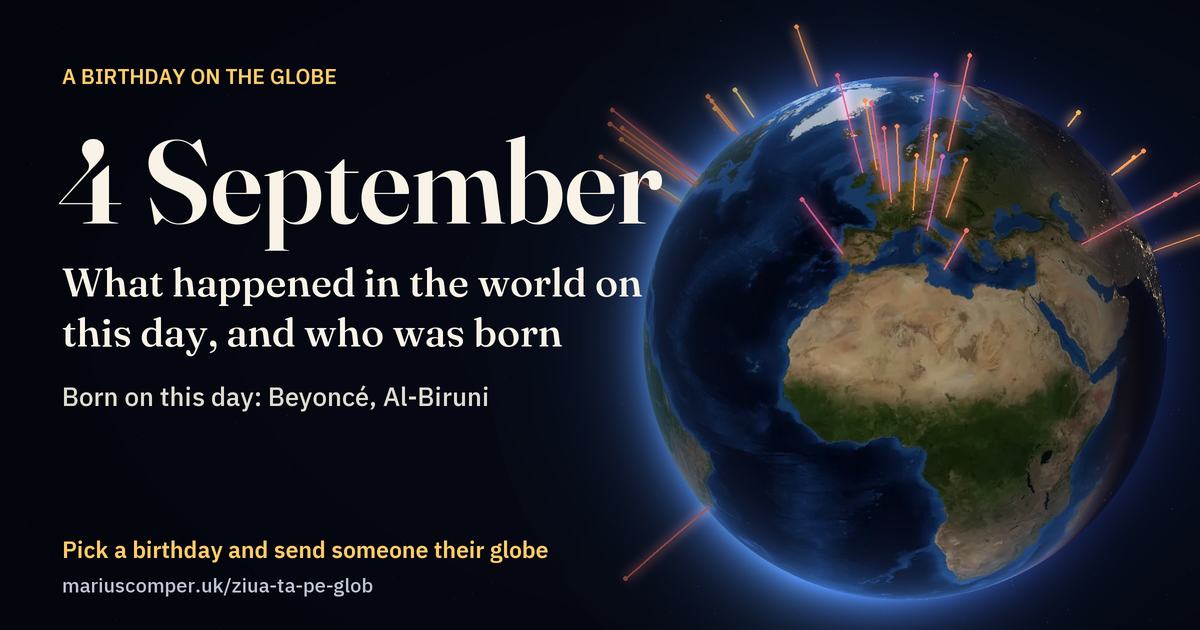
For 4 September, the English Wikipedia lists 60 events and 193 births. 33 of the events stand at their places as rays of light; six more are dashed circles, where the sentence links only to a country or a sea. The taller the ray, the longer ago it happened. The people born that day come further down, as blue points.
A birthday, yours or someone else’s:
Turn it into a greetingScroll: the globe turns to each place
The day you were born, on the globe.
Three things from your day
Scroll: your day first, then 4 September through the years
The Earth on 4 September
The picture on the globe was assembled by NASA from satellite photographs taken in September 2004: the snow, the ice and the green are those of the month.
On 4 September the Sun passes straight overhead at noon along the parallel of 7.2° north. In London, the day lasts about 13 hours 25 minutes.
Beyond 83° north the Sun no longer sets; beyond 83° south it no longer rises.
The line between day and night is tilted on the globe exactly as on this day of the year. On the dark side you can see the lights of towns.
Britain & Ireland · Flight of the Earls
1607
The Flight of the Earls takes place in Ireland (14 September N.S.).
On the map: Flight of the Earls.
Britain & Ireland · Edinburgh
1964
Scotland's Forth Road Bridge near Edinburgh officially opens.
On the map: Edinburgh.
Europe · Treaty of Alcáçovas
1479
The Treaty of Alcáçovas is signed by the Catholic Monarchs of Castile and Aragon on one side and Afonso V and his son, Prince John of Portugal.
On the map: the coordinates Wikidata gives for the article “Treaty of Alcáçovas”.
Also on the day’s list of Wikipedia in Spanish.
Europe · Leipzig
1989
In Leipzig, East Germany, the first of weekly demonstration for the legalisation of opposition groups and democratic reforms takes place.
On the map: Leipzig.
Asia · Tokyo DisneySea
2001
Tokyo DisneySea opens to the public as part of the Tokyo Disney Resort in Urayasu, Chiba, Japan.
On the map: Tokyo DisneySea.
Also on the day’s list of Wikipedia in Chinese.
Latin America · Old Cathedral of Rio de Janeiro
1843
The state wedding of Teresa Cristina of the Two Sicilies and Emperor Pedro II of Brazil took place at the Cathedral of Rio de Janeiro.
On the map: Old Cathedral of Rio de Janeiro.
North America · Darlington Raceway
1950
Darlington Raceway is the site of the inaugural Southern 500, the first 500-mile NASCAR race.
On the map: Darlington Raceway.
North America · War Memorial Opera House
1951
The first live transcontinental television broadcast takes place in San Francisco, United States, from the Japanese Peace Treaty Conference.
On the map: War Memorial Opera House.
North America · Stanford University
1998
Google is founded by Larry Page and Sergey Brin, two PhD students at Stanford University.
On the map: Stanford University.
Also on the day’s list of Wikipedia in Romanian.
4 September
What the other Wikipedias remember#
For these years the English list has nothing on this day. The events below come from the same day’s lists on Wikipedia in Chinese and were translated for this page.
From Wikipedia in Chinese · Seoul
1990
The North Korean premier Yon Hyong Muk crosses the 38th parallel and arrives in Seoul, where he holds with the South Korean premier Kang Young-hoon the first prime-ministerial talks between the two sides since the division of the Korean Peninsula.
On the map: Seoul.
Translated from the list on Wikipedia in Chinese.
4 September
Born on 4 September#
The English Wikipedia lists 193 births for this day. The blue points are the birthplaces of 60 of these people: those written about in the most Wikipedia editions, where Wikidata gives a place of birth.
Born on 4 September
1981
Beyoncé, American singer-songwriter
Place of birth: Houston.
Born on 4 September
973
Al-Biruni, Persian physician and polymath (died 1048)
Place of birth: Kath.
Born on 4 September
1824
Anton Bruckner, Austrian organist and composer (died 1896)
Place of birth: Ansfelden.
Born on 4 September
1896
Antonin Artaud, French actor, director, and playwright (died 1948)
Place of birth: Marseille.
Born on 4 September
1985
Raúl Albiol, Spanish footballer
Place of birth: Vilamarxant.
Born in Britain and Ireland
1934
Clive Granger, Welsh-American economist and academic, Nobel Prize laureate (died 2009)
Place of birth: Swansea.
Born in Britain and Ireland
1975
Mark Ronson, English DJ, producer, and songwriter, co-founded Allido Records
Place of birth: London.
Born in Britain and Ireland
1990
James Bay, English singer-songwriter and guitarist
Place of birth: Hitchin.
4 September
Number one in the charts that week
At the cinema
An animal recorded that day
The record can be seen in GBIF, which brings together wildlife records from around the world.
All your birthdays
The weather that day
Data: Met Office Hadley Centre (HadCET); NOAA (GHCN-Daily, Mauna Loa).
Above the Earth
Sources: Jonathan McDowell, GCAT (launches); GFZ Potsdam (Kp index). Days are counted in Universal Time.
Football that day
International matches played that day:
Source: the “International football results” dataset kept by Mart Jürisoo (CC0).
Also that day
The earthquake’s page at the USGS
Source: the USGS catalogue. The day is counted in Universal Time (UTC).
In those days
Make a link for someone
Type the name, pick the day and the year of birth. The link opens straight on their day, with their name in the greeting.
The link carries the name, date and place typed here; anyone who gets it can see them.
Put another birthday beside it
Your mother’s, your child’s, a friend’s: the two days appear side by side.
Below: 4 September through the years.
The whole globe of the day
Drag the globe to turn it. Touch a ray or a point to read what happened there.
Everything Wikipedia lists for 4 September
The list is the English Wikipedia’s, in its own wording, as it stood in October 2026. 21 events have no place on the map: the sentence links to no place with coordinates, only to places too wide to mark, or to several countries.
- 476
Romulus Augustulus is deposed when Odoacer proclaims himself "King of Italy", thus ending the Western Roman Empire.
no place on the mapWikipedia: Fall of the Western Roman Empire - 626
Li Shimin, posthumously known as Emperor Taizong of Tang, assumes the throne over the Tang dynasty of China.
no place on the mapWikipedia: Posthumous name - 929
Battle of Lenzen: Slavic forces (the Redarii and the Obotrites) are defeated by a Saxon army near the fortified stronghold of Lenzen in Brandenburg.
Europe · Lenzen (Elbe)Wikipedia: Battle of Lenzen - 1260
The Sienese Ghibellines, supported by the forces of Manfred, King of Sicily, defeat the Florentine Guelphs at Montaperti.
Europe · Battle of MontapertiWikipedia: Battle of Montaperti - 1282
Peter III of Aragon is proclaimed King of Sicily in Palermo.
no place on the mapWikipedia: Peter III of Aragon - 1479
The Treaty of Alcáçovas is signed by the Catholic Monarchs of Castile and Aragon on one side and Afonso V and his son, Prince John of Portugal.
Europe · Treaty of AlcáçovasWikipedia: Treaty of Alcáçovas - 1607
The Flight of the Earls takes place in Ireland (14 September N.S.).
Britain & Ireland · Flight of the EarlsWikipedia: Flight of the Earls - 1666
In London, England, the most destructive damage from the Great Fire occurs.
Britain & Ireland · Great Fire of LondonWikipedia: Great Fire of London - 1746
The Treaty of Kerden concludes the Ottoman–Persian War (1743–1746).
Asia · KordanWikipedia: Treaty of Kerden - 1774
New Caledonia is first sighted by Europeans, during the second voyage of Captain James Cook.
Oceania · New CaledoniaWikipedia: New Caledonia - 1781
Los Angeles is founded as El Pueblo de Nuestra Señora La Reina de los Ángeles (The Village of Our Lady, the Queen of the Angels) by 44 Spanish settlers.
no place on the mapWikipedia: Pueblo de Los Ángeles - 1797
Coup of 18 Fructidor in France.
Europe · Tuileries PalaceWikipedia: Coup of 18 Fructidor - 1800
French Revolutionary Wars: Facing starvation and a death rate of 100 soldiers per day, the French garrison in Malta surrendered to British forces, ending a two-year siege.
Europe · Siege of MaltaWikipedia: French Revolutionary Wars - 1800
The French garrison in Valletta surrenders to British troops who had been called at the invitation of the Maltese. The islands of Malta and Gozo become the Malta Protectorate.
Europe · VallettaWikipedia: Malta - 1812
War of 1812: The Siege of Fort Harrison begins when the fort is set on fire.
North America · Fort Harrison, IndianaWikipedia: Fort Harrison, Indiana - 1813
Future U.S. president Andrew Jackson is shot in a tavern brawl with future U.S. Senator Thomas Hart Benton and others.
no place on the mapWikipedia: 1813 Jackson–Benton brawl - 1827
The Great Fire of Turku almost completely destroys Finland's former capital city.
Europe · Great Fire of TurkuWikipedia: Great Fire of Turku - 1839
Battle of Kowloon: British vessels open fire on Chinese war junks enforcing a food sales embargo on the British community in China in the first armed conflict of the First Opium War.
Asia · Battle of KowloonWikipedia: Battle of Kowloon - 1843
The state wedding of Teresa Cristina of the Two Sicilies and Emperor Pedro II of Brazil took place at the Cathedral of Rio de Janeiro.
Latin America · Old Cathedral of Rio de JaneiroWikipedia: Teresa Cristina of the Two Sicilies - 1862
American Civil War Maryland Campaign: General Robert E. Lee takes the Army of Northern Virginia, and the war, into the North.
North America · MarylandWikipedia: American Civil War - 1870
Emperor Napoleon III of France is deposed and the Third Republic is declared.
Europe · French Third RepublicWikipedia: Napoleon III - 1882
The Pearl Street Station in New York City becomes the first power plant to supply electricity to paying customers.
North America · Pearl Street StationWikipedia: Pearl Street Station - 1886
American Indian Wars: After almost 30 years of fighting, Apache leader Geronimo, with his remaining warriors, surrenders to General Nelson Miles in Arizona.
North America · ArizonaWikipedia: American Indian Wars - 1888
George Eastman registers the trademark Kodak and receives a patent for his camera that uses roll film.
no place on the mapWikipedia: George Eastman - 1912
Albanian rebels succeed in their revolt when the Ottoman Empire agrees to fulfill their demands
Europe · AlbaniaWikipedia: Albania - 1919
Mustafa Kemal Atatürk, who founded the Republic of Turkey, gathers a congress in Sivas to make decisions as to the future of Anatolia and Thrace.
no place on the mapWikipedia: Mustafa Kemal Atatürk - 1920
Peasants in and around Križ began a rebellion to protest economic and conscription policies enacted by the Kingdom of Serbs, Croats and Slovenes.
Europe · Križ, Zagreb CountyWikipedia: 1920 Croatian Peasant Rebellion - 1923
Maiden flight of the first U.S. airship, the USS Shenandoah.
no place on the mapWikipedia: Airship - 1934
Evelyn Waugh's novel A Handful of Dust was first published in full.
no place on the mapWikipedia: Evelyn Waugh - 1936
Spanish Civil War: Largo Caballero forms a war cabinet to direct the republican war effort.
no place on the mapWikipedia: Spanish Civil War - 1939
World War II: William J. Murphy commands the first Royal Air Force attack on Germany.
no place on the mapWikipedia: World War II - 1941
World War II: A German submarine makes the first attack of the war against a United States warship, the USS Greer.
no place on the mapWikipedia: USS Greer - 1944
World War II: Finland exits from the war with Soviet Union.
no place on the mapWikipedia: Continuation War - 1944
World War II: The British 11th Armoured Division liberates the Belgian city of Antwerp.
Europe · AntwerpWikipedia: 11th Armoured Division - 1948
Queen Wilhelmina of the Netherlands abdicates for health reasons.
no place on the mapWikipedia: Wilhelmina of the Netherlands - 1949
Paul Robeson performs a second concert in Peekskill, New York eight days after the Peekskill riots.
North America · Peekskill riotsWikipedia: Peekskill riots - 1950
Darlington Raceway is the site of the inaugural Southern 500, the first 500-mile NASCAR race.
North America · Darlington RacewayWikipedia: Southern 500 - 1951
The first live transcontinental television broadcast takes place in San Francisco, United States, from the Japanese Peace Treaty Conference.
North America · War Memorial Opera HouseWikipedia: Treaty of San Francisco - 1955
A white U.S. soldier raped and murdered a five-year-old local girl in Kadena, Okinawa.
Asia · Yumiko-chan incidentWikipedia: Yumiko-chan incident - 1957
American Civil Rights Movement: Little Rock Crisis: The governor of Arkansas calls out the National Guard to prevent African American students from enrolling in Little Rock Central High School, resulting in the lawsuit Cooper v. Aaron the following year.
North America · Little Rock NineWikipedia: Civil rights movement - 1963
Swissair Flight 306 crashes near Dürrenäsch, Switzerland, killing all 80 people on board.
Europe · Swissair Flight 306Wikipedia: Swissair Flight 306 - 1964
Scotland's Forth Road Bridge near Edinburgh officially opens.
Britain & Ireland · EdinburghWikipedia: Forth Road Bridge - 1967
Vietnam War: Operation Swift begins when U.S. Marines engage the North Vietnamese in battle in the Que Son Valley.
Asia · Quế SơnWikipedia: Vietnam War - 1970
Salvador Allende is elected President of Chile.
Latin America · ChileWikipedia: Salvador Allende - 1971
Alaska Airlines Flight 1866 crashes near Juneau, Alaska, killing all 111 people on board.
North America · Alaska Airlines Flight 1866Wikipedia: Alaska Airlines Flight 1866 - 1972
Mark Spitz becomes the first competitor to win seven medals at a single Olympic Games.
no place on the mapWikipedia: Mark Spitz - 1972
The Price Is Right premieres on CBS. It currently is the longest running game show on American television.
no place on the mapWikipedia: The Price Is Right - 1975
The Sinai Interim Agreement relating to the Arab–Israeli conflict is signed.
no place on the mapWikipedia: Sinai Interim Agreement - 1977
The Golden Dragon massacre takes place in San Francisco.
North America · Golden Dragon massacreWikipedia: Golden Dragon massacre - 1985
The discovery of Buckminsterfullerene, the first fullerene molecule of carbon.
no place on the mapWikipedia: Buckminsterfullerene - 1989
In Leipzig, East Germany, the first of weekly demonstration for the legalisation of opposition groups and democratic reforms takes place.
Europe · LeipzigWikipedia: Leipzig - 1995
The 1995 Okinawa rape occurs when 3 US servicemen abduct and rape a schoolchild. This would cause widespread protest against the US military presence on the prefecture.
Asia · KinWikipedia: 1995 Okinawa rape incident - 1998
Google is founded by Larry Page and Sergey Brin, two PhD students at Stanford University.
North America · Stanford UniversityWikipedia: Stanford University - 2001
Tokyo DisneySea opens to the public as part of the Tokyo Disney Resort in Urayasu, Chiba, Japan.
Asia · Tokyo DisneySeaWikipedia: Urayasu - 2002
The Oakland Athletics win their 20th consecutive game, an American League record, until the Cleveland Indians surpassed it in 2017.
no place on the mapWikipedia: Oakland Athletics - 2007
Three terrorists suspected to be a part of Al-Qaeda are arrested in Germany after allegedly planning attacks on both the Frankfurt International airport and US military installations.
no place on the mapWikipedia: 2007 bomb plot in Germany - 2010
A magnitude-7.1 earthquake struck the Canterbury Region of New Zealand, causing two deaths and up to NZ$40 billion in damages.
Oceania · 2010 Canterbury earthquakeWikipedia: 2010 Canterbury earthquake - 2020
Pope Benedict XVI becomes the longest-lived pope, 93 years, four months, 16 days, surpassing Pope Leo XIII, who died in 1903.
no place on the mapWikipedia: Pope Benedict XVI - 2022
Ten people are killed and 15 are injured in a stabbing spree in 13 locations on the James Smith Cree Nation and in Weldon, Saskatchewan.
North America · James Smith Cree NationWikipedia: 2022 Saskatchewan stabbings - 2024
A 14-year-old gunman kills four people and injures seven in a mass shooting at Apalachee High School near Winder, Georgia.
North America · 2024 Apalachee High School shootingWikipedia: 2024 Apalachee High School shooting
What the other Wikipedias remember
For these years the English list has nothing on this day. The events below come from the same day’s lists on Wikipedia in Chinese and were translated for this page.
- 1990
The North Korean premier Yon Hyong Muk crosses the 38th parallel and arrives in Seoul, where he holds with the South Korean premier Kang Young-hoon the first prime-ministerial talks between the two sides since the division of the Korean Peninsula.
Who was born on 4 September
In order of how many Wikipedia editions have an article about each. The first 60 of 193 are shown.
- 1981
Beyoncé, American singer-songwriter
HoustonWikipedia: Beyoncé - 973
Al-Biruni, Persian physician and polymath (died 1048)
- 1768
François-René de Chateaubriand, French historian and politician, Minister of Foreign Affairs for France (died 1848)
- 1824
Anton Bruckner, Austrian organist and composer (died 1896)
AnsfeldenWikipedia: Anton Bruckner - 1969
Giorgi Margvelashvili, Georgian academic and politician, 4th President of Georgia
- 1896
Antonin Artaud, French actor, director, and playwright (died 1948)
MarseilleWikipedia: Antonin Artaud - 1985
Raúl Albiol, Spanish footballer
VilamarxantWikipedia: Raúl Albiol - 1927
John McCarthy, American computer scientist and academic (died 2011)
- 1809
Juliusz Słowacki, Polish poet and playwright (died 1849)
KremenetsWikipedia: Juliusz Słowacki - 1913
Kenzō Tange, Japanese architect (died 2005)
- 1906
Max Delbrück, German-American biophysicist and academic, Nobel Prize laureate (died 1981)
CharlottenburgWikipedia: Max Delbrück - 1962
Shinya Yamanaka, Japanese physician and biologist, Nobel Prize laureate
HiraokaWikipedia: Shinya Yamanaka - 1241
Alexander III, king of Scotland (died 1286)
- 1926
Ivan Illich, Austrian priest and philosopher (died 2002)
ViennaWikipedia: Ivan Illich - 1993
Yannick Carrasco, Belgian footballer
- 1913
Stanford Moore, American biochemist and academic, Nobel Prize laureate (died 1982)
ChicagoWikipedia: Stanford Moore - 1934
Clive Granger, Welsh-American economist and academic, Nobel Prize laureate (died 2009)
SwanseaWikipedia: Clive Granger - 1908
Richard Wright, American novelist, short story writer, essayist, and poet (died 1960)
NatchezWikipedia: Richard Wright - 1953
Fatih Terim, Turkish footballer and manager
- 1877
Kārlis Ulmanis, Latvian prime minister and president (died 1942)
- 1891
Fritz Todt, German engineer, politician, and senior Nazi official (died 1942)
PforzheimWikipedia: Fritz Todt - 1563
Wanli, Chinese emperor (died 1620)
BeijingWikipedia: Wanli Emperor - 1975
Mark Ronson, English DJ, producer, and songwriter, co-founded Allido Records
LondonWikipedia: Mark Ronson - 1892
Darius Milhaud, French composer and educator (died 1974)
MarseilleWikipedia: Darius Milhaud - 1850
Luigi Cadorna, Italian field marshal (died 1928)
PallanzaWikipedia: Luigi Cadorna - 1825
Dadabhai Naoroji, Indian academic and politician, President of the Indian National Congress (died 1917)
- 1986
Ayumi Kaihori, Japanese footballer
Nagaokakyō-shiWikipedia: Ayumi Kaihori - 1934
Eduard Khil, Russian baritone singer (died 2012)
SmolenskWikipedia: Eduard Khil - 1937
Dawn Fraser, Australian swimmer and politician
BalmainWikipedia: Dawn Fraser - 1968
John DiMaggio, American voice actor
North PlainfieldWikipedia: John DiMaggio - 1888
Oskar Schlemmer, German painter, sculptor, designer and choreographer (died 1943)
StuttgartWikipedia: Oskar Schlemmer - 1934
Jan Švankmajer, Czech filmmaker and artist
- 1978
Wes Bentley, American actor and producer
JonesboroWikipedia: Wes Bentley - 1557
Sophie of Mecklenburg-Güstrow, queen consort of Denmark and Norway (died 1631)
- 1803
Sarah Childress Polk, First Lady of the United States (died 1891)
MurfreesboroWikipedia: Sarah Childress Polk - 2000
Sergio Gómez, Spanish footballer
BadalonaWikipedia: Sergio Gómez - 1931
Mitzi Gaynor, American actress, singer, and dancer (died 2024)
ChicagoWikipedia: Mitzi Gaynor - 1957
Khandi Alexander, American actress, dancer, and choreographer
New York CityWikipedia: Khandi Alexander - 1960
Damon Wayans, American actor, director, producer, and screenwriter
New York CityWikipedia: Damon Wayans - 1908
Edward Dmytryk, Canadian-American director and producer (died 1999)
Grand ForksWikipedia: Edward Dmytryk - 1917
Henry Ford II, American businessman (died 1987)
DetroitWikipedia: Henry Ford II - 1936
Judea Pearl, computer scientist recognized for his pioneering work in the fields of AI and probabilistic reasoning
Tel AvivWikipedia: Judea Pearl - 1973
Jason David Frank, American actor and mixed martial artist (died 2022)
- 1990
James Bay, English singer-songwriter and guitarist
HitchinWikipedia: James Bay - 1846
Daniel Burnham, American architect, designed the World's Columbian Exposition (died 1912)
HendersonWikipedia: Daniel Burnham - 1905
Mary Renault, English-South African author (died 1983)
LondonWikipedia: Mary Renault - 1979
Max Greenfield, American actor
Dobbs FerryWikipedia: Max Greenfield - 1596
Constantijn Huygens, Dutch poet and composer (died 1687)
The HagueWikipedia: Constantijn Huygens - 1755
Axel von Fersen the Younger, Swedish general and politician (died 1810)
Jakob and Johannes parishWikipedia: Axel von Fersen the Younger - 1956
Blackie Lawless, American singer-songwriter and guitarist
- 1969
Noah Taylor, Australian actor
LondonWikipedia: Noah Taylor - 1809
Manuel Montt, Chilean scholar and politician, 6th President of Chile (died 1880)
PetorcaWikipedia: Manuel Montt - 1986
Xavier Woods, American wrestler
ColumbusWikipedia: Xavier Woods - 1928
Dick York, American actor (died 1992)
Fort WayneWikipedia: Dick York - 1981
Richard Garcia, Australian footballer
- 1848
Lewis Howard Latimer, American inventor (died 1928)
- 1944
Tony Atkinson, English economist and academic (died 2017)
CaerleonWikipedia: Tony Atkinson - 1970
Igor Cavalera, Brazilian drummer
Belo HorizonteWikipedia: Igor Cavalera - 1972
Carlos Ponce, Puerto-Rican entertainer
SanturceWikipedia: Carlos Ponce - 1977
Awesome Kong (Kia Stevens), American wrestler
CarsonWikipedia: Awesome Kong
What is celebrated on 4 September
- Christian feast day: Candida the Elder
- Christian feast day: Blessed Catherine of Racconigi
- Christian feast day: Blessed Dina Bélanger
- Christian feast day: Hermione of Ephesus
- Christian feast day: Ida of Herzfeld
- Christian feast day: Irmgardis (of Süchteln)
- Christian feast day: Moses and Aaron (Catholic, Lutheran Church and Eastern Orthodox Church)
- Christian feast day: Paul Jones (Episcopal Church)
- Christian feast day: Rosalia
- Christian feast day: Rose of Viterbo
- Christian feast day: Rufinus, Silvanus, and Vitalicus
- Christian feast day: Thamel and companions
- Christian feast day: Ultan of Ardbraccan
- Christian feast day: September 4 (Eastern Orthodox liturgics)
A greeting link for someone
Type a name and, if you like, the year of birth. The link opens with a greeting, and beside each event it says how old the person turned that day, or how many years before their birth it happened.
The name and the year go only into the link you send.
All 366 days
How the globe is made
Where the events come from
Each edition of this page uses the day’s list from Wikipedia in its own language: Romanian, English, Spanish, Chinese. The lists are written by volunteers and differ from one edition to the next; the text of each event is Wikipedia’s, with a link to the article. A row that appears twice in a list is shown once. The lists have not been checked event by event: they are Wikipedia’s, mistakes included.
For events before 1582, and for countries that moved to the Gregorian calendar later (Britain in 1752, Russia in 1918), the same day may be counted Old Style in one list and New Style in another.
The chapter “What the other Wikipedias remember” adds up to five events a day from the lists of the other three editions, only for years in which the English list has nothing on that day. They were translated for this page, passed the same filters as the tour, and are not counted among the events of the English list.
How an event gets onto the map
The place comes from Wikidata. If the sentence links to the article about the event itself (a battle, an opening, an earthquake), dated to the same year, the ray stands on its coordinates or on those of its location. Otherwise it stands on the first place the sentence links to: a town, a building, a mountain, an island. This second step can be wrong: sometimes the sentence only mentions the place. That is why the page says, under each event, which place the ray stands on.
When the sentence links to a single state or province, or to a single sea, lake or desert larger than 5,000 km², the globe shows a dashed circle, not a ray. The circle has the area Wikidata gives, with its radius kept between 1.2° and 16°, or a radius of 4.5° when Wikidata gives no area; it says only that the sentence links to that place. Organisations, ships, spacecraft, museum objects, rivers, mountain ranges, languages and continents are never used as places. When a sentence names several states and no exact place, the event stays in the list only.
What the height means
The height of a ray shows how many years have passed, on a logarithmic scale: 10 years, 100 years and 1,000 years are equal steps apart; anything older than about 2,600 years has the tallest ray. The colour runs from pale yellow for recent years to violet for antiquity.
Where the tour stops
In each region the tour stops at up to three events (five in Britain and Ireland), chosen mainly by three things: whether Wikipedia’s editors put the event in the “On this day” box of their main page (the English, Spanish and Chinese editions), how many Wikipedia editions have an article about it, and how many of the four lists include it. Events whose sentence or article is about a war, an attack, a crime or a disaster are left out of the tour; they stay in the whole list, in Wikipedia’s wording. The filter is a list of words and a list of Wikidata types, so it can miss some.
The tour of births names the people with articles in the most editions and leaves aside those whom the list or Wikidata describes as rulers, politicians, commanders, leaders of movements or criminals; they stay in the list.
The Earth and the Sun
The daytime images are NASA’s Blue Marble Next Generation mosaics, one for each month of 2004; the night side is Black Marble 2016. The tilt of the line between day and night is computed for the day; the hour is chosen so that the place being read is in daylight. The latitude where the Sun stands overhead is the average of the four years of the leap cycle; in a given year it can differ by up to 0.4°.
The day you were born
The number ones come from the weekly lists on Wikipedia: Billboard for the United States (from 1940; the Hot 100 from August 1958), the UK Singles Chart (from November 1952), Los 40 Principales for Spain (from July 1966) and, for Romania, the Romanian Top 100 and Airplay 100 (2001–2021, with missing weeks). The page shows the chart of the week in which the day of birth falls, with its date; Billboard and the UK chart are dated at the end of their week. For Romania before 2001 and for China these sources have no weekly chart.
The films are those that reached cinemas in the United States up to ten days before or three days after that day (some of them in a few cinemas at first), from the English Wikipedia’s yearly lists (from 1968), in order of how many editions have an article about them. The events “in those days” are the ones on the neighbouring days’ lists that carry the year of birth, passed through the same filter as the tour.
The day of birth, year included
The Moon, the star sign and the constellation are worked out by the page itself, for noon Universal Time on the day. The lit part of the Moon is rounded and can differ by a few per cent from that at the hour of birth. The sign follows the usual zodiac of twelve equal parts starting at the March equinox; the constellation is the one the Sun actually stood in front of, by the borders set by the International Astronomical Union, and within a day of a border the page does not name it. When the Sun changes sign while it is that day anywhere on Earth, the page gives the moment of crossing, rounded to ten minutes and accurate to within about a quarter of an hour, and the clock time in a few cities, with the time zone and summer time of that year.
The year in the Chinese calendar is the one your device’s own calendar gives for the date, checked against the Hong Kong Observatory’s tables. “All your birthdays” uses the same sources as the rest of the chapter for the same day in every year since the birth: the temperature, well-known launches that took place on that very day, matches of the teams the edition follows, snow deeper than 10 cm and strong geomagnetic storms. The three things at the top and the four on the picture are chosen in a fixed order (the song, the animal, a full Moon, a well-known launch before an ordinary earthquake); on the picture you can change them.
When the link carries a year of birth, the page adds a few things about that exact day. The weather is the Met Office’s Central England temperature record and the readings from New York’s Central Park; the “usual high” is the average of the daily highs of 1961–1990 for that date, with two days either side. The carbon dioxide figure is the monthly mean at the Mauna Loa observatory, where measurements begin in March 1958.
The earthquake is the one with the largest magnitude in the USGS catalogue for that day, counted in Universal Time. Before the 1960s the catalogue has gaps even above magnitude 5.5, so in the older years many days have no earthquake. The page gives only the magnitude and the place: the country the epicentre falls in or, when the epicentre is at sea within 300 km of a coast, the nearest country; farther out, only the ocean.
The launches are those that reached orbit or left for the Moon and the planets, from Jonathan McDowell’s GCAT catalogue. If nothing left that day, the page shows the nearest launch within three days before or after, and says how many days away it was. The geomagnetic storm appears only when the Kp index reached at least 5 in one of the day’s eight three-hour intervals.
The animal comes from GBIF: an observation made by a person (the animal seen or heard, or its tracks), dated to that exact day, with coordinates and a CC0 or CC BY licence. Only a few hundred well-known species are searched (mammals, birds, turtles, butterflies); of those noted that day, mammals and species with articles in many Wikipedia editions come first; birds noted almost every day, and species used recently, wait their turn. Observations dated 1 January are left out, because records without a day are often filed there. An observation shows that the animal was recorded there, not how many animals there were.
The matches are those between national teams. Only matches of England, Scotland, Wales, Northern Ireland, the Republic of Ireland, the United States, Canada and Australia are shown, along with those at the big final tournaments. The picture to send is drawn in the page from the day’s globe and the facts above, and stays on your device until you send it.
Sources
- Events, births and holidays: the day’s page on Wikipedia, text under CC BY-SA 4.0.
- Coordinates, places of birth and the number of editions: Wikidata (CC0).
- The Earth by day: NASA Blue Marble Next Generation. The Earth by night: NASA Black Marble 2016.
- Borders and regions: Natural Earth.
- World population and births per year: UN World Population Prospects 2024.
- Charts and films: Wikipedia’s lists for Billboard, the UK Singles Chart, Los 40 Principales, Romanian Top 100, Airplay 100 and American films by year (CC BY-SA 4.0).
- Weather: Met Office Hadley Centre, HadCET (Open Government Licence) and NOAA GHCN-Daily, New York Central Park. Carbon dioxide: NOAA Global Monitoring Laboratory, Mauna Loa.
- Earthquakes: the USGS catalogue. Launches: Jonathan McDowell, GCAT (CC BY). Kp index: GFZ Potsdam (CC BY 4.0). Matches: International football results, Mart Jürisoo (CC0).
- Animal observations: GBIF, with a link to each record; species names come from Wikidata.