A birthday on the globe
17 March on the globe: what happened in the world on this day, and who was born
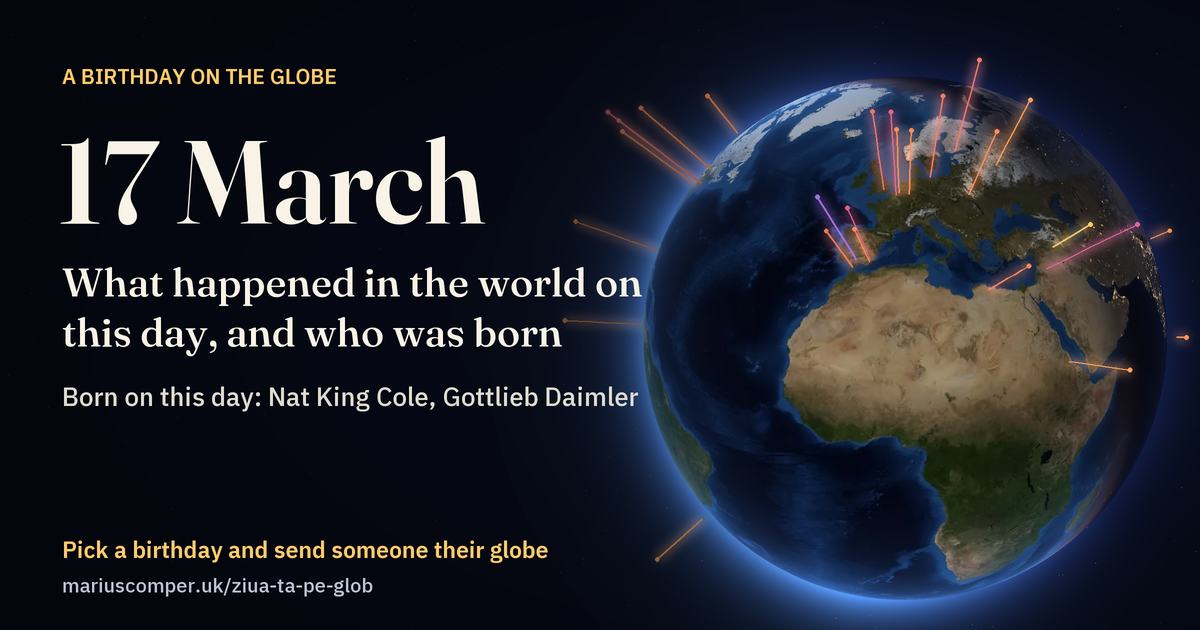
For 17 March, the English Wikipedia lists 46 events and 211 births. 26 of the events stand at their places as rays of light; nine more are dashed circles, where the sentence links only to a country or a sea. The taller the ray, the longer ago it happened. The people born that day come further down, as blue points.
A birthday, yours or someone else’s:
Turn it into a greetingScroll: the globe turns to each place
The day you were born, on the globe.
Three things from your day
Scroll: your day first, then 17 March through the years
The Earth on 17 March
The picture on the globe was assembled by NASA from satellite photographs taken in March 2004: the snow, the ice and the green are those of the month.
On 17 March the Sun passes straight overhead at noon along the parallel of 1.1° south. In London, the day lasts about 12 hours.
The line between day and night is tilted on the globe exactly as on this day of the year. On the dark side you can see the lights of towns.
Britain & Ireland · London
1824
The Anglo-Dutch Treaty is signed in London, dividing the Malay archipelago. As a result, the Malay Peninsula is dominated by the British, while Sumatra and Java and surrounding areas are dominated by the Dutch.
On the map: London.
Europe · Helsinki
1862
The first railway line of Finland between cities of Helsinki and Hämeenlinna, called Päärata, is officially opened.
On the map: Helsinki.
Europe · Treaty of Brussels
1948
Belgium, France, Luxembourg, the Netherlands and the United Kingdom sign the Treaty of Brussels, a precursor to the North Atlantic Treaty establishing NATO.
On the map: the coordinates Wikidata gives for the article “Treaty of Brussels”.
Also on the day’s list of Wikipedia in Chinese.
North America · University of California, Berkeley
1950
Researchers at the University of California, Berkeley announce the creation of element 98, which they name "californium".
On the map: University of California, Berkeley.
Also on the day’s list of Wikipedia in Spanish and Romanian.
17 March
What the other Wikipedias remember#
For these years the English list has nothing on this day. The events below come from the same day’s lists on Wikipedia in Spanish, Romanian and Chinese and were translated for this page.
From Wikipedia in Spanish · Royal Opera House
1749
In England, at the Covent Garden Theatre in London, George Frideric Handel presents his oratorio Solomon.
On the map: Royal Opera House.
Translated from the list on Wikipedia in Spanish.
From Wikipedia in Romanian · Paris
1901
The 71 paintings of the Dutch painter Vincent van Gogh are exhibited at the Bernheim-Jeune gallery in Paris, 11 years after his death, and cause a sensation.
On the map: Paris.
Translated from the list on Wikipedia in Romanian.
From Wikipedia in Chinese · Sapporo
2021
The Sapporo District Court rules that Japan's current marriage system, by not covering same-sex couples, violates the right to equality laid down in Article 14 of the Constitution of Japan.
On the map: Sapporo.
Translated from the list on Wikipedia in Chinese.
17 March
Born on 17 March#
The English Wikipedia lists 211 births for this day. The blue points are the birthplaces of 59 of these people: those written about in the most Wikipedia editions, where Wikidata gives a place of birth.
Born on 17 March
1919
Nat King Cole, American singer, pianist, and television host (died 1965)
Place of birth: Montgomery.
Born on 17 March
1834
Gottlieb Daimler, German engineer and businessman, co-founded Daimler-Motoren-Gesellschaft (died 1900)
Place of birth: Schorndorf.
Born on 17 March
1938
Rudolf Nureyev, Russian-French dancer and choreographer (died 1993)
Place of birth: Razdolnoe.
Born on 17 March
1989
Shinji Kagawa, Japanese footballer
Place of birth: Tarumi-ku.
Born in Britain and Ireland
1992
John Boyega, British actor and producer
Place of birth: London.
Born in Britain and Ireland
1969
Alexander McQueen, English fashion designer, founded eponymous brand (died 2010)
Place of birth: Lewisham.
17 March
Number one in the charts that week
At the cinema
An animal recorded that day
The record can be seen in GBIF, which brings together wildlife records from around the world.
All your birthdays
The weather that day
Data: Met Office Hadley Centre (HadCET); NOAA (GHCN-Daily, Mauna Loa).
Above the Earth
Sources: Jonathan McDowell, GCAT (launches); GFZ Potsdam (Kp index). Days are counted in Universal Time.
Football that day
International matches played that day:
Source: the “International football results” dataset kept by Mart Jürisoo (CC0).
Also that day
The earthquake’s page at the USGS
Source: the USGS catalogue. The day is counted in Universal Time (UTC).
In those days
Make a link for someone
Type the name, pick the day and the year of birth. The link opens straight on their day, with their name in the greeting.
The link carries the name, date and place typed here; anyone who gets it can see them.
Put another birthday beside it
Your mother’s, your child’s, a friend’s: the two days appear side by side.
Below: 17 March through the years.
The whole globe of the day
Drag the globe to turn it. Touch a ray or a point to read what happened there.
Everything Wikipedia lists for 17 March
The list is the English Wikipedia’s, in its own wording, as it stood in October 2026. 11 events have no place on the map: the sentence links to no place with coordinates, only to places too wide to mark, or to several countries.
- 45 BC
In his last victory, Julius Caesar defeats the Pompeian forces of Titus Labienus and Pompey the Younger in the Battle of Munda.
Europe · Battle of MundaWikipedia: Battle of Munda - 180
Commodus becomes sole emperor of the Roman Empire at the age of eighteen, following the death of his father, Marcus Aurelius.
Europe · Roman EmpireWikipedia: Commodus - 455
Petronius Maximus becomes, with support of the Roman Senate, emperor of the Western Roman Empire; he forces Licinia Eudoxia, the widow of his predecessor, Valentinian III, to marry him.
Europe · Western Roman EmpireWikipedia: Petronius Maximus - 1337
Edward the Black Prince is made Duke of Cornwall, the first duchy in England.
Britain & Ireland · Kingdom of EnglandWikipedia: Edward the Black Prince - 1400
Turko-Mongol emperor Timur sacks Damascus.
Asia · Siege of DamascusWikipedia: Siege of Damascus - 1452
Reconquista: Combined Castilian and Murcian forces defeated the Emirate of Granada at the Battle of Los Alporchones around the city of Lorca.
Europe · Battle of Los AlporchonesWikipedia: Battle of Los Alporchones - 1677
Franco-Dutch War: France captured the town of Valenciennes in the Spanish Netherlands.
Europe · Siege of ValenciennesWikipedia: Siege of Valenciennes - 1776
American Revolutionary War: The British Army evacuates Boston, ending the Siege of Boston, after George Washington and Henry Knox place artillery in positions overlooking the city.
North America · Fortification of Dorchester HeightsWikipedia: Evacuation Day - 1805
The Italian Republic, with Napoleon as president, becomes the Kingdom of Italy, with Napoleon as King of Italy.
no place on the mapWikipedia: Italian Republic - 1824
The Anglo-Dutch Treaty is signed in London, dividing the Malay archipelago. As a result, the Malay Peninsula is dominated by the British, while Sumatra and Java and surrounding areas are dominated by the Dutch.
Britain & Ireland · LondonWikipedia: Anglo-Dutch Treaty of 1824 - 1842
The Female Relief Society of Nauvoo is formally organized with Emma Smith as president.
no place on the mapWikipedia: Relief Society - 1860
The First Taranaki War begins in Taranaki, New Zealand, a major phase of the New Zealand Wars.
Oceania · Taranaki RegionWikipedia: First Taranaki War - 1861
The Kingdom of Italy is proclaimed.
Europe · Kingdom of ItalyWikipedia: Kingdom of Italy - 1862
The first railway line of Finland between cities of Helsinki and Hämeenlinna, called Päärata, is officially opened.
Europe · HelsinkiWikipedia: Rail transport in Finland - 1864
Second Schleswig War: In an attempt to end a Danish blockade, Eduard von Jachmann led a Prussian squadron in an attack against a Danish fleet led by Edvard van Dockum.
Europe · Battle of JasmundWikipedia: Battle of Jasmund - 1891
SS Utopia collides with HMS Anson in the Bay of Gibraltar and sinks, killing 562 of the 880 passengers on board.
Europe · Bay of GibraltarWikipedia: SS Utopia - 1902
The Dorchester Heights Monument , memorializing the siege of Boston during the American Revolutionary War, was dedicated.
North America · Dorchester Heights MonumentWikipedia: Dorchester Heights Monument - 1917
World War I: Hugh Grosvenor, 2nd Duke of Westminster led a force to rescue 92 prisoners of war from Bir Hakeim, killing the Senussi guards and their families.
Africa · Bir Hakeim rescueWikipedia: World War I - 1921
The Second Polish Republic adopts the March Constitution.
Europe · Second Polish RepublicWikipedia: Second Polish Republic - 1942
Holocaust: The first Jews from the Lvov Ghetto are gassed at the Belzec death camp in what is today eastern Poland.
Europe · Lwów GhettoWikipedia: The Holocaust - 1945
World War II: The Ludendorff Bridge in Remagen, Germany, collapses, ten days after its capture.
Europe · RemagenWikipedia: World War II - 1948
Belgium, France, Luxembourg, the Netherlands and the United Kingdom sign the Treaty of Brussels, a precursor to the North Atlantic Treaty establishing NATO.
Europe · Treaty of BrusselsWikipedia: Treaty of Brussels - 1950
Researchers at the University of California, Berkeley announce the creation of element 98, which they name "californium".
North America · University of California, BerkeleyWikipedia: University of California, Berkeley - 1955
Ice hockey fans in Montreal rioted to protest the suspension of Montreal Canadiens star Maurice Richard for hitting an official.
North America · MontrealWikipedia: Richard Riot - 1957
A plane crash in Cebu, Philippines kills Philippine President Ramon Magsaysay and 24 others.
Asia · 1957 Cebu Douglas C-47 crashWikipedia: 1957 Cebu Douglas C-47 crash - 1958
The United States launches the first solar-powered satellite, which is also the first satellite to achieve a long-term orbit.
no place on the mapWikipedia: Vanguard 1 - 1960
Northwest Airlines Flight 710 explodes and crashes near Cannelton, Indiana, killing 63.
North America · Northwest Airlines Flight 710Wikipedia: Northwest Airlines Flight 710 - 1960
U.S. President Dwight D. Eisenhower signs the National Security Council directive on the anti-Cuban covert action program that will ultimately lead to the Bay of Pigs Invasion.
Latin America · Bay of Pigs InvasionWikipedia: Bay of Pigs Invasion - 1962
A Clockwork Orange, a British dystopian novel by Anthony Burgess, is published.
no place on the mapWikipedia: A Clockwork Orange - 1963
Mount Agung erupts on Bali killing more than 1,100 people.
Asia · Mount AgungWikipedia: Mount Agung - 1966
Off the coast of Spain in the Mediterranean, the DSV Alvin submarine finds a missing American hydrogen bomb.
Europe · 1966 Palomares accidentWikipedia: 1966 Palomares accident - 1968
As a result of nerve gas testing by the U.S. Army Chemical Corps in Skull Valley, Utah, over 6,000 sheep are found dead.
no place on the mapWikipedia: Dugway sheep incident - 1969
Golda Meir becomes the first female Prime Minister of Israel.
no place on the mapWikipedia: Golda Meir - 1973
The Pulitzer Prize–winning photograph Burst of Joy is taken, depicting a former prisoner of war being reunited with his family, which came to symbolize the end of United States involvement in the Vietnam War.
no place on the mapWikipedia: Burst of Joy - 1979
Aeroflot Flight 1691 crashes on approach to Vnukovo International Airport, killing 58.
Europe · Aeroflot Flight 1691Wikipedia: Aeroflot Flight 1691 - 1979
The Penmanshiel Tunnel collapses during engineering works, killing two workers.
no place on the mapWikipedia: Penmanshiel Tunnel - 1985
Serial killer Richard Ramirez, aka the "Night Stalker", commits the first two murders in his Los Angeles murder spree.
no place on the mapWikipedia: Richard Ramirez - 1988
A Colombian Boeing 727 jetliner, Avianca Flight 410, crashes into a mountainside near the Venezuelan border killing 143.
Latin America · Avianca Flight 410Wikipedia: Avianca Flight 410 - 1988
Eritrean War of Independence: The Nadew Command, an Ethiopian army corps in Eritrea, is attacked on three sides by military units of the Eritrean People's Liberation Front in the opening action of the Battle of Afabet.
Africa · Battle of AfabetWikipedia: Eritrean War of Independence - 1992
A referendum to end apartheid in South Africa is passed 68.7% to 31.2%.
Africa · South AfricaWikipedia: 1992 South African apartheid referendum - 1992
Israeli Embassy attack in Buenos Aires: Car bomb attack kills 29 and injures 242.
Latin America · 1992 Buenos Aires Israeli embassy bombingWikipedia: 1992 Buenos Aires Israeli embassy bombing - 2000
Five hundred and thirty members of the Ugandan cult Movement for the Restoration of the Ten Commandments of God die in a fire, considered to be a mass murder or suicide orchestrated by leaders of the cult. Elsewhere another 248 members are later found dead.
Africa · UgandaWikipedia: Uganda - 2003
Leader of the House of Commons and Lord President of the Council, Robin Cook, resigns from the British Cabinet in disagreement with government plans for the 2003 invasion of Iraq.
no place on the mapWikipedia: 2003 invasion of Iraq - 2004
Unrest in Kosovo: More than 22 are killed and 200 wounded. Thirty-five Serbian Orthodox shrines in Kosovo and two mosques in Serbia are destroyed.
no place on the mapWikipedia: 2004 unrest in Kosovo - 2011
First Libyan Civil War: The United Nations Security Council adopted Resolution 1973, authorizing military intervention in Libya to protect civilians.
Africa · LibyaWikipedia: 2011 military intervention in Libya - 2016
Rojava conflict: At a conference in Rmelan, the Movement for a Democratic Society declares the establishment of the Democratic Federation of Northern Syria.
Asia · RmelanWikipedia: Rojava Revolution
What the other Wikipedias remember
For these years the English list has nothing on this day. The events below come from the same day’s lists on Wikipedia in Spanish, Romanian and Chinese and were translated for this page.
- 1749
In England, at the Covent Garden Theatre in London, George Frideric Handel presents his oratorio Solomon.
Britain & Ireland · Royal Opera HouseTranslated from the list on Wikipedia in SpanishWikipedia: Royal Opera House - 1901
The 71 paintings of the Dutch painter Vincent van Gogh are exhibited at the Bernheim-Jeune gallery in Paris, 11 years after his death, and cause a sensation.
- 2021
The Sapporo District Court rules that Japan's current marriage system, by not covering same-sex couples, violates the right to equality laid down in Article 14 of the Constitution of Japan.
Who was born on 17 March
In order of how many Wikipedia editions have an article about each. The first 60 of 211 are shown.
- 763
Harun al-Rashid, Abbasid caliph (died 809)
- 1920
Sheikh Mujibur Rahman, Bangladeshi politician, 1st President of Bangladesh (died 1975)
Tungipara UpazilaWikipedia: Sheikh Mujibur Rahman - 1537
Toyotomi Hideyoshi, Japanese daimyō (died 1598)
Nakamura-kuWikipedia: Toyotomi Hideyoshi - 1919
Nat King Cole, American singer, pianist, and television host (died 1965)
MontgomeryWikipedia: Nat King Cole - 1834
Gottlieb Daimler, German engineer and businessman, co-founded Daimler-Motoren-Gesellschaft (died 1900)
SchorndorfWikipedia: Gottlieb Daimler - 1938
Rudolf Nureyev, Russian-French dancer and choreographer (died 1993)
RazdolnoeWikipedia: Rudolf Nureyev - 1986
Edin Džeko, Bosnian footballer
SarajevoWikipedia: Edin Džeko - 1989
Shinji Kagawa, Japanese footballer
Tarumi-kuWikipedia: Shinji Kagawa - 1948
William Gibson, American-Canadian author and screenwriter
- 1473
James IV of Scotland (died 1513)
Holyrood AbbeyWikipedia: James IV - 1983
Raul Meireles, Portuguese footballer
- 1881
Walter Rudolf Hess, Swiss physiologist and academic, Nobel Prize laureate (died 1973)
FrauenfeldWikipedia: Walter Rudolf Hess - 1979
Stormy Daniels, American adult film actress
Baton RougeWikipedia: Stormy Daniels - 1939
Giovanni Trapattoni, Italian footballer and manager
Cusano MilaninoWikipedia: Giovanni Trapattoni - 1997
Katie Ledecky, American swimmer
Washington, D.C.Wikipedia: Katie Ledecky - 1992
John Boyega, British actor and producer
LondonWikipedia: John Boyega - 1964
Rob Lowe, American actor
CharlottesvilleWikipedia: Rob Lowe - 1969
Alexander McQueen, English fashion designer, founded eponymous brand (died 2010)
LewishamWikipedia: Alexander McQueen - 1926
Siegfried Lenz, Polish-German author and playwright (died 2014)
- 1990
Saina Nehwal, Indian badminton player
Hisar districtWikipedia: Saina Nehwal - 1856
Mikhail Vrubel, Russian painter (died 1910)
- 1982
Steven Pienaar, South African footballer
JohannesburgWikipedia: Steven Pienaar - 1976
Álvaro Recoba, Uruguayan footballer
MontevideoWikipedia: Álvaro Recoba - 1930
James Irwin, American colonel, pilot, and astronaut, eighth astronaut to walk on the moon (died 1991)
PittsburghWikipedia: James Irwin - 1994
Marcel Sabitzer, Austrian footballer
- 1942
John Wayne Gacy, American serial killer and rapist (died 1994)
EdgewaterWikipedia: John Wayne Gacy - 1975
Puneeth Rajkumar, Indian actor, singer, and producer (died 2021)
ChennaiWikipedia: Puneeth Rajkumar - 1988
Grimes, Canadian musician, singer-songwriter, producer, and visual artist
VancouverWikipedia: Grimes - 1990
Hozier, Irish musician
- 1987
Federico Fazio, Argentine footballer
Buenos AiresWikipedia: Federico Fazio - 1900
Alfred Newman, American composer and conductor (died 1970)
New HavenWikipedia: Alfred Newman - 1907
Takeo Miki, Japanese politician, 41st Prime Minister of Japan (died 1988)
- 1936
Ken Mattingly, American admiral, pilot, and astronaut (died 2023)
ChicagoWikipedia: Ken Mattingly - 1988
Fraser Forster, English footballer
- 1941
Paul Kantner, American singer-songwriter and guitarist (died 2016)
San FranciscoWikipedia: Paul Kantner - 1989
Harry Melling, English actor
LondonWikipedia: Harry Melling - 1976
Stephen Gately, Irish singer-songwriter and actor (died 2009)
- 1862
Silvio Gesell, Belgian merchant and economist (died 1930)
Sankt VithWikipedia: Silvio Gesell - 1992
Yeltsin Tejeda, Costa Rican footballer
- 1908
Brigitte Helm, German-Swiss actress (died 1996)
SchönebergWikipedia: Brigitte Helm - 1979
Samoa Joe, American professional wrestler
Orange CountyWikipedia: Samoa Joe - 1988
Rasmus Elm, Swedish footballer
KalmarWikipedia: Rasmus Elm - 1933
Penelope Lively, English author
- 1981
Nicky Jam, Puerto Rican singer-songwriter
LawrenceWikipedia: Nicky Jam - 1886
Princess Patricia of Connaught (died 1974)
Buckingham PalaceWikipedia: Princess Patricia of Connaught - 1902
Bobby Jones, American golfer and lawyer (died 1971)
AtlantaWikipedia: Bobby Jones - 1955
Cynthia McKinney, American activist and politician
AtlantaWikipedia: Cynthia McKinney - 1777
Roger B. Taney, American politician and jurist, 5th Chief Justice of the United States (died 1864)
Calvert CountyWikipedia: Roger B. Taney - 1880
Lawrence Oates, English lieutenant and explorer (died 1912)
- 1925
Gabriele Ferzetti, Italian actor (died 2015)
- 1981
Servet Çetin, Turkish footballer
- 1981
Kyle Korver, American basketball player
LakewoodWikipedia: Kyle Korver - 1987
Rob Kardashian, American television personality
Los AngelesWikipedia: Rob Kardashian - 1231
Emperor Shijō of Japan (died 1242)
- 1846
Kate Greenaway, English author and illustrator (died 1901)
- 1944
Pattie Boyd, English model, author, and photographer
TauntonWikipedia: Pattie Boyd - 1888
Paul Ramadier, French lawyer and politician, Prime Minister of France (died 1961)
La RochelleWikipedia: Paul Ramadier - 1938
Keith O'Brien, Northern Ireland-born Scottish cleric, theologian, and cardinal (died 2018)
BallycastleWikipedia: Keith O'Brien - 1964
Lee Dixon, English footballer and journalist
ManchesterWikipedia: Lee Dixon - 1995
Claressa Shields, American boxer and mixed martial artist
What is celebrated on 17 March
- Birthday of Sheikh Mujibur Rahman (Bangladesh)
- Children's Day (Bangladesh)
- Christian feast day: Alexius of Rome (Eastern Church)
- Christian feast day: Gertrude of Nivelles
- Christian feast day: John Sarkander
- Christian feast day: Joseph of Arimathea (Western Church)
- Christian feast day: Patrick of Ireland
- Christian feast day: March 17 (Eastern Orthodox liturgics)
- Evacuation Day (Suffolk County, Massachusetts)
- Saint Patrick's Day, a public holiday in Ireland, Montserrat and the Canadian province of Newfoundland and Labrador, widely celebrated in the English-speaking world and to a lesser degree in other parts of the world.
A greeting link for someone
Type a name and, if you like, the year of birth. The link opens with a greeting, and beside each event it says how old the person turned that day, or how many years before their birth it happened.
The name and the year go only into the link you send.
All 366 days
How the globe is made
Where the events come from
Each edition of this page uses the day’s list from Wikipedia in its own language: Romanian, English, Spanish, Chinese. The lists are written by volunteers and differ from one edition to the next; the text of each event is Wikipedia’s, with a link to the article. A row that appears twice in a list is shown once. The lists have not been checked event by event: they are Wikipedia’s, mistakes included.
For events before 1582, and for countries that moved to the Gregorian calendar later (Britain in 1752, Russia in 1918), the same day may be counted Old Style in one list and New Style in another.
The chapter “What the other Wikipedias remember” adds up to five events a day from the lists of the other three editions, only for years in which the English list has nothing on that day. They were translated for this page, passed the same filters as the tour, and are not counted among the events of the English list.
How an event gets onto the map
The place comes from Wikidata. If the sentence links to the article about the event itself (a battle, an opening, an earthquake), dated to the same year, the ray stands on its coordinates or on those of its location. Otherwise it stands on the first place the sentence links to: a town, a building, a mountain, an island. This second step can be wrong: sometimes the sentence only mentions the place. That is why the page says, under each event, which place the ray stands on.
When the sentence links to a single state or province, or to a single sea, lake or desert larger than 5,000 km², the globe shows a dashed circle, not a ray. The circle has the area Wikidata gives, with its radius kept between 1.2° and 16°, or a radius of 4.5° when Wikidata gives no area; it says only that the sentence links to that place. Organisations, ships, spacecraft, museum objects, rivers, mountain ranges, languages and continents are never used as places. When a sentence names several states and no exact place, the event stays in the list only.
What the height means
The height of a ray shows how many years have passed, on a logarithmic scale: 10 years, 100 years and 1,000 years are equal steps apart; anything older than about 2,600 years has the tallest ray. The colour runs from pale yellow for recent years to violet for antiquity.
Where the tour stops
In each region the tour stops at up to three events (five in Britain and Ireland), chosen mainly by three things: whether Wikipedia’s editors put the event in the “On this day” box of their main page (the English, Spanish and Chinese editions), how many Wikipedia editions have an article about it, and how many of the four lists include it. Events whose sentence or article is about a war, an attack, a crime or a disaster are left out of the tour; they stay in the whole list, in Wikipedia’s wording. The filter is a list of words and a list of Wikidata types, so it can miss some.
The tour of births names the people with articles in the most editions and leaves aside those whom the list or Wikidata describes as rulers, politicians, commanders, leaders of movements or criminals; they stay in the list.
The Earth and the Sun
The daytime images are NASA’s Blue Marble Next Generation mosaics, one for each month of 2004; the night side is Black Marble 2016. The tilt of the line between day and night is computed for the day; the hour is chosen so that the place being read is in daylight. The latitude where the Sun stands overhead is the average of the four years of the leap cycle; in a given year it can differ by up to 0.4°.
The day you were born
The number ones come from the weekly lists on Wikipedia: Billboard for the United States (from 1940; the Hot 100 from August 1958), the UK Singles Chart (from November 1952), Los 40 Principales for Spain (from July 1966) and, for Romania, the Romanian Top 100 and Airplay 100 (2001–2021, with missing weeks). The page shows the chart of the week in which the day of birth falls, with its date; Billboard and the UK chart are dated at the end of their week. For Romania before 2001 and for China these sources have no weekly chart.
The films are those that reached cinemas in the United States up to ten days before or three days after that day (some of them in a few cinemas at first), from the English Wikipedia’s yearly lists (from 1968), in order of how many editions have an article about them. The events “in those days” are the ones on the neighbouring days’ lists that carry the year of birth, passed through the same filter as the tour.
The day of birth, year included
The Moon, the star sign and the constellation are worked out by the page itself, for noon Universal Time on the day. The lit part of the Moon is rounded and can differ by a few per cent from that at the hour of birth. The sign follows the usual zodiac of twelve equal parts starting at the March equinox; the constellation is the one the Sun actually stood in front of, by the borders set by the International Astronomical Union, and within a day of a border the page does not name it. When the Sun changes sign while it is that day anywhere on Earth, the page gives the moment of crossing, rounded to ten minutes and accurate to within about a quarter of an hour, and the clock time in a few cities, with the time zone and summer time of that year.
The year in the Chinese calendar is the one your device’s own calendar gives for the date, checked against the Hong Kong Observatory’s tables. “All your birthdays” uses the same sources as the rest of the chapter for the same day in every year since the birth: the temperature, well-known launches that took place on that very day, matches of the teams the edition follows, snow deeper than 10 cm and strong geomagnetic storms. The three things at the top and the four on the picture are chosen in a fixed order (the song, the animal, a full Moon, a well-known launch before an ordinary earthquake); on the picture you can change them.
When the link carries a year of birth, the page adds a few things about that exact day. The weather is the Met Office’s Central England temperature record and the readings from New York’s Central Park; the “usual high” is the average of the daily highs of 1961–1990 for that date, with two days either side. The carbon dioxide figure is the monthly mean at the Mauna Loa observatory, where measurements begin in March 1958.
The earthquake is the one with the largest magnitude in the USGS catalogue for that day, counted in Universal Time. Before the 1960s the catalogue has gaps even above magnitude 5.5, so in the older years many days have no earthquake. The page gives only the magnitude and the place: the country the epicentre falls in or, when the epicentre is at sea within 300 km of a coast, the nearest country; farther out, only the ocean.
The launches are those that reached orbit or left for the Moon and the planets, from Jonathan McDowell’s GCAT catalogue. If nothing left that day, the page shows the nearest launch within three days before or after, and says how many days away it was. The geomagnetic storm appears only when the Kp index reached at least 5 in one of the day’s eight three-hour intervals.
The animal comes from GBIF: an observation made by a person (the animal seen or heard, or its tracks), dated to that exact day, with coordinates and a CC0 or CC BY licence. Only a few hundred well-known species are searched (mammals, birds, turtles, butterflies); of those noted that day, mammals and species with articles in many Wikipedia editions come first; birds noted almost every day, and species used recently, wait their turn. Observations dated 1 January are left out, because records without a day are often filed there. An observation shows that the animal was recorded there, not how many animals there were.
The matches are those between national teams. Only matches of England, Scotland, Wales, Northern Ireland, the Republic of Ireland, the United States, Canada and Australia are shown, along with those at the big final tournaments. The picture to send is drawn in the page from the day’s globe and the facts above, and stays on your device until you send it.
Sources
- Events, births and holidays: the day’s page on Wikipedia, text under CC BY-SA 4.0.
- Coordinates, places of birth and the number of editions: Wikidata (CC0).
- The Earth by day: NASA Blue Marble Next Generation. The Earth by night: NASA Black Marble 2016.
- Borders and regions: Natural Earth.
- World population and births per year: UN World Population Prospects 2024.
- Charts and films: Wikipedia’s lists for Billboard, the UK Singles Chart, Los 40 Principales, Romanian Top 100, Airplay 100 and American films by year (CC BY-SA 4.0).
- Weather: Met Office Hadley Centre, HadCET (Open Government Licence) and NOAA GHCN-Daily, New York Central Park. Carbon dioxide: NOAA Global Monitoring Laboratory, Mauna Loa.
- Earthquakes: the USGS catalogue. Launches: Jonathan McDowell, GCAT (CC BY). Kp index: GFZ Potsdam (CC BY 4.0). Matches: International football results, Mart Jürisoo (CC0).
- Animal observations: GBIF, with a link to each record; species names come from Wikidata.