A birthday on the globe
19 September on the globe: what happened in the world on this day, and who was born
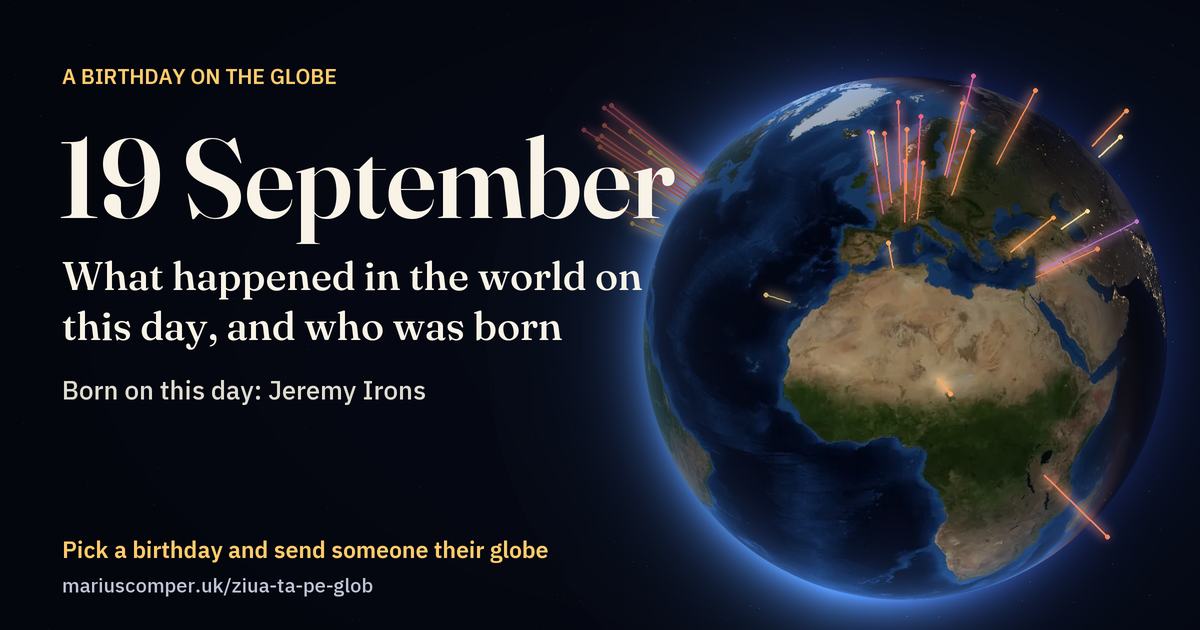
For 19 September, the English Wikipedia lists 54 events and 206 births. 36 of the events stand at their places as rays of light; three more are dashed circles, where the sentence links only to a country or a sea. The taller the ray, the longer ago it happened. The people born that day come further down, as blue points.
A birthday, yours or someone else’s:
Turn it into a greetingScroll: the globe turns to each place
The day you were born, on the globe.
Three things from your day
Scroll: your day first, then 19 September through the years
The Earth on 19 September
The picture on the globe was assembled by NASA from satellite photographs taken in September 2004: the snow, the ice and the green are those of the month.
On 19 September the Sun passes straight overhead at noon along the parallel of 1.5° north. In London, the day lasts about 12 hours 25 minutes.
The line between day and night is tilted on the globe exactly as on this day of the year. On the dark side you can see the lights of towns.
Europe · Our Lady of La Salette
1846
Two French shepherd children, Mélanie Calvat and Maximin Giraud, experience a Marian apparition on a mountaintop near La Salette, France, now known as Our Lady of La Salette.
On the map: the coordinates Wikidata gives for the article “Our Lady of La Salette”.
Europe · San Siro
1926
Football stadium San Siro is inaugurated in Milan, Italy
On the map: San Siro.
Also on the day’s list of Wikipedia in Spanish and Chinese.
Asia · Hohhot
2023
Chinese authorities cancelled a run of performances of The Mongol Khan, the first Mongolian play to be performed internationally, forty minutes before its planned premiere in Hohhot.
On the map: Hohhot.
North America · Carnegie Mellon University
1982
Scott Fahlman posts the first documented emoticons :-) and :-( on the Carnegie Mellon University bulletin board system.
On the map: Carnegie Mellon University.
Also on the day’s list of Wikipedia in Spanish and Chinese.
19 September
What the other Wikipedias remember#
For these years the English list has nothing on this day. The events below come from the same day’s lists on Wikipedia in Spanish and were translated for this page.
From Wikipedia in Spanish · Disneyland
1959
In the United States, the Soviet leader Nikita Khrushchev visits Disneyland.
On the map: Disneyland.
Translated from the list on Wikipedia in Spanish.
From Wikipedia in Spanish · Seoul Olympic Main Stadium
1988
At the Seoul Olympic Games, the American diver Greg Louganis suffers a head injury in the preliminaries of the 3-metre springboard event.
On the map: Seoul Olympic Main Stadium.
Translated from the list on Wikipedia in Spanish.
The article on Wikipedia in Spanish: Juegos Olímpicos de Seúl 1988
19 September
Born on 19 September#
The English Wikipedia lists 206 births for this day. The blue points are the birthplaces of 59 of these people: those written about in the most Wikipedia editions, where Wikidata gives a place of birth.
Born on 19 September
1948
Jeremy Irons, English actor, winner of multiple accolades (Oscar, Tony, Emmy, Golden Globe)
Place of birth: Cowes.
Born on 19 September
1926
Masatoshi Koshiba, Japanese physicist and academic, Nobel Prize laureate (died 2020)
Place of birth: Toyohashi.
Born on 19 September
1985
Song Joong-ki, South Korean actor
Place of birth: Daejeon.
Born on 19 September
1922
Emil Zátopek, Czech runner (died 2000)
Place of birth: Kopřivnice.
Born on 19 September
1921
Paulo Freire, Brazilian philosopher, theorist, and academic (died 1997)
Place of birth: Recife.
Born in Britain and Ireland
1990
Kieran Trippier, English footballer
Place of birth: Bury.
Born in Britain and Ireland
1963
David Seaman, English footballer
Place of birth: Rotherham.
Born in Britain and Ireland
1934
Brian Epstein, English businessman, The Beatles manager (died 1967)
Place of birth: Liverpool.
19 September
Number one in the charts that week
At the cinema
An animal recorded that day
The record can be seen in GBIF, which brings together wildlife records from around the world.
All your birthdays
The weather that day
Data: Met Office Hadley Centre (HadCET); NOAA (GHCN-Daily, Mauna Loa).
Above the Earth
Sources: Jonathan McDowell, GCAT (launches); GFZ Potsdam (Kp index). Days are counted in Universal Time.
Football that day
International matches played that day:
Source: the “International football results” dataset kept by Mart Jürisoo (CC0).
Also that day
The earthquake’s page at the USGS
Source: the USGS catalogue. The day is counted in Universal Time (UTC).
In those days
Make a link for someone
Type the name, pick the day and the year of birth. The link opens straight on their day, with their name in the greeting.
The link carries the name, date and place typed here; anyone who gets it can see them.
Put another birthday beside it
Your mother’s, your child’s, a friend’s: the two days appear side by side.
Below: 19 September through the years.
The whole globe of the day
Drag the globe to turn it. Touch a ray or a point to read what happened there.
Everything Wikipedia lists for 19 September
The list is the English Wikipedia’s, in its own wording, as it stood in October 2026. 15 events have no place on the map: the sentence links to no place with coordinates, only to places too wide to mark, or to several countries.
- 96
Nerva, suspected of complicity of the death of Domitian, is declared emperor by Senate. The Senate then annuls laws passed by Domitian and orders his statues to be destroyed.
no place on the mapWikipedia: Nerva - 634
Siege of Damascus: The Rashidun Arabs under Khalid ibn al-Walid capture Damascus from the Byzantine Empire.
Asia · Siege of DamascusWikipedia: Siege of Damascus - 1356
Battle of Poitiers: An English army under the command of Edward the Black Prince defeats a French army and captures King John II.
Europe · Battle of PoitiersWikipedia: Battle of Poitiers - 1410
End of the Siege of Marienburg: The State of the Teutonic Order repulses the joint Polish—Lithuanian forces.
Europe · Siege of MarienburgWikipedia: Siege of Marienburg - 1622
Imperial-Spanish forces under the count of Tilly and Gonzalo Fernández de Córdoba capture Heidelberg, the capital of the Palatinate during the Thirty Years' War.
Europe · Siege of HeidelbergWikipedia: Siege of Heidelberg - 1676
Jamestown is burned to the ground by the forces of Nathaniel Bacon during Bacon's Rebellion.
North America · JamestownWikipedia: Jamestown - 1692
Salem witch trials: Giles Corey was crushed to death for refusing to enter a plea to charges of witchcraft, reportedly asking the sheriff for "more weight" during his execution.
North America · Salem witch trialsWikipedia: Salem witch trials - 1777
American Revolutionary War: British forces win a tactically expensive victory over the Continental Army in the First Battle of Saratoga.
North America · Battles of SaratogaWikipedia: Battles of Saratoga - 1778
The Continental Congress passes the first United States federal budget.
no place on the mapWikipedia: Continental Congress - 1796
George Washington's Farewell Address is printed across America as an open letter to the public.
no place on the mapWikipedia: George Washington's Farewell Address - 1799
French Revolutionary Wars: French-Dutch victory against the Russians and British in the Battle of Bergen.
Europe · Battle of BergenWikipedia: Battle of Bergen - 1846
Two French shepherd children, Mélanie Calvat and Maximin Giraud, experience a Marian apparition on a mountaintop near La Salette, France, now known as Our Lady of La Salette.
Europe · Our Lady of La SaletteWikipedia: Our Lady of La Salette - 1852
Annibale de Gasparis discovers the asteroid Massalia from the north dome of the Astronomical Observatory of Capodimonte.
no place on the mapWikipedia: Annibale de Gasparis - 1862
American Civil War: Union troops under William Rosecrans defeat a Confederate force commanded by Sterling Price.
North America · Battle of IukaWikipedia: American Civil War - 1863
American Civil War: The first day of the Battle of Chickamauga, in northwestern Georgia, the bloodiest two-day battle of the conflict, and the only significant Confederate victory in the war's Western Theater.
North America · Battle of ChickamaugaWikipedia: Battle of Chickamauga - 1864
American Civil War: Union troops under Philip Sheridan defeat a Confederate force commanded by Jubal Early. With over 50,000 troops engaged, it was the largest battle fought in the Shenandoah Valley.
North America · Third Battle of WinchesterWikipedia: Third Battle of Winchester - 1868
La Gloriosa begins in Spain.
Europe · SpainWikipedia: Glorious Revolution - 1870
Franco-Prussian War: The siege of Paris begins. The city held out for over four months before surrendering.
Europe · Siege of ParisWikipedia: Franco-Prussian War - 1893
In New Zealand, the Electoral Act of 1893 is consented to by the governor, giving all women in New Zealand the right to vote.
no place on the mapWikipedia: Women's suffrage in New Zealand - 1902
A stampede at Shiloh Baptist Church in Birmingham, Alabama, leads to the death of 115 attendees.
North America · Shiloh Baptist Church stampedeWikipedia: Shiloh Baptist Church stampede - 1916
World War I: During the East African Campaign, colonial forces of the Belgian Congo (Force Publique) under the command of Charles Tombeur capture the town of Tabora after heavy fighting.
Africa · Battle of TaboraWikipedia: World War I - 1918
The battle of Megiddo begins in which British forces attack the right flank of the Ottoman army during World War I.
Asia · Battle of MegiddoWikipedia: Battle of Megiddo - 1926
Football stadium San Siro is inaugurated in Milan, Italy
Europe · San SiroWikipedia: San Siro - 1939
World War II: The Battle of Kępa Oksywska concludes, with Polish losses reaching roughly 14% of all the forces engaged.
Europe · Battle of Kępa OksywskaWikipedia: World War II - 1940
World War II: Witold Pilecki is voluntarily captured and sent to Auschwitz concentration camp to gather and smuggle out information for the resistance movement.
Europe · Auschwitz concentration campWikipedia: Witold Pilecki - 1944
World War II: The Battle of Hürtgen Forest begins. It will become the second-longest individual battle that the U.S. Army has ever fought.
Europe · Battle of Hürtgen ForestWikipedia: Battle of Hürtgen Forest - 1944
World War II: The Moscow Armistice between Finland and the Soviet Union is signed, which officially ended the Continuation War.
Europe · MoscowWikipedia: Moscow Armistice - 1946
The Council of Europe is founded following a speech by Winston Churchill at the University of Zurich.
no place on the mapWikipedia: Council of Europe - 1950
Korean War: An attack by North Korean forces was repelled at the Battle of Nam River.
Asia · Battle of Nam RiverWikipedia: Korean War - 1960
Indian Prime Minister Jawaharlal Nehru and Pakistani President Ayub Khan sign the Indus Waters Treaty for the control and management of the Indus, Chenab, Jhelum, Ravi, Sutlej and Beas rivers.
no place on the mapWikipedia: Jawaharlal Nehru - 1970
Kostas Georgakis, a Greek student of geology, sets himself ablaze in Matteotti Square in Genoa, Italy, as a protest against the dictatorial regime of Georgios Papadopoulos.
no place on the mapWikipedia: Kostas Georgakis - 1970
Michael Eavis hosts the first Glastonbury Festival.
no place on the mapWikipedia: Glastonbury Festival - 1976
Turkish Airlines Flight 452 hits the Taurus Mountains, outskirt of Karatepe, Turkey, killing all 154 passengers and crew.
Asia · Turkish Airlines Flight 452Wikipedia: Turkish Airlines Flight 452 - 1976
Two Imperial Iranian Air Force F-4 Phantom II jets fly out to investigate an unidentified flying object.
no place on the mapWikipedia: 1976 Tehran UFO incident - 1978
The Solomon Islands join the United Nations.
Oceania · Solomon IslandsWikipedia: Solomon Islands - 1982
Scott Fahlman posts the first documented emoticons :-) and :-( on the Carnegie Mellon University bulletin board system.
North America · Carnegie Mellon UniversityWikipedia: Scott Fahlman - 1983
Saint Kitts and Nevis gains its independence.
Latin America · Saint Kitts and NevisWikipedia: Saint Kitts and Nevis - 1985
A strong earthquake kills thousands and destroys about 400 buildings in Mexico City.
Latin America · 1985 Mexico City earthquakeWikipedia: 1985 Mexico City earthquake - 1985
Tipper Gore and other political wives form the Parents Music Resource Center as Frank Zappa, John Denver, and other musicians testify at U.S. Congressional hearings on obscenity in rock music.
no place on the mapWikipedia: Tipper Gore - 1989
A bomb destroys UTA Flight 772 in mid-air above the Tùnùrù Desert, Niger, killing all 170 passengers and crew.
Africa · UTA Flight 772Wikipedia: UTA Flight 772 - 1991
Ötzi the Iceman is discovered in the Alps on the border between Italy and Austria.
no place on the mapWikipedia: Ötzi - 1995
The Washington Post and The New York Times publish the Unabomber Manifesto.
no place on the mapWikipedia: Industrial Society and Its Future - 1997
The Guelb El-Kebir massacre in Algeria kills 53 people.
Africa · Guelb El-Kebir massacreWikipedia: Guelb El-Kebir massacre - 2006
The Thai army stages a coup. The Constitution is revoked and martial law is declared.
no place on the mapWikipedia: 2006 Thai coup d'état - 2008
A Learjet 60 carrying musicians Travis Barker and Adam "DJ AM" Goldstein crashes during a rejected takeoff from Colombia Metropolitan Airport in West Columbia, South Carolina, killing four of the six people on board. Barker and Goldstein both survive.
North America · 2008 South Carolina Learjet 60 crashWikipedia: 2008 South Carolina Learjet 60 crash - 2010
The leaking oil well in the Deepwater Horizon oil spill is sealed.
North America · Deepwater Horizon oil spillWikipedia: Deepwater Horizon oil spill - 2011
Mariano Rivera of the New York Yankees surpasses Trevor Hoffman to become Major League Baseball's all-time career saves leader with 602.
no place on the mapWikipedia: Mariano Rivera - 2016
In the wake of a manhunt, the suspect in a series of bombings in New York and New Jersey is apprehended after a shootout with police.
North America · 2016 New York and New Jersey bombingsWikipedia: 2016 New York and New Jersey bombings - 2017
The 2017 Puebla earthquake strikes Mexico, causing 370 deaths and over 6,000 injuries, as well as extensive damage.
Latin America · 2017 Puebla earthquakeWikipedia: 2017 Puebla earthquake - 2021
The Cumbre Vieja volcano, on the island of La Palma in the Canary Islands, erupts. The eruption lasts for almost three months, ending on December 13.
Europe · Cumbre ViejaWikipedia: La Palma - 2022
A strong earthquake kills 2 and injures over 30 in Mexico's state of Michoacán.
Latin America · 2022 Michoacán earthquakeWikipedia: 2022 Michoacán earthquake - 2022
The state funeral of Queen Elizabeth II of the United Kingdom is held at Westminster Abbey, London.
Britain & Ireland · Balmoral CastleWikipedia: Death and state funeral of Elizabeth II - 2023
Azerbaijan launches a military offensive against the Republic of Artsakh in the Nagorno-Karabakh region; this leads to the flight of the Armenian population.
Asia · 2023 Azerbaijani offensive in Nagorno-KarabakhWikipedia: 2023 Azerbaijani offensive in Nagorno-Karabakh - 2023
Chinese authorities cancelled a run of performances of The Mongol Khan, the first Mongolian play to be performed internationally, forty minutes before its planned premiere in Hohhot.
Asia · HohhotWikipedia: The Mongol Khan
What the other Wikipedias remember
For these years the English list has nothing on this day. The events below come from the same day’s lists on Wikipedia in Spanish and were translated for this page.
- 1959
In the United States, the Soviet leader Nikita Khrushchev visits Disneyland.
- 1988
At the Seoul Olympic Games, the American diver Greg Louganis suffers a head injury in the preliminaries of the 3-metre springboard event.
Asia · Seoul Olympic Main StadiumTranslated from the list on Wikipedia in SpanishWikipedia: Juegos Olímpicos de Seúl 1988
Who was born on 19 September
In order of how many Wikipedia editions have an article about each. The first 60 of 206 are shown.
- 86
Antoninus Pius, Roman emperor (died 161)
LanuviumWikipedia: Antoninus Pius - 1948
Jeremy Irons, English actor, winner of multiple accolades (Oscar, Tony, Emmy, Golden Globe)
- 1551
Henry III of France (died 1589)
Palace of FontainebleauWikipedia: Henry III of France - 1926
Masatoshi Koshiba, Japanese physicist and academic, Nobel Prize laureate (died 2020)
ToyohashiWikipedia: Masatoshi Koshiba - 1985
Song Joong-ki, South Korean actor
DaejeonWikipedia: Song Joong-ki - 1802
Lajos Kossuth, Hungarian journalist, lawyer, and politician, Governor-President of Hungary (died 1894)
- 1922
Emil Zátopek, Czech runner (died 2000)
KopřivniceWikipedia: Emil Zátopek - 1921
Paulo Freire, Brazilian philosopher, theorist, and academic (died 1997)
RecifeWikipedia: Paulo Freire - 866
Leo VI the Wise, Byzantine emperor (died 912)
ConstantinopleWikipedia: Leo VI the Wise - 1898
Giuseppe Saragat, Italian lawyer and politician, 5th President of Italy (died 1988)
- 1967
Aleksandr Karelin, Russian wrestler and politician
NovosibirskWikipedia: Aleksandr Karelin - 1974
Jimmy Fallon, American comedian, television host, actor, singer, writer, and producer
BrooklynWikipedia: Jimmy Fallon - 1990
Kieran Trippier, English footballer
- 1941
Cass Elliot, American singer-songwriter, actress, comedian, and television personality (died 1974)
BaltimoreWikipedia: Cass Elliot - 1963
David Seaman, English footballer
RotherhamWikipedia: David Seaman - 1934
Brian Epstein, English businessman, The Beatles manager (died 1967)
LiverpoolWikipedia: Brian Epstein - 1982
Eduardo Carvalho, Portuguese footballer
MirandelaWikipedia: Eduardo Carvalho - 1986
Sally Pearson, Australian athlete and hurdler
SydneyWikipedia: Sally Pearson - 1941
Umberto Bossi, Italian politician (died 2026)
Cassano MagnagoWikipedia: Umberto Bossi - 1749
Jean Baptiste Joseph Delambre, French mathematician and astronomer (died 1822)
- 1936
Al Oerter, American discus thrower (died 2007)
AstoriaWikipedia: Al Oerter - 1972
N. K. Jemisin, American science fiction and fantasy writer
Iowa CityWikipedia: N. K. Jemisin - 1867
Arthur Rackham, English illustrator (died 1939)
LewishamWikipedia: Arthur Rackham - 1913
Frances Farmer, American actress (died 1970)
SeattleWikipedia: Frances Farmer - 1927
Rosemary Harris, English actress
- 1803
Maria Anna of Savoy (died 1884)
- 1941
Mariangela Melato, Italian actress (died 2013)
- 1963
Jarvis Cocker, English singer-songwriter and guitarist
SheffieldWikipedia: Jarvis Cocker - 1377
Albert IV, Duke of Austria (died 1404)
- 1948
Mykhaylo Fomenko, Ukrainian footballer and manager (died 2024)
Mala RybytsiaWikipedia: Mykhaylo Fomenko - 1964
Trisha Yearwood, American country singer
MonticelloWikipedia: Trisha Yearwood - 1992
Diego Antonio Reyes, Mexican footballer
Mexico CityWikipedia: Diego Reyes - 1560
Thomas Cavendish, English naval explorer, led the third expedition to circumnavigate the globe (died 1592)
Grimston HallWikipedia: Thomas Cavendish - 1969
Candy Dulfer, Dutch saxophonist
AmsterdamWikipedia: Candy Dulfer - 1981
Damiano Cunego, Italian cyclist
Cerro VeroneseWikipedia: Damiano Cunego - 1998
Trae Young, American basketball player
LubbockWikipedia: Trae Young - 1869
Ben Turpin, American comedian and actor (died 1940)
New OrleansWikipedia: Ben Turpin - 1977
Tommaso Rocchi, Italian footballer
- 1982
Eleni Daniilidou, Greek tennis player
- 1973
Cristiano da Matta, Brazilian racing driver
Belo HorizonteWikipedia: Cristiano da Matta - 1922
Damon Knight, American author and critic (died 2002)
Baker CityWikipedia: Damon Knight - 1995
Rachel Sennott, American actress
Hartford CountyWikipedia: Rachel Sennott - 1991
CJ McCollum, American basketball player
CantonWikipedia: CJ McCollum - 1426
Marie of Cleves, Duchess of Orléans, French noble (died 1487)
Duchy of ClevesWikipedia: Marie of Cleves, Duchess of Orléans - 1759
William Kirby, English priest and entomologist (died 1850)
WitneshamWikipedia: William Kirby - 1947
Tanith Lee, English author (died 2015)
LondonWikipedia: Tanith Lee - 1974
Hidetaka Miyazaki, Japanese video game designer and executive
ShizuokaWikipedia: Hidetaka Miyazaki - 1778
Henry Brougham, 1st Baron Brougham and Vaux, Scottish lawyer and politician, Lord Chancellor of Great Britain (died 1868)
- 1951
Daniel Lanois, Canadian singer-songwriter, guitarist, and producer
- 1972
Ashot Nadanian, Armenian chess player and coach
- 1984
Eva Marie, American wrestler
Walnut CreekWikipedia: Eva Marie - 1910
Margaret Lindsay, American actress (died 1981)
DubuqueWikipedia: Margaret Lindsay - 1926
James Lipton, American actor, producer, and screenwriter (died 2020)
DetroitWikipedia: James Lipton - 1927
William Hickey, American actor (died 1997)
BrooklynWikipedia: William Hickey - 1931
Brook Benton, American pop/R&B/rock & roll singer-songwriter (died 1988)
LugoffWikipedia: Brook Benton - 1932
Stefanie Zweig, German journalist and author (died 2014)
GłubczyceWikipedia: Stefanie Zweig - 1976
Raja Bell, American basketball player
Saint CroixWikipedia: Raja Bell - 1977
Emil Sutovsky, Israeli chess player
- 1986
Leon Best, English footballer
NottinghamWikipedia: Leon Best - 931
Mu Zong, emperor of the Liao Dynasty (died 969)
What is celebrated on 19 September
- Christian feast day: Alonso de Orozco Mena
- Christian feast day: Emilie de Rodat
- Christian feast day: Blessed Francisca Cualladó Baixauli
- Christian feast day: Goeric of Metz
- Christian feast day: Januarius (Western Christianity) Feast of San Gennaro
- Christian feast day: Maria de Cervelló
- Christian feast day: Our Lady of La Salette
- Christian feast day: Theodore of Tarsus (Anglican Communion, Roman Catholic Church, Eastern Orthodox Church)
- Christian feast day: Trophimus, Sabbatius, and Dorymedon
- Christian feast day: September 19 (Eastern Orthodox liturgics)
- Armed Forces Day (Chile)
- Day of the First Public Appearance of the Slovak National Council
- Second day of Fiestas Patrias (Chile)
- Independence Day, celebrates the independence of Saint Kitts and Nevis from the United Kingdom in 1983.
A greeting link for someone
Type a name and, if you like, the year of birth. The link opens with a greeting, and beside each event it says how old the person turned that day, or how many years before their birth it happened.
The name and the year go only into the link you send.
All 366 days
How the globe is made
Where the events come from
Each edition of this page uses the day’s list from Wikipedia in its own language: Romanian, English, Spanish, Chinese. The lists are written by volunteers and differ from one edition to the next; the text of each event is Wikipedia’s, with a link to the article. A row that appears twice in a list is shown once. The lists have not been checked event by event: they are Wikipedia’s, mistakes included.
For events before 1582, and for countries that moved to the Gregorian calendar later (Britain in 1752, Russia in 1918), the same day may be counted Old Style in one list and New Style in another.
The chapter “What the other Wikipedias remember” adds up to five events a day from the lists of the other three editions, only for years in which the English list has nothing on that day. They were translated for this page, passed the same filters as the tour, and are not counted among the events of the English list.
How an event gets onto the map
The place comes from Wikidata. If the sentence links to the article about the event itself (a battle, an opening, an earthquake), dated to the same year, the ray stands on its coordinates or on those of its location. Otherwise it stands on the first place the sentence links to: a town, a building, a mountain, an island. This second step can be wrong: sometimes the sentence only mentions the place. That is why the page says, under each event, which place the ray stands on.
When the sentence links to a single state or province, or to a single sea, lake or desert larger than 5,000 km², the globe shows a dashed circle, not a ray. The circle has the area Wikidata gives, with its radius kept between 1.2° and 16°, or a radius of 4.5° when Wikidata gives no area; it says only that the sentence links to that place. Organisations, ships, spacecraft, museum objects, rivers, mountain ranges, languages and continents are never used as places. When a sentence names several states and no exact place, the event stays in the list only.
What the height means
The height of a ray shows how many years have passed, on a logarithmic scale: 10 years, 100 years and 1,000 years are equal steps apart; anything older than about 2,600 years has the tallest ray. The colour runs from pale yellow for recent years to violet for antiquity.
Where the tour stops
In each region the tour stops at up to three events (five in Britain and Ireland), chosen mainly by three things: whether Wikipedia’s editors put the event in the “On this day” box of their main page (the English, Spanish and Chinese editions), how many Wikipedia editions have an article about it, and how many of the four lists include it. Events whose sentence or article is about a war, an attack, a crime or a disaster are left out of the tour; they stay in the whole list, in Wikipedia’s wording. The filter is a list of words and a list of Wikidata types, so it can miss some.
The tour of births names the people with articles in the most editions and leaves aside those whom the list or Wikidata describes as rulers, politicians, commanders, leaders of movements or criminals; they stay in the list.
The Earth and the Sun
The daytime images are NASA’s Blue Marble Next Generation mosaics, one for each month of 2004; the night side is Black Marble 2016. The tilt of the line between day and night is computed for the day; the hour is chosen so that the place being read is in daylight. The latitude where the Sun stands overhead is the average of the four years of the leap cycle; in a given year it can differ by up to 0.4°.
The day you were born
The number ones come from the weekly lists on Wikipedia: Billboard for the United States (from 1940; the Hot 100 from August 1958), the UK Singles Chart (from November 1952), Los 40 Principales for Spain (from July 1966) and, for Romania, the Romanian Top 100 and Airplay 100 (2001–2021, with missing weeks). The page shows the chart of the week in which the day of birth falls, with its date; Billboard and the UK chart are dated at the end of their week. For Romania before 2001 and for China these sources have no weekly chart.
The films are those that reached cinemas in the United States up to ten days before or three days after that day (some of them in a few cinemas at first), from the English Wikipedia’s yearly lists (from 1968), in order of how many editions have an article about them. The events “in those days” are the ones on the neighbouring days’ lists that carry the year of birth, passed through the same filter as the tour.
The day of birth, year included
The Moon, the star sign and the constellation are worked out by the page itself, for noon Universal Time on the day. The lit part of the Moon is rounded and can differ by a few per cent from that at the hour of birth. The sign follows the usual zodiac of twelve equal parts starting at the March equinox; the constellation is the one the Sun actually stood in front of, by the borders set by the International Astronomical Union, and within a day of a border the page does not name it. When the Sun changes sign while it is that day anywhere on Earth, the page gives the moment of crossing, rounded to ten minutes and accurate to within about a quarter of an hour, and the clock time in a few cities, with the time zone and summer time of that year.
The year in the Chinese calendar is the one your device’s own calendar gives for the date, checked against the Hong Kong Observatory’s tables. “All your birthdays” uses the same sources as the rest of the chapter for the same day in every year since the birth: the temperature, well-known launches that took place on that very day, matches of the teams the edition follows, snow deeper than 10 cm and strong geomagnetic storms. The three things at the top and the four on the picture are chosen in a fixed order (the song, the animal, a full Moon, a well-known launch before an ordinary earthquake); on the picture you can change them.
When the link carries a year of birth, the page adds a few things about that exact day. The weather is the Met Office’s Central England temperature record and the readings from New York’s Central Park; the “usual high” is the average of the daily highs of 1961–1990 for that date, with two days either side. The carbon dioxide figure is the monthly mean at the Mauna Loa observatory, where measurements begin in March 1958.
The earthquake is the one with the largest magnitude in the USGS catalogue for that day, counted in Universal Time. Before the 1960s the catalogue has gaps even above magnitude 5.5, so in the older years many days have no earthquake. The page gives only the magnitude and the place: the country the epicentre falls in or, when the epicentre is at sea within 300 km of a coast, the nearest country; farther out, only the ocean.
The launches are those that reached orbit or left for the Moon and the planets, from Jonathan McDowell’s GCAT catalogue. If nothing left that day, the page shows the nearest launch within three days before or after, and says how many days away it was. The geomagnetic storm appears only when the Kp index reached at least 5 in one of the day’s eight three-hour intervals.
The animal comes from GBIF: an observation made by a person (the animal seen or heard, or its tracks), dated to that exact day, with coordinates and a CC0 or CC BY licence. Only a few hundred well-known species are searched (mammals, birds, turtles, butterflies); of those noted that day, mammals and species with articles in many Wikipedia editions come first; birds noted almost every day, and species used recently, wait their turn. Observations dated 1 January are left out, because records without a day are often filed there. An observation shows that the animal was recorded there, not how many animals there were.
The matches are those between national teams. Only matches of England, Scotland, Wales, Northern Ireland, the Republic of Ireland, the United States, Canada and Australia are shown, along with those at the big final tournaments. The picture to send is drawn in the page from the day’s globe and the facts above, and stays on your device until you send it.
Sources
- Events, births and holidays: the day’s page on Wikipedia, text under CC BY-SA 4.0.
- Coordinates, places of birth and the number of editions: Wikidata (CC0).
- The Earth by day: NASA Blue Marble Next Generation. The Earth by night: NASA Black Marble 2016.
- Borders and regions: Natural Earth.
- World population and births per year: UN World Population Prospects 2024.
- Charts and films: Wikipedia’s lists for Billboard, the UK Singles Chart, Los 40 Principales, Romanian Top 100, Airplay 100 and American films by year (CC BY-SA 4.0).
- Weather: Met Office Hadley Centre, HadCET (Open Government Licence) and NOAA GHCN-Daily, New York Central Park. Carbon dioxide: NOAA Global Monitoring Laboratory, Mauna Loa.
- Earthquakes: the USGS catalogue. Launches: Jonathan McDowell, GCAT (CC BY). Kp index: GFZ Potsdam (CC BY 4.0). Matches: International football results, Mart Jürisoo (CC0).
- Animal observations: GBIF, with a link to each record; species names come from Wikidata.