A birthday on the globe
30 June on the globe: what happened in the world on this day, and who was born
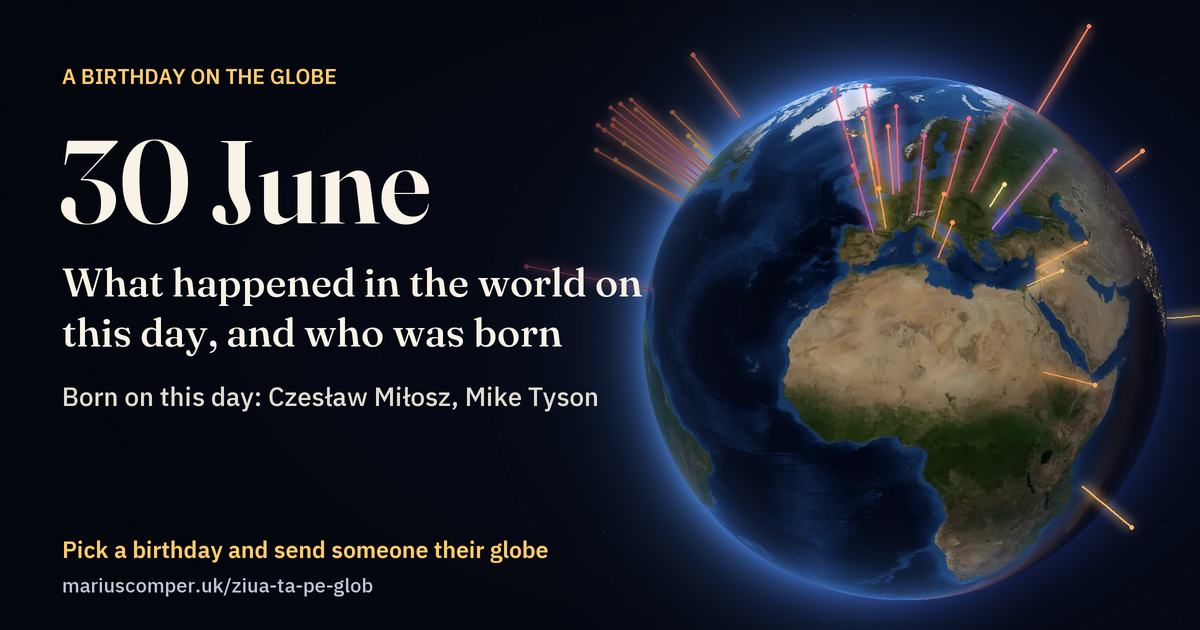
For 30 June, the English Wikipedia lists 67 events and 200 births. 39 of the events stand at their places as rays of light; eight more are dashed circles, where the sentence links only to a country or a sea. The taller the ray, the longer ago it happened. The people born that day come further down, as blue points.
A birthday, yours or someone else’s:
Turn it into a greetingScroll: the globe turns to each place
The day you were born, on the globe.
Three things from your day
Scroll: your day first, then 30 June through the years
The Earth on 30 June
The picture on the globe was assembled by NASA from satellite photographs taken in June 2004: the snow, the ice and the green are those of the month.
On 30 June the Sun passes straight overhead at noon along the parallel of 23.2° north. In London, the day lasts about 16 hours 35 minutes.
Beyond 67° north the Sun no longer sets; beyond 67° south it no longer rises.
The line between day and night is tilted on the globe exactly as on this day of the year. On the dark side you can see the lights of towns.
Britain & Ireland · Oxford University Museum of Natural History
1860
The 1860 Oxford evolution debate at the Oxford University Museum of Natural History takes place.
On the map: Oxford University Museum of Natural History.
Also on the day’s list of Wikipedia in Chinese.
Europe · Saint Peter's Square
1963
The coronation of Pope Paul VI took place, the last such ceremony before its abandonment by later popes.
On the map: Saint Peter's Square.
North America · United States Congress
1805
Under An act to divide the Indiana Territory into two separate governments, adopted by the U.S. Congress on January 11, 1805, the Michigan Territory is organized.
On the map: United States Congress.
North America · Niagara Falls
1859
French acrobat Charles Blondin crosses Niagara Falls on a tightrope.
On the map: Niagara Falls.
Also on the day’s list of Wikipedia in Spanish and Romanian.
North America · Supreme Court of the United States
1986
The U.S. Supreme Court rules in Bowers v. Hardwick that states can outlaw homosexual acts between consenting adults.
On the map: Supreme Court of the United States.
30 June
What the other Wikipedias remember#
For these years the English list has nothing on this day. The events below come from the same day’s lists on Wikipedia in Spanish and were translated for this page.
From Wikipedia in Spanish · Hong Kong
1997
In Hong Kong (China), the Treaty of Nanking expires and the peninsula ceases to belong to the United Kingdom.
On the map: Hong Kong.
Translated from the list on Wikipedia in Spanish.
30 June
Born on 30 June#
The English Wikipedia lists 200 births for this day. The blue points are the birthplaces of 60 of these people: those written about in the most Wikipedia editions, where Wikidata gives a place of birth.
Born on 30 June
1911
Czesław Miłosz, Polish novelist, essayist, and poet, Nobel Prize laureate (died 2004)
Place of birth: Šeteniai.
Born on 30 June
1966
Mike Tyson, American boxer and actor
Place of birth: Brooklyn.
Born on 30 June
1985
Michael Phelps, American swimmer
Place of birth: Baltimore.
Born on 30 June
1926
Paul Berg, American biochemist and academic, Nobel Prize laureate (died 2023)
Place of birth: Brooklyn.
Born on 30 June
1936
Assia Djebar, Algerian-French author and translator (died 2015)
Place of birth: Cherchell.
Born in Britain and Ireland
1983
Cheryl, English singer and TV personality
Place of birth: Newcastle upon Tyne.
Born in Britain and Ireland
1817
Joseph Dalton Hooker, English botanist and explorer (died 1911)
Place of birth: Halesworth.
Born in Britain and Ireland
1685
John Gay, English poet and playwright (died 1732)
Place of birth: Barnstaple.
30 June
Number one in the charts that week
At the cinema
An animal recorded that day
The record can be seen in GBIF, which brings together wildlife records from around the world.
All your birthdays
The weather that day
Data: Met Office Hadley Centre (HadCET); NOAA (GHCN-Daily, Mauna Loa).
Above the Earth
Sources: Jonathan McDowell, GCAT (launches); GFZ Potsdam (Kp index). Days are counted in Universal Time.
Football that day
International matches played that day:
Source: the “International football results” dataset kept by Mart Jürisoo (CC0).
Also that day
The earthquake’s page at the USGS
Source: the USGS catalogue. The day is counted in Universal Time (UTC).
In those days
Make a link for someone
Type the name, pick the day and the year of birth. The link opens straight on their day, with their name in the greeting.
The link carries the name, date and place typed here; anyone who gets it can see them.
Put another birthday beside it
Your mother’s, your child’s, a friend’s: the two days appear side by side.
Below: 30 June through the years.
The whole globe of the day
Drag the globe to turn it. Touch a ray or a point to read what happened there.
Everything Wikipedia lists for 30 June
The list is the English Wikipedia’s, in its own wording, as it stood in October 2026. 20 events have no place on the map: the sentence links to no place with coordinates, only to places too wide to mark, or to several countries.
- 296
Pope Marcellinus begins his papacy.
no place on the mapWikipedia: Pope Marcellinus - 763
The Byzantine army of emperor Constantine V defeats the Bulgarian forces in the Battle of Anchialus.
Europe · Battle of AnchialusWikipedia: Battle of Anchialus - 1398
Zhu Yunwen ascended the throne to the Ming dynasty to become the Jianwen Emperor.
Asia · Ming dynastyWikipedia: Ming dynasty - 1422
Battle of Arbedo between the duke of Milan and the Swiss cantons.
Europe · Battle of ArbedoWikipedia: Battle of Arbedo - 1521
Spanish forces defeat a combined French and Navarrese army at the Battle of Noáin during the Spanish conquest of Iberian Navarre.
Europe · Battle of NoáinWikipedia: Battle of Noáin - 1559
King Henry II of France is mortally wounded in a jousting match against Gabriel de Lorges, Count of Montgomery.
no place on the mapWikipedia: Henry II of France - 1598
The Spanish-held Castillo San Felipe del Morro in San Juan, Puerto Rico having been besieged for fifteen days, surrenders to an English force under Sir George Clifford, Earl of Cumberland.
Latin America · Castillo San Felipe del MorroWikipedia: Castillo San Felipe del Morro - 1632
The University of Tartu is founded.
no place on the mapWikipedia: University of Tartu - 1643
Royalists loyal to King Charles I led by the Earl of Newcastle defeat Parliamentarian troops commanded by Lord Fairfax in the battle of Adwalton Moor, allowing them to capture Bradford and Leeds.
Britain & Ireland · Battle of Adwalton MoorWikipedia: Battle of Adwalton Moor - 1651
The Deluge: Khmelnytsky Uprising: The Battle of Berestechko ends with a Polish victory.
Europe · Battle of BerestechkoWikipedia: Khmelnytsky Uprising - 1688
The Immortal Seven issue the Invitation to William, which would culminate in the Glorious Revolution.
Britain & Ireland · British IslesWikipedia: Glorious Revolution - 1691
A Williamite army under Godert de Ginkell takes the city of Athlone from the Jacobites after a short siege.
Britain & Ireland · Siege of AthloneWikipedia: Siege of Athlone - 1703
The Battle of Ekeren between a Dutch force and a French force.
Europe · Battle of EkerenWikipedia: Battle of Ekeren - 1758
Seven Years' War: Habsburg Austrian forces destroy a Prussian reinforcement and supply convoy in the Battle of Domstadtl, helping to expel Prussian King Frederick the Great from Moravia.
Europe · Battle of DomstadtlWikipedia: Battle of Domstadtl - 1794
Northwest Indian War: Native American forces under Blue Jacket attack Fort Recovery.
North America · Battle of Fort RecoveryWikipedia: Battle of Fort Recovery - 1805
Under An act to divide the Indiana Territory into two separate governments, adopted by the U.S. Congress on January 11, 1805, the Michigan Territory is organized.
North America · United States CongressWikipedia: United States Congress - 1859
French acrobat Charles Blondin crosses Niagara Falls on a tightrope.
North America · Niagara FallsWikipedia: Acrobatics - 1860
The 1860 Oxford evolution debate at the Oxford University Museum of Natural History takes place.
Britain & Ireland · Oxford University Museum of Natural HistoryWikipedia: 1860 Oxford evolution debate - 1864
U.S. President Abraham Lincoln grants Yosemite Valley to California for "public use, resort and recreation".
North America · CaliforniaWikipedia: President of the United States - 1876
Serbia declares war on the Ottoman Empire, leading to the Serbian Wars for Independence.
no place on the mapWikipedia: Serbian–Ottoman Wars - 1882
Charles J. Guiteau is hanged in Washington, D.C. for the assassination of U.S. President James Garfield.
North America · Washington, D.C.Wikipedia: Assassination of James A. Garfield - 1886
The first transcontinental train trip across Canada departs from Montreal, Quebec. It arrives in Port Moody, British Columbia on July 4.
North America · MontrealWikipedia: Montreal - 1892
The Homestead Strike begins near Pittsburgh, Pennsylvania.
North America · HomesteadWikipedia: Homestead strike - 1894
Tower Bridge, a combined bascule and suspension bridge over the River Thames in London, was inaugurated.
no place on the mapWikipedia: Tower Bridge - 1900
A savage fire wrecked three steamships docked at a pier in Hoboken, New Jersey. Over 200 crew members and passengers are killed, and hundreds injured.
North America · 1900 Hoboken Docks fireWikipedia: 1900 Hoboken Docks fire - 1905
Albert Einstein sends the article On the Electrodynamics of Moving Bodies, in which he introduces special relativity, for publication in Annalen der Physik.
no place on the mapWikipedia: Albert Einstein - 1905
Nadir of American race relations: A mob of white Americans killed eight people in Oconee County, Georgia, as part of a mass lynching.
North America · Watkinsville lynchingWikipedia: Watkinsville lynching - 1906
The United States Congress passes the Meat Inspection Act and Pure Food and Drug Act.
no place on the mapWikipedia: Pure Food and Drug Act - 1908
The Tunguska Event, the largest impact event on Earth in human recorded history, resulting in a massive explosion over Eastern Siberia.
Asia · Tunguska eventWikipedia: Tunguska event - 1912
The Regina Cyclone, Canada's deadliest tornado event, kills 28 people in Regina, Saskatchewan.
North America · Regina CycloneWikipedia: Regina Cyclone - 1916
World War I: In "the day Sussex died", elements of the Royal Sussex Regiment take heavy casualties in the Battle of the Boar's Head at Richebourg-l'Avoué in France.
Europe · Attack on the Boar's HeadWikipedia: World War I - 1921
U.S. President Warren G. Harding appoints former President William Howard Taft as Chief Justice of the United States.
no place on the mapWikipedia: Warren G. Harding - 1922
In Washington D.C., U.S. Secretary of State Charles Evans Hughes and Dominican Ambassador Francisco J. Peynado sign the Hughes–Peynado agreement, which ends the United States occupation of the Dominican Republic.
no place on the mapWikipedia: Military Government of Santo Domingo - 1934
The Night of the Long Knives, Adolf Hitler's violent purge of his political rivals in Germany, takes place.
Europe · Nazi GermanyWikipedia: Night of the Long Knives - 1936
Emperor Haile Selassie of Abyssinia appeals for aid to the League of Nations against Italy's invasion of his country.
Africa · Ethiopian EmpireWikipedia: Haile Selassie - 1937
The world's first emergency telephone number, 999, is introduced in London.
no place on the mapWikipedia: Emergency telephone number - 1944
World War II: The Battle of Cherbourg ends with the fall of the strategically valuable port to American forces.
Europe · Battle of CherbourgWikipedia: World War II - 1953
The first Chevrolet Corvette rolls off the assembly line in Flint, Michigan.
North America · Flint, MichiganWikipedia: Chevrolet Corvette - 1956
A TWA Super Constellation and a United Airlines DC-7 collide above the Grand Canyon in Arizona and crash, killing all 128 on board both airliners.
North America · 1956 Grand Canyon mid-air collisionWikipedia: 1956 Grand Canyon mid-air collision - 1959
A United States Air Force F-100 Super Sabre from Kadena Air Base, Okinawa, crashes into a nearby elementary school, killing 11 students plus six residents from the local neighborhood.
Asia · 1959 Okinawa F-100 crashWikipedia: 1959 Okinawa F-100 crash - 1960
Belgian Congo gains independence as Republic of the Congo (Léopoldville).
no place on the mapWikipedia: Belgian Congo - 1963
Ciaculli bombing: a car bomb, intended for Mafia boss Salvatore Greco, kills seven police officers and military personnel near Palermo.
Europe · CiaculliWikipedia: Ciaculli massacre - 1963
The coronation of Pope Paul VI took place, the last such ceremony before its abandonment by later popes.
Europe · Saint Peter's SquareWikipedia: Coronation of Pope Paul VI - 1966
The National Organization for Women, the United States' largest feminist organization, is founded.
no place on the mapWikipedia: National Organization for Women - 1968
Pope Paul VI issues the Credo of the People of God.
no place on the mapWikipedia: Pope Paul VI - 1971
The crew of the Soviet Soyuz 11 spacecraft are killed when their air supply escapes through a faulty valve.
Asia · Soviet UnionWikipedia: Soviet Union - 1972
The first leap second is added to the UTC time system.
no place on the mapWikipedia: Leap second - 1973
Concorde 001 intercepts the path of a total solar eclipse and follows the moon's shadow, experiencing the longest total eclipse observation.
Africa · SaharaWikipedia: 1973 Concorde eclipse flight - 1974
The Baltimore municipal strike of 1974 begins.
no place on the mapWikipedia: 1974 Baltimore municipal strike - 1977
The Southeast Asia Treaty Organization disbands.
no place on the mapWikipedia: Southeast Asia Treaty Organization - 1985
Ryan White, an HIV/AIDS patient in the US, was denied re-admission to his school after he had contracted the disease from hemophilia treatments.
no place on the mapWikipedia: Ryan White - 1985
Thirty-nine American hostages from the hijacked TWA Flight 847 are freed in Beirut after being held for 17 days.
Asia · BeirutWikipedia: TWA Flight 847 - 1986
The U.S. Supreme Court rules in Bowers v. Hardwick that states can outlaw homosexual acts between consenting adults.
North America · Supreme Court of the United StatesWikipedia: Supreme Court of the United States - 1989
A building fire in Atlanta killed five people.
North America · Peachtree 25th Building fireWikipedia: Peachtree 25th Building fire - 1989
A coup d'état in Sudan deposes the democratically elected government of Prime Minister Sadiq al-Mahdi and President Ahmed al-Mirghani.
Africa · 1989 Sudanese coup d'étatWikipedia: 1989 Sudanese coup d'état - 1990
East and West Germany merge their economies.
no place on the mapWikipedia: German reunification - 1993
Malta is officially subdivided into 68 local councils by the Local Councils Act.
no place on the mapWikipedia: Local councils of Malta - 1994
An Airbus A330-300 crashes during a test flight at Toulouse–Blagnac Airport, killing all seven people on board.
Europe · Airbus Industrie Flight 129Wikipedia: Airbus Industrie Flight 129 - 2007
A Jeep Cherokee filled with propane canisters drives into the entrance of Glasgow Airport, Scotland in a failed terrorist attack. This was linked to the 2007 London car bombs that had taken place the day before.
Britain & Ireland · 2007 Glasgow Airport attackWikipedia: 2007 Glasgow Airport attack - 2009
Yemenia Flight 626, an Airbus A310-300, crashes into the Indian Ocean near Comoros, killing 152 of the 153 people on board. A 14-year-old girl named Bahia Bakari survives the crash.
Africa · Yemenia Flight 626Wikipedia: Yemenia Flight 626 - 2013
Nineteen firefighters die controlling a wildfire near Yarnell, Arizona.
North America · Yarnell Hill FireWikipedia: Yarnell Hill Fire - 2013
Protests begin around Egypt against President Mohamed Morsi and the ruling Freedom and Justice Party, leading to their overthrow during the 2013 Egyptian coup d'état.
Africa · 2013 Egyptian coup d'étatWikipedia: 2013 Egyptian coup d'état - 2015
A Hercules C-130 military aircraft with 113 people on board crashes in a residential area in Medan, Indonesia, resulting in at least 116 deaths.
Asia · 2015 Sumatra Indonesian Air Force C-130 crashWikipedia: 2015 Sumatra Indonesian Air Force C-130 crash - 2019
Donald Trump becomes the first sitting US President to visit the Democratic People's Republic of Korea (North Korea).
Asia · North KoreaWikipedia: 2019 Koreas–United States DMZ Summit - 2020
The Hong Kong National Security Law is passed by the Standing Committee of the National People's Congress and immediately comes into effect after gazettal.
no place on the mapWikipedia: 2020 Hong Kong national security law - 2021
The Tiger Fire ignites near Black Canyon City, Arizona, and goes on to burn 16,278 acres (6,587 ha) of land before being fully contained on July 30.
North America · Tiger FireWikipedia: Tiger Fire - 2023
A Tajik citizen with ISIS connections, wanted in Tajikistan for murder and kidnapping, kills two people at Chișinău International Airport in Moldova, after being denied entry to the country.
Europe · Chișinău International AirportWikipedia: Tajikistan
What the other Wikipedias remember
For these years the English list has nothing on this day. The events below come from the same day’s lists on Wikipedia in Spanish and were translated for this page.
- 1997
In Hong Kong (China), the Treaty of Nanking expires and the peninsula ceases to belong to the United Kingdom.
Who was born on 30 June
In order of how many Wikipedia editions have an article about each. The first 60 of 200 are shown.
- 1911
Czesław Miłosz, Polish novelist, essayist, and poet, Nobel Prize laureate (died 2004)
ŠeteniaiWikipedia: Czesław Miłosz - 1966
Mike Tyson, American boxer and actor
BrooklynWikipedia: Mike Tyson - 1985
Michael Phelps, American swimmer
BaltimoreWikipedia: Michael Phelps - 1954
Serzh Sargsyan, Armenian politician, 3rd President of Armenia
KhankendiWikipedia: Serzh Sargsyan - 1470
Charles VIII of France (died 1498)
- 1893
Walter Ulbricht, German soldier and politician, chief decision maker and head of state of the GDR (East Germany) (died 1973)
LeipzigWikipedia: Walter Ulbricht - 1926
Paul Berg, American biochemist and academic, Nobel Prize laureate (died 2023)
BrooklynWikipedia: Paul Berg - 1936
Assia Djebar, Algerian-French author and translator (died 2015)
CherchellWikipedia: Assia Djebar - 1917
Susan Hayward, American actress (died 1975)
BrooklynWikipedia: Susan Hayward - 1917
Lena Horne, American actress, singer, and activist (died 2010)
BrooklynWikipedia: Lena Horne - 1955
Egils Levits, Latvian judge, jurist, 10th President of Latvia
- 1884
Georges Duhamel, French author and critic (died 1966)
- 1983
Cheryl, English singer and TV personality
Newcastle upon TyneWikipedia: Cheryl - 1817
Joseph Dalton Hooker, English botanist and explorer (died 1911)
HalesworthWikipedia: Joseph Dalton Hooker - 1975
Ralf Schumacher, German race car driver
- 1685
John Gay, English poet and playwright (died 1732)
BarnstapleWikipedia: John Gay - 1959
Vincent D'Onofrio, American actor
BrooklynWikipedia: Vincent D'Onofrio - 1963
Yngwie Malmsteen, Swedish guitarist and songwriter
StockholmWikipedia: Yngwie Malmsteen - 1982
Lizzy Caplan, American actress
Los AngelesWikipedia: Lizzy Caplan - 1755
Paul Barras, French soldier and politician (died 1829)
Fox-AmphouxWikipedia: Paul Barras - 1986
Fredy Guarín, Colombian footballer
Puerto BoyacáWikipedia: Fredy Guarín - 1906
Anthony Mann, American actor and director (died 1967)
San DiegoWikipedia: Anthony Mann - 1985
Cody Rhodes, American wrestler
CharlotteWikipedia: Cody Rhodes - 1789
Horace Vernet, French painter and academic (died 1863)
- 1981
Barbora Špotáková, Czech javelin thrower
Jablonec nad NisouWikipedia: Barbora Špotáková - 1791
Félix Savart, French physicist and psychologist (died 1841)
MézièresWikipedia: Félix Savart - 1942
Robert Ballard, American lieutenant and oceanographer
WichitaWikipedia: Robert Ballard - 1907
Roman Shukhevych, Ukrainian general and politician (died 1950)
KrakovetsWikipedia: Roman Shukhevych - 1939
José Emilio Pacheco, Mexican poet and author (died 2014)
Mexico CityWikipedia: José Emilio Pacheco - 1963
Rupert Graves, English actor, director, and screenwriter
Weston-super-MareWikipedia: Rupert Graves - 1968
Phil Anselmo, American singer-songwriter and producer
New OrleansWikipedia: Phil Anselmo - 1984
Fantasia Barrino, American singer-songwriter and actress
High PointWikipedia: Fantasia - 1909
Juan Bosch, 43rd President of the Dominican Republic (died 2001)
La Vega ProvinceWikipedia: Juan Bosch - 1914
Francisco da Costa Gomes, Portuguese general and politician, 15th President of Portugal (died 2001)
- 1964
Alexandra, Countess of Frederiksborg
- 1989
Asbel Kiprop, Kenyan runner
EldoretWikipedia: Asbel Kiprop - 1951
Stanley Clarke, American bass player and composer
PhiladelphiaWikipedia: Stanley Clarke - 1963
Olha Bryzhina, Ukrainian sprinter
KrasnokamskWikipedia: Olha Bryzghina - 1971
Monica Potter, American actress
ClevelandWikipedia: Monica Potter - 1913
Alfonso López Michelsen, Colombian lawyer and politician, 24th President of Colombia (died 2007)
- 1965
Mitch Richmond, American basketball player
Fort LauderdaleWikipedia: Mitch Richmond - 1958
Esa-Pekka Salonen, Finnish conductor and composer
HelsinkiWikipedia: Esa-Pekka Salonen - 1965
Gary Pallister, English footballer and sportscaster
RamsgateWikipedia: Gary Pallister - 1986
Alicia Fox, American wrestler, model, and actress
Ponte Vedra BeachWikipedia: Alicia Fox - 1998
Tom Davies, English footballer
LiverpoolWikipedia: Tom Davies - 1503
John Frederick I, Elector of Saxony (died 1554)
- 1933
Tomislav Ivić, Croatian football coach and manager (died 2011)
- 1973
Frank Rost, German footballer and manager
ChemnitzWikipedia: Frank Rost - 1979
Sylvain Chavanel, French cyclist
ChâtelleraultWikipedia: Sylvain Chavanel - 1985
Trevor Ariza, American basketball player
- 1478
John, Prince of Asturias, Son of Ferdinand II of Aragon and Isabella I of Castile (died 1497)
- 1930
Ahmed Zaki Yamani, Saudi Arabian politician (died 2021)
- 1468
John, Elector of Saxony (died 1532)
- 1899
Madge Bellamy, American actress (died 1990)
HillsboroWikipedia: Madge Bellamy - 1936
Tony Musante, American actor and screenwriter (died 2013)
BridgeportWikipedia: Tony Musante - 1938
Billy Mills, American distance runner
Pine RidgeWikipedia: Billy Mills - 1892
Pierre Blanchar, Algerian-French actor and director (died 1963)
- 1927
Shirley Fry Irvin, American tennis player (died 2021)
- 1722
Jiří Antonín Benda, Czech composer, violinist and Kapellmeister (died 1795)
Benátky nad Jizerou IIWikipedia: Georg Benda - 1943
Florence Ballard, American pop/soul singer (died 1976)
DetroitWikipedia: Florence Ballard
What is celebrated on 30 June
- Christian feast day: St. Paul the Apostle (solo feast day)
- Christian feast day: Feast of the 12 Apostles
- Christian feast day: First Martyrs of the Church of Rome
- Christian feast day: Our Lady of Good Help (Quebec, Canada)
- Christian feast day: St. Martial
- Christian feast day: St. Theobald of Provins
- Christian feast day: Erentrude
- Christian feast day: St. Adolf of Osnabrück
- Christian feast day: St. Otto of Bamberg
- Christian feast day: Blessed Philip Powell
- Christian feast day: Blessed Vasyl Velychkovsky
- Christian feast day: Blessed Zynoviy Kovalyk
- Christian feast day: June 30 (Eastern Orthodox liturgics)
- Armed Forces Day (Guatemala)
A greeting link for someone
Type a name and, if you like, the year of birth. The link opens with a greeting, and beside each event it says how old the person turned that day, or how many years before their birth it happened.
The name and the year go only into the link you send.
All 366 days
How the globe is made
Where the events come from
Each edition of this page uses the day’s list from Wikipedia in its own language: Romanian, English, Spanish, Chinese. The lists are written by volunteers and differ from one edition to the next; the text of each event is Wikipedia’s, with a link to the article. A row that appears twice in a list is shown once. The lists have not been checked event by event: they are Wikipedia’s, mistakes included.
For events before 1582, and for countries that moved to the Gregorian calendar later (Britain in 1752, Russia in 1918), the same day may be counted Old Style in one list and New Style in another.
The chapter “What the other Wikipedias remember” adds up to five events a day from the lists of the other three editions, only for years in which the English list has nothing on that day. They were translated for this page, passed the same filters as the tour, and are not counted among the events of the English list.
How an event gets onto the map
The place comes from Wikidata. If the sentence links to the article about the event itself (a battle, an opening, an earthquake), dated to the same year, the ray stands on its coordinates or on those of its location. Otherwise it stands on the first place the sentence links to: a town, a building, a mountain, an island. This second step can be wrong: sometimes the sentence only mentions the place. That is why the page says, under each event, which place the ray stands on.
When the sentence links to a single state or province, or to a single sea, lake or desert larger than 5,000 km², the globe shows a dashed circle, not a ray. The circle has the area Wikidata gives, with its radius kept between 1.2° and 16°, or a radius of 4.5° when Wikidata gives no area; it says only that the sentence links to that place. Organisations, ships, spacecraft, museum objects, rivers, mountain ranges, languages and continents are never used as places. When a sentence names several states and no exact place, the event stays in the list only.
What the height means
The height of a ray shows how many years have passed, on a logarithmic scale: 10 years, 100 years and 1,000 years are equal steps apart; anything older than about 2,600 years has the tallest ray. The colour runs from pale yellow for recent years to violet for antiquity.
Where the tour stops
In each region the tour stops at up to three events (five in Britain and Ireland), chosen mainly by three things: whether Wikipedia’s editors put the event in the “On this day” box of their main page (the English, Spanish and Chinese editions), how many Wikipedia editions have an article about it, and how many of the four lists include it. Events whose sentence or article is about a war, an attack, a crime or a disaster are left out of the tour; they stay in the whole list, in Wikipedia’s wording. The filter is a list of words and a list of Wikidata types, so it can miss some.
The tour of births names the people with articles in the most editions and leaves aside those whom the list or Wikidata describes as rulers, politicians, commanders, leaders of movements or criminals; they stay in the list.
The Earth and the Sun
The daytime images are NASA’s Blue Marble Next Generation mosaics, one for each month of 2004; the night side is Black Marble 2016. The tilt of the line between day and night is computed for the day; the hour is chosen so that the place being read is in daylight. The latitude where the Sun stands overhead is the average of the four years of the leap cycle; in a given year it can differ by up to 0.4°.
The day you were born
The number ones come from the weekly lists on Wikipedia: Billboard for the United States (from 1940; the Hot 100 from August 1958), the UK Singles Chart (from November 1952), Los 40 Principales for Spain (from July 1966) and, for Romania, the Romanian Top 100 and Airplay 100 (2001–2021, with missing weeks). The page shows the chart of the week in which the day of birth falls, with its date; Billboard and the UK chart are dated at the end of their week. For Romania before 2001 and for China these sources have no weekly chart.
The films are those that reached cinemas in the United States up to ten days before or three days after that day (some of them in a few cinemas at first), from the English Wikipedia’s yearly lists (from 1968), in order of how many editions have an article about them. The events “in those days” are the ones on the neighbouring days’ lists that carry the year of birth, passed through the same filter as the tour.
The day of birth, year included
The Moon, the star sign and the constellation are worked out by the page itself, for noon Universal Time on the day. The lit part of the Moon is rounded and can differ by a few per cent from that at the hour of birth. The sign follows the usual zodiac of twelve equal parts starting at the March equinox; the constellation is the one the Sun actually stood in front of, by the borders set by the International Astronomical Union, and within a day of a border the page does not name it. When the Sun changes sign while it is that day anywhere on Earth, the page gives the moment of crossing, rounded to ten minutes and accurate to within about a quarter of an hour, and the clock time in a few cities, with the time zone and summer time of that year.
The year in the Chinese calendar is the one your device’s own calendar gives for the date, checked against the Hong Kong Observatory’s tables. “All your birthdays” uses the same sources as the rest of the chapter for the same day in every year since the birth: the temperature, well-known launches that took place on that very day, matches of the teams the edition follows, snow deeper than 10 cm and strong geomagnetic storms. The three things at the top and the four on the picture are chosen in a fixed order (the song, the animal, a full Moon, a well-known launch before an ordinary earthquake); on the picture you can change them.
When the link carries a year of birth, the page adds a few things about that exact day. The weather is the Met Office’s Central England temperature record and the readings from New York’s Central Park; the “usual high” is the average of the daily highs of 1961–1990 for that date, with two days either side. The carbon dioxide figure is the monthly mean at the Mauna Loa observatory, where measurements begin in March 1958.
The earthquake is the one with the largest magnitude in the USGS catalogue for that day, counted in Universal Time. Before the 1960s the catalogue has gaps even above magnitude 5.5, so in the older years many days have no earthquake. The page gives only the magnitude and the place: the country the epicentre falls in or, when the epicentre is at sea within 300 km of a coast, the nearest country; farther out, only the ocean.
The launches are those that reached orbit or left for the Moon and the planets, from Jonathan McDowell’s GCAT catalogue. If nothing left that day, the page shows the nearest launch within three days before or after, and says how many days away it was. The geomagnetic storm appears only when the Kp index reached at least 5 in one of the day’s eight three-hour intervals.
The animal comes from GBIF: an observation made by a person (the animal seen or heard, or its tracks), dated to that exact day, with coordinates and a CC0 or CC BY licence. Only a few hundred well-known species are searched (mammals, birds, turtles, butterflies); of those noted that day, mammals and species with articles in many Wikipedia editions come first; birds noted almost every day, and species used recently, wait their turn. Observations dated 1 January are left out, because records without a day are often filed there. An observation shows that the animal was recorded there, not how many animals there were.
The matches are those between national teams. Only matches of England, Scotland, Wales, Northern Ireland, the Republic of Ireland, the United States, Canada and Australia are shown, along with those at the big final tournaments. The picture to send is drawn in the page from the day’s globe and the facts above, and stays on your device until you send it.
Sources
- Events, births and holidays: the day’s page on Wikipedia, text under CC BY-SA 4.0.
- Coordinates, places of birth and the number of editions: Wikidata (CC0).
- The Earth by day: NASA Blue Marble Next Generation. The Earth by night: NASA Black Marble 2016.
- Borders and regions: Natural Earth.
- World population and births per year: UN World Population Prospects 2024.
- Charts and films: Wikipedia’s lists for Billboard, the UK Singles Chart, Los 40 Principales, Romanian Top 100, Airplay 100 and American films by year (CC BY-SA 4.0).
- Weather: Met Office Hadley Centre, HadCET (Open Government Licence) and NOAA GHCN-Daily, New York Central Park. Carbon dioxide: NOAA Global Monitoring Laboratory, Mauna Loa.
- Earthquakes: the USGS catalogue. Launches: Jonathan McDowell, GCAT (CC BY). Kp index: GFZ Potsdam (CC BY 4.0). Matches: International football results, Mart Jürisoo (CC0).
- Animal observations: GBIF, with a link to each record; species names come from Wikidata.