A birthday on the globe
6 July on the globe: what happened in the world on this day, and who was born
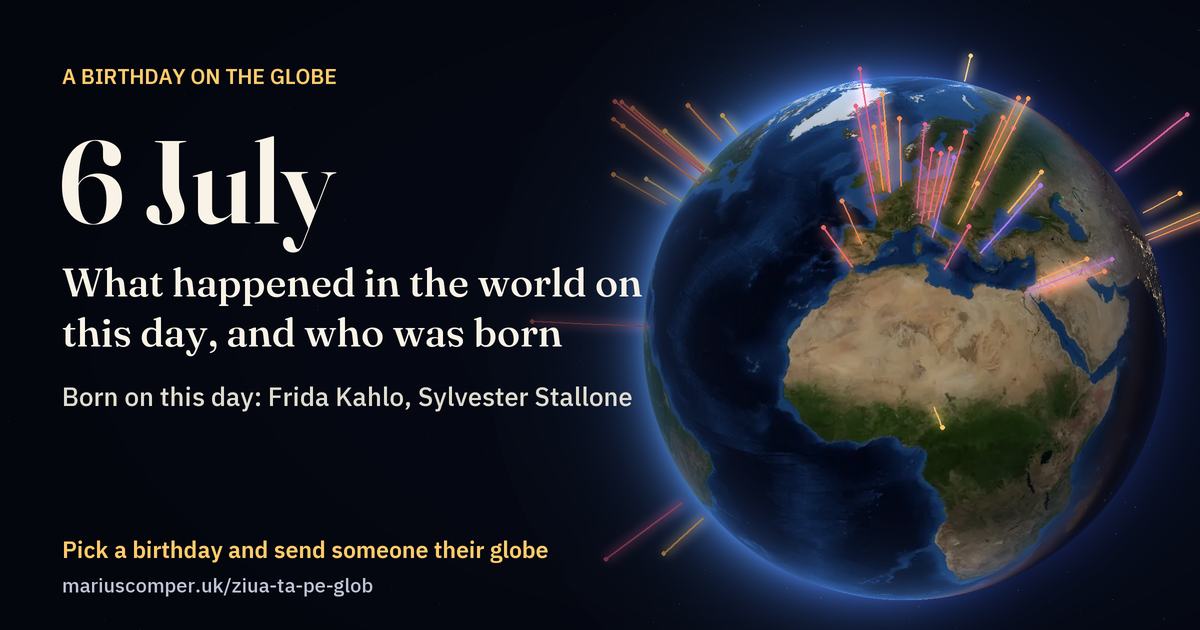
For 6 July, the English Wikipedia lists 72 events and 189 births. 47 of the events stand at their places as rays of light; six more are dashed circles, where the sentence links only to a country or a sea. The taller the ray, the longer ago it happened. The people born that day come further down, as blue points.
A birthday, yours or someone else’s:
Turn it into a greetingScroll: the globe turns to each place
The day you were born, on the globe.
Three things from your day
Scroll: your day first, then 6 July through the years
The Earth on 6 July
The picture on the globe was assembled by NASA from satellite photographs taken in July 2004: the snow, the ice and the green are those of the month.
On 6 July the Sun passes straight overhead at noon along the parallel of 22.7° north. In London, the day lasts about 16 hours 30 minutes.
Beyond 67° north the Sun no longer sets; beyond 67° south it no longer rises.
The line between day and night is tilted on the globe exactly as on this day of the year. On the dark side you can see the lights of towns.
Britain & Ireland · Edinburgh
1560
The Treaty of Edinburgh is signed by Scotland and England.
On the map: Edinburgh.
Britain & Ireland · Wimbledon Championships
1957
Althea Gibson wins at the Wimbledon Championships, becoming the first black athlete to do so.
On the map: Wimbledon Championships.
Also on the day’s list of Wikipedia in Romanian and Chinese.
Europe · Patriarchate of Aquileia
1751
Pope Benedict XIV suppresses the Patriarchate of Aquileia and establishes from its territory the Archdiocese of Udine and Gorizia.
On the map: Patriarchate of Aquileia.
Also on the day’s list of Wikipedia in Chinese.
Europe · Padua
1791
At Padua, the Emperor Leopold II calls on the monarchs of Europe to join him in demanding the king of France Louis XVI's freedom.
On the map: Padua.
Europe · Yevpatoria
2003
The 70-metre Yevpatoria Planetary Radar sends a METI message (Cosmic Call 2) to five stars: Hip 4872, HD 245409, 55 Cancri (HD 75732), HD 10307 and 47 Ursae Majoris (HD 95128). The messages will arrive to these stars in 2036, 2040, 2044, and 2049, respectively.
On the map: Yevpatoria.
Also on the day’s list of Wikipedia in Chinese.
Asia · Barak Valley
1947
Referendum held in Sylhet to decide its fate in the Partition of India.
On the map: Barak Valley.
Asia · Hong Kong International Airport
1998
Hong Kong International Airport opens in Chek Lap Kok, Hong Kong, replacing Kai Tak Airport as the city's international airport.
On the map: Hong Kong International Airport.
Also on the day’s list of Wikipedia in Spanish and Chinese.
Oceania · Brisbane
1940
Story Bridge, a major landmark in Brisbane, as well as Australia's longest cantilever bridge is formally opened.
On the map: Brisbane.
Also on the day’s list of Wikipedia in Chinese.
Latin America · Córdoba, Argentina
1573
Córdoba, Argentina, is founded by Jerónimo Luis de Cabrera.
On the map: Córdoba, Argentina.
Also on the day’s list of Wikipedia in Spanish and Chinese.
North America · Jackson, Michigan
1854
The Republican Party of the United States held its first convention in Jackson, Michigan.
On the map: Jackson, Michigan.
Also on the day’s list of Wikipedia in Chinese.
6 July
What the other Wikipedias remember#
For these years the English list has nothing on this day. The events below come from the same day’s lists on Wikipedia in Spanish and were translated for this page.
From Wikipedia in Spanish · London
2005
In Singapore, the members of the IOC designate the city of London as host of the 2012 Olympic Games, beating the favourites Paris and Madrid and two other cities, New York and Moscow.
On the map: London.
Translated from the list on Wikipedia in Spanish.
The article on Wikipedia in Spanish: Juegos Olímpicos de Londres 2012
6 July
Born on 6 July#
The English Wikipedia lists 189 births for this day. The blue points are the birthplaces of 59 of these people: those written about in the most Wikipedia editions, where Wikidata gives a place of birth.
Born on 6 July
1907
Frida Kahlo, Mexican painter and educator (died 1954)
Place of birth: Mexico City.
Born on 6 July
1946
Sylvester Stallone, American actor, director, and screenwriter
Place of birth: Hell's Kitchen.
Born on 6 July
1975
50 Cent, American rapper and actor
Place of birth: South Jamaica.
Born on 6 July
1887
Marc Chagall, Belarusian-French painter and poet (died 1985)
Place of birth: Liozna.
Born in Britain and Ireland
1952
Hilary Mantel, English author and critic (died 2022)
Place of birth: Glossop.
Born in Britain and Ireland
1958
Jennifer Saunders, English actress, comedian and screenwriter
Place of birth: Sleaford.
Born in Britain and Ireland
1785
William Hooker, English botanist and academic (died 1865)
Place of birth: Norwich.
6 July
Number one in the charts that week
At the cinema
An animal recorded that day
The record can be seen in GBIF, which brings together wildlife records from around the world.
All your birthdays
The weather that day
Data: Met Office Hadley Centre (HadCET); NOAA (GHCN-Daily, Mauna Loa).
Above the Earth
Sources: Jonathan McDowell, GCAT (launches); GFZ Potsdam (Kp index). Days are counted in Universal Time.
Football that day
International matches played that day:
Source: the “International football results” dataset kept by Mart Jürisoo (CC0).
Also that day
The earthquake’s page at the USGS
Source: the USGS catalogue. The day is counted in Universal Time (UTC).
In those days
Make a link for someone
Type the name, pick the day and the year of birth. The link opens straight on their day, with their name in the greeting.
The link carries the name, date and place typed here; anyone who gets it can see them.
Put another birthday beside it
Your mother’s, your child’s, a friend’s: the two days appear side by side.
Below: 6 July through the years.
The whole globe of the day
Drag the globe to turn it. Touch a ray or a point to read what happened there.
Everything Wikipedia lists for 6 July
The list is the English Wikipedia’s, in its own wording, as it stood in October 2026. 19 events have no place on the map: the sentence links to no place with coordinates, only to places too wide to mark, or to several countries.
- 371 BC
The Battle of Leuctra shatters Sparta's reputation of military invincibility.
Europe · Battle of LeuctraWikipedia: Battle of Leuctra - 83 BC
The Temple of Jupiter on the Capitoline Hill in Rome is burned down and the Sibylline books of prophecy destroyed with it.
Europe · Temple of Jupiter Optimus MaximusWikipedia: Temple of Jupiter Optimus Maximus - 640
Battle of Heliopolis: The Muslim Arab army under 'Amr ibn al-'As defeat the Byzantine forces near Heliopolis (Egypt).
Africa · Battle of HeliopolisWikipedia: Battle of Heliopolis - 1253
Mindaugas is crowned King of Lithuania.
Europe · LithuaniaWikipedia: Mindaugas - 1348
Pope Clement VI issues a papal bull protecting the Jews accused of having caused the Black Death.
no place on the mapWikipedia: Black Death - 1411
Ming China's Admiral Zheng He returns to Nanjing after the third treasure voyage and presents the Sinhalese king, captured during the Ming–Kotte War, to the Yongle Emperor.
Asia · NanjingWikipedia: Ming–Kotte War - 1415
Jan Hus is condemned by the assembly of the council in the Konstanz Cathedral as a heretic and sentenced to be burned at the stake.
Europe · Konstanz MinsterWikipedia: Jan Hus - 1438
A temporary compromise between the rebellious Transylvanian peasants and the noblemen is signed in Kolozsmonostor Abbey.
Europe · Kolozsmonostor AbbeyWikipedia: Transylvanian peasant revolt - 1439
The reunion of the Catholic and Orthodox Church is proclaimed and celebrated with a public holiday.
no place on the mapWikipedia: Eastern Orthodox Church - 1483
Richard III and Anne Neville are crowned King and Queen of England.
no place on the mapWikipedia: Richard III of England - 1484
Portuguese sea captain Diogo Cão finds the mouth of the Congo River.
no place on the mapWikipedia: Diogo Cão - 1495
First Italian War: Battle of Fornovo: Charles VIII defeats the Holy League.
Europe · Battle of FornovoWikipedia: Battle of Fornovo - 1536
The explorer Jacques Cartier lands at St. Malo at the end of his second expedition to North America. He returns with none of the gold he expected to find.
no place on the mapWikipedia: Jacques Cartier - 1536
Thomas More is executed after having been condemned on perjured evidence.
no place on the mapWikipedia: Thomas More - 1557
King Philip II of Spain, consort of Queen Mary I of England, sets out from Dover to war with France, which eventually resulted in the loss of the city of Calais, the last English possession on the continent, and Mary I never seeing her husband again.
Britain & Ireland · DoverWikipedia: Philip II of Spain - 1560
The Treaty of Edinburgh is signed by Scotland and England.
Britain & Ireland · EdinburghWikipedia: Treaty of Edinburgh - 1573
Córdoba, Argentina, is founded by Jerónimo Luis de Cabrera.
Latin America · Córdoba, ArgentinaWikipedia: Córdoba, Argentina - 1573
French Wars of Religion: Siege of La Rochelle ends.
Europe · Siege of La RochelleWikipedia: French Wars of Religion - 1614
Raid on Żejtun: The south east of Malta, and the town of Żejtun, suffer a raid from Ottoman forces. This was the last unsuccessful attempt by the Ottomans to conquer the island of Malta.
Europe · ŻejtunWikipedia: Raid on Żejtun - 1630
Thirty Years' War: Four thousand Swedish troops under Gustavus Adolphus land in Pomerania, Germany.
no place on the mapWikipedia: Thirty Years' War - 1685
Battle of Sedgemoor: Last battle of the Monmouth Rebellion. Troops of King James II defeat troops of James Scott, 1st Duke of Monmouth.
Britain & Ireland · Battle of SedgemoorWikipedia: Battle of Sedgemoor - 1751
Pope Benedict XIV suppresses the Patriarchate of Aquileia and establishes from its territory the Archdiocese of Udine and Gorizia.
Europe · Patriarchate of AquileiaWikipedia: Pope Benedict XIV - 1777
American Revolutionary War: Siege of Fort Ticonderoga: After a bombardment by British artillery under General John Burgoyne, American forces retreat from Fort Ticonderoga, New York.
North America · Siege of Fort TiconderogaWikipedia: Siege of Fort Ticonderoga - 1779
Battle of Grenada: The French defeat British naval forces in the Caribbean during the American Revolutionary War.
Latin America · Battle of GrenadaWikipedia: Battle of Grenada - 1791
At Padua, the Emperor Leopold II calls on the monarchs of Europe to join him in demanding the king of France Louis XVI's freedom.
Europe · PaduaWikipedia: Padua - 1801
First Battle of Algeciras: Outnumbered French Navy ships defeat the Royal Navy in the fortified Spanish port of Algeciras.
Europe · First Battle of AlgecirasWikipedia: First Battle of Algeciras - 1809
The second day of the Battle of Wagram; France defeats the Austrian army in the largest battle to date of the Napoleonic Wars.
Europe · Battle of WagramWikipedia: Battle of Wagram - 1854
The Republican Party of the United States held its first convention in Jackson, Michigan.
North America · Jackson, MichiganWikipedia: Republican Party - 1885
Louis Pasteur successfully tests his vaccine against rabies on Joseph Meister, a boy who was bitten by a rabid dog.
no place on the mapWikipedia: Louis Pasteur - 1887
David Kalākaua, monarch of the Kingdom of Hawaii, is forced to sign the Bayonet Constitution, which transfers much of the king's authority to the Legislature of the Kingdom of Hawaii.
North America · Hawaiian KingdomWikipedia: Kalākaua - 1892
Three thousand eight hundred striking steelworkers engage in a day-long battle with Pinkerton agents during the Homestead Strike, leaving ten dead and dozens wounded.
North America · HomesteadWikipedia: Homestead strike - 1915
First World War: The British and French prime ministers, H. H. Asquith and René Viviani, met at Calais to discuss future offensives including the Gallipoli campaign.
Europe · CalaisWikipedia: World War I - 1916
First World War: Russian troops won a victory in the Battle of Kostiuchnówka, with the Polish Legions playing a key role on the Austro-Hungarian side.
Europe · Battle of KostiuchnówkaWikipedia: World War I - 1917
World War I: Arabian troops led by T. E. Lawrence ("Lawrence of Arabia") and Auda ibu Tayi capture Aqaba from the Ottoman Empire during the Arab Revolt.
Asia · AqabaWikipedia: World War I - 1918
The Left SR uprising in Russia starts with the assassination of German ambassador Wilhelm von Mirbach by Cheka members.
no place on the mapWikipedia: Left SR uprising - 1919
The British dirigible R34 lands in New York, completing the first crossing of the Atlantic Ocean by an airship.
no place on the mapWikipedia: R33-class airship - 1933
The first Major League Baseball All-Star Game is played in Chicago's Comiskey Park. The American League defeated the National League 4–2.
North America · Comiskey ParkWikipedia: Major League Baseball All-Star Game - 1936
A major breach of the Manchester, Bolton and Bury Canal in England sends millions of gallons of water cascading 200 feet (61 m) into the River Irwell.
no place on the mapWikipedia: Manchester, Bolton and Bury Canal - 1937
Spanish Civil War: Battle of Brunete: The battle begins with Spanish Republican troops going on the offensive against the Nationalists to relieve pressure on Madrid.
Europe · Battle of BruneteWikipedia: Spanish Civil War - 1939
Anti-Jewish legislation in prewar Nazi Germany closes the last remaining Jewish enterprises.
no place on the mapWikipedia: Anti-Jewish legislation in pre-war Nazi Germany - 1940
Story Bridge, a major landmark in Brisbane, as well as Australia's longest cantilever bridge is formally opened.
Oceania · BrisbaneWikipedia: Story Bridge - 1941
World War II: The German army launches its offensive to encircle several Soviet armies near Smolensk.
Europe · Battle of SmolenskWikipedia: Battle of Smolensk - 1942
Anne Frank and her family go into hiding in the "Secret Annexe" above her father's office in an Amsterdam warehouse.
Europe · Anne Frank HouseWikipedia: Anne Frank House - 1944
Jackie Robinson refuses to move to the back of a bus, leading to his court-martial.
no place on the mapWikipedia: Jackie Robinson - 1944
The Hartford circus fire, one of America's worst fire disasters, kills approximately 168 people and injures over 700 in Hartford, Connecticut.
North America · Hartford circus fireWikipedia: Hartford circus fire - 1947
Referendum held in Sylhet to decide its fate in the Partition of India.
Asia · Barak ValleyWikipedia: 1947 Sylhet referendum - 1947
The AK-47 goes into production in the Soviet Union.
Asia · Soviet UnionWikipedia: AK-47 - 1957
Althea Gibson wins at the Wimbledon Championships, becoming the first black athlete to do so.
Britain & Ireland · Wimbledon ChampionshipsWikipedia: Wimbledon Championships - 1957
John Lennon and Paul McCartney meet for the first time, as teenagers at Woolton Fete, three years before forming the Beatles.
no place on the mapWikipedia: John Lennon - 1962
As a part of Operation Plowshare, the Sedan nuclear test takes place.
North America · SedanWikipedia: Sedan - 1962
The Late Late Show, the world's longest-running chat show by the same broadcaster, airs on RTÉ One for the first time.
no place on the mapWikipedia: The Late Late Show - 1964
Malawi declares its independence from the United Kingdom.
Africa · MalawiWikipedia: Malawi - 1966
Malawi becomes a republic, with Hastings Banda as its first President.
no place on the mapWikipedia: Republic - 1967
Nigerian Civil War: Nigerian forces invade Biafra, beginning the war.
no place on the mapWikipedia: Nigerian Civil War - 1971
After visiting several Asian communist countries, Romanian leader Nicolae Ceaușescu gave a speech on a number of neo-Stalinist and socialist-realist ideals, which became known as the July Theses.
no place on the mapWikipedia: Nicolae Ceaușescu - 1975
The Comoros declares independence from France.
Africa · ComorosWikipedia: Comoros - 1982
While attempting to return to Sheremetyevo International Airport, Aeroflot Flight 411, an Ilyushin Il-62, crashes near Mendeleyevo, Moscow Oblast, killing all 90 people on board.
Europe · Aeroflot Flight 411Wikipedia: Aeroflot Flight 411 - 1988
The Piper Alpha drilling platform in the North Sea is destroyed by explosions and fires. One hundred sixty-seven oil workers are killed, making it the world's worst offshore oil disaster in terms of direct loss of life.
Oceans · Piper AlphaWikipedia: Piper Alpha - 1989
The Tel Aviv–Jerusalem bus 405 suicide attack: Sixteen bus passengers are killed when a member of the Palestinian Islamic Jihad took control of the bus and drove it over a cliff.
Asia · 1989 Tel Aviv–Jerusalem bus attackWikipedia: 1989 Tel Aviv–Jerusalem bus attack - 1995
In the Bosnian War, under the command of General Ratko Mladić, Serbia begins its attack on the Bosnian town of Srebrenica.
Europe · SrebrenicaWikipedia: Bosnian War - 1996
A McDonnell Douglas MD-88 operating as Delta Air Lines Flight 1288 experiences a turbine engine failure during takeoff from Pensacola International Airport, killing two and injuring five of the 147 people on board.
North America · Delta Air Lines Flight 1288Wikipedia: Delta Air Lines Flight 1288 - 1997
The Troubles: In response to the Drumcree dispute, five days of mass protests, riots and gun battles begin in Irish nationalist districts of Northern Ireland.
Britain & Ireland · Northern IrelandWikipedia: The Troubles - 1998
Hong Kong International Airport opens in Chek Lap Kok, Hong Kong, replacing Kai Tak Airport as the city's international airport.
Asia · Hong Kong International AirportWikipedia: Hong Kong International Airport - 2003
The 70-metre Yevpatoria Planetary Radar sends a METI message (Cosmic Call 2) to five stars: Hip 4872, HD 245409, 55 Cancri (HD 75732), HD 10307 and 47 Ursae Majoris (HD 95128). The messages will arrive to these stars in 2036, 2040, 2044, and 2049, respectively.
Europe · YevpatoriaWikipedia: Cosmic Call - 2006
A gunman killed an 18-year-old man and injured six other people in a mass shooting on Cabildo Avenue in Buenos Aires, Argentina.
Latin America · Buenos AiresWikipedia: Martín Ríos - 2006
The Nathu La pass between India and China, sealed during the Sino-Indian War, re-opens for trade after 44 years.
Asia · Nathu LaWikipedia: Sino-Indian War - 2009
Jadranka Kosor became the first female prime minister of Croatia.
no place on the mapWikipedia: Jadranka Kosor - 2013
A 73-car oil train derails in the town of Lac-Mégantic, Quebec and explodes into flames, killing at least 47 people and destroying more than 30 buildings in the town's central area.
North America · Lac-Mégantic, QuebecWikipedia: Lac-Mégantic rail disaster - 2013
A Boeing 777 operating as Asiana Airlines Flight 214 crashes at San Francisco International Airport, killing three and injuring 181 of the 307 people on board.
North America · Asiana Airlines Flight 214Wikipedia: Asiana Airlines Flight 214 - 2013
At least 42 people are killed in a shooting at a school in Yobe State, Nigeria.
Africa · Mamudo school massacreWikipedia: Mamudo school massacre - 2021
An Antonov An-26 operating as Petropavlovsk-Kamchatsky Air Flight 251 crashes on approach to Palana Airport, killing all 28 aboard.
Asia · Petropavlovsk-Kamchatsky Air Flight 251Wikipedia: Petropavlovsk-Kamchatsky Air Flight 251 - 2022
The Georgia Guidestones, a monument in the United States, are heavily damaged in a bombing, and are dismantled later the same day.
North America · Georgia GuidestonesWikipedia: Georgia Guidestones
What the other Wikipedias remember
For these years the English list has nothing on this day. The events below come from the same day’s lists on Wikipedia in Spanish and were translated for this page.
- 2005
In Singapore, the members of the IOC designate the city of London as host of the 2012 Olympic Games, beating the favourites Paris and Madrid and two other cities, New York and Moscow.
Britain & Ireland · LondonTranslated from the list on Wikipedia in SpanishWikipedia: Juegos Olímpicos de Londres 2012
Who was born on 6 July
In order of how many Wikipedia editions have an article about each. The first 60 of 189 are shown.
- 1946
George W. Bush, American businessman and politician, 43rd President of the United States
Yale – New Haven HospitalWikipedia: George W. Bush - 1907
Frida Kahlo, Mexican painter and educator (died 1954)
Mexico CityWikipedia: Frida Kahlo - 1935
Tenzin Gyatso, 14th Dalai Lama
TaktserWikipedia: 14th Dalai Lama - 1946
Sylvester Stallone, American actor, director, and screenwriter
Hell's KitchenWikipedia: Sylvester Stallone - 1940
Nursultan Nazarbayev, Kazakh politician, 1st President of Kazakhstan
ShamalganWikipedia: Nursultan Nazarbayev - 1975
50 Cent, American rapper and actor
South JamaicaWikipedia: 50 Cent - 1796
Nicholas I of Russia (died 1855)
- 1921
Nancy Reagan, American actress and activist, 42nd First Lady of the United States (died 2016)
Sloane Hospital for WomenWikipedia: Nancy Reagan - 1887
Marc Chagall, Belarusian-French painter and poet (died 1985)
LioznaWikipedia: Marc Chagall - 1980
Eva Green, French actress and model
ParisWikipedia: Eva Green - 1923
Wojciech Jaruzelski, Polish general and politician, 1st President of the Third Polish Republic (died 2014)
- 1951
Geoffrey Rush, Australian actor and producer
ToowoombaWikipedia: Geoffrey Rush - 1946
Peter Singer, Australian philosopher and academic
MelbourneWikipedia: Peter Singer - 1832
Maximilian I of Mexico (died 1867)
Schönbrunn PalaceWikipedia: Maximilian I of Mexico - 1979
Kevin Hart, American comedian, actor, producer, and screenwriter
United StatesWikipedia: Kevin Hart - 1886
Marc Bloch, French historian and academic (died 1944)
2nd arrondissement of LyonWikipedia: Marc Bloch - 1927
Janet Leigh, American actress and author (died 2004)
MercedWikipedia: Janet Leigh - 1878
Eino Leino, Finnish poet and journalist (died 1926)
HövelöWikipedia: Eino Leino - 1952
Hilary Mantel, English author and critic (died 2022)
GlossopWikipedia: Hilary Mantel - 1903
Hugo Theorell, Swedish biochemist and academic, Nobel Prize laureate (died 1982)
Linköping Cathedral CongregationWikipedia: Hugo Theorell - 1980
Pau Gasol, Spanish basketball player
BarcelonaWikipedia: Pau Gasol - 1818
Adolf Anderssen, German chess player (died 1879)
WrocławWikipedia: Adolf Anderssen - 1985
Ranveer Singh, Indian film actor
MumbaiWikipedia: Ranveer Singh - 1925
Bill Haley, American singer-songwriter and guitarist (died 1981)
Highland ParkWikipedia: Bill Haley - 1937
Michael Sata, Zambian police officer and politician, 5th President of Zambia (died 2014)
- 1981
Roman Shirokov, Russian footballer
DedovskWikipedia: Roman Shirokov - 1937
Ned Beatty, American actor (died 2021)
LouisvilleWikipedia: Ned Beatty - 1948
Nathalie Baye, French actress (died 2026)
MainnevilleWikipedia: Nathalie Baye - 1912
Heinrich Harrer, Austrian geographer and mountaineer (died 2006)
- 1974
Zé Roberto, Brazilian footballer
São PauloWikipedia: Zé Roberto - 1937
Vladimir Ashkenazy, Russian-Icelandic pianist and conductor
Nizhny NovgorodWikipedia: Vladimir Ashkenazy - 1958
Jennifer Saunders, English actress, comedian and screenwriter
SleafordWikipedia: Jennifer Saunders - 1387
Queen Blanche I of Navarre (died 1441)
- 1785
William Hooker, English botanist and academic (died 1865)
- 1952
Adi Shamir, Israeli cryptographer and co-inventor of RSA cryptography
Tel AvivWikipedia: Adi Shamir - 1977
Max Mirnyi, Belarusian tennis player
- 1885
Ernst Busch, German field marshal (died 1945)
SteeleWikipedia: Ernst Busch - 1898
Hanns Eisler, German-Austrian soldier and composer (died 1962)
LeipzigWikipedia: Hanns Eisler - 1868
Princess Victoria of the United Kingdom (died 1935)
Marlborough HouseWikipedia: Princess Victoria of the United Kingdom - 1941
David Crystal, British linguist, author, and academic
LisburnWikipedia: David Crystal - 1887
Annette Kellermann, Australian swimmer and actress (died 1975)
- 1987
Kate Nash, English singer-songwriter, guitarist, and actress
HarrowWikipedia: Kate Nash - 1747
John Paul Jones, Scottish-American captain, early leader in the Continental Navy (died 1792)
KirkcudbrightshireWikipedia: John Paul Jones - 1789
María Isabella of Spain (died 1846)
- 1976
Rory Delap, English-Irish footballer
Sutton ColdfieldWikipedia: Rory Delap - 1817
Albert von Kölliker, Swiss anatomist and physiologist (died 1905)
- 1929
Hélène Carrère d'Encausse, French politician historian (died 2023)
16th arrondissement of ParisWikipedia: Hélène Carrère d'Encausse - 2000
Zion Williamson, American basketball player
SalisburyWikipedia: Zion Williamson - 1865
Émile Jaques-Dalcroze, Swiss composer and educator (died 1950)
- 1972
Laurent Gaudé, French author and playwright
14th arrondissement of ParisWikipedia: Laurent Gaudé - 1823
Sophie Adlersparre, Swedish publisher, writer, and women's rights activist (died 1895)
- 1922
William Schallert, American actor; president (1979–81) of the Screen Actors Guild (died 2016)
Los AngelesWikipedia: William Schallert - 1782
Maria Luisa of Spain (died 1824)
Real Sitio de San IldefonsoWikipedia: Maria Luisa, Duchess of Lucca - 1931
Della Reese, American actress and singer (died 2017)
Black BottomWikipedia: Della Reese - 1937
Bessie Head, Botswanan writer (died 1986)
PietermaritzburgWikipedia: Bessie Head - 1939
Mary Peters, English-Irish pentathlete and shot putter
HalewoodWikipedia: Mary Peters - 1949
Noli de Castro, Filipino journalist and politician, 14th Vice President of the Philippines
- 1970
Inspectah Deck, American rapper and producer
The BronxWikipedia: Inspectah Deck - 1975
Sebastián Rulli, Argentine-Mexican actor and model
Buenos AiresWikipedia: Sebastián Rulli - 1983
Gregory Smith, Canadian actor, director, and producer
TorontoWikipedia: Gregory Smith
What is celebrated on 6 July
- The first day of the Festival of San Fermín, which lasts until July 14. (Pamplona)
- Christian feast day: Goar of Aquitaine
- Christian feast day: Maria Goretti
- Christian feast day: Blessed Mary Theresa Ledóchowska
- Christian feast day: Moninne
- Christian feast day: Nazaria Ignacia March Mesa
- Christian feast day: Romulus of Fiesole
- Christian feast day: Thomas More
- Christian feast day: July 6 (Eastern Orthodox liturgics)
- Constitution Day (Cayman Islands)
- Day of the Capital (Kazakhstan)
- Independence Day (Comoros), celebrates the independence of the Comoros from France in 1975.
- Independence Day (Malawi), celebrates the independence of Malawi from United Kingdom in 1964.
- International Kissing Day (informally observed)
A greeting link for someone
Type a name and, if you like, the year of birth. The link opens with a greeting, and beside each event it says how old the person turned that day, or how many years before their birth it happened.
The name and the year go only into the link you send.
All 366 days
How the globe is made
Where the events come from
Each edition of this page uses the day’s list from Wikipedia in its own language: Romanian, English, Spanish, Chinese. The lists are written by volunteers and differ from one edition to the next; the text of each event is Wikipedia’s, with a link to the article. A row that appears twice in a list is shown once. The lists have not been checked event by event: they are Wikipedia’s, mistakes included.
For events before 1582, and for countries that moved to the Gregorian calendar later (Britain in 1752, Russia in 1918), the same day may be counted Old Style in one list and New Style in another.
The chapter “What the other Wikipedias remember” adds up to five events a day from the lists of the other three editions, only for years in which the English list has nothing on that day. They were translated for this page, passed the same filters as the tour, and are not counted among the events of the English list.
How an event gets onto the map
The place comes from Wikidata. If the sentence links to the article about the event itself (a battle, an opening, an earthquake), dated to the same year, the ray stands on its coordinates or on those of its location. Otherwise it stands on the first place the sentence links to: a town, a building, a mountain, an island. This second step can be wrong: sometimes the sentence only mentions the place. That is why the page says, under each event, which place the ray stands on.
When the sentence links to a single state or province, or to a single sea, lake or desert larger than 5,000 km², the globe shows a dashed circle, not a ray. The circle has the area Wikidata gives, with its radius kept between 1.2° and 16°, or a radius of 4.5° when Wikidata gives no area; it says only that the sentence links to that place. Organisations, ships, spacecraft, museum objects, rivers, mountain ranges, languages and continents are never used as places. When a sentence names several states and no exact place, the event stays in the list only.
What the height means
The height of a ray shows how many years have passed, on a logarithmic scale: 10 years, 100 years and 1,000 years are equal steps apart; anything older than about 2,600 years has the tallest ray. The colour runs from pale yellow for recent years to violet for antiquity.
Where the tour stops
In each region the tour stops at up to three events (five in Britain and Ireland), chosen mainly by three things: whether Wikipedia’s editors put the event in the “On this day” box of their main page (the English, Spanish and Chinese editions), how many Wikipedia editions have an article about it, and how many of the four lists include it. Events whose sentence or article is about a war, an attack, a crime or a disaster are left out of the tour; they stay in the whole list, in Wikipedia’s wording. The filter is a list of words and a list of Wikidata types, so it can miss some.
The tour of births names the people with articles in the most editions and leaves aside those whom the list or Wikidata describes as rulers, politicians, commanders, leaders of movements or criminals; they stay in the list.
The Earth and the Sun
The daytime images are NASA’s Blue Marble Next Generation mosaics, one for each month of 2004; the night side is Black Marble 2016. The tilt of the line between day and night is computed for the day; the hour is chosen so that the place being read is in daylight. The latitude where the Sun stands overhead is the average of the four years of the leap cycle; in a given year it can differ by up to 0.4°.
The day you were born
The number ones come from the weekly lists on Wikipedia: Billboard for the United States (from 1940; the Hot 100 from August 1958), the UK Singles Chart (from November 1952), Los 40 Principales for Spain (from July 1966) and, for Romania, the Romanian Top 100 and Airplay 100 (2001–2021, with missing weeks). The page shows the chart of the week in which the day of birth falls, with its date; Billboard and the UK chart are dated at the end of their week. For Romania before 2001 and for China these sources have no weekly chart.
The films are those that reached cinemas in the United States up to ten days before or three days after that day (some of them in a few cinemas at first), from the English Wikipedia’s yearly lists (from 1968), in order of how many editions have an article about them. The events “in those days” are the ones on the neighbouring days’ lists that carry the year of birth, passed through the same filter as the tour.
The day of birth, year included
The Moon, the star sign and the constellation are worked out by the page itself, for noon Universal Time on the day. The lit part of the Moon is rounded and can differ by a few per cent from that at the hour of birth. The sign follows the usual zodiac of twelve equal parts starting at the March equinox; the constellation is the one the Sun actually stood in front of, by the borders set by the International Astronomical Union, and within a day of a border the page does not name it. When the Sun changes sign while it is that day anywhere on Earth, the page gives the moment of crossing, rounded to ten minutes and accurate to within about a quarter of an hour, and the clock time in a few cities, with the time zone and summer time of that year.
The year in the Chinese calendar is the one your device’s own calendar gives for the date, checked against the Hong Kong Observatory’s tables. “All your birthdays” uses the same sources as the rest of the chapter for the same day in every year since the birth: the temperature, well-known launches that took place on that very day, matches of the teams the edition follows, snow deeper than 10 cm and strong geomagnetic storms. The three things at the top and the four on the picture are chosen in a fixed order (the song, the animal, a full Moon, a well-known launch before an ordinary earthquake); on the picture you can change them.
When the link carries a year of birth, the page adds a few things about that exact day. The weather is the Met Office’s Central England temperature record and the readings from New York’s Central Park; the “usual high” is the average of the daily highs of 1961–1990 for that date, with two days either side. The carbon dioxide figure is the monthly mean at the Mauna Loa observatory, where measurements begin in March 1958.
The earthquake is the one with the largest magnitude in the USGS catalogue for that day, counted in Universal Time. Before the 1960s the catalogue has gaps even above magnitude 5.5, so in the older years many days have no earthquake. The page gives only the magnitude and the place: the country the epicentre falls in or, when the epicentre is at sea within 300 km of a coast, the nearest country; farther out, only the ocean.
The launches are those that reached orbit or left for the Moon and the planets, from Jonathan McDowell’s GCAT catalogue. If nothing left that day, the page shows the nearest launch within three days before or after, and says how many days away it was. The geomagnetic storm appears only when the Kp index reached at least 5 in one of the day’s eight three-hour intervals.
The animal comes from GBIF: an observation made by a person (the animal seen or heard, or its tracks), dated to that exact day, with coordinates and a CC0 or CC BY licence. Only a few hundred well-known species are searched (mammals, birds, turtles, butterflies); of those noted that day, mammals and species with articles in many Wikipedia editions come first; birds noted almost every day, and species used recently, wait their turn. Observations dated 1 January are left out, because records without a day are often filed there. An observation shows that the animal was recorded there, not how many animals there were.
The matches are those between national teams. Only matches of England, Scotland, Wales, Northern Ireland, the Republic of Ireland, the United States, Canada and Australia are shown, along with those at the big final tournaments. The picture to send is drawn in the page from the day’s globe and the facts above, and stays on your device until you send it.
Sources
- Events, births and holidays: the day’s page on Wikipedia, text under CC BY-SA 4.0.
- Coordinates, places of birth and the number of editions: Wikidata (CC0).
- The Earth by day: NASA Blue Marble Next Generation. The Earth by night: NASA Black Marble 2016.
- Borders and regions: Natural Earth.
- World population and births per year: UN World Population Prospects 2024.
- Charts and films: Wikipedia’s lists for Billboard, the UK Singles Chart, Los 40 Principales, Romanian Top 100, Airplay 100 and American films by year (CC BY-SA 4.0).
- Weather: Met Office Hadley Centre, HadCET (Open Government Licence) and NOAA GHCN-Daily, New York Central Park. Carbon dioxide: NOAA Global Monitoring Laboratory, Mauna Loa.
- Earthquakes: the USGS catalogue. Launches: Jonathan McDowell, GCAT (CC BY). Kp index: GFZ Potsdam (CC BY 4.0). Matches: International football results, Mart Jürisoo (CC0).
- Animal observations: GBIF, with a link to each record; species names come from Wikidata.