A birthday on the globe
2 April on the globe: what happened in the world on this day, and who was born
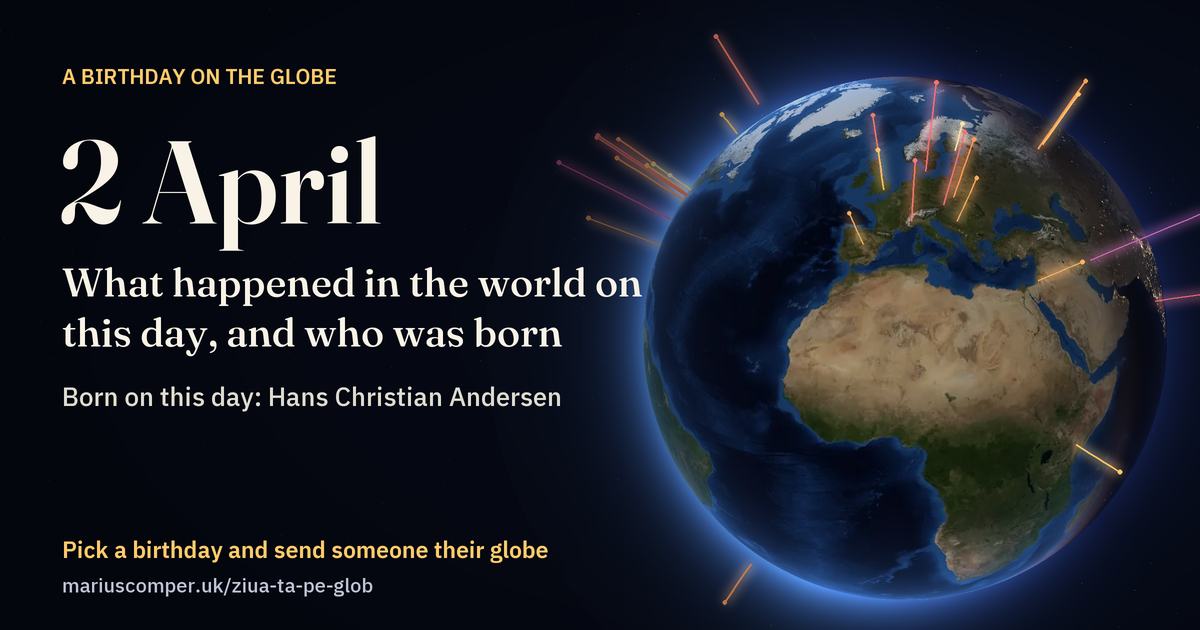
For 2 April, the English Wikipedia lists 44 events and 222 births. 27 of the events stand at their places as rays of light; six more are dashed circles, where the sentence links only to a country or a sea. The taller the ray, the longer ago it happened. The people born that day come further down, as blue points.
A birthday, yours or someone else’s:
Turn it into a greetingScroll: the globe turns to each place
The day you were born, on the globe.
Three things from your day
Scroll: your day first, then 2 April through the years
The Earth on 2 April
The picture on the globe was assembled by NASA from satellite photographs taken in April 2004: the snow, the ice and the green are those of the month.
On 2 April the Sun passes straight overhead at noon along the parallel of 5.1° north. In London, the day lasts about 13 hours.
Beyond 85° north the Sun no longer sets; beyond 85° south it no longer rises.
The line between day and night is tilted on the globe exactly as on this day of the year. On the dark side you can see the lights of towns.
Britain & Ireland · Royal Court Theatre
1871
Creatures of Impulse, by W. S. Gilbert, premiered at the Court Theatre in London.
On the map: Royal Court Theatre.
Europe · Vienna
1800
Ludwig van Beethoven leads the premiere of his First Symphony in Vienna.
On the map: Vienna.
Also on the day’s list of Wikipedia in Spanish, Romanian and Chinese.
Latin America · Havana
1989
Soviet leader Mikhail Gorbachev arrives in Havana, Cuba, to meet with Fidel Castro in an attempt to mend strained relations.
On the map: Havana.
Also on the day’s list of Wikipedia in Spanish.
North America · Uptown Theater
1968
2001: A Space Odyssey, the epic science fiction film produced and directed by Stanley Kubrick, premiered at the Uptown Theater in Washington, D.C.
On the map: Uptown Theater.
North America · White House Rose Garden
2025
Liberation Day tariffs: U.S. President Donald Trump announces sweeping worldwide tariffs.
On the map: White House Rose Garden.
2 April
What the other Wikipedias remember#
For these years the English list has nothing on this day. The events below come from the same day’s lists on Wikipedia in Spanish, Romanian and Chinese and were translated for this page.
From Wikipedia in Spanish · Vitoria-Gasteiz
1332
In Vitoria (Spain), the deed of incorporation of Álava into Castile is signed, with Castile recognising Álava's charter of rights.
On the map: Vitoria-Gasteiz.
Translated from the list on Wikipedia in Spanish.
From Wikipedia in Romanian · Constantinople
1453
Mehmed II begins the assault on the city of Constantinople.
On the map: Constantinople.
Translated from the list on Wikipedia in Romanian.
From Wikipedia in Spanish · Madrid
1550
In Madrid, the King of Spain orders that Castilian be taught to the indigenous peoples.
On the map: Madrid.
Translated from the list on Wikipedia in Spanish.
From Wikipedia in Chinese · United States Congress
1900
Under the Foraker Act passed by the United States Congress, Puerto Rico is granted limited self-government.
On the map: United States Congress.
Translated from the list on Wikipedia in Chinese.
From Wikipedia in Spanish · Dortmund
1974
In Dortmund (Germany), the Signal Iduna Park stadium is inaugurated.
On the map: Dortmund.
Translated from the list on Wikipedia in Spanish.
2 April
Born on 2 April#
The English Wikipedia lists 222 births for this day. The blue points are the birthplaces of 60 of these people: those written about in the most Wikipedia editions, where Wikidata gives a place of birth.
Born on 2 April
1805
Hans Christian Andersen, Danish novelist, short story writer, and poet (died 1875)
Place of birth: Odense.
Born on 2 April
1840
Émile Zola, French novelist, playwright, journalist (died 1902)
Place of birth: rue Saint-Joseph.
Born on 2 April
1725
Giacomo Casanova, Italian explorer and author (died 1798)
Place of birth: Venice.
Born on 2 April
1914
Alec Guinness, English actor (died 2000)
Place of birth: Marylebone.
Born on 2 April
1939
Marvin Gaye, American singer-songwriter (died 1984)
Place of birth: Washington, D.C..
Born in Britain and Ireland
1966
Teddy Sheringham, English international footballer and coach
Place of birth: Highams Park.
2 April
Number one in the charts that week
At the cinema
An animal recorded that day
The record can be seen in GBIF, which brings together wildlife records from around the world.
All your birthdays
The weather that day
Data: Met Office Hadley Centre (HadCET); NOAA (GHCN-Daily, Mauna Loa).
Above the Earth
Sources: Jonathan McDowell, GCAT (launches); GFZ Potsdam (Kp index). Days are counted in Universal Time.
Football that day
International matches played that day:
Source: the “International football results” dataset kept by Mart Jürisoo (CC0).
Also that day
The earthquake’s page at the USGS
Source: the USGS catalogue. The day is counted in Universal Time (UTC).
In those days
Make a link for someone
Type the name, pick the day and the year of birth. The link opens straight on their day, with their name in the greeting.
The link carries the name, date and place typed here; anyone who gets it can see them.
Put another birthday beside it
Your mother’s, your child’s, a friend’s: the two days appear side by side.
Below: 2 April through the years.
The whole globe of the day
Drag the globe to turn it. Touch a ray or a point to read what happened there.
Everything Wikipedia lists for 2 April
The list is the English Wikipedia’s, in its own wording, as it stood in October 2026. 11 events have no place on the map: the sentence links to no place with coordinates, only to places too wide to mark, or to several countries.
- 1107
Seljuq sultan Muhammad I Tapar begins the siege of Shahdiz, a fortress of the Nizari Ismailis.
Asia · ShahdizWikipedia: Shahdiz - 1285
Election of Pope Honorius IV following the death of Pope Martin IV.
no place on the mapWikipedia: Pope Honorius IV - 1513
Having spotted land on March 27, Spanish explorer Juan Ponce de León comes ashore on what is now the U.S. state of Florida, landing somewhere between the modern city of St. Augustine and the mouth of the St. Johns River.
North America · St. Augustine, FloridaWikipedia: Juan Ponce de León - 1725
J. S. Bach's cantata Bleib bei uns, denn es will Abend werden, BWV 6, is first performed in Leipzig on Easter Monday.
no place on the mapWikipedia: Johann Sebastian Bach - 1755
Commodore William James captures the Maratha fortress of Suvarnadurg on the west coast of India.
Asia · SuvarnadurgWikipedia: Commodore - 1792
The Coinage Act is passed by Congress, establishing the United States Mint.
no place on the mapWikipedia: Coinage Act of 1792 - 1800
Ludwig van Beethoven leads the premiere of his First Symphony in Vienna.
Europe · ViennaWikipedia: Ludwig van Beethoven - 1801
French Revolutionary Wars: In the Battle of Copenhagen a British Royal Navy squadron defeats a hastily assembled, smaller, mostly-volunteer Dano-Norwegian Navy at high cost, forcing Denmark out of the Second League of Armed Neutrality.
Europe · Battle of CopenhagenWikipedia: Battle of Copenhagen - 1860
The first modern Italian Parliament is opened in Turin, following the annexation of Central Italy into the Kingdom of Sardinia.
Europe · TurinWikipedia: Italian Parliament - 1863
American Civil War: The largest in a series of Southern bread riots occurs in Richmond, Virginia.
North America · Richmond, VirginiaWikipedia: American Civil War - 1865
American Civil War: Defeat at the Third Battle of Petersburg forces the Army of Northern Virginia and the Confederate government to abandon Richmond, Virginia.
North America · Third Battle of PetersburgWikipedia: Third Battle of Petersburg - 1871
Creatures of Impulse, by W. S. Gilbert, premiered at the Court Theatre in London.
Britain & Ireland · Royal Court TheatreWikipedia: Royal Court Theatre - 1885
Canadian Cree warriors attack the village of Frog Lake, killing nine.
North America · Frog Lake MassacreWikipedia: Frog Lake Massacre - 1911
The Australian Bureau of Statistics conducts the country's first national census.
no place on the mapWikipedia: Australian Bureau of Statistics - 1912
The ill-fated RMS Titanic begins sea trials.
no place on the mapWikipedia: Titanic - 1917
American entry into World War I: President Wilson asks the U.S. Congress for a declaration of war on Germany.
no place on the mapWikipedia: American entry into World War I - 1921
The Autonomous Government of Khorasan, a military government encompassing the modern state of Iran, is established.
Asia · IranWikipedia: Autonomous Government of Khorasan - 1930
After the mysterious death of Empress Zewditu, Haile Selassie is proclaimed emperor of Ethiopia.
Africa · EthiopiaWikipedia: Zewditu - 1968
2001: A Space Odyssey, the epic science fiction film produced and directed by Stanley Kubrick, premiered at the Uptown Theater in Washington, D.C.
North America · Uptown TheaterWikipedia: 2001: A Space Odyssey - 1969
LOT Polish Airlines Flight 165 crashes into the Polica mountain near Zawoja, Poland, killing 53.
Europe · LOT Polish Airlines Flight 165Wikipedia: LOT Polish Airlines Flight 165 - 1975
Vietnam War: Thousands of civilian refugees flee from Quảng Ngãi Province in front of advancing North Vietnamese troops.
no place on the mapWikipedia: Vietnam War - 1976
Prince Norodom Sihanouk resigns as leader of Cambodia and is placed under house arrest.
Asia · CambodiaWikipedia: Norodom Sihanouk - 1979
A Soviet bio-warfare laboratory at Sverdlovsk accidentally releases airborne anthrax spores, killing 66 plus an unknown amount of livestock.
Asia · Sverdlovsk anthrax leakWikipedia: Sverdlovsk anthrax leak - 1980
United States President Jimmy Carter signs the Crude Oil Windfall Profits Tax Act.
no place on the mapWikipedia: Jimmy Carter - 1982
Falklands War: Argentina invades the Falkland Islands.
Latin America · Falklands WarWikipedia: Falklands War - 1986
Alabama governor George Wallace, a former segregationist, best known for the "Stand in the Schoolhouse Door", announces that he will not seek a fifth four-year term and will retire from public life upon the end of his term in January 1987.
North America · Stand in the Schoolhouse DoorWikipedia: Alabama - 1989
Soviet leader Mikhail Gorbachev arrives in Havana, Cuba, to meet with Fidel Castro in an attempt to mend strained relations.
Latin America · HavanaWikipedia: Soviet Union - 1991
Rita Johnston becomes the first female Premier of a Canadian province when she succeeds William Vander Zalm (who had resigned) as Premier of British Columbia.
no place on the mapWikipedia: Rita Johnston - 1992
Forty-two civilians are massacred in the town of Bijeljina in Bosnia and Herzegovina.
Europe · Bijeljina massacreWikipedia: Bijeljina massacre - 1992
In New York, Mafia boss John Gotti is convicted of murder and racketeering and is later sentenced to life in prison.
North America · New YorkWikipedia: New York - 2002
Israeli forces surround the Church of the Nativity in Bethlehem, into which armed Palestinians had retreated.
Asia · Siege of the Church of the NativityWikipedia: Israel - 2004
Islamist terrorists involved in the 11 March 2004 Madrid attacks attempt to bomb the Spanish high-speed train AVE near Madrid; the attack is thwarted.
Europe · 2004 Madrid train bombingsWikipedia: 2004 Madrid train bombings - 2006
Over 60 tornadoes break out in the United States; Tennessee is hardest hit with 29 people killed.
North America · TennesseeWikipedia: Tornado - 2011
India wins the Cricket World Cup for the second time in history under the captaincy of MS Dhoni.
no place on the mapWikipedia: 2011 Cricket World Cup - 2012
A mass shooting at Oikos University in California leaves seven people dead and three injured.
North America · 2012 Oikos University shootingWikipedia: 2012 Oikos University shooting - 2012
UTair Flight 120 crashes after takeoff from Roshchino International Airport in Tyumen, Russia, killing 33 and injuring 10.
Asia · UTair Flight 120Wikipedia: UTair Flight 120 - 2014
A spree shooting occurs at the Fort Hood army base in Texas, with four dead, including the gunman, and 16 others injured.
North America · 2014 Fort Hood shootingsWikipedia: 2014 Fort Hood shootings - 2015
Four men steal items worth up to £200 million from an underground safe deposit facility in London's Hatton Garden area in what has been called the "largest burglary in English legal history."
Britain & Ireland · Hatton Garden safe deposit burglaryWikipedia: Hatton Garden safe deposit burglary - 2015
Gunmen attack Garissa University College in Kenya, killing at least 148 people and wounding 79 others.
Africa · Garissa University College attackWikipedia: Garissa University College attack - 2020
COVID-19 pandemic: The total number of confirmed cases reach one million.
no place on the mapWikipedia: COVID-19 pandemic - 2021
A Capitol Police officer is killed and another injured when an attacker rams his car into a barricade outside the United States Capitol.
North America · 2021 United States Capitol car attackWikipedia: 2021 United States Capitol car attack - 2021
At least 49 people are killed in a train derailment in Taiwan after a truck accidentally rolls onto the track.
Asia · TaiwanWikipedia: 2021 Hualien train derailment - 2024
Viertola school shooting: A 12-year-old pupil is killed and two others injured by a shooter of the same age in Vantaa, Finland.
Europe · 2024 Viertola school shootingWikipedia: 2024 Viertola school shooting - 2025
Liberation Day tariffs: U.S. President Donald Trump announces sweeping worldwide tariffs.
North America · White House Rose GardenWikipedia: Liberation Day tariffs
What the other Wikipedias remember
For these years the English list has nothing on this day. The events below come from the same day’s lists on Wikipedia in Spanish, Romanian and Chinese and were translated for this page.
- 1332
In Vitoria (Spain), the deed of incorporation of Álava into Castile is signed, with Castile recognising Álava's charter of rights.
- 1453
Mehmed II begins the assault on the city of Constantinople.
- 1550
In Madrid, the King of Spain orders that Castilian be taught to the indigenous peoples.
- 1900
Under the Foraker Act passed by the United States Congress, Puerto Rico is granted limited self-government.
North America · United States CongressTranslated from the list on Wikipedia in ChineseWikipedia: 美国国会 - 1974
In Dortmund (Germany), the Signal Iduna Park stadium is inaugurated.
Who was born on 2 April
In order of how many Wikipedia editions have an article about each. The first 60 of 222 are shown.
- 1805
Hans Christian Andersen, Danish novelist, short story writer, and poet (died 1875)
- 747
Charlemagne, Frankish king (died 814)
FranciafWikipedia: Charlemagne - 1840
Émile Zola, French novelist, playwright, journalist (died 1902)
rue Saint-JosephWikipedia: Émile Zola - 1725
Giacomo Casanova, Italian explorer and author (died 1798)
- 1914
Alec Guinness, English actor (died 2000)
MaryleboneWikipedia: Alec Guinness - 1939
Marvin Gaye, American singer-songwriter (died 1984)
Washington, D.C.Wikipedia: Marvin Gaye - 1647
Maria Sibylla Merian, German-Dutch botanist and illustrator (died 1717)
FrankfurtWikipedia: Maria Sibylla Merian - 1977
Michael Fassbender, German-Irish actor and producer
HeidelbergWikipedia: Michael Fassbender - 1891
Max Ernst, German painter, sculptor, and poet (died 1976)
BrühlWikipedia: Max Ernst - 1928
Serge Gainsbourg, French singer-songwriter, actor, and director (died 1991)
4th arrondissement of ParisWikipedia: Serge Gainsbourg - 1975
Pedro Pascal, Chilean and American actor
SantiagoWikipedia: Pedro Pascal - 1969
Ajay Devgn, Indian actor, director, and producer
New DelhiWikipedia: Ajay Devgn - 1926
Jack Brabham, Australian race car driver (died 2014)
HurstvilleWikipedia: Jack Brabham - 1986
Ibrahim Afellay, Dutch footballer
UtrechtWikipedia: Ibrahim Afellay - 1755
Jean Anthelme Brillat-Savarin, French lawyer and politician (died 1826)
Hôtel Brillat-SavarinWikipedia: Jean Anthelme Brillat-Savarin - 1990
Miralem Pjanić, Bosnian footballer
- 1838
Léon Gambetta, French lawyer and politician, 45th Prime Minister of France (died 1882)
CahorsWikipedia: Léon Gambetta - 1862
Nicholas Murray Butler, American philosopher and academic, Nobel Prize laureate (died 1947)
ElizabethWikipedia: Nicholas Murray Butler - 1966
Teddy Sheringham, English international footballer and coach
Highams ParkWikipedia: Teddy Sheringham - 1996
André Onana, Cameroonian footballer
CentreWikipedia: André Onana - 1827
William Holman Hunt, English soldier and painter (died 1910)
- 1945
Linda Hunt, American actress
MorristownWikipedia: Linda Hunt - 1962
Clark Gregg, American actor
- 1982
David Ferrer, Spanish tennis player
- 1971
Edmundo Alves de Souza Neto, Brazilian footballer
NiteróiWikipedia: Edmundo - 1798
August Heinrich Hoffmann von Fallersleben, German poet and academic (died 1874)
- 1982
Marco Amelia, Italian footballer
FrascatiWikipedia: Marco Amelia - 1841
Clément Ader, French engineer, designed the Ader Avion III (died 1926)
- 1947
Camille Paglia, American author and critic
EndicottWikipedia: Camille Paglia - 2002
Emma Myers, American actress
OrlandoWikipedia: Emma Myers - 1545
Elisabeth of Valois, queen consort of Spain (died 1568)
FontainebleauWikipedia: Elisabeth of Valois - 1947
Emmylou Harris, American singer-songwriter and guitarist
BirminghamWikipedia: Emmylou Harris - 1980
Carlos Salcido, Mexican international footballer
OcotlánWikipedia: Carlos Salcido - 1988
Jesse Plemons, American actor
DallasWikipedia: Jesse Plemons - 1618
Francesco Maria Grimaldi, Italian mathematician and physicist (died 1663)
- 1842
Dominic Savio, Italian Catholic saint, adolescent student of Saint John Bosco (died 1857)
San GiovanniWikipedia: Dominic Savio - 1875
Walter Chrysler, American businessman, founded Chrysler (died 1940)
- 1934
Paul Cohen, American mathematician and theorist (died 2007)
Long BranchWikipedia: Paul Cohen - 1961
Christopher Meloni, American actor
Washington, D.C.Wikipedia: Christopher Meloni - 1653
Prince George of Denmark, Duke of Cumberland (died 1708)
Copenhagen CastleWikipedia: Prince George of Denmark - 1965
Rodney King, American victim of police brutality (died 2012)
SacramentoWikipedia: Rodney King - 1991
Quavo, American rapper
AthensWikipedia: Quavo - 1792
Francisco de Paula Santander, Colombian general and politician, 4th President of the Republic of the New Granada (died 1840)
Villa del RosarioWikipedia: Francisco de Paula Santander - 1960
Linford Christie, Jamaican-English sprinter
Saint Andrew ParishWikipedia: Linford Christie - 1971
Todd Woodbridge, Australian tennis player and sportscaster
- 1983
Arthur Boka, Ivorian footballer
AbidjanWikipedia: Arthur Boka - 1984
Miguel Ángel Moyá, Spanish footballer
BinissalemWikipedia: Miguel Ángel Moyá - 1990
Yevgeniya Kanayeva, Russian gymnast
- 2000
Josip Stanišić, Croatian footballer
- 1973
Roselyn Sánchez, Puerto Rican-American actress
San JuanWikipedia: Roselyn Sánchez - 1933
György Konrád, Hungarian sociologist and author (died 2019)
DebrecenWikipedia: György Konrád - 181
Emperor Xian of Han, Chinese emperor (died 234)
- 1959
Juha Kankkunen, Finnish race car driver
- 1586
Pietro Della Valle, Italian traveler (died 1652)
- 1902
Menachem Mendel Schneerson, the seventh Lubavitcher Rebbe (died 1994)
- 1908
Buddy Ebsen, American actor and dancer (died 2003)
BellevilleWikipedia: Buddy Ebsen - 1994
Pascal Siakam, Cameroonian basketball player
DoualaWikipedia: Pascal Siakam - 1959
Badou Ezzaki, Moroccan footballer and manager
Sidi KacemWikipedia: Ezzaki Badou - 1942
Leon Russell, American singer-songwriter and pianist (died 2016)
LawtonWikipedia: Leon Russell - 1985
Stéphane Lambiel, Swiss figure skater
MartignyWikipedia: Stéphane Lambiel
What is celebrated on 2 April
- Christian feast day: Abundius of Como
- Christian feast day: Amphianus of Lycia
- Christian feast day: Æbbe the Younger
- Christian feast day: Bronach of Glen-Seichis (Irish martyrology)
- Christian feast day: Blessed Elisabetta Vendramini
- Christian feast day: Francis of Paola
- Christian feast day: Francisco Coll Guitart
- Christian feast day: Henry Budd (Anglican Church of Canada)
- Christian feast day: Blessed Laura Evangelista Alvarado Cardozo
- Christian feast day: Blessed Nicholas Charnetsky
- Christian feast day: Nicetius of Lyon
- Christian feast day: Theodosia of Tyre
- Christian feast day: Urban of Langres
- Christian feast day: Blessed Vilmos Apor
A greeting link for someone
Type a name and, if you like, the year of birth. The link opens with a greeting, and beside each event it says how old the person turned that day, or how many years before their birth it happened.
The name and the year go only into the link you send.
All 366 days
How the globe is made
Where the events come from
Each edition of this page uses the day’s list from Wikipedia in its own language: Romanian, English, Spanish, Chinese. The lists are written by volunteers and differ from one edition to the next; the text of each event is Wikipedia’s, with a link to the article. A row that appears twice in a list is shown once. The lists have not been checked event by event: they are Wikipedia’s, mistakes included.
For events before 1582, and for countries that moved to the Gregorian calendar later (Britain in 1752, Russia in 1918), the same day may be counted Old Style in one list and New Style in another.
The chapter “What the other Wikipedias remember” adds up to five events a day from the lists of the other three editions, only for years in which the English list has nothing on that day. They were translated for this page, passed the same filters as the tour, and are not counted among the events of the English list.
How an event gets onto the map
The place comes from Wikidata. If the sentence links to the article about the event itself (a battle, an opening, an earthquake), dated to the same year, the ray stands on its coordinates or on those of its location. Otherwise it stands on the first place the sentence links to: a town, a building, a mountain, an island. This second step can be wrong: sometimes the sentence only mentions the place. That is why the page says, under each event, which place the ray stands on.
When the sentence links to a single state or province, or to a single sea, lake or desert larger than 5,000 km², the globe shows a dashed circle, not a ray. The circle has the area Wikidata gives, with its radius kept between 1.2° and 16°, or a radius of 4.5° when Wikidata gives no area; it says only that the sentence links to that place. Organisations, ships, spacecraft, museum objects, rivers, mountain ranges, languages and continents are never used as places. When a sentence names several states and no exact place, the event stays in the list only.
What the height means
The height of a ray shows how many years have passed, on a logarithmic scale: 10 years, 100 years and 1,000 years are equal steps apart; anything older than about 2,600 years has the tallest ray. The colour runs from pale yellow for recent years to violet for antiquity.
Where the tour stops
In each region the tour stops at up to three events (five in Britain and Ireland), chosen mainly by three things: whether Wikipedia’s editors put the event in the “On this day” box of their main page (the English, Spanish and Chinese editions), how many Wikipedia editions have an article about it, and how many of the four lists include it. Events whose sentence or article is about a war, an attack, a crime or a disaster are left out of the tour; they stay in the whole list, in Wikipedia’s wording. The filter is a list of words and a list of Wikidata types, so it can miss some.
The tour of births names the people with articles in the most editions and leaves aside those whom the list or Wikidata describes as rulers, politicians, commanders, leaders of movements or criminals; they stay in the list.
The Earth and the Sun
The daytime images are NASA’s Blue Marble Next Generation mosaics, one for each month of 2004; the night side is Black Marble 2016. The tilt of the line between day and night is computed for the day; the hour is chosen so that the place being read is in daylight. The latitude where the Sun stands overhead is the average of the four years of the leap cycle; in a given year it can differ by up to 0.4°.
The day you were born
The number ones come from the weekly lists on Wikipedia: Billboard for the United States (from 1940; the Hot 100 from August 1958), the UK Singles Chart (from November 1952), Los 40 Principales for Spain (from July 1966) and, for Romania, the Romanian Top 100 and Airplay 100 (2001–2021, with missing weeks). The page shows the chart of the week in which the day of birth falls, with its date; Billboard and the UK chart are dated at the end of their week. For Romania before 2001 and for China these sources have no weekly chart.
The films are those that reached cinemas in the United States up to ten days before or three days after that day (some of them in a few cinemas at first), from the English Wikipedia’s yearly lists (from 1968), in order of how many editions have an article about them. The events “in those days” are the ones on the neighbouring days’ lists that carry the year of birth, passed through the same filter as the tour.
The day of birth, year included
The Moon, the star sign and the constellation are worked out by the page itself, for noon Universal Time on the day. The lit part of the Moon is rounded and can differ by a few per cent from that at the hour of birth. The sign follows the usual zodiac of twelve equal parts starting at the March equinox; the constellation is the one the Sun actually stood in front of, by the borders set by the International Astronomical Union, and within a day of a border the page does not name it. When the Sun changes sign while it is that day anywhere on Earth, the page gives the moment of crossing, rounded to ten minutes and accurate to within about a quarter of an hour, and the clock time in a few cities, with the time zone and summer time of that year.
The year in the Chinese calendar is the one your device’s own calendar gives for the date, checked against the Hong Kong Observatory’s tables. “All your birthdays” uses the same sources as the rest of the chapter for the same day in every year since the birth: the temperature, well-known launches that took place on that very day, matches of the teams the edition follows, snow deeper than 10 cm and strong geomagnetic storms. The three things at the top and the four on the picture are chosen in a fixed order (the song, the animal, a full Moon, a well-known launch before an ordinary earthquake); on the picture you can change them.
When the link carries a year of birth, the page adds a few things about that exact day. The weather is the Met Office’s Central England temperature record and the readings from New York’s Central Park; the “usual high” is the average of the daily highs of 1961–1990 for that date, with two days either side. The carbon dioxide figure is the monthly mean at the Mauna Loa observatory, where measurements begin in March 1958.
The earthquake is the one with the largest magnitude in the USGS catalogue for that day, counted in Universal Time. Before the 1960s the catalogue has gaps even above magnitude 5.5, so in the older years many days have no earthquake. The page gives only the magnitude and the place: the country the epicentre falls in or, when the epicentre is at sea within 300 km of a coast, the nearest country; farther out, only the ocean.
The launches are those that reached orbit or left for the Moon and the planets, from Jonathan McDowell’s GCAT catalogue. If nothing left that day, the page shows the nearest launch within three days before or after, and says how many days away it was. The geomagnetic storm appears only when the Kp index reached at least 5 in one of the day’s eight three-hour intervals.
The animal comes from GBIF: an observation made by a person (the animal seen or heard, or its tracks), dated to that exact day, with coordinates and a CC0 or CC BY licence. Only a few hundred well-known species are searched (mammals, birds, turtles, butterflies); of those noted that day, mammals and species with articles in many Wikipedia editions come first; birds noted almost every day, and species used recently, wait their turn. Observations dated 1 January are left out, because records without a day are often filed there. An observation shows that the animal was recorded there, not how many animals there were.
The matches are those between national teams. Only matches of England, Scotland, Wales, Northern Ireland, the Republic of Ireland, the United States, Canada and Australia are shown, along with those at the big final tournaments. The picture to send is drawn in the page from the day’s globe and the facts above, and stays on your device until you send it.
Sources
- Events, births and holidays: the day’s page on Wikipedia, text under CC BY-SA 4.0.
- Coordinates, places of birth and the number of editions: Wikidata (CC0).
- The Earth by day: NASA Blue Marble Next Generation. The Earth by night: NASA Black Marble 2016.
- Borders and regions: Natural Earth.
- World population and births per year: UN World Population Prospects 2024.
- Charts and films: Wikipedia’s lists for Billboard, the UK Singles Chart, Los 40 Principales, Romanian Top 100, Airplay 100 and American films by year (CC BY-SA 4.0).
- Weather: Met Office Hadley Centre, HadCET (Open Government Licence) and NOAA GHCN-Daily, New York Central Park. Carbon dioxide: NOAA Global Monitoring Laboratory, Mauna Loa.
- Earthquakes: the USGS catalogue. Launches: Jonathan McDowell, GCAT (CC BY). Kp index: GFZ Potsdam (CC BY 4.0). Matches: International football results, Mart Jürisoo (CC0).
- Animal observations: GBIF, with a link to each record; species names come from Wikidata.