A birthday on the globe
26 January on the globe: what happened in the world on this day, and who was born
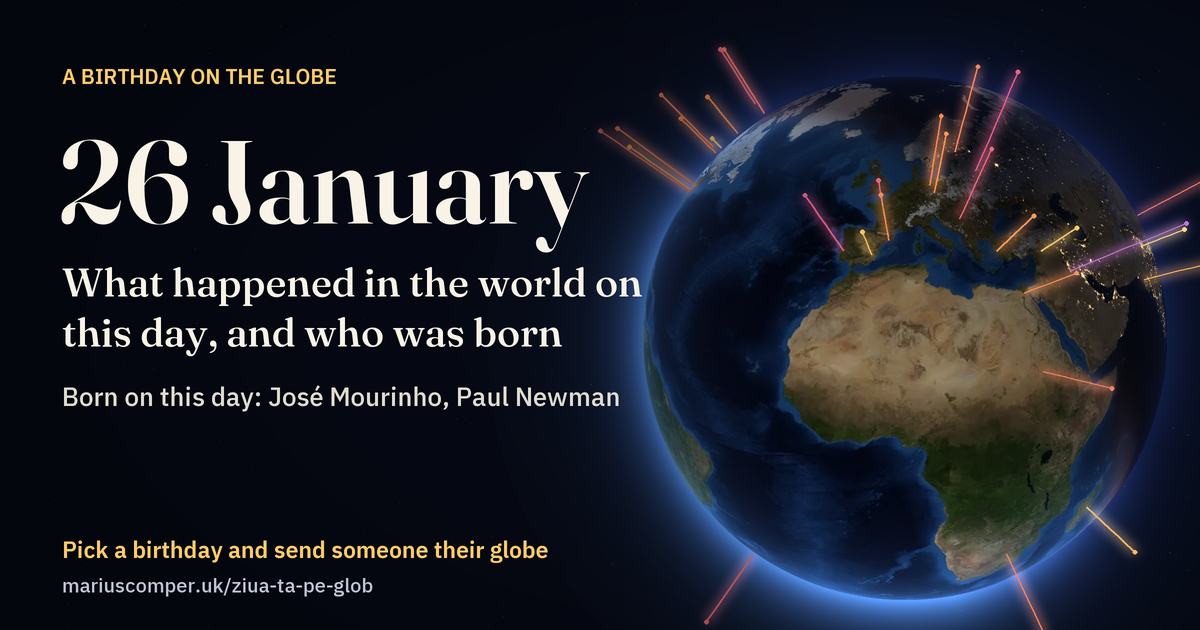
For 26 January, the English Wikipedia lists 49 events and 212 births. 32 of the events stand at their places as rays of light; six more are dashed circles, where the sentence links only to a country or a sea. The taller the ray, the longer ago it happened. The people born that day come further down, as blue points.
A birthday, yours or someone else’s:
Turn it into a greetingScroll: the globe turns to each place
The day you were born, on the globe.
Three things from your day
Scroll: your day first, then 26 January through the years
The Earth on 26 January
The picture on the globe was assembled by NASA from satellite photographs taken in January 2004: the snow, the ice and the green are those of the month.
On 26 January the Sun passes straight overhead at noon along the parallel of 18.8° south. In London, the day lasts about 8 hours 50 minutes.
Beyond 71° south the Sun no longer sets; beyond 71° north it no longer rises.
The line between day and night is tilted on the globe exactly as on this day of the year. On the dark side you can see the lights of towns.
Europe · Treaty of Karlowitz
1699
For the first time, the Ottoman Empire permanently cedes territory to the Christian powers.
On the map: the coordinates Wikidata gives for the article “Treaty of Karlowitz”.
Also on the day’s list of Wikipedia in Spanish and Romanian.
Europe · Berlin
1934
German–Polish declaration of non-aggression is signed.
On the map: Berlin.
Also on the day’s list of Wikipedia in Chinese.
Africa · Premier Mine
1905
The world's largest diamond ever, the Cullinan, which weighs 3,106.75 carats (0.621350 kg), is found at the Premier Mine near Pretoria in South Africa.
On the map: Premier Mine.
Asia · Hong Kong Island
1841
Gordon Bremer takes formal possession of Hong Kong Island at what is now Possession Point, establishing British Hong Kong.
On the map: Hong Kong Island.
Also on the day’s list of Wikipedia in Chinese.
Oceania · Port Jackson
1788
The British First Fleet, led by Arthur Phillip, sails into Port Jackson (Sydney Harbour) to establish Sydney, the first permanent European settlement on Australia. Commemorated as Australia Day.
On the map: Port Jackson.
Also on the day’s list of Wikipedia in Spanish and Chinese.
Oceania · Disappearance of the Beaumont children
1966
The three Beaumont children disappear from a beach in Glenelg, South Australia, resulting in one of the country's largest-ever police investigations.
On the map: the coordinates Wikidata gives for the article “Disappearance of the Beaumont children”.
Also on the day’s list of Wikipedia in Chinese.
Latin America · Port Egmont
1765
A British naval expedition arrives at and names Port Egmont in the Falkland Islands, founding a settlement there eight days later. (Arrival was 15 January 1765 O.S.)
On the map: Port Egmont.
North America · Rocky Mountain National Park
1915
The Rocky Mountain National Park is established by an act of the U.S. Congress.
On the map: Rocky Mountain National Park.
North America · Apollo Theater
1934
The Apollo Theater reopens in Harlem, New York City.
On the map: Apollo Theater.
Also on the day’s list of Wikipedia in Spanish.
North America · Hale Telescope
1949
The Hale Telescope at Palomar Observatory sees first light under the direction of Edwin Hubble, becoming the largest aperture optical telescope (until BTA-6 is built in 1976).
On the map: Hale Telescope.
Also on the day’s list of Wikipedia in Chinese.
26 January
What the other Wikipedias remember#
For these years the English list has nothing on this day. The events below come from the same day’s lists on Wikipedia in Romanian and were translated for this page.
From Wikipedia in Romanian · Saint Petersburg
1924
Three days after Lenin's death, the Second Congress of Soviets of the USSR renames the city of Petrograd Leningrad, as a lasting tribute to the dead revolutionary.
On the map: Saint Petersburg.
Translated from the list on Wikipedia in Romanian.
From Wikipedia in Romanian · Hindi
1965
Hindi becomes the official language of India.
On the map: Hindi.
Translated from the list on Wikipedia in Romanian.
26 January
Born on 26 January#
The English Wikipedia lists 212 births for this day. The blue points are the birthplaces of 60 of these people: those written about in the most Wikipedia editions, where Wikidata gives a place of birth.
Born on 26 January
1963
José Mourinho, Portuguese footballer and manager
Place of birth: Setúbal.
Born on 26 January
1925
Paul Newman, American actor, activist, director, race car driver, and businessman, co-founded Newman's Own (died 2008)
Place of birth: Shaker Heights.
Born on 26 January
1958
Ellen DeGeneres, American comedian, actress, and talk show host
Place of birth: Metairie.
Born on 26 January
1944
Angela Davis, American activist, academic, and author
Place of birth: Birmingham.
Born on 26 January
1715
Claude Adrien Helvétius, French philosopher (died 1771)
Place of birth: rue Sainte-Anne.
Born in Britain and Ireland
1973
Brendan Rodgers, Northern Irish footballer and manager
Place of birth: Carnlough.
Born in Britain and Ireland
1945
Jacqueline du Pré, English cellist (died 1987)
Place of birth: Oxford.
Born in Britain and Ireland
1963
Andrew Ridgeley, English singer-songwriter and guitarist
Place of birth: Windlesham.
26 January
Number one in the charts that week
At the cinema
An animal recorded that day
The record can be seen in GBIF, which brings together wildlife records from around the world.
All your birthdays
The weather that day
Data: Met Office Hadley Centre (HadCET); NOAA (GHCN-Daily, Mauna Loa).
Above the Earth
Sources: Jonathan McDowell, GCAT (launches); GFZ Potsdam (Kp index). Days are counted in Universal Time.
Football that day
International matches played that day:
Source: the “International football results” dataset kept by Mart Jürisoo (CC0).
Also that day
The earthquake’s page at the USGS
Source: the USGS catalogue. The day is counted in Universal Time (UTC).
In those days
Make a link for someone
Type the name, pick the day and the year of birth. The link opens straight on their day, with their name in the greeting.
The link carries the name, date and place typed here; anyone who gets it can see them.
Put another birthday beside it
Your mother’s, your child’s, a friend’s: the two days appear side by side.
Below: 26 January through the years.
The whole globe of the day
Drag the globe to turn it. Touch a ray or a point to read what happened there.
Everything Wikipedia lists for 26 January
The list is the English Wikipedia’s, in its own wording, as it stood in October 2026. 11 events have no place on the map: the sentence links to no place with coordinates, only to places too wide to mark, or to several countries.
- 661
The Rashidun Caliphate is effectively ended with the assassination of Ali, the last caliph.
Asia · Assassination of AliWikipedia: Assassination of Ali - 1531
The 6.4–7.1 Mw Lisbon earthquake kills about thirty thousand people.
Europe · 1531 Lisbon earthquakeWikipedia: 1531 Lisbon earthquake - 1564
The Council of Trent establishes an official distinction between Roman Catholicism and Protestantism.
no place on the mapWikipedia: Council of Trent - 1564
The Grand Duchy of Lithuania defeats the Tsardom of Russia in the Battle of Ula during the Livonian War.
Europe · Battle of the UlaWikipedia: Battle of the Ula - 1641
Reapers' War: Battle of Montjuïc, decisive victory of the Catalan army (with French support) over the Spanish army.
Europe · Battle of MontjuïcWikipedia: Battle of Montjuïc - 1699
For the first time, the Ottoman Empire permanently cedes territory to the Christian powers.
Europe · Treaty of KarlowitzWikipedia: Treaty of Karlowitz - 1700
The 8.7–9.2 Mw Cascadia earthquake takes place off the west coast of North America, as evidenced by Japanese records.
North America · 1700 Cascadia earthquakeWikipedia: 1700 Cascadia earthquake - 1765
A British naval expedition arrives at and names Port Egmont in the Falkland Islands, founding a settlement there eight days later. (Arrival was 15 January 1765 O.S.)
Latin America · Port EgmontWikipedia: Port Egmont - 1788
The British First Fleet, led by Arthur Phillip, sails into Port Jackson (Sydney Harbour) to establish Sydney, the first permanent European settlement on Australia. Commemorated as Australia Day.
Oceania · Port JacksonWikipedia: First Fleet - 1808
The Rum Rebellion is the only successful (albeit short-lived) armed takeover of the government in New South Wales.
Oceania · SydneyWikipedia: Rum Rebellion - 1837
Michigan is admitted as the 26th U.S. state.
North America · MichiganWikipedia: Michigan - 1841
Gordon Bremer takes formal possession of Hong Kong Island at what is now Possession Point, establishing British Hong Kong.
Asia · Hong Kong IslandWikipedia: Possession Street - 1855
Point No Point Treaty is signed in Washington Territory.
North America · Washington TerritoryWikipedia: Point No Point Treaty - 1856
First Battle of Seattle: Marines from the USS Decatur drive off Native American attackers after all-day battle with settlers.
North America · Battle of SeattleWikipedia: Battle of Seattle - 1861
American Civil War: The state of Louisiana secedes from the Union.
North America · LouisianaWikipedia: American Civil War - 1863
American Civil War: General Ambrose Burnside is relieved of command of the Army of the Potomac after the disastrous Fredericksburg campaign. He is replaced by Joseph Hooker.
North America · Battle of FredericksburgWikipedia: Battle of Fredericksburg - 1863
American Civil War: Governor of Massachusetts John Albion Andrew receives permission from the Secretary of War to raise a militia organization for men of African descent.
no place on the mapWikipedia: Governor of Massachusetts - 1870
Reconstruction Era: Virginia is readmitted to the Union.
North America · VirginiaWikipedia: Reconstruction era - 1885
Troops loyal to The Mahdi conquer Khartoum, killing the Governor-General Charles George Gordon.
Africa · Siege of KhartoumWikipedia: Siege of Khartoum - 1905
The world's largest diamond ever, the Cullinan, which weighs 3,106.75 carats (0.621350 kg), is found at the Premier Mine near Pretoria in South Africa.
Africa · Premier MineWikipedia: Diamond - 1915
The Rocky Mountain National Park is established by an act of the U.S. Congress.
North America · Rocky Mountain National ParkWikipedia: Rocky Mountain National Park - 1918
Finnish Civil War: A group of Red Guards hangs a red lantern atop the tower of Helsinki Workers' Hall to symbolically mark the start of the war.
Europe · PaasitorniWikipedia: Finnish Civil War - 1926
The first demonstration of the television by John Logie Baird.
no place on the mapWikipedia: John Logie Baird - 1930
The Indian National Congress declares 26 January as Independence Day or as the day for Poorna Swaraj ("Complete Independence") which occurred 17 years later.
no place on the mapWikipedia: Indian National Congress - 1934
German–Polish declaration of non-aggression is signed.
Europe · BerlinWikipedia: German–Polish declaration of non-aggression - 1934
The Apollo Theater reopens in Harlem, New York City.
North America · Apollo TheaterWikipedia: Apollo Theater - 1939
Spanish Civil War: Catalonia Offensive: Troops loyal to nationalist General Francisco Franco and aided by Italy take Barcelona.
Europe · BarcelonaWikipedia: Spanish Civil War - 1942
World War II: The first United States forces arrive in Europe, landing in Northern Ireland.
Britain & Ireland · Northern IrelandWikipedia: World War II - 1945
World War II: Audie Murphy displays valor and bravery in action for which he will later be awarded the Medal of Honor.
no place on the mapWikipedia: Audie Murphy - 1949
The Hale Telescope at Palomar Observatory sees first light under the direction of Edwin Hubble, becoming the largest aperture optical telescope (until BTA-6 is built in 1976).
North America · Hale TelescopeWikipedia: Palomar Observatory - 1950
The Constitution of India comes into force, forming a republic. Rajendra Prasad is sworn in as the first President of India. Observed as Republic Day in India.
no place on the mapWikipedia: Constitution of India - 1952
Black Saturday in Egypt: rioters burn Cairo's central business district, targeting British and upper-class Egyptian businesses.
Africa · Cairo fireWikipedia: Cairo fire - 1956
Soviet Union cedes Porkkala back to Finland.
no place on the mapWikipedia: Porkkalanniemi - 1959
The 41-acre (17 ha) Chain Island is listed for sale by the California State Lands Commission, with a minimum bid of $5,226.
North America · Chain IslandWikipedia: Chain Island - 1962
Ranger 3 is launched to study the Moon. The space probe later misses the Moon by 22,000 miles (35,400 km).
no place on the mapWikipedia: Ranger 3 - 1966
The three Beaumont children disappear from a beach in Glenelg, South Australia, resulting in one of the country's largest-ever police investigations.
Oceania · Disappearance of the Beaumont childrenWikipedia: Disappearance of the Beaumont children - 1972
JAT Flight 367 is destroyed by a terrorist bomb, killing 27 of the 28 people on board the DC-9. Flight attendant Vesna Vulović survives with critical injuries.
Europe · JAT Flight 367Wikipedia: JAT Flight 367 - 1974
Turkish Airlines Flight 301 crashes during takeoff from Izmir Cumaovası Airport (now İzmir Adnan Menderes Airport), killing 66 of the 73 people on board the Fokker F28 Fellowship.
Asia · Turkish Airlines Flight 301Wikipedia: Turkish Airlines Flight 301 - 1986
The Ugandan government of Tito Okello is overthrown by the National Resistance Army, led by Yoweri Museveni.
no place on the mapWikipedia: Tito Okello - 1991
Mohamed Siad Barre is removed from power in Somalia, ending centralized government, and is succeeded by Ali Mahdi.
Africa · SomaliaWikipedia: Siad Barre - 1998
Lewinsky scandal: On American television, U.S. President Bill Clinton denies having had "sexual relations" with former White House intern Monica Lewinsky.
North America · Clinton–Lewinsky scandalWikipedia: Clinton–Lewinsky scandal - 2001
Diane Whipple, a lacrosse coach, is killed in a dog attack in San Francisco. The resulting court case clarified the meaning of implied malice murder.
no place on the mapWikipedia: Death of Diane Whipple - 2001
The 7.7 Mw Gujarat earthquake shakes Western India, leaving 13,805–20,023 dead and about 166,800 injured.
Asia · 2001 Gujarat earthquakeWikipedia: 2001 Gujarat earthquake - 2009
Nadya Suleman gives birth to the world's first surviving octuplets.
no place on the mapWikipedia: Nadya Suleman - 2009
Rioting breaks out in Antananarivo, Madagascar, sparking a political crisis that will result in the replacement of President Marc Ravalomanana with Andry Rajoelina.
Africa · AntananarivoWikipedia: 2009 Malagasy political crisis - 2015
An aircraft crashes at Los Llanos Air Base in Albacete, Spain, killing 11 people and injuring 21 others.
Europe · 2015 Los Llanos Air Base crashWikipedia: 2015 Los Llanos Air Base crash - 2015
Syrian civil war: The People's Protection Units (YPG) recaptures the city of Kobanî from the Islamic State of Iraq and the Levant (ISIL), marking a turning point in the Siege of Kobanî.
Asia · KobaniWikipedia: Siege of Kobanî - 2020
A Sikorsky S-76B flying from John Wayne Airport to Camarillo Airport crashes in Calabasas, 30 miles west of Los Angeles, killing all nine people on board, including five-time NBA champion Kobe Bryant and his daughter Gianna Bryant.
North America · 2020 Calabasas helicopter crashWikipedia: 2020 Calabasas helicopter crash - 2021
Protesters and farmers storm the Red Fort near Delhi, clashing with police. One protester is killed and more than 80 police officers are injured.
Asia · New DelhiWikipedia: 2021 Indian farmers' Republic Day protest
What the other Wikipedias remember
For these years the English list has nothing on this day. The events below come from the same day’s lists on Wikipedia in Romanian and were translated for this page.
- 1924
Three days after Lenin's death, the Second Congress of Soviets of the USSR renames the city of Petrograd Leningrad, as a lasting tribute to the dead revolutionary.
Europe · Saint PetersburgTranslated from the list on Wikipedia in RomanianWikipedia: Vladimir Ilici Lenin - 1965
Hindi becomes the official language of India.
Who was born on 26 January
In order of how many Wikipedia editions have an article about each. The first 60 of 212 are shown.
- 1880
Douglas MacArthur, American general, Medal of Honor recipient (died 1964)
Little RockWikipedia: Douglas MacArthur - 1963
José Mourinho, Portuguese footballer and manager
SetúbalWikipedia: José Mourinho - 1925
Paul Newman, American actor, activist, director, race car driver, and businessman, co-founded Newman's Own (died 2008)
Shaker HeightsWikipedia: Paul Newman - 1958
Ellen DeGeneres, American comedian, actress, and talk show host
MetairieWikipedia: Ellen DeGeneres - 1944
Angela Davis, American activist, academic, and author
BirminghamWikipedia: Angela Davis - 1953
Anders Fogh Rasmussen, Danish politician and diplomat, 39th Prime Minister of Denmark
Ginnerup ParishWikipedia: Anders Fogh Rasmussen - 1763
Charles XIV John of Sweden (died 1844)
- 1715
Claude Adrien Helvétius, French philosopher (died 1771)
rue Sainte-AnneWikipedia: Claude Adrien Helvétius - 1961
Wayne Gretzky, Canadian ice hockey player and coach
BrantfordWikipedia: Wayne Gretzky - 1911
Polykarp Kusch, German-American physicist and academic, Nobel Prize laureate (died 1993)
BlankenburgWikipedia: Polykarp Kusch - 1950
Jörg Haider, Austrian lawyer and politician, Governor of Carinthia (died 2008)
Bad Goisern am HallstätterseeWikipedia: Jörg Haider - 1781
Ludwig Achim von Arnim, German poet and author (died 1831)
Palais WrangelWikipedia: Achim von Arnim - 1955
Eddie Van Halen, Dutch-American guitarist, songwriter, and producer (died 2020)
NijmegenWikipedia: Eddie Van Halen - 1990
Sergio Pérez, Mexican race car driver
GuadalajaraWikipedia: Sergio Pérez - 1928
Roger Vadim, French actor and director (died 2000)
- 1904
Seán MacBride, Irish lawyer and politician, Irish Minister for External Affairs Nobel Prize laureate (died 1988)
16th arrondissement of ParisWikipedia: Seán MacBride - 1965
Kevin McCarthy, American politician, 55th Speaker of the United States House of Representatives
BakersfieldWikipedia: Kevin McCarthy - 1973
Brendan Rodgers, Northern Irish footballer and manager
CarnloughWikipedia: Brendan Rodgers - 1991
Alex Sandro, Brazilian footballer
CatanduvaWikipedia: Alex Sandro - 1877
Kees van Dongen, Dutch painter (died 1968)
DelfshavenWikipedia: Kees van Dongen - 1921
Akio Morita, Japanese businessman, co-founded Sony (died 1999)
NagoyaWikipedia: Akio Morita - 1993
Florian Thauvin, French footballer
OrléansWikipedia: Florian Thauvin - 1842
François Coppée, French poet and author (died 1908)
- 1852
Pierre Savorgnan de Brazza, Italian-French explorer (died 1905)
- 1987
Sebastian Giovinco, Italian footballer
- 1990
Peter Sagan, Slovak professional cyclist
ŽilinaWikipedia: Peter Sagan - 1892
Bessie Coleman, American pilot (died 1926)
AtlantaWikipedia: Bessie Coleman - 1908
Stéphane Grappelli, French violinist (died 1997)
- 1947
Patrick Dewaere, French actor and composer (died 1982)
Saint-BrieucWikipedia: Patrick Dewaere - 1977
Vince Carter, American basketball player
Daytona BeachWikipedia: Vince Carter - 1996
Hwang Hee-chan, South Korean football player
ChuncheonWikipedia: Hwang Hee-chan - 1962
Oscar Ruggeri, Argentine footballer and manager
Corral de BustosWikipedia: Oscar Ruggeri - 1949
David Strathairn, American actor
San FranciscoWikipedia: David Strathairn - 1992
Mercedes Moné, American wrestler
FairfieldWikipedia: Mercedes Moné - 1918
Philip José Farmer, American author (died 2009)
Terre HauteWikipedia: Philip José Farmer - 1945
Jacqueline du Pré, English cellist (died 1987)
- 1919
Valentino Mazzola, Italian footballer (died 1949)
Cassano d’AddaWikipedia: Valentino Mazzola - 1981
Gustavo Dudamel, Venezuelan violinist, composer, and conductor
BarquisimetoWikipedia: Gustavo Dudamel - 2000
Ester Expósito, Spanish actress
- 1958
Anita Baker, American singer-songwriter
ToledoWikipedia: Anita Baker - 1924
Alice Babs, Swedish singer and actress (died 2014)
Kalmar cathedral parishWikipedia: Alice Babs - 1953
Lucinda Williams, American singer-songwriter and guitarist
Lake CharlesWikipedia: Lucinda Williams - 1891
Frank Costello, Italian-American mob boss (died 1973)
Cassano allo IonioWikipedia: Frank Costello - 1935
Paula Rego, Portuguese-born British visual artist (died 2022)
LisbonWikipedia: Paula Rego - 1946
Christopher Hampton, Portuguese-English director, screenwriter, and playwright
Faial IslandWikipedia: Christopher Hampton - 1963
Andrew Ridgeley, English singer-songwriter and guitarist
WindleshamWikipedia: Andrew Ridgeley - 1981
José de Jesús Corona, Mexican footballer
GuadalajaraWikipedia: José de Jesús Corona - 1995
Jean-Charles Castelletto, Cameroonian footballer
- 1925
Joan Leslie, American actress (died 2015)
DetroitWikipedia: Joan Leslie - 1946
Gene Siskel, American journalist and film critic (died 1999)
ChicagoWikipedia: Gene Siskel - 1947
Michel Sardou, French singer-songwriter and actor
17th arrondissement of ParisWikipedia: Michel Sardou - 1986
Kim Jae-joong, South Korean singer, songwriter, actor, and director
GongjuWikipedia: Kim Jae-joong - 1996
Zakaria Bakkali, Belgian footballer
- 1998
Moonbin, South Korean singer and actor. (died 2023)
CheongjuWikipedia: Moonbin - 1905
Maria von Trapp, Austrian-American singer (died 1987)
- 1919
Bill Nicholson, English footballer and manager (died 2004)
ScarboroughWikipedia: Bill Nicholson - 1993
Miguel Borja, Colombian footballer
La PazWikipedia: Miguel Borja - 1582
Giovanni Lanfranco, Italian painter (died 1647)
- 1714
Jean-Baptiste Pigalle, French sculptor and educator (died 1785)
- 1861
Louis Anquetin, French painter (died 1932)
ÉtrépagnyWikipedia: Louis Anquetin
What is celebrated on 26 January
- Christian feast day: Saint Alberic of Cîteaux
- Christian feast day: Blessed Gabriele Allegra
- Christian feast day: Saint Paula of Rome
- Christian feast day: Saint Timothy
- Christian feast day: Saint Titus
- Christian feast day: January 26 (Eastern Orthodox liturgics)
- Australia Day (Australia)
- Republic Day (India)
A greeting link for someone
Type a name and, if you like, the year of birth. The link opens with a greeting, and beside each event it says how old the person turned that day, or how many years before their birth it happened.
The name and the year go only into the link you send.
All 366 days
How the globe is made
Where the events come from
Each edition of this page uses the day’s list from Wikipedia in its own language: Romanian, English, Spanish, Chinese. The lists are written by volunteers and differ from one edition to the next; the text of each event is Wikipedia’s, with a link to the article. A row that appears twice in a list is shown once. The lists have not been checked event by event: they are Wikipedia’s, mistakes included.
For events before 1582, and for countries that moved to the Gregorian calendar later (Britain in 1752, Russia in 1918), the same day may be counted Old Style in one list and New Style in another.
The chapter “What the other Wikipedias remember” adds up to five events a day from the lists of the other three editions, only for years in which the English list has nothing on that day. They were translated for this page, passed the same filters as the tour, and are not counted among the events of the English list.
How an event gets onto the map
The place comes from Wikidata. If the sentence links to the article about the event itself (a battle, an opening, an earthquake), dated to the same year, the ray stands on its coordinates or on those of its location. Otherwise it stands on the first place the sentence links to: a town, a building, a mountain, an island. This second step can be wrong: sometimes the sentence only mentions the place. That is why the page says, under each event, which place the ray stands on.
When the sentence links to a single state or province, or to a single sea, lake or desert larger than 5,000 km², the globe shows a dashed circle, not a ray. The circle has the area Wikidata gives, with its radius kept between 1.2° and 16°, or a radius of 4.5° when Wikidata gives no area; it says only that the sentence links to that place. Organisations, ships, spacecraft, museum objects, rivers, mountain ranges, languages and continents are never used as places. When a sentence names several states and no exact place, the event stays in the list only.
What the height means
The height of a ray shows how many years have passed, on a logarithmic scale: 10 years, 100 years and 1,000 years are equal steps apart; anything older than about 2,600 years has the tallest ray. The colour runs from pale yellow for recent years to violet for antiquity.
Where the tour stops
In each region the tour stops at up to three events (five in Britain and Ireland), chosen mainly by three things: whether Wikipedia’s editors put the event in the “On this day” box of their main page (the English, Spanish and Chinese editions), how many Wikipedia editions have an article about it, and how many of the four lists include it. Events whose sentence or article is about a war, an attack, a crime or a disaster are left out of the tour; they stay in the whole list, in Wikipedia’s wording. The filter is a list of words and a list of Wikidata types, so it can miss some.
The tour of births names the people with articles in the most editions and leaves aside those whom the list or Wikidata describes as rulers, politicians, commanders, leaders of movements or criminals; they stay in the list.
The Earth and the Sun
The daytime images are NASA’s Blue Marble Next Generation mosaics, one for each month of 2004; the night side is Black Marble 2016. The tilt of the line between day and night is computed for the day; the hour is chosen so that the place being read is in daylight. The latitude where the Sun stands overhead is the average of the four years of the leap cycle; in a given year it can differ by up to 0.4°.
The day you were born
The number ones come from the weekly lists on Wikipedia: Billboard for the United States (from 1940; the Hot 100 from August 1958), the UK Singles Chart (from November 1952), Los 40 Principales for Spain (from July 1966) and, for Romania, the Romanian Top 100 and Airplay 100 (2001–2021, with missing weeks). The page shows the chart of the week in which the day of birth falls, with its date; Billboard and the UK chart are dated at the end of their week. For Romania before 2001 and for China these sources have no weekly chart.
The films are those that reached cinemas in the United States up to ten days before or three days after that day (some of them in a few cinemas at first), from the English Wikipedia’s yearly lists (from 1968), in order of how many editions have an article about them. The events “in those days” are the ones on the neighbouring days’ lists that carry the year of birth, passed through the same filter as the tour.
The day of birth, year included
The Moon, the star sign and the constellation are worked out by the page itself, for noon Universal Time on the day. The lit part of the Moon is rounded and can differ by a few per cent from that at the hour of birth. The sign follows the usual zodiac of twelve equal parts starting at the March equinox; the constellation is the one the Sun actually stood in front of, by the borders set by the International Astronomical Union, and within a day of a border the page does not name it. When the Sun changes sign while it is that day anywhere on Earth, the page gives the moment of crossing, rounded to ten minutes and accurate to within about a quarter of an hour, and the clock time in a few cities, with the time zone and summer time of that year.
The year in the Chinese calendar is the one your device’s own calendar gives for the date, checked against the Hong Kong Observatory’s tables. “All your birthdays” uses the same sources as the rest of the chapter for the same day in every year since the birth: the temperature, well-known launches that took place on that very day, matches of the teams the edition follows, snow deeper than 10 cm and strong geomagnetic storms. The three things at the top and the four on the picture are chosen in a fixed order (the song, the animal, a full Moon, a well-known launch before an ordinary earthquake); on the picture you can change them.
When the link carries a year of birth, the page adds a few things about that exact day. The weather is the Met Office’s Central England temperature record and the readings from New York’s Central Park; the “usual high” is the average of the daily highs of 1961–1990 for that date, with two days either side. The carbon dioxide figure is the monthly mean at the Mauna Loa observatory, where measurements begin in March 1958.
The earthquake is the one with the largest magnitude in the USGS catalogue for that day, counted in Universal Time. Before the 1960s the catalogue has gaps even above magnitude 5.5, so in the older years many days have no earthquake. The page gives only the magnitude and the place: the country the epicentre falls in or, when the epicentre is at sea within 300 km of a coast, the nearest country; farther out, only the ocean.
The launches are those that reached orbit or left for the Moon and the planets, from Jonathan McDowell’s GCAT catalogue. If nothing left that day, the page shows the nearest launch within three days before or after, and says how many days away it was. The geomagnetic storm appears only when the Kp index reached at least 5 in one of the day’s eight three-hour intervals.
The animal comes from GBIF: an observation made by a person (the animal seen or heard, or its tracks), dated to that exact day, with coordinates and a CC0 or CC BY licence. Only a few hundred well-known species are searched (mammals, birds, turtles, butterflies); of those noted that day, mammals and species with articles in many Wikipedia editions come first; birds noted almost every day, and species used recently, wait their turn. Observations dated 1 January are left out, because records without a day are often filed there. An observation shows that the animal was recorded there, not how many animals there were.
The matches are those between national teams. Only matches of England, Scotland, Wales, Northern Ireland, the Republic of Ireland, the United States, Canada and Australia are shown, along with those at the big final tournaments. The picture to send is drawn in the page from the day’s globe and the facts above, and stays on your device until you send it.
Sources
- Events, births and holidays: the day’s page on Wikipedia, text under CC BY-SA 4.0.
- Coordinates, places of birth and the number of editions: Wikidata (CC0).
- The Earth by day: NASA Blue Marble Next Generation. The Earth by night: NASA Black Marble 2016.
- Borders and regions: Natural Earth.
- World population and births per year: UN World Population Prospects 2024.
- Charts and films: Wikipedia’s lists for Billboard, the UK Singles Chart, Los 40 Principales, Romanian Top 100, Airplay 100 and American films by year (CC BY-SA 4.0).
- Weather: Met Office Hadley Centre, HadCET (Open Government Licence) and NOAA GHCN-Daily, New York Central Park. Carbon dioxide: NOAA Global Monitoring Laboratory, Mauna Loa.
- Earthquakes: the USGS catalogue. Launches: Jonathan McDowell, GCAT (CC BY). Kp index: GFZ Potsdam (CC BY 4.0). Matches: International football results, Mart Jürisoo (CC0).
- Animal observations: GBIF, with a link to each record; species names come from Wikidata.