A birthday on the globe
15 June on the globe: what happened in the world on this day, and who was born
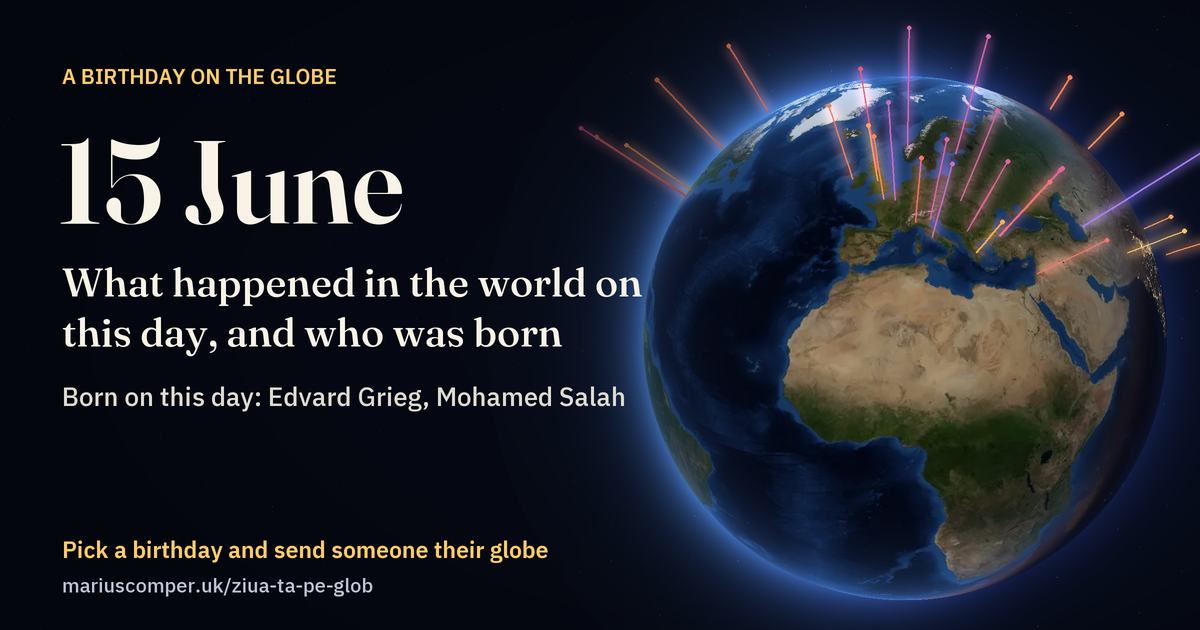
For 15 June, the English Wikipedia lists 44 events and 223 births. 30 of the events stand at their places as rays of light; two more are dashed circles, where the sentence links only to a country or a sea. The taller the ray, the longer ago it happened. The people born that day come further down, as blue points.
A birthday, yours or someone else’s:
Turn it into a greetingScroll: the globe turns to each place
The day you were born, on the globe.
Three things from your day
Scroll: your day first, then 15 June through the years
The Earth on 15 June
The picture on the globe was assembled by NASA from satellite photographs taken in June 2004: the snow, the ice and the green are those of the month.
On 15 June the Sun passes straight overhead at noon along the parallel of 23.3° north. In London, the day lasts about 16 hours 35 minutes.
Beyond 67° north the Sun no longer sets; beyond 67° south it no longer rises.
The line between day and night is tilted on the globe exactly as on this day of the year. On the dark side you can see the lights of towns.
Britain & Ireland · Clifden
1919
John Alcock and Arthur Brown complete the first nonstop transatlantic flight when they reach Clifden, County Galway, Ireland.
On the map: Clifden.
Europe · Rome
844
Louis II is crowned as king of Italy at Rome by pope Sergius II.
On the map: Rome.
Asia · Assyrian eclipse
763 BC
Assyrians record a solar eclipse that is later used to fix the chronology of Mesopotamian history.
On the map: Assyrian eclipse.
Asia · Constantinople
1285
The Byzantine Empire and the Republic of Venice conclude a treaty. Apart from agreeing on a ten year truce, the Venetians are alloted a commercial quarter in Constantinople and are restored to earlier privileges.
On the map: Constantinople.
Oceans · Northwestern Hawaiian Islands
2006
US president George W. Bush designated 140,000 square miles (360,000 km2) around the Northwestern Hawaiian Islands as the Papahānaumokuākea Marine National Monument, now one of the world's largest protected areas.
On the map: Northwestern Hawaiian Islands.
Also on the day’s list of Wikipedia in Chinese.
15 June
What the other Wikipedias remember#
For these years the English list has nothing on this day. The events below come from the same day’s lists on Wikipedia in Spanish and Chinese and were translated for this page.
From Wikipedia in Spanish · Bilbao
1300
In Spain, the town of Bilbao is founded.
On the map: Bilbao.
Translated from the list on Wikipedia in Spanish.
From Wikipedia in Chinese · Basel
1954
After consultations among the Italian, Belgian and French football associations, the Union of European Football Associations (UEFA) is founded in Basel, Switzerland.
On the map: Basel.
Translated from the list on Wikipedia in Chinese.
15 June
Born on 15 June#
The English Wikipedia lists 223 births for this day. The blue points are the birthplaces of 60 of these people: those written about in the most Wikipedia editions, where Wikidata gives a place of birth.
Born on 15 June
1843
Edvard Grieg, Norwegian pianist and composer (died 1907)
Place of birth: Bergen.
Born on 15 June
1992
Mohamed Salah, Egyptian footballer
Place of birth: Nagrig.
Born on 15 June
1964
Courteney Cox, American actress and producer
Place of birth: Birmingham.
Born on 15 June
1969
Ice Cube, American rapper, producer, and actor
Place of birth: Los Angeles.
Born on 15 June
1969
Oliver Kahn, German footballer and sportscaster
Place of birth: Karlsruhe.
Born in Britain and Ireland
1949
Simon Callow, English actor and director
Place of birth: Streatham.
Born in Britain and Ireland
1765
Henry Thomas Colebrooke, English orientalist (died 1837)
Place of birth: London.
15 June
Number one in the charts that week
At the cinema
An animal recorded that day
The record can be seen in GBIF, which brings together wildlife records from around the world.
All your birthdays
The weather that day
Data: Met Office Hadley Centre (HadCET); NOAA (GHCN-Daily, Mauna Loa).
Above the Earth
Sources: Jonathan McDowell, GCAT (launches); GFZ Potsdam (Kp index). Days are counted in Universal Time.
Football that day
International matches played that day:
Source: the “International football results” dataset kept by Mart Jürisoo (CC0).
Also that day
The earthquake’s page at the USGS
Source: the USGS catalogue. The day is counted in Universal Time (UTC).
In those days
Make a link for someone
Type the name, pick the day and the year of birth. The link opens straight on their day, with their name in the greeting.
The link carries the name, date and place typed here; anyone who gets it can see them.
Put another birthday beside it
Your mother’s, your child’s, a friend’s: the two days appear side by side.
Below: 15 June through the years.
The whole globe of the day
Drag the globe to turn it. Touch a ray or a point to read what happened there.
Everything Wikipedia lists for 15 June
The list is the English Wikipedia’s, in its own wording, as it stood in October 2026. 12 events have no place on the map: the sentence links to no place with coordinates, only to places too wide to mark, or to several countries.
- 763 BC
Assyrians record a solar eclipse that is later used to fix the chronology of Mesopotamian history.
Asia · Assyrian eclipseWikipedia: Assyrian eclipse - 844
Louis II is crowned as king of Italy at Rome by pope Sergius II.
Europe · RomeWikipedia: Louis II of Italy - 923
Battle of Soissons: King Robert I of France is killed and King Charles the Simple is arrested by the supporters of Duke Rudolph of Burgundy.
Europe · Battle of SoissonsWikipedia: Battle of Soissons - 1184
The naval Battle of Fimreite is won by the Birkebeiner pretender Sverre Sigurdsson. Sigurdsson takes the Norwegian throne and King Magnus V of Norway is killed.
Europe · Battle of FimreiteWikipedia: Battle of Fimreite - 1215
King John of England puts his seal to Magna Carta.
no place on the mapWikipedia: John, King of England - 1219
Northern Crusades: Danish victory at the Battle of Lindanise (modern-day Tallinn) establishes the Danish Duchy of Estonia.
Europe · Battle of LyndanisseWikipedia: Battle of Lyndanisse - 1246
With the death of Frederick II, Duke of Austria, the Babenberg dynasty ends in Austria.
no place on the mapWikipedia: Frederick II of Austria - 1285
The Byzantine Empire and the Republic of Venice conclude a treaty. Apart from agreeing on a ten year truce, the Venetians are alloted a commercial quarter in Constantinople and are restored to earlier privileges.
Asia · ConstantinopleWikipedia: Byzantine–Venetian treaty of 1285 - 1310
The Tiepolo conspiracy, seeking to seize power in the Republic of Venice, is thwarted after bloody street clashes in Venice. The suppression of the revolt will lead to the creation of the Council of Ten.
Europe · RialtoWikipedia: Tiepolo conspiracy - 1312
At the Battle of Rozgony, King Charles I of Hungary wins a decisive victory over the family of Palatine Amade Aba.
Europe · Battle of RozgonyWikipedia: Battle of Rozgony - 1389
The Ottomans under Sultan Murad I defeat a Serb army under Lazar of Serbia in the battle of Kosovo. Both leaders are killed in the battle.
Europe · Battle of KosovoWikipedia: Battle of Kosovo - 1410
In a decisive battle at Onon River, the Mongol forces of Oljei Temur were decimated by the Chinese armies of the Yongle Emperor.
no place on the mapWikipedia: Yongle Emperor's campaigns against the Mongols - 1410
Ottoman Interregnum: Süleyman Çelebi defeats his brother Musa Çelebi outside the Byzantine capital, Constantinople.
Asia · EyüpsultanWikipedia: Battle of Kosmidion - 1520
Pope Leo X threatens to excommunicate Martin Luther in Exsurge Domine.
no place on the mapWikipedia: Exsurge Domine - 1567
Mary, Queen of Scots, and her new husband Bothwell are confronted by disgruntled Scottish nobles in the encounter at Carberry Hill. The stand-off ends with the surrender of queen Mary.
Britain & Ireland · MusselburghWikipedia: Battle of Carberry Hill - 1607
Virginia colonists finish building James's Fort, to defend against Spanish and Native American attacks.
North America · JamestownWikipedia: Jamestown - 1800
War of the Second Coalition: The signing of the Convention of Alessandria brought temporary peace between France and Austria.
Europe · AlessandriaWikipedia: Convention of Alessandria - 1804
New Hampshire approves the Twelfth Amendment to the United States Constitution, ratifying the document.
North America · New HampshireWikipedia: New Hampshire - 1826
In the Auspicious Incident, the Janissary mutiny against Sultan Mahmud II is defeated and the Janissary corps is disbanded as a result.
Asia · IstanbulWikipedia: Auspicious Incident - 1834
The looting of Safed commences.
Asia · 1834 looting of SafedWikipedia: 1834 looting of Safed - 1846
The Oregon Treaty extends the border between the United States and British North America, established by the Treaty of 1818, westward to the Pacific Ocean.
no place on the mapWikipedia: Oregon Treaty - 1859
Ambiguity in the Oregon Treaty leads to the "Northwestern Boundary Dispute" between American and British/Canadian settlers.
North America · Pig WarWikipedia: Pig War - 1864
American Civil War: The Second Battle of Petersburg begins.
North America · Second Battle of PetersburgWikipedia: American Civil War - 1878
Eadweard Muybridge took a series of photographs to prove that all four feet of a horse leave the ground when it gallops, which became the basis of motion pictures
no place on the mapWikipedia: Eadweard Muybridge - 1896
One of the deadliest tsunamis in Japan's history kills more than 22,000 people.
Oceans · 1896 Sanriku earthquakeWikipedia: 1896 Sanriku earthquake - 1904
A fire aboard the steamboat SS General Slocum in New York City's East River kills 1,000.
no place on the mapWikipedia: PS General Slocum - 1919
John Alcock and Arthur Brown complete the first nonstop transatlantic flight when they reach Clifden, County Galway, Ireland.
Britain & Ireland · ClifdenWikipedia: Transatlantic flight of Alcock and Brown - 1920
Following the 1920 Schleswig plebiscites, Northern Schleswig is transferred from Germany to Denmark.
no place on the mapWikipedia: 1920 Schleswig plebiscites - 1920
Three African-American circus workers were lynched by a mob in Duluth, Minnesota, a crime that shocked the country for having taken place in the Northern United States.
North America · Duluth lynchingsWikipedia: Duluth lynchings - 1921
Bessie Coleman became the first Black person to earn an international pilot's license from the Fédération Aéronautique Internationale.
no place on the mapWikipedia: Bessie Coleman - 1940
World War II: Operation Aerial begins: Allied troops start to evacuate France, following Germany's takeover of Paris and most of the nation.
Europe · Operation AerialWikipedia: World War II - 1944
In the Saskatchewan general election, the CCF, led by Tommy Douglas, is elected and forms the first socialist government in North America.
no place on the mapWikipedia: 1944 Saskatchewan general election - 1944
World War II: The United States Army Air Forces began the first air raid of its strategic bombing campaign against the Japanese archipelago, although little damage was caused.
Asia · Bombing of YawataWikipedia: Bombing of Yawata - 1944
World War II: The United States invades Saipan, capital of Japan's South Seas Mandate.
Oceania · Battle of SaipanWikipedia: Battle of Saipan - 1972
Cathay Pacific Flight 700Z is destroyed by a bomb over Pleiku, Vietnam (then South Vietnam) and kills 81 people.
Asia · Cathay Pacific Flight 700ZWikipedia: Cathay Pacific Flight 700Z - 1977
After the death of dictator Francisco Franco in 1975, the first democratic elections take place in Spain.
Europe · SpainWikipedia: Death and funeral of Francisco Franco - 1978
King Hussein of Jordan married American Lisa Halaby, who became known as Queen Noor of Jordan.
no place on the mapWikipedia: Hussein of Jordan - 1988
The Ariane 4 rocket is launched on its maiden flight.
no place on the mapWikipedia: Ariane 4 - 1991
In the Philippines, Mount Pinatubo erupts in the second largest volcanic eruption of the 20th century, killing over 800 people.
Asia · 1991 eruption of Mount PinatuboWikipedia: 1991 eruption of Mount Pinatubo - 1992
The United States Supreme Court rules in United States v. Álvarez-Machaín that it is permissible for the United States to forcibly extradite suspects in foreign countries and bring them to the United States for trial, without approval from those other countries.
North America · Supreme Court of the United StatesWikipedia: Supreme Court of the United States - 1995
Western Greece was struck by an earthquake registering 6.4–6.5 Mw that killed 26 people.
Europe · 1995 Aigio earthquakeWikipedia: 1995 Aigio earthquake - 1996
The Troubles: The Provisional Irish Republican Army (IRA) detonates a powerful truck bomb in the middle of Manchester, England, devastating the city centre and injuring 200 people.
Britain & Ireland · 1996 Manchester bombingWikipedia: The Troubles - 2006
US president George W. Bush designated 140,000 square miles (360,000 km2) around the Northwestern Hawaiian Islands as the Papahānaumokuākea Marine National Monument, now one of the world's largest protected areas.
Oceans · Northwestern Hawaiian IslandsWikipedia: George W. Bush - 2013
A bomb explodes on a bus in the Pakistani city of Quetta, killing at least 25 people and wounding 22 others.
Asia · QuettaWikipedia: June 2013 Quetta attacks
What the other Wikipedias remember
For these years the English list has nothing on this day. The events below come from the same day’s lists on Wikipedia in Spanish and Chinese and were translated for this page.
- 1300
In Spain, the town of Bilbao is founded.
- 1954
After consultations among the Italian, Belgian and French football associations, the Union of European Football Associations (UEFA) is founded in Basel, Switzerland.
Who was born on 15 June
In order of how many Wikipedia editions have an article about each. The first 60 of 223 are shown.
- 1953
Xi Jinping, Chinese engineer and politician, General Secretary of the Communist Party and President of China
BeijingWikipedia: Xi Jinping - 1914
Yuri Andropov, Russian politician (died 1984)
Soluno-DmitriyevskoyeWikipedia: Yuri Andropov - 1843
Edvard Grieg, Norwegian pianist and composer (died 1907)
BergenWikipedia: Edvard Grieg - 1992
Mohamed Salah, Egyptian footballer
NagrigWikipedia: Mohamed Salah - 1964
Courteney Cox, American actress and producer
BirminghamWikipedia: Courteney Cox - 1969
Ice Cube, American rapper, producer, and actor
Los AngelesWikipedia: Ice Cube - 1969
Oliver Kahn, German footballer and sportscaster
KarlsruheWikipedia: Oliver Kahn - 1943
Johnny Hallyday, French singer and actor (died 2017)
9th arrondissement of ParisWikipedia: Johnny Hallyday - 1963
Helen Hunt, American actress, director, and producer
Culver CityWikipedia: Helen Hunt - 1949
Jim Varney, American actor, comedian, and screenwriter (died 2000)
LexingtonWikipedia: Jim Varney - 1902
Erik Erikson, German-American psychologist and psychoanalyst (died 1994)
FrankfurtWikipedia: Erik Erikson - 1973
Neil Patrick Harris, American actor and singer
AlbuquerqueWikipedia: Neil Patrick Harris - 1916
Herbert A. Simon, American political scientist and economist, Nobel Prize laureate (died 2001)
MilwaukeeWikipedia: Herbert A. Simon - 1964
Michael Laudrup, Danish footballer and manager
FrederiksbergWikipedia: Michael Laudrup - 1920
Alberto Sordi, Italian actor, director, and screenwriter (died 2003)
- 1330
Edward, the Black Prince of England (died 1376)
Woodstock PalaceWikipedia: Edward the Black Prince - 1946
Demis Roussos, Egyptian-Greek singer-songwriter and bass player (died 2015)
AlexandriaWikipedia: Demis Roussos - 1947
Alain Aspect, French physicist (Nobel Prize 2022 for experiments with entangled photons)
- 1933
Mohammad-Ali Rajai, Iranian politician, 2nd President of Iran (died 1981)
- 1917
John Fenn, American chemist and academic, Nobel Prize laureate (died 2010)
New York CityWikipedia: John B. Fenn - 1950
Lakshmi Mittal, Indian-English businessman
RajgarhWikipedia: Lakshmi Mittal - 1966
Raimonds Vējonis, Latvian politician, 9th President of Latvia
- 1479
Lisa del Giocondo, Italian model, subject of the Mona Lisa (died 1542)
FlorenceWikipedia: Lisa del Giocondo - 1954
Jim Belushi, American actor
WheatonWikipedia: Jim Belushi - 1965
Karim Massimov, Kazakhstani politician, 7th Prime Minister of Kazakhstan
- 1763
Kobayashi Issa, Japanese priest and poet (died 1827)
KashiwabaraWikipedia: Kobayashi Issa - 1924
Ezer Weizman, Israeli general and politician, 7th President of Israel (died 2005)
Tel AvivWikipedia: Ezer Weizman - 1945
Robert Sarah, Guinean cardinal
OurousWikipedia: Robert Sarah - 1915
Thomas Huckle Weller, American biologist and virologist, Nobel Prize laureate (died 2008)
Ann ArborWikipedia: Thomas Huckle Weller - 1932
Mario Cuomo, American lawyer and politician, 52nd Governor of New York (died 2015)
JamaicaWikipedia: Mario Cuomo - 1943
Poul Nyrup Rasmussen, Danish politician, 38th Prime Minister of Denmark
- 1906
Léon Degrelle, Belgian SS officer (died 1994)
- 1994
Iñaki Williams, Basque-Ghanaian footballer
- 1996
Aurora, Norwegian singer-songwriter
StavangerWikipedia: Aurora - 1937
Waylon Jennings, American singer-songwriter and guitarist (died 2002)
LittlefieldWikipedia: Waylon Jennings - 1918
François Tombalbaye, Chadian politician, 1st President of Chad (died 1975)
- 1927
Hugo Pratt, Italian author and illustrator (died 1995)
RiminiWikipedia: Hugo Pratt - 1992
Dafne Schippers, Dutch heptathlete and sprinter
UtrechtWikipedia: Dafne Schippers - 1973
Tore Andre Flo, Norwegian footballer and coach
Stryn MunicipalityWikipedia: Tore André Flo - 1981
John Paintsil, Ghanaian footballer
KumasiWikipedia: John Paintsil - 1923
Erland Josephson, Swedish actor and director (died 2012)
Kungsholm parishWikipedia: Erland Josephson - 1941
Harry Nilsson, American singer-songwriter (died 1994)
BrooklynWikipedia: Harry Nilsson - 1978
Wilfred Bouma, Dutch footballer
HelmondWikipedia: Wilfred Bouma - 1878
Margaret Abbott, Indian-American golfer (died 1955)
KolkataWikipedia: Margaret Abbott - 1767
Rachel Jackson, American wife of Andrew Jackson (died 1828)
Halifax CountyWikipedia: Rachel Jackson - 1942
Peter Norman, Australian sprinter (died 2006)
MelbourneWikipedia: Peter Norman - 2003
Pablo Barrios, Spanish footballer
MadridWikipedia: Pablo Barrios - 1755
Antoine François, comte de Fourcroy, French chemist and entomologist (died 1809)
- 1954
Paul Rusesabagina, Rwandan humanitarian
- 1970
Leah Remini, American actress and producer
BrooklynWikipedia: Leah Remini - 1553
Archduke Ernest of Austria (died 1595)
- 1969
Cédric Pioline, French tennis player
Neuilly-sur-SeineWikipedia: Cédric Pioline - 1989
Bayley, American wrestler
NewarkWikipedia: Bayley - 1921
Erroll Garner, American pianist and composer (died 1977)
PittsburghWikipedia: Erroll Garner - 1936
William Levada, American cardinal (died 2019)
Long BeachWikipedia: William Levada - 1949
Simon Callow, English actor and director
StreathamWikipedia: Simon Callow - 1979
Yulia Nestsiarenka, Belarusian sprinter
- 1519
Henry FitzRoy, 1st Duke of Richmond and Somerset, English politician, Lord Lieutenant of Ireland (died 1536)
- 1765
Henry Thomas Colebrooke, English orientalist (died 1837)
- 1955
Julie Hagerty, American model and actress
CincinnatiWikipedia: Julie Hagerty
What is celebrated on 15 June
- Arbor Day (Costa Rica)
- Christian feast day: Abraham of Clermont (or of St Cyriacus)
- Christian feast day: Alice (or Adelaide) of Schaerbeek
- Christian feast day: Amos
- Christian feast day: Blessed Albertina Berkenbrock
- Christian feast day: Blessed Clement Vismara
- Christian feast day: Edburga of Winchester
- Christian feast day: Evelyn Underhill (Church of England and The Episcopal Church)
- Christian feast day: Germaine Cousin
- Christian feast day: Landelin (of Crespin or of Lobbes)
- Christian feast day: Blessed Peter Snow
- Christian feast day: Trillo
- Christian feast day: Vitus (Guy), Modestus and Crescentia
- Christian feast day: June 15 (Eastern Orthodox liturgics)
A greeting link for someone
Type a name and, if you like, the year of birth. The link opens with a greeting, and beside each event it says how old the person turned that day, or how many years before their birth it happened.
The name and the year go only into the link you send.
All 366 days
How the globe is made
Where the events come from
Each edition of this page uses the day’s list from Wikipedia in its own language: Romanian, English, Spanish, Chinese. The lists are written by volunteers and differ from one edition to the next; the text of each event is Wikipedia’s, with a link to the article. A row that appears twice in a list is shown once. The lists have not been checked event by event: they are Wikipedia’s, mistakes included.
For events before 1582, and for countries that moved to the Gregorian calendar later (Britain in 1752, Russia in 1918), the same day may be counted Old Style in one list and New Style in another.
The chapter “What the other Wikipedias remember” adds up to five events a day from the lists of the other three editions, only for years in which the English list has nothing on that day. They were translated for this page, passed the same filters as the tour, and are not counted among the events of the English list.
How an event gets onto the map
The place comes from Wikidata. If the sentence links to the article about the event itself (a battle, an opening, an earthquake), dated to the same year, the ray stands on its coordinates or on those of its location. Otherwise it stands on the first place the sentence links to: a town, a building, a mountain, an island. This second step can be wrong: sometimes the sentence only mentions the place. That is why the page says, under each event, which place the ray stands on.
When the sentence links to a single state or province, or to a single sea, lake or desert larger than 5,000 km², the globe shows a dashed circle, not a ray. The circle has the area Wikidata gives, with its radius kept between 1.2° and 16°, or a radius of 4.5° when Wikidata gives no area; it says only that the sentence links to that place. Organisations, ships, spacecraft, museum objects, rivers, mountain ranges, languages and continents are never used as places. When a sentence names several states and no exact place, the event stays in the list only.
What the height means
The height of a ray shows how many years have passed, on a logarithmic scale: 10 years, 100 years and 1,000 years are equal steps apart; anything older than about 2,600 years has the tallest ray. The colour runs from pale yellow for recent years to violet for antiquity.
Where the tour stops
In each region the tour stops at up to three events (five in Britain and Ireland), chosen mainly by three things: whether Wikipedia’s editors put the event in the “On this day” box of their main page (the English, Spanish and Chinese editions), how many Wikipedia editions have an article about it, and how many of the four lists include it. Events whose sentence or article is about a war, an attack, a crime or a disaster are left out of the tour; they stay in the whole list, in Wikipedia’s wording. The filter is a list of words and a list of Wikidata types, so it can miss some.
The tour of births names the people with articles in the most editions and leaves aside those whom the list or Wikidata describes as rulers, politicians, commanders, leaders of movements or criminals; they stay in the list.
The Earth and the Sun
The daytime images are NASA’s Blue Marble Next Generation mosaics, one for each month of 2004; the night side is Black Marble 2016. The tilt of the line between day and night is computed for the day; the hour is chosen so that the place being read is in daylight. The latitude where the Sun stands overhead is the average of the four years of the leap cycle; in a given year it can differ by up to 0.4°.
The day you were born
The number ones come from the weekly lists on Wikipedia: Billboard for the United States (from 1940; the Hot 100 from August 1958), the UK Singles Chart (from November 1952), Los 40 Principales for Spain (from July 1966) and, for Romania, the Romanian Top 100 and Airplay 100 (2001–2021, with missing weeks). The page shows the chart of the week in which the day of birth falls, with its date; Billboard and the UK chart are dated at the end of their week. For Romania before 2001 and for China these sources have no weekly chart.
The films are those that reached cinemas in the United States up to ten days before or three days after that day (some of them in a few cinemas at first), from the English Wikipedia’s yearly lists (from 1968), in order of how many editions have an article about them. The events “in those days” are the ones on the neighbouring days’ lists that carry the year of birth, passed through the same filter as the tour.
The day of birth, year included
The Moon, the star sign and the constellation are worked out by the page itself, for noon Universal Time on the day. The lit part of the Moon is rounded and can differ by a few per cent from that at the hour of birth. The sign follows the usual zodiac of twelve equal parts starting at the March equinox; the constellation is the one the Sun actually stood in front of, by the borders set by the International Astronomical Union, and within a day of a border the page does not name it. When the Sun changes sign while it is that day anywhere on Earth, the page gives the moment of crossing, rounded to ten minutes and accurate to within about a quarter of an hour, and the clock time in a few cities, with the time zone and summer time of that year.
The year in the Chinese calendar is the one your device’s own calendar gives for the date, checked against the Hong Kong Observatory’s tables. “All your birthdays” uses the same sources as the rest of the chapter for the same day in every year since the birth: the temperature, well-known launches that took place on that very day, matches of the teams the edition follows, snow deeper than 10 cm and strong geomagnetic storms. The three things at the top and the four on the picture are chosen in a fixed order (the song, the animal, a full Moon, a well-known launch before an ordinary earthquake); on the picture you can change them.
When the link carries a year of birth, the page adds a few things about that exact day. The weather is the Met Office’s Central England temperature record and the readings from New York’s Central Park; the “usual high” is the average of the daily highs of 1961–1990 for that date, with two days either side. The carbon dioxide figure is the monthly mean at the Mauna Loa observatory, where measurements begin in March 1958.
The earthquake is the one with the largest magnitude in the USGS catalogue for that day, counted in Universal Time. Before the 1960s the catalogue has gaps even above magnitude 5.5, so in the older years many days have no earthquake. The page gives only the magnitude and the place: the country the epicentre falls in or, when the epicentre is at sea within 300 km of a coast, the nearest country; farther out, only the ocean.
The launches are those that reached orbit or left for the Moon and the planets, from Jonathan McDowell’s GCAT catalogue. If nothing left that day, the page shows the nearest launch within three days before or after, and says how many days away it was. The geomagnetic storm appears only when the Kp index reached at least 5 in one of the day’s eight three-hour intervals.
The animal comes from GBIF: an observation made by a person (the animal seen or heard, or its tracks), dated to that exact day, with coordinates and a CC0 or CC BY licence. Only a few hundred well-known species are searched (mammals, birds, turtles, butterflies); of those noted that day, mammals and species with articles in many Wikipedia editions come first; birds noted almost every day, and species used recently, wait their turn. Observations dated 1 January are left out, because records without a day are often filed there. An observation shows that the animal was recorded there, not how many animals there were.
The matches are those between national teams. Only matches of England, Scotland, Wales, Northern Ireland, the Republic of Ireland, the United States, Canada and Australia are shown, along with those at the big final tournaments. The picture to send is drawn in the page from the day’s globe and the facts above, and stays on your device until you send it.
Sources
- Events, births and holidays: the day’s page on Wikipedia, text under CC BY-SA 4.0.
- Coordinates, places of birth and the number of editions: Wikidata (CC0).
- The Earth by day: NASA Blue Marble Next Generation. The Earth by night: NASA Black Marble 2016.
- Borders and regions: Natural Earth.
- World population and births per year: UN World Population Prospects 2024.
- Charts and films: Wikipedia’s lists for Billboard, the UK Singles Chart, Los 40 Principales, Romanian Top 100, Airplay 100 and American films by year (CC BY-SA 4.0).
- Weather: Met Office Hadley Centre, HadCET (Open Government Licence) and NOAA GHCN-Daily, New York Central Park. Carbon dioxide: NOAA Global Monitoring Laboratory, Mauna Loa.
- Earthquakes: the USGS catalogue. Launches: Jonathan McDowell, GCAT (CC BY). Kp index: GFZ Potsdam (CC BY 4.0). Matches: International football results, Mart Jürisoo (CC0).
- Animal observations: GBIF, with a link to each record; species names come from Wikidata.