A birthday on the globe
5 February on the globe: what happened in the world on this day, and who was born
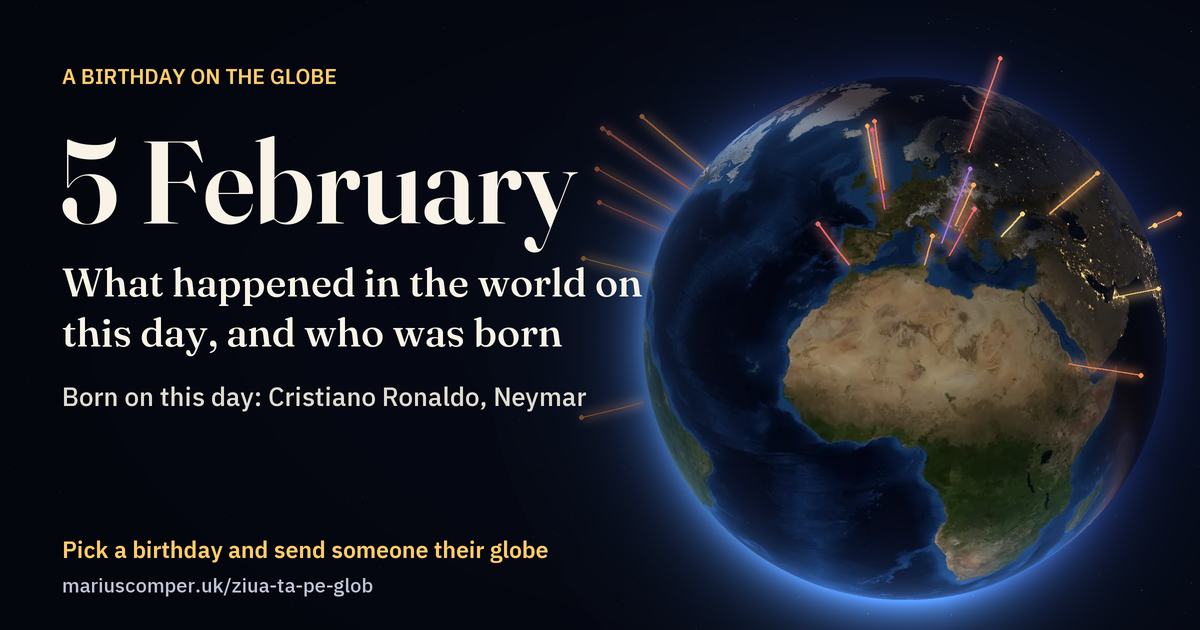
For 5 February, the English Wikipedia lists 53 events and 216 births. 25 of the events stand at their places as rays of light; four more are dashed circles, where the sentence links only to a country or a sea. The taller the ray, the longer ago it happened. The people born that day come further down, as blue points.
A birthday, yours or someone else’s:
Turn it into a greetingScroll: the globe turns to each place
The day you were born, on the globe.
Three things from your day
Scroll: your day first, then 5 February through the years
The Earth on 5 February
The picture on the globe was assembled by NASA from satellite photographs taken in February 2004: the snow, the ice and the green are those of the month.
On 5 February the Sun passes straight overhead at noon along the parallel of 16.1° south. In London, the day lasts about 9 hours 20 minutes.
Beyond 74° south the Sun no longer sets; beyond 74° north it no longer rises.
The line between day and night is tilted on the globe exactly as on this day of the year. On the dark side you can see the lights of towns.
Britain & Ireland · Royal Observatory, Greenwich
1924
The Royal Greenwich Observatory begins broadcasting the hourly time signals known as the Greenwich Time Signal.
On the map: Royal Observatory, Greenwich.
Also on the day’s list of Wikipedia in Chinese.
Europe · Hermitage Museum
1852
The New Hermitage Museum in Saint Petersburg, Russia, one of the largest and oldest museums in the world, opens to the public.
On the map: Hermitage Museum.
Also on the day’s list of Wikipedia in Spanish, Romanian and Chinese.
Asia · Abu Dhabi
2019
Pope Francis becomes the first Pope in history to visit and perform papal mass in the Arabian Peninsula during his visit to Abu Dhabi.
On the map: Abu Dhabi.
Oceania · Welcome Stranger
1869
The largest alluvial gold nugget in history, called the "Welcome Stranger", is found in Moliagul, Victoria, Australia.
On the map: Welcome Stranger.
Latin America · General Hospital of Mexico
1905
In Mexico, the General Hospital of Mexico is inaugurated, initially with four basic specialties.
On the map: General Hospital of Mexico.
Also on the day’s list of Wikipedia in Spanish.
North America · United States Congress
1917
The Congress of the United States passes the Immigration Act of 1917 over President Woodrow Wilson's veto.
On the map: United States Congress.
5 February
What the other Wikipedias remember#
For these years the English list has nothing on this day. The events below come from the same day’s lists on Wikipedia in Spanish and were translated for this page.
From Wikipedia in Spanish · Barcelona
1929
An Iberian necropolis is discovered in Montjuïc, in Barcelona.
On the map: Barcelona.
Translated from the list on Wikipedia in Spanish.
From Wikipedia in Spanish · The Hague
1970
In The Hague, the International Court of Justice rejects the Belgian Government's claim against the Spanish Government in the dispute over the Barcelona Traction, Light and Power Company.
On the map: The Hague.
Translated from the list on Wikipedia in Spanish.
The article on Wikipedia in Spanish: Corte Internacional de Justicia
From Wikipedia in Spanish · The Hague
2003
In The Hague (Netherlands), the International Court of Justice orders the United States to temporarily suspend the execution of three Mexican prisoners.
On the map: The Hague.
Translated from the list on Wikipedia in Spanish.
The article on Wikipedia in Spanish: Corte Internacional de Justicia
5 February
Born on 5 February#
The English Wikipedia lists 216 births for this day. The blue points are the birthplaces of 59 of these people: those written about in the most Wikipedia editions, where Wikidata gives a place of birth.
Born on 5 February
1985
Cristiano Ronaldo, Portuguese footballer
Place of birth: Funchal.
Born on 5 February
1946
Charlotte Rampling, English actress
Place of birth: Sturmer.
Born on 5 February
1914
William S. Burroughs, American novelist, short story writer, and essayist (died 1997)
Place of birth: St. Louis.
Born in Britain and Ireland
1914
Alan Lloyd Hodgkin, English physiologist, biophysicist, and academic, Nobel Prize laureate (died 1998)
Place of birth: Banbury.
Born in Britain and Ireland
1948
Tom Wilkinson, English actor (died 2023)
Place of birth: Leeds.
Born in Britain and Ireland
1969
Michael Sheen, Welsh actor and director
Place of birth: Newport.
5 February
Number one in the charts that week
At the cinema
An animal recorded that day
The record can be seen in GBIF, which brings together wildlife records from around the world.
All your birthdays
The weather that day
Data: Met Office Hadley Centre (HadCET); NOAA (GHCN-Daily, Mauna Loa).
Above the Earth
Sources: Jonathan McDowell, GCAT (launches); GFZ Potsdam (Kp index). Days are counted in Universal Time.
Football that day
International matches played that day:
Source: the “International football results” dataset kept by Mart Jürisoo (CC0).
Also that day
The earthquake’s page at the USGS
Source: the USGS catalogue. The day is counted in Universal Time (UTC).
In those days
Make a link for someone
Type the name, pick the day and the year of birth. The link opens straight on their day, with their name in the greeting.
The link carries the name, date and place typed here; anyone who gets it can see them.
Put another birthday beside it
Your mother’s, your child’s, a friend’s: the two days appear side by side.
Below: 5 February through the years.
The whole globe of the day
Drag the globe to turn it. Touch a ray or a point to read what happened there.
Everything Wikipedia lists for 5 February
The list is the English Wikipedia’s, in its own wording, as it stood in October 2026. 24 events have no place on the map: the sentence links to no place with coordinates, only to places too wide to mark, or to several countries.
- 2 BC
Caesar Augustus is granted the title pater patriae by the Roman Senate.
no place on the mapWikipedia: Augustus - 62
An earthquake with an estimated intensity between IX or X on the Mercalli scale occurs in Pompeii, Italy.
Europe · AD 62 Pompeii earthquakeWikipedia: AD 62 Pompeii earthquake - 756
An Lushan proclaims himself Emperor of China, founding the short-lived state of Yan.
no place on the mapWikipedia: An Lushan - 1265
Pope Clement IV is elected as the 183rd Bishop of Rome and head of the Catholic Church.
no place on the mapWikipedia: Pope Clement IV - 1576
Henry of Navarre abjures Catholicism at Tours and rejoins the Protestant forces in the French Wars of Religion.
Europe · ToursWikipedia: French Wars of Religion - 1597
A group of early Japanese Christians are killed by the new government of Japan for being seen as a threat to Japanese society.
no place on the mapWikipedia: Kakure Kirishitan - 1783
In Calabria, a sequence of strong earthquakes begins.
Europe · 1783 Calabrian earthquakesWikipedia: 1783 Calabrian earthquakes - 1810
Peninsular War: Siege of Cádiz begins.
Europe · Siege of CádizWikipedia: Peninsular War - 1818
Jean-Baptiste Bernadotte ascends to the thrones of Sweden and Norway.
no place on the mapWikipedia: Charles XIV John - 1852
The New Hermitage Museum in Saint Petersburg, Russia, one of the largest and oldest museums in the world, opens to the public.
Europe · Hermitage MuseumWikipedia: Hermitage Museum - 1859
Alexandru Ioan Cuza, Prince of Moldavia, is also elected as prince of Wallachia, joining the two principalities as a personal union called the United Principalities, an autonomous region within the Ottoman Empire, which ushered in the birth of the modern Romanian state.
no place on the mapWikipedia: Alexandru Ioan Cuza - 1861
In a speech before the U.S. Congress, Representative John Edward Bouligny refused to join his fellow Louisiana congressmen in heeding the state's secession convention and resigning.
North America · United States CongressWikipedia: United States Congress - 1869
The largest alluvial gold nugget in history, called the "Welcome Stranger", is found in Moliagul, Victoria, Australia.
Oceania · Welcome StrangerWikipedia: Alluvium - 1885
King Leopold II of Belgium establishes the Congo as a personal possession.
Africa · Congo Free StateWikipedia: Leopold II of Belgium - 1901
J. P. Morgan incorporates U.S. Steel in the state of New Jersey, although the company would not start doing business until February 25 and the assets of Andrew Carnegie's Carnegie Steel Company, Elbert H. Gary's Federal Steel Company, and William Henry Moore's National Steel Company were not acquired until April 1.
North America · New JerseyWikipedia: J. P. Morgan - 1905
In Mexico, the General Hospital of Mexico is inaugurated, initially with four basic specialties.
Latin America · General Hospital of MexicoWikipedia: General Hospital of Mexico - 1907
Belgian chemist Leo Baekeland announces the creation of Bakelite, the world's first synthetic plastic.
no place on the mapWikipedia: Leo Baekeland - 1909
Belgian chemist Leo Baekeland announced his invention of Bakelite, the world's first synthetic plastic.
no place on the mapWikipedia: Leo Baekeland - 1913
Claudio Monteverdi's last opera L'incoronazione di Poppea was performed theatrically for the first time in more than 250 years.
no place on the mapWikipedia: Claudio Monteverdi - 1913
Greek military aviators Michael Moutoussis and Aristeidis Moraitinis perform the first naval air mission in history, with a Farman MF.7 hydroplane.
no place on the mapWikipedia: Hellenic Air Force - 1917
The Congress of the United States passes the Immigration Act of 1917 over President Woodrow Wilson's veto.
North America · United States CongressWikipedia: Immigration Act of 1917 - 1917
The current constitution of Mexico is adopted, establishing a federal republic with powers separated into independent executive, legislative, and judicial branches.
no place on the mapWikipedia: Constitution of Mexico - 1918
SS Tuscania is torpedoed off the coast of Ireland; it is the first ship carrying American troops to Europe to be torpedoed and sunk.
no place on the mapWikipedia: SS Tuscania - 1918
Stephen W. Thompson shoots down a German airplane; this is the first aerial victory by the U.S. military.
no place on the mapWikipedia: Stephen W. Thompson - 1919
Charlie Chaplin, Mary Pickford, Douglas Fairbanks, and D. W. Griffith launch United Artists.
no place on the mapWikipedia: Charlie Chaplin - 1923
Australian cricketer Bill Ponsford made 429 runs to break the world record for the highest first-class score.
no place on the mapWikipedia: Cricket - 1924
The Royal Greenwich Observatory begins broadcasting the hourly time signals known as the Greenwich Time Signal.
Britain & Ireland · Royal Observatory, GreenwichWikipedia: Royal Observatory, Greenwich - 1933
Mutiny on Royal Netherlands Navy warship HNLMS De Zeven Provinciën off the coast of Sumatra, Dutch East Indies.
no place on the mapWikipedia: Royal Netherlands Navy - 1941
World War II: Allied forces begin the Battle of Keren to capture Keren, Eritrea.
Africa · Battle of KerenWikipedia: World War II - 1945
World War II: General Douglas MacArthur returns to Manila.
Asia · ManilaWikipedia: Douglas MacArthur - 1958
A hydrogen bomb known as the Tybee Bomb is lost by the US Air Force off the coast of Savannah, Georgia, never to be recovered.
North America · 1958 Tybee Island mid-air collisionWikipedia: 1958 Tybee Island mid-air collision - 1958
Gamal Abdel Nasser is nominated to be the first president of the United Arab Republic.
Africa · United Arab RepublicWikipedia: Gamal Abdel Nasser - 1962
French President Charles de Gaulle calls for Algeria to be granted independence.
Africa · AlgeriaWikipedia: President of France - 1963
The European Court of Justice's ruling in Van Gend en Loos v Nederlandse Administratie der Belastingen establishes the principle of direct effect, one of the most important, if not the most important, decisions in the development of European Union law.
no place on the mapWikipedia: European Court of Justice - 1967
Cultural Revolution: The Shanghai People's Commune is formally proclaimed, with Yao Wenyuan and Zhang Chunqiao being appointed as its leaders.
no place on the mapWikipedia: Cultural Revolution - 1971
Astronauts land on the Moon in the Apollo 14 mission.
no place on the mapWikipedia: Apollo 14 - 1975
Riots break out in Lima, Peru after the police forces go on strike the day before. The uprising (locally known as the Limazo) is bloodily suppressed by the military dictatorship.
Latin America · LimaWikipedia: Limazo - 1981
Operation Soap: The Metropolitan Toronto Police Force raids four gay bathhouses in Toronto, Ontario, Canada, arresting just under 300, triggering mass protest and rallies.
North America · Toronto Police ServiceWikipedia: Operation Soap - 1985
Ugo Vetere, then the mayor of Rome, and Chedli Klibi, then the mayor of Carthage, meet in Tunis to sign a treaty of friendship officially ending the Third Punic War which lasted 2,131 years.
Africa · CarthageWikipedia: Third Punic War - 1988
Manuel Noriega is indicted on drug smuggling and money laundering charges.
no place on the mapWikipedia: Manuel Noriega - 1994
Byron De La Beckwith is convicted of the 1963 murder of civil rights leader Medgar Evers.
no place on the mapWikipedia: Byron De La Beckwith - 1994
Markale massacres, more than 60 people are killed and some 200 wounded as a mortar shell explodes in a downtown marketplace in Sarajevo.
Europe · Markale massacresWikipedia: Markale massacres - 1997
The so-called Big Three banks in Switzerland announce the creation of a $71 million fund to aid Holocaust survivors and their families.
no place on the mapWikipedia: The Holocaust - 2000
Russian forces massacre at least 60 civilians in the Novye Aldi suburb of Grozny, Chechnya.
Europe · Novye Aldi massacreWikipedia: Novye Aldi massacre - 2004
At least 21 cockle-gatherers were drowned by an incoming tide in Morecambe Bay, England, prompting the establishment of the British government's Gangmasters Licensing Authority.
Britain & Ireland · Morecambe Bay cockling disasterWikipedia: Morecambe Bay cockling disaster - 2004
Rebels from the Revolutionary Artibonite Resistance Front capture the city of Gonaïves, starting the 2004 Haiti rebellion.
Latin America · GonaïvesWikipedia: 2004 Haitian coup d'état - 2008
A major tornado outbreak across the Southern United States kills 57.
no place on the mapWikipedia: Southern United States - 2009
The United States Navy guided missile cruiser Port Royal ran aground on a coral reef off the island of Oahu.
North America · 2009 USS Port Royal groundingWikipedia: 2009 USS Port Royal grounding - 2016
Cybercriminals initiate the Bangladesh Bank robbery, using the SWIFT network to fraudulently transfer $101 million from the Federal Reserve Bank of New York account of Bangladesh Bank.
Asia · Solaire Resort & CasinoWikipedia: Bangladesh Bank robbery - 2016
New Zealand politician Steven Joyce is hit by a flung rubber dildo in a Waitangi Day protest.
Oceania · WaitangiWikipedia: Waitangi dildo incident - 2019
Pope Francis becomes the first Pope in history to visit and perform papal mass in the Arabian Peninsula during his visit to Abu Dhabi.
Asia · Abu DhabiWikipedia: Pope Francis - 2020
Pegasus Airlines Flight 2193 overshoots the runway at Sabiha Gökçen International Airport and crashes, killing three people and injuring 179.
Asia · Pegasus Airlines Flight 2193Wikipedia: Pegasus Airlines Flight 2193 - 2020
United States President Donald Trump is acquitted by the United States Senate in his first impeachment trial.
no place on the mapWikipedia: Donald Trump
What the other Wikipedias remember
For these years the English list has nothing on this day. The events below come from the same day’s lists on Wikipedia in Spanish and were translated for this page.
- 1929
An Iberian necropolis is discovered in Montjuïc, in Barcelona.
- 1970
In The Hague, the International Court of Justice rejects the Belgian Government's claim against the Spanish Government in the dispute over the Barcelona Traction, Light and Power Company.
Europe · The HagueTranslated from the list on Wikipedia in SpanishWikipedia: Corte Internacional de Justicia - 2003
In The Hague (Netherlands), the International Court of Justice orders the United States to temporarily suspend the execution of three Mexican prisoners.
Europe · The HagueTranslated from the list on Wikipedia in SpanishWikipedia: Corte Internacional de Justicia
Who was born on 5 February
In order of how many Wikipedia editions have an article about each. The first 60 of 216 are shown.
- 1985
Cristiano Ronaldo, Portuguese footballer
FunchalWikipedia: Cristiano Ronaldo - 1992
Neymar, Brazilian footballer
Mogi das CruzesWikipedia: Neymar - 1946
Charlotte Rampling, English actress
- 1914
William S. Burroughs, American novelist, short story writer, and essayist (died 1997)
St. LouisWikipedia: William S. Burroughs - 1788
Robert Peel, English lieutenant and politician, Prime Minister of the United Kingdom (died 1850)
RamsbottomWikipedia: Robert Peel - 1976
Abhishek Bachchan, Indian actor
- 1984
Carlos Tevez, Argentinian footballer
CiudadelaWikipedia: Carlos Tevez - 1915
Robert Hofstadter, American physicist and academic, Nobel Prize laureate (died 1990)
New York CityWikipedia: Robert Hofstadter - 1965
Gheorghe Hagi, Romanian footballer and manager
SăceleWikipedia: Gheorghe Hagi - 1900
Adlai Stevenson II, American soldier, politician, and diplomat, 5th United States Ambassador to the United Nations (died 1965)
Los AngelesWikipedia: Adlai Stevenson II - 1848
Joris-Karl Huysmans, French author and critic (died 1907)
- 1975
Giovanni van Bronckhorst, Dutch footballer and manager
RotterdamWikipedia: Giovanni van Bronckhorst - 1626
Marie de Rabutin-Chantal, marquise de Sévigné, French author (died 1696)
- 1804
Johan Ludvig Runeberg, Finnish poet and hymn-writer (died 1877)
JakobstadWikipedia: Johan Ludvig Runeberg - 1914
Alan Lloyd Hodgkin, English physiologist, biophysicist, and academic, Nobel Prize laureate (died 1998)
BanburyWikipedia: Alan Hodgkin - 1986
Vedran Ćorluka, Croatian footballer
Modran, DerventaWikipedia: Vedran Ćorluka - 1948
Sven-Göran Eriksson, Swedish footballer and manager (died 2024)
- 1948
Tom Wilkinson, English actor (died 2023)
- 1964
Laura Linney, American actress
ManhattanWikipedia: Laura Linney - 1948
Barbara Hershey, American actress
HollywoodWikipedia: Barbara Hershey - 1962
Jennifer Jason Leigh, American actress, screenwriter, producer and director
HollywoodWikipedia: Jennifer Jason Leigh - 1934
Hank Aaron, American baseball player (died 2021)
MobileWikipedia: Hank Aaron - 1992
Stefan de Vrij, Dutch footballer
Ouderkerk aan den IJsselWikipedia: Stefan de Vrij - 1919
Andreas Papandreou, Greek economist and politician, Prime Minister of Greece (died 1996)
- 1969
Michael Sheen, Welsh actor and director
NewportWikipedia: Michael Sheen - 1943
Michael Mann, American director, producer, and screenwriter
ChicagoWikipedia: Michael Mann - 1972
Queen Mary of Denmark
- 1982
Rodrigo Palacio, Argentinian footballer
Bahía BlancaWikipedia: Rodrigo Palacio - 1808
Carl Spitzweg, German painter and poet (died 1885)
MunichWikipedia: Carl Spitzweg - 1840
John Boyd Dunlop, Scottish businessman, co-founded Dunlop Rubber (died 1921)
DreghornWikipedia: John Boyd Dunlop - 1878
André Citroën, French engineer and businessman, founded Citroën (died 1935)
9th arrondissement of ParisWikipedia: André Citroën - 1932
Cesare Maldini, Italian footballer and manager (died 2016)
TriesteWikipedia: Cesare Maldini - 1906
John Carradine, American actor (died 1988)
Greenwich VillageWikipedia: John Carradine - 1852
Terauchi Masatake, Japanese field marshal and politician, 9th Prime Minister of Japan (died 1919)
HirakawaWikipedia: Terauchi Masatake - 1919
Red Buttons, American actor (died 2006)
ManhattanWikipedia: Red Buttons - 1995
Adnan Januzaj, Belgian-Albanian footballer
BrusselsWikipedia: Adnan Januzaj - 1910
Francisco Varallo, Argentinian footballer (died 2010)
La PlataWikipedia: Francisco Varallo - 1940
H. R. Giger, Swiss painter, sculptor, and set designer (died 2014)
- 1943
Nolan Bushnell, American engineer and businessman, founded Atari, Inc.
ClearfieldWikipedia: Nolan Bushnell - 1964
Duff McKagan, American singer-songwriter, bass player, and producer
SeattleWikipedia: Duff McKagan - 1959
Jennifer Granholm, Canadian-American lawyer and politician, 47th Governor of Michigan
VancouverWikipedia: Jennifer Granholm - 1840
Hiram Maxim, American engineer, invented the Maxim gun (died 1916)
SangervilleWikipedia: Hiram Maxim - 1969
Bobby Brown, American singer-songwriter, dancer, and actor
RoxburyWikipedia: Bobby Brown - 1977
Ben Ainslie, English sailor
MacclesfieldWikipedia: Ben Ainslie - 1996
Stina Blackstenius, Swedish footballer
VadstenaWikipedia: Stina Blackstenius - 1929
Fred Sinowatz, Austrian politician, 19th Chancellor of Austria (died 2008)
Neufeld an der LeithaWikipedia: Fred Sinowatz - 1965
Quique Sánchez Flores, Spanish footballer and manager
- 1976
John Aloisi, Australian footballer and manager
AdelaideWikipedia: John Aloisi - 1981
Loukas Vyntra, Czech-Greek footballer
Město AlbrechticeWikipedia: Loukas Vyntra - 1968
Marcus Grönholm, Finnish race car driver
KauniainenWikipedia: Marcus Grönholm - 1978
Samuel Sánchez, Spanish cyclist
- 1989
Jeremy Sumpter, American actor
Carmel-by-the-SeaWikipedia: Jeremy Sumpter - 976
Sanjō, emperor of Japan (died 1017)
- 1973
Trijntje Oosterhuis, Dutch singer-songwriter
AmsterdamWikipedia: Trijntje Oosterhuis - 1980
Jo Swinson, Scottish politician
GlasgowWikipedia: Jo Swinson - 1810
Ole Bull, Norwegian violinist and composer (died 1880)
BergenWikipedia: Ole Bull - 1997
Patrick Roberts, English footballer
Kingston upon ThamesWikipedia: Patrick Roberts - 1438
Philip II, duke of Savoy (died 1497)
ChambéryWikipedia: Philip II of Savoy - 1907
Pierre Pflimlin, French politician, Prime Minister of France (died 2000)
RoubaixWikipedia: Pierre Pflimlin - 1909
Grażyna Bacewicz, Polish violinist and composer (died 1969)
What is celebrated on 5 February
- Christian feast day: Adelaide of Vilich
- Christian feast day: Agatha of Sicily
- Christian feast day: Avitus of Vienne
- Christian feast day: Bertulf (Bertoul) of Renty
- Christian feast day: Ingenuinus (Jenewein)
- Christian feast day: Roger Williams, Anne Hutchinson (Episcopal Church (United States))
- Christian feast day: 26 Martyrs of Japan (in Evangelical Lutheran Church in America and Anglican Church in Japan)
- Christian feast day: February 5 (Eastern Orthodox liturgics)
- Kashmir Solidarity Day (Pakistan)
- Runeberg Day (Finland)
A greeting link for someone
Type a name and, if you like, the year of birth. The link opens with a greeting, and beside each event it says how old the person turned that day, or how many years before their birth it happened.
The name and the year go only into the link you send.
All 366 days
How the globe is made
Where the events come from
Each edition of this page uses the day’s list from Wikipedia in its own language: Romanian, English, Spanish, Chinese. The lists are written by volunteers and differ from one edition to the next; the text of each event is Wikipedia’s, with a link to the article. A row that appears twice in a list is shown once. The lists have not been checked event by event: they are Wikipedia’s, mistakes included.
For events before 1582, and for countries that moved to the Gregorian calendar later (Britain in 1752, Russia in 1918), the same day may be counted Old Style in one list and New Style in another.
The chapter “What the other Wikipedias remember” adds up to five events a day from the lists of the other three editions, only for years in which the English list has nothing on that day. They were translated for this page, passed the same filters as the tour, and are not counted among the events of the English list.
How an event gets onto the map
The place comes from Wikidata. If the sentence links to the article about the event itself (a battle, an opening, an earthquake), dated to the same year, the ray stands on its coordinates or on those of its location. Otherwise it stands on the first place the sentence links to: a town, a building, a mountain, an island. This second step can be wrong: sometimes the sentence only mentions the place. That is why the page says, under each event, which place the ray stands on.
When the sentence links to a single state or province, or to a single sea, lake or desert larger than 5,000 km², the globe shows a dashed circle, not a ray. The circle has the area Wikidata gives, with its radius kept between 1.2° and 16°, or a radius of 4.5° when Wikidata gives no area; it says only that the sentence links to that place. Organisations, ships, spacecraft, museum objects, rivers, mountain ranges, languages and continents are never used as places. When a sentence names several states and no exact place, the event stays in the list only.
What the height means
The height of a ray shows how many years have passed, on a logarithmic scale: 10 years, 100 years and 1,000 years are equal steps apart; anything older than about 2,600 years has the tallest ray. The colour runs from pale yellow for recent years to violet for antiquity.
Where the tour stops
In each region the tour stops at up to three events (five in Britain and Ireland), chosen mainly by three things: whether Wikipedia’s editors put the event in the “On this day” box of their main page (the English, Spanish and Chinese editions), how many Wikipedia editions have an article about it, and how many of the four lists include it. Events whose sentence or article is about a war, an attack, a crime or a disaster are left out of the tour; they stay in the whole list, in Wikipedia’s wording. The filter is a list of words and a list of Wikidata types, so it can miss some.
The tour of births names the people with articles in the most editions and leaves aside those whom the list or Wikidata describes as rulers, politicians, commanders, leaders of movements or criminals; they stay in the list.
The Earth and the Sun
The daytime images are NASA’s Blue Marble Next Generation mosaics, one for each month of 2004; the night side is Black Marble 2016. The tilt of the line between day and night is computed for the day; the hour is chosen so that the place being read is in daylight. The latitude where the Sun stands overhead is the average of the four years of the leap cycle; in a given year it can differ by up to 0.4°.
The day you were born
The number ones come from the weekly lists on Wikipedia: Billboard for the United States (from 1940; the Hot 100 from August 1958), the UK Singles Chart (from November 1952), Los 40 Principales for Spain (from July 1966) and, for Romania, the Romanian Top 100 and Airplay 100 (2001–2021, with missing weeks). The page shows the chart of the week in which the day of birth falls, with its date; Billboard and the UK chart are dated at the end of their week. For Romania before 2001 and for China these sources have no weekly chart.
The films are those that reached cinemas in the United States up to ten days before or three days after that day (some of them in a few cinemas at first), from the English Wikipedia’s yearly lists (from 1968), in order of how many editions have an article about them. The events “in those days” are the ones on the neighbouring days’ lists that carry the year of birth, passed through the same filter as the tour.
The day of birth, year included
The Moon, the star sign and the constellation are worked out by the page itself, for noon Universal Time on the day. The lit part of the Moon is rounded and can differ by a few per cent from that at the hour of birth. The sign follows the usual zodiac of twelve equal parts starting at the March equinox; the constellation is the one the Sun actually stood in front of, by the borders set by the International Astronomical Union, and within a day of a border the page does not name it. When the Sun changes sign while it is that day anywhere on Earth, the page gives the moment of crossing, rounded to ten minutes and accurate to within about a quarter of an hour, and the clock time in a few cities, with the time zone and summer time of that year.
The year in the Chinese calendar is the one your device’s own calendar gives for the date, checked against the Hong Kong Observatory’s tables. “All your birthdays” uses the same sources as the rest of the chapter for the same day in every year since the birth: the temperature, well-known launches that took place on that very day, matches of the teams the edition follows, snow deeper than 10 cm and strong geomagnetic storms. The three things at the top and the four on the picture are chosen in a fixed order (the song, the animal, a full Moon, a well-known launch before an ordinary earthquake); on the picture you can change them.
When the link carries a year of birth, the page adds a few things about that exact day. The weather is the Met Office’s Central England temperature record and the readings from New York’s Central Park; the “usual high” is the average of the daily highs of 1961–1990 for that date, with two days either side. The carbon dioxide figure is the monthly mean at the Mauna Loa observatory, where measurements begin in March 1958.
The earthquake is the one with the largest magnitude in the USGS catalogue for that day, counted in Universal Time. Before the 1960s the catalogue has gaps even above magnitude 5.5, so in the older years many days have no earthquake. The page gives only the magnitude and the place: the country the epicentre falls in or, when the epicentre is at sea within 300 km of a coast, the nearest country; farther out, only the ocean.
The launches are those that reached orbit or left for the Moon and the planets, from Jonathan McDowell’s GCAT catalogue. If nothing left that day, the page shows the nearest launch within three days before or after, and says how many days away it was. The geomagnetic storm appears only when the Kp index reached at least 5 in one of the day’s eight three-hour intervals.
The animal comes from GBIF: an observation made by a person (the animal seen or heard, or its tracks), dated to that exact day, with coordinates and a CC0 or CC BY licence. Only a few hundred well-known species are searched (mammals, birds, turtles, butterflies); of those noted that day, mammals and species with articles in many Wikipedia editions come first; birds noted almost every day, and species used recently, wait their turn. Observations dated 1 January are left out, because records without a day are often filed there. An observation shows that the animal was recorded there, not how many animals there were.
The matches are those between national teams. Only matches of England, Scotland, Wales, Northern Ireland, the Republic of Ireland, the United States, Canada and Australia are shown, along with those at the big final tournaments. The picture to send is drawn in the page from the day’s globe and the facts above, and stays on your device until you send it.
Sources
- Events, births and holidays: the day’s page on Wikipedia, text under CC BY-SA 4.0.
- Coordinates, places of birth and the number of editions: Wikidata (CC0).
- The Earth by day: NASA Blue Marble Next Generation. The Earth by night: NASA Black Marble 2016.
- Borders and regions: Natural Earth.
- World population and births per year: UN World Population Prospects 2024.
- Charts and films: Wikipedia’s lists for Billboard, the UK Singles Chart, Los 40 Principales, Romanian Top 100, Airplay 100 and American films by year (CC BY-SA 4.0).
- Weather: Met Office Hadley Centre, HadCET (Open Government Licence) and NOAA GHCN-Daily, New York Central Park. Carbon dioxide: NOAA Global Monitoring Laboratory, Mauna Loa.
- Earthquakes: the USGS catalogue. Launches: Jonathan McDowell, GCAT (CC BY). Kp index: GFZ Potsdam (CC BY 4.0). Matches: International football results, Mart Jürisoo (CC0).
- Animal observations: GBIF, with a link to each record; species names come from Wikidata.