A birthday on the globe
16 February on the globe: what happened in the world on this day, and who was born
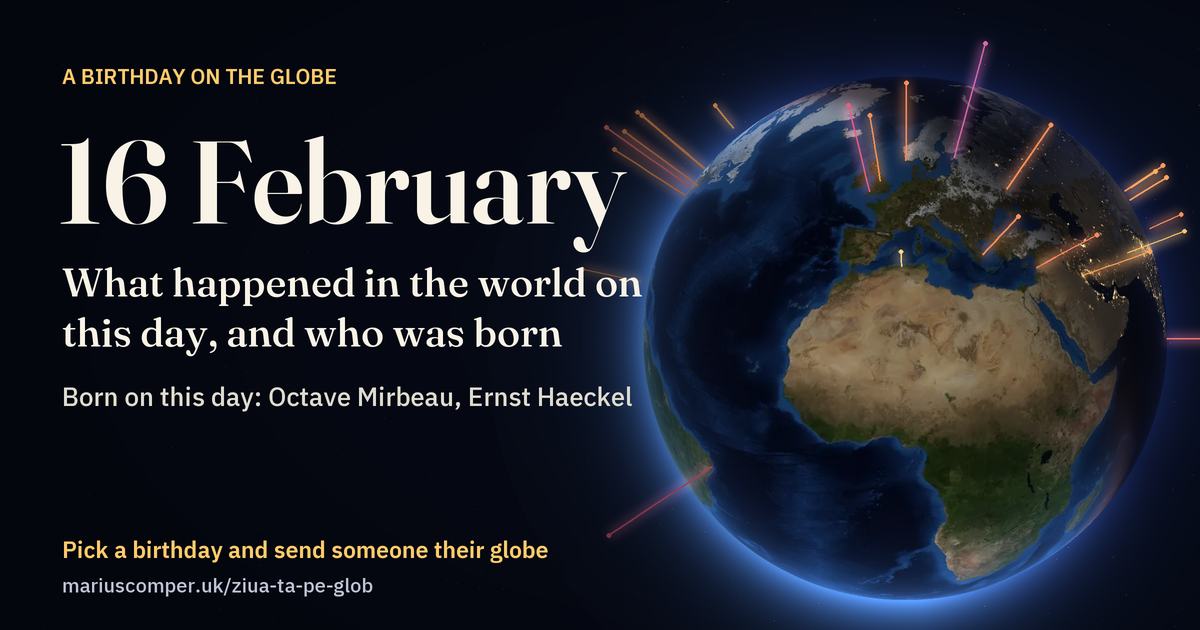
For 16 February, the English Wikipedia lists 51 events and 195 births. 24 of the events stand at their places as rays of light; five more are dashed circles, where the sentence links only to a country or a sea. The taller the ray, the longer ago it happened. The people born that day come further down, as blue points.
A birthday, yours or someone else’s:
Turn it into a greetingScroll: the globe turns to each place
The day you were born, on the globe.
Three things from your day
Scroll: your day first, then 16 February through the years
The Earth on 16 February
The picture on the globe was assembled by NASA from satellite photographs taken in February 2004: the snow, the ice and the green are those of the month.
On 16 February the Sun passes straight overhead at noon along the parallel of 12.5° south. In London, the day lasts about 10 hours.
Beyond 78° south the Sun no longer sets; beyond 78° north it no longer rises.
The line between day and night is tilted on the globe exactly as on this day of the year. On the dark side you can see the lights of towns.
Asia · Byblos
1922
A landslide in Byblos revealed a sarcophagus in an underground tomb that was later discovered to be part of a large Bronze Age necropolis.
On the map: Byblos.
Oceania · Marlborough Sounds
1986
The Soviet liner MS Mikhail Lermontov runs aground in the Marlborough Sounds, New Zealand.
On the map: Marlborough Sounds.
North America · DuSable Black History Museum
1961
The DuSable Museum, the first museum dedicated to the study and conservation of African American history, culture, and art, was chartered.
On the map: DuSable Black History Museum.
North America · Haleyville, Alabama
1968
In Haleyville, Alabama, the first 9-1-1 emergency telephone system goes into service.
On the map: Haleyville, Alabama.
North America · Chicago
1978
The first computer bulletin board system is created (CBBS in Chicago).
On the map: Chicago.
16 February
Born on 16 February#
The English Wikipedia lists 195 births for this day. The blue points are the birthplaces of 60 of these people: those written about in the most Wikipedia editions, where Wikidata gives a place of birth.
Born on 16 February
1848
Octave Mirbeau, French journalist, novelist, and playwright (died 1917)
Place of birth: Trévières.
Born on 16 February
1834
Ernst Haeckel, German biologist, physician, and philosopher (died 1919)
Place of birth: Potsdam.
Born on 16 February
1497
Philip Melanchthon, German astronomer, theologian, and academic (died 1560)
Place of birth: Bretten.
Born on 16 February
1989
Elizabeth Olsen, American actress
Place of birth: Sherman Oaks.
Born on 16 February
1959
John McEnroe, American tennis player and sportscaster
Place of birth: Wiesbaden.
Born in Britain and Ireland
1822
Francis Galton, English biologist and statistician (died 1911)
Place of birth: Sparkbrook.
Born in Britain and Ireland
1954
Iain Banks, Scottish author and playwright (died 2013)
Place of birth: Dunfermline.
Born in Britain and Ireland
1926
John Schlesinger, English actor and director (died 2003)
Place of birth: London.
16 February
Number one in the charts that week
At the cinema
An animal recorded that day
The record can be seen in GBIF, which brings together wildlife records from around the world.
All your birthdays
The weather that day
Data: Met Office Hadley Centre (HadCET); NOAA (GHCN-Daily, Mauna Loa).
Above the Earth
Sources: Jonathan McDowell, GCAT (launches); GFZ Potsdam (Kp index). Days are counted in Universal Time.
Football that day
International matches played that day:
Source: the “International football results” dataset kept by Mart Jürisoo (CC0).
Also that day
The earthquake’s page at the USGS
Source: the USGS catalogue. The day is counted in Universal Time (UTC).
In those days
Make a link for someone
Type the name, pick the day and the year of birth. The link opens straight on their day, with their name in the greeting.
The link carries the name, date and place typed here; anyone who gets it can see them.
Put another birthday beside it
Your mother’s, your child’s, a friend’s: the two days appear side by side.
Below: 16 February through the years.
The whole globe of the day
Drag the globe to turn it. Touch a ray or a point to read what happened there.
Everything Wikipedia lists for 16 February
The list is the English Wikipedia’s, in its own wording, as it stood in October 2026. 22 events have no place on the map: the sentence links to no place with coordinates, only to places too wide to mark, or to several countries.
- 1249
Andrew of Longjumeau is dispatched by Louis IX of France as his ambassador to meet with the Khagan of the Mongol Empire.
Asia · Mongol EmpireWikipedia: André de Longjumeau - 1270
The Grand Duchy of Lithuania defeats the Livonian Order in the Battle of Karuse.
Europe · Battle of KaruseWikipedia: Battle of Karuse - 1630
Dutch forces led by Hendrick Lonck capture Olinda in what was to become part of Dutch Brazil.
Latin America · OlindaWikipedia: Dutch invasions of Brazil - 1646
Battle of Torrington, Devon: The last major battle of the First English Civil War.
Britain & Ireland · Battle of TorringtonWikipedia: Battle of Torrington - 1699
First Leopoldine Diploma is issued by the Holy Roman Emperor, recognizing the Greek Catholic clergy enjoyed the same privileges as Roman Catholic priests in the Principality of Transylvania.
Europe · Principality of TransylvaniaWikipedia: Leopold I, Holy Roman Emperor - 1742
Spencer Compton, Earl of Wilmington, becomes British Prime Minister.
no place on the mapWikipedia: Spencer Compton, 1st Earl of Wilmington - 1796
Colombo in Ceylon (now Sri Lanka) falls to the British, completing their invasion of Ceylon.
Asia · ColomboWikipedia: Invasion of Ceylon - 1804
First Barbary War: Stephen Decatur leads a raid to burn the pirate-held frigate USS Philadelphia.
no place on the mapWikipedia: First Barbary War - 1859
The French government passed a law setting the musical note A4 to a frequency of 435 hertz, in the first attempt to standardize concert pitch.
no place on the mapWikipedia: Musical note - 1862
American Civil War: General Ulysses S. Grant captures Fort Donelson, Tennessee.
North America · Battle of Fort DonelsonWikipedia: American Civil War - 1866
Spencer Compton Cavendish, Marquess of Hartington becomes British Secretary of State for War.
no place on the mapWikipedia: Spencer Cavendish, 8th Duke of Devonshire - 1881
The Canadian Pacific Railway is incorporated by Act of Parliament at Ottawa (44th Vic., c.1).
no place on the mapWikipedia: Canadian Pacific Railway - 1899
Iceland's first football club, Knattspyrnufélag Reykjavíkur, is founded.
Europe · IcelandWikipedia: Iceland - 1900
The Southern Cross expedition led by Carsten Borchgrevink achieves a new Farthest South of 78° 50'S, making the first landing at the Great Ice Barrier.
no place on the mapWikipedia: Southern Cross Expedition - 1918
The Council of Lithuania unanimously adopts the Act of Independence, declaring Lithuania an independent state.
Europe · LithuaniaWikipedia: Act of Independence of Lithuania - 1922
A landslide in Byblos revealed a sarcophagus in an underground tomb that was later discovered to be part of a large Bronze Age necropolis.
Asia · ByblosWikipedia: Byblos - 1923
Howard Carter unseals the burial chamber of Pharaoh Tutankhamun.
no place on the mapWikipedia: Howard Carter - 1930
The Romanian Football Federation joins FIFA.
no place on the mapWikipedia: Romanian Football Federation - 1934
The Austrian Civil War ends with the defeat of the Social Democrats and the Republikanischer Schutzbund.
no place on the mapWikipedia: Austrian Civil War - 1934
The Commission of Government is officially sworn in; ending 79 years of responsible government in Newfoundland.
no place on the mapWikipedia: Newfoundland Commission of Government - 1936
The Popular Front wins the 1936 Spanish general election.
no place on the mapWikipedia: 1936 Spanish general election - 1937
Wallace H. Carothers receives a United States patent for nylon.
no place on the mapWikipedia: Wallace Carothers - 1940
World War II: Altmark incident: The German tanker Altmark is boarded by sailors from the British destroyer HMS Cossack. A total of 299 British prisoners are freed.
Europe · Altmark incidentWikipedia: Altmark incident - 1942
World War II: Attack on Aruba, first World War II German shots fired on a land based object in the Americas.
no place on the mapWikipedia: Attack on Aruba - 1942
World War II: In Athens, the Greek People's Liberation Army is established
Europe · AthensWikipedia: Athens - 1943
World War II: In the early phases of the Third Battle of Kharkov, Red Army troops re-enter the city.
Europe · Third Battle of KharkovWikipedia: Third Battle of Kharkov - 1945
The Alaska Equal Rights Act of 1945, the first anti-discrimination law in the United States, was signed into law.
no place on the mapWikipedia: Alaska Equal Rights Act of 1945 - 1945
World War II: American forces land on Corregidor Island in the Philippines.
Asia · Battle of CorregidorWikipedia: Battle of Corregidor - 1959
Fidel Castro becomes Premier of Cuba after dictator Fulgencio Batista was overthrown on January 1.
Latin America · CubaWikipedia: Fidel Castro - 1960
The U.S. Navy submarine USS Triton begins Operation Sandblast, setting sail from New London, Connecticut, to begin the first submerged circumnavigation of the globe.
North America · New London, ConnecticutWikipedia: USS Triton - 1961
Explorer program: Explorer 9 (S-56a) is launched.
no place on the mapWikipedia: Explorers Program - 1961
The DuSable Museum, the first museum dedicated to the study and conservation of African American history, culture, and art, was chartered.
North America · DuSable Black History MuseumWikipedia: DuSable Black History Museum - 1962
Flooding in the coastal areas of West Germany kills 315 and destroys the homes of about 60,000 people.
no place on the mapWikipedia: North Sea flood of 1962 - 1962
The Great Sheffield Gale impacts the United Kingdom, killing nine people; the city of Sheffield is devastated, with 150,000 homes damaged.
Britain & Ireland · SheffieldWikipedia: Great Sheffield Gale - 1968
Civil Air Transport Flight 010 crashes near Shongshan Airport in Taiwan, killing 21 of the 63 people on board and one more on the ground.
Asia · Songshan AirportWikipedia: Civil Air Transport Flight 10 - 1968
In Haleyville, Alabama, the first 9-1-1 emergency telephone system goes into service.
North America · Haleyville, AlabamaWikipedia: Haleyville, Alabama - 1978
The first computer bulletin board system is created (CBBS in Chicago).
North America · ChicagoWikipedia: Bulletin board system - 1983
The Ash Wednesday bushfires in Victoria and South Australia kill 75.
no place on the mapWikipedia: Ash Wednesday bushfires - 1984
Iran launches Operation Dawn 5, a major offensive during the Iran–Iraq War targeting the Basra–Baghdad highway, resulting in heavy casualties on both sides.
Asia · BasraWikipedia: Operation Dawn 5 - 1985
Hezbollah is founded.
no place on the mapWikipedia: Hezbollah - 1986
China Airlines Flight 2265 crashes into the Pacific Ocean near Penghu Airport in Taiwan, killing all 13 aboard.
Asia · Penghu AirportWikipedia: China Airlines Flight 2265 - 1986
The Soviet liner MS Mikhail Lermontov runs aground in the Marlborough Sounds, New Zealand.
Oceania · Marlborough SoundsWikipedia: Marlborough Sounds - 1991
Nicaraguan Contras leader Enrique Bermúdez is assassinated in Managua.
Latin America · ManaguaWikipedia: Nicaragua - 1996
A Chicago-bound Amtrak train, the Capitol Limited, collides with a MARC commuter train bound for Washington, D.C., killing 11 people.
no place on the mapWikipedia: 1996 Maryland train collision - 1998
China Airlines Flight 676 crashes into a road and residential area near Chiang Kai-shek International Airport in Taiwan, killing all 196 aboard and six more on the ground.
Asia · China Airlines Flight 676Wikipedia: China Airlines Flight 676 - 2000
Emery Worldwide Airlines Flight 17 crashes near Sacramento Mather Airport in Rancho Cordova, California, killing all three aboard.
North America · Emery Worldwide Airlines Flight 17Wikipedia: Emery Worldwide Airlines Flight 17 - 2005
The Kyoto Protocol comes into force, following its ratification by Russia.
no place on the mapWikipedia: Kyoto Protocol - 2005
The National Hockey League cancels the entire 2004–05 regular season and playoffs.
no place on the mapWikipedia: National Hockey League - 2006
The last Mobile army surgical hospital (MASH) is decommissioned by the United States Army.
no place on the mapWikipedia: Mobile Army Surgical Hospital - 2013
A bomb blast at a market in Hazara Town, Quetta, Pakistan kills more than 80 people and injures 190 others.
Asia · February 2013 Quetta bombingWikipedia: February 2013 Quetta bombing - 2021
Five thousand people gathered in the town of Kherrata, Bejaia Province to mark the second anniversary of the Hirak protest movement. Demonstrations had been suspended because of the COVID-19 pandemic in Algeria.
Africa · KherrataWikipedia: Hirak
Who was born on 16 February
In order of how many Wikipedia editions have an article about each. The first 60 of 195 are shown.
- 1848
Octave Mirbeau, French journalist, novelist, and playwright (died 1917)
TrévièresWikipedia: Octave Mirbeau - 1941
Kim Jong Il, North Korean commander and politician, 2nd Supreme Leader of North Korea (died 2011)
VyatskoyeWikipedia: Kim Jong Il - 1834
Ernst Haeckel, German biologist, physician, and philosopher (died 1919)
PotsdamWikipedia: Ernst Haeckel - 1497
Philip Melanchthon, German astronomer, theologian, and academic (died 1560)
- 1989
Elizabeth Olsen, American actress
Sherman OaksWikipedia: Elizabeth Olsen - 1959
John McEnroe, American tennis player and sportscaster
WiesbadenWikipedia: John McEnroe - 1986
Diego Godín, Uruguayan footballer
RosarioWikipedia: Diego Godín - 1822
Francis Galton, English biologist and statistician (died 1911)
SparkbrookWikipedia: Francis Galton - 1990
The Weeknd, Canadian singer-songwriter and producer
ScarboroughWikipedia: The Weeknd - 1873
Radoje Domanović, Serbian journalist and author (died 1908)
OvsišteWikipedia: Radoje Domanović - 1979
Valentino Rossi, Italian motorcycle racer
- 1974
Mahershala Ali, American actor
OaklandWikipedia: Mahershala Ali - 1964
Bebeto, Brazilian footballer and manager
SalvadorWikipedia: Bebeto - 1838
Henry Adams, American journalist, historian, and author (died 1918)
- 1904
George F. Kennan, American historian and diplomat, United States Ambassador to the Soviet Union (died 2005)
MilwaukeeWikipedia: George F. Kennan - 1994
Ava Max, American singer and songwriter
MilwaukeeWikipedia: Ava Max - 1831
Nikolai Leskov, Russian author, playwright, and journalist (died 1895)
- 1848
Hugo de Vries, Dutch botanist, geneticist, and academic (died 1935)
HaarlemWikipedia: Hugo de Vries - 1812
Henry Wilson, American colonel and politician, 18th Vice President of the United States (died 1875)
FarmingtonWikipedia: Henry Wilson - 1954
Iain Banks, Scottish author and playwright (died 2013)
DunfermlineWikipedia: Iain Banks - 1988
Kim Soo-hyun, South Korean actor and singer
- 1994
Federico Bernardeschi, Italian footballer
- 1620
Frederick William, Elector of Brandenburg (died 1688)
Berlin PalaceWikipedia: Frederick William, the Great Elector - 1973
Cathy Freeman, Australian sprinter
Slade PointWikipedia: Cathy Freeman - 1951
William Katt, American actor
Los AngelesWikipedia: William Katt - 1958
Ice-T, American rapper and actor
NewarkWikipedia: Ice-T - 1906
Vera Menchik, Russian-Czechoslovak-British chess player (died 1944)
MoscowWikipedia: Vera Menchik - 1991
Sergio Canales, Spanish footballer
SantanderWikipedia: Sergio Canales - 1926
John Schlesinger, English actor and director (died 2003)
- 1222
Nichiren, founder of Nichiren Buddhism (died 1282)
Tanjō-ji TempleWikipedia: Nichiren - 1957
LeVar Burton, American actor, director, and producer
LandstuhlWikipedia: LeVar Burton - 1964
Christopher Eccleston, English actor
LangworthyWikipedia: Christopher Eccleston - 1970
Angelo Peruzzi, Italian footballer and manager
- 1514
Georg Joachim Rheticus, Austrian cartographer and instrument maker (died 1574)
FeldkirchWikipedia: Georg Joachim Rheticus - 1519
Gaspard II de Coligny, French admiral (died 1572)
Châtillon-ColignyWikipedia: Gaspard II de Coligny - 1982
Rickie Lambert, English footballer
- 1985
Ron Vlaar, Dutch footballer
HensbroekWikipedia: Ron Vlaar - 1821
Heinrich Barth, German explorer and scholar (died 1865)
HamburgWikipedia: Heinrich Barth - 1884
Robert J. Flaherty, American director and producer (died 1951)
Iron MountainWikipedia: Robert J. Flaherty - 1935
Sonny Bono, American actor, singer, and politician (died 1998)
DetroitWikipedia: Sonny Bono - 1988
Denílson, Brazilian footballer
São PauloWikipedia: Denílson - 1727
Nikolaus Joseph von Jacquin, Austrian botanist, chemist, and mycologist (died 1817)
- 1698
Pierre Bouguer, French mathematician, geophysicist, and astronomer (died 1758)
Le CroisicWikipedia: Pierre Bouguer - 1932
Ahmad Tejan Kabbah, Sierra Leonean economist, lawyer, and politician, 3rd President of Sierra Leone (died 2014)
PendembuWikipedia: Ahmad Tejan Kabbah - 1987
Jon Ossoff, American politician and filmmaker
AtlantaWikipedia: Jon Ossoff - 1841
Armand Guillaumin, French painter (died 1927)
- 1988
Andrea Ranocchia, Italian footballer
- 1471
Krishnadevaraya, emperor of the Vijayanagara Empire (died 1529)
- 1994
Annika Beck, German tennis player
GiessenWikipedia: Annika Beck - 1331
Coluccio Salutati, Italian political leader (died 1406)
StignanoWikipedia: Coluccio Salutati - 1786
Maria Pavlovna, Russian Grand Duchess (died 1859)
- 1926
Margot Frank, German-Dutch holocaust victim (died 1945)
FrankfurtWikipedia: Margot Frank - 1944
Richard Ford, American novelist and short story writer
JacksonWikipedia: Richard Ford - 1954
Margaux Hemingway, American model and actress (died 1996)
PortlandWikipedia: Margaux Hemingway - 1982
Lupe Fiasco, American rapper
ChicagoWikipedia: Lupe Fiasco - 1978
Tia Hellebaut, Belgian high jumper and chemist
AntwerpWikipedia: Tia Hellebaut - 1944
António Mascarenhas Monteiro, Cape Verdean politician, 2nd President of Cape Verde (died 2016)
Ribeira da BarcaWikipedia: António Mascarenhas Monteiro - 1958
Oscar Schmidt, Brazilian basketball player (died 2026)
- 1972
Sarah Clarke, American actress
St. LouisWikipedia: Sarah Clarke - 1965
Dave Lombardo, Cuban-American musician and songwriter
HavanaWikipedia: Dave Lombardo
What is celebrated on 16 February
- Christian feast day: Abda of Edessa
- Christian feast day: Elias and companions
- Christian feast day: Juliana of Nicomedia (Catholic Church)
- Christian feast day: Onesimus
- Christian feast day: Charles Todd Quintard (Episcopal Church (USA))
- Christian feast day: February 16 (Eastern Orthodox liturgics)
- Day of the Shining Star (Kim Jong Il's birthday) (North Korea)
- Restoration of Lithuania's Statehood Day, celebrate the independence of Lithuania from Russia and Germany in 1918 (Lithuania)
- Elizabeth Peratrovich Day (Alaska)
A greeting link for someone
Type a name and, if you like, the year of birth. The link opens with a greeting, and beside each event it says how old the person turned that day, or how many years before their birth it happened.
The name and the year go only into the link you send.
All 366 days
How the globe is made
Where the events come from
Each edition of this page uses the day’s list from Wikipedia in its own language: Romanian, English, Spanish, Chinese. The lists are written by volunteers and differ from one edition to the next; the text of each event is Wikipedia’s, with a link to the article. A row that appears twice in a list is shown once. The lists have not been checked event by event: they are Wikipedia’s, mistakes included.
For events before 1582, and for countries that moved to the Gregorian calendar later (Britain in 1752, Russia in 1918), the same day may be counted Old Style in one list and New Style in another.
The chapter “What the other Wikipedias remember” adds up to five events a day from the lists of the other three editions, only for years in which the English list has nothing on that day. They were translated for this page, passed the same filters as the tour, and are not counted among the events of the English list.
How an event gets onto the map
The place comes from Wikidata. If the sentence links to the article about the event itself (a battle, an opening, an earthquake), dated to the same year, the ray stands on its coordinates or on those of its location. Otherwise it stands on the first place the sentence links to: a town, a building, a mountain, an island. This second step can be wrong: sometimes the sentence only mentions the place. That is why the page says, under each event, which place the ray stands on.
When the sentence links to a single state or province, or to a single sea, lake or desert larger than 5,000 km², the globe shows a dashed circle, not a ray. The circle has the area Wikidata gives, with its radius kept between 1.2° and 16°, or a radius of 4.5° when Wikidata gives no area; it says only that the sentence links to that place. Organisations, ships, spacecraft, museum objects, rivers, mountain ranges, languages and continents are never used as places. When a sentence names several states and no exact place, the event stays in the list only.
What the height means
The height of a ray shows how many years have passed, on a logarithmic scale: 10 years, 100 years and 1,000 years are equal steps apart; anything older than about 2,600 years has the tallest ray. The colour runs from pale yellow for recent years to violet for antiquity.
Where the tour stops
In each region the tour stops at up to three events (five in Britain and Ireland), chosen mainly by three things: whether Wikipedia’s editors put the event in the “On this day” box of their main page (the English, Spanish and Chinese editions), how many Wikipedia editions have an article about it, and how many of the four lists include it. Events whose sentence or article is about a war, an attack, a crime or a disaster are left out of the tour; they stay in the whole list, in Wikipedia’s wording. The filter is a list of words and a list of Wikidata types, so it can miss some.
The tour of births names the people with articles in the most editions and leaves aside those whom the list or Wikidata describes as rulers, politicians, commanders, leaders of movements or criminals; they stay in the list.
The Earth and the Sun
The daytime images are NASA’s Blue Marble Next Generation mosaics, one for each month of 2004; the night side is Black Marble 2016. The tilt of the line between day and night is computed for the day; the hour is chosen so that the place being read is in daylight. The latitude where the Sun stands overhead is the average of the four years of the leap cycle; in a given year it can differ by up to 0.4°.
The day you were born
The number ones come from the weekly lists on Wikipedia: Billboard for the United States (from 1940; the Hot 100 from August 1958), the UK Singles Chart (from November 1952), Los 40 Principales for Spain (from July 1966) and, for Romania, the Romanian Top 100 and Airplay 100 (2001–2021, with missing weeks). The page shows the chart of the week in which the day of birth falls, with its date; Billboard and the UK chart are dated at the end of their week. For Romania before 2001 and for China these sources have no weekly chart.
The films are those that reached cinemas in the United States up to ten days before or three days after that day (some of them in a few cinemas at first), from the English Wikipedia’s yearly lists (from 1968), in order of how many editions have an article about them. The events “in those days” are the ones on the neighbouring days’ lists that carry the year of birth, passed through the same filter as the tour.
The day of birth, year included
The Moon, the star sign and the constellation are worked out by the page itself, for noon Universal Time on the day. The lit part of the Moon is rounded and can differ by a few per cent from that at the hour of birth. The sign follows the usual zodiac of twelve equal parts starting at the March equinox; the constellation is the one the Sun actually stood in front of, by the borders set by the International Astronomical Union, and within a day of a border the page does not name it. When the Sun changes sign while it is that day anywhere on Earth, the page gives the moment of crossing, rounded to ten minutes and accurate to within about a quarter of an hour, and the clock time in a few cities, with the time zone and summer time of that year.
The year in the Chinese calendar is the one your device’s own calendar gives for the date, checked against the Hong Kong Observatory’s tables. “All your birthdays” uses the same sources as the rest of the chapter for the same day in every year since the birth: the temperature, well-known launches that took place on that very day, matches of the teams the edition follows, snow deeper than 10 cm and strong geomagnetic storms. The three things at the top and the four on the picture are chosen in a fixed order (the song, the animal, a full Moon, a well-known launch before an ordinary earthquake); on the picture you can change them.
When the link carries a year of birth, the page adds a few things about that exact day. The weather is the Met Office’s Central England temperature record and the readings from New York’s Central Park; the “usual high” is the average of the daily highs of 1961–1990 for that date, with two days either side. The carbon dioxide figure is the monthly mean at the Mauna Loa observatory, where measurements begin in March 1958.
The earthquake is the one with the largest magnitude in the USGS catalogue for that day, counted in Universal Time. Before the 1960s the catalogue has gaps even above magnitude 5.5, so in the older years many days have no earthquake. The page gives only the magnitude and the place: the country the epicentre falls in or, when the epicentre is at sea within 300 km of a coast, the nearest country; farther out, only the ocean.
The launches are those that reached orbit or left for the Moon and the planets, from Jonathan McDowell’s GCAT catalogue. If nothing left that day, the page shows the nearest launch within three days before or after, and says how many days away it was. The geomagnetic storm appears only when the Kp index reached at least 5 in one of the day’s eight three-hour intervals.
The animal comes from GBIF: an observation made by a person (the animal seen or heard, or its tracks), dated to that exact day, with coordinates and a CC0 or CC BY licence. Only a few hundred well-known species are searched (mammals, birds, turtles, butterflies); of those noted that day, mammals and species with articles in many Wikipedia editions come first; birds noted almost every day, and species used recently, wait their turn. Observations dated 1 January are left out, because records without a day are often filed there. An observation shows that the animal was recorded there, not how many animals there were.
The matches are those between national teams. Only matches of England, Scotland, Wales, Northern Ireland, the Republic of Ireland, the United States, Canada and Australia are shown, along with those at the big final tournaments. The picture to send is drawn in the page from the day’s globe and the facts above, and stays on your device until you send it.
Sources
- Events, births and holidays: the day’s page on Wikipedia, text under CC BY-SA 4.0.
- Coordinates, places of birth and the number of editions: Wikidata (CC0).
- The Earth by day: NASA Blue Marble Next Generation. The Earth by night: NASA Black Marble 2016.
- Borders and regions: Natural Earth.
- World population and births per year: UN World Population Prospects 2024.
- Charts and films: Wikipedia’s lists for Billboard, the UK Singles Chart, Los 40 Principales, Romanian Top 100, Airplay 100 and American films by year (CC BY-SA 4.0).
- Weather: Met Office Hadley Centre, HadCET (Open Government Licence) and NOAA GHCN-Daily, New York Central Park. Carbon dioxide: NOAA Global Monitoring Laboratory, Mauna Loa.
- Earthquakes: the USGS catalogue. Launches: Jonathan McDowell, GCAT (CC BY). Kp index: GFZ Potsdam (CC BY 4.0). Matches: International football results, Mart Jürisoo (CC0).
- Animal observations: GBIF, with a link to each record; species names come from Wikidata.