A birthday on the globe
29 June on the globe: what happened in the world on this day, and who was born
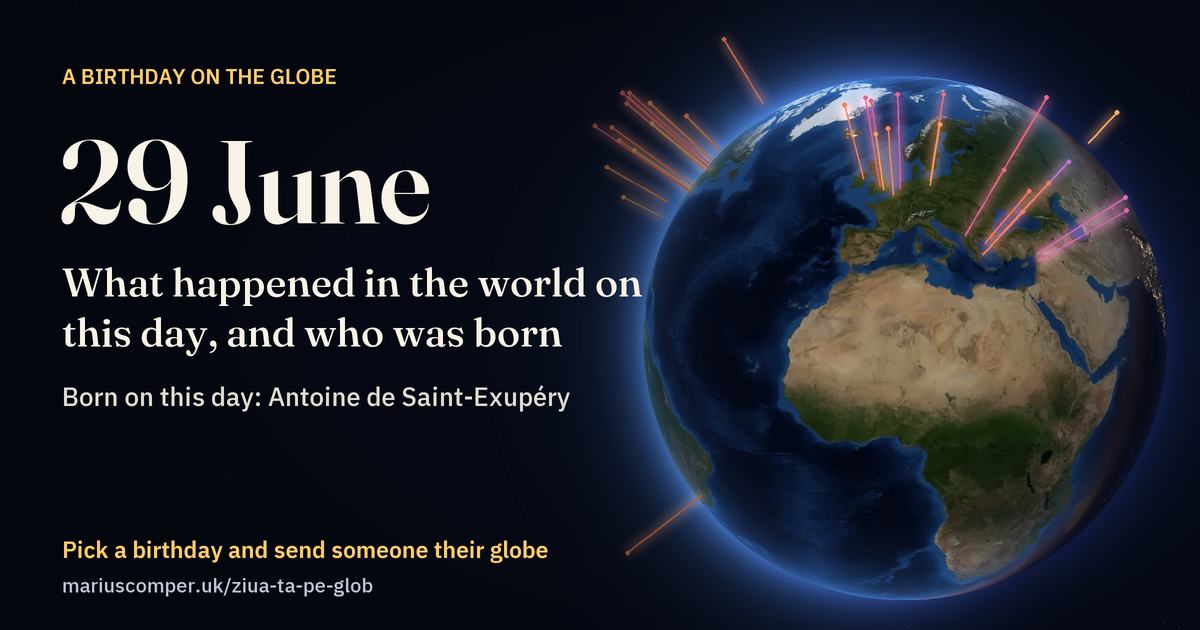
For 29 June, the English Wikipedia lists 56 events and 248 births. 33 of the events stand at their places as rays of light; six more are dashed circles, where the sentence links only to a country or a sea. The taller the ray, the longer ago it happened. The people born that day come further down, as blue points.
A birthday, yours or someone else’s:
Turn it into a greetingScroll: the globe turns to each place
The day you were born, on the globe.
Three things from your day
Scroll: your day first, then 29 June through the years
The Earth on 29 June
The picture on the globe was assembled by NASA from satellite photographs taken in June 2004: the snow, the ice and the green are those of the month.
On 29 June the Sun passes straight overhead at noon along the parallel of 23.2° north. In London, the day lasts about 16 hours 35 minutes.
Beyond 67° north the Sun no longer sets; beyond 67° south it no longer rises.
The line between day and night is tilted on the globe exactly as on this day of the year. On the dark side you can see the lights of towns.
Britain & Ireland · London
1987
Vincent van Gogh's painting, the Le Pont de Trinquetaille, is bought for $20.4 million at an auction in London, England.
On the map: London.
Europe · Athens
1874
Greek politician Charilaos Trikoupis publishes a manifesto in the Athens daily Kairoi entitled "Who's to Blame?" leveling complaints against King George. Trikoupis is elected Prime Minister of Greece the next year.
On the map: Athens.
Also on the day’s list of Wikipedia in Spanish.
Europe · 1976 Conference of Communist and Workers Parties of Europe
1976
The Conference of Communist and Workers Parties of Europe convenes in East Berlin.
On the map: the coordinates Wikidata gives for the article “1976 Conference of Communist and Workers Parties of Europe”.
Wikipedia: 1976 Conference of Communist and Workers Parties of Europe
Asia · Ecumenical Patriarchate of Constantinople
1850
Autocephaly officially granted by the Ecumenical Patriarchate of Constantinople to the Church of Greece.
On the map: Ecumenical Patriarchate of Constantinople.
North America · Glengarry County
1786
Alexander Macdonell and over five hundred Roman Catholic highlanders leave Scotland to settle in Glengarry County, Ontario.
On the map: Glengarry County.
North America · Long Beach
1952
The first Miss Universe pageant is held. Armi Kuusela from Finland wins the title of Miss Universe 1952.
On the map: Long Beach.
29 June
What the other Wikipedias remember#
For these years the English list has nothing on this day. The events below come from the same day’s lists on Wikipedia in Spanish and were translated for this page.
From Wikipedia in Spanish · Furs of Valencia
1707
In Spain, Philip V abolishes, by means of the Nueva Planta Decrees, the Fueros of Aragon and Valencia, both ceasing to exist as kingdoms independent of Castile.
On the map: Furs of Valencia.
Translated from the list on Wikipedia in Spanish.
From Wikipedia in Spanish · Gran Canaria
2005
UNESCO declares the island of Gran Canaria a "biosphere reserve".
On the map: Gran Canaria.
Translated from the list on Wikipedia in Spanish.
29 June
Born on 29 June#
The English Wikipedia lists 248 births for this day. The blue points are the birthplaces of 60 of these people: those written about in the most Wikipedia editions, where Wikidata gives a place of birth.
Born on 29 June
1900
Antoine de Saint-Exupéry, French poet and pilot (died 1944)
Place of birth: Lyon.
Born on 29 June
1798
Giacomo Leopardi, Italian poet and philosopher (died 1837)
Place of birth: Recanati.
Born on 29 June
2003
Jude Bellingham, English footballer
Place of birth: Stourbridge.
Born on 29 June
1929
Oriana Fallaci, Italian journalist and author (died 2006)
Place of birth: Florence.
Born on 29 June
1978
Nicole Scherzinger, American singer-songwriter, dancer, and actress
Place of birth: Honolulu.
Born in Britain and Ireland
1948
Ian Paice, English drummer, songwriter, and producer
Place of birth: Nottingham.
Born in Britain and Ireland
1928
Ian Bannen, Scottish actor (died 1999)
Place of birth: Airdrie.
Born in Britain and Ireland
1977
Zuleikha Robinson, English actress
Place of birth: London.
29 June
Number one in the charts that week
At the cinema
An animal recorded that day
The record can be seen in GBIF, which brings together wildlife records from around the world.
All your birthdays
The weather that day
Data: Met Office Hadley Centre (HadCET); NOAA (GHCN-Daily, Mauna Loa).
Above the Earth
Sources: Jonathan McDowell, GCAT (launches); GFZ Potsdam (Kp index). Days are counted in Universal Time.
Football that day
International matches played that day:
Source: the “International football results” dataset kept by Mart Jürisoo (CC0).
Also that day
The earthquake’s page at the USGS
Source: the USGS catalogue. The day is counted in Universal Time (UTC).
In those days
Make a link for someone
Type the name, pick the day and the year of birth. The link opens straight on their day, with their name in the greeting.
The link carries the name, date and place typed here; anyone who gets it can see them.
Put another birthday beside it
Your mother’s, your child’s, a friend’s: the two days appear side by side.
Below: 29 June through the years.
The whole globe of the day
Drag the globe to turn it. Touch a ray or a point to read what happened there.
Everything Wikipedia lists for 29 June
The list is the English Wikipedia’s, in its own wording, as it stood in October 2026. 17 events have no place on the map: the sentence links to no place with coordinates, only to places too wide to mark, or to several countries.
- 226
Cao Rui succeeds his father as emperor of Wei.
no place on the mapWikipedia: Cao Rui - 626
The Avars and Sassanids besiege Constantinople, held by Byzantine troops under Patrician Bonus.
Asia · Siege of ConstantinopleWikipedia: Pannonian Avars - 1072
Former Byzantine Emperor Romanos IV Diogenes is blinded on command of caesar John Doukas.
no place on the mapWikipedia: Romanos IV Diogenes - 1149
Raymond of Poitiers is defeated and killed at the Battle of Inab by Nur ad-Din Zangi.
Asia · Battle of InabWikipedia: Battle of Inab - 1170
A major earthquake hits Syria, badly damaging towns such as Hama and Shaizar and structures such as the Krak des Chevaliers and the cathedral of St. Peter in Antioch.
Asia · 1170 Syria earthquakeWikipedia: 1170 Syria earthquake - 1194
Sverre is crowned King of Norway, leading to his excommunication by the Catholic Church and civil war.
no place on the mapWikipedia: Sverre of Norway - 1444
Skanderbeg defeats an Ottoman invasion force at Torvioll.
Europe · Battle of TorviollWikipedia: Battle of Torvioll - 1457
The Dutch city of Dordrecht is devastated by fire.
Europe · DordrechtWikipedia: Dordrecht - 1534
Jacques Cartier is the first European to reach Prince Edward Island.
North America · Prince Edward IslandWikipedia: Jacques Cartier - 1613
The Globe Theatre in London, built by William Shakespeare's playing company, the Lord Chamberlain's Men, burns to the ground.
Britain & Ireland · Globe TheatreWikipedia: Globe Theatre - 1620
English crown bans tobacco growing in England, giving the Virginia Company a monopoly in exchange for tax of one shilling per pound.
no place on the mapWikipedia: History of tobacco - 1644
Charles I of England defeats a Parliamentarian detachment at the Battle of Cropredy Bridge.
Britain & Ireland · Battle of Cropredy BridgeWikipedia: Battle of Cropredy Bridge - 1659
At the Battle of Konotop the Ukrainian armies of Ivan Vyhovsky defeat the Russians led by Prince Trubetskoy.
Europe · Battle of KonotopWikipedia: Battle of Konotop - 1764
One of the strongest tornadoes in history strikes Woldegk, Germany, killing one person while leveling numerous mansions with winds estimated greater than 300 miles per hour (480 km/h).
Europe · WoldegkWikipedia: 1764 Woldegk tornado - 1776
The first privateer battle of the American Revolutionary War, the Battle of Turtle Gut Inlet, was fought near Cape May, New Jersey.
North America · Battle of Turtle Gut InletWikipedia: Battle of Turtle Gut Inlet - 1786
Alexander Macdonell and over five hundred Roman Catholic highlanders leave Scotland to settle in Glengarry County, Ontario.
North America · Glengarry CountyWikipedia: Alexander Macdonell - 1807
Russo-Turkish War: Admiral Dmitry Senyavin destroys the Ottoman fleet in the Battle of Athos.
Europe · Battle of AthosWikipedia: Russo-Turkish War - 1832
Black Hawk War: Three men working in a cornfield were attacked by Sauk Native Americans, resulting in two deaths.
North America · Sinsinawa Mound raidWikipedia: Black Hawk War - 1850
Autocephaly officially granted by the Ecumenical Patriarchate of Constantinople to the Church of Greece.
Asia · Ecumenical Patriarchate of ConstantinopleWikipedia: Autocephaly - 1864
At least 99 people, mostly German and Polish immigrants, are killed in Canada's worst railway disaster after a train fails to stop for an open drawbridge and plunges into the Rivière Richelieu near St-Hilaire, Quebec.
North America · Mont-Saint-HilaireWikipedia: Beloeil train disaster - 1874
Greek politician Charilaos Trikoupis publishes a manifesto in the Athens daily Kairoi entitled "Who's to Blame?" leveling complaints against King George. Trikoupis is elected Prime Minister of Greece the next year.
Europe · AthensWikipedia: Charilaos Trikoupis - 1880
France annexes Tahiti, renaming the independent Kingdom of Tahiti as "Etablissements de français de l'Océanie".
Oceania · TahitiWikipedia: Tahiti - 1881
In Sudan, Muhammad Ahmad declares himself to be the Mahdi, the messianic redeemer of Islam.
no place on the mapWikipedia: Muhammad Ahmad - 1888
George Edward Gouraud records Handel's Israel in Egypt onto a phonograph cylinder, thought for many years to be the oldest known recording of music.
no place on the mapWikipedia: George Edward Gouraud - 1889
Hyde Park and several other Illinois townships vote to be annexed by Chicago, forming the largest United States city in area and second largest in population at the time.
North America · Hyde Park Township, IllinoisWikipedia: Hyde Park Township, Illinois - 1913
More than 50,000 Union and Confederate veterans gathered at the Gettysburg Battlefield, the largest combined reunion of American Civil War veterans ever held.
North America · Gettysburg BattlefieldWikipedia: American Civil War - 1913
The Bulgarian army launches attacks against Serbian positions, triggering the Second Balkan War.
Europe · Kingdom of SerbiaWikipedia: Second Balkan War - 1915
The North Saskatchewan River flood of 1915 is the worst flood in Edmonton history.
North America · EdmontonWikipedia: North Saskatchewan River flood of 1915 - 1916
British diplomat turned Irish nationalist Roger Casement is sentenced to death for his part in the Easter Rising.
Britain & Ireland · County MeathWikipedia: Easter Rising - 1922
France grants "one square kilometer" at Vimy Ridge "freely, and for all time, to the Government of Canada, the free use of the land exempt from all taxes".
Europe · Battle of Vimy RidgeWikipedia: Battle of Vimy Ridge - 1927
The Bird of Paradise, a U.S. Army Air Corps Fokker tri-motor, completes the first transpacific flight, from the mainland United States to Hawaii.
no place on the mapWikipedia: Bird of Paradise - 1945
The Soviet Union annexes the Czechoslovak province of Carpathian Ruthenia.
no place on the mapWikipedia: Soviet Union - 1950
Korean War: U.S. President Harry S. Truman authorizes a sea blockade of Korea.
no place on the mapWikipedia: Korean War - 1950
The United States defeated England during the FIFA World Cup in one of the greatest upsets in the competition's history.
Latin America · Estádio IndependênciaWikipedia: United States v England - 1952
The first Miss Universe pageant is held. Armi Kuusela from Finland wins the title of Miss Universe 1952.
North America · Long BeachWikipedia: Miss Universe 1952 - 1956
The Federal Aid Highway Act of 1956 is signed by U.S. President Dwight D. Eisenhower, officially creating the United States Interstate Highway System.
no place on the mapWikipedia: Federal-Aid Highway Act of 1956 - 1967
Actress Jayne Mansfield, her boyfriend Sam Brody, and their driver were killed in a car accident outside of New Orleans, while her children Miklós, Zoltán, and Mariska Hargitay escaped with only minor injuries.
North America · New OrleansWikipedia: Jayne Mansfield - 1971
Prior to re-entry (following a record-setting stay aboard the Soviet Union's Salyut 1 space station), the crew capsule of the Soyuz 11 spacecraft depressurizes, killing the three cosmonauts on board. Georgy Dobrovolsky, Vladislav Volkov and Viktor Patsayev are the first humans to die in space.
Asia · Soviet UnionWikipedia: Soviet Union - 1972
A Convair CV-580 and De Havilland Canada DHC-6 Twin Otter collide above Lake Winnebago near Appleton, Wisconsin, killing 13.
North America · 1972 Lake Winnebago mid-air collisionWikipedia: 1972 Lake Winnebago mid-air collision - 1972
The United States Supreme Court rules in the case Furman v. Georgia that arbitrary and inconsistent imposition of the death penalty violates the Eighth and Fourteenth Amendments and constitutes cruel and unusual punishment.
North America · Supreme Court of the United StatesWikipedia: Supreme Court of the United States - 1974
Mikhail Baryshnikov defects from the Soviet Union to Canada while on tour with the Kirov Ballet.
Asia · Soviet UnionWikipedia: Mikhail Baryshnikov - 1974
Vice President Isabel Perón assumes powers and duties as Acting President of Argentina, while her husband President Juan Perón is terminally ill.
no place on the mapWikipedia: Isabel Perón - 1975
Pope Paul VI ordains some 350 priests in St. Peter's Square in the largest ordination in history
no place on the mapWikipedia: 1975 Jubilee ordination - 1976
The Conference of Communist and Workers Parties of Europe convenes in East Berlin.
Europe · 1976 Conference of Communist and Workers Parties of EuropeWikipedia: 1976 Conference of Communist and Workers Parties of Europe - 1976
The Seychelles become independent from the United Kingdom.
Oceans · SeychellesWikipedia: Seychelles - 1986
The Argentina national football team wins the FIFA World Cup held in Mexico after defeating the West Germany national football team by a score of 3–2 in the final at the Estadio Azteca.
Latin America · León StadiumWikipedia: 1986 FIFA World Cup - 1987
Vincent van Gogh's painting, the Le Pont de Trinquetaille, is bought for $20.4 million at an auction in London, England.
Britain & Ireland · LondonWikipedia: Vincent van Gogh - 1995
Space Shuttle program: STS-71 Mission (Atlantis) docks with the Russian space station Mir for the first time.
no place on the mapWikipedia: Space Shuttle program - 1995
The Sampoong Department Store collapses in the Seocho District of Seoul, South Korea, killing 502 and injuring 937.
Asia · Sampoong Department Store collapseWikipedia: Sampoong Department Store collapse - 2002
Naval clashes between South Korea and North Korea lead to the death of six South Korean sailors and sinking of a North Korean vessel.
Asia · North KoreaWikipedia: Battle of Yeonpyeong - 2003
An overloaded balcony collapsed in Chicago, United States, killing 13 people and injuring 57 others.
North America · 2003 Chicago balcony collapseWikipedia: 2003 Chicago balcony collapse - 2006
Hamdan v. Rumsfeld: The U.S. Supreme Court rules that President George W. Bush's plan to try Guantanamo Bay detainees in military tribunals violates U.S. and international law.
North America · Supreme Court of the United StatesWikipedia: Supreme Court of the United States - 2007
Apple Inc. releases its first mobile phone, the iPhone.
no place on the mapWikipedia: Apple Inc. - 2012
A derecho sweeps across the eastern United States, leaving at least 22 people dead and millions without power.
no place on the mapWikipedia: Derecho - 2014
The Islamic State of Iraq and the Levant self-declares its caliphate in Syria and northern Iraq.
no place on the mapWikipedia: Islamic State - 2020
Reddit banned r/The_Donald, a pro-Trump subreddit, for rule violations and antagonizing the company.
no place on the mapWikipedia: Reddit
What the other Wikipedias remember
For these years the English list has nothing on this day. The events below come from the same day’s lists on Wikipedia in Spanish and were translated for this page.
- 1707
In Spain, Philip V abolishes, by means of the Nueva Planta Decrees, the Fueros of Aragon and Valencia, both ceasing to exist as kingdoms independent of Castile.
Europe · Furs of ValenciaTranslated from the list on Wikipedia in SpanishWikipedia: Felipe V de España - 2005
UNESCO declares the island of Gran Canaria a "biosphere reserve".
Who was born on 29 June
In order of how many Wikipedia editions have an article about each. The first 60 of 248 are shown.
- 1900
Antoine de Saint-Exupéry, French poet and pilot (died 1944)
- 1798
Giacomo Leopardi, Italian poet and philosopher (died 1837)
RecanatiWikipedia: Giacomo Leopardi - 1925
Giorgio Napolitano, Italian journalist and politician, 11th President of Italy (died 2023)
- 1957
Gurbanguly Berdimuhamedow, Turkmen dentist and politician, 2nd President of Turkmenistan
- 2003
Jude Bellingham, English footballer
StourbridgeWikipedia: Jude Bellingham - 1326
Murad I, Ottoman Sultan (died 1389)
BursaWikipedia: Murad I - 1929
Oriana Fallaci, Italian journalist and author (died 2006)
FlorenceWikipedia: Oriana Fallaci - 1886
Robert Schuman, Luxembourgian-French lawyer and politician, Prime Minister of France (died 1963)
LuxembourgWikipedia: Robert Schuman - 1978
Nicole Scherzinger, American singer-songwriter, dancer, and actress
HonoluluWikipedia: Nicole Scherzinger - 1801
Frédéric Bastiat, French economist and theorist (died 1850)
BayonneWikipedia: Frédéric Bastiat - 1945
Chandrika Kumaratunga, Sri Lankan journalist and politician, 5th President of Sri Lanka
- 1849
Sergei Witte, Russian politician, 1st Chairmen of Council of Ministers of the Russian Empire (died 1915)
TbilisiWikipedia: Sergei Witte - 1930
Sławomir Mrożek, Polish-French author and playwright (died 2013)
BorzęcinWikipedia: Sławomir Mrożek - 1988
Éver Banega, Argentine footballer
RosarioWikipedia: Éver Banega - 1994
Leandro Paredes, Argentine footballer
San JustoWikipedia: Leandro Paredes - 1844
Peter I of Serbia (died 1921)
BelgradeWikipedia: Peter I of Serbia - 1991
Kawhi Leonard, American basketball player
RiversideWikipedia: Kawhi Leonard - 1963
Anne-Sophie Mutter, German violinist
RheinfeldenWikipedia: Anne-Sophie Mutter - 1398
John II of Aragon and Navarre (died 1479)
Medina del CampoWikipedia: John II of Aragon - 1911
Bernard Herrmann, American composer and conductor (died 1975)
New York CityWikipedia: Bernard Herrmann - 1818
Angelo Secchi, Italian astronomer and academic (died 1878)
Reggio EmiliaWikipedia: Angelo Secchi - 1880
Ludwig Beck, German general (died 1944)
BiebrichWikipedia: Ludwig Beck - 1911
Prince Bernhard of Lippe-Biesterfeld (died 2004)
- 1994
Camila Mendes, American actress and model
CharlottesvilleWikipedia: Camila Mendes - 1944
Gary Busey, American actor
BaytownWikipedia: Gary Busey - 1993
Oliver Tree, American singer-songwriter (died 2026)
Santa CruzWikipedia: Oliver Tree - 1482
Maria of Aragon, Queen of Portugal (died 1517)
- 1868
George Ellery Hale, American astronomer and journalist (died 1938)
- 1926
Jaber Al-Ahmad Al-Sabah, Kuwaiti ruler, 3rd Emir of Kuwait (died 2006)
Kuwait CityWikipedia: Jaber Al-Ahmad Al-Sabah - 1947
Richard Lewis, American actor and screenwriter (died 2024)
BrooklynWikipedia: Richard Lewis - 1954
Léo Júnior, Brazilian footballer, coach, and manager
João PessoaWikipedia: Léo Júnior - 1962
Joan Laporta, Spanish businessman and politician
BarcelonaWikipedia: Joan Laporta - 1948
Ian Paice, English drummer, songwriter, and producer
NottinghamWikipedia: Ian Paice - 1136
Petronilla of Aragon (died 1173)
- 1986
Edward Maya, Romanian singer-songwriter and producer
BucharestWikipedia: Edward Maya - 1596
Emperor Go-Mizunoo of Japan (died 1680)
- 1920
Ray Harryhausen, American animator and producer (died 2013)
Los AngelesWikipedia: Ray Harryhausen - 1956
Pedro Santana Lopes, Portuguese lawyer and politician, 118th Prime Minister of Portugal
- 1982
Lily Rabe, American actress
New York CityWikipedia: Lily Rabe - 1941
Stokely Carmichael, Trinidadian-American activist (died 1998)
Port of SpainWikipedia: Stokely Carmichael - 1873
Leo Frobenius, German ethnologist and archaeologist (died 1938)
BerlinWikipedia: Leo Frobenius - 1958
Rosa Mota, Portuguese runner
PortoWikipedia: Rosa Mota - 1972
DJ Shadow, American DJ and record producer
HaywardWikipedia: DJ Shadow - 1981
Joe Johnson, American basketball player
Little RockWikipedia: Joe Johnson - 1906
Ivan Chernyakhovsky, Ukrainian general (died 1945)
OksanynaWikipedia: Ivan Chernyakhovsky - 1939
Amarildo Tavares da Silveira, Brazilian footballer and coach
Campos dos GoytacazesWikipedia: Amarildo - 1957
María Conchita Alonso, Cuban-Venezuelan singer and actress
CienfuegosWikipedia: María Conchita Alonso - 1990
Yann M'Vila, French footballer
AmiensWikipedia: Yann M'Vila - 1998
Gjon's Tears, Swiss singer-songwriter
SaanenWikipedia: Gjon's Tears - 1893
Prasanta Chandra Mahalanobis, Indian economist and statistician (died 1972)
- 1944
Seán Patrick O'Malley, American cardinal
LakewoodWikipedia: Seán Patrick O'Malley - 1967
Melora Hardin, American actress and singer
HoustonWikipedia: Melora Hardin - 1914
Rafael Kubelík, Czech-American conductor and composer (died 1996)
BýchoryWikipedia: Rafael Kubelík - 1928
Ian Bannen, Scottish actor (died 1999)
AirdrieWikipedia: Ian Bannen - 1986
José Manuel Jurado, Spanish footballer
Sanlúcar de BarramedaWikipedia: José Manuel Jurado - 1991
Suk Hyun-jun, South Korean footballer
ChungjuWikipedia: Suk Hyun-jun - 1833
Peter Waage, Norwegian chemist and academic (died 1900)
Flekkefjord MunicipalityWikipedia: Peter Waage - 1920
César Rodríguez Álvarez, Spanish footballer and manager (died 1995)
- 1977
Zuleikha Robinson, English actress
- 1982
Colin Jost, American comedian
Staten IslandWikipedia: Colin Jost
What is celebrated on 29 June
- Christian feast day: Cassius of Narni
- Christian feast day: Hemma of Gurk
- Christian feast day: Mary, mother of John Mark
- Christian feast day: Feast of Saints Peter and Paul (Western Christianity), and its related observances: Haro Wine Festival (Haro, La Rioja)
- Christian feast day: Feast of Saints Peter and Paul (Western Christianity), and its related observances: l-Imnarja (Malta)
- Christian feast day: June 29 (Eastern Orthodox liturgics)
- Engineer's Day (Ecuador)
- Independence Day (Seychelles), celebrates the independence of Seychelles from the United Kingdom in 1976.
- Veterans' Day (Netherlands)
- National Statistics Day (India)
A greeting link for someone
Type a name and, if you like, the year of birth. The link opens with a greeting, and beside each event it says how old the person turned that day, or how many years before their birth it happened.
The name and the year go only into the link you send.
All 366 days
How the globe is made
Where the events come from
Each edition of this page uses the day’s list from Wikipedia in its own language: Romanian, English, Spanish, Chinese. The lists are written by volunteers and differ from one edition to the next; the text of each event is Wikipedia’s, with a link to the article. A row that appears twice in a list is shown once. The lists have not been checked event by event: they are Wikipedia’s, mistakes included.
For events before 1582, and for countries that moved to the Gregorian calendar later (Britain in 1752, Russia in 1918), the same day may be counted Old Style in one list and New Style in another.
The chapter “What the other Wikipedias remember” adds up to five events a day from the lists of the other three editions, only for years in which the English list has nothing on that day. They were translated for this page, passed the same filters as the tour, and are not counted among the events of the English list.
How an event gets onto the map
The place comes from Wikidata. If the sentence links to the article about the event itself (a battle, an opening, an earthquake), dated to the same year, the ray stands on its coordinates or on those of its location. Otherwise it stands on the first place the sentence links to: a town, a building, a mountain, an island. This second step can be wrong: sometimes the sentence only mentions the place. That is why the page says, under each event, which place the ray stands on.
When the sentence links to a single state or province, or to a single sea, lake or desert larger than 5,000 km², the globe shows a dashed circle, not a ray. The circle has the area Wikidata gives, with its radius kept between 1.2° and 16°, or a radius of 4.5° when Wikidata gives no area; it says only that the sentence links to that place. Organisations, ships, spacecraft, museum objects, rivers, mountain ranges, languages and continents are never used as places. When a sentence names several states and no exact place, the event stays in the list only.
What the height means
The height of a ray shows how many years have passed, on a logarithmic scale: 10 years, 100 years and 1,000 years are equal steps apart; anything older than about 2,600 years has the tallest ray. The colour runs from pale yellow for recent years to violet for antiquity.
Where the tour stops
In each region the tour stops at up to three events (five in Britain and Ireland), chosen mainly by three things: whether Wikipedia’s editors put the event in the “On this day” box of their main page (the English, Spanish and Chinese editions), how many Wikipedia editions have an article about it, and how many of the four lists include it. Events whose sentence or article is about a war, an attack, a crime or a disaster are left out of the tour; they stay in the whole list, in Wikipedia’s wording. The filter is a list of words and a list of Wikidata types, so it can miss some.
The tour of births names the people with articles in the most editions and leaves aside those whom the list or Wikidata describes as rulers, politicians, commanders, leaders of movements or criminals; they stay in the list.
The Earth and the Sun
The daytime images are NASA’s Blue Marble Next Generation mosaics, one for each month of 2004; the night side is Black Marble 2016. The tilt of the line between day and night is computed for the day; the hour is chosen so that the place being read is in daylight. The latitude where the Sun stands overhead is the average of the four years of the leap cycle; in a given year it can differ by up to 0.4°.
The day you were born
The number ones come from the weekly lists on Wikipedia: Billboard for the United States (from 1940; the Hot 100 from August 1958), the UK Singles Chart (from November 1952), Los 40 Principales for Spain (from July 1966) and, for Romania, the Romanian Top 100 and Airplay 100 (2001–2021, with missing weeks). The page shows the chart of the week in which the day of birth falls, with its date; Billboard and the UK chart are dated at the end of their week. For Romania before 2001 and for China these sources have no weekly chart.
The films are those that reached cinemas in the United States up to ten days before or three days after that day (some of them in a few cinemas at first), from the English Wikipedia’s yearly lists (from 1968), in order of how many editions have an article about them. The events “in those days” are the ones on the neighbouring days’ lists that carry the year of birth, passed through the same filter as the tour.
The day of birth, year included
The Moon, the star sign and the constellation are worked out by the page itself, for noon Universal Time on the day. The lit part of the Moon is rounded and can differ by a few per cent from that at the hour of birth. The sign follows the usual zodiac of twelve equal parts starting at the March equinox; the constellation is the one the Sun actually stood in front of, by the borders set by the International Astronomical Union, and within a day of a border the page does not name it. When the Sun changes sign while it is that day anywhere on Earth, the page gives the moment of crossing, rounded to ten minutes and accurate to within about a quarter of an hour, and the clock time in a few cities, with the time zone and summer time of that year.
The year in the Chinese calendar is the one your device’s own calendar gives for the date, checked against the Hong Kong Observatory’s tables. “All your birthdays” uses the same sources as the rest of the chapter for the same day in every year since the birth: the temperature, well-known launches that took place on that very day, matches of the teams the edition follows, snow deeper than 10 cm and strong geomagnetic storms. The three things at the top and the four on the picture are chosen in a fixed order (the song, the animal, a full Moon, a well-known launch before an ordinary earthquake); on the picture you can change them.
When the link carries a year of birth, the page adds a few things about that exact day. The weather is the Met Office’s Central England temperature record and the readings from New York’s Central Park; the “usual high” is the average of the daily highs of 1961–1990 for that date, with two days either side. The carbon dioxide figure is the monthly mean at the Mauna Loa observatory, where measurements begin in March 1958.
The earthquake is the one with the largest magnitude in the USGS catalogue for that day, counted in Universal Time. Before the 1960s the catalogue has gaps even above magnitude 5.5, so in the older years many days have no earthquake. The page gives only the magnitude and the place: the country the epicentre falls in or, when the epicentre is at sea within 300 km of a coast, the nearest country; farther out, only the ocean.
The launches are those that reached orbit or left for the Moon and the planets, from Jonathan McDowell’s GCAT catalogue. If nothing left that day, the page shows the nearest launch within three days before or after, and says how many days away it was. The geomagnetic storm appears only when the Kp index reached at least 5 in one of the day’s eight three-hour intervals.
The animal comes from GBIF: an observation made by a person (the animal seen or heard, or its tracks), dated to that exact day, with coordinates and a CC0 or CC BY licence. Only a few hundred well-known species are searched (mammals, birds, turtles, butterflies); of those noted that day, mammals and species with articles in many Wikipedia editions come first; birds noted almost every day, and species used recently, wait their turn. Observations dated 1 January are left out, because records without a day are often filed there. An observation shows that the animal was recorded there, not how many animals there were.
The matches are those between national teams. Only matches of England, Scotland, Wales, Northern Ireland, the Republic of Ireland, the United States, Canada and Australia are shown, along with those at the big final tournaments. The picture to send is drawn in the page from the day’s globe and the facts above, and stays on your device until you send it.
Sources
- Events, births and holidays: the day’s page on Wikipedia, text under CC BY-SA 4.0.
- Coordinates, places of birth and the number of editions: Wikidata (CC0).
- The Earth by day: NASA Blue Marble Next Generation. The Earth by night: NASA Black Marble 2016.
- Borders and regions: Natural Earth.
- World population and births per year: UN World Population Prospects 2024.
- Charts and films: Wikipedia’s lists for Billboard, the UK Singles Chart, Los 40 Principales, Romanian Top 100, Airplay 100 and American films by year (CC BY-SA 4.0).
- Weather: Met Office Hadley Centre, HadCET (Open Government Licence) and NOAA GHCN-Daily, New York Central Park. Carbon dioxide: NOAA Global Monitoring Laboratory, Mauna Loa.
- Earthquakes: the USGS catalogue. Launches: Jonathan McDowell, GCAT (CC BY). Kp index: GFZ Potsdam (CC BY 4.0). Matches: International football results, Mart Jürisoo (CC0).
- Animal observations: GBIF, with a link to each record; species names come from Wikidata.