A birthday on the globe
21 March on the globe: what happened in the world on this day, and who was born
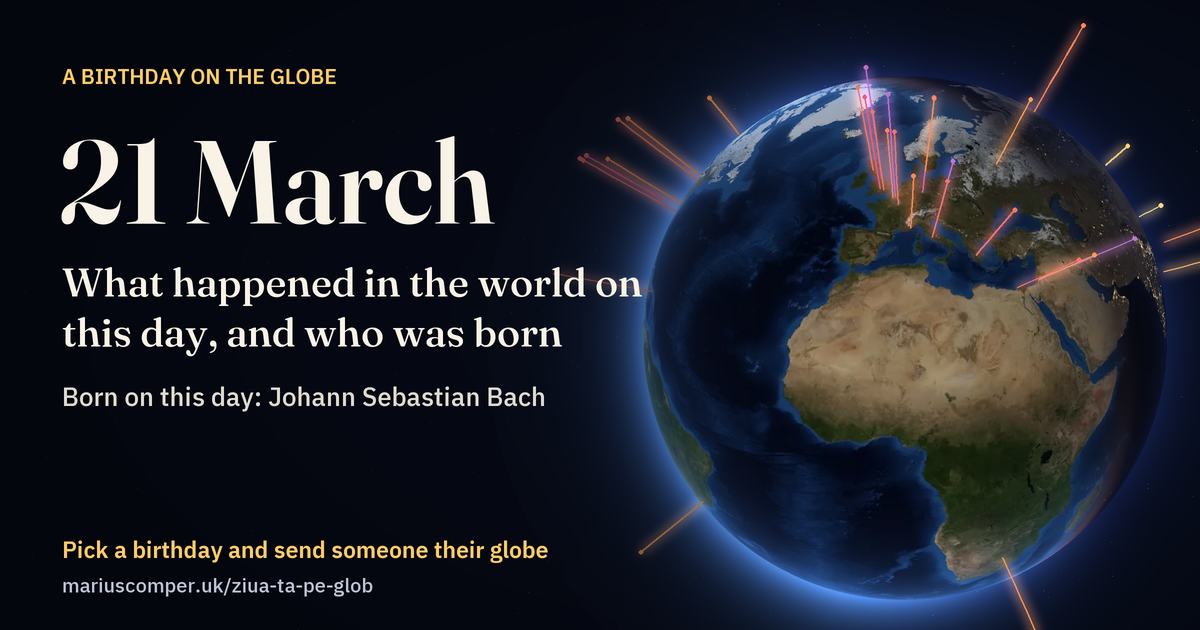
For 21 March, the English Wikipedia lists 59 events and 293 births. 32 of the events stand at their places as rays of light; four more are dashed circles, where the sentence links only to a country or a sea. The taller the ray, the longer ago it happened. The people born that day come further down, as blue points.
A birthday, yours or someone else’s:
Turn it into a greetingScroll: the globe turns to each place
The day you were born, on the globe.
Three things from your day
Scroll: your day first, then 21 March through the years
The Earth on 21 March
The picture on the globe was assembled by NASA from satellite photographs taken in March 2004: the snow, the ice and the green are those of the month.
On 21 March the Sun passes straight overhead at noon along the parallel of 0.4° north. In London, the day lasts about 12 hours 15 minutes.
The line between day and night is tilted on the globe exactly as on this day of the year. On the dark side you can see the lights of towns.
Britain & Ireland · London
1829
The Wellington–Winchilsea duel takes place in London involving the Prime Minister the Duke of Wellington.
On the map: London.
Europe · Opéra de Monte-Carlo
1925
Ravel's opera L'enfant et les sortilèges, to a libretto by Colette, is premiered at the Opéra de Monte-Carlo.
On the map: Opéra de Monte-Carlo.
Asia · Jerusalem
630
Emperor Heraclius returns the True Cross, one of the holiest Christian relics, to Jerusalem.
On the map: Jerusalem.
Also on the day’s list of Wikipedia in Chinese.
North America · Savannah
1861
Alexander H. Stephens gives the Cornerstone Speech.
On the map: Savannah.
North America · Cleveland
1952
Alan Freed presents the Moondog Coronation Ball, the first rock and roll concert, in Cleveland, Ohio.
On the map: Cleveland.
North America · Alcatraz Federal Penitentiary
1963
Alcatraz Federal Penitentiary closes.
On the map: Alcatraz Federal Penitentiary.
Also on the day’s list of Wikipedia in Chinese.
21 March
What the other Wikipedias remember#
For these years the English list has nothing on this day. The events below come from the same day’s lists on Wikipedia in Romanian and were translated for this page.
From Wikipedia in Romanian · Copenhagen
1964
In Copenhagen, Denmark, Gigliola Cinquetti wins the 9th Eurovision Song Contest for Italy with the song "Non ho l'età".
On the map: Copenhagen.
Translated from the list on Wikipedia in Romanian.
21 March
Born on 21 March#
The English Wikipedia lists 293 births for this day. The blue points are the birthplaces of 59 of these people: those written about in the most Wikipedia editions, where Wikidata gives a place of birth.
Born on 21 March
1685
Johann Sebastian Bach, German Baroque composer and musician (died 1750)
Place of birth: Eisenach.
Born on 21 March
1768
Joseph Fourier, French mathematician and physicist (died 1830)
Place of birth: Auxerre.
Born on 21 March
1980
Ronaldinho, Brazilian footballer
Place of birth: Porto Alegre.
Born on 21 March
1958
Gary Oldman, English actor, filmmaker, musician, and author
Place of birth: London.
Born on 21 March
1991
Antoine Griezmann, French footballer
Place of birth: Mâcon.
Born in Britain and Ireland
1946
Timothy Dalton, Welsh-English actor
Place of birth: Colwyn Bay.
Born in Britain and Ireland
1925
Peter Brook, English-French director and producer (died 2022)
Place of birth: Chiswick.
Born in Britain and Ireland
1935
Brian Clough, English footballer and manager (died 2004)
Place of birth: Middlesbrough.
21 March
Number one in the charts that week
At the cinema
An animal recorded that day
The record can be seen in GBIF, which brings together wildlife records from around the world.
All your birthdays
The weather that day
Data: Met Office Hadley Centre (HadCET); NOAA (GHCN-Daily, Mauna Loa).
Above the Earth
Sources: Jonathan McDowell, GCAT (launches); GFZ Potsdam (Kp index). Days are counted in Universal Time.
Football that day
International matches played that day:
Source: the “International football results” dataset kept by Mart Jürisoo (CC0).
Also that day
The earthquake’s page at the USGS
Source: the USGS catalogue. The day is counted in Universal Time (UTC).
In those days
Make a link for someone
Type the name, pick the day and the year of birth. The link opens straight on their day, with their name in the greeting.
The link carries the name, date and place typed here; anyone who gets it can see them.
Put another birthday beside it
Your mother’s, your child’s, a friend’s: the two days appear side by side.
Below: 21 March through the years.
The whole globe of the day
Drag the globe to turn it. Touch a ray or a point to read what happened there.
Everything Wikipedia lists for 21 March
The list is the English Wikipedia’s, in its own wording, as it stood in October 2026. 23 events have no place on the map: the sentence links to no place with coordinates, only to places too wide to mark, or to several countries.
- 537
Siege of Rome: King Vitiges attempts to assault the northern and eastern city walls, but is repulsed at the Praenestine Gate, known as the Vivarium, by the defenders under the Byzantine generals Bessas and Peranius.
Europe · Siege of RomeWikipedia: Siege of Rome - 630
Emperor Heraclius returns the True Cross, one of the holiest Christian relics, to Jerusalem.
Asia · JerusalemWikipedia: Heraclius - 717
Battle of Vincy between Charles Martel and Ragenfrid.
Europe · Battle of VincyWikipedia: Battle of Vincy - 867
An army of the Kingdom of Northumbria attempts to recapture York from the Great Heathen Army but is defeated in the battle of York.
Britain & Ireland · Battle of YorkWikipedia: Battle of York - 1152
Annulment of the marriage of King Louis VII of France and Queen Eleanor of Aquitaine.
no place on the mapWikipedia: Louis VII of France - 1180
Emperor Antoku accedes to the throne of Japan.
no place on the mapWikipedia: Emperor Antoku - 1349
Erfurt massacre: Outbreak of an antisemitic pogrom in Erfurt, Germany, during which between 100 and up to 3000 Jews were killed by Christians after being accused of causing the Black Death.
Europe · ErfurtWikipedia: Erfurt massacre - 1556
On the day of his execution in Oxford, former archbishop of Canterbury Thomas Cranmer deviates from the scripted sermon by renouncing the recantations he has made and adds, "And as for the pope, I refuse him, as Christ's enemy, and Antichrist with all his false doctrine."
Britain & Ireland · OxfordWikipedia: Oxford - 1788
A fire in New Orleans leaves most of the town in ruins.
North America · Great New Orleans FireWikipedia: Great New Orleans Fire - 1800
With the church leadership driven out of Rome during an armed conflict, Pius VII is crowned Pope in Venice with a temporary papal tiara made of papier-mâché.
Europe · RomeWikipedia: Papal States - 1801
The Battle of Alexandria is fought between British and French forces near the ruins of Nicopolis near Alexandria in Egypt.
Africa · Battle of AlexandriaWikipedia: Battle of Alexandria - 1804
Code Napoléon is adopted as French civil law.
no place on the mapWikipedia: Napoleonic Code - 1814
Napoleonic Wars: Austrian forces repel French troops in the Battle of Arcis-sur-Aube.
Europe · Battle of Arcis-sur-AubeWikipedia: Napoleonic Wars - 1821
Greek War of Independence: Greek revolutionaries seize Kalavryta.
Europe · KalavrytaWikipedia: Greek War of Independence - 1825
During his tour of the United States, the Marquis de Lafayette laid the cornerstone for the Nathanael Greene Monument in Savannah, Georgia.
North America · Nathanael Greene MonumentWikipedia: Visit of the Marquis de Lafayette to the United States - 1829
The Wellington–Winchilsea duel takes place in London involving the Prime Minister the Duke of Wellington.
Britain & Ireland · LondonWikipedia: Wellington–Winchilsea duel - 1844
The Baháʼí calendar begins. This is the first day of the first year of the Baháʼí calendar. It is annually celebrated by members of the Baháʼí Faith as the Baháʼí New Year or Náw-Rúz.
no place on the mapWikipedia: Baháʼí calendar - 1861
Alexander H. Stephens gives the Cornerstone Speech.
North America · SavannahWikipedia: Cornerstone Speech - 1871
Journalist Henry Morton Stanley begins his trek to find the missionary and explorer David Livingstone.
no place on the mapWikipedia: Henry Morton Stanley - 1871
Otto von Bismarck is appointed as the first Chancellor of the German Empire.
no place on the mapWikipedia: Otto von Bismarck - 1874
Queen's Park defeated Clydesdale 2–0 in the final of the inaugural Scottish Cup.
Britain & Ireland · Hampden ParkWikipedia: 1874 Scottish Cup final - 1913
More than 360 were killed and 20,000 homes were destroyed in the Great Dayton Flood in Dayton, Ohio, U.S.
North America · Dayton, OhioWikipedia: Great Dayton Flood - 1918
World War I: The first phase of the German spring offensive, Operation Michael, begins.
Europe · German spring offensiveWikipedia: World War I - 1919
The Hungarian Soviet Republic is established becoming the first Communist government to be formed in Europe after the October Revolution in Russia.
no place on the mapWikipedia: October Revolution - 1921
The New Economic Policy is implemented by the Bolshevik Party in response to the economic failure as a result of war communism.
Asia · War communismWikipedia: War communism - 1925
Ravel's opera L'enfant et les sortilèges, to a libretto by Colette, is premiered at the Opéra de Monte-Carlo.
Europe · Opéra de Monte-CarloWikipedia: L'enfant et les sortilèges - 1925
Syngman Rhee is removed from office after being impeached as the President of the Provisional Government of the Republic of Korea.
Asia · Provisional Government of the Republic of KoreaWikipedia: Syngman Rhee - 1925
The Butler Act prohibits the teaching of human evolution in Tennessee.
North America · TennesseeWikipedia: Butler Act - 1928
Charles Lindbergh is presented with the Medal of Honor for the first solo trans-Atlantic flight.
no place on the mapWikipedia: Charles Lindbergh - 1934
The landmark Australian Eastern Mission led by John Latham departs on its three-month tour of East and South-East Asia.
no place on the mapWikipedia: Australian Eastern Mission - 1935
Shah of Iran Reza Shah Pahlavi formally asks the international community to call Persia by its native name, Iran.
Asia · IranWikipedia: List of monarchs of Iran - 1937
Ponce massacre: Nineteen unarmed civilians in Ponce, Puerto Rico are gunned down by police in a terrorist attack ordered by the US-appointed Governor, Blanton Winship.
Latin America · Ponce massacreWikipedia: Ponce massacre - 1943
Wehrmacht officer Rudolf von Gersdorff plots to assassinate Adolf Hitler by using a suicide bomb, but the plan falls through; von Gersdorff is able to defuse the bomb in time and avoid suspicion.
no place on the mapWikipedia: Wehrmacht - 1945
World War II: British troops liberate Mandalay, Burma.
Asia · MandalayWikipedia: World War II - 1945
World War II: Bulgaria and the Soviet Union successfully complete their defense of the north bank of the Drava River as the Battle of the Transdanubian Hills concludes.
no place on the mapWikipedia: Battle of the Transdanubian Hills - 1945
World War II: Operation Carthage: Royal Air Force planes bomb Gestapo headquarters in Copenhagen, Denmark. They also accidentally hit a school, killing 125 civilians.
Europe · Operation CarthageWikipedia: Operation Carthage - 1946
The Los Angeles Rams sign Kenny Washington, making him the first African American player in professional American football since 1933.
no place on the mapWikipedia: Los Angeles Rams - 1952
Alan Freed presents the Moondog Coronation Ball, the first rock and roll concert, in Cleveland, Ohio.
North America · ClevelandWikipedia: Alan Freed - 1960
Apartheid: Sharpeville massacre, South Africa: Police open fire on a group of black South African demonstrators, killing 69 and wounding 180.
Africa · Sharpeville massacreWikipedia: Sharpeville massacre - 1963
Alcatraz Federal Penitentiary closes.
North America · Alcatraz Federal PenitentiaryWikipedia: Alcatraz Federal Penitentiary - 1965
Martin Luther King Jr. leads 3,200 people on the start of the third and finally successful civil rights march from Selma to Montgomery, Alabama.
North America · Selma, AlabamaWikipedia: Selma to Montgomery marches - 1965
Ranger program: NASA launches Ranger 9, the last in a series of uncrewed lunar space probes.
no place on the mapWikipedia: Ranger program - 1968
Battle of Karameh in Jordan between the Israel Defense Forces and the combined forces of the Jordanian Armed Forces and PLO.
Asia · Battle of KaramehWikipedia: Battle of Karameh - 1970
San Diego Comic-Con, the largest pop and culture festival in the world, hosts its inaugural event.
no place on the mapWikipedia: San Diego Comic-Con - 1970
The first Earth Day proclamation is issued by Joseph Alioto, Mayor of San Francisco.
no place on the mapWikipedia: Earth Day - 1980
Cold War: American President Jimmy Carter announces a United States boycott of the 1980 Summer Olympics in Moscow to protest the Soviet–Afghan War.
Europe · 1980 Summer OlympicsWikipedia: 1980 Summer Olympics boycott - 1980
The American soap opera Dallas aired the episode "A House Divided", which led to eight months of international speculation on "Who shot J.R.?"
no place on the mapWikipedia: Dallas - 1983
The first cases of the 1983 West Bank fainting epidemic begin; Israelis and Palestinians accuse each other of poison gas, but the cause is later determined mostly to be psychosomatic.
no place on the mapWikipedia: 1983 West Bank fainting epidemic - 1985
Canadian paraplegic athlete and humanitarian Rick Hansen begins his circumnavigation of the globe in a wheelchair in the name of spinal cord injury medical research.
no place on the mapWikipedia: Paraplegia - 1986
Debi Thomas becomes the first African American to win the World Figure Skating Championships.
no place on the mapWikipedia: Debi Thomas - 1989
Transbrasil Flight 801 crashes into a slum near São Paulo/Guarulhos International Airport, killing 25 people.
Latin America · GuarulhosWikipedia: Transbrasil Flight 801 - 1990
Namibia becomes independent after 75 years of South African rule.
no place on the mapWikipedia: Namibia - 1994
The United Nations Framework Convention on Climate Change enters into force.
no place on the mapWikipedia: United Nations Framework Convention on Climate Change - 1999
Bertrand Piccard and Brian Jones become the first to circumnavigate the Earth in a hot air balloon.
no place on the mapWikipedia: Bertrand Piccard - 2000
Pope John Paul II makes his first ever pontifical visit to Israel.
Asia · IsraelWikipedia: Israel - 2006
A man smashed the statue of Phra Phrom at the Erawan Shrine in Bangkok, Thailand, with a hammer, and was subsequently beaten to death by bystanders.
Asia · Erawan ShrineWikipedia: Erawan Shrine - 2006
The social media site Twitter (now officially named X) is founded.
no place on the mapWikipedia: Social media - 2019
The 2019 Xiangshui chemical plant explosion occurs, killing at least 47 people and injuring 640 others.
Asia · 2019 Xiangshui chemical plant explosionWikipedia: 2019 Xiangshui chemical plant explosion - 2022
China Eastern Airlines Flight 5735 crashes in Guangxi, China, killing 132 people.
Asia · China Eastern Airlines Flight 5735Wikipedia: China Eastern Airlines Flight 5735
What the other Wikipedias remember
For these years the English list has nothing on this day. The events below come from the same day’s lists on Wikipedia in Romanian and were translated for this page.
- 1964
In Copenhagen, Denmark, Gigliola Cinquetti wins the 9th Eurovision Song Contest for Italy with the song "Non ho l'età".
Who was born on 21 March
In order of how many Wikipedia editions have an article about each. The first 60 of 293 are shown.
- 1685
Johann Sebastian Bach, German Baroque composer and musician (died 1750)
EisenachWikipedia: Johann Sebastian Bach - 1955
Jair Bolsonaro, Brazilian politician and retired military officer, 38th President of Brazil
GlicérioWikipedia: Jair Bolsonaro - 1768
Joseph Fourier, French mathematician and physicist (died 1830)
AuxerreWikipedia: Joseph Fourier - 1980
Ronaldinho, Brazilian footballer
Porto AlegreWikipedia: Ronaldinho - 1960
Ayrton Senna, Brazilian race car driver (died 1994)
São PauloWikipedia: Ayrton Senna - 1958
Gary Oldman, English actor, filmmaker, musician, and author
LondonWikipedia: Gary Oldman - 1950
Sergey Lavrov, Russian politician and diplomat, Russian Minister of Foreign Affairs
MoscowWikipedia: Sergey Lavrov - 1991
Antoine Griezmann, French footballer
- 1949
Slavoj Žižek, Slovenian sociologist, philosopher, and academic
LjubljanaWikipedia: Slavoj Žižek - 1839
Modest Mussorgsky, Russian pianist and composer (died 1881)
- 1806
Benito Juárez, Mexican lawyer and politician, 25th President of Mexico (died 1872)
San Pablo GuelataoWikipedia: Benito Juárez - 1961
Lothar Matthäus, German footballer and manager
ErlangenWikipedia: Lothar Matthäus - 1989
Jordi Alba, Spanish footballer
L'Hospitalet de LlobregatWikipedia: Jordi Alba - 1946
Timothy Dalton, Welsh-English actor
Colwyn BayWikipedia: Timothy Dalton - 1763
Jean Paul, German journalist and author (died 1825)
WunsiedelWikipedia: Jean Paul - 1963
Ronald Koeman, Dutch footballer and manager
ZaandamWikipedia: Ronald Koeman - 1962
Matthew Broderick, American actor
ManhattanWikipedia: Matthew Broderick - 1927
Hans-Dietrich Genscher, German soldier and politician, Vice-Chancellor of Germany (died 2016)
ReideburgWikipedia: Hans-Dietrich Genscher - 1932
Walter Gilbert, American physicist and chemist, Nobel Prize laureate
- 1954
Prayut Chan-o-cha, Thai politician, Prime Minister of Thailand
Mueang Nakhon RatchasimaWikipedia: Prayut Chan-o-cha - 1626
Peter of Saint Joseph Betancur, Spanish saint and missionary (died 1667)
Vilaflor de ChasnaWikipedia: Peter of Saint Joseph de Betancur - 1920
Éric Rohmer, French director, film critic, journalist, novelist and screenwriter (died 2010)
- 1925
Peter Brook, English-French director and producer (died 2022)
ChiswickWikipedia: Peter Brook - 1962
Rosie O'Donnell, American actress, producer, and talk show host
CommackWikipedia: Rosie O'Donnell - 1923
Nizar Qabbani, Syrian poet, publisher, and diplomat (died 1998)
DamascusWikipedia: Nizar Qabbani - 1992
Karolína Plíšková, Czech tennis player
- 1980
Marit Bjørgen, Norwegian skier
TrondheimWikipedia: Marit Bjørgen - 1935
Brian Clough, English footballer and manager (died 2004)
MiddlesbroughWikipedia: Brian Clough - 1975
Mark Williams, Welsh snooker player
- 927
Emperor Taizu of Song (died 976)
- 1942
Françoise Dorléac, French actress (died 1967)
17th arrondissement of ParisWikipedia: Françoise Dorléac - 1980
Deryck Whibley, Canadian singer-songwriter, guitarist, and producer
ScarboroughWikipedia: Deryck Whibley - 1940
Solomon Burke, American singer-songwriter (died 2010)
PhiladelphiaWikipedia: Solomon Burke - 1986
Scott Eastwood, American actor
Carmel-by-the-SeaWikipedia: Scott Eastwood - 1989
Nicolás Lodeiro, Uruguayan footballer
- 1474
Angela Merici, Italian educator and saint (died 1540)
Desenzano del GardaWikipedia: Angela Merici - 1978
Kevin Federline, American dancer and television personality
- 1916
Bismillah Khan, Indian shehnai player (died 2006)
DumraonWikipedia: Bismillah Khan - 1944
Marie-Christine Barrault, French actress
8th arrondissement of ParisWikipedia: Marie-Christine Barrault - 1986
Michu, Spanish footballer
OviedoWikipedia: Michu - 2000
Jace Norman, American actor
CorralesWikipedia: Jace Norman - 2007
Ethan Nwaneri, English footballer
EnfieldWikipedia: Ethan Nwaneri - 1972
Derartu Tulu, Ethiopian runner
BekojiWikipedia: Derartu Tulu - 1922
Russ Meyer, American director, producer, and screenwriter (died 2004)
OaklandWikipedia: Russ Meyer - 1985
Sonequa Martin-Green, American actress
RussellvilleWikipedia: Sonequa Martin-Green - 1902
Son House, American blues singer-songwriter and guitarist (died 1988)
- 1959
Nobuo Uematsu, Japanese keyboard player and composer
Kōchi-shiWikipedia: Nobuo Uematsu - 1884
George David Birkhoff, American mathematician (died 1944)
Overisel TownshipWikipedia: George David Birkhoff - 1887
M. N. Roy, Indian philosopher and politician (died 1954)
24 Parganas districtWikipedia: M. N. Roy - 1923
Nirmala Srivastava, Indian religious leader, founded Sahaja Yoga (died 2011)
ChhindwaraWikipedia: Nirmala Srivastava - 1927
Halton Arp, American-German astronomer and critic (died 2013)
New York CityWikipedia: Halton Arp - 1521
Maurice, Elector of Saxony (died 1553)
- 1825
Alexander Mozhaysky, Russian soldier and engineer (died 1890)
- 1880
Broncho Billy Anderson, American actor, director, and producer (died 1971)
Little RockWikipedia: Broncho Billy Anderson - 1876
Walter Tewksbury, American runner and hurdler (died 1968)
- 1928
Surya Bahadur Thapa, Nepalese politician, 24th Prime Minister of Nepal (died 2015)
DhankutaWikipedia: Surya Bahadur Thapa - 1997
Nat Phillips, English footballer
BoltonWikipedia: Nat Phillips - 1933
Michael Heseltine, Welsh businessman and politician, Deputy Prime Minister of the United Kingdom
SwanseaWikipedia: Michael Heseltine - 1955
Bärbel Wöckel, German sprinter
LeipzigWikipedia: Bärbel Wöckel - 1958
Marlies Göhr, German sprinter
What is celebrated on 21 March
- Arbor Day (Lesotho)
- Arbor Day (Portugal)
- Christian feast day: Augustine Zhao Rong
- Christian feast day: Benedetta Cambiagio Frassinello
- Christian feast day: Passing of Saint Benedict (Order of Saint Benedict, pre-1970 Calendar)
- Christian feast day: Birillus
- Christian feast day: Enda of Aran
- Christian feast day: Nicholas of Flüe
- Christian feast day: Serapion of Thmuis
- Christian feast day: Thomas Cranmer (Anglicanism)
- Christian feast day: March 21 (Eastern Orthodox liturgics)
- Early music
- Education Freedom Day
- Harmony Day (Australia)
A greeting link for someone
Type a name and, if you like, the year of birth. The link opens with a greeting, and beside each event it says how old the person turned that day, or how many years before their birth it happened.
The name and the year go only into the link you send.
All 366 days
How the globe is made
Where the events come from
Each edition of this page uses the day’s list from Wikipedia in its own language: Romanian, English, Spanish, Chinese. The lists are written by volunteers and differ from one edition to the next; the text of each event is Wikipedia’s, with a link to the article. A row that appears twice in a list is shown once. The lists have not been checked event by event: they are Wikipedia’s, mistakes included.
For events before 1582, and for countries that moved to the Gregorian calendar later (Britain in 1752, Russia in 1918), the same day may be counted Old Style in one list and New Style in another.
The chapter “What the other Wikipedias remember” adds up to five events a day from the lists of the other three editions, only for years in which the English list has nothing on that day. They were translated for this page, passed the same filters as the tour, and are not counted among the events of the English list.
How an event gets onto the map
The place comes from Wikidata. If the sentence links to the article about the event itself (a battle, an opening, an earthquake), dated to the same year, the ray stands on its coordinates or on those of its location. Otherwise it stands on the first place the sentence links to: a town, a building, a mountain, an island. This second step can be wrong: sometimes the sentence only mentions the place. That is why the page says, under each event, which place the ray stands on.
When the sentence links to a single state or province, or to a single sea, lake or desert larger than 5,000 km², the globe shows a dashed circle, not a ray. The circle has the area Wikidata gives, with its radius kept between 1.2° and 16°, or a radius of 4.5° when Wikidata gives no area; it says only that the sentence links to that place. Organisations, ships, spacecraft, museum objects, rivers, mountain ranges, languages and continents are never used as places. When a sentence names several states and no exact place, the event stays in the list only.
What the height means
The height of a ray shows how many years have passed, on a logarithmic scale: 10 years, 100 years and 1,000 years are equal steps apart; anything older than about 2,600 years has the tallest ray. The colour runs from pale yellow for recent years to violet for antiquity.
Where the tour stops
In each region the tour stops at up to three events (five in Britain and Ireland), chosen mainly by three things: whether Wikipedia’s editors put the event in the “On this day” box of their main page (the English, Spanish and Chinese editions), how many Wikipedia editions have an article about it, and how many of the four lists include it. Events whose sentence or article is about a war, an attack, a crime or a disaster are left out of the tour; they stay in the whole list, in Wikipedia’s wording. The filter is a list of words and a list of Wikidata types, so it can miss some.
The tour of births names the people with articles in the most editions and leaves aside those whom the list or Wikidata describes as rulers, politicians, commanders, leaders of movements or criminals; they stay in the list.
The Earth and the Sun
The daytime images are NASA’s Blue Marble Next Generation mosaics, one for each month of 2004; the night side is Black Marble 2016. The tilt of the line between day and night is computed for the day; the hour is chosen so that the place being read is in daylight. The latitude where the Sun stands overhead is the average of the four years of the leap cycle; in a given year it can differ by up to 0.4°.
The day you were born
The number ones come from the weekly lists on Wikipedia: Billboard for the United States (from 1940; the Hot 100 from August 1958), the UK Singles Chart (from November 1952), Los 40 Principales for Spain (from July 1966) and, for Romania, the Romanian Top 100 and Airplay 100 (2001–2021, with missing weeks). The page shows the chart of the week in which the day of birth falls, with its date; Billboard and the UK chart are dated at the end of their week. For Romania before 2001 and for China these sources have no weekly chart.
The films are those that reached cinemas in the United States up to ten days before or three days after that day (some of them in a few cinemas at first), from the English Wikipedia’s yearly lists (from 1968), in order of how many editions have an article about them. The events “in those days” are the ones on the neighbouring days’ lists that carry the year of birth, passed through the same filter as the tour.
The day of birth, year included
The Moon, the star sign and the constellation are worked out by the page itself, for noon Universal Time on the day. The lit part of the Moon is rounded and can differ by a few per cent from that at the hour of birth. The sign follows the usual zodiac of twelve equal parts starting at the March equinox; the constellation is the one the Sun actually stood in front of, by the borders set by the International Astronomical Union, and within a day of a border the page does not name it. When the Sun changes sign while it is that day anywhere on Earth, the page gives the moment of crossing, rounded to ten minutes and accurate to within about a quarter of an hour, and the clock time in a few cities, with the time zone and summer time of that year.
The year in the Chinese calendar is the one your device’s own calendar gives for the date, checked against the Hong Kong Observatory’s tables. “All your birthdays” uses the same sources as the rest of the chapter for the same day in every year since the birth: the temperature, well-known launches that took place on that very day, matches of the teams the edition follows, snow deeper than 10 cm and strong geomagnetic storms. The three things at the top and the four on the picture are chosen in a fixed order (the song, the animal, a full Moon, a well-known launch before an ordinary earthquake); on the picture you can change them.
When the link carries a year of birth, the page adds a few things about that exact day. The weather is the Met Office’s Central England temperature record and the readings from New York’s Central Park; the “usual high” is the average of the daily highs of 1961–1990 for that date, with two days either side. The carbon dioxide figure is the monthly mean at the Mauna Loa observatory, where measurements begin in March 1958.
The earthquake is the one with the largest magnitude in the USGS catalogue for that day, counted in Universal Time. Before the 1960s the catalogue has gaps even above magnitude 5.5, so in the older years many days have no earthquake. The page gives only the magnitude and the place: the country the epicentre falls in or, when the epicentre is at sea within 300 km of a coast, the nearest country; farther out, only the ocean.
The launches are those that reached orbit or left for the Moon and the planets, from Jonathan McDowell’s GCAT catalogue. If nothing left that day, the page shows the nearest launch within three days before or after, and says how many days away it was. The geomagnetic storm appears only when the Kp index reached at least 5 in one of the day’s eight three-hour intervals.
The animal comes from GBIF: an observation made by a person (the animal seen or heard, or its tracks), dated to that exact day, with coordinates and a CC0 or CC BY licence. Only a few hundred well-known species are searched (mammals, birds, turtles, butterflies); of those noted that day, mammals and species with articles in many Wikipedia editions come first; birds noted almost every day, and species used recently, wait their turn. Observations dated 1 January are left out, because records without a day are often filed there. An observation shows that the animal was recorded there, not how many animals there were.
The matches are those between national teams. Only matches of England, Scotland, Wales, Northern Ireland, the Republic of Ireland, the United States, Canada and Australia are shown, along with those at the big final tournaments. The picture to send is drawn in the page from the day’s globe and the facts above, and stays on your device until you send it.
Sources
- Events, births and holidays: the day’s page on Wikipedia, text under CC BY-SA 4.0.
- Coordinates, places of birth and the number of editions: Wikidata (CC0).
- The Earth by day: NASA Blue Marble Next Generation. The Earth by night: NASA Black Marble 2016.
- Borders and regions: Natural Earth.
- World population and births per year: UN World Population Prospects 2024.
- Charts and films: Wikipedia’s lists for Billboard, the UK Singles Chart, Los 40 Principales, Romanian Top 100, Airplay 100 and American films by year (CC BY-SA 4.0).
- Weather: Met Office Hadley Centre, HadCET (Open Government Licence) and NOAA GHCN-Daily, New York Central Park. Carbon dioxide: NOAA Global Monitoring Laboratory, Mauna Loa.
- Earthquakes: the USGS catalogue. Launches: Jonathan McDowell, GCAT (CC BY). Kp index: GFZ Potsdam (CC BY 4.0). Matches: International football results, Mart Jürisoo (CC0).
- Animal observations: GBIF, with a link to each record; species names come from Wikidata.