A birthday on the globe
28 March on the globe: what happened in the world on this day, and who was born
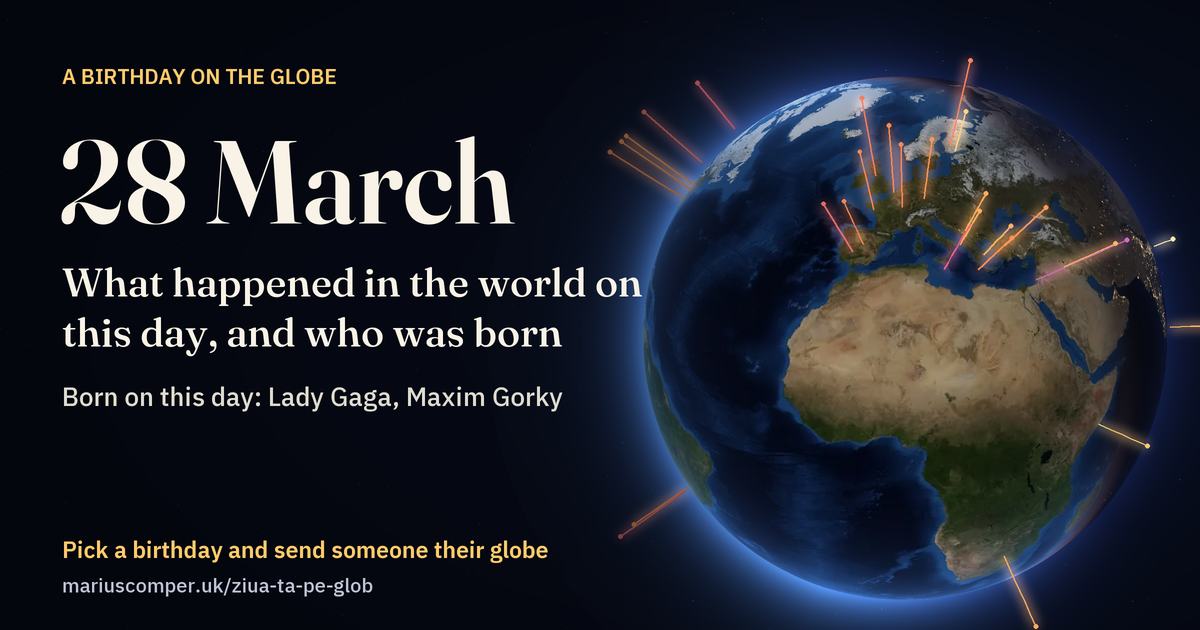
For 28 March, the English Wikipedia lists 50 events and 178 births. 28 of the events stand at their places as rays of light; three more are dashed circles, where the sentence links only to a country or a sea. The taller the ray, the longer ago it happened. The people born that day come further down, as blue points.
A birthday, yours or someone else’s:
Turn it into a greetingScroll: the globe turns to each place
The day you were born, on the globe.
Three things from your day
Scroll: your day first, then 28 March through the years
The Earth on 28 March
The picture on the globe was assembled by NASA from satellite photographs taken in March 2004: the snow, the ice and the green are those of the month.
On 28 March the Sun passes straight overhead at noon along the parallel of 3.2° north. In London, the day lasts about 12 hours 45 minutes.
Beyond 87° north the Sun no longer sets; beyond 87° south it no longer rises.
The line between day and night is tilted on the globe exactly as on this day of the year. On the dark side you can see the lights of towns.
Britain & Ireland · Keswick School of Industrial Art
1902
The Hexham Abbey high-altar cross, amongst the most important works produced that year by the Keswick School of Industrial Art, was unveiled on Good Friday.
On the map: Keswick School of Industrial Art.
Europe · Athens International Airport
2001
Athens International Airport Eleftherios Venizelos begins operation.
On the map: Athens International Airport.
North America · Presidio of San Francisco
1776
Juan Bautista de Anza finds the site for the Presidio of San Francisco.
On the map: Presidio of San Francisco.
North America · Supreme Court of the United States
1978
The US Supreme Court hands down 5–3 decision in Stump v. Sparkman, a controversial case involving involuntary sterilization and judicial immunity.
On the map: Supreme Court of the United States.
28 March
What the other Wikipedias remember#
For these years the English list has nothing on this day. The events below come from the same day’s lists on Wikipedia in Chinese and Romanian and were translated for this page.
From Wikipedia in Chinese · Supreme Court of the United States
1898
The United States Supreme Court rules in United States v. Wong Kim Ark, holding that all persons born within the United States are United States citizens.
On the map: Supreme Court of the United States.
Translated from the list on Wikipedia in Chinese.
From Wikipedia in Romanian · Constantinople
1930
The Turkish cities of Constantinople and Angora change their names to Istanbul and Ankara respectively.
On the map: Constantinople.
Translated from the list on Wikipedia in Romanian.
From Wikipedia in Chinese · Taipei Metro
1996
The Muzha Line of the Taipei Metro formally opens to service, as the first metro line in Taiwan.
On the map: Taipei Metro.
Translated from the list on Wikipedia in Chinese.
28 March
Born on 28 March#
The English Wikipedia lists 178 births for this day. The blue points are the birthplaces of 60 of these people: those written about in the most Wikipedia editions, where Wikidata gives a place of birth.
Born on 28 March
1986
Lady Gaga, American singer-songwriter and actress
Place of birth: Lenox Hill Hospital.
Born on 28 March
1868
Maxim Gorky, Russian novelist, short story writer, and playwright (died 1936)
Place of birth: Nizhny Novgorod.
Born on 28 March
1930
Jerome Isaac Friedman, American physicist and academic, Nobel Prize laureate
Place of birth: Chicago.
Born on 28 March
1942
Daniel Dennett, American philosopher and academic (died 2024)
Born on 28 March
1985
Stanislas Wawrinka, Swiss tennis player
Place of birth: Lausanne.
Born in Britain and Ireland
1921
Dirk Bogarde, English actor and author (died 1999)
Place of birth: West Hampstead.
Born in Britain and Ireland
1942
Mike Newell, English director and producer
Place of birth: St Albans.
Born in Britain and Ireland
1902
Flora Robson, English actress (died 1984)
Place of birth: South Shields.
28 March
Number one in the charts that week
At the cinema
An animal recorded that day
The record can be seen in GBIF, which brings together wildlife records from around the world.
All your birthdays
The weather that day
Data: Met Office Hadley Centre (HadCET); NOAA (GHCN-Daily, Mauna Loa).
Above the Earth
Sources: Jonathan McDowell, GCAT (launches); GFZ Potsdam (Kp index). Days are counted in Universal Time.
Football that day
International matches played that day:
Source: the “International football results” dataset kept by Mart Jürisoo (CC0).
Also that day
The earthquake’s page at the USGS
Source: the USGS catalogue. The day is counted in Universal Time (UTC).
In those days
Make a link for someone
Type the name, pick the day and the year of birth. The link opens straight on their day, with their name in the greeting.
The link carries the name, date and place typed here; anyone who gets it can see them.
Put another birthday beside it
Your mother’s, your child’s, a friend’s: the two days appear side by side.
Below: 28 March through the years.
The whole globe of the day
Drag the globe to turn it. Touch a ray or a point to read what happened there.
Everything Wikipedia lists for 28 March
The list is the English Wikipedia’s, in its own wording, as it stood in October 2026. 19 events have no place on the map: the sentence links to no place with coordinates, only to places too wide to mark, or to several countries.
- 37
Roman emperor Caligula accepts the titles of the Principate, bestowed on him by the Senate.
no place on the mapWikipedia: Roman emperor - 193
After assassinating the Roman Emperor Pertinax, his Praetorian Guards auction off the throne to Didius Julianus.
no place on the mapWikipedia: Assassination - 364
Roman Emperor Valentinian I appoints his brother Flavius Valens co-emperor.
no place on the mapWikipedia: Valentinian I - 1065
The Great German Pilgrimage, which had been under attack by Bedouin bandits for three days, is rescued by the Fatimid governor of Ramla.
Asia · RamlaWikipedia: Great German Pilgrimage of 1064–65 - 1566
The foundation stone of Valletta, Malta's capital city, is laid by Jean Parisot de Valette, Grand Master of the Sovereign Military Order of Malta.
Europe · VallettaWikipedia: Valletta - 1646
Irish Confederate Wars: Donough MacCarty, 1st Earl of Clancarty, signed the First Ormond Peace for the Confederates in exchange for greater freedom of religion.
Britain & Ireland · Confederate IrelandWikipedia: Irish Confederate Wars - 1745
War of the Austrian Succession: In the Battle of Vilshofen, Austrian forces defeat French forces.
no place on the mapWikipedia: War of the Austrian Succession - 1776
Juan Bautista de Anza finds the site for the Presidio of San Francisco.
North America · Presidio of San FranciscoWikipedia: Juan Bautista de Anza - 1795
Partitions of Poland: The Duchy of Courland and Semigallia, a northern fief of the Polish–Lithuanian Commonwealth, ceases to exist and becomes part of Imperial Russia.
no place on the mapWikipedia: Partitions of Poland - 1801
Treaty of Florence is signed, ending the war between the French Republic and the Kingdom of Naples.
no place on the mapWikipedia: Treaty of Florence - 1802
Heinrich Wilhelm Matthäus Olbers discovers 2 Pallas, the second asteroid ever to be discovered.
no place on the mapWikipedia: Heinrich Wilhelm Matthias Olbers - 1809
Peninsular War: France defeats Spain in the Battle of Medellín.
Europe · Battle of MedellínWikipedia: Battle of Medellín - 1814
War of 1812: In the Battle of Valparaíso, two American naval vessels are captured by two Royal Navy vessels.
Latin America · ValparaísoWikipedia: Battle of Valparaíso - 1842
First concert of the Vienna Philharmonic Orchestra, conducted by Otto Nicolai.
no place on the mapWikipedia: Vienna Philharmonic - 1854
Crimean War: France and Britain declare war on Russia.
no place on the mapWikipedia: Crimean War - 1860
First Taranaki War: The Battle of Waireka begins.
Oceania · Taranaki RegionWikipedia: First Taranaki War - 1862
American Civil War: In the Battle of Glorieta Pass, Union forces stop the Confederate invasion of the New Mexico Territory. The battle began on March 26.
North America · Battle of Glorieta PassWikipedia: American Civil War - 1902
The Hexham Abbey high-altar cross, amongst the most important works produced that year by the Keswick School of Industrial Art, was unveiled on Good Friday.
Britain & Ireland · Keswick School of Industrial ArtWikipedia: Hexham Abbey high-altar cross - 1910
Henri Fabre becomes the first person to fly a seaplane, the Fabre Hydravion, after taking off from water runway Étang le Barre, near Marseille.
no place on the mapWikipedia: Fabre Hydravion - 1918
Finnish Civil War: On the so-called "Bloody Maundy Thursday of Tampere", the Whites force the Reds to attack the city center, where the city's fiercest battles being fought in Kalevankangas with large casualties on both sides. During the same day, an explosion at the Red headquarters of Tampere kills several commanders.
Europe · TampereWikipedia: Finnish Civil War - 1918
General John J. Pershing, during World War I, cancels 42nd 'Rainbow' Division's orders to Rolampont for further training and diverted it to the occupy the Baccarat sector. Rainbow Division becomes "the first American division to take over an entire sector on its own, which it held longer than any other American division-occupied sector alone for a period of three months".
Europe · RolampontWikipedia: World War I - 1920
Palm Sunday tornado outbreak of 1920 affects the Great Lakes region and Deep South states.
North America · Great LakesWikipedia: 1920 Palm Sunday tornado outbreak - 1933
The Imperial Airways biplane City of Liverpool is believed to be the first airliner lost to sabotage when a passenger sets a fire on board.
Europe · 1933 Imperial Airways Diksmuide crashWikipedia: 1933 Imperial Airways Diksmuide crash - 1935
The Nazi propaganda film Triumph of the Will, directed by Leni Riefenstahl, premiered in Berlin.
no place on the mapWikipedia: Propaganda in Nazi Germany - 1939
Spanish Civil War: Generalissimo Francisco Franco conquers Madrid after a three-year siege.
Europe · MadridWikipedia: Spanish Civil War - 1941
World War II: First day of the Battle of Cape Matapan in Greece between the navies of the United Kingdom and Australia, and the Royal Italian navy.
Europe · Battle of Cape MatapanWikipedia: World War II - 1942
World War II: A British combined force permanently disables the Louis Joubert Lock in Saint-Nazaire in order to keep the German battleship Tirpitz away from the mid-ocean convoy lanes.
Europe · St Nazaire RaidWikipedia: St Nazaire Raid - 1946
Cold War: The United States Department of State releases the Acheson–Lilienthal Report, outlining a plan for the international control of nuclear power.
no place on the mapWikipedia: Cold War - 1959
The State Council of the People's Republic of China dissolves the government of Tibet.
no place on the mapWikipedia: History of Tibet - 1961
ČSA Flight 511 crashes in Igensdorf, Germany, killing 52.
Europe · ČSA Flight 511Wikipedia: ČSA Flight 511 - 1963
Civil rights movement: Over one hundred high school students conduct a sit-in protest in Rome, Georgia.
North America · Rome sit-insWikipedia: Civil rights movement - 1965
An Mw 7.4 earthquake in Chile sets off a series of tailings dam failures, burying the town of El Cobre and killing at least 500 people.
Latin America · 1965 La Ligua earthquakeWikipedia: 1965 La Ligua earthquake - 1968
Brazilian high school student Edson Luís de Lima Souto is killed by military police at a student protest.
no place on the mapWikipedia: Edson Luís de Lima Souto - 1968
Colonel Sun, written by Kingsley Amis, was published, becoming the first James Bond novel published after the death of Ian Fleming in 1964.
no place on the mapWikipedia: Colonel Sun - 1969
Greek poet and Nobel Prize laureate Giorgos Seferis makes a famous statement on the BBC World Service opposing the junta in Greece.
no place on the mapWikipedia: Nobel Prize in Literature - 1970
An earthquake strikes western Turkey at about 23:05 local time, killing 1,086 and injuring at least 1,200.
Asia · 1970 Gediz earthquakeWikipedia: 1970 Gediz earthquake - 1978
The US Supreme Court hands down 5–3 decision in Stump v. Sparkman, a controversial case involving involuntary sterilization and judicial immunity.
North America · Supreme Court of the United StatesWikipedia: Supreme Court of the United States - 1979
A coolant leak at the Three Mile Island's Unit 2 nuclear reactor outside Harrisburg, Pennsylvania leads to the core overheating and a partial meltdown.
North America · Three Mile Island accidentWikipedia: Three Mile Island accident - 1979
The British House of Commons passes a vote of no confidence against James Callaghan's government by one vote, precipitating a general election.
no place on the mapWikipedia: 1979 United Kingdom general election - 1990
United States President George H. W. Bush posthumously awards Jesse Owens the Congressional Gold Medal.
no place on the mapWikipedia: George H. W. Bush - 1994
In South Africa, African National Congress security guards kill dozens of Inkatha Freedom Party protesters.
Africa · Shell House massacreWikipedia: Shell House massacre - 1997
In the Tragedy of Otranto, the Italian Navy vessel Sibilla collided with the Albanian civilian vessel Kateri i Radës, causing the latter to sink and leading to dozens of deaths.
Europe · Tragedy of OtrantoWikipedia: Tragedy of Otranto - 1999
Kosovo War: Serb paramilitary and military forces kill at least 130 Kosovo Albanians in Izbica.
Europe · Izbica massacreWikipedia: Kosovo War - 2001
Athens International Airport Eleftherios Venizelos begins operation.
Europe · Athens International AirportWikipedia: Athens International Airport - 2003
In a friendly fire incident, two American A-10 Thunderbolt II aircraft attack British tanks participating in the 2003 invasion of Iraq, killing one soldier.
Asia · 190th Fighter Squadron, Blues and Royals friendly fire incidentWikipedia: 190th Fighter Squadron, Blues and Royals friendly fire incident - 2005
An earthquake shakes northern Sumatra with a magnitude of 8.6 and killing over 1000 people.
Asia · 2005 Nias–Simeulue earthquakeWikipedia: 2005 Nias–Simeulue earthquake - 2006
At least one million union members, students and unemployed take to the streets in France in protest at the government's proposed First Employment Contract law.
no place on the mapWikipedia: 2006 youth protests in France - 2015
A siege of a hotel in Mogadishu by al-Shabaab militants, which began the previous day and killed at least 20 people, ended with the Somali Armed Forces recapturing the premises.
Africa · 2015 Makka al-Mukarama hotel attackWikipedia: 2015 Makka al-Mukarama hotel attack - 2020
The region of Uusimaa (with the capital city Helsinki) is temporarily isolated from the rest of Finland due to increased COVID-19 infections.
Europe · HelsinkiWikipedia: 2020 Uusimaa lockdown - 2025
An earthquake strikes close to Mandalay, Myanmar with a magnitude of 7.7, killing over 5400 people.
Asia · 2025 Myanmar earthquakeWikipedia: 2025 Myanmar earthquake
What the other Wikipedias remember
For these years the English list has nothing on this day. The events below come from the same day’s lists on Wikipedia in Chinese and Romanian and were translated for this page.
- 1898
The United States Supreme Court rules in United States v. Wong Kim Ark, holding that all persons born within the United States are United States citizens.
North America · Supreme Court of the United StatesTranslated from the list on Wikipedia in ChineseWikipedia: 美国最高法院 - 1930
The Turkish cities of Constantinople and Angora change their names to Istanbul and Ankara respectively.
- 1996
The Muzha Line of the Taipei Metro formally opens to service, as the first metro line in Taiwan.
Who was born on 28 March
In order of how many Wikipedia editions have an article about each. The first 60 of 178 are shown.
- 1986
Lady Gaga, American singer-songwriter and actress
Lenox Hill HospitalWikipedia: Lady Gaga - 1868
Maxim Gorky, Russian novelist, short story writer, and playwright (died 1936)
Nizhny NovgorodWikipedia: Maxim Gorky - 1936
Mario Vargas Llosa, Peruvian writer and politician, Nobel Prize laureate (died 2025)
ArequipaWikipedia: Mario Vargas Llosa - 1945
Rodrigo Duterte, Filipino politician, 16th President of the Philippines
- 1515
Teresa of Ávila, Spanish nun and saint (died 1582)
- 1592
John Amos Comenius, Czech bishop and educator (died 1670)
Uherský BrodWikipedia: John Amos Comenius - 1928
Zbigniew Brzezinski, Polish-American political activist and analyst; United States National Security Advisor (died 2017)
- 1862
Aristide Briand, French politician, Prime Minister of France, Nobel Prize laureate (died 1932)
- 1959
Laura Chinchilla, Costa Rican politician, 46th President of Costa Rica
San JoséWikipedia: Laura Chinchilla - 1930
Jerome Isaac Friedman, American physicist and academic, Nobel Prize laureate
- 1942
Daniel Dennett, American philosopher and academic (died 2024)
- 1985
Stanislas Wawrinka, Swiss tennis player
LausanneWikipedia: Stan Wawrinka - 1955
Reba McEntire, American singer-songwriter and actress
McAlesterWikipedia: Reba McEntire - 1970
Vince Vaughn, American actor
MinneapolisWikipedia: Vince Vaughn - 1925
Innokenty Smoktunovsky, Russian actor (died 1994)
TatyanovkaWikipedia: Innokenty Smoktunovsky - 1928
Alexander Grothendieck, German-French mathematician and theorist (died 2014)
- 1981
Julia Stiles, American actress
New York CityWikipedia: Julia Stiles - 1948
Dianne Wiest, American actress
Kansas CityWikipedia: Dianne Wiest - 1985
Steve Mandanda, French footballer
KinshasaWikipedia: Steve Mandanda - 1914
Bohumil Hrabal, Czech author (died 1997)
Brno-ŽideniceWikipedia: Bohumil Hrabal - 1892
Corneille Heymans, Belgian physiologist and academic, Nobel Prize laureate (died 1968)
- 1960
José Maria Neves, Cape Verdeian politician, 4th Prime Minister of Cape Verde
Santa CatarinaWikipedia: José Maria Neves - 1750
Francisco de Miranda, Venezuelan general and politician (died 1816)
- 1946
Alejandro Toledo, Peruvian economist and politician, President of Peru
- 1910
Ingrid of Sweden, Queen of Denmark (died 2000)
Stockholm PalaceWikipedia: Ingrid of Sweden - 1472
Fra Bartolomeo, Italian painter (died 1517)
- 1921
Dirk Bogarde, English actor and author (died 1999)
West HampsteadWikipedia: Dirk Bogarde - 1973
Björn Kuipers, Dutch footballer and referee
OldenzaalWikipedia: Björn Kuipers - 1994
Jackson Wang, Hong Kong rapper
Hong KongWikipedia: Jackson Wang - 1912
Marina Raskova, Russian pilot and navigator (died 1943)
- 1953
Melchior Ndadaye, Burundian banker and politician, 4th President of Burundi (died 1993)
BurundiWikipedia: Melchior Ndadaye - 1969
Brett Ratner, American director and producer
Miami BeachWikipedia: Brett Ratner - 1975
Iván Helguera, Spanish footballer
SantanderWikipedia: Iván Helguera - 1914
Edmund Muskie, American politician, 64th Governor of Maine, 58th United States Secretary of State (died 1996)
RumfordWikipedia: Edmund Muskie - 1942
Mike Newell, English director and producer
St AlbansWikipedia: Mike Newell - 1986
Barbora Strýcová, Czech tennis player
- 1727
Maximilian III Joseph, Elector of Bavaria, (died 1777)
- 1897
Sepp Herberger, German footballer and manager (died 1977)
MannheimWikipedia: Sepp Herberger - 1944
Rick Barry, American basketball player
ElizabethWikipedia: Rick Barry - 1943
Conchata Ferrell, American actress (died 2020)
CharlestonWikipedia: Conchata Ferrell - 1946
Henry Paulson, American banker and politician, 74th United States Secretary of the Treasury
Palm BeachWikipedia: Henry Paulson - 1990
Laura Harrier, American actress and model
ChicagoWikipedia: Laura Harrier - 1902
Flora Robson, English actress (died 1984)
South ShieldsWikipedia: Flora Robson - 1909
Nelson Algren, American novelist and short story writer (died 1981)
DetroitWikipedia: Nelson Algren - 1851
Bernardino Machado, Portuguese academic and politician, 3rd President of Portugal (died 1944)
Rio de JaneiroWikipedia: Bernardino Machado - 1942
Neil Kinnock, Welsh politician, Vice-President of the European Commission
TredegarWikipedia: Neil Kinnock - 1895
Christian Herter, American politician, United States Secretary of State (died 1966)
- 1935
Józef Szmidt, Polish triple jumper (died 2024)
MiechowiceWikipedia: Józef Szmidt - 1968
Iris Chang, Chinese-American journalist and author (died 2004)
PrincetonWikipedia: Iris Chang - 1973
Umaga, American Samoan wrestler (died 2009)
San FranciscoWikipedia: Umaga - 1924
Freddie Bartholomew, American actor (died 1992)
- 1940
Luis Cubilla, Uruguayan footballer and coach (died 2013)
- 1840
Emin Pasha, German-Jewish Egyptian physician and politician (died 1892)
- 1894
Ernst Lindemann, German captain (died 1941)
AltenkirchenWikipedia: Ernst Lindemann - 1984
Christopher Samba, Congolese footballer
CréteilWikipedia: Christopher Samba - 1992
Sergi Gómez, Spanish footballer
Arenys de MarWikipedia: Sergi Gómez - 1903
Rudolf Serkin, Czech-American pianist and educator (died 1991)
- 1946
Wubbo Ockels, Dutch physicist and astronaut (died 2014)
AlmeloWikipedia: Wubbo Ockels - 1987
Yohan Benalouane, French-Tunisian footballer
Bagnols-sur-CèzeWikipedia: Yohan Benalouane - 1890
Paul Whiteman, American violinist, composer, and bandleader (died 1967)
DenverWikipedia: Paul Whiteman
What is celebrated on 28 March
- Christian feast day: Christopher Wharton
- Christian feast day: Jeanne-Marie de Maille
- Christian feast day: Józef Sebastian Pelczar
- Christian feast day: Priscus
- Christian feast day: Pope Sixtus III
- Christian feast day: Stephen Harding
- Christian feast day: March 28 (Eastern Orthodox liturgics)
- Serfs Emancipation Day (Tibet)
- Teachers' Day (Czech Republic and Slovakia)
A greeting link for someone
Type a name and, if you like, the year of birth. The link opens with a greeting, and beside each event it says how old the person turned that day, or how many years before their birth it happened.
The name and the year go only into the link you send.
All 366 days
How the globe is made
Where the events come from
Each edition of this page uses the day’s list from Wikipedia in its own language: Romanian, English, Spanish, Chinese. The lists are written by volunteers and differ from one edition to the next; the text of each event is Wikipedia’s, with a link to the article. A row that appears twice in a list is shown once. The lists have not been checked event by event: they are Wikipedia’s, mistakes included.
For events before 1582, and for countries that moved to the Gregorian calendar later (Britain in 1752, Russia in 1918), the same day may be counted Old Style in one list and New Style in another.
The chapter “What the other Wikipedias remember” adds up to five events a day from the lists of the other three editions, only for years in which the English list has nothing on that day. They were translated for this page, passed the same filters as the tour, and are not counted among the events of the English list.
How an event gets onto the map
The place comes from Wikidata. If the sentence links to the article about the event itself (a battle, an opening, an earthquake), dated to the same year, the ray stands on its coordinates or on those of its location. Otherwise it stands on the first place the sentence links to: a town, a building, a mountain, an island. This second step can be wrong: sometimes the sentence only mentions the place. That is why the page says, under each event, which place the ray stands on.
When the sentence links to a single state or province, or to a single sea, lake or desert larger than 5,000 km², the globe shows a dashed circle, not a ray. The circle has the area Wikidata gives, with its radius kept between 1.2° and 16°, or a radius of 4.5° when Wikidata gives no area; it says only that the sentence links to that place. Organisations, ships, spacecraft, museum objects, rivers, mountain ranges, languages and continents are never used as places. When a sentence names several states and no exact place, the event stays in the list only.
What the height means
The height of a ray shows how many years have passed, on a logarithmic scale: 10 years, 100 years and 1,000 years are equal steps apart; anything older than about 2,600 years has the tallest ray. The colour runs from pale yellow for recent years to violet for antiquity.
Where the tour stops
In each region the tour stops at up to three events (five in Britain and Ireland), chosen mainly by three things: whether Wikipedia’s editors put the event in the “On this day” box of their main page (the English, Spanish and Chinese editions), how many Wikipedia editions have an article about it, and how many of the four lists include it. Events whose sentence or article is about a war, an attack, a crime or a disaster are left out of the tour; they stay in the whole list, in Wikipedia’s wording. The filter is a list of words and a list of Wikidata types, so it can miss some.
The tour of births names the people with articles in the most editions and leaves aside those whom the list or Wikidata describes as rulers, politicians, commanders, leaders of movements or criminals; they stay in the list.
The Earth and the Sun
The daytime images are NASA’s Blue Marble Next Generation mosaics, one for each month of 2004; the night side is Black Marble 2016. The tilt of the line between day and night is computed for the day; the hour is chosen so that the place being read is in daylight. The latitude where the Sun stands overhead is the average of the four years of the leap cycle; in a given year it can differ by up to 0.4°.
The day you were born
The number ones come from the weekly lists on Wikipedia: Billboard for the United States (from 1940; the Hot 100 from August 1958), the UK Singles Chart (from November 1952), Los 40 Principales for Spain (from July 1966) and, for Romania, the Romanian Top 100 and Airplay 100 (2001–2021, with missing weeks). The page shows the chart of the week in which the day of birth falls, with its date; Billboard and the UK chart are dated at the end of their week. For Romania before 2001 and for China these sources have no weekly chart.
The films are those that reached cinemas in the United States up to ten days before or three days after that day (some of them in a few cinemas at first), from the English Wikipedia’s yearly lists (from 1968), in order of how many editions have an article about them. The events “in those days” are the ones on the neighbouring days’ lists that carry the year of birth, passed through the same filter as the tour.
The day of birth, year included
The Moon, the star sign and the constellation are worked out by the page itself, for noon Universal Time on the day. The lit part of the Moon is rounded and can differ by a few per cent from that at the hour of birth. The sign follows the usual zodiac of twelve equal parts starting at the March equinox; the constellation is the one the Sun actually stood in front of, by the borders set by the International Astronomical Union, and within a day of a border the page does not name it. When the Sun changes sign while it is that day anywhere on Earth, the page gives the moment of crossing, rounded to ten minutes and accurate to within about a quarter of an hour, and the clock time in a few cities, with the time zone and summer time of that year.
The year in the Chinese calendar is the one your device’s own calendar gives for the date, checked against the Hong Kong Observatory’s tables. “All your birthdays” uses the same sources as the rest of the chapter for the same day in every year since the birth: the temperature, well-known launches that took place on that very day, matches of the teams the edition follows, snow deeper than 10 cm and strong geomagnetic storms. The three things at the top and the four on the picture are chosen in a fixed order (the song, the animal, a full Moon, a well-known launch before an ordinary earthquake); on the picture you can change them.
When the link carries a year of birth, the page adds a few things about that exact day. The weather is the Met Office’s Central England temperature record and the readings from New York’s Central Park; the “usual high” is the average of the daily highs of 1961–1990 for that date, with two days either side. The carbon dioxide figure is the monthly mean at the Mauna Loa observatory, where measurements begin in March 1958.
The earthquake is the one with the largest magnitude in the USGS catalogue for that day, counted in Universal Time. Before the 1960s the catalogue has gaps even above magnitude 5.5, so in the older years many days have no earthquake. The page gives only the magnitude and the place: the country the epicentre falls in or, when the epicentre is at sea within 300 km of a coast, the nearest country; farther out, only the ocean.
The launches are those that reached orbit or left for the Moon and the planets, from Jonathan McDowell’s GCAT catalogue. If nothing left that day, the page shows the nearest launch within three days before or after, and says how many days away it was. The geomagnetic storm appears only when the Kp index reached at least 5 in one of the day’s eight three-hour intervals.
The animal comes from GBIF: an observation made by a person (the animal seen or heard, or its tracks), dated to that exact day, with coordinates and a CC0 or CC BY licence. Only a few hundred well-known species are searched (mammals, birds, turtles, butterflies); of those noted that day, mammals and species with articles in many Wikipedia editions come first; birds noted almost every day, and species used recently, wait their turn. Observations dated 1 January are left out, because records without a day are often filed there. An observation shows that the animal was recorded there, not how many animals there were.
The matches are those between national teams. Only matches of England, Scotland, Wales, Northern Ireland, the Republic of Ireland, the United States, Canada and Australia are shown, along with those at the big final tournaments. The picture to send is drawn in the page from the day’s globe and the facts above, and stays on your device until you send it.
Sources
- Events, births and holidays: the day’s page on Wikipedia, text under CC BY-SA 4.0.
- Coordinates, places of birth and the number of editions: Wikidata (CC0).
- The Earth by day: NASA Blue Marble Next Generation. The Earth by night: NASA Black Marble 2016.
- Borders and regions: Natural Earth.
- World population and births per year: UN World Population Prospects 2024.
- Charts and films: Wikipedia’s lists for Billboard, the UK Singles Chart, Los 40 Principales, Romanian Top 100, Airplay 100 and American films by year (CC BY-SA 4.0).
- Weather: Met Office Hadley Centre, HadCET (Open Government Licence) and NOAA GHCN-Daily, New York Central Park. Carbon dioxide: NOAA Global Monitoring Laboratory, Mauna Loa.
- Earthquakes: the USGS catalogue. Launches: Jonathan McDowell, GCAT (CC BY). Kp index: GFZ Potsdam (CC BY 4.0). Matches: International football results, Mart Jürisoo (CC0).
- Animal observations: GBIF, with a link to each record; species names come from Wikidata.