A birthday on the globe
26 March on the globe: what happened in the world on this day, and who was born
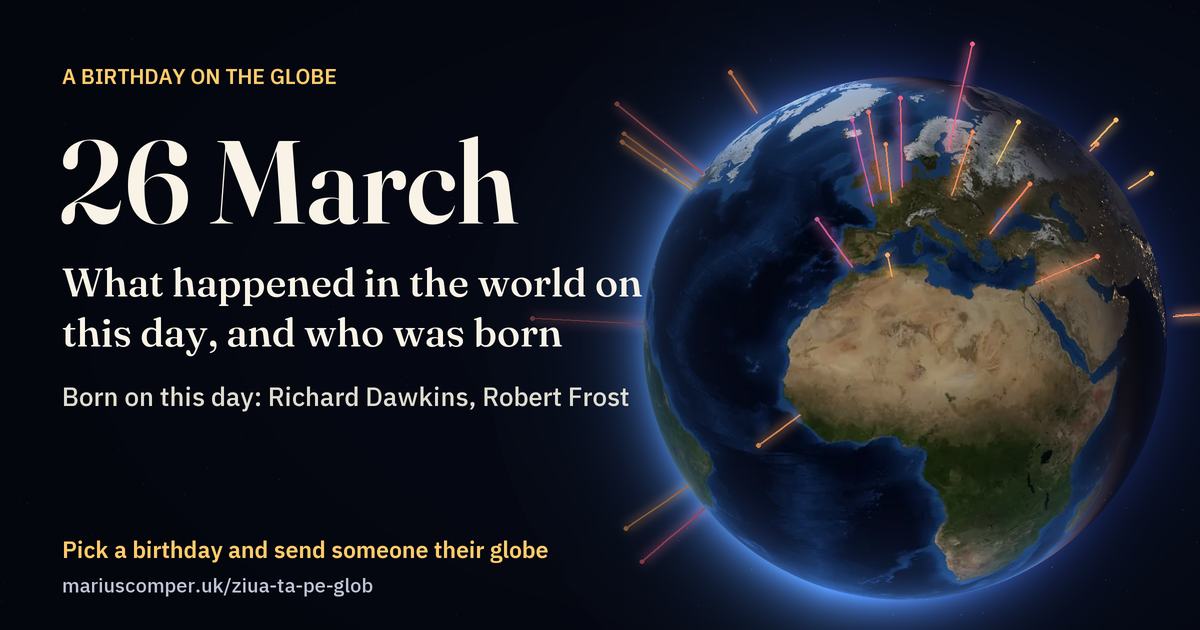
For 26 March, the English Wikipedia lists 59 events and 261 births. 28 of the events stand at their places as rays of light; eight more are dashed circles, where the sentence links only to a country or a sea. The taller the ray, the longer ago it happened. The people born that day come further down, as blue points.
A birthday, yours or someone else’s:
Turn it into a greetingScroll: the globe turns to each place
The day you were born, on the globe.
Three things from your day
Scroll: your day first, then 26 March through the years
The Earth on 26 March
The picture on the globe was assembled by NASA from satellite photographs taken in March 2004: the snow, the ice and the green are those of the month.
On 26 March the Sun passes straight overhead at noon along the parallel of 2.4° north. In London, the day lasts about 12 hours 35 minutes.
Beyond 88° north the Sun no longer sets; beyond 88° south it no longer rises.
The line between day and night is tilted on the globe exactly as on this day of the year. On the dark side you can see the lights of towns.
Britain & Ireland · Henley Royal Regatta
1839
The first Henley Royal Regatta is held.
On the map: Henley Royal Regatta.
Europe · Utrecht University
1636
Utrecht University is founded in the Netherlands.
On the map: Utrecht University.
Europe · Royal Academy of Turku
1640
The Royal Academy of Turku, the first university of Finland, is founded in the city of Turku by Queen Christina of Sweden at the proposal of Count Per Brahe.
On the map: Royal Academy of Turku.
Europe · Paris
1958
The African Regroupment Party is launched at a meeting in Paris.
On the map: Paris.
Asia · Taipei
2005
Around 200,000 to 300,000 Taiwanese demonstrate in Taipei in opposition to the Anti-Secession Law of China.
On the map: Taipei.
Latin America · Asunción
1991
Argentina, Brazil, Uruguay and Paraguay sign the Treaty of Asunción, establishing Mercosur, the South Common Market.
On the map: Asunción.
Also on the day’s list of Wikipedia in Spanish.
North America · Palmyra, New York
1830
The Book of Mormon is published in Palmyra, New York.
On the map: Palmyra, New York.
North America · New York City
1967
Ten thousand people gather for one of many Central Park be-ins in New York City.
On the map: New York City.
North America · White House
1979
Anwar al-Sadat, Menachem Begin and Jimmy Carter sign the Egypt–Israel peace treaty in Washington, D.C.
On the map: White House.
Also on the day’s list of Wikipedia in Spanish.
26 March
What the other Wikipedias remember#
For these years the English list has nothing on this day. The events below come from the same day’s lists on Wikipedia in Spanish and Romanian and were translated for this page.
From Wikipedia in Spanish · Bilbao
1901
In Bilbao, the Banco de Vizcaya is founded.
On the map: Bilbao.
Translated from the list on Wikipedia in Spanish.
From Wikipedia in Romanian · Schengen Agreement
1995
The Schengen Agreement enters into force for the first seven EU countries, under which the signatory countries refrain from controlling the movement of goods and persons at their common borders.
On the map: Schengen Agreement.
Translated from the list on Wikipedia in Romanian.
The article on Wikipedia in Romanian: Acordul de la Schengen
From Wikipedia in Spanish · The O2 Arena
2022
At the O2 Arena in London, Phil Collins announces his retirement from music, giving his last concert with the band Genesis.
On the map: The O2 Arena.
Translated from the list on Wikipedia in Spanish.
26 March
Born on 26 March#
The English Wikipedia lists 261 births for this day. The blue points are the birthplaces of 60 of these people: those written about in the most Wikipedia editions, where Wikidata gives a place of birth.
Born on 26 March
1941
Richard Dawkins, Kenyan-English ethologist, biologist, and academic
Place of birth: Nairobi.
Born on 26 March
1874
Robert Frost, American poet and playwright (died 1963)
Place of birth: San Francisco.
Born on 26 March
1985
Keira Knightley, English actress
Place of birth: Teddington.
Born on 26 March
1973
Larry Page, American computer scientist and businessman, co-founder of Google
Place of birth: East Lansing.
Born on 26 March
1911
Tennessee Williams, American playwright and poet (died 1983)
Place of birth: Columbus.
Born in Britain and Ireland
1938
Anthony James Leggett, English-American physicist and academic, Nobel Prize laureate (died 2026)
Place of birth: Camberwell.
Born in Britain and Ireland
1970
Martin McDonagh, English-born Irish playwright, screenwriter, and director
Place of birth: London.
Born in Britain and Ireland
1911
J. L. Austin, English philosopher and academic (died 1960)
Place of birth: Lancaster.
26 March
Number one in the charts that week
At the cinema
An animal recorded that day
The record can be seen in GBIF, which brings together wildlife records from around the world.
All your birthdays
The weather that day
Data: Met Office Hadley Centre (HadCET); NOAA (GHCN-Daily, Mauna Loa).
Above the Earth
Sources: Jonathan McDowell, GCAT (launches); GFZ Potsdam (Kp index). Days are counted in Universal Time.
Football that day
International matches played that day:
Source: the “International football results” dataset kept by Mart Jürisoo (CC0).
Also that day
The earthquake’s page at the USGS
Source: the USGS catalogue. The day is counted in Universal Time (UTC).
In those days
Make a link for someone
Type the name, pick the day and the year of birth. The link opens straight on their day, with their name in the greeting.
The link carries the name, date and place typed here; anyone who gets it can see them.
Put another birthday beside it
Your mother’s, your child’s, a friend’s: the two days appear side by side.
Below: 26 March through the years.
The whole globe of the day
Drag the globe to turn it. Touch a ray or a point to read what happened there.
Everything Wikipedia lists for 26 March
The list is the English Wikipedia’s, in its own wording, as it stood in October 2026. 23 events have no place on the map: the sentence links to no place with coordinates, only to places too wide to mark, or to several countries.
- 590
Emperor Maurice proclaims his son Theodosius as co-emperor of the Byzantine Empire.
Asia · Byzantine EmpireWikipedia: Maurice - 624
First Eid al-Fitr celebration.
no place on the mapWikipedia: Eid al-Fitr - 752
Election of Pope Stephen II following the death of Pope Zachary.
no place on the mapWikipedia: Pope Stephen II - 1021
The death of the Fatimid caliph al-Hakim bi-Amr Allah, kept secret for six weeks, is announced, along with the succession of his son, al-Zahir li-i'zaz Din Allah.
no place on the mapWikipedia: Fatimid Caliphate - 1027
Pope John XIX crowns Conrad II as Holy Roman Emperor.
no place on the mapWikipedia: Pope John XIX - 1169
Saladin becomes the emir of Egypt.
Africa · EgyptWikipedia: Saladin - 1244
The crown of Aragon and the crown of Castile agree in the Treaty of Almizra on the limits of their respective expansion into al-Andalus.
no place on the mapWikipedia: Treaty of Almizra - 1344
The Siege of Algeciras, one of the first European military engagements where gunpowder was used, comes to an end.
Europe · Siege of AlgecirasWikipedia: Siege of Algeciras - 1351
Combat of the Thirty: Thirty Breton knights call out and defeat thirty English knights.
Europe · Combat of the ThirtyWikipedia: Combat of the Thirty - 1484
William Caxton prints his translation of Aesop's Fables.
no place on the mapWikipedia: William Caxton - 1552
Guru Amar Das becomes the Third Sikh guru.
no place on the mapWikipedia: Guru Amar Das - 1636
Utrecht University is founded in the Netherlands.
Europe · Utrecht UniversityWikipedia: Utrecht University - 1640
The Royal Academy of Turku, the first university of Finland, is founded in the city of Turku by Queen Christina of Sweden at the proposal of Count Per Brahe.
Europe · Royal Academy of TurkuWikipedia: Royal Academy of Turku - 1651
The silver-loaded Spanish ship San José, pushed south by strong winds, is wrecked on the coast of southern Chile and its surviving crew members are killed by indigenous Cuncos.
Latin America · Wreckage of San JoséWikipedia: Real Situado - 1697
Safavid government troops take control of Basra.
Asia · Safavid IranWikipedia: Safavid occupation of Basra - 1700
William Dampier is the first European to circumnavigate New Britain, discovering it is an island (which he names Nova Britannia) rather than part of New Guinea.
no place on the mapWikipedia: William Dampier - 1812
A political cartoon in the Boston-Gazette coins the term "gerrymander" to describe oddly shaped electoral districts designed to help incumbents win reelection.
no place on the mapWikipedia: Gerrymandering - 1812
An earthquake devastates Caracas, Venezuela.
Latin America · 1812 Caracas earthquakeWikipedia: 1812 Caracas earthquake - 1830
The Book of Mormon is published in Palmyra, New York.
North America · Palmyra, New YorkWikipedia: Book of Mormon - 1839
The first Henley Royal Regatta is held.
Britain & Ireland · Henley Royal RegattaWikipedia: Henley Royal Regatta - 1871
The elections of Commune council of the Paris Commune are held.
no place on the mapWikipedia: Paris Commune - 1873
A Dutch military expedition was launched to bombard Banda Aceh, the capital of the Aceh Sultanate in present-day Indonesia, beginning the Aceh War.
Asia · Aceh WarWikipedia: First Aceh Expedition - 1885
The Métis people of the District of Saskatchewan under Louis Riel begin the North-West Rebellion against Canada.
no place on the mapWikipedia: North-West Rebellion - 1896
An explosion at the Brunner Mine near Greymouth, New Zealand, kills 65 coal miners in the country's worst industrial accident.
Oceania · Brunner Mine disasterWikipedia: Brunner Mine disaster - 1913
First Balkan War: Bulgarian forces capture Adrianople.
Asia · Siege of AdrianopleWikipedia: First Balkan War - 1915
The Vancouver Millionaires win the 1915 Stanley Cup Final, the first championship played between the Pacific Coast Hockey Association and the National Hockey Association.
no place on the mapWikipedia: 1915 Stanley Cup Final - 1917
World War I: First Battle of Gaza: British troops are halted after 17,000 Turks block their advance.
Asia · First Battle of GazaWikipedia: World War I - 1922
The German Social Democratic Party is founded in Poland.
no place on the mapWikipedia: German Social Democratic Party - 1931
Ho Chi Minh Communist Youth Union is founded in Vietnam.
Asia · VietnamWikipedia: Ho Chi Minh Communist Youth Union - 1931
Swissair is founded as the national airline of Switzerland.
Europe · SwitzerlandWikipedia: Swissair - 1934
The United Kingdom driving test is introduced.
no place on the mapWikipedia: United Kingdom driving test - 1939
Spanish Civil War: Nationalists begin their final offensive of the war.
Europe · Francoist SpainWikipedia: Spanish Civil War - 1942
The American tanker Dixie Arrow is torpedoed and sunk off Cape Hatteras, North Carolina, by the German U-boat U-71.
North America · North CarolinaWikipedia: SS Dixie Arrow - 1942
The Holocaust: The first female prisoners arrive at Auschwitz concentration camp in German-occupied Poland.
Europe · Auschwitz concentration campWikipedia: The Holocaust - 1945
World War II: The Battle of Iwo Jima ends as the island is officially secured by American forces.
Oceans · Battle of Iwo JimaWikipedia: World War II - 1953
Jonas Salk announced the successful test of his polio vaccine on a small group of adults and children.
no place on the mapWikipedia: Jonas Salk - 1954
Nuclear weapons testing: The Romeo shot of Operation Castle is detonated at Bikini Atoll. Yield: 11 megatons.
Oceans · Castle RomeoWikipedia: Castle Romeo - 1955
Pan Am Flight 845/26 ditches in the Pacific Ocean off the coast of Oregon, killing four.
North America · Pan Am Flight 845/26Wikipedia: Pan Am Flight 845/26 - 1958
The African Regroupment Party is launched at a meeting in Paris.
Europe · ParisWikipedia: African Regroupment Party - 1958
The United States Army launches Explorer 3.
no place on the mapWikipedia: Explorer 3 - 1967
Ten thousand people gather for one of many Central Park be-ins in New York City.
North America · New York CityWikipedia: Central Park be-ins - 1970
South Vietnamese President Nguyễn Văn Thiệu implements a land reform program to solve the problem of land tenancy.
Asia · South VietnamWikipedia: South Vietnam - 1971
East Pakistan, then a province of Pakistan, declares its independence from Pakistan to form Bangladesh; the Bangladesh War of Independence begins.
no place on the mapWikipedia: Bangladesh Liberation War - 1974
A group of peasant women in Chamoli district, Uttarakhand, India, surrounded trees in order to prevent loggers from felling them, giving rise to the Chipko movement.
no place on the mapWikipedia: Chamoli district - 1975
The Biological Weapons Convention comes into force.
no place on the mapWikipedia: Biological Weapons Convention - 1979
An Interflug Ilyushin Il-18 crashes at Quatro de Fevereiro Airport during a rejected takeoff, killing 10.
Africa · 1979 Interflug Ilyushin Il-18 crashWikipedia: 1979 Interflug Ilyushin Il-18 crash - 1979
Anwar al-Sadat, Menachem Begin and Jimmy Carter sign the Egypt–Israel peace treaty in Washington, D.C.
North America · White HouseWikipedia: Egypt–Israel peace treaty - 1981
Social Democratic Party (UK) is founded as a party.
no place on the mapWikipedia: Social Democratic Party - 1982
A groundbreaking ceremony for the Vietnam Veterans Memorial is held in Washington, D.C.
North America · Vietnam Veterans MemorialWikipedia: Vietnam Veterans Memorial - 1991
Argentina, Brazil, Uruguay and Paraguay sign the Treaty of Asunción, establishing Mercosur, the South Common Market.
Latin America · AsunciónWikipedia: Treaty of Asunción - 1991
Singapore Airlines Flight 117 is hijacked by four Pakistani terrorists and diverted to Changi Airport.
Asia · Singapore Airlines Flight 117Wikipedia: Singapore Airlines Flight 117 - 1997
Thirty-nine bodies are found in the Heaven's Gate mass suicides.
no place on the mapWikipedia: Heaven's Gate - 1998
During the Algerian Civil War, the Oued Bouaicha massacre sees fifty-two people, mostly infants, killed with axes and knives.
Africa · Oued Bouaicha massacreWikipedia: Oued Bouaicha massacre - 1999
A jury began deliberations in the trial of Jack Kevorkian, an American practitioner of physician-assisted suicide who was charged with murder in the death of a terminally ill patient.
no place on the mapWikipedia: Jack Kevorkian - 2005
Around 200,000 to 300,000 Taiwanese demonstrate in Taipei in opposition to the Anti-Secession Law of China.
Asia · TaipeiWikipedia: Taiwan - 2009
A prototype of the Tesla Model S, one of the most influential electric cars in history, was unveiled.
no place on the mapWikipedia: Tesla Model S - 2010
The South Korean Navy corvette Cheonan is torpedoed, killing 46 sailors. After an international investigation, the President of the United Nations Security Council blames North Korea.
Asia · Sinking of ROKS CheonanWikipedia: Sinking of ROKS Cheonan - 2017
Russia-wide anti-corruption protests in 99 cities. The Levada Center survey showed that 38% of surveyed Russians supported protests and that 67 percent held Putin personally responsible for high-level corruption.
Europe · Levada CenterWikipedia: 2017–2018 Russian protests - 2024
The Francis Scott Key Bridge collapses following a collision between the MV Dali container ship and one of the bridge's support pillars, killing six people.
North America · Francis Scott Key Bridge collapseWikipedia: Francis Scott Key Bridge collapse
What the other Wikipedias remember
For these years the English list has nothing on this day. The events below come from the same day’s lists on Wikipedia in Spanish and Romanian and were translated for this page.
- 1901
In Bilbao, the Banco de Vizcaya is founded.
- 1995
The Schengen Agreement enters into force for the first seven EU countries, under which the signatory countries refrain from controlling the movement of goods and persons at their common borders.
Europe · Schengen AgreementTranslated from the list on Wikipedia in RomanianWikipedia: Acordul de la Schengen - 2022
At the O2 Arena in London, Phil Collins announces his retirement from music, giving his last concert with the band Genesis.
Britain & Ireland · The O2 ArenaTranslated from the list on Wikipedia in SpanishWikipedia: The O2 Arena
Who was born on 26 March
In order of how many Wikipedia editions have an article about each. The first 60 of 261 are shown.
- 1941
Richard Dawkins, Kenyan-English ethologist, biologist, and academic
NairobiWikipedia: Richard Dawkins - 1874
Robert Frost, American poet and playwright (died 1963)
San FranciscoWikipedia: Robert Frost - 1940
Nancy Pelosi, American lawyer and politician, 52nd Speaker of the United States House of Representatives
BaltimoreWikipedia: Nancy Pelosi - 1985
Keira Knightley, English actress
TeddingtonWikipedia: Keira Knightley - 1973
Larry Page, American computer scientist and businessman, co-founder of Google
East LansingWikipedia: Larry Page - 1911
Tennessee Williams, American playwright and poet (died 1983)
ColumbusWikipedia: Tennessee Williams - 1875
Syngman Rhee, South Korean journalist and politician, 1st President of South Korea (died 1965)
Pyongsan CountyWikipedia: Syngman Rhee - 1944
Diana Ross, American singer-songwriter, producer, and actress
DetroitWikipedia: Diana Ross - 1913
Paul Erdős, Hungarian-Polish mathematician and academic (died 1996)
BudapestWikipedia: Paul Erdős - 1905
Viktor Frankl, Austrian neurologist and psychiatrist (died 1997)
ViennaWikipedia: Viktor Frankl - 1931
Leonard Nimoy, American actor (died 2015)
West EndWikipedia: Leonard Nimoy - 1934
Alan Arkin, American actor (died 2023)
BrooklynWikipedia: Alan Arkin - 1940
James Caan, American actor and singer (died 2022)
The BronxWikipedia: James Caan - 1938
Anthony James Leggett, English-American physicist and academic, Nobel Prize laureate (died 2026)
CamberwellWikipedia: Anthony Leggett - 1982
Mikel Arteta, Spanish footballer
San SebastiánWikipedia: Mikel Arteta - 1948
Steven Tyler, American singer-songwriter and actor
New York CityWikipedia: Steven Tyler - 1949
Patrick Süskind, German author and screenwriter
- 1951
Carl Wieman, American physicist and academic, Nobel Prize laureate
CorvallisWikipedia: Carl Wieman - 1904
Joseph Campbell, American mythologist and author (died 1987)
White PlainsWikipedia: Joseph Campbell - 1942
Erica Jong, American novelist and poet
New York CityWikipedia: Erica Jong - 1925
Pierre Boulez, French pianist, composer, and conductor (died 2016)
MontbrisonWikipedia: Pierre Boulez - 1916
Christian B. Anfinsen, American biochemist and academic, Nobel Prize laureate (died 1995)
MonessenWikipedia: Christian B. Anfinsen - 1516
Conrad Gessner, Swiss botanist and zoologist (died 1565)
- 1911
Bernard Katz, German-English biophysicist, Nobel Prize laureate (died 2003)
LeipzigWikipedia: Bernard Katz - 1950
Martin Short, Canadian-American actor, screenwriter, and producer
HamiltonWikipedia: Martin Short - 1943
Bob Woodward, American journalist and author
GenevaWikipedia: Bob Woodward - 1989
Simon Kjær, Danish footballer
HorsensWikipedia: Simon Kjær - 1930
Sandra Day O'Connor, American lawyer and jurist (died 2023)
- 1893
Palmiro Togliatti, Italian journalist and politician, Italian Minister of Justice (died 1964)
- 1950
Alan Silvestri, American composer and conductor
ManhattanWikipedia: Alan Silvestri - 1972
Leslie Mann, American actress
San FranciscoWikipedia: Leslie Mann - 1868
King Fuad I of Egypt (died 1936)
- 1947
Subhash Kak, Indian-American professor and author
SrinagarWikipedia: Subhash Kak - 1962
John Stockton, American basketball player and coach
SpokaneWikipedia: John Stockton - 1970
Martin McDonagh, English-born Irish playwright, screenwriter, and director
- 1850
Edward Bellamy, American author, socialist, and utopian visionary (died 1898)
ChicopeeWikipedia: Edward Bellamy - 1911
J. L. Austin, English philosopher and academic (died 1960)
LancasterWikipedia: J. L. Austin - 1933
Tinto Brass, Italian director and screenwriter
- 1753
Benjamin Thompson, American-French physicist and politician, Under-Secretary of State for the Colonies (died 1814)
- 1976
Amy Smart, American actress and former model
Los AngelesWikipedia: Amy Smart - 1914
William Westmoreland, American general, commander during the Vietnam War (died 2005)
SpartanburgWikipedia: William Westmoreland - 1916
Sterling Hayden, American actor and author (died 1986)
MontclairWikipedia: Sterling Hayden - 1961
William Hague, English historian and politician, First Secretary of State
RotherhamWikipedia: William Hague - 1859
A. E. Housman, English poet and scholar (died 1936)
WorcestershireWikipedia: A. E. Housman - 1953
Elaine Chao, Taiwanese-American banker and politician, 24th United States Secretary of Labor
TaipeiWikipedia: Elaine Chao - 1966
Michael Imperioli, American actor and screenwriter
Mount VernonWikipedia: Michael Imperioli - 1985
Jonathan Groff, American actor and singer
LancasterWikipedia: Jonathan Groff - 1957
Shirin Neshat, Iranian visual artist
QazvinWikipedia: Shirin Neshat - 1687
Sophia Dorothea of Hanover, queen consort of Prussia (died 1757)
- 1898
Rudolf Dassler, German businessman, founded Puma SE (died 1974)
HerzogenaurachWikipedia: Rudolf Dassler - 1907
Mahadevi Varma, Indian poet and activist (died 1987)
FarrukhabadWikipedia: Mahadevi Varma - 1992
Stoffel Vandoorne, Belgian racing driver
KortrijkWikipedia: Stoffel Vandoorne - 1960
Jennifer Grey, American actress and dancer
New York CityWikipedia: Jennifer Grey - 1990
Xiumin, South Korean singer and actor
SeoulWikipedia: Xiumin - 1876
William of Wied, prince of Albania (died 1945)
- 1904
Emilio Fernández, Mexican actor, director, and screenwriter (died 1986)
Sabinas MunicipalityWikipedia: Emilio Fernández - 1908
Franz Stangl, Austrian-German SS officer, convicted Holocaust extermination camp commandant (died 1971)
AltmünsterWikipedia: Franz Stangl - 1881
Guccio Gucci, Italian fashion designer, founded Gucci (died 1953)
FlorenceWikipedia: Guccio Gucci - 1973
T. R. Knight, American actor
MinneapolisWikipedia: T. R. Knight - 1909
Héctor José Cámpora, former President of Argentina (died 1980)
MercedesWikipedia: Héctor José Cámpora
What is celebrated on 26 March
- Christian feast days: Barontius and Desiderius
- Christian feast days: Castulus
- Christian feast days: Emmanuel and companions
- Christian feast days: Felicitas
- Christian feast days: Harriet Monsell (Church of England)
- Christian feast days: Larissa
- Christian feast days: Ludger
- Christian feast days: Maddalena Caterina Morano
- Christian feast days: Richard Allen (Episcopal Church (USA))
- Christian feast days: March 26 (Eastern Orthodox liturgics)
- Independence Day and National Day (Bangladesh), celebrates the declaration of independence from Pakistan in 1971.
- Martyr's Day or Day of Democracy (Mali)
- National Science Appreciation Day (United States)
- Prince Kūhiō Day (Hawaii, United States)
A greeting link for someone
Type a name and, if you like, the year of birth. The link opens with a greeting, and beside each event it says how old the person turned that day, or how many years before their birth it happened.
The name and the year go only into the link you send.
All 366 days
How the globe is made
Where the events come from
Each edition of this page uses the day’s list from Wikipedia in its own language: Romanian, English, Spanish, Chinese. The lists are written by volunteers and differ from one edition to the next; the text of each event is Wikipedia’s, with a link to the article. A row that appears twice in a list is shown once. The lists have not been checked event by event: they are Wikipedia’s, mistakes included.
For events before 1582, and for countries that moved to the Gregorian calendar later (Britain in 1752, Russia in 1918), the same day may be counted Old Style in one list and New Style in another.
The chapter “What the other Wikipedias remember” adds up to five events a day from the lists of the other three editions, only for years in which the English list has nothing on that day. They were translated for this page, passed the same filters as the tour, and are not counted among the events of the English list.
How an event gets onto the map
The place comes from Wikidata. If the sentence links to the article about the event itself (a battle, an opening, an earthquake), dated to the same year, the ray stands on its coordinates or on those of its location. Otherwise it stands on the first place the sentence links to: a town, a building, a mountain, an island. This second step can be wrong: sometimes the sentence only mentions the place. That is why the page says, under each event, which place the ray stands on.
When the sentence links to a single state or province, or to a single sea, lake or desert larger than 5,000 km², the globe shows a dashed circle, not a ray. The circle has the area Wikidata gives, with its radius kept between 1.2° and 16°, or a radius of 4.5° when Wikidata gives no area; it says only that the sentence links to that place. Organisations, ships, spacecraft, museum objects, rivers, mountain ranges, languages and continents are never used as places. When a sentence names several states and no exact place, the event stays in the list only.
What the height means
The height of a ray shows how many years have passed, on a logarithmic scale: 10 years, 100 years and 1,000 years are equal steps apart; anything older than about 2,600 years has the tallest ray. The colour runs from pale yellow for recent years to violet for antiquity.
Where the tour stops
In each region the tour stops at up to three events (five in Britain and Ireland), chosen mainly by three things: whether Wikipedia’s editors put the event in the “On this day” box of their main page (the English, Spanish and Chinese editions), how many Wikipedia editions have an article about it, and how many of the four lists include it. Events whose sentence or article is about a war, an attack, a crime or a disaster are left out of the tour; they stay in the whole list, in Wikipedia’s wording. The filter is a list of words and a list of Wikidata types, so it can miss some.
The tour of births names the people with articles in the most editions and leaves aside those whom the list or Wikidata describes as rulers, politicians, commanders, leaders of movements or criminals; they stay in the list.
The Earth and the Sun
The daytime images are NASA’s Blue Marble Next Generation mosaics, one for each month of 2004; the night side is Black Marble 2016. The tilt of the line between day and night is computed for the day; the hour is chosen so that the place being read is in daylight. The latitude where the Sun stands overhead is the average of the four years of the leap cycle; in a given year it can differ by up to 0.4°.
The day you were born
The number ones come from the weekly lists on Wikipedia: Billboard for the United States (from 1940; the Hot 100 from August 1958), the UK Singles Chart (from November 1952), Los 40 Principales for Spain (from July 1966) and, for Romania, the Romanian Top 100 and Airplay 100 (2001–2021, with missing weeks). The page shows the chart of the week in which the day of birth falls, with its date; Billboard and the UK chart are dated at the end of their week. For Romania before 2001 and for China these sources have no weekly chart.
The films are those that reached cinemas in the United States up to ten days before or three days after that day (some of them in a few cinemas at first), from the English Wikipedia’s yearly lists (from 1968), in order of how many editions have an article about them. The events “in those days” are the ones on the neighbouring days’ lists that carry the year of birth, passed through the same filter as the tour.
The day of birth, year included
The Moon, the star sign and the constellation are worked out by the page itself, for noon Universal Time on the day. The lit part of the Moon is rounded and can differ by a few per cent from that at the hour of birth. The sign follows the usual zodiac of twelve equal parts starting at the March equinox; the constellation is the one the Sun actually stood in front of, by the borders set by the International Astronomical Union, and within a day of a border the page does not name it. When the Sun changes sign while it is that day anywhere on Earth, the page gives the moment of crossing, rounded to ten minutes and accurate to within about a quarter of an hour, and the clock time in a few cities, with the time zone and summer time of that year.
The year in the Chinese calendar is the one your device’s own calendar gives for the date, checked against the Hong Kong Observatory’s tables. “All your birthdays” uses the same sources as the rest of the chapter for the same day in every year since the birth: the temperature, well-known launches that took place on that very day, matches of the teams the edition follows, snow deeper than 10 cm and strong geomagnetic storms. The three things at the top and the four on the picture are chosen in a fixed order (the song, the animal, a full Moon, a well-known launch before an ordinary earthquake); on the picture you can change them.
When the link carries a year of birth, the page adds a few things about that exact day. The weather is the Met Office’s Central England temperature record and the readings from New York’s Central Park; the “usual high” is the average of the daily highs of 1961–1990 for that date, with two days either side. The carbon dioxide figure is the monthly mean at the Mauna Loa observatory, where measurements begin in March 1958.
The earthquake is the one with the largest magnitude in the USGS catalogue for that day, counted in Universal Time. Before the 1960s the catalogue has gaps even above magnitude 5.5, so in the older years many days have no earthquake. The page gives only the magnitude and the place: the country the epicentre falls in or, when the epicentre is at sea within 300 km of a coast, the nearest country; farther out, only the ocean.
The launches are those that reached orbit or left for the Moon and the planets, from Jonathan McDowell’s GCAT catalogue. If nothing left that day, the page shows the nearest launch within three days before or after, and says how many days away it was. The geomagnetic storm appears only when the Kp index reached at least 5 in one of the day’s eight three-hour intervals.
The animal comes from GBIF: an observation made by a person (the animal seen or heard, or its tracks), dated to that exact day, with coordinates and a CC0 or CC BY licence. Only a few hundred well-known species are searched (mammals, birds, turtles, butterflies); of those noted that day, mammals and species with articles in many Wikipedia editions come first; birds noted almost every day, and species used recently, wait their turn. Observations dated 1 January are left out, because records without a day are often filed there. An observation shows that the animal was recorded there, not how many animals there were.
The matches are those between national teams. Only matches of England, Scotland, Wales, Northern Ireland, the Republic of Ireland, the United States, Canada and Australia are shown, along with those at the big final tournaments. The picture to send is drawn in the page from the day’s globe and the facts above, and stays on your device until you send it.
Sources
- Events, births and holidays: the day’s page on Wikipedia, text under CC BY-SA 4.0.
- Coordinates, places of birth and the number of editions: Wikidata (CC0).
- The Earth by day: NASA Blue Marble Next Generation. The Earth by night: NASA Black Marble 2016.
- Borders and regions: Natural Earth.
- World population and births per year: UN World Population Prospects 2024.
- Charts and films: Wikipedia’s lists for Billboard, the UK Singles Chart, Los 40 Principales, Romanian Top 100, Airplay 100 and American films by year (CC BY-SA 4.0).
- Weather: Met Office Hadley Centre, HadCET (Open Government Licence) and NOAA GHCN-Daily, New York Central Park. Carbon dioxide: NOAA Global Monitoring Laboratory, Mauna Loa.
- Earthquakes: the USGS catalogue. Launches: Jonathan McDowell, GCAT (CC BY). Kp index: GFZ Potsdam (CC BY 4.0). Matches: International football results, Mart Jürisoo (CC0).
- Animal observations: GBIF, with a link to each record; species names come from Wikidata.