A birthday on the globe
2 July on the globe: what happened in the world on this day, and who was born
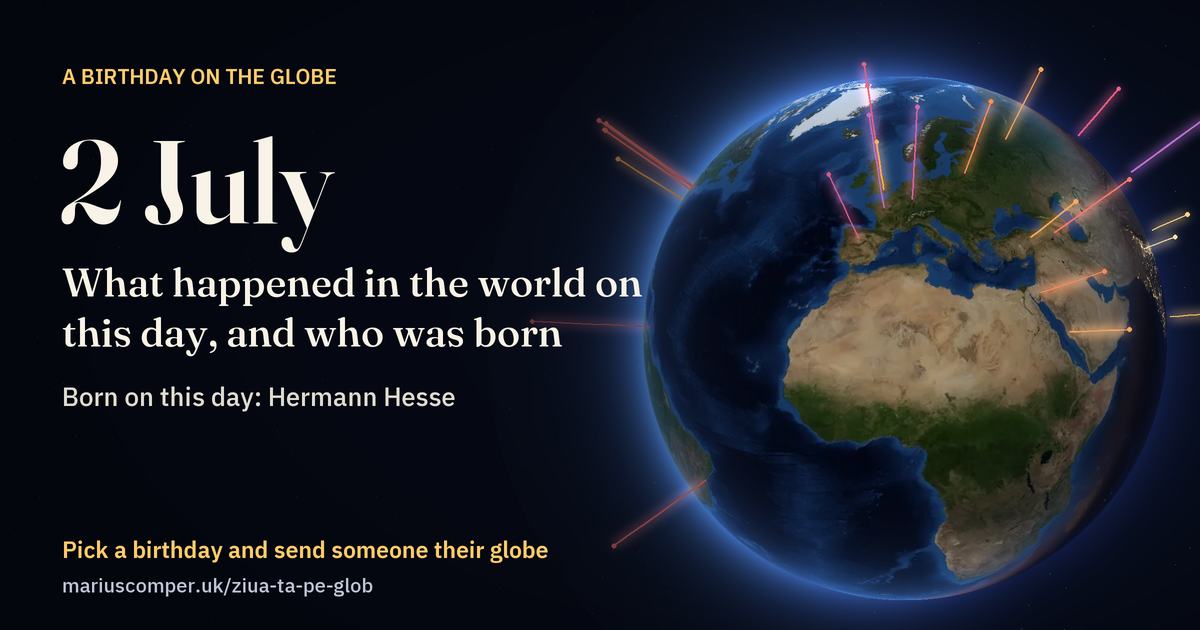
For 2 July, the English Wikipedia lists 40 events and 167 births. 26 of the events stand at their places as rays of light; three more are dashed circles, where the sentence links only to a country or a sea. The taller the ray, the longer ago it happened. The people born that day come further down, as blue points.
A birthday, yours or someone else’s:
Turn it into a greetingScroll: the globe turns to each place
The day you were born, on the globe.
Three things from your day
Scroll: your day first, then 2 July through the years
The Earth on 2 July
The picture on the globe was assembled by NASA from satellite photographs taken in July 2004: the snow, the ice and the green are those of the month.
On 2 July the Sun passes straight overhead at noon along the parallel of 23.0° north. In London, the day lasts about 16 hours 35 minutes.
Beyond 67° north the Sun no longer sets; beyond 67° south it no longer rises.
The line between day and night is tilted on the globe exactly as on this day of the year. On the dark side you can see the lights of towns.
Britain & Ireland · Hyde Park
2005
The Live 8 benefit concerts takes place in the G8 states and in South Africa. More than 1,000 musicians perform and are broadcast on 182 television networks and 2,000 radio networks.
On the map: Hyde Park.
Also on the day’s list of Wikipedia in Spanish, Romanian and Chinese.
Europe · Tordesillas
1494
Age of Discovery: The Treaty of Tordesillas is ratified by Spain.
On the map: Tordesillas.
North America · United States Declaration of Independence
1776
American Revolution: The Continental Congress adopts the Lee Resolution severing ties with the Kingdom of Great Britain. The wording of the formal Declaration of Independence was agreed upon and publicly released two days later, on July 4.
On the map: the coordinates Wikidata gives for the article “United States Declaration of Independence”.
North America · United States Congress
1890
The U.S. Congress passes the Sherman Antitrust Act.
On the map: United States Congress.
Also on the day’s list of Wikipedia in Chinese.
2 July
What the other Wikipedias remember#
For these years the English list has nothing on this day. The events below come from the same day’s lists on Wikipedia in Chinese and Spanish and were translated for this page.
From Wikipedia in Chinese · Friedrichshafen
1900
The Zeppelin airship, invented by the German engineer Zeppelin, makes its first flight over Lake Constance near Friedrichshafen.
On the map: Friedrichshafen.
Translated from the list on Wikipedia in Chinese.
From Wikipedia in Chinese · Kinkaku-ji Temple
1950
The Shariden of Rokuon-ji in Kyoto, Japan, is burned down by a monk suffering from mental illness; it is rebuilt five years later.
On the map: Kinkaku-ji Temple.
Translated from the list on Wikipedia in Chinese.
From Wikipedia in Spanish · Prague
2003
The IOC, meeting in Prague, chooses Vancouver as host of the 2010 Winter Olympics.
On the map: Prague.
Translated from the list on Wikipedia in Spanish.
The article on Wikipedia in Spanish: Juegos Olímpicos de Vancouver 2010
2 July
Born on 2 July#
The English Wikipedia lists 167 births for this day. The blue points are the birthplaces of 59 of these people: those written about in the most Wikipedia editions, where Wikidata gives a place of birth.
Born on 2 July
1877
Hermann Hesse, German-born Swiss poet, novelist, and painter, Nobel Prize laureate (died 1962)
Place of birth: Calw.
Born on 2 July
1923
Wisława Szymborska, Polish poet and translator, Nobel Prize laureate (died 2012)
Place of birth: Prowent.
Born on 2 July
1862
William Henry Bragg, English physicist, chemist, and mathematician, Nobel Prize laureate (died 1942)
Place of birth: Wigton.
Born on 2 July
1986
Lindsay Lohan, American actress and singer
Place of birth: The Bronx.
Born on 2 July
1906
Hans Bethe, German-American physicist and academic, Nobel Prize laureate (died 2005)
Place of birth: Strasbourg.
Born in Britain and Ireland
1489
Thomas Cranmer, English archbishop, theologian, and Protestant martyr (died 1556)
Place of birth: Aslockton.
Born in Britain and Ireland
1990
Danny Rose, English footballer
Place of birth: Doncaster.
2 July
Number one in the charts that week
At the cinema
An animal recorded that day
The record can be seen in GBIF, which brings together wildlife records from around the world.
All your birthdays
The weather that day
Data: Met Office Hadley Centre (HadCET); NOAA (GHCN-Daily, Mauna Loa).
Above the Earth
Sources: Jonathan McDowell, GCAT (launches); GFZ Potsdam (Kp index). Days are counted in Universal Time.
Football that day
International matches played that day:
Source: the “International football results” dataset kept by Mart Jürisoo (CC0).
Also that day
The earthquake’s page at the USGS
Source: the USGS catalogue. The day is counted in Universal Time (UTC).
In those days
Make a link for someone
Type the name, pick the day and the year of birth. The link opens straight on their day, with their name in the greeting.
The link carries the name, date and place typed here; anyone who gets it can see them.
Put another birthday beside it
Your mother’s, your child’s, a friend’s: the two days appear side by side.
Below: 2 July through the years.
The whole globe of the day
Drag the globe to turn it. Touch a ray or a point to read what happened there.
Everything Wikipedia lists for 2 July
The list is the English Wikipedia’s, in its own wording, as it stood in October 2026. 11 events have no place on the map: the sentence links to no place with coordinates, only to places too wide to mark, or to several countries.
- 311
Beginning of the papacy of Pope Miltiades.
no place on the mapWikipedia: Pope Miltiades - 626
Li Shimin, the future Emperor Taizong of Tang, ambushes and kills his rival brothers Li Yuanji and Li Jiancheng in the Xuanwu Gate Incident.
Asia · Xuanwu Gate IncidentWikipedia: Xuanwu Gate Incident - 706
The bodies of Emperor Gaozong of Tang and Empress Wu Zetian were interred in the Qianling Mausoleum.
Asia · Qianling MausoleumWikipedia: Emperor Gaozong of Tang - 866
Battle of Brissarthe: The Franks led by Robert the Strong are defeated by a joint Breton-Viking army.
Europe · Battle of BrissartheWikipedia: Battle of Brissarthe - 1298
Battle of Göllheim: Albert I of Habsburg defeats Adolf of Nassau-Weilburg.
Europe · Battle of GöllheimWikipedia: Battle of Göllheim - 1494
Age of Discovery: The Treaty of Tordesillas is ratified by Spain.
Europe · TordesillasWikipedia: Treaty of Tordesillas - 1582
Battle of Yamazaki: Toyotomi Hideyoshi defeats Akechi Mitsuhide.
Asia · Battle of YamazakiWikipedia: Battle of Yamazaki - 1644
English Civil War: Battle of Marston Moor.
Britain & Ireland · Battle of Marston MoorWikipedia: Battle of Marston Moor - 1645
Wars of the Three Kingdoms: Battle of Alford.
Britain & Ireland · Battle of AlfordWikipedia: Battle of Alford - 1724
On the Feast of the Visitation, Bach led the first performance of his Meine Seel erhebt den Herren, BWV 10, based on the German Magnificat.
no place on the mapWikipedia: Visitation - 1776
American Revolution: The Continental Congress adopts the Lee Resolution severing ties with the Kingdom of Great Britain. The wording of the formal Declaration of Independence was agreed upon and publicly released two days later, on July 4.
North America · United States Declaration of IndependenceWikipedia: American Revolution - 1779
American Revolutionary War: French troops landed near St. George's, Grenada, and began their capture of the island.
Latin America · St. George's, GrenadaWikipedia: American Revolutionary War - 1816
The French frigate Méduse ran aground off the coast of present-day Mauritania, with the survivors escaping on a makeshift raft, depicted in Théodore Géricault's painting The Raft of the Medusa.
no place on the mapWikipedia: The Raft of the Medusa - 1823
Bahia Independence Day: The Siege of Salvador ends Portuguese rule in Brazil, with the final defeat of the Portuguese crown loyalists in the province of Bahia.
Latin America · Siege of SalvadorWikipedia: Siege of Salvador - 1840
A Ms 7.4 earthquake strikes present-day Turkey and Armenia; combined with the effects of an eruption on Mount Ararat, kills 10,000 people.
Asia · 1840 Ararat earthquakeWikipedia: 1840 Ararat earthquake - 1863
American Civil War: On the second day of the Battle of Gettysburg - the Battle of Little Round Top takes place and results in a Union victory after the Confederate troops unsuccessfully try to assault the Union left flank.
North America · Battle of GettysburgWikipedia: American Civil War - 1881
Charles J. Guiteau shoots and fatally wounds U.S. President James A. Garfield (who will die of complications from his wounds on September 19).
North America · Assassination of James A. GarfieldWikipedia: Assassination of James A. Garfield - 1890
The U.S. Congress passes the Sherman Antitrust Act.
North America · United States CongressWikipedia: United States Congress - 1917
In the leadup to the Battle of Aqaba, T. E. Lawrence and his Arab forces defeat a battalion of Ottomans at Abu al-Lissan.
Asia · AqabaWikipedia: Battle of Aqaba - 1921
World War I: U.S. President Warren G. Harding signs the Knox–Porter Resolution formally ending the war between the United States and Germany.
Europe · Weimar RepublicWikipedia: World War I - 1934
The Night of the Long Knives ends after three days of killings.
Europe · Nazi GermanyWikipedia: Night of the Long Knives - 1937
Amelia Earhart and navigator Fred Noonan are last heard from over the Pacific Ocean and disappear while attempting to make the first equatorial round-the-world flight.
no place on the mapWikipedia: Amelia Earhart - 1941
A German SS unit arrived in Vilnius, Lithuania, and began the systematic execution of up to 100,000 people over the next three years.
Europe · Ponary massacreWikipedia: Ponary massacre - 1964
Civil rights movement: U.S. President Lyndon B. Johnson signs the Civil Rights Act of 1964 meant to prohibit segregation in public places.
no place on the mapWikipedia: Civil Rights Act of 1964 - 1966
France conducts its first nuclear weapon test in the Pacific, on Moruroa Atoll.
Oceania · MoruroaWikipedia: 1966–70 French nuclear tests - 1976
End of South Vietnam; Communist North Vietnam annexes the former South Vietnam to form the unified Socialist Republic of Vietnam.
- 1986
Aeroflot Flight 2306 crashes while attempting an emergency landing at Syktyvkar Airport in Syktyvkar, in present-day Komi Republic, Russia, killing 54 people.
Europe · Aeroflot Flight 2306Wikipedia: Aeroflot Flight 2306 - 1986
Rodrigo Rojas and Carmen Gloria Quintana are burnt alive during a street demonstration against the dictatorship of General Augusto Pinochet in Chile in the Quemados case.
Latin America · ChileWikipedia: Quemados case - 1990
In the 1990 Mecca tunnel tragedy, 1,400 Muslim pilgrims are suffocated to death and trampled upon in a pedestrian tunnel leading to the holy city of Mecca.
Asia · MinaWikipedia: 1990 Mecca tunnel tragedy - 1990
Singing Revolution: The Soviet economic blockade of Lithuania was lifted when the Lithuanian parliament agreed to suspend the effects of their act to re-establish Lithuania as a state.
no place on the mapWikipedia: Singing Revolution - 1993
A mob sets fire to the Hotel Madımak in Sivas, Turkey, where an Alevi cultural festival was taking place, killing 37 people.
Asia · Sivas massacreWikipedia: Sivas massacre - 1994
USAir Flight 1016 crashes near Charlotte Douglas International Airport, killing 37 of the 57 people on board.
North America · USAir Flight 1016Wikipedia: USAir Flight 1016 - 1997
The Bank of Thailand floats the baht, triggering the Asian financial crisis.
no place on the mapWikipedia: 1997 Asian financial crisis - 1998
Harry Potter and the Chamber of Secrets by J. K. Rowling, the second novel of the Harry Potter series, was published.
no place on the mapWikipedia: Harry Potter and the Chamber of Secrets - 2000
Vicente Fox Quesada is elected the first President of México from an opposition party, the Partido Acción Nacional, after more than 70 years of continuous rule by the Partido Revolucionario Institucional, in the 2000 Mexican general election.
no place on the mapWikipedia: 2000 Mexican general election - 2005
The Live 8 benefit concerts takes place in the G8 states and in South Africa. More than 1,000 musicians perform and are broadcast on 182 television networks and 2,000 radio networks.
Britain & Ireland · Hyde ParkWikipedia: Live 8 - 2013
A magnitude 6.1 earthquake strikes Aceh, Indonesia, killing at least 42 people and injuring 420 others.
Asia · 2013 Aceh earthquakeWikipedia: 2013 Aceh earthquake - 2013
The International Astronomical Union announced that the fourth and fifth moons of Pluto to be discovered would be named Kerberos and Styx, respectively.
no place on the mapWikipedia: International Astronomical Union - 2020
A landslide at a jade mine in Hpakant killed 175–200 miners, the deadliest mining accident in Burmese history.
Asia · 2020 Hpakant jade mine disasterWikipedia: 2020 Hpakant jade mine disaster - 2024
A stampede during a religious event in Uttar Pradesh, India, leaves at least 121 people dead and 150 others injured.
Asia · 2024 Hathras crowd crushWikipedia: 2024 Hathras crowd crush
What the other Wikipedias remember
For these years the English list has nothing on this day. The events below come from the same day’s lists on Wikipedia in Chinese and Spanish and were translated for this page.
- 1900
The Zeppelin airship, invented by the German engineer Zeppelin, makes its first flight over Lake Constance near Friedrichshafen.
- 1950
The Shariden of Rokuon-ji in Kyoto, Japan, is burned down by a monk suffering from mental illness; it is rebuilt five years later.
- 2003
The IOC, meeting in Prague, chooses Vancouver as host of the 2010 Winter Olympics.
Europe · PragueTranslated from the list on Wikipedia in SpanishWikipedia: Juegos Olímpicos de Vancouver 2010
Who was born on 2 July
In order of how many Wikipedia editions have an article about each. The first 60 of 167 are shown.
- 1877
Hermann Hesse, German-born Swiss poet, novelist, and painter, Nobel Prize laureate (died 1962)
- 1923
Wisława Szymborska, Polish poet and translator, Nobel Prize laureate (died 2012)
- 1925
Patrice Lumumba, Congolese politician, 1st Prime Minister of the Democratic Republic of the Congo (died 1961)
KatakokombeWikipedia: Patrice Lumumba - 1929
Imelda Marcos, Filipino politician; 10th First Lady of the Philippines
ManilaWikipedia: Imelda Marcos - 1862
William Henry Bragg, English physicist, chemist, and mathematician, Nobel Prize laureate (died 1942)
- 1986
Lindsay Lohan, American actress and singer
The BronxWikipedia: Lindsay Lohan - 1906
Hans Bethe, German-American physicist and academic, Nobel Prize laureate (died 2005)
StrasbourgWikipedia: Hans Bethe - 1990
Margot Robbie, Australian actress and producer
- 1714
Christoph Willibald Gluck, German composer (died 1787)
- 1947
Larry David, American actor, comedian, producer, and screenwriter
Sheepshead BayWikipedia: Larry David - 1903
Alec Douglas-Home, English cricketer and politician, 66th Prime Minister of the United Kingdom (died 1995)
MayfairWikipedia: Alec Douglas-Home - 1930
Carlos Menem, Argentinian lawyer and politician, 50th President of Argentina (died 2021)
AnillacoWikipedia: Carlos Menem - 1985
Ashley Tisdale, American actress, singer, and producer
Ocean TownshipWikipedia: Ashley Tisdale - 1903
Olav V, Norwegian king, 1957–1991 (died 1991)
- 1942
Vicente Fox, Mexican businessman and politician, 35th President of Mexico
Mexico CityWikipedia: Vicente Fox - 419
Valentinian III, Roman emperor (died 455)
RavennaWikipedia: Valentinian III - 1724
Friedrich Gottlieb Klopstock, German poet and author (died 1803)
QuedlinburgWikipedia: Friedrich Gottlieb Klopstock - 1489
Thomas Cranmer, English archbishop, theologian, and Protestant martyr (died 1556)
AslocktonWikipedia: Thomas Cranmer - 1978
Jüri Ratas, Estonian politician, 42nd Mayor of Tallinn
TallinnWikipedia: Jüri Ratas - 1989
Alex Morgan, American soccer player
San DimasWikipedia: Alex Morgan - 1946
Richard Axel, American neuroscientist and biologist, Nobel Prize laureate
BrooklynWikipedia: Richard Axel - 1922
Pierre Cardin, Italian-French fashion designer (died 2020)
Sant'Andrea di BarbaranaWikipedia: Pierre Cardin - 1990
Danny Rose, English footballer
DoncasterWikipedia: Danny Rose - 1916
Hans-Ulrich Rudel, German colonel and pilot (died 1982)
Grzędy, Lower Silesian VoivodeshipWikipedia: Hans-Ulrich Rudel - 1975
Kristen Michal, Estonian lawyer and politician
TallinnWikipedia: Kristen Michal - 1983
Michelle Branch, American singer-songwriter and guitarist
PhoenixWikipedia: Michelle Branch - 1987
Esteban Granero, Spanish footballer
Pozuelo de AlarcónWikipedia: Esteban Granero - 1876
Wilhelm Cuno, German businessman and politician, Chancellor of Germany (died 1933)
- 1957
Bret Hart, Canadian wrestler
CalgaryWikipedia: Bret Hart - 1486
Jacopo Sansovino, Italian sculptor and architect (died 1570)
FlorenceWikipedia: Jacopo Sansovino - 1904
René Lacoste, French tennis player and businessman, created the polo shirt (died 1996)
10ᵗʰ arrondissement of ParisWikipedia: René Lacoste - 1908
Thurgood Marshall, American lawyer and civil rights activist, 32nd Solicitor General of the United States, and former Associate Justice of the Supreme Court of the United States (died 1993)
BaltimoreWikipedia: Thurgood Marshall - 1975
Elizabeth Reaser, American actress
Bloomfield TownshipWikipedia: Elizabeth Reaser - 1993
Saweetie, American rapper
HaywardWikipedia: Saweetie - 1936
Omar Suleiman, Egyptian general and politician, 16th Vice President of Egypt (died 2012)
- 1988
Lee Chung-yong, South Korean footballer
- 1930
Ahmad Jamal, American jazz musician (died 2023)
PittsburghWikipedia: Ahmad Jamal - 1956
Jerry Hall, American model and actress
GonzalesWikipedia: Jerry Hall - 1937
Richard Petty, American race car driver and sportscaster
Level Cross, Randolph County, North CarolinaWikipedia: Richard Petty - 1994
Henrik Kristoffersen, Norwegian skier
RælingenWikipedia: Henrik Kristoffersen - 1821
Charles Tupper, Canadian physician and politician, 6th Prime Minister of Canada (died 1915)
AmherstWikipedia: Charles Tupper - 1940
Georgi Ivanov, Bulgarian military officer, cosmonaut and politician
LovechWikipedia: Georgi Ivanov - 1952
Sylvia Rivera, American transgender rights activist (died 2002)
New York CityWikipedia: Sylvia Rivera - 1990
Kayla Harrison, American judoka
MiddletownWikipedia: Kayla Harrison - 1994
Derrick White, American basketball player
ParkerWikipedia: Derrick White - 1923
Cyril M. Kornbluth, American soldier and author (died 1958)
ManhattanWikipedia: Cyril M. Kornbluth - 1925
Medgar Evers, American soldier and civil rights movement activist (died 1963)
DecaturWikipedia: Medgar Evers - 1937
Polly Holliday, American actress (died 2025)
- 1939
Alexandros Panagoulis, Greek poet and politician (died 1976)
- 1946
Ron Silver, American actor, director, and political activist (died 2009)
ManhattanWikipedia: Ron Silver - 1984
Elise Stefanik, American politician
- 1995
Ryan Murphy, American swimmer
- 1954
Wendy Schaal, American actress
ChicagoWikipedia: Wendy Schaal - 1984
Johnny Weir, American figure skater
CoatesvilleWikipedia: Johnny Weir - 1849
Maria Theresa of Austria-Este (died 1919)
- 1938
David Owen, English physician and politician, Secretary of State for Foreign and Commonwealth Affairs
PlymptonWikipedia: David Owen - 1940
Kenneth Clarke, English politician, Lord High Chancellor of Great Britain
West BridgfordWikipedia: Kenneth Clarke - 1976
Ľudovít Ódor, Prime minister of Slovakia
KomárnoWikipedia: Ľudovít Ódor - 1825
Émile Ollivier, French statesman (died 1913)
MarseilleWikipedia: Émile Ollivier - 1869
Liane de Pougy, French-Swiss dancer and author (died 1950)
La FlècheWikipedia: Liane de Pougy
What is celebrated on 2 July
- Christian feast day: Aberoh and Atom (Coptic Church)
- Christian feast day: Bernardino Realino
- Christian feast day: Blessed Eugénie Joubert
- Christian feast day: Feast of the Visitation (Anglicanism; Levoča at Mariánska hora)
- Christian feast day: Monegundis
- Christian feast day: Oudoceus
- Christian feast day: Martinian and Processus
- Christian feast day: Pishoy (Coptic Church)
- Christian feast day: Stephen III of Moldavia (Romanian Orthodox Church)
- Christian feast day: July 2 (Eastern Orthodox liturgics)
- Flag Day (Curaçao)
- Palio di Provenzano (Siena, Italy)
- Police Day (Azerbaijan)
A greeting link for someone
Type a name and, if you like, the year of birth. The link opens with a greeting, and beside each event it says how old the person turned that day, or how many years before their birth it happened.
The name and the year go only into the link you send.
All 366 days
How the globe is made
Where the events come from
Each edition of this page uses the day’s list from Wikipedia in its own language: Romanian, English, Spanish, Chinese. The lists are written by volunteers and differ from one edition to the next; the text of each event is Wikipedia’s, with a link to the article. A row that appears twice in a list is shown once. The lists have not been checked event by event: they are Wikipedia’s, mistakes included.
For events before 1582, and for countries that moved to the Gregorian calendar later (Britain in 1752, Russia in 1918), the same day may be counted Old Style in one list and New Style in another.
The chapter “What the other Wikipedias remember” adds up to five events a day from the lists of the other three editions, only for years in which the English list has nothing on that day. They were translated for this page, passed the same filters as the tour, and are not counted among the events of the English list.
How an event gets onto the map
The place comes from Wikidata. If the sentence links to the article about the event itself (a battle, an opening, an earthquake), dated to the same year, the ray stands on its coordinates or on those of its location. Otherwise it stands on the first place the sentence links to: a town, a building, a mountain, an island. This second step can be wrong: sometimes the sentence only mentions the place. That is why the page says, under each event, which place the ray stands on.
When the sentence links to a single state or province, or to a single sea, lake or desert larger than 5,000 km², the globe shows a dashed circle, not a ray. The circle has the area Wikidata gives, with its radius kept between 1.2° and 16°, or a radius of 4.5° when Wikidata gives no area; it says only that the sentence links to that place. Organisations, ships, spacecraft, museum objects, rivers, mountain ranges, languages and continents are never used as places. When a sentence names several states and no exact place, the event stays in the list only.
What the height means
The height of a ray shows how many years have passed, on a logarithmic scale: 10 years, 100 years and 1,000 years are equal steps apart; anything older than about 2,600 years has the tallest ray. The colour runs from pale yellow for recent years to violet for antiquity.
Where the tour stops
In each region the tour stops at up to three events (five in Britain and Ireland), chosen mainly by three things: whether Wikipedia’s editors put the event in the “On this day” box of their main page (the English, Spanish and Chinese editions), how many Wikipedia editions have an article about it, and how many of the four lists include it. Events whose sentence or article is about a war, an attack, a crime or a disaster are left out of the tour; they stay in the whole list, in Wikipedia’s wording. The filter is a list of words and a list of Wikidata types, so it can miss some.
The tour of births names the people with articles in the most editions and leaves aside those whom the list or Wikidata describes as rulers, politicians, commanders, leaders of movements or criminals; they stay in the list.
The Earth and the Sun
The daytime images are NASA’s Blue Marble Next Generation mosaics, one for each month of 2004; the night side is Black Marble 2016. The tilt of the line between day and night is computed for the day; the hour is chosen so that the place being read is in daylight. The latitude where the Sun stands overhead is the average of the four years of the leap cycle; in a given year it can differ by up to 0.4°.
The day you were born
The number ones come from the weekly lists on Wikipedia: Billboard for the United States (from 1940; the Hot 100 from August 1958), the UK Singles Chart (from November 1952), Los 40 Principales for Spain (from July 1966) and, for Romania, the Romanian Top 100 and Airplay 100 (2001–2021, with missing weeks). The page shows the chart of the week in which the day of birth falls, with its date; Billboard and the UK chart are dated at the end of their week. For Romania before 2001 and for China these sources have no weekly chart.
The films are those that reached cinemas in the United States up to ten days before or three days after that day (some of them in a few cinemas at first), from the English Wikipedia’s yearly lists (from 1968), in order of how many editions have an article about them. The events “in those days” are the ones on the neighbouring days’ lists that carry the year of birth, passed through the same filter as the tour.
The day of birth, year included
The Moon, the star sign and the constellation are worked out by the page itself, for noon Universal Time on the day. The lit part of the Moon is rounded and can differ by a few per cent from that at the hour of birth. The sign follows the usual zodiac of twelve equal parts starting at the March equinox; the constellation is the one the Sun actually stood in front of, by the borders set by the International Astronomical Union, and within a day of a border the page does not name it. When the Sun changes sign while it is that day anywhere on Earth, the page gives the moment of crossing, rounded to ten minutes and accurate to within about a quarter of an hour, and the clock time in a few cities, with the time zone and summer time of that year.
The year in the Chinese calendar is the one your device’s own calendar gives for the date, checked against the Hong Kong Observatory’s tables. “All your birthdays” uses the same sources as the rest of the chapter for the same day in every year since the birth: the temperature, well-known launches that took place on that very day, matches of the teams the edition follows, snow deeper than 10 cm and strong geomagnetic storms. The three things at the top and the four on the picture are chosen in a fixed order (the song, the animal, a full Moon, a well-known launch before an ordinary earthquake); on the picture you can change them.
When the link carries a year of birth, the page adds a few things about that exact day. The weather is the Met Office’s Central England temperature record and the readings from New York’s Central Park; the “usual high” is the average of the daily highs of 1961–1990 for that date, with two days either side. The carbon dioxide figure is the monthly mean at the Mauna Loa observatory, where measurements begin in March 1958.
The earthquake is the one with the largest magnitude in the USGS catalogue for that day, counted in Universal Time. Before the 1960s the catalogue has gaps even above magnitude 5.5, so in the older years many days have no earthquake. The page gives only the magnitude and the place: the country the epicentre falls in or, when the epicentre is at sea within 300 km of a coast, the nearest country; farther out, only the ocean.
The launches are those that reached orbit or left for the Moon and the planets, from Jonathan McDowell’s GCAT catalogue. If nothing left that day, the page shows the nearest launch within three days before or after, and says how many days away it was. The geomagnetic storm appears only when the Kp index reached at least 5 in one of the day’s eight three-hour intervals.
The animal comes from GBIF: an observation made by a person (the animal seen or heard, or its tracks), dated to that exact day, with coordinates and a CC0 or CC BY licence. Only a few hundred well-known species are searched (mammals, birds, turtles, butterflies); of those noted that day, mammals and species with articles in many Wikipedia editions come first; birds noted almost every day, and species used recently, wait their turn. Observations dated 1 January are left out, because records without a day are often filed there. An observation shows that the animal was recorded there, not how many animals there were.
The matches are those between national teams. Only matches of England, Scotland, Wales, Northern Ireland, the Republic of Ireland, the United States, Canada and Australia are shown, along with those at the big final tournaments. The picture to send is drawn in the page from the day’s globe and the facts above, and stays on your device until you send it.
Sources
- Events, births and holidays: the day’s page on Wikipedia, text under CC BY-SA 4.0.
- Coordinates, places of birth and the number of editions: Wikidata (CC0).
- The Earth by day: NASA Blue Marble Next Generation. The Earth by night: NASA Black Marble 2016.
- Borders and regions: Natural Earth.
- World population and births per year: UN World Population Prospects 2024.
- Charts and films: Wikipedia’s lists for Billboard, the UK Singles Chart, Los 40 Principales, Romanian Top 100, Airplay 100 and American films by year (CC BY-SA 4.0).
- Weather: Met Office Hadley Centre, HadCET (Open Government Licence) and NOAA GHCN-Daily, New York Central Park. Carbon dioxide: NOAA Global Monitoring Laboratory, Mauna Loa.
- Earthquakes: the USGS catalogue. Launches: Jonathan McDowell, GCAT (CC BY). Kp index: GFZ Potsdam (CC BY 4.0). Matches: International football results, Mart Jürisoo (CC0).
- Animal observations: GBIF, with a link to each record; species names come from Wikidata.