A birthday on the globe
26 May on the globe: what happened in the world on this day, and who was born
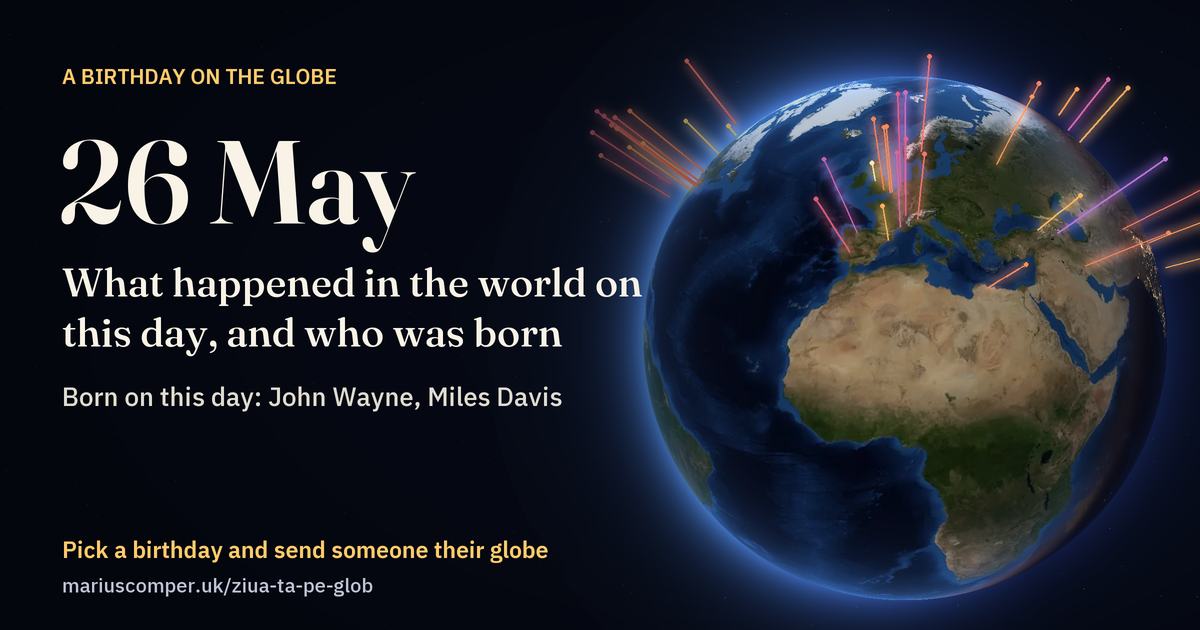
For 26 May, the English Wikipedia lists 69 events and 180 births. 38 of the events stand at their places as rays of light; six more are dashed circles, where the sentence links only to a country or a sea. The taller the ray, the longer ago it happened. The people born that day come further down, as blue points.
A birthday, yours or someone else’s:
Turn it into a greetingScroll: the globe turns to each place
The day you were born, on the globe.
Three things from your day
Scroll: your day first, then 26 May through the years
The Earth on 26 May
The picture on the globe was assembled by NASA from satellite photographs taken in May 2004: the snow, the ice and the green are those of the month.
On 26 May the Sun passes straight overhead at noon along the parallel of 21.2° north. In London, the day lasts about 16 hours 5 minutes.
Beyond 69° north the Sun no longer sets; beyond 69° south it no longer rises.
The line between day and night is tilted on the globe exactly as on this day of the year. On the dark side you can see the lights of towns.
Britain & Ireland · Vauxhall
1906
Vauxhall Bridge in London opened, crossing the River Thames between Vauxhall and Westminster.
On the map: Vauxhall.
Also on the day’s list of Wikipedia in Chinese.
Europe · Milan Cathedral
1805
Napoléon Bonaparte assumes the title of King of Italy and is crowned with the Iron Crown of Lombardy in Milan Cathedral, the gothic cathedral in Milan.
On the map: Milan Cathedral.
Also on the day’s list of Wikipedia in Spanish, Romanian and Chinese.
Europe · Dormition Cathedral
1896
Nicholas II is crowned as the last Tsar of Imperial Russia.
On the map: Dormition Cathedral.
Wikipedia: Coronation of Nicholas II and Alexandra Feodorovna
Europe · Camp Nou
1999
Manchester United won the UEFA Champions League final to become the first English football club to win three major championships in the same season.
On the map: Camp Nou.
Also on the day’s list of Wikipedia in Chinese.
Asia · Jalalabad
1879
Russia and the United Kingdom sign the Treaty of Gandamak establishing an Afghan state.
On the map: Jalalabad.
North America · Montana Territory
1864
President Abraham Lincoln signs legislation organizing the Montana Territory.
On the map: Montana Territory.
North America · Boston University
1869
Boston University is chartered by the Commonwealth of Massachusetts.
On the map: Boston University.
North America · Supreme Court of the United States
1998
The Supreme Court of the United States rules in New Jersey v. New York that Ellis Island, the historic gateway for millions of immigrants, is mainly in the state of New Jersey, not New York.
On the map: Supreme Court of the United States.
Also on the day’s list of Wikipedia in Spanish.
26 May
What the other Wikipedias remember#
For these years the English list has nothing on this day. The events below come from the same day’s lists on Wikipedia in Spanish and were translated for this page.
From Wikipedia in Spanish · Paris
1914
In Paris, the opera The Nightingale by Igor Stravinsky premieres.
On the map: Paris.
Translated from the list on Wikipedia in Spanish.
From Wikipedia in Spanish · Eurovision Song Contest 2012
2012
In Baku (Azerbaijan), the Eurovision Song Contest is held; Sweden wins, with Loreen and her song "Euphoria".
On the map: Eurovision Song Contest 2012.
Translated from the list on Wikipedia in Spanish.
The article on Wikipedia in Spanish: Festival de la Canción de Eurovisión 2012
26 May
Born on 26 May#
The English Wikipedia lists 180 births for this day. The blue points are the birthplaces of 60 of these people: those written about in the most Wikipedia editions, where Wikidata gives a place of birth.
Born on 26 May
1907
John Wayne, American actor, director, and producer (died 1979)
Place of birth: Winterset.
Born on 26 May
1926
Miles Davis, American trumpet player, composer, and bandleader (died 1991)
Place of birth: Alton.
Born on 26 May
1951
Sally Ride, American physicist and astronaut, founded Sally Ride Science (died 2012)
Place of birth: Los Angeles.
Born on 26 May
1966
Helena Bonham Carter, English actress
Place of birth: London.
Born on 26 May
1964
Lenny Kravitz, American singer-songwriter, multi-instrumentalist, producer, and actor
Place of birth: New York City.
Born in Britain and Ireland
1913
Peter Cushing, English actor (died 1994)
Place of birth: Kenley.
Born in Britain and Ireland
1623
William Petty, English economist and philosopher (died 1687)
Place of birth: Romsey.
Born in Britain and Ireland
1909
Matt Busby, Scottish footballer and manager (died 1994)
Place of birth: Bellshill.
26 May
Number one in the charts that week
At the cinema
An animal recorded that day
The record can be seen in GBIF, which brings together wildlife records from around the world.
All your birthdays
The weather that day
Data: Met Office Hadley Centre (HadCET); NOAA (GHCN-Daily, Mauna Loa).
Above the Earth
Sources: Jonathan McDowell, GCAT (launches); GFZ Potsdam (Kp index). Days are counted in Universal Time.
Football that day
International matches played that day:
Source: the “International football results” dataset kept by Mart Jürisoo (CC0).
Also that day
The earthquake’s page at the USGS
Source: the USGS catalogue. The day is counted in Universal Time (UTC).
In those days
Make a link for someone
Type the name, pick the day and the year of birth. The link opens straight on their day, with their name in the greeting.
The link carries the name, date and place typed here; anyone who gets it can see them.
Put another birthday beside it
Your mother’s, your child’s, a friend’s: the two days appear side by side.
Below: 26 May through the years.
The whole globe of the day
Drag the globe to turn it. Touch a ray or a point to read what happened there.
Everything Wikipedia lists for 26 May
The list is the English Wikipedia’s, in its own wording, as it stood in October 2026. 25 events have no place on the map: the sentence links to no place with coordinates, only to places too wide to mark, or to several countries.
- 17
Germanicus celebrates a triumph in Rome for his victories over the Cherusci, Chatti, and other German tribes west of the Elbe.
no place on the mapWikipedia: Germanicus - 451
Battle of Avarayr between Armenian rebels and the Sasanian Empire takes place. The Sasanids defeat the Armenians militarily but guarantee them freedom to openly practice Christianity.
Asia · Battle of AvarayrWikipedia: Battle of Avarayr - 866
Basil I is crowned as co-emperor of the Byzantine Empire by Michael III.
no place on the mapWikipedia: Basil I - 946
England is left temporarily without a monarch after the death of King Edmund I in a street fight, resulting in Edmund's brother Eadred assuming the throne for the minority of Edmund's two sons.
Britain & Ireland · Kingdom of EnglandWikipedia: Kingdom of England - 961
King Otto I elects his six-year-old son Otto II as heir apparent and co-ruler of the East Frankish Kingdom. He is crowned at Aachen, and placed under the tutelage of his grandmother Matilda.
Europe · AachenWikipedia: Otto the Great - 1135
Alfonso VII of León and Castile is crowned in León Cathedral as Imperator totius Hispaniae (Emperor of all of Spain).
Europe · León CathedralWikipedia: León Cathedral - 1293
An earthquake strikes Kamakura, Kanagawa, Japan, killing about 23,000.
Asia · 1293 Kamakura earthquakeWikipedia: 1293 Kamakura earthquake - 1328
William of Ockham, the Franciscan Minister-General Michael of Cesena, and two other Franciscan leaders secretly leave Avignon, fearing a death sentence from Pope John XXII.
Europe · AvignonWikipedia: William of Ockham - 1538
Geneva expels John Calvin and his followers from the city. Calvin lives in exile in Strasbourg for the next three years.
Europe · GenevaWikipedia: Geneva - 1573
The Battle of Haarlemmermeer, a naval engagement in the Eighty Years' War.
Europe · Battle of HaarlemmermeerWikipedia: Battle of Haarlemmermeer - 1637
Pequot War: A combined English and Mohegan force under John Mason attacks a village in Connecticut, massacring approximately 500 Pequots.
North America · Mystic massacreWikipedia: Mystic massacre - 1644
Portuguese Restoration War: Portuguese and Spanish forces both claim victory in the Battle of Montijo.
Europe · Battle of MontijoWikipedia: Battle of Montijo - 1736
The Battle of Ackia is fought near the present site of Tupelo, Mississippi. British and Chickasaw soldiers repel a French and Choctaw attack on the then-Chickasaw village of Ackia.
North America · Tupelo, MississippiWikipedia: Chickasaw Campaign of 1736 - 1783
A Great Jubilee Day held at North Stratford, Connecticut, celebrates the end of fighting in the American Revolutionary War.
North America · Trumbull, ConnecticutWikipedia: American Revolutionary War - 1805
Napoléon Bonaparte assumes the title of King of Italy and is crowned with the Iron Crown of Lombardy in Milan Cathedral, the gothic cathedral in Milan.
Europe · Milan CathedralWikipedia: Iron Crown - 1821
Establishment of the Peloponnesian Senate by the Greek rebels.
no place on the mapWikipedia: Greek War of Independence - 1822
At least 113 people die in the Grue Church fire, the biggest fire disaster in Norway's history.
Europe · Grue Church fireWikipedia: Grue Church fire - 1864
President Abraham Lincoln signs legislation organizing the Montana Territory.
North America · Montana TerritoryWikipedia: Abraham Lincoln - 1865
Conclusion of the American Civil War: The Confederate General Edmund Kirby Smith, commander of the Trans-Mississippi division, is the last full general of the Confederate Army to surrender, at Galveston, Texas.
North America · Galveston, TexasWikipedia: Conclusion of the American Civil War - 1868
Impeachment of Andrew Johnson: President Andrew Johnson is acquitted by one vote in the United States Senate.
no place on the mapWikipedia: Impeachment of Andrew Johnson - 1869
Boston University is chartered by the Commonwealth of Massachusetts.
North America · Boston UniversityWikipedia: Boston University - 1879
Russia and the United Kingdom sign the Treaty of Gandamak establishing an Afghan state.
Asia · JalalabadWikipedia: Treaty of Gandamak - 1888
The comic novel The Diary of a Nobody by brothers George and Weedon Grossmith first appeared in serial form in Punch.
no place on the mapWikipedia: The Diary of a Nobody - 1894
Germany's Emanuel Lasker defeated Wilhelm Steinitz to become the world chess champion, beginning a record 27-year reign.
North America · World Chess Championship 1894Wikipedia: World Chess Championship 1894 - 1896
Charles Dow publishes the first edition of the Dow Jones Industrial Average.
no place on the mapWikipedia: Charles Dow - 1896
Nicholas II is crowned as the last Tsar of Imperial Russia.
Europe · Dormition CathedralWikipedia: Coronation of Nicholas II and Alexandra Feodorovna - 1897
The Church of England returned the original manuscript of William Bradford's Of Plymouth Plantation, an account of the Pilgrims and the early years of the Plymouth Colony, to the state of Massachusetts.
North America · MassachusettsWikipedia: Church of England - 1900
Thousand Days' War: The Colombian Conservative Party turns the tide of war in their favor with victory against the Colombian Liberal Party in the Battle of Palonegro.
no place on the mapWikipedia: Battle of Palonegro - 1903
Românul de la Pind, the longest-running newspaper by and about Aromanians until World War II, is founded.
no place on the mapWikipedia: World War II - 1906
Vauxhall Bridge in London opened, crossing the River Thames between Vauxhall and Westminster.
Britain & Ireland · VauxhallWikipedia: Vauxhall Bridge - 1908
The first major commercial oil strike in the Middle East is made at Masjed Soleyman in southwest Persia. The rights to the resource were quickly acquired by the Anglo-Persian Oil Company.
Asia · Masjed SoleymanWikipedia: Masjed Soleyman - 1918
The Democratic Republic of Georgia is established.
Asia · Democratic Republic of GeorgiaWikipedia: Democratic Republic of Georgia - 1923
The first 24 Hours of Le Mans is held in France. Run annually in June thereafter, it became the oldest endurance racing event in the world.
no place on the mapWikipedia: 24 Hours of Le Mans - 1926
Abd el-Krim ends surrenders to the French, bringing an end to the Rif War.
no place on the mapWikipedia: Rif War - 1927
The last Ford Model T rolls off the assembly line after a production run of 15,007,003 vehicles.
no place on the mapWikipedia: Ford Model T - 1932
Donoghue v Stevenson is decided, ultimately establishing the foundation for negligence in common law jurisdictions worldwide.
no place on the mapWikipedia: Negligence - 1933
American singer Jimmie Rodgers died at the Taft Hotel in New York City.
North America · The MichelangeloWikipedia: Jimmie Rodgers - 1936
In the House of Commons of Northern Ireland, Tommy Henderson begins speaking on the Appropriation bill. By the time he sits down in the early hours of the following morning, he had spoken for ten hours.
no place on the mapWikipedia: House of Commons of Northern Ireland - 1937
Walter Reuther and members of the United Auto Workers (UAW) clash with Ford Motor Company security guards at the River Rouge Complex in Dearborn, Michigan, during the Battle of the Overpass.
North America · Battle of the OverpassWikipedia: Battle of the Overpass - 1938
In the United States, the House Un-American Activities Committee begins its first session.
no place on the mapWikipedia: House Un-American Activities Committee - 1940
World War II: Operation Dynamo: In northern France, Allied forces begin a massive evacuation from Dunkirk, France. The Battle of Dunkirk begins simultaneously as Allied defenders fight to slow down the German offensive.
Europe · Dunkirk evacuationWikipedia: Dunkirk evacuation - 1940
World War II: The Siege of Calais ends with the surrender of the British and French garrison.
Europe · Siege of CalaisWikipedia: Siege of Calais - 1942
World War II: The Battle of Gazala begins, in present-day Libya.
Africa · Battle of GazalaWikipedia: Battle of Gazala - 1948
The U.S. Congress passes Public Law 80-557, which permanently establishes the Civil Air Patrol as an auxiliary of the United States Air Force.
no place on the mapWikipedia: Civil Air Patrol - 1966
British Guiana gains independence, becoming Guyana.
Latin America · GuyanaWikipedia: British Guiana - 1967
The Beatles' album Sgt. Pepper's Lonely Hearts Club Band is released.
no place on the mapWikipedia: The Beatles - 1968
H-dagurinn in Iceland: Traffic changes from driving on the left to driving on the right overnight.
no place on the mapWikipedia: H-dagurinn - 1969
Apollo program: Apollo 10 returns to Earth after a successful eight-day test of all the components needed for the forthcoming first crewed Moon landing.
no place on the mapWikipedia: Apollo program - 1970
The Soviet Tupolev Tu-144 becomes the first commercial transport to exceed Mach 2.
no place on the mapWikipedia: Tupolev Tu-144 - 1971
Bangladesh Liberation War: The Pakistan Army slaughters at least 71 Hindus in Burunga, Sylhet, Bangladesh.
Asia · Burunga massacreWikipedia: Burunga massacre - 1972
Cold War: The United States and the Soviet Union sign the Anti-Ballistic Missile Treaty.
Europe · MoscowWikipedia: Anti-Ballistic Missile Treaty - 1981
An EA-6B Prowler crashes on the flight deck of the aircraft carrier USS Nimitz, killing 14 crewmen and injuring 45 others.
no place on the mapWikipedia: Grumman EA-6B Prowler - 1981
Italian Prime Minister Arnaldo Forlani and his coalition cabinet resign following a scandal over membership of the pseudo-masonic lodge P2 (Propaganda Due).
no place on the mapWikipedia: Prime Minister of Italy - 1983
The 7.8 Mw Sea of Japan earthquake shakes northern Honshu with a maximum Mercalli intensity of VIII (Severe). A destructive tsunami is generated that leaves about 100 people dead.
Asia · 1983 Sea of Japan earthquakeWikipedia: 1983 Sea of Japan earthquake - 1986
The European Community adopts the European flag.
no place on the mapWikipedia: European Economic Community - 1989
Tropical Storm Cecil dissipated over Laos after devastating Quảng Nam province, Vietnam, and causing the deaths of 751 people.
Asia · Quảng Nam provinceWikipedia: Tropical Storm Cecil - 1991
Lauda Air Flight 004 breaks apart in mid-air and crashes in the Phu Toei National Park in the Suphan Buri province of Thailand, killing all 223 people on board.
Asia · Lauda Air Flight 004Wikipedia: Lauda Air Flight 004 - 1991
Zviad Gamsakhurdia becomes the first elected President of the Republic of Georgia in the post-Soviet era.
Asia · GeorgiaWikipedia: Zviad Gamsakhurdia - 1998
A MIAT Mongolian Airlines Harbin Y-12 crashes near Erdenet, Orkhon Province, Mongolia, resulting in 28 deaths.
Asia · ErdenetWikipedia: 1998 MIAT Harbin Y-12 crash - 1998
The Supreme Court of the United States rules in New Jersey v. New York that Ellis Island, the historic gateway for millions of immigrants, is mainly in the state of New Jersey, not New York.
North America · Supreme Court of the United StatesWikipedia: Supreme Court of the United States - 1998
The first "National Sorry Day" is held in Australia. Reconciliation events are held nationally, and attended by over a million people.
no place on the mapWikipedia: National Sorry Day - 1999
Manchester United won the UEFA Champions League final to become the first English football club to win three major championships in the same season.
Europe · Camp NouWikipedia: 1999 UEFA Champions League final - 2002
The tugboat Robert Y. Love collides with a support pier of Interstate 40 on the Arkansas River near Webbers Falls, Oklahoma, resulting in 14 deaths and 11 others injured.
North America · I-40 bridge disasterWikipedia: I-40 bridge disaster - 2003
Ukrainian-Mediterranean Airlines Flight 4230 crashes in the Turkish town of Maçka, killing 75.
Asia · Ukrainian-Mediterranean Airlines Flight 4230Wikipedia: Ukrainian-Mediterranean Airlines Flight 4230 - 2008
Severe flooding begins in eastern and southern China that will ultimately cause 148 deaths and force the evacuation of 1.3 million.
no place on the mapWikipedia: 2008 South China floods - 2014
Narendra Modi takes oath as the 15th Prime Minister of India.
no place on the mapWikipedia: Narendra Modi - 2020
Protests triggered by the murder of George Floyd erupt in Minneapolis–Saint Paul, later becoming widespread across the United States and around the world.
North America · Murder of George FloydWikipedia: Murder of George Floyd - 2021
Ten people are killed in a shooting at a VTA rail yard in San Jose, California, United States.
North America · 2021 San Jose shootingWikipedia: 2021 San Jose shooting - 2025
65 people are injured when a car rams into a crowd on Water Street, near Liverpool F.C.'s Premier League trophy parade.
Britain & Ireland · 2025 Liverpool parade attackWikipedia: 2025 Liverpool parade attack
What the other Wikipedias remember
For these years the English list has nothing on this day. The events below come from the same day’s lists on Wikipedia in Spanish and were translated for this page.
- 1914
In Paris, the opera The Nightingale by Igor Stravinsky premieres.
- 2012
In Baku (Azerbaijan), the Eurovision Song Contest is held; Sweden wins, with Loreen and her song "Euphoria".
Asia · Eurovision Song Contest 2012Translated from the list on Wikipedia in SpanishWikipedia: Festival de la Canción de Eurovisión 2012
Who was born on 26 May
In order of how many Wikipedia editions have an article about each. The first 60 of 180 are shown.
- 1907
John Wayne, American actor, director, and producer (died 1979)
WintersetWikipedia: John Wayne - 1926
Miles Davis, American trumpet player, composer, and bandleader (died 1991)
- 1951
Sally Ride, American physicist and astronaut, founded Sally Ride Science (died 2012)
Los AngelesWikipedia: Sally Ride - 1966
Helena Bonham Carter, English actress
- 1478
Clement VII, pope of the Catholic Church (died 1534)
FlorenceWikipedia: Pope Clement VII - 1949
Jeremy Corbyn, British journalist and politician
ChippenhamWikipedia: Jeremy Corbyn - 1968
Frederik X, King of Denmark
RigshospitaletWikipedia: Frederik X - 1566
Mehmed III, Ottoman sultan (died 1603)
ManisaWikipedia: Mehmed III - 1964
Lenny Kravitz, American singer-songwriter, multi-instrumentalist, producer, and actor
New York CityWikipedia: Lenny Kravitz - 1912
János Kádár, Hungarian mechanic and politician, 46th Prime Minister of Hungary (died 1989)
RijekaWikipedia: János Kádár - 1949
Ward Cunningham, American computer programmer, developed the first wiki
Michigan CityWikipedia: Ward Cunningham - 1867
Mary of Teck, Queen Consort of George V of the United Kingdom, Empress Consort of India (died 1953)
Kensington PalaceWikipedia: Mary of Teck - 1667
Abraham de Moivre, French-English mathematician and theorist (died 1754)
Vitry-le-FrançoisWikipedia: Abraham de Moivre - 1895
Dorothea Lange, American photographer and journalist (died 1965)
HobokenWikipedia: Dorothea Lange - 1948
Stevie Nicks, American singer-songwriter
PhoenixWikipedia: Stevie Nicks - 1650
John Churchill, 1st Duke of Marlborough, English general and politician, Lord Lieutenant of Oxfordshire (died 1722)
- 1977
Luca Toni, Italian footballer
Pavullo nel FrignanoWikipedia: Luca Toni - 1913
Peter Cushing, English actor (died 1994)
KenleyWikipedia: Peter Cushing - 1975
Lauryn Hill, American singer-songwriter, producer, and actress
East OrangeWikipedia: Lauryn Hill - 1988
Juan Cuadrado, Colombian footballer
NecoclíWikipedia: Juan Cuadrado - 1822
Edmond de Goncourt, French author and critic, founded the Académie Goncourt (died 1896)
- 1920
Peggy Lee, American singer-songwriter and actress (died 2002)
JamestownWikipedia: Peggy Lee - 1971
Matt Stone, American actor, animator, screenwriter, producer, and composer
HoustonWikipedia: Matt Stone - 1623
William Petty, English economist and philosopher (died 1687)
RomseyWikipedia: William Petty - 1894
Paul Lukas, Hungarian-American actor and singer (died 1971)
BudapestWikipedia: Paul Lukas - 1909
Matt Busby, Scottish footballer and manager (died 1994)
BellshillWikipedia: Matt Busby - 1949
Pam Grier, American actress
Winston-SalemWikipedia: Pam Grier - 1928
Jack Kevorkian, American pathologist, author, and assisted suicide activist (died 2011)
PontiacWikipedia: Jack Kevorkian - 1909
Adolfo López Mateos, Mexican politician, 48th President of Mexico (died 1969)
Ciudad López MateosWikipedia: Adolfo López Mateos - 1602
Philippe de Champaigne, Dutch-French painter (died 1674)
- 1700
Nicolaus Zinzendorf, German bishop and saint (died 1760)
- 1886
Al Jolson, American singer and actor (died 1950)
SeredžiusWikipedia: Al Jolson - 1983
Demy de Zeeuw, Dutch footballer
ApeldoornWikipedia: Demy de Zeeuw - 1881
Adolfo de la Huerta, Mexican politician and provisional president, 1920 (died 1955)
Heroica GuaymasWikipedia: Adolfo de la Huerta - 1938
Lyudmila Petrushevskaya, Russian author and playwright
- 1941
Aldrich Ames, American CIA officer and criminal (died 2026)
River FallsWikipedia: Aldrich Ames - 1908
Robert Morley, English actor (died 1992)
SemleyWikipedia: Robert Morley - 1962
Black, English singer-songwriter (died 2016)
West DerbyWikipedia: Black - 1979
Mehmet Okur, Turkish basketball player
YalovaWikipedia: Mehmet Okur - 1923
James Arness, American actor (died 2011)
MinneapolisWikipedia: James Arness - 1940
Levon Helm, American singer-songwriter, drummer, producer, and actor (died 2012)
ElaineWikipedia: Levon Helm - 1954
Alan Hollinghurst, English novelist, poet, short story writer, and translator
- 1988
Dani Samuels, Australian discus thrower
City of FairfieldWikipedia: Dani Stevens - 1951
Muhammed Faris, Syrian military aviator and cosmonaut (died 2024)
- 1904
Necip Fazıl Kısakürek, Turkish author, poet, and playwright (died 1983)
IstanbulWikipedia: Necip Fazıl Kısakürek - 1913
Pierre Daninos, French author (died 2005)
16th arrondissement of ParisWikipedia: Pierre Daninos - 1936
Natalya Gorbanevskaya, Russian-Polish poet and activist (died 2013)
- 1958
Margaret Colin, American actress
BrooklynWikipedia: Margaret Colin - 1966
Zola Budd, South African runner
BloemfonteinWikipedia: Zola Budd - 1949
Philip Michael Thomas, American actor
ColumbusWikipedia: Philip Michael Thomas - 1960
Romas Ubartas, Lithuanian discus thrower
PanevėžysWikipedia: Romas Ubartas - 1961
Tarsem Singh, Indian-American director, producer, and screenwriter
JalandharWikipedia: Tarsem Singh - 1970
Nobuhiro Watsuki, Japanese illustrator
NagaokaWikipedia: Nobuhiro Watsuki - 1865
Robert W. Chambers, American author and illustrator (died 1933)
BrooklynWikipedia: Robert W. Chambers - 1883
Peter Kürten, German serial killer (died 1931)
MülheimWikipedia: Peter Kürten - 1951
Ramón Calderón, Spanish lawyer and businessman
PalenciaWikipedia: Ramón Calderón - 1953
Kay Hagan, American lawyer and politician (died 2019)
ShelbyWikipedia: Kay Hagan - 1953
Michael Portillo, English journalist, politician and TV presenter
- 1863
Bob Fitzsimmons, English-New Zealand boxer (died 1917)
HelstonWikipedia: Bob Fitzsimmons - 1979
Ashley Massaro, American wrestler and model (died 2019)
New York CityWikipedia: Ashley Massaro
What is celebrated on 26 May
- Christian feast day: Andrew Kaggwa
- Christian feast day: Augustine of Canterbury (Anglican Communion and Eastern Orthodox)
- Christian feast day: Lambert of Vence
- Christian feast day: Mariana de Jesús de Paredes
- Christian feast day: Martyrs of the Paris Commune
- Christian feast day: Peter Sanz (one of Martyr Saints of China)
- Christian feast day: Philip Neri
- Christian feast day: Pope Eleutherius
- Christian feast day: Zachary, Bishop of Vienne
- Christian feast day: May 26 (Eastern Orthodox liturgics)
- Independence Day, commemorates the declaration of independence of the Democratic Republic of Georgia in 1918 (Georgia)
- Independence Day, celebrates the independence of Guyana from the United Kingdom in 1966.
- Mother's Day (Poland)
- National Paper Airplane Day (United States)
A greeting link for someone
Type a name and, if you like, the year of birth. The link opens with a greeting, and beside each event it says how old the person turned that day, or how many years before their birth it happened.
The name and the year go only into the link you send.
All 366 days
How the globe is made
Where the events come from
Each edition of this page uses the day’s list from Wikipedia in its own language: Romanian, English, Spanish, Chinese. The lists are written by volunteers and differ from one edition to the next; the text of each event is Wikipedia’s, with a link to the article. A row that appears twice in a list is shown once. The lists have not been checked event by event: they are Wikipedia’s, mistakes included.
For events before 1582, and for countries that moved to the Gregorian calendar later (Britain in 1752, Russia in 1918), the same day may be counted Old Style in one list and New Style in another.
The chapter “What the other Wikipedias remember” adds up to five events a day from the lists of the other three editions, only for years in which the English list has nothing on that day. They were translated for this page, passed the same filters as the tour, and are not counted among the events of the English list.
How an event gets onto the map
The place comes from Wikidata. If the sentence links to the article about the event itself (a battle, an opening, an earthquake), dated to the same year, the ray stands on its coordinates or on those of its location. Otherwise it stands on the first place the sentence links to: a town, a building, a mountain, an island. This second step can be wrong: sometimes the sentence only mentions the place. That is why the page says, under each event, which place the ray stands on.
When the sentence links to a single state or province, or to a single sea, lake or desert larger than 5,000 km², the globe shows a dashed circle, not a ray. The circle has the area Wikidata gives, with its radius kept between 1.2° and 16°, or a radius of 4.5° when Wikidata gives no area; it says only that the sentence links to that place. Organisations, ships, spacecraft, museum objects, rivers, mountain ranges, languages and continents are never used as places. When a sentence names several states and no exact place, the event stays in the list only.
What the height means
The height of a ray shows how many years have passed, on a logarithmic scale: 10 years, 100 years and 1,000 years are equal steps apart; anything older than about 2,600 years has the tallest ray. The colour runs from pale yellow for recent years to violet for antiquity.
Where the tour stops
In each region the tour stops at up to three events (five in Britain and Ireland), chosen mainly by three things: whether Wikipedia’s editors put the event in the “On this day” box of their main page (the English, Spanish and Chinese editions), how many Wikipedia editions have an article about it, and how many of the four lists include it. Events whose sentence or article is about a war, an attack, a crime or a disaster are left out of the tour; they stay in the whole list, in Wikipedia’s wording. The filter is a list of words and a list of Wikidata types, so it can miss some.
The tour of births names the people with articles in the most editions and leaves aside those whom the list or Wikidata describes as rulers, politicians, commanders, leaders of movements or criminals; they stay in the list.
The Earth and the Sun
The daytime images are NASA’s Blue Marble Next Generation mosaics, one for each month of 2004; the night side is Black Marble 2016. The tilt of the line between day and night is computed for the day; the hour is chosen so that the place being read is in daylight. The latitude where the Sun stands overhead is the average of the four years of the leap cycle; in a given year it can differ by up to 0.4°.
The day you were born
The number ones come from the weekly lists on Wikipedia: Billboard for the United States (from 1940; the Hot 100 from August 1958), the UK Singles Chart (from November 1952), Los 40 Principales for Spain (from July 1966) and, for Romania, the Romanian Top 100 and Airplay 100 (2001–2021, with missing weeks). The page shows the chart of the week in which the day of birth falls, with its date; Billboard and the UK chart are dated at the end of their week. For Romania before 2001 and for China these sources have no weekly chart.
The films are those that reached cinemas in the United States up to ten days before or three days after that day (some of them in a few cinemas at first), from the English Wikipedia’s yearly lists (from 1968), in order of how many editions have an article about them. The events “in those days” are the ones on the neighbouring days’ lists that carry the year of birth, passed through the same filter as the tour.
The day of birth, year included
The Moon, the star sign and the constellation are worked out by the page itself, for noon Universal Time on the day. The lit part of the Moon is rounded and can differ by a few per cent from that at the hour of birth. The sign follows the usual zodiac of twelve equal parts starting at the March equinox; the constellation is the one the Sun actually stood in front of, by the borders set by the International Astronomical Union, and within a day of a border the page does not name it. When the Sun changes sign while it is that day anywhere on Earth, the page gives the moment of crossing, rounded to ten minutes and accurate to within about a quarter of an hour, and the clock time in a few cities, with the time zone and summer time of that year.
The year in the Chinese calendar is the one your device’s own calendar gives for the date, checked against the Hong Kong Observatory’s tables. “All your birthdays” uses the same sources as the rest of the chapter for the same day in every year since the birth: the temperature, well-known launches that took place on that very day, matches of the teams the edition follows, snow deeper than 10 cm and strong geomagnetic storms. The three things at the top and the four on the picture are chosen in a fixed order (the song, the animal, a full Moon, a well-known launch before an ordinary earthquake); on the picture you can change them.
When the link carries a year of birth, the page adds a few things about that exact day. The weather is the Met Office’s Central England temperature record and the readings from New York’s Central Park; the “usual high” is the average of the daily highs of 1961–1990 for that date, with two days either side. The carbon dioxide figure is the monthly mean at the Mauna Loa observatory, where measurements begin in March 1958.
The earthquake is the one with the largest magnitude in the USGS catalogue for that day, counted in Universal Time. Before the 1960s the catalogue has gaps even above magnitude 5.5, so in the older years many days have no earthquake. The page gives only the magnitude and the place: the country the epicentre falls in or, when the epicentre is at sea within 300 km of a coast, the nearest country; farther out, only the ocean.
The launches are those that reached orbit or left for the Moon and the planets, from Jonathan McDowell’s GCAT catalogue. If nothing left that day, the page shows the nearest launch within three days before or after, and says how many days away it was. The geomagnetic storm appears only when the Kp index reached at least 5 in one of the day’s eight three-hour intervals.
The animal comes from GBIF: an observation made by a person (the animal seen or heard, or its tracks), dated to that exact day, with coordinates and a CC0 or CC BY licence. Only a few hundred well-known species are searched (mammals, birds, turtles, butterflies); of those noted that day, mammals and species with articles in many Wikipedia editions come first; birds noted almost every day, and species used recently, wait their turn. Observations dated 1 January are left out, because records without a day are often filed there. An observation shows that the animal was recorded there, not how many animals there were.
The matches are those between national teams. Only matches of England, Scotland, Wales, Northern Ireland, the Republic of Ireland, the United States, Canada and Australia are shown, along with those at the big final tournaments. The picture to send is drawn in the page from the day’s globe and the facts above, and stays on your device until you send it.
Sources
- Events, births and holidays: the day’s page on Wikipedia, text under CC BY-SA 4.0.
- Coordinates, places of birth and the number of editions: Wikidata (CC0).
- The Earth by day: NASA Blue Marble Next Generation. The Earth by night: NASA Black Marble 2016.
- Borders and regions: Natural Earth.
- World population and births per year: UN World Population Prospects 2024.
- Charts and films: Wikipedia’s lists for Billboard, the UK Singles Chart, Los 40 Principales, Romanian Top 100, Airplay 100 and American films by year (CC BY-SA 4.0).
- Weather: Met Office Hadley Centre, HadCET (Open Government Licence) and NOAA GHCN-Daily, New York Central Park. Carbon dioxide: NOAA Global Monitoring Laboratory, Mauna Loa.
- Earthquakes: the USGS catalogue. Launches: Jonathan McDowell, GCAT (CC BY). Kp index: GFZ Potsdam (CC BY 4.0). Matches: International football results, Mart Jürisoo (CC0).
- Animal observations: GBIF, with a link to each record; species names come from Wikidata.