A birthday on the globe
24 June on the globe: what happened in the world on this day, and who was born
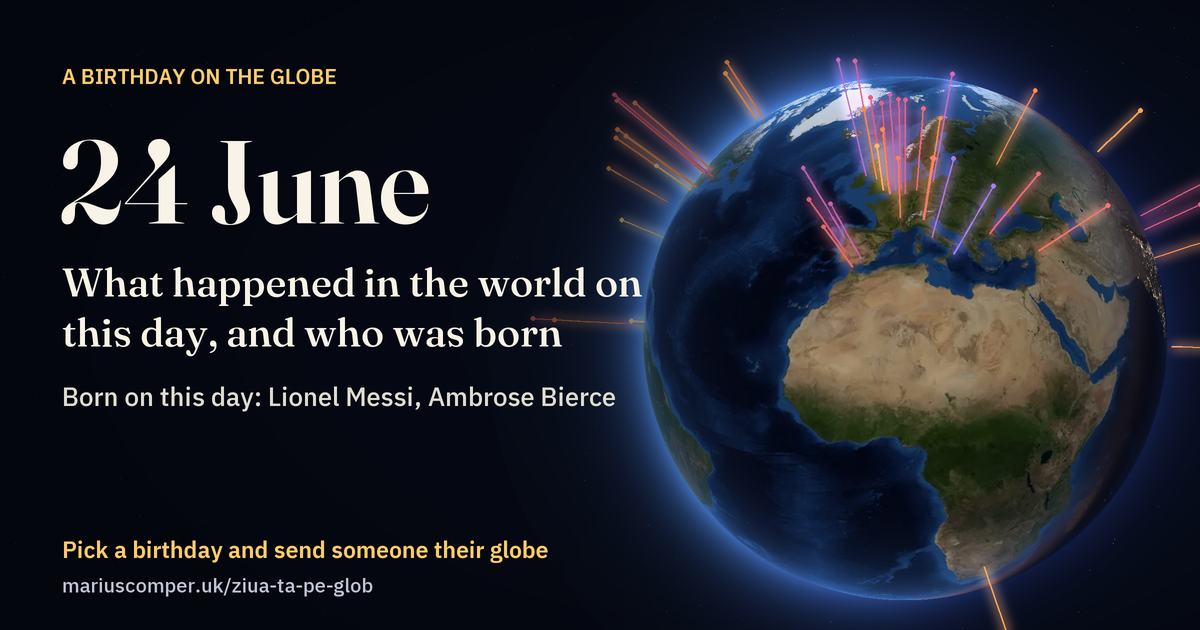
For 24 June, the English Wikipedia lists 73 events and 284 births. 45 of the events stand at their places as rays of light; six more are dashed circles, where the sentence links only to a country or a sea. The taller the ray, the longer ago it happened. The people born that day come further down, as blue points.
A birthday, yours or someone else’s:
Turn it into a greetingScroll: the globe turns to each place
The day you were born, on the globe.
Three things from your day
Scroll: your day first, then 24 June through the years
The Earth on 24 June
The picture on the globe was assembled by NASA from satellite photographs taken in June 2004: the snow, the ice and the green are those of the month.
On 24 June the Sun passes straight overhead at noon along the parallel of 23.4° north. In London, the day lasts about 16 hours 40 minutes.
Beyond 67° north the Sun no longer sets; beyond 67° south it no longer rises.
The line between day and night is tilted on the globe exactly as on this day of the year. On the dark side you can see the lights of towns.
Britain & Ireland · Westminster Abbey
1509
Henry VIII and Catherine of Aragon are crowned King and Queen of England.
On the map: Westminster Abbey.
Europe · Aqua Traiana
109
Roman emperor Trajan inaugurates the Aqua Traiana, an aqueduct that channels water from Lake Bracciano, 40 kilometres (25 miles) northwest of Rome.
On the map: Aqua Traiana.
Europe · Field of the Cloth of Gold
1520
The Field of the Cloth of Gold, a summit meeting between Henry VIII of England and Francis I of France, ends.
On the map: Field of the Cloth of Gold.
Europe · Red Square
1945
The first Victory Day Parade takes place on Red Square in Moscow, Soviet Union, symbolizing the victory of the Soviet Union over Nazi Germany.
On the map: Red Square.
North America · Mount Rainier
1947
Kenneth Arnold makes the first widely reported UFO sighting near Mount Rainier, Washington.
On the map: Mount Rainier.
North America · Supreme Court of the United States
1957
In Roth v. United States, the U.S. Supreme Court rules that obscenity is not protected by the First Amendment.
On the map: Supreme Court of the United States.
North America · Supreme Court of the United States
2022
In Dobbs v. Jackson Women's Health Organization, the U.S. Supreme Court rules that the U.S. Constitution does not assign the authority to regulate abortions to the federal government, thereby returning such authority to the individual states. This overturns the prior decisions in Roe v. Wade (1973) and Planned Parenthood v. Casey (1992).
On the map: Supreme Court of the United States.
Also on the day’s list of Wikipedia in Spanish and Chinese.
24 June
Born on 24 June#
The English Wikipedia lists 284 births for this day. The blue points are the birthplaces of 60 of these people: those written about in the most Wikipedia editions, where Wikidata gives a place of birth.
Born on 24 June
1987
Lionel Messi, Argentine footballer
Place of birth: Rosario.
Born on 24 June
1842
Ambrose Bierce, American short story writer, essayist, and journalist (died 1914)
Place of birth: Meigs County.
Born on 24 June
1883
Victor Francis Hess, Austrian-American physicist and academic, Nobel Prize laureate (died 1964)
Place of birth: Schloss Waldstein.
Born on 24 June
1911
Juan Manuel Fangio, Argentine race car driver (died 1995)
Place of birth: Balcarce.
Born on 24 June
1941
Julia Kristeva, Bulgarian-French psychoanalyst and author
Place of birth: Sliven.
Born in Britain and Ireland
1915
Fred Hoyle, English astronomer and author (died 2001)
Place of birth: Bingley.
Born in Britain and Ireland
1944
Jeff Beck, English guitarist and songwriter (died 2023)
Place of birth: Wallington.
Born in Britain and Ireland
1961
Iain Glen, Scottish actor
Place of birth: Edinburgh.
24 June
Number one in the charts that week
At the cinema
An animal recorded that day
The record can be seen in GBIF, which brings together wildlife records from around the world.
All your birthdays
The weather that day
Data: Met Office Hadley Centre (HadCET); NOAA (GHCN-Daily, Mauna Loa).
Above the Earth
Sources: Jonathan McDowell, GCAT (launches); GFZ Potsdam (Kp index). Days are counted in Universal Time.
Football that day
International matches played that day:
Source: the “International football results” dataset kept by Mart Jürisoo (CC0).
Also that day
The earthquake’s page at the USGS
Source: the USGS catalogue. The day is counted in Universal Time (UTC).
In those days
Make a link for someone
Type the name, pick the day and the year of birth. The link opens straight on their day, with their name in the greeting.
The link carries the name, date and place typed here; anyone who gets it can see them.
Put another birthday beside it
Your mother’s, your child’s, a friend’s: the two days appear side by side.
Below: 24 June through the years.
The whole globe of the day
Drag the globe to turn it. Touch a ray or a point to read what happened there.
Everything Wikipedia lists for 24 June
The list is the English Wikipedia’s, in its own wording, as it stood in October 2026. 22 events have no place on the map: the sentence links to no place with coordinates, only to places too wide to mark, or to several countries.
- 1312 BC
Mursili II launches a campaign against the Kingdom of Azzi-Hayasa.
Europe · Mursili's eclipseWikipedia: Mursili's eclipse - 109
Roman emperor Trajan inaugurates the Aqua Traiana, an aqueduct that channels water from Lake Bracciano, 40 kilometres (25 miles) northwest of Rome.
Europe · Aqua TraianaWikipedia: Trajan - 474
Julius Nepos forces Roman usurper Glycerius to abdicate the throne and proclaims himself Emperor of the Western Roman Empire.
Europe · Western Roman EmpireWikipedia: Julius Nepos - 637
The Battle of Moira is fought between the High King of Ireland and the Kings of Ulster and Dál Riata. It is claimed to be the largest battle in the history of Ireland.
Britain & Ireland · Battle of MoiraWikipedia: Battle of Moira - 843
The Vikings sack the French city of Nantes.
no place on the mapWikipedia: Vikings in Brittany - 972
Battle of Cedynia, the first documented victory of Polish forces, takes place.
Europe · Battle of CedyniaWikipedia: Battle of Cedynia - 1128
Battle of São Mamede, near Guimarães: Forces led by Afonso I defeat forces led by his mother Teresa of León and her lover Fernando Pérez de Traba.
Europe · GuimarãesWikipedia: Battle of São Mamede - 1230
The Siege of Jaén begins, in the context of the Spanish Reconquista.
Europe · Siege of JaénWikipedia: Siege of Jaén - 1314
First War of Scottish Independence: The Battle of Bannockburn concludes with a decisive victory by Scottish forces led by Robert the Bruce.
Britain & Ireland · Battle of BannockburnWikipedia: First War of Scottish Independence - 1340
Hundred Years' War: Battle of Sluys: The French fleet is almost completely destroyed by the English fleet commanded personally by King Edward III.
Europe · Battle of SluysWikipedia: Battle of Sluys - 1374
A sudden outbreak of St. John's Dance causes people in the streets of Aachen, Germany, to experience hallucinations and begin to jump and twitch uncontrollably until they collapse from exhaustion.
Europe · AachenWikipedia: Dancing mania - 1497
John Cabot lands in North America at Newfoundland leading the first European exploration of the region since the Vikings.
North America · NewfoundlandWikipedia: John Cabot - 1509
Henry VIII and Catherine of Aragon are crowned King and Queen of England.
Britain & Ireland · Westminster AbbeyWikipedia: Coronation of Henry VIII and Catherine - 1520
The Field of the Cloth of Gold, a summit meeting between Henry VIII of England and Francis I of France, ends.
Europe · Field of the Cloth of GoldWikipedia: Field of the Cloth of Gold - 1535
The Anabaptist state of Münster is conquered and disbanded.
no place on the mapWikipedia: Münster rebellion - 1540
English King Henry VIII commands his fourth wife, Anne of Cleves, to leave the court.
no place on the mapWikipedia: Henry VIII - 1559
The Book of Common Prayer, a major component of the Elizabethan religious settlement, was introduced as the liturgy of the Church of England through the Act of Uniformity 1558.
no place on the mapWikipedia: Church of England - 1571
Miguel López de Legazpi conquers Manila for Spain, modern day capital of the Philippines.
Asia · ManilaWikipedia: Miguel López de Legazpi - 1593
The Dutch city of Geertruidenberg held by the Spanish, capitulates to a besieging Dutch and English army led by Maurice of Nassau.
Europe · GeertruidenbergWikipedia: Siege of Geertruidenberg - 1604
Samuel de Champlain encounters the mouth of the Saint John River, site of Reversing Falls and the present-day city of Saint John, New Brunswick, Canada.
North America · Reversing FallsWikipedia: Samuel de Champlain - 1622
Battle of Macau: The Dutch make a failed attempt to capture Macau.
Asia · MacauWikipedia: Battle of Macau - 1663
The Spanish garrison of Évora capitulates, following the Portuguese victory at the Battle of Ameixial.
Europe · Battle of AmeixialWikipedia: Battle of Ameixial - 1713
The treaty of Adrianople ends the Russo-Turkish War of 1710–1713, which restores territory to the Ottomans while allowing the Russians to focus on their war against the Swedes.
Asia · EdirneWikipedia: Treaty of Adrianople - 1717
The Premier Grand Lodge of England is founded in London, the first Masonic Grand Lodge in the world (now the United Grand Lodge of England).
no place on the mapWikipedia: Premier Grand Lodge of England - 1724
On the Feast of St. John the Baptist, Bach leads the first performance of his Christ unser Herr zum Jordan kam, BWV 7, the third cantata of his chorale cantata cycle.
no place on the mapWikipedia: Nativity of John the Baptist - 1762
Battle of Wilhelmsthal: The British-Hanoverian army of Ferdinand of Brunswick defeats French forces in Westphalia.
Europe · Battle of WilhelmsthalWikipedia: Battle of Wilhelmsthal - 1779
American Revolutionary War: The Great Siege of Gibraltar begins.
Europe · Great Siege of GibraltarWikipedia: American Revolutionary War - 1793
The first Republican constitution in France is adopted.
no place on the mapWikipedia: French Constitution of 1793 - 1812
Napoleonic Wars: Napoleon's Grande Armée crosses the Neman river beginning the invasion of Russia.
no place on the mapWikipedia: Napoleonic Wars - 1813
Battle of Beaver Dams: A British and Indian combined force defeats the United States Army.
North America · Battle of Beaver DamsWikipedia: Battle of Beaver Dams - 1821
Battle of Carabobo: Decisive battle in the war of independence of Venezuela from Spain.
Latin America · Battle of CaraboboWikipedia: Battle of Carabobo - 1839
An Egyptian army under Ibrahim Pascha routs an Ottoman army under Hafiz Pasha in the battle of Nezib.
Asia · Battle of NezibWikipedia: Battle of Nezib - 1859
Battle of Solferino (Battle of the Three Sovereigns): Sardinia and France defeat Austria in Solferino, northern Italy.
Europe · Battle of SolferinoWikipedia: Battle of Solferino - 1866
Austro-Prussian War: In the Battle of Custoza an Austrian army defeats the Italian army.
Europe · Battle of CustozaWikipedia: Austro-Prussian War - 1880
First performance of O Canada at the Congrès national des Canadiens-Français. The song would later become the national anthem of Canada.
no place on the mapWikipedia: O Canada - 1894
Assassination of the French President, Sadi Carnot by Sante Caserio during the Ère des attentats (1892–1894).
Europe · Assassination of Sadi CarnotWikipedia: Assassination of Sadi Carnot - 1913
Greece and Serbia annul their alliance with Bulgaria.
no place on the mapWikipedia: Serbia - 1916
Mary Pickford becomes the first female film star to sign a million-dollar contract.
no place on the mapWikipedia: Mary Pickford - 1918
First airmail service in Canada from Montreal to Toronto.
North America · MontrealWikipedia: Airmail - 1922
The American Professional Football Association is renamed the National Football League.
no place on the mapWikipedia: National Football League - 1932
A bloodless revolution instigated by the People's Party ends the absolute power of King Prajadhipok of Siam (now Thailand).
no place on the mapWikipedia: Siamese revolution of 1932 - 1937
The U.S. Navy's first two fast battleships, North Carolina and Washington, of the North Carolina class, were respectively ordered from the New York and Philadelphia Naval Shipyards.
North America · Brooklyn Navy YardWikipedia: Philadelphia Naval Shipyard - 1939
Siam is renamed Thailand by Plaek Phibunsongkhram, the country's third prime minister.
no place on the mapWikipedia: Plaek Phibunsongkhram - 1939
The first of the Thai cultural mandates was issued, officially changing the country's name from Siam to Thailand.
no place on the mapWikipedia: Thai cultural mandates - 1940
World War II: Operation Collar, the first British Commando raid on occupied France, by No 11 Independent Company.
Europe · Neufchâtel-HardelotWikipedia: Operation Collar - 1943
US military police attempt to arrest a black soldier in Bamber Bridge, England, sparking the Battle of Bamber Bridge mutiny that leaves one dead and seven wounded.
Britain & Ireland · Bamber BridgeWikipedia: Battle of Bamber Bridge - 1945
The first Victory Day Parade takes place on Red Square in Moscow, Soviet Union, symbolizing the victory of the Soviet Union over Nazi Germany.
Europe · Red SquareWikipedia: Victory Day parades - 1947
Kenneth Arnold makes the first widely reported UFO sighting near Mount Rainier, Washington.
North America · Mount RainierWikipedia: Kenneth Arnold UFO sighting - 1948
Cold War: Start of the Berlin Blockade: The Soviet Union makes overland travel between West Germany and West Berlin impossible.
Europe · Berlin BlockadeWikipedia: Berlin Blockade - 1949
The first television western, Hopalong Cassidy, starring William Boyd, is aired on NBC.
no place on the mapWikipedia: Westerns on television - 1950
Apartheid: In South Africa, the Group Areas Act is passed, formally segregating races.
no place on the mapWikipedia: Apartheid - 1954
First Indochina War: Battle of Mang Yang Pass: Viet Minh troops belonging to the 803rd Regiment ambush G.M. 100 of France in An Khê.
Asia · Battle of Mang Yang PassWikipedia: Battle of Mang Yang Pass - 1957
In Roth v. United States, the U.S. Supreme Court rules that obscenity is not protected by the First Amendment.
North America · Supreme Court of the United StatesWikipedia: Supreme Court of the United States - 1960
Venezuelan President Rómulo Betancourt is injured in an assassination attempt.
Latin America · Paseo Los PróceresWikipedia: Attempted assassination of Rómulo Betancourt - 1963
The United Kingdom grants Zanzibar internal self-government.
Africa · ZanzibarWikipedia: Zanzibar - 1973
The UpStairs Lounge arson attack takes place at a gay bar located on the second floor of the three-story building at 141 Chartres Street in the French Quarter of New Orleans, Louisiana, US. Thirty-two people die as a result of fire or smoke inhalation.
North America · UpStairs Lounge arson attackWikipedia: UpStairs Lounge arson attack - 1975
Eastern Air Lines Flight 66 encounters severe wind shear and crashes on final approach to New York's JFK Airport killing 113 of the 124 passengers on board, making it the deadliest U.S. plane crash at the time. This accident led to decades of research into downburst and microburst phenomena and their effects on aircraft.
North America · Eastern Air Lines Flight 66Wikipedia: Eastern Air Lines Flight 66 - 1978
Ahmad al-Ghashmi, the president of the Yemen Arab Republic, is killed when a bomb exploded in a suitcase carried by a South Yemeni envoy.
Asia · Yemen Arab RepublicWikipedia: Ahmad al-Ghashmi - 1981
The Humber Bridge opens to traffic, connecting Yorkshire and Lincolnshire. It remained the world's longest bridge span for 17 years.
Britain & Ireland · LincolnshireWikipedia: Humber Bridge - 1982
"The Jakarta Incident": British Airways Flight 009 flies into a cloud of volcanic ash thrown up by the eruption of Mount Galunggung, resulting in the failure of all four engines.
Asia · British Airways Flight 009Wikipedia: British Airways Flight 009 - 1989
Jiang Zemin succeeds Zhao Ziyang to become the General Secretary of the Chinese Communist Party after the 1989 Tiananmen Square protests and massacre.
Asia · 1989 Tiananmen Square protests and massacreWikipedia: 1989 Tiananmen Square protests and massacre - 1994
A Boeing B-52 Stratofortress crashes at Fairchild Air Force Base near Spokane, Washington, killing four.
North America · 1994 Fairchild Air Force Base B-52 crashWikipedia: 1994 Fairchild Air Force Base B-52 crash - 1995
Rugby World Cup: South Africa defeats New Zealand and Nelson Mandela presents Francois Pienaar with the Webb Ellis Cup in an iconic post-apartheid moment.
Africa · 1995 Rugby World CupWikipedia: 1995 Rugby World Cup - 2002
The Igandu train disaster in Tanzania kills 281, the worst train accident in African history.
Africa · TanzaniaWikipedia: Igandu train collision - 2004
In New York, capital punishment is declared unconstitutional.
no place on the mapWikipedia: Capital punishment - 2010
At Wimbledon, John Isner of the United States defeats Nicolas Mahut of France, in the longest match in professional tennis history.
Britain & Ireland · All England Lawn Tennis and Croquet ClubWikipedia: Isner–Mahut match at the 2010 Wimbledon Championships - 2010
Julia Gillard assumes office as the first female Prime Minister of Australia.
no place on the mapWikipedia: Julia Gillard - 2012
Death of Lonesome George, the last known individual of Chelonoidis nigra abingdonii, a subspecies of the Galápagos tortoise.
no place on the mapWikipedia: Lonesome George - 2013
Former Italian Prime Minister Silvio Berlusconi is found guilty of abusing his power and engaging in sex with an underage prostitute, and is sentenced to seven years in prison.
no place on the mapWikipedia: Prime Minister of Italy - 2021
The Champlain Towers South condominium in Surfside, Florida suffers a sudden partial collapse, killing 98 people inside.
North America · Surfside condominium collapseWikipedia: Surfside condominium collapse - 2022
In Dobbs v. Jackson Women's Health Organization, the U.S. Supreme Court rules that the U.S. Constitution does not assign the authority to regulate abortions to the federal government, thereby returning such authority to the individual states. This overturns the prior decisions in Roe v. Wade (1973) and Planned Parenthood v. Casey (1992).
North America · Supreme Court of the United StatesWikipedia: Supreme Court of the United States - 2023
The Wagner Group led by Yevgeny Prigozhin launches an insurrection against the Russian government.
no place on the mapWikipedia: Wagner Group rebellion - 2026
Two earthquakes strike Venezuela, leaving more than 2,200 people dead and dozens of others missing.
Latin America · 2026 Venezuela earthquakesWikipedia: 2026 Venezuela earthquakes
Who was born on 24 June
In order of how many Wikipedia editions have an article about each. The first 60 of 284 are shown.
- 1987
Lionel Messi, Argentine footballer
RosarioWikipedia: Lionel Messi - 1842
Ambrose Bierce, American short story writer, essayist, and journalist (died 1914)
Meigs CountyWikipedia: Ambrose Bierce - 1962
Claudia Sheinbaum, Mexican politician
Mexico CityWikipedia: Claudia Sheinbaum - 1883
Victor Francis Hess, Austrian-American physicist and academic, Nobel Prize laureate (died 1964)
Schloss WaldsteinWikipedia: Victor Hess - 1911
Juan Manuel Fangio, Argentine race car driver (died 1995)
BalcarceWikipedia: Juan Manuel Fangio - 1941
Julia Kristeva, Bulgarian-French psychoanalyst and author
- 1927
Martin Lewis Perl, American physicist and engineer, Nobel Prize laureate (died 2014)
ManhattanWikipedia: Martin Lewis Perl - 1911
Ernesto Sabato, Argentine physicist and academic (died 2011)
CauceteWikipedia: Ernesto Sabato - 1915
Fred Hoyle, English astronomer and author (died 2001)
BingleyWikipedia: Fred Hoyle - 1992
David Alaba, Austrian footballer
ViennaWikipedia: David Alaba - 1838
Jan Matejko, Polish painter (died 1893)
Free City of KrakówWikipedia: Jan Matejko - 1944
Jeff Beck, English guitarist and songwriter (died 2023)
WallingtonWikipedia: Jeff Beck - 1978
Shunsuke Nakamura, Japanese footballer
YokohamaWikipedia: Shunsuke Nakamura - 1978
Juan Román Riquelme, Argentine footballer and chairman
San FernandoWikipedia: Juan Román Riquelme - 1930
Claude Chabrol, French actor, director, producer, and screenwriter (died 2010)
10ᵗʰ arrondissement of ParisWikipedia: Claude Chabrol - 1953
William E. Moerner, American chemist and physicist, Nobel Prize laureate
PleasantonWikipedia: William E. Moerner - 1850
Herbert Kitchener, 1st Earl Kitchener, Irish field marshal and politician, Governor-General of Sudan (died 1916)
BallylongfordWikipedia: Herbert Kitchener, 1st Earl Kitchener - 1999
Darwin Núñez, Uruguayan footballer
ArtigasWikipedia: Darwin Núñez - 1929
Carolyn S. Shoemaker, American astronomer (died 2021)
- 1937
Anita Desai, Indian-American author and academic
MussoorieWikipedia: Anita Desai - 1938
Abulfaz Elchibey, Azerbaijani politician, 1st democratically elected Azerbaijani President (died 2000)
- 1979
Mindy Kaling, American actress and producer
CambridgeWikipedia: Mindy Kaling - 1314
Philippa of Hainault Queen of England (died 1369)
ValenciennesWikipedia: Philippa of Hainault - 1895
Jack Dempsey, American boxer and soldier (died 1983)
ManassaWikipedia: Jack Dempsey - 1961
Iain Glen, Scottish actor
EdinburghWikipedia: Iain Glen - 1888
Gerrit Rietveld, Dutch architect, designed the Rietveld Schröder House (died 1964)
UtrechtWikipedia: Gerrit Rietveld - 1795
Ernst Heinrich Weber, German physician and psychologist (died 1878)
Lutherstadt WittenbergWikipedia: Ernst Heinrich Weber - 1813
Henry Ward Beecher, American minister and reformer (died 1887)
LitchfieldWikipedia: Henry Ward Beecher - 1986
Solange Knowles, American singer-songwriter and actress
HoustonWikipedia: Solange Knowles - 1942
Eduardo Frei Ruiz-Tagle, Chilean engineer and politician, 32nd President of Chile
- 1947
Peter Weller, American actor and director
Stevens PointWikipedia: Peter Weller - 1962
Gautam Adani, Indian industrialist and billionaire
AhmedabadWikipedia: Gautam Adani - 1978
Luis García, Spanish footballer
BarcelonaWikipedia: Luis García - 1988
Micah Richards, English footballer
BirminghamWikipedia: Micah Richards - 1982
Kevin Nolan, English footballer
LiverpoolWikipedia: Kevin Nolan - 1980
Cicinho, Brazilian footballer
PradópolisWikipedia: Cicinho - 1980
Minka Kelly, American actress
Los AngelesWikipedia: Minka Kelly - 1519
Theodore Beza, French theologian and scholar (died 1605)
VézelayWikipedia: Theodore Beza - 1893
Roy O. Disney, American businessman, co-founded The Walt Disney Company (died 1971)
ChicagoWikipedia: Roy O. Disney - 1950
Nancy Allen, American actress
The BronxWikipedia: Nancy Allen - 1985
Diego Alves Carreira, Brazilian footballer
Rio de JaneiroWikipedia: Diego Alves - 1532
Robert Dudley, 1st Earl of Leicester, English politician (died 1588)
- 1386
John of Capistrano, Italian priest and saint (died 1456)
CapestranoWikipedia: John of Capistrano - 1996
Duki, Argentine rapper
AlmagroWikipedia: Duki - 1901
Harry Partch, American composer and theorist (died 1974)
CaliforniaWikipedia: Harry Partch - 1907
Arseny Tarkovsky, Russian poet and translator (died 1989)
KropyvnytskyiWikipedia: Arseny Tarkovsky - 1940
Vittorio Storaro, Italian cinematographer
- 1946
Ellison Onizuka, American engineer, and astronaut (died 1986)
Kailua-KonaWikipedia: Ellison Onizuka - 1616
Ferdinand Bol, Dutch painter, etcher and draftsman, student of Rembrandt (died 1680)
DordrechtWikipedia: Ferdinand Bol - 1978
Emppu Vuorinen, Finnish guitarist and songwriter
- 1777
John Ross, Scottish commander and explorer (died 1856)
StranraerWikipedia: John Ross - 1869
Prince George of Greece and Denmark (died 1957)
- 1946
Robert Reich, American economist and politician, 22nd United States Secretary of Labor
ScrantonWikipedia: Robert Reich - 1972
Robbie McEwen, Australian cyclist
BrisbaneWikipedia: Robbie McEwen - 1804
Stephan Endlicher, Austrian botanist, numismatist, and sinologist (died 1849)
BratislavaWikipedia: Stephan Endlicher - 1883
Jean Metzinger, French artist (died 1956)
- 1998
Federico Gatti, Italian footballer
- 1535
Joanna of Austria, Princess of Portugal (died 1573)
- 1880
Oswald Veblen, American mathematician and academic (g. 1960)
DecorahWikipedia: Oswald Veblen - 1945
George Pataki, American lawyer and politician, 53rd Governor of New York
PeekskillWikipedia: George Pataki
What is celebrated on 24 June
- Army Day or Battle of Carabobo Day (Venezuela)
- Bannockburn Day (Scotland)
- Christian feast day: Gohard
- Christian feast day: Joseph Yuan
- Christian feast day: María Guadalupe García Zavala
- Christian feast day: Nativity of Saint John the Baptist
- Christian feast day: Rumbold of Mechlin
- Christian feast day: June 24 (Eastern Orthodox liturgics)
- Day of the Caboclo (Amazonas, Brazil)
- Inti Raymi, a winter solstice festival and a New Year in the Andes of the Southern Hemisphere (Sacsayhuamán)
- St John's Day and the second day of the Midsummer celebrations (although this is not the astronomical summer solstice, see June 20) (Roman Catholic Church, Europe), and its related observances: Enyovden (Bulgaria)
- St John's Day and the second day of the Midsummer celebrations (although this is not the astronomical summer solstice, see June 20) (Roman Catholic Church, Europe), and its related observances: Jaanipäev (Estonia)
- St John's Day and the second day of the Midsummer celebrations (although this is not the astronomical summer solstice, see June 20) (Roman Catholic Church, Europe), and its related observances: Jāņi (Latvia)
- St John's Day and the second day of the Midsummer celebrations (although this is not the astronomical summer solstice, see June 20) (Roman Catholic Church, Europe), and its related observances: Jónsmessa (Iceland)
A greeting link for someone
Type a name and, if you like, the year of birth. The link opens with a greeting, and beside each event it says how old the person turned that day, or how many years before their birth it happened.
The name and the year go only into the link you send.
All 366 days
How the globe is made
Where the events come from
Each edition of this page uses the day’s list from Wikipedia in its own language: Romanian, English, Spanish, Chinese. The lists are written by volunteers and differ from one edition to the next; the text of each event is Wikipedia’s, with a link to the article. A row that appears twice in a list is shown once. The lists have not been checked event by event: they are Wikipedia’s, mistakes included.
For events before 1582, and for countries that moved to the Gregorian calendar later (Britain in 1752, Russia in 1918), the same day may be counted Old Style in one list and New Style in another.
The chapter “What the other Wikipedias remember” adds up to five events a day from the lists of the other three editions, only for years in which the English list has nothing on that day. They were translated for this page, passed the same filters as the tour, and are not counted among the events of the English list.
How an event gets onto the map
The place comes from Wikidata. If the sentence links to the article about the event itself (a battle, an opening, an earthquake), dated to the same year, the ray stands on its coordinates or on those of its location. Otherwise it stands on the first place the sentence links to: a town, a building, a mountain, an island. This second step can be wrong: sometimes the sentence only mentions the place. That is why the page says, under each event, which place the ray stands on.
When the sentence links to a single state or province, or to a single sea, lake or desert larger than 5,000 km², the globe shows a dashed circle, not a ray. The circle has the area Wikidata gives, with its radius kept between 1.2° and 16°, or a radius of 4.5° when Wikidata gives no area; it says only that the sentence links to that place. Organisations, ships, spacecraft, museum objects, rivers, mountain ranges, languages and continents are never used as places. When a sentence names several states and no exact place, the event stays in the list only.
What the height means
The height of a ray shows how many years have passed, on a logarithmic scale: 10 years, 100 years and 1,000 years are equal steps apart; anything older than about 2,600 years has the tallest ray. The colour runs from pale yellow for recent years to violet for antiquity.
Where the tour stops
In each region the tour stops at up to three events (five in Britain and Ireland), chosen mainly by three things: whether Wikipedia’s editors put the event in the “On this day” box of their main page (the English, Spanish and Chinese editions), how many Wikipedia editions have an article about it, and how many of the four lists include it. Events whose sentence or article is about a war, an attack, a crime or a disaster are left out of the tour; they stay in the whole list, in Wikipedia’s wording. The filter is a list of words and a list of Wikidata types, so it can miss some.
The tour of births names the people with articles in the most editions and leaves aside those whom the list or Wikidata describes as rulers, politicians, commanders, leaders of movements or criminals; they stay in the list.
The Earth and the Sun
The daytime images are NASA’s Blue Marble Next Generation mosaics, one for each month of 2004; the night side is Black Marble 2016. The tilt of the line between day and night is computed for the day; the hour is chosen so that the place being read is in daylight. The latitude where the Sun stands overhead is the average of the four years of the leap cycle; in a given year it can differ by up to 0.4°.
The day you were born
The number ones come from the weekly lists on Wikipedia: Billboard for the United States (from 1940; the Hot 100 from August 1958), the UK Singles Chart (from November 1952), Los 40 Principales for Spain (from July 1966) and, for Romania, the Romanian Top 100 and Airplay 100 (2001–2021, with missing weeks). The page shows the chart of the week in which the day of birth falls, with its date; Billboard and the UK chart are dated at the end of their week. For Romania before 2001 and for China these sources have no weekly chart.
The films are those that reached cinemas in the United States up to ten days before or three days after that day (some of them in a few cinemas at first), from the English Wikipedia’s yearly lists (from 1968), in order of how many editions have an article about them. The events “in those days” are the ones on the neighbouring days’ lists that carry the year of birth, passed through the same filter as the tour.
The day of birth, year included
The Moon, the star sign and the constellation are worked out by the page itself, for noon Universal Time on the day. The lit part of the Moon is rounded and can differ by a few per cent from that at the hour of birth. The sign follows the usual zodiac of twelve equal parts starting at the March equinox; the constellation is the one the Sun actually stood in front of, by the borders set by the International Astronomical Union, and within a day of a border the page does not name it. When the Sun changes sign while it is that day anywhere on Earth, the page gives the moment of crossing, rounded to ten minutes and accurate to within about a quarter of an hour, and the clock time in a few cities, with the time zone and summer time of that year.
The year in the Chinese calendar is the one your device’s own calendar gives for the date, checked against the Hong Kong Observatory’s tables. “All your birthdays” uses the same sources as the rest of the chapter for the same day in every year since the birth: the temperature, well-known launches that took place on that very day, matches of the teams the edition follows, snow deeper than 10 cm and strong geomagnetic storms. The three things at the top and the four on the picture are chosen in a fixed order (the song, the animal, a full Moon, a well-known launch before an ordinary earthquake); on the picture you can change them.
When the link carries a year of birth, the page adds a few things about that exact day. The weather is the Met Office’s Central England temperature record and the readings from New York’s Central Park; the “usual high” is the average of the daily highs of 1961–1990 for that date, with two days either side. The carbon dioxide figure is the monthly mean at the Mauna Loa observatory, where measurements begin in March 1958.
The earthquake is the one with the largest magnitude in the USGS catalogue for that day, counted in Universal Time. Before the 1960s the catalogue has gaps even above magnitude 5.5, so in the older years many days have no earthquake. The page gives only the magnitude and the place: the country the epicentre falls in or, when the epicentre is at sea within 300 km of a coast, the nearest country; farther out, only the ocean.
The launches are those that reached orbit or left for the Moon and the planets, from Jonathan McDowell’s GCAT catalogue. If nothing left that day, the page shows the nearest launch within three days before or after, and says how many days away it was. The geomagnetic storm appears only when the Kp index reached at least 5 in one of the day’s eight three-hour intervals.
The animal comes from GBIF: an observation made by a person (the animal seen or heard, or its tracks), dated to that exact day, with coordinates and a CC0 or CC BY licence. Only a few hundred well-known species are searched (mammals, birds, turtles, butterflies); of those noted that day, mammals and species with articles in many Wikipedia editions come first; birds noted almost every day, and species used recently, wait their turn. Observations dated 1 January are left out, because records without a day are often filed there. An observation shows that the animal was recorded there, not how many animals there were.
The matches are those between national teams. Only matches of England, Scotland, Wales, Northern Ireland, the Republic of Ireland, the United States, Canada and Australia are shown, along with those at the big final tournaments. The picture to send is drawn in the page from the day’s globe and the facts above, and stays on your device until you send it.
Sources
- Events, births and holidays: the day’s page on Wikipedia, text under CC BY-SA 4.0.
- Coordinates, places of birth and the number of editions: Wikidata (CC0).
- The Earth by day: NASA Blue Marble Next Generation. The Earth by night: NASA Black Marble 2016.
- Borders and regions: Natural Earth.
- World population and births per year: UN World Population Prospects 2024.
- Charts and films: Wikipedia’s lists for Billboard, the UK Singles Chart, Los 40 Principales, Romanian Top 100, Airplay 100 and American films by year (CC BY-SA 4.0).
- Weather: Met Office Hadley Centre, HadCET (Open Government Licence) and NOAA GHCN-Daily, New York Central Park. Carbon dioxide: NOAA Global Monitoring Laboratory, Mauna Loa.
- Earthquakes: the USGS catalogue. Launches: Jonathan McDowell, GCAT (CC BY). Kp index: GFZ Potsdam (CC BY 4.0). Matches: International football results, Mart Jürisoo (CC0).
- Animal observations: GBIF, with a link to each record; species names come from Wikidata.