A birthday on the globe
2 June on the globe: what happened in the world on this day, and who was born
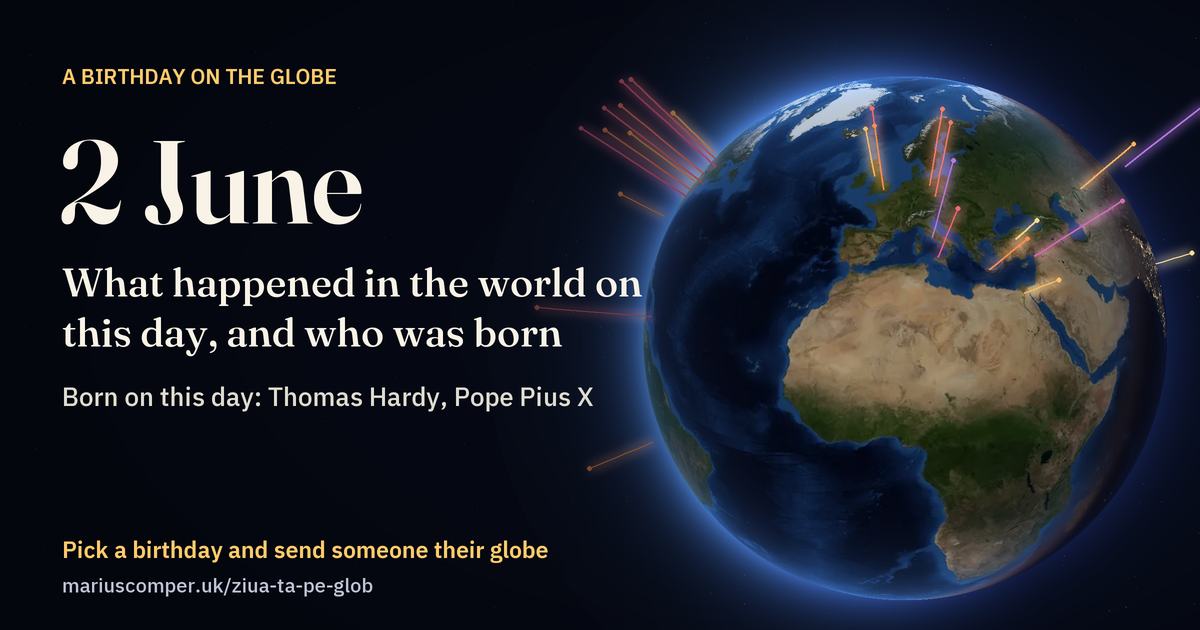
For 2 June, the English Wikipedia lists 48 events and 206 births. 25 of the events stand at their places as rays of light; three more are dashed circles, where the sentence links only to a country or a sea. The taller the ray, the longer ago it happened. The people born that day come further down, as blue points.
A birthday, yours or someone else’s:
Turn it into a greetingScroll: the globe turns to each place
The day you were born, on the globe.
Three things from your day
Scroll: your day first, then 2 June through the years
The Earth on 2 June
The picture on the globe was assembled by NASA from satellite photographs taken in June 2004: the snow, the ice and the green are those of the month.
On 2 June the Sun passes straight overhead at noon along the parallel of 22.2° north. In London, the day lasts about 16 hours 20 minutes.
Beyond 68° north the Sun no longer sets; beyond 68° south it no longer rises.
The line between day and night is tilted on the globe exactly as on this day of the year. On the dark side you can see the lights of towns.
Britain & Ireland · Westminster Abbey
1953
The coronation of Queen Elizabeth II at Westminster Abbey becomes the first British coronation, and one of the first major international events, to be televised.
On the map: Westminster Abbey.
Also on the day’s list of Wikipedia in Spanish and Chinese.
Europe · Prague
1848
The Slavic Congress opens in Prague.
On the map: Prague.
Asia · Baikonur
2003
Europe launches its first voyage to another planet, Mars. The European Space Agency's Mars Express probe launches from the Baikonur space center in Kazakhstan.
On the map: Baikonur.
Asia · Ankara
2022
Following a request from Ankara, the United Nations officially changes the name of the Republic of Turkey in the organization from what was previously known as "Turkey" to "Türkiye".
On the map: Ankara.
North America · Colony of Virginia
1608
The Colony of Virginia gets a charter, extending borders from "sea to sea".
On the map: Colony of Virginia.
North America · Quebec City
1615
The first Récollet missionaries arrive at Quebec City, from Rouen, France.
On the map: Quebec City.
North America · Blue Room
1886
The wedding of Grover Cleveland and Frances Folsom took place in the White House, in the only time that a U.S. president has married in the building.
On the map: Blue Room.
2 June
What the other Wikipedias remember#
For these years the English list has nothing on this day. The events below come from the same day’s lists on Wikipedia in Spanish and were translated for this page.
From Wikipedia in Spanish · Milan
2007
In Milan (Italy), for the first time in history, a woman, Laura Pausini, gives a concert at the famous San Siro stadium.
On the map: Milan.
Translated from the list on Wikipedia in Spanish.
The article on Wikipedia in Spanish: Estadio Giuseppe Meazza
2 June
Born on 2 June#
The English Wikipedia lists 206 births for this day. The blue points are the birthplaces of 60 of these people: those written about in the most Wikipedia editions, where Wikidata gives a place of birth.
Born on 2 June
1840
Thomas Hardy, English novelist and poet (died 1928)
Place of birth: Dorchester.
Born on 2 June
1857
Karl Adolph Gjellerup, Danish author and poet, Nobel Prize laureate (died 1919)
Place of birth: Roholte.
Born on 2 June
1988
Sergio Agüero, Argentine footballer
Place of birth: Buenos Aires.
Born on 2 June
1857
Edward Elgar, English composer and educator (died 1934)
Place of birth: Lower Broadheath.
Born in Britain and Ireland
1972
Wentworth Miller, American actor and screenwriter
Place of birth: Chipping Norton.
Born in Britain and Ireland
1941
Charlie Watts, English drummer, songwriter, and producer (died 2021)
Place of birth: London.
Born in Britain and Ireland
1978
Dominic Cooper, English actor
Place of birth: Greenwich.
2 June
Number one in the charts that week
At the cinema
An animal recorded that day
The record can be seen in GBIF, which brings together wildlife records from around the world.
All your birthdays
The weather that day
Data: Met Office Hadley Centre (HadCET); NOAA (GHCN-Daily, Mauna Loa).
Above the Earth
Sources: Jonathan McDowell, GCAT (launches); GFZ Potsdam (Kp index). Days are counted in Universal Time.
Football that day
International matches played that day:
Source: the “International football results” dataset kept by Mart Jürisoo (CC0).
Also that day
The earthquake’s page at the USGS
Source: the USGS catalogue. The day is counted in Universal Time (UTC).
In those days
Make a link for someone
Type the name, pick the day and the year of birth. The link opens straight on their day, with their name in the greeting.
The link carries the name, date and place typed here; anyone who gets it can see them.
Put another birthday beside it
Your mother’s, your child’s, a friend’s: the two days appear side by side.
Below: 2 June through the years.
The whole globe of the day
Drag the globe to turn it. Touch a ray or a point to read what happened there.
Everything Wikipedia lists for 2 June
The list is the English Wikipedia’s, in its own wording, as it stood in October 2026. 20 events have no place on the map: the sentence links to no place with coordinates, only to places too wide to mark, or to several countries.
- 260
Sima Zhao's regicide of Cao Mao: The figurehead Wei emperor Cao Mao personally leads an attempt to oust his regent, Sima Zhao; the attempted coup is crushed and the emperor killed.
Asia · LuoyangWikipedia: Sima Zhao's regicide of Cao Mao - 455
Sack of Rome: Vandals enter Rome, and plunder the city for two weeks.
Europe · Sack of RomeWikipedia: Sack of Rome - 575
Pope Benedict I is consecrated after obtaining imperial approval from Constantinople.
no place on the mapWikipedia: Pope Benedict I - 1098
First Crusade: The first Siege of Antioch ends as Crusader forces take the city; the second siege began five days later.
Asia · Siege of AntiochWikipedia: First Crusade - 1259
Wedding of Manfred, King of Sicily, and Byzantine princess Helena Angelina Doukaina.
no place on the mapWikipedia: Manfred, King of Sicily - 1608
The Colony of Virginia gets a charter, extending borders from "sea to sea".
North America · Colony of VirginiaWikipedia: Colony of Virginia - 1615
The first Récollet missionaries arrive at Quebec City, from Rouen, France.
North America · Quebec CityWikipedia: Recollects - 1676
Franco-Dutch War: France ensures the supremacy of its naval fleet for the remainder of the war with its victory in the Battle of Palermo.
Europe · Battle of PalermoWikipedia: Battle of Palermo - 1692
Bridget Bishop is the first person to be tried for witchcraft in Salem, Massachusetts; she is found guilty the same day and hanged on June 10.
North America · Salem witch trialsWikipedia: Salem witch trials - 1763
Pontiac's Rebellion: At what is now Mackinaw City, Michigan, Chippewas capture Fort Michilimackinac by diverting the garrison's attention with a game of lacrosse, then chasing a ball into the fort.
North America · Mackinaw City, MichiganWikipedia: Pontiac's War - 1774
Intolerable Acts: The Quartering Act of 1774 is enacted, allowing a governor in colonial America to house British soldiers in uninhabited houses, outhouses, barns, or other buildings if suitable quarters are not provided.
North America · Thirteen ColoniesWikipedia: Intolerable Acts - 1780
The anti-Catholic Gordon Riots in London leave an estimated 300 to 700 people dead.
Britain & Ireland · LondonWikipedia: Gordon Riots - 1793
French Revolution: François Hanriot, leader of the Parisian National Guard, arrests 22 Girondists selected by Jean-Paul Marat, setting the stage for the Reign of Terror.
Europe · French First RepublicWikipedia: French Revolution - 1802
Henry Hacking killed the Aboriginal Australian resistance fighter Pemulwuy after Philip Gidley King ordered that he be brought in dead or alive.
no place on the mapWikipedia: Pemulwuy - 1805
Napoleonic Wars: A Franco-Spanish fleet recaptures from the British the island of Diamond Rock, which guards the entrance to the bay leading to Fort-de-France, Martinique.
Europe · Battle of Diamond RockWikipedia: Napoleonic Wars - 1848
The Slavic Congress opens in Prague.
Europe · PragueWikipedia: Prague Slavic Congress, 1848 - 1866
The Fenians defeat Canadian forces at Ridgeway and Fort Erie, but the raids end soon after.
North America · Battle of RidgewayWikipedia: Battle of Ridgeway - 1878
Nobiling assassination attempt by anarchist Karl Nobiling targeting the German Kaiser, Wilhelm I.
Europe · Nobiling assassination attemptWikipedia: Nobiling assassination attempt - 1886
The wedding of Grover Cleveland and Frances Folsom took place in the White House, in the only time that a U.S. president has married in the building.
North America · Blue RoomWikipedia: Wedding of Grover Cleveland and Frances Folsom - 1896
Guglielmo Marconi applies for a patent for his wireless telegraph.
no place on the mapWikipedia: Guglielmo Marconi - 1909
Alfred Deakin becomes Prime Minister of Australia for the third time.
no place on the mapWikipedia: Alfred Deakin - 1910
Charles Rolls, a co-founder of Rolls-Royce Limited, becomes the first man to make a non-stop double crossing of the English Channel by plane.
no place on the mapWikipedia: Charles Rolls - 1919
Anarchists simultaneously set off bombs in eight separate U.S. cities.
no place on the mapWikipedia: Anarchism - 1924
U.S. President Calvin Coolidge signs the Indian Citizenship Act into law, granting citizenship to all Native Americans born within the territorial limits of the United States.
no place on the mapWikipedia: Native Americans in the United States - 1941
World War II: German paratroopers murder Greek civilians in the villages of Kondomari and Alikianos.
Europe · Massacre of KondomariWikipedia: Massacre of Kondomari - 1946
Birth of the Italian Republic: In a referendum, Italians vote to turn Italy from a monarchy into a Republic. After the referendum, King Umberto II of Italy is exiled.
Europe · ItalyWikipedia: 1946 Italian institutional referendum - 1953
The coronation of Queen Elizabeth II at Westminster Abbey becomes the first British coronation, and one of the first major international events, to be televised.
Britain & Ireland · Westminster AbbeyWikipedia: Coronation of Elizabeth II - 1955
The USSR and Yugoslavia sign the Belgrade declaration and thus normalize relations between the two countries, discontinued since 1948.
no place on the mapWikipedia: Belgrade declaration - 1958
Aeronaves de México Flight 111 crashes on approach to Guadalajara International Airport, killing 45.
Latin America · Aeronaves de México Flight 111Wikipedia: Aeronaves de México Flight 111 - 1962
During the FIFA World Cup, police intervene multiple times in fights between Chilean and Italian players in one of the most violent games in football history.
Latin America · Carlos Dittborn StadiumWikipedia: 1962 FIFA World Cup - 1964
The Palestine Liberation Organization (PLO) is formed.
no place on the mapWikipedia: Palestine Liberation Organization - 1966
Surveyor program: Surveyor 1 lands in Oceanus Procellarum on the Moon, becoming the first U.S. spacecraft to soft-land on another world.
no place on the mapWikipedia: Surveyor program - 1967
Luis Monge is executed in Colorado's gas chamber, in the last pre-Furman execution in the United States.
no place on the mapWikipedia: Capital punishment in Colorado - 1967
Protests in West Berlin against the arrival of the Shah of Iran are brutally suppressed, during which Benno Ohnesorg is killed by a police officer. His death results in the founding of the terrorist group 2 June Movement.
no place on the mapWikipedia: West Berlin - 1973
Della Aleksander co-presented an episode of Open Door on transgender women's lives.
no place on the mapWikipedia: Della Aleksander - 1979
Pope John Paul II starts his first official visit to his native Poland, becoming the first Pope to visit a Communist country.
no place on the mapWikipedia: Pope John Paul II - 1983
After an emergency landing because of an in-flight fire, twenty-three passengers aboard Air Canada Flight 797 are killed when a flashover occurs as the plane's doors open. Because of this incident, numerous new safety regulations are put in place.
North America · Air Canada Flight 797Wikipedia: Air Canada Flight 797 - 1990
The Lower Ohio Valley tornado outbreak spawns 66 confirmed tornadoes in Illinois, Indiana, Kentucky, and Ohio, killing 12.
no place on the mapWikipedia: June 1990 Lower Ohio Valley tornado outbreak - 1995
Bosnian War: U.S. Air Force captain Scott O'Grady was shot down while patrolling the NATO no-fly zone over Bosnia, but ejected safely and was rescued six days later.
no place on the mapWikipedia: Bosnian War - 1997
In Denver, Timothy McVeigh is convicted on 11 counts of murder and conspiracy for his role in the 1995 bombing of the Alfred P. Murrah Federal Building in Oklahoma City, in which 168 people died. He was executed four years later.
North America · DenverWikipedia: Oklahoma City bombing - 1998
Space Shuttle Discovery is launched on STS-91, the final mission of the Shuttle-Mir program.
no place on the mapWikipedia: Space Shuttle Discovery - 2003
Europe launches its first voyage to another planet, Mars. The European Space Agency's Mars Express probe launches from the Baikonur space center in Kazakhstan.
Asia · BaikonurWikipedia: Mars - 2008
Artist Tim Buckley published "Loss" as part of his webcomic Ctrl+Alt+Del.
no place on the mapWikipedia: Tim Buckley - 2010
Twelve people are killed and eleven others injured in a spree shooting in Cumbria, England, before the perpetrator takes his own life.
Britain & Ireland · SeascaleWikipedia: Cumbria shootings - 2012
Former Egyptian President Hosni Mubarak is sentenced to life imprisonment for his role in the killing of demonstrators during the 2011 Egyptian revolution.
Africa · 2011 Egyptian revolutionWikipedia: 2011 Egyptian revolution - 2014
Telangana officially becomes the 29th state of India, formed from ten districts of northwestern Andhra Pradesh.
no place on the mapWikipedia: Telangana - 2022
Following a request from Ankara, the United Nations officially changes the name of the Republic of Turkey in the organization from what was previously known as "Turkey" to "Türkiye".
Asia · AnkaraWikipedia: Ankara - 2023
A collision between two passenger trains and a parked freight train near the city of Balasor, Odisha in eastern India, results in 296 deaths and more than 1,200 people injured.
Asia · 2023 Odisha train collisionWikipedia: 2023 Odisha train collision
What the other Wikipedias remember
For these years the English list has nothing on this day. The events below come from the same day’s lists on Wikipedia in Spanish and were translated for this page.
- 2007
In Milan (Italy), for the first time in history, a woman, Laura Pausini, gives a concert at the famous San Siro stadium.
Who was born on 2 June
In order of how many Wikipedia editions have an article about each. The first 60 of 206 are shown.
- 1840
Thomas Hardy, English novelist and poet (died 1928)
DorchesterWikipedia: Thomas Hardy - 1835
Pope Pius X (died 1914)
Riese Pio XWikipedia: Pope Pius X - 1740
Marquis de Sade, French philosopher and politician (died 1814)
Hôtel de CondéWikipedia: Marquis de Sade - 1857
Karl Adolph Gjellerup, Danish author and poet, Nobel Prize laureate (died 1919)
- 1988
Sergio Agüero, Argentine footballer
Buenos AiresWikipedia: Sergio Agüero - 1535
Pope Leo XI (died 1605)
FlorenceWikipedia: Pope Leo XI - 1857
Edward Elgar, English composer and educator (died 1934)
Lower BroadheathWikipedia: Edward Elgar - 1940
Constantine II of Greece (died 2023)
Psychiko PalaceWikipedia: Constantine II of Greece - 1731
Martha Washington, First Lady of the United States (died 1802)
Chestnut GroveWikipedia: Martha Washington - 1904
Johnny Weissmuller, Hungarian-American swimmer and actor (died 1984)
FreidorfWikipedia: Johnny Weissmuller - 1972
Wentworth Miller, American actor and screenwriter
Chipping NortonWikipedia: Wentworth Miller - 1987
Sonakshi Sinha, Indian actress
- 1930
Pete Conrad, American captain, pilot, and astronaut (died 1999)
PhiladelphiaWikipedia: Pete Conrad - 1977
Zachary Quinto, American actor and producer
PittsburghWikipedia: Zachary Quinto - 1988
Awkwafina, American actress, rapper, and comedian
Stony BrookWikipedia: Awkwafina - 1941
Charlie Watts, English drummer, songwriter, and producer (died 2021)
LondonWikipedia: Charlie Watts - 1979
Morena Baccarin, Brazilian-American actress
Rio de JaneiroWikipedia: Morena Baccarin - 1923
Lloyd Shapley, American mathematician and economist, Nobel Prize laureate (died 2016)
CambridgeWikipedia: Lloyd Shapley - 1978
Justin Long, American actor
FairfieldWikipedia: Justin Long - 1981
Nikolay Davydenko, Russian tennis player
SiverskodonetskWikipedia: Nikolay Davydenko - 1920
Marcel Reich-Ranicki, Polish-German author and critic (died 2013)
WłocławekWikipedia: Marcel Reich-Ranicki - 1978
Dominic Cooper, English actor
GreenwichWikipedia: Dominic Cooper - 1980
Abby Wambach, American soccer player and coach
RochesterWikipedia: Abby Wambach - 1937
Sally Kellerman, American actress (died 2022)
Long BeachWikipedia: Sally Kellerman - 1978
Yi So-yeon, biotechnologist and astronaut, the first Korean in space
GwangjuWikipedia: Yi So-yeon - 1423
Ferdinand I of Naples (died 1494)
ValenciaWikipedia: Ferdinand I of Naples - 1941
Stacy Keach, American actor
SavannahWikipedia: Stacy Keach - 1946
Lasse Hallström, Swedish director, producer, and screenwriter
Johannes parishWikipedia: Lasse Hallström - 1977
A.J. Styles, American wrestler
JacksonvilleWikipedia: AJ Styles - 1974
Gata Kamsky, Russian-American chess player
NovokuznetskWikipedia: Gata Kamsky - 1955
Mani Ratnam, Indian director, producer, and screenwriter
MaduraiWikipedia: Mani Ratnam - 1972
Wayne Brady, American actor, comedian, game show host, and singer
ColumbusWikipedia: Wayne Brady - 1743
Alessandro Cagliostro, Italian occultist and explorer (died 1795)
- 1921
Clair Patterson, American geochemist, determined age of the earth, discovered ubiquitous lead poisoning (died 1995)
MitchellvilleWikipedia: Clair Patterson - 1954
Dennis Haysbert, American actor and producer
San MateoWikipedia: Dennis Haysbert - 1863
Felix Weingartner, Croatian-Austrian pianist, composer, and conductor (died 1942)
- 1899
Lotte Reiniger, German animator and director (died 1981)
CharlottenburgWikipedia: Lotte Reiniger - 1944
Marvin Hamlisch, American composer and conductor (died 2012)
ManhattanWikipedia: Marvin Hamlisch - 1922
Juan Antonio Bardem, Spanish director and screenwriter (died 2002)
- 1951
Gilbert Baker, American artist, gay rights activist, and designer of the rainbow flag (died 2017)
ChanuteWikipedia: Gilbert Baker - 1305
Abu Sa'id Bahadur Khan, ruler of Ilkhanate (died 1335)
- 1946
Peter Sutcliffe, English serial killer (died 2020)
BingleyWikipedia: Peter Sutcliffe - 1953
Cornel West, American philosopher, author, and academic
- 1936
Volodymyr Holubnychy, Ukrainian race walker (died 2021)
- 1969
Paulo Sérgio, Brazilian footballer
São PauloWikipedia: Paulo Sérgio - 1935
Carol Shields, American-Canadian novelist and short story writer (died 2003)
Oak ParkWikipedia: Carol Shields - 1967
Nadhim Zahawi, British politician
BaghdadWikipedia: Nadhim Zahawi - 1976
Earl Boykins, American basketball player
ClevelandWikipedia: Earl Boykins - 1489
Charles, Duke of Vendôme (died 1537)
- 1891
Takijirō Ōnishi, Japanese admiral and pilot (died 1945)
- 1982
Jewel Staite, Canadian actress
White RockWikipedia: Jewel Staite - 1992
Pajtim Kasami, Swiss footballer
StrugaWikipedia: Pajtim Kasami - 1993
Adam Taggart, Australian footballer
- 1943
Crescenzio Sepe, Italian cardinal
CarinaroWikipedia: Crescenzio Sepe - 1955
Dana Carvey, American comedian and actor
MissoulaWikipedia: Dana Carvey - 1915
Lester del Rey, American science fiction author (died 1993)
Saratoga TownshipWikipedia: Lester del Rey - 1945
Richard Long, English painter, sculptor, and photographer
BristolWikipedia: Richard Long - 1964
Caroline Link, German director and screenwriter
Bad NauheimWikipedia: Caroline Link - 1978
Nikki Cox, American actress
Los AngelesWikipedia: Nikki Cox - 1951
Arnold Mühren, Dutch footballer and manager
VolendamWikipedia: Arnold Mühren
What is celebrated on 2 June
- Children's Day (North Korea)
- Christian feast day: Ahudemmeh (Syriac Orthodox Church)
- Christian feast day: Alexander (martyr)
- Christian feast day: Elmo
- Christian feast day: Felix of Nicosia
- Christian feast day: Marcellinus and Peter
- Christian feast day: Martyrs of Lyon, including Blandina
- Christian feast day: Pope Eugene I
- Christian feast day: Pothinus
- Christian feast day: Blessed Sadok and 48 Dominican martyrs from Sandomierz
- Christian feast day: June 2 (Eastern Orthodox liturgics)
- Civil Aviation Day (Azerbaijan)
- Coronation of King Jigme Singye Wangchuck, also Social Forestry Day (Bhutan)
- Day of Hristo Botev (Bulgaria)
A greeting link for someone
Type a name and, if you like, the year of birth. The link opens with a greeting, and beside each event it says how old the person turned that day, or how many years before their birth it happened.
The name and the year go only into the link you send.
All 366 days
How the globe is made
Where the events come from
Each edition of this page uses the day’s list from Wikipedia in its own language: Romanian, English, Spanish, Chinese. The lists are written by volunteers and differ from one edition to the next; the text of each event is Wikipedia’s, with a link to the article. A row that appears twice in a list is shown once. The lists have not been checked event by event: they are Wikipedia’s, mistakes included.
For events before 1582, and for countries that moved to the Gregorian calendar later (Britain in 1752, Russia in 1918), the same day may be counted Old Style in one list and New Style in another.
The chapter “What the other Wikipedias remember” adds up to five events a day from the lists of the other three editions, only for years in which the English list has nothing on that day. They were translated for this page, passed the same filters as the tour, and are not counted among the events of the English list.
How an event gets onto the map
The place comes from Wikidata. If the sentence links to the article about the event itself (a battle, an opening, an earthquake), dated to the same year, the ray stands on its coordinates or on those of its location. Otherwise it stands on the first place the sentence links to: a town, a building, a mountain, an island. This second step can be wrong: sometimes the sentence only mentions the place. That is why the page says, under each event, which place the ray stands on.
When the sentence links to a single state or province, or to a single sea, lake or desert larger than 5,000 km², the globe shows a dashed circle, not a ray. The circle has the area Wikidata gives, with its radius kept between 1.2° and 16°, or a radius of 4.5° when Wikidata gives no area; it says only that the sentence links to that place. Organisations, ships, spacecraft, museum objects, rivers, mountain ranges, languages and continents are never used as places. When a sentence names several states and no exact place, the event stays in the list only.
What the height means
The height of a ray shows how many years have passed, on a logarithmic scale: 10 years, 100 years and 1,000 years are equal steps apart; anything older than about 2,600 years has the tallest ray. The colour runs from pale yellow for recent years to violet for antiquity.
Where the tour stops
In each region the tour stops at up to three events (five in Britain and Ireland), chosen mainly by three things: whether Wikipedia’s editors put the event in the “On this day” box of their main page (the English, Spanish and Chinese editions), how many Wikipedia editions have an article about it, and how many of the four lists include it. Events whose sentence or article is about a war, an attack, a crime or a disaster are left out of the tour; they stay in the whole list, in Wikipedia’s wording. The filter is a list of words and a list of Wikidata types, so it can miss some.
The tour of births names the people with articles in the most editions and leaves aside those whom the list or Wikidata describes as rulers, politicians, commanders, leaders of movements or criminals; they stay in the list.
The Earth and the Sun
The daytime images are NASA’s Blue Marble Next Generation mosaics, one for each month of 2004; the night side is Black Marble 2016. The tilt of the line between day and night is computed for the day; the hour is chosen so that the place being read is in daylight. The latitude where the Sun stands overhead is the average of the four years of the leap cycle; in a given year it can differ by up to 0.4°.
The day you were born
The number ones come from the weekly lists on Wikipedia: Billboard for the United States (from 1940; the Hot 100 from August 1958), the UK Singles Chart (from November 1952), Los 40 Principales for Spain (from July 1966) and, for Romania, the Romanian Top 100 and Airplay 100 (2001–2021, with missing weeks). The page shows the chart of the week in which the day of birth falls, with its date; Billboard and the UK chart are dated at the end of their week. For Romania before 2001 and for China these sources have no weekly chart.
The films are those that reached cinemas in the United States up to ten days before or three days after that day (some of them in a few cinemas at first), from the English Wikipedia’s yearly lists (from 1968), in order of how many editions have an article about them. The events “in those days” are the ones on the neighbouring days’ lists that carry the year of birth, passed through the same filter as the tour.
The day of birth, year included
The Moon, the star sign and the constellation are worked out by the page itself, for noon Universal Time on the day. The lit part of the Moon is rounded and can differ by a few per cent from that at the hour of birth. The sign follows the usual zodiac of twelve equal parts starting at the March equinox; the constellation is the one the Sun actually stood in front of, by the borders set by the International Astronomical Union, and within a day of a border the page does not name it. When the Sun changes sign while it is that day anywhere on Earth, the page gives the moment of crossing, rounded to ten minutes and accurate to within about a quarter of an hour, and the clock time in a few cities, with the time zone and summer time of that year.
The year in the Chinese calendar is the one your device’s own calendar gives for the date, checked against the Hong Kong Observatory’s tables. “All your birthdays” uses the same sources as the rest of the chapter for the same day in every year since the birth: the temperature, well-known launches that took place on that very day, matches of the teams the edition follows, snow deeper than 10 cm and strong geomagnetic storms. The three things at the top and the four on the picture are chosen in a fixed order (the song, the animal, a full Moon, a well-known launch before an ordinary earthquake); on the picture you can change them.
When the link carries a year of birth, the page adds a few things about that exact day. The weather is the Met Office’s Central England temperature record and the readings from New York’s Central Park; the “usual high” is the average of the daily highs of 1961–1990 for that date, with two days either side. The carbon dioxide figure is the monthly mean at the Mauna Loa observatory, where measurements begin in March 1958.
The earthquake is the one with the largest magnitude in the USGS catalogue for that day, counted in Universal Time. Before the 1960s the catalogue has gaps even above magnitude 5.5, so in the older years many days have no earthquake. The page gives only the magnitude and the place: the country the epicentre falls in or, when the epicentre is at sea within 300 km of a coast, the nearest country; farther out, only the ocean.
The launches are those that reached orbit or left for the Moon and the planets, from Jonathan McDowell’s GCAT catalogue. If nothing left that day, the page shows the nearest launch within three days before or after, and says how many days away it was. The geomagnetic storm appears only when the Kp index reached at least 5 in one of the day’s eight three-hour intervals.
The animal comes from GBIF: an observation made by a person (the animal seen or heard, or its tracks), dated to that exact day, with coordinates and a CC0 or CC BY licence. Only a few hundred well-known species are searched (mammals, birds, turtles, butterflies); of those noted that day, mammals and species with articles in many Wikipedia editions come first; birds noted almost every day, and species used recently, wait their turn. Observations dated 1 January are left out, because records without a day are often filed there. An observation shows that the animal was recorded there, not how many animals there were.
The matches are those between national teams. Only matches of England, Scotland, Wales, Northern Ireland, the Republic of Ireland, the United States, Canada and Australia are shown, along with those at the big final tournaments. The picture to send is drawn in the page from the day’s globe and the facts above, and stays on your device until you send it.
Sources
- Events, births and holidays: the day’s page on Wikipedia, text under CC BY-SA 4.0.
- Coordinates, places of birth and the number of editions: Wikidata (CC0).
- The Earth by day: NASA Blue Marble Next Generation. The Earth by night: NASA Black Marble 2016.
- Borders and regions: Natural Earth.
- World population and births per year: UN World Population Prospects 2024.
- Charts and films: Wikipedia’s lists for Billboard, the UK Singles Chart, Los 40 Principales, Romanian Top 100, Airplay 100 and American films by year (CC BY-SA 4.0).
- Weather: Met Office Hadley Centre, HadCET (Open Government Licence) and NOAA GHCN-Daily, New York Central Park. Carbon dioxide: NOAA Global Monitoring Laboratory, Mauna Loa.
- Earthquakes: the USGS catalogue. Launches: Jonathan McDowell, GCAT (CC BY). Kp index: GFZ Potsdam (CC BY 4.0). Matches: International football results, Mart Jürisoo (CC0).
- Animal observations: GBIF, with a link to each record; species names come from Wikidata.