A birthday on the globe
12 March on the globe: what happened in the world on this day, and who was born
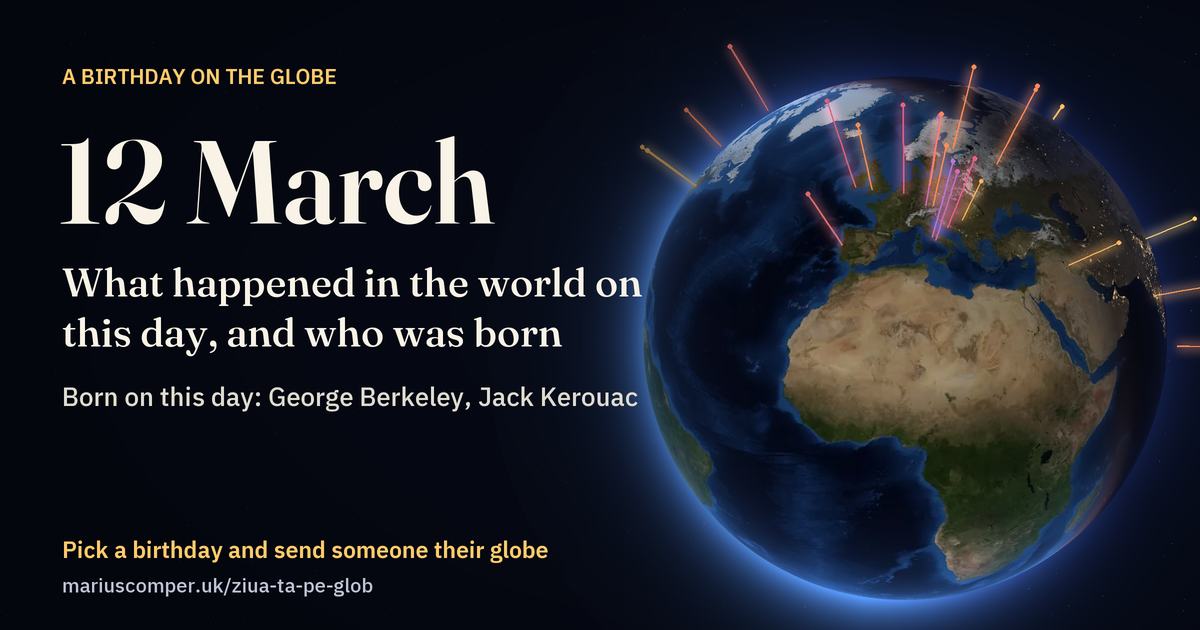
For 12 March, the English Wikipedia lists 44 events and 292 births. 24 of the events stand at their places as rays of light; six more are dashed circles, where the sentence links only to a country or a sea. The taller the ray, the longer ago it happened. The people born that day come further down, as blue points.
A birthday, yours or someone else’s:
Turn it into a greetingScroll: the globe turns to each place
The day you were born, on the globe.
Three things from your day
Scroll: your day first, then 12 March through the years
The Earth on 12 March
The picture on the globe was assembled by NASA from satellite photographs taken in March 2004: the snow, the ice and the green are those of the month.
On 12 March the Sun passes straight overhead at noon along the parallel of 3.1° south. In London, the day lasts about 11 hours 40 minutes.
Beyond 87° south the Sun no longer sets; beyond 87° north it no longer rises.
The line between day and night is tilted on the globe exactly as on this day of the year. On the dark side you can see the lights of towns.
Europe · Munich
1158
German city Munich (München) is first mentioned as forum apud Munichen in the Augsburg arbitration by Holy Roman Emperor Friedrich I.
On the map: Munich.
Europe · Moscow
1918
Moscow becomes the capital of Russia again after Saint Petersburg held this status for most of the period since 1713.
On the map: Moscow.
Also on the day’s list of Wikipedia in Spanish, Romanian and Chinese.
Oceania · Canberra
1913
The future capital of Australia is officially named Canberra.
On the map: Canberra.
Also on the day’s list of Wikipedia in Spanish, Romanian and Chinese.
12 March
Born on 12 March#
The English Wikipedia lists 292 births for this day. The blue points are the birthplaces of 60 of these people: those written about in the most Wikipedia editions, where Wikidata gives a place of birth.
Born on 12 March
1685
George Berkeley, Irish bishop and philosopher (died 1753)
Place of birth: Dysart Castle.
Born on 12 March
1922
Jack Kerouac, American author and poet (died 1969)
Place of birth: Lowell.
Born on 12 March
1946
Liza Minnelli, American actress, singer and dancer
Place of birth: Los Angeles.
Born on 12 March
1824
Gustav Kirchhoff, Russian-German physicist and academic (died 1887)
Place of birth: Königsberg.
Born on 12 March
1925
Leo Esaki, Japanese physicist and academic, Nobel Prize laureate
Place of birth: Takaida.
Born in Britain and Ireland
1956
Steve Harris, English bass player and songwriter
Place of birth: London.
Born in Britain and Ireland
1784
William Buckland, English geologist and paleontologist; Dean of Westminster (died 1856)
Place of birth: Axminster.
Born in Britain and Ireland
1997
Dean Henderson, English footballer
Place of birth: Whitehaven.
12 March
Number one in the charts that week
At the cinema
An animal recorded that day
The record can be seen in GBIF, which brings together wildlife records from around the world.
All your birthdays
The weather that day
Data: Met Office Hadley Centre (HadCET); NOAA (GHCN-Daily, Mauna Loa).
Above the Earth
Sources: Jonathan McDowell, GCAT (launches); GFZ Potsdam (Kp index). Days are counted in Universal Time.
Football that day
International matches played that day:
Source: the “International football results” dataset kept by Mart Jürisoo (CC0).
Also that day
The earthquake’s page at the USGS
Source: the USGS catalogue. The day is counted in Universal Time (UTC).
In those days
Make a link for someone
Type the name, pick the day and the year of birth. The link opens straight on their day, with their name in the greeting.
The link carries the name, date and place typed here; anyone who gets it can see them.
Put another birthday beside it
Your mother’s, your child’s, a friend’s: the two days appear side by side.
Below: 12 March through the years.
The whole globe of the day
Drag the globe to turn it. Touch a ray or a point to read what happened there.
Everything Wikipedia lists for 12 March
The list is the English Wikipedia’s, in its own wording, as it stood in October 2026. 14 events have no place on the map: the sentence links to no place with coordinates, only to places too wide to mark, or to several countries.
- 538
Vitiges, king of the Ostrogoths, ends his siege of Rome and retreats to Ravenna, leaving the city to the victorious Byzantine general, Belisarius.
Europe · Siege of RomeWikipedia: Siege of Rome - 1088
Election of Urban II as the 159th Pope of the Catholic Church. He is best known for initiating the Crusades.
Europe · 1088 papal electionWikipedia: 1088 papal election - 1158
German city Munich (München) is first mentioned as forum apud Munichen in the Augsburg arbitration by Holy Roman Emperor Friedrich I.
Europe · MunichWikipedia: Munich - 1391
Konrad von Wallenrode is elected the 24th Grand Master of the Teutonic Order (date is O.S.).
no place on the mapWikipedia: Konrad von Wallenrode - 1537
Croatian–Ottoman wars: After the execution of feudal lord Petar Kružić, Croatian forces at Klis surrendered to the Ottoman forces in exchange for their safe passage to northern locations.
Europe · Fortress of KlisWikipedia: Siege of Klis - 1579
Start of the Siege of Maastricht, part of the Eighty Years' War.
Europe · Siege of MaastrichtWikipedia: Siege of Maastricht - 1622
Ignatius of Loyola and Francis Xavier, founders of the Society of Jesus, are canonized by the Roman Catholic Church.
no place on the mapWikipedia: Ignatius of Loyola - 1689
James II of England lands at Kinsale, starting the Williamite War in Ireland.
Britain & Ireland · KinsaleWikipedia: Williamite War in Ireland - 1811
Peninsular War: A day after a successful rearguard action, French Marshal Michel Ney once again successfully delays the pursuing Anglo-Portuguese force at the Battle of Redinha.
Europe · RedinhaWikipedia: Battle of Redinha - 1862
Paddle steamer Brother Jonathan docks in Fort Victoria (now Victoria, British Columbia), carrying smallpox-infected passengers from San Francisco. The ensuing epidemic killed an estimated two-thirds of First Nations in the province of British Columbia.
North America · Fort VictoriaWikipedia: Brother Jonathan - 1881
Andrew Watson captained the Scotland national football team against England, becoming the world's first black international footballer.
no place on the mapWikipedia: Andrew Watson - 1912
The Girl Guides (later renamed the Girl Scouts of the USA) are founded in the United States.
North America · United StatesWikipedia: Girl Guides - 1913
The future capital of Australia is officially named Canberra.
Oceania · CanberraWikipedia: Australia - 1918
Moscow becomes the capital of Russia again after Saint Petersburg held this status for most of the period since 1713.
Europe · MoscowWikipedia: Moscow - 1920
The Kapp Putsch begins when the Marinebrigade Ehrhardt is ordered to march on Berlin.
Europe · BerlinWikipedia: Kapp Putsch - 1928
In California, the St. Francis Dam fails; the resulting floods kill 431 people.
North America · St. Francis DamWikipedia: California - 1930
Mahatma Gandhi begins the Salt March, a 200-mile (320 km) march to the sea to protest the British monopoly on salt in India.
no place on the mapWikipedia: Salt March - 1933
Great Depression: Franklin D. Roosevelt addresses the nation for the first time as President of the United States. This is also the first of his "fireside chats".
no place on the mapWikipedia: Great Depression - 1934
Supported by the Estonian army, Konstantin Päts staged a coup d'état, beginning the Era of Silence.
no place on the mapWikipedia: Konstantin Päts - 1938
Anschluss: German troops occupy and annex Austria.
Europe · AnschlussWikipedia: Anschluss - 1940
The most destructive train accident in Finnish history kills 39 and injures 69 people in Turenki, Janakkala.
Europe · TurenkiWikipedia: Turenki rail accident - 1940
Winter War: Finland signs the Moscow Peace Treaty with the Soviet Union, ceding almost all of Finnish Karelia.
Europe · Moscow Peace TreatyWikipedia: Moscow Peace Treaty - 1942
The Battle of Java ends with the surrender of the American-British-Dutch-Australian Command to the Empire of Japan in Bandung, West Java, Dutch East Indies.
Asia · BandungWikipedia: Battle of Java - 1947
Cold War: The Truman Doctrine is proclaimed to help stem the spread of Communism.
no place on the mapWikipedia: Cold War - 1950
The Llandow air disaster kills 80 people when the aircraft they are travelling in crashes near Sigingstone, Wales. At the time this was the world's deadliest air disaster.
Britain & Ireland · Llandow air disasterWikipedia: Llandow air disaster - 1952
British diplomat Lord Ismay was appointed the first secretary general of NATO.
no place on the mapWikipedia: Hastings Ismay, 1st Baron Ismay - 1967
Suharto takes power from Sukarno when the Provisional People's Consultative Assembly inaugurate him as Acting President of Indonesia.
Asia · IndonesiaWikipedia: Suharto - 1968
Mauritius gains independence from the United Kingdom.
no place on the mapWikipedia: Mauritius - 1971
The 1971 Turkish military memorandum is sent to the Süleyman Demirel government of Turkey and the government resigns.
Asia · TurkeyWikipedia: 1971 Turkish military memorandum - 1989
Tim Berners-Lee submits his proposal to CERN for an information management system, which subsequently develops into the World Wide Web.
no place on the mapWikipedia: Tim Berners-Lee - 1992
Mauritius becomes a republic while remaining a member of the Commonwealth of Nations.
Oceans · MauritiusWikipedia: Mauritius - 1993
North Korea announces that it will withdraw from the Treaty on the Non-Proliferation of Nuclear Weapons and refuses to allow inspectors access to its nuclear sites.
Asia · North KoreaWikipedia: Treaty on the Non-Proliferation of Nuclear Weapons - 1993
Several bombs explode in Mumbai, India, killing about 300 people and injuring hundreds more.
Asia · MumbaiWikipedia: 1993 Bombay bombings - 1999
Former Warsaw Pact members the Czech Republic, Hungary and Poland join NATO.
no place on the mapWikipedia: NATO - 2003
The World Health Organization officially release a global warning of outbreaks of Severe acute respiratory syndrome (SARS).
no place on the mapWikipedia: World Health Organization - 2003
Zoran Đinđić, Prime Minister of Serbia, is assassinated in Belgrade.
Europe · Assassination of Zoran ĐinđićWikipedia: Assassination of Zoran Đinđić - 2004
President of South Korea, Roh Moo-hyun, is impeached by its National Assembly, the first such impeachment in the nation's history.
no place on the mapWikipedia: President of South Korea - 2006
In Mahmoudiyah, Iraq, 14-year-old Abeer Qassim Hamza al-Janabi is raped and murdered by five American soldiers of the 502nd Infantry Regiment, who also murder both of her parents and her sister.
Asia · Mahmudiyah rape and murdersWikipedia: Mahmudiyah rape and murders - 2009
Financier Bernie Madoff pleads guilty to one of the largest frauds in Wall Street's history.
North America · Wall StreetWikipedia: Bernie Madoff - 2011
A reactor at the Fukushima Daiichi Nuclear Power Plant explodes and releases radioactivity into the atmosphere a day after the 2011 Tōhoku earthquake and tsunami.
Asia · 2011 Tōhoku earthquake and tsunamiWikipedia: 2011 Tōhoku earthquake and tsunami - 2014
A gas explosion in the New York City neighborhood of East Harlem kills eight and injures 70 others.
North America · 2014 East Harlem gas explosionWikipedia: 2014 East Harlem gas explosion - 2018
US-Bangla Airlines Flight 211 crashes at Tribhuvan International Airport in Katmandu, killing 51 and injuring 20.
Asia · US-Bangla Airlines Flight 211Wikipedia: US-Bangla Airlines Flight 211 - 2019
In the House of Commons, the revised EU Withdrawal Bill was rejected by a margin of 149 votes.
no place on the mapWikipedia: European Union (Withdrawal) Act 2018 - 2020
The United States suspends travel from Europe due to the COVID-19 pandemic.
North America · United StatesWikipedia: COVID-19 pandemic
Who was born on 12 March
In order of how many Wikipedia editions have an article about each. The first 60 of 292 are shown.
- 1685
George Berkeley, Irish bishop and philosopher (died 1753)
Dysart CastleWikipedia: George Berkeley - 1863
Gabriele D'Annunzio, Italian soldier, journalist, poet, and playwright (died 1938)
- 1947
Mitt Romney, American businessman and politician, 70th Governor of Massachusetts
Harper University HospitalWikipedia: Mitt Romney - 1922
Jack Kerouac, American author and poet (died 1969)
LowellWikipedia: Jack Kerouac - 1946
Liza Minnelli, American actress, singer and dancer
Los AngelesWikipedia: Liza Minnelli - 1824
Gustav Kirchhoff, Russian-German physicist and academic (died 1887)
KönigsbergWikipedia: Gustav Kirchhoff - 1943
Ratko Mladić, Bosnian Serb military officer and war criminal (died 2026)
BožanovićiWikipedia: Ratko Mladić - 1925
Leo Esaki, Japanese physicist and academic, Nobel Prize laureate
TakaidaWikipedia: Leo Esaki - 1863
Vladimir Vernadsky, Russian and Ukrainian mineralogist and chemist (died 1945)
Saint PetersburgWikipedia: Vladimir Vernadsky - 1927
Raúl Alfonsín, Argentine lawyer and politician, 46th President of Argentina (died 2009)
ChascomúsWikipedia: Raúl Alfonsín - 1968
Aaron Eckhart, American actor and producer
CupertinoWikipedia: Aaron Eckhart - 1928
Edward Albee, American director and playwright (died 2016)
Washington, D.C.Wikipedia: Edward Albee - 1984
Shreya Ghoshal, Indian singer
DurgapurWikipedia: Shreya Ghoshal - 1877
Wilhelm Frick, German lawyer and politician, German Federal Minister of the Interior (died 1946)
AlsenzWikipedia: Wilhelm Frick - 1959
Milorad Dodik, Bosnian Serb politician and president of Republika Srpska
Banja LukaWikipedia: Milorad Dodik - 1956
Steve Harris, English bass player and songwriter
LondonWikipedia: Steve Harris - 1613
André Le Nôtre, French gardener and architect (died 1700)
- 1982
Hisato Satō, Japanese footballer
KasukabeWikipedia: Hisato Satō - 1994
Christina Grimmie, American singer-songwriter (died 2016)
MarltonWikipedia: Christina Grimmie - 1925
Harry Harrison, American author and illustrator (died 2012)
StamfordWikipedia: Harry Harrison - 1784
William Buckland, English geologist and paleontologist; Dean of Westminster (died 1856)
AxminsterWikipedia: William Buckland - 1952
Yasuhiko Okudera, former Japanese footballer
- 1946
Frank Welker, American voice actor and singer
DenverWikipedia: Frank Welker - 1982
Yūto Satō, Japanese footballer
KasukabeWikipedia: Yūto Satō - 1984
Jaimie Alexander, American actress
GreenvilleWikipedia: Jaimie Alexander - 1987
Teimour Radjabov, Azerbaijani chess player
- 1835
Simon Newcomb, Canadian-American astronomer and mathematician (died 1909)
WallaceWikipedia: Simon Newcomb - 1923
Wally Schirra, American captain, pilot, and astronaut (died 2007)
HackensackWikipedia: Wally Schirra - 1962
Andreas Köpke, German footballer
- 1672
Richard Steele, Irish-Welsh journalist and politician (died 1729)
- 1910
Masayoshi Ōhira, Japanese politician, 68th Prime Minister of Japan (died 1980)
- 1911
Gustavo Díaz Ordaz, Mexican academic and politician, 49th President of Mexico (died 1979)
Ciudad SerdanWikipedia: Gustavo Díaz Ordaz - 1948
James Taylor, American singer-songwriter and guitarist
- 1976
Zhao Wei, Chinese actress, film director, producer and pop singer
- 1270
Charles, Count of Valois (died 1325)
VincennesWikipedia: Charles, Count of Valois - 1940
Al Jarreau, American singer (died 2017)
MilwaukeeWikipedia: Al Jarreau - 1968
Tammy Duckworth, Thai-American colonel, pilot, and politician
BangkokWikipedia: Tammy Duckworth - 1997
Dean Henderson, English footballer
WhitehavenWikipedia: Dean Henderson - 1988
Kostas Mitroglou, Greek footballer
- 1637
Anne Hyde, Duchess of York and Albany (died 1671)
WindsorWikipedia: Anne Hyde - 1821
John Abbott, Canadian lawyer and politician, 3rd Prime Minister of Canada (died 1893)
Saint-André-EstWikipedia: John Abbott - 1838
William Henry Perkin, English chemist and academic (died 1907)
- 1905
Takashi Shimura, Japanese actor (died 1982)
- 1950
Javier Clemente, Spanish footballer and manager
BarakaldoWikipedia: Javier Clemente - 1843
Gabriel Tarde, French sociologist and criminologist (died 1904)
Sarlat-la-CanédaWikipedia: Gabriel Tarde - 1954
Anish Kapoor, Indian-English sculptor
MumbaiWikipedia: Anish Kapoor - 1956
Lesley Manville, English actress
BrightonWikipedia: Lesley Manville - 1806
Jane Pierce, American wife of Franklin Pierce, 15th First Lady of the United States (died 1863)
HamptonWikipedia: Jane Pierce - 1996
Serhou Guirassy, French-Guinean footballer
- 1710
Thomas Arne, English composer (died 1778)
LondonWikipedia: Thomas Arne - 1815
Louis-Jules Trochu, French military leader and politician (died 1896)
Le PalaisWikipedia: Louis-Jules Trochu - 1881
Väinö Tanner, Finnish politician of Social Democratic Party of Finland; the Prime Minister of Finland (died 1966)
HelsinkiWikipedia: Väinö Tanner - 1956
Pim Verbeek, Dutch football manager (died 2019)
RotterdamWikipedia: Pim Verbeek - 1607
Paul Gerhardt, German poet and composer (died 1676)
GräfenhainichenWikipedia: Paul Gerhardt - 1781
Frederica of Baden, Queen consort to Gustav IV Adolf of Sweden (died 1826)
KarlsruheWikipedia: Frederica of Baden - 1626
John Aubrey, English historian and philosopher (died 1697)
MalmesburyWikipedia: John Aubrey - 1878
Gemma Galgani, Italian mystic and saint (died 1903)
CapannoriWikipedia: Gemma Galgani - 1921
Gianni Agnelli, Italian businessman (died 2001)
- 1962
Titus Welliver, American actor
New HavenWikipedia: Titus Welliver - 1997
Allan Saint-Maximin, French footballer
Châtenay-MalabryWikipedia: Allan Saint-Maximin
What is celebrated on 12 March
- Arbor Day (China)
- Arbor Day (Taiwan)
- Aztec New Year
- Christian feast day: Alphege
- Christian feast day: Angela Salawa
- Christian feast day: Bernard of Carinola (or of Capua)
- Christian feast day: Gorgonius, Peter Cubicularius and Dorotheus of Nicomedia
- Christian feast day: Mura (McFeredach)
- Christian feast day: Fina
- Christian feast day: Maximilian of Tebessa
- Christian feast day: Paul Aurelian
- Christian feast day: Pope Gregory I (Eastern Orthodox Church, Eastern Catholic Church, and Anglican Communion)
- Christian feast day: Theophanes the Confessor
- Christian feast day: March 12 (Eastern Orthodox liturgics)
A greeting link for someone
Type a name and, if you like, the year of birth. The link opens with a greeting, and beside each event it says how old the person turned that day, or how many years before their birth it happened.
The name and the year go only into the link you send.
All 366 days
How the globe is made
Where the events come from
Each edition of this page uses the day’s list from Wikipedia in its own language: Romanian, English, Spanish, Chinese. The lists are written by volunteers and differ from one edition to the next; the text of each event is Wikipedia’s, with a link to the article. A row that appears twice in a list is shown once. The lists have not been checked event by event: they are Wikipedia’s, mistakes included.
For events before 1582, and for countries that moved to the Gregorian calendar later (Britain in 1752, Russia in 1918), the same day may be counted Old Style in one list and New Style in another.
The chapter “What the other Wikipedias remember” adds up to five events a day from the lists of the other three editions, only for years in which the English list has nothing on that day. They were translated for this page, passed the same filters as the tour, and are not counted among the events of the English list.
How an event gets onto the map
The place comes from Wikidata. If the sentence links to the article about the event itself (a battle, an opening, an earthquake), dated to the same year, the ray stands on its coordinates or on those of its location. Otherwise it stands on the first place the sentence links to: a town, a building, a mountain, an island. This second step can be wrong: sometimes the sentence only mentions the place. That is why the page says, under each event, which place the ray stands on.
When the sentence links to a single state or province, or to a single sea, lake or desert larger than 5,000 km², the globe shows a dashed circle, not a ray. The circle has the area Wikidata gives, with its radius kept between 1.2° and 16°, or a radius of 4.5° when Wikidata gives no area; it says only that the sentence links to that place. Organisations, ships, spacecraft, museum objects, rivers, mountain ranges, languages and continents are never used as places. When a sentence names several states and no exact place, the event stays in the list only.
What the height means
The height of a ray shows how many years have passed, on a logarithmic scale: 10 years, 100 years and 1,000 years are equal steps apart; anything older than about 2,600 years has the tallest ray. The colour runs from pale yellow for recent years to violet for antiquity.
Where the tour stops
In each region the tour stops at up to three events (five in Britain and Ireland), chosen mainly by three things: whether Wikipedia’s editors put the event in the “On this day” box of their main page (the English, Spanish and Chinese editions), how many Wikipedia editions have an article about it, and how many of the four lists include it. Events whose sentence or article is about a war, an attack, a crime or a disaster are left out of the tour; they stay in the whole list, in Wikipedia’s wording. The filter is a list of words and a list of Wikidata types, so it can miss some.
The tour of births names the people with articles in the most editions and leaves aside those whom the list or Wikidata describes as rulers, politicians, commanders, leaders of movements or criminals; they stay in the list.
The Earth and the Sun
The daytime images are NASA’s Blue Marble Next Generation mosaics, one for each month of 2004; the night side is Black Marble 2016. The tilt of the line between day and night is computed for the day; the hour is chosen so that the place being read is in daylight. The latitude where the Sun stands overhead is the average of the four years of the leap cycle; in a given year it can differ by up to 0.4°.
The day you were born
The number ones come from the weekly lists on Wikipedia: Billboard for the United States (from 1940; the Hot 100 from August 1958), the UK Singles Chart (from November 1952), Los 40 Principales for Spain (from July 1966) and, for Romania, the Romanian Top 100 and Airplay 100 (2001–2021, with missing weeks). The page shows the chart of the week in which the day of birth falls, with its date; Billboard and the UK chart are dated at the end of their week. For Romania before 2001 and for China these sources have no weekly chart.
The films are those that reached cinemas in the United States up to ten days before or three days after that day (some of them in a few cinemas at first), from the English Wikipedia’s yearly lists (from 1968), in order of how many editions have an article about them. The events “in those days” are the ones on the neighbouring days’ lists that carry the year of birth, passed through the same filter as the tour.
The day of birth, year included
The Moon, the star sign and the constellation are worked out by the page itself, for noon Universal Time on the day. The lit part of the Moon is rounded and can differ by a few per cent from that at the hour of birth. The sign follows the usual zodiac of twelve equal parts starting at the March equinox; the constellation is the one the Sun actually stood in front of, by the borders set by the International Astronomical Union, and within a day of a border the page does not name it. When the Sun changes sign while it is that day anywhere on Earth, the page gives the moment of crossing, rounded to ten minutes and accurate to within about a quarter of an hour, and the clock time in a few cities, with the time zone and summer time of that year.
The year in the Chinese calendar is the one your device’s own calendar gives for the date, checked against the Hong Kong Observatory’s tables. “All your birthdays” uses the same sources as the rest of the chapter for the same day in every year since the birth: the temperature, well-known launches that took place on that very day, matches of the teams the edition follows, snow deeper than 10 cm and strong geomagnetic storms. The three things at the top and the four on the picture are chosen in a fixed order (the song, the animal, a full Moon, a well-known launch before an ordinary earthquake); on the picture you can change them.
When the link carries a year of birth, the page adds a few things about that exact day. The weather is the Met Office’s Central England temperature record and the readings from New York’s Central Park; the “usual high” is the average of the daily highs of 1961–1990 for that date, with two days either side. The carbon dioxide figure is the monthly mean at the Mauna Loa observatory, where measurements begin in March 1958.
The earthquake is the one with the largest magnitude in the USGS catalogue for that day, counted in Universal Time. Before the 1960s the catalogue has gaps even above magnitude 5.5, so in the older years many days have no earthquake. The page gives only the magnitude and the place: the country the epicentre falls in or, when the epicentre is at sea within 300 km of a coast, the nearest country; farther out, only the ocean.
The launches are those that reached orbit or left for the Moon and the planets, from Jonathan McDowell’s GCAT catalogue. If nothing left that day, the page shows the nearest launch within three days before or after, and says how many days away it was. The geomagnetic storm appears only when the Kp index reached at least 5 in one of the day’s eight three-hour intervals.
The animal comes from GBIF: an observation made by a person (the animal seen or heard, or its tracks), dated to that exact day, with coordinates and a CC0 or CC BY licence. Only a few hundred well-known species are searched (mammals, birds, turtles, butterflies); of those noted that day, mammals and species with articles in many Wikipedia editions come first; birds noted almost every day, and species used recently, wait their turn. Observations dated 1 January are left out, because records without a day are often filed there. An observation shows that the animal was recorded there, not how many animals there were.
The matches are those between national teams. Only matches of England, Scotland, Wales, Northern Ireland, the Republic of Ireland, the United States, Canada and Australia are shown, along with those at the big final tournaments. The picture to send is drawn in the page from the day’s globe and the facts above, and stays on your device until you send it.
Sources
- Events, births and holidays: the day’s page on Wikipedia, text under CC BY-SA 4.0.
- Coordinates, places of birth and the number of editions: Wikidata (CC0).
- The Earth by day: NASA Blue Marble Next Generation. The Earth by night: NASA Black Marble 2016.
- Borders and regions: Natural Earth.
- World population and births per year: UN World Population Prospects 2024.
- Charts and films: Wikipedia’s lists for Billboard, the UK Singles Chart, Los 40 Principales, Romanian Top 100, Airplay 100 and American films by year (CC BY-SA 4.0).
- Weather: Met Office Hadley Centre, HadCET (Open Government Licence) and NOAA GHCN-Daily, New York Central Park. Carbon dioxide: NOAA Global Monitoring Laboratory, Mauna Loa.
- Earthquakes: the USGS catalogue. Launches: Jonathan McDowell, GCAT (CC BY). Kp index: GFZ Potsdam (CC BY 4.0). Matches: International football results, Mart Jürisoo (CC0).
- Animal observations: GBIF, with a link to each record; species names come from Wikidata.