A birthday on the globe
16 October on the globe: what happened in the world on this day, and who was born
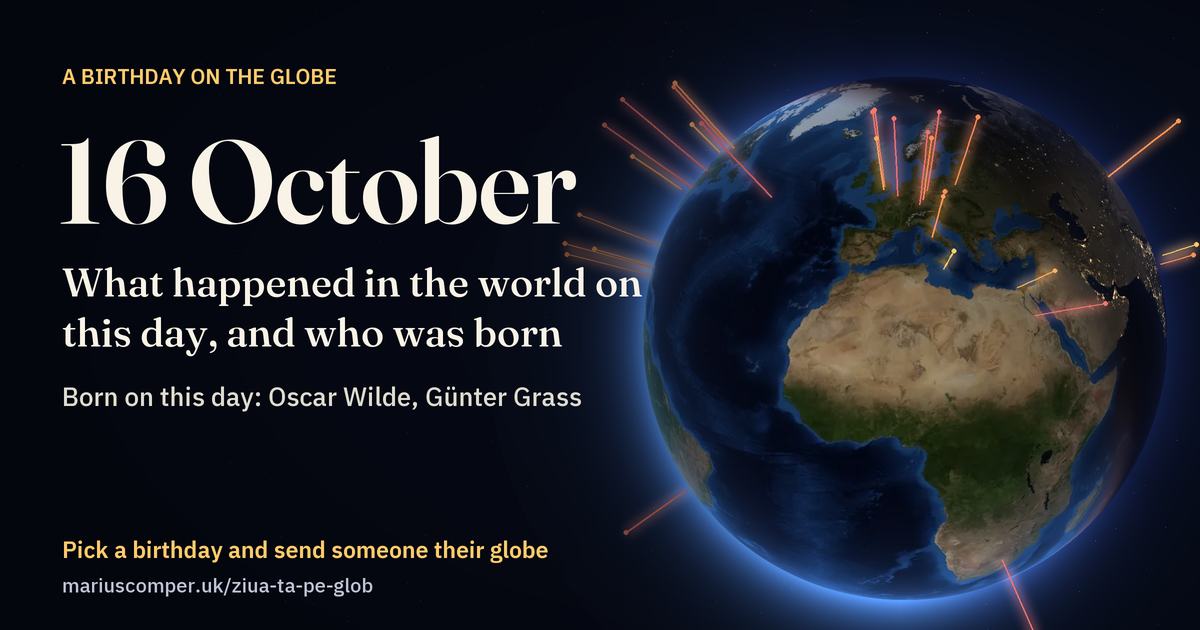
For 16 October, the English Wikipedia lists 66 events and 257 births. 30 of the events stand at their places as rays of light; three more are dashed circles, where the sentence links only to a country or a sea. The taller the ray, the longer ago it happened. The people born that day come further down, as blue points.
A birthday, yours or someone else’s:
Turn it into a greetingScroll: the globe turns to each place
The day you were born, on the globe.
Three things from your day
Scroll: your day first, then 16 October through the years
The Earth on 16 October
The picture on the globe was assembled by NASA from satellite photographs taken in October 2004: the snow, the ice and the green are those of the month.
On 16 October the Sun passes straight overhead at noon along the parallel of 8.9° south. In London, the day lasts about 10 hours 40 minutes.
Beyond 81° south the Sun no longer sets; beyond 81° north it no longer rises.
The line between day and night is tilted on the globe exactly as on this day of the year. On the dark side you can see the lights of towns.
Britain & Ireland · Girton College, Cambridge
1869
Girton College, Cambridge is founded, becoming England's first residential college for women.
On the map: Girton College, Cambridge.
Also on the day’s list of Wikipedia in Spanish.
Europe · October 1978 conclave
1978
Cardinal Karol Wojtyła is elected to the papacy as Pope John Paul II, he becomes the first non-Italian pontiff since 1523.
On the map: the coordinates Wikidata gives for the article “October 1978 conclave”.
Africa · Bibliotheca Alexandrina
2002
The Bibliotheca Alexandrina opens in Egypt, commemorating the ancient library of Alexandria.
On the map: Bibliotheca Alexandrina.
Also on the day’s list of Wikipedia in Spanish.
Asia · Mangsee Islands
1947
The Philippines takes over the administration of the Turtle Islands and the Mangsee Islands from the United Kingdom.
On the map: Mangsee Islands.
Asia · Project 596
1964
China detonates its first nuclear weapon.
On the map: the coordinates Wikidata gives for the article “Project 596”.
Also on the day’s list of Wikipedia in Spanish and Chinese.
North America · Queen's University at Kingston
1841
Queen's University is founded in the Province of Canada.
On the map: Queen's University at Kingston.
Also on the day’s list of Wikipedia in Spanish and Chinese.
North America · Brigham Young University
1875
Brigham Young University is founded in Provo, Utah.
On the map: Brigham Young University.
Also on the day’s list of Wikipedia in Spanish and Chinese.
16 October
Born on 16 October#
The English Wikipedia lists 257 births for this day. The blue points are the birthplaces of 60 of these people: those written about in the most Wikipedia editions, where Wikidata gives a place of birth.
Born on 16 October
1854
Oscar Wilde, Irish playwright, novelist, and poet (died 1900)
Place of birth: Dublin.
Born on 16 October
1927
Günter Grass, German novelist, poet, playwright, Nobel Prize laureate (died 2015)
Place of birth: Free City of Danzig.
Born on 16 October
1888
Eugene O'Neill, American playwright, Nobel Prize laureate (died 1953)
Place of birth: New York City.
Born on 16 October
1997
Naomi Osaka, Japanese tennis player
Place of birth: Chūō-ku.
Born in Britain and Ireland
1925
Angela Lansbury, English-American actress, singer, and producer (died 2022)
Place of birth: London.
Born in Britain and Ireland
1803
Robert Stephenson, English railway and civil engineer (died 1859)
Place of birth: Willington Quay.
Born in Britain and Ireland
1861
J. B. Bury, Irish historian and scholar (died 1927)
Place of birth: County Monaghan.
16 October
Number one in the charts that week
At the cinema
An animal recorded that day
The record can be seen in GBIF, which brings together wildlife records from around the world.
All your birthdays
The weather that day
Data: Met Office Hadley Centre (HadCET); NOAA (GHCN-Daily, Mauna Loa).
Above the Earth
Sources: Jonathan McDowell, GCAT (launches); GFZ Potsdam (Kp index). Days are counted in Universal Time.
Football that day
International matches played that day:
Source: the “International football results” dataset kept by Mart Jürisoo (CC0).
Also that day
The earthquake’s page at the USGS
Source: the USGS catalogue. The day is counted in Universal Time (UTC).
In those days
Make a link for someone
Type the name, pick the day and the year of birth. The link opens straight on their day, with their name in the greeting.
The link carries the name, date and place typed here; anyone who gets it can see them.
Put another birthday beside it
Your mother’s, your child’s, a friend’s: the two days appear side by side.
Below: 16 October through the years.
The whole globe of the day
Drag the globe to turn it. Touch a ray or a point to read what happened there.
Everything Wikipedia lists for 16 October
The list is the English Wikipedia’s, in its own wording, as it stood in October 2026. 33 events have no place on the map: the sentence links to no place with coordinates, only to places too wide to mark, or to several countries.
- 456
Ricimer defeats Avitus at Piacenza and becomes master of the Western Roman Empire.
no place on the mapWikipedia: Ricimer - 690
Empress Wu Zetian ascends to the throne of the Tang dynasty and proclaims herself ruler of the Chinese Empire.
no place on the mapWikipedia: Wu Zetian - 912
Abd ar-Rahman III becomes the eighth Emir of Córdoba.
no place on the mapWikipedia: Abd al-Rahman III - 955
King Otto I defeats a Slavic revolt in what is now Mecklenburg-Vorpommern.
no place on the mapWikipedia: Battle on the Raxa - 1311
The Council of Vienne convenes for the first time.
no place on the mapWikipedia: Council of Vienne - 1384
Jadwiga is crowned King of Poland, although she is a woman.
no place on the mapWikipedia: Jadwiga of Poland - 1590
Prince Gesualdo of Venosa murders his wife and her lover.
no place on the mapWikipedia: Carlo Gesualdo - 1736
Mathematician William Whiston's predicted comet fails to strike the Earth.
no place on the mapWikipedia: William Whiston - 1780
American Revolutionary War: The British-led Royalton raid is the last Native American raid on New England.
North America · Vermont RepublicWikipedia: Royalton raid - 1780
The Great Hurricane of 1780 finishes after its sixth day, killing between 20,000 and 24,000 residents of the Lesser Antilles.
Oceans · North Atlantic OceanWikipedia: Great Hurricane of 1780 - 1793
French Revolution: Queen Marie Antoinette is executed.
no place on the mapWikipedia: Marie Antoinette - 1793
War of the First Coalition: French victory at the Battle of Wattignies forces Austria to raise the siege of Maubeuge.
Europe · Battle of WattigniesWikipedia: Battle of Wattignies - 1805
War of the Third Coalition: Napoleon surrounds the Austrian army at Ulm.
Europe · Battle of UlmWikipedia: Battle of Ulm - 1813
The Sixth Coalition attacks Napoleon in the four-day Battle of Leipzig.
Europe · Battle of LeipzigWikipedia: Battle of Leipzig - 1817
Italian explorer and archaeologist Giovanni Belzoni, uncovered the Tomb of Seti I in the Valley of the Kings.
Africa · Tomb of Seti IWikipedia: Tomb of Seti I - 1817
Simón Bolívar sentences Manuel Piar to death for challenging the racial-caste in Venezuela.
no place on the mapWikipedia: Manuel Piar - 1834
Much of the ancient structure of the Palace of Westminster in London burns to the ground.
Britain & Ireland · Burning of ParliamentWikipedia: Burning of Parliament - 1836
Great Trek: Afrikaner voortrekkers repulse a Matabele attack, but lose their livestock.
Africa · Battle of VegkopWikipedia: Battle of Vegkop - 1841
Queen's University is founded in the Province of Canada.
North America · Queen's University at KingstonWikipedia: Queen's University at Kingston - 1843
William Rowan Hamilton invents quaternions, a three-dimensional system of complex numbers.
no place on the mapWikipedia: William Rowan Hamilton - 1846
William T. G. Morton administers ether anesthesia during a surgical operation.
no place on the mapWikipedia: William T. G. Morton - 1859
Origins of the American Civil War: Abolitionist John Brown and his supporters launch a raid on Harpers Ferry, Virginia (now West Virginia).
North America · John Brown's raid on Harpers FerryWikipedia: John Brown's raid on Harpers Ferry - 1869
Girton College, Cambridge is founded, becoming England's first residential college for women.
Britain & Ireland · Girton College, CambridgeWikipedia: Girton College, Cambridge - 1869
The Cardiff Giant, one of the most famous American hoaxes, is "discovered".
no place on the mapWikipedia: Cardiff Giant - 1875
Brigham Young University is founded in Provo, Utah.
North America · Brigham Young UniversityWikipedia: Brigham Young University - 1882
The Nickel Plate Railroad opens for business.
no place on the mapWikipedia: Nickel Plate Road - 1891
A diplomatic incident between the United States and Chile occurred after U.S. sailors were attacked in Valparaíso, nearly leading to war.
Latin America · ValparaísoWikipedia: Baltimore crisis - 1905
The Partition of Bengal in India takes place.
no place on the mapWikipedia: Partition of Bengal - 1909
William Howard Taft and Porfirio Díaz hold the first summit between a U.S. and a Mexican president. They narrowly escape assassination.
no place on the mapWikipedia: William Howard Taft - 1916
Margaret Sanger opens the first family planning clinic in the United States.
no place on the mapWikipedia: Margaret Sanger - 1919
Adolf Hitler delivers his first public address at a meeting of the German Workers' Party.
no place on the mapWikipedia: German Workers' Party - 1923
Walt Disney and his brother, Roy, found the Disney Brothers Cartoon Studio, today known as The Walt Disney Company.
no place on the mapWikipedia: Walt Disney - 1934
Chinese Communists begin the Long March to escape Nationalist encirclement.
Asia · People's Republic of ChinaWikipedia: Long March - 1939
World War II: No. 603 Squadron RAF intercepts the first Luftwaffe raid on Britain.
no place on the mapWikipedia: World War II - 1940
Holocaust in Poland: The Warsaw Ghetto is established.
Europe · Warsaw GhettoWikipedia: Warsaw Ghetto - 1943
Holocaust in Italy: Raid on the Roman Ghetto.
Europe · Raid on the Roman GhettoWikipedia: Raid on the Roman Ghetto - 1944
A four-day air battle over Taiwan ended with a decisive American victory, destroying hundreds of Japanese aircraft and military facilities.
Oceans · Philippine SeaWikipedia: Formosa Air Battle - 1946
Nuremberg trials: Ten defendants found guilty by the International Military Tribunal are executed by hanging.
Europe · Nuremberg trialsWikipedia: Nuremberg trials - 1947
The Philippines takes over the administration of the Turtle Islands and the Mangsee Islands from the United Kingdom.
Asia · Mangsee IslandsWikipedia: Turtle Islands, Tawi-Tawi - 1949
The Greek Communist Party announces a "temporary cease-fire", thus ending the Greek Civil War.
no place on the mapWikipedia: Greek Civil War - 1950
The first novel of the The Chronicles of Narnia series by C. S. Lewis, The Lion, the Witch and the Wardrobe, was published in the United Kingdom.
no place on the mapWikipedia: The Chronicles of Narnia - 1951
The first Prime Minister of Pakistan, Liaquat Ali Khan, is assassinated in Rawalpindi.
no place on the mapWikipedia: Liaquat Ali Khan - 1953
Cuban revolutionary Fidel Castro delivers his "History Will Absolve Me" speech, and is sentenced to 15 years' imprisonment by the Fulgencio Batista government for leading an attack on the Moncada Barracks.
Latin America · Santiago de CubaWikipedia: History Will Absolve Me - 1962
Cuban Missile Crisis begins: U.S. President John F. Kennedy is informed of photos taken on October 14 by a U-2 showing nuclear missiles (the crisis will last for 13 days starting from this point).
Latin America · Cuban Missile CrisisWikipedia: Cuban Missile Crisis - 1964
China detonates its first nuclear weapon.
Asia · Project 596Wikipedia: Project 596 - 1964
Leonid Brezhnev becomes leader of the Soviet Communist Party, while Alexei Kosygin becomes the head of government.
no place on the mapWikipedia: Leonid Brezhnev - 1968
Kingston, Jamaica is rocked by the Rodney riots, inspired by the barring of Walter Rodney from the country.
Latin America · KingstonWikipedia: Rodney riots - 1968
Tommie Smith and John Carlos are ejected from the US Olympic team for participating in the Olympics Black Power salute.
no place on the mapWikipedia: 1968 Olympics Black Power salute - 1968
Yasunari Kawabata becomes the first Japanese person to be awarded the Nobel Prize in Literature.
no place on the mapWikipedia: Yasunari Kawabata - 1970
Canadian Prime Minister Pierre Trudeau invokes the War Measures Act during the October Crisis.
North America · October CrisisWikipedia: October Crisis - 1973
Henry Kissinger and Lê Đức Thọ are awarded the Nobel Peace Prize.
no place on the mapWikipedia: Henry Kissinger - 1975
Indonesian troops kill the Balibo Five, a group of Australian journalists, in Portuguese Timor.
no place on the mapWikipedia: Balibo Five - 1975
The Australian Coalition sparks a constitutional crisis when they vote to defer funding for the government's annual budget.
Oceania · CanberraWikipedia: 1975 Australian constitutional crisis - 1975
Three-year-old Rahima Banu, from Bangladesh, is the last known case of naturally occurring smallpox.
no place on the mapWikipedia: Rahima Banu - 1978
Cardinal Karol Wojtyła is elected to the papacy as Pope John Paul II, he becomes the first non-Italian pontiff since 1523.
Europe · October 1978 conclaveWikipedia: October 1978 conclave - 1984
Desmond Tutu is awarded the Nobel Peace Prize.
no place on the mapWikipedia: Desmond Tutu - 1991
George Hennard runs amok in Killeen, Texas, killing 23 and wounding 20.
North America · Luby's shootingWikipedia: Luby's shooting - 1995
The Million Man March takes place in Washington, D.C. About 837,000 attend.
no place on the mapWikipedia: Million Man March - 1995
The Skye Bridge in Scotland is opened.
no place on the mapWikipedia: Skye Bridge - 1996
Eighty-four football fans die and 180 are injured in a massive crush at a match in Guatemala City.
Latin America · Doroteo Guamuch Flores StadiumWikipedia: Estadio Doroteo Guamuch Flores disaster - 1998
Former Chilean dictator Augusto Pinochet is arrested in London on a murder extradition warrant.
Britain & Ireland · LondonWikipedia: Indictment and arrest of Augusto Pinochet - 1999
The magnitude 7.1 Hector Mine earthquake strikes Southern California
North America · 1999 Hector Mine earthquakeWikipedia: 1999 Hector Mine earthquake - 2002
The Bibliotheca Alexandrina opens in Egypt, commemorating the ancient library of Alexandria.
Africa · Bibliotheca AlexandrinaWikipedia: Bibliotheca Alexandrina - 2013
Lao Airlines Flight 301 crashes on approach to Pakse International Airport in Laos, killing 49 people.
Asia · Lao Airlines Flight 301Wikipedia: Lao Airlines Flight 301 - 2017
Storm Ophelia strikes the U.K. and Ireland causing major damage and power loss.
no place on the mapWikipedia: Hurricane Ophelia - 2017
The Maltese journalist and anti-corruption activist Daphne Caruana Galizia was killed in a car bomb attack in Bidnija.
Europe · BidnijaWikipedia: Daphne Caruana Galizia
Who was born on 16 October
In order of how many Wikipedia editions have an article about each. The first 60 of 257 are shown.
- 1854
Oscar Wilde, Irish playwright, novelist, and poet (died 1900)
DublinWikipedia: Oscar Wilde - 1927
Günter Grass, German novelist, poet, playwright, Nobel Prize laureate (died 2015)
Free City of DanzigWikipedia: Günter Grass - 1886
David Ben-Gurion, Polish-Israeli soldier and politician, 1st Prime Minister of Israel (died 1973)
- 1888
Eugene O'Neill, American playwright, Nobel Prize laureate (died 1953)
New York CityWikipedia: Eugene O'Neill - 1908
Enver Hoxha, Albanian general and politician, Prime Minister of Albania (died 1985)
GjirokastërWikipedia: Enver Hoxha - 1997
Naomi Osaka, Japanese tennis player
Chūō-kuWikipedia: Naomi Osaka - 1983
Loreen, Swedish singer
DanderydWikipedia: Loreen - 1918
Louis Althusser, Algerian-French philosopher and academic (died 1990)
Bir Mourad RaisWikipedia: Louis Althusser - 1925
Angela Lansbury, English-American actress, singer, and producer (died 2022)
- 1841
Itō Hirobumi, Japanese lawyer and politician, 1st Prime Minister of Japan (died 1909)
TsukariWikipedia: Itō Hirobumi - 1890
Michael Collins, Irish general and politician, 2nd Irish Minister for Finance (died 1922)
ClonakiltyWikipedia: Michael Collins - 1948
Hema Malini, Indian actress, director, producer, and politician
AmmankudiWikipedia: Hema Malini - 1958
Tim Robbins, American actor, director, and screenwriter
West CovinaWikipedia: Tim Robbins - 1854
Karl Kautsky, Czech-German journalist, philosopher, and theologian (died 1938)
PragueWikipedia: Karl Kautsky - 1997
Charles Leclerc, Monégasque racing driver
Monte CarloWikipedia: Charles Leclerc - 1863
Austen Chamberlain, English businessman and politician, Chancellor of the Exchequer, Nobel Prize laureate (died 1937)
BirminghamWikipedia: Austen Chamberlain - 1977
John Mayer, American singer-songwriter, guitarist, and producer
BridgeportWikipedia: John Mayer - 1430
James II of Scotland (died 1460)
Holyrood AbbeyWikipedia: James II of Scotland - 1962
Flea, Australian-American bass player, songwriter, and actor
MelbourneWikipedia: Flea - 1986
Inna, Romanian singer
MangaliaWikipedia: Inna - 1827
Arnold Böcklin, Swiss painter (died 1901)
- 1929
Fernanda Montenegro, Brazilian actress
Rio de JaneiroWikipedia: Fernanda Montenegro - 1758
Noah Webster, American lexicographer (died 1843)
West HartfordWikipedia: Noah Webster - 1938
Nico, German singer-songwriter, model, and actress (died 1988)
CologneWikipedia: Nico - 1953
Paulo Roberto Falcão, Brazilian footballer and manager
Abelardo LuzWikipedia: Paulo Roberto Falcão - 1936
Andrei Chikatilo, Ukrainian-Russian serial killer (died 1994)
YabluchneWikipedia: Andrei Chikatilo - 1970
Mehmet Scholl, German footballer and manager
KarlsruheWikipedia: Mehmet Scholl - 1890
Maria Goretti, Italian martyr and saint (died 1902)
CorinaldoWikipedia: Maria Goretti - 1962
Dmitri Hvorostovsky, Russian opera singer (died 2017)
KrasnoyarskWikipedia: Dmitri Hvorostovsky - 1986
Franco Armani, Argentine footballer
CasildaWikipedia: Franco Armani - 1840
Kuroda Kiyotaka, Japanese general and politician, 2nd Prime Minister of Japan (died 1900)
Shinyashiki-chōWikipedia: Kuroda Kiyotaka - 1985
Casey Stoner, Australian motorcycle racer
SouthportWikipedia: Casey Stoner - 1923
Linda Darnell, American actress (died 1965)
DallasWikipedia: Linda Darnell - 1928
Mary Daly, American philosopher and theologian (died 2010)
SchenectadyWikipedia: Mary Daly - 1961
Marc Levy, French author
Boulogne-BillancourtWikipedia: Marc Levy - 1803
Robert Stephenson, English railway and civil engineer (died 1859)
Willington QuayWikipedia: Robert Stephenson - 1946
Suzanne Somers, American actress and producer (died 2023)
San BrunoWikipedia: Suzanne Somers - 1993
Caroline Garcia, French tennis player
- 1351
Gian Galeazzo Visconti, first Duke of Milan (died 1402)
- 2001
Willian Pacho, Ecuadorian footballer
Quinindé CantonWikipedia: Willian Pacho - 1890
Paul Strand, American photographer and director (died 1975)
New York CityWikipedia: Paul Strand - 1944
Elizabeth Loftus, American psychologist
Los AngelesWikipedia: Elizabeth Loftus - 1980
Sue Bird, Israeli-American basketball player
SyossetWikipedia: Sue Bird - 1962
Manute Bol, Sudanese-American basketball player and activist (died 2010)
TuraleiWikipedia: Manute Bol - 1983
Philipp Kohlschreiber, German tennis player
AugsburgWikipedia: Philipp Kohlschreiber - 1988
Zoltán Stieber, Hungarian footballer
- 1847
Maria Pia of Savoy, Queen Consort of Luis I of Portugal (died 1911)
- 1982
Cristian Riveros, Paraguayan footballer
Julio Augusto SaldívarWikipedia: Cristian Riveros - 1992
Kostas Fortounis, Greek footballer
TrikalaWikipedia: Kostas Fortounis - 1620
Pierre Paul Puget, French painter and sculptor (died 1694)
MarseilleWikipedia: Pierre Puget - 1954
Corinna Harfouch, German actress
- 1980
Caterina Scorsone, Canadian-American actress
TorontoWikipedia: Caterina Scorsone - 1679
Jan Dismas Zelenka, Czech viol player and composer (died 1745)
Louňovice pod BlaníkemWikipedia: Jan Dismas Zelenka - 1861
J. B. Bury, Irish historian and scholar (died 1927)
County MonaghanWikipedia: J. B. Bury - 1974
Aurela Gaçe, Albanian singer
LlakatundiWikipedia: Aurela Gaçe - 1930
John Polkinghorne, English physicist, theologian and priest (died 2021)
Weston-super-MareWikipedia: John Polkinghorne - 1956
Marin Alsop, American violinist and conductor
ManhattanWikipedia: Marin Alsop - 1898
William O. Douglas, American lawyer and jurist (died 1980)
Maine TownshipWikipedia: William O. Douglas - 1947
Terry Griffiths, Welsh snooker player and coach (died 2024)
LlanelliWikipedia: Terry Griffiths - 1931
Charles Colson, American lawyer and politician (died 2012)
What is celebrated on 16 October
- Air Force Day (Bulgaria)
- Boss's Day (United States)
- Christian feast day: Balderic (Baudry) of Monfaucon
- Christian feast day: Bercharius
- Christian feast day: Bertrand of Comminges
- Christian feast day: Colmán of Kilroot (Colman mac Cathbaid)
- Christian feast day: Eliphius
- Christian feast day: Fortunatus of Casei
- Christian feast day: Gall
- Christian feast day: Gerard Majella
- Christian feast day: Hedwig of Silesia
- Christian feast day: Hugh Latimer (Anglicanism)
- Christian feast day: Junian (of Saint-Junien)
- Christian feast day: Marguerite Marie Alacoque
A greeting link for someone
Type a name and, if you like, the year of birth. The link opens with a greeting, and beside each event it says how old the person turned that day, or how many years before their birth it happened.
The name and the year go only into the link you send.
All 366 days
How the globe is made
Where the events come from
Each edition of this page uses the day’s list from Wikipedia in its own language: Romanian, English, Spanish, Chinese. The lists are written by volunteers and differ from one edition to the next; the text of each event is Wikipedia’s, with a link to the article. A row that appears twice in a list is shown once. The lists have not been checked event by event: they are Wikipedia’s, mistakes included.
For events before 1582, and for countries that moved to the Gregorian calendar later (Britain in 1752, Russia in 1918), the same day may be counted Old Style in one list and New Style in another.
The chapter “What the other Wikipedias remember” adds up to five events a day from the lists of the other three editions, only for years in which the English list has nothing on that day. They were translated for this page, passed the same filters as the tour, and are not counted among the events of the English list.
How an event gets onto the map
The place comes from Wikidata. If the sentence links to the article about the event itself (a battle, an opening, an earthquake), dated to the same year, the ray stands on its coordinates or on those of its location. Otherwise it stands on the first place the sentence links to: a town, a building, a mountain, an island. This second step can be wrong: sometimes the sentence only mentions the place. That is why the page says, under each event, which place the ray stands on.
When the sentence links to a single state or province, or to a single sea, lake or desert larger than 5,000 km², the globe shows a dashed circle, not a ray. The circle has the area Wikidata gives, with its radius kept between 1.2° and 16°, or a radius of 4.5° when Wikidata gives no area; it says only that the sentence links to that place. Organisations, ships, spacecraft, museum objects, rivers, mountain ranges, languages and continents are never used as places. When a sentence names several states and no exact place, the event stays in the list only.
What the height means
The height of a ray shows how many years have passed, on a logarithmic scale: 10 years, 100 years and 1,000 years are equal steps apart; anything older than about 2,600 years has the tallest ray. The colour runs from pale yellow for recent years to violet for antiquity.
Where the tour stops
In each region the tour stops at up to three events (five in Britain and Ireland), chosen mainly by three things: whether Wikipedia’s editors put the event in the “On this day” box of their main page (the English, Spanish and Chinese editions), how many Wikipedia editions have an article about it, and how many of the four lists include it. Events whose sentence or article is about a war, an attack, a crime or a disaster are left out of the tour; they stay in the whole list, in Wikipedia’s wording. The filter is a list of words and a list of Wikidata types, so it can miss some.
The tour of births names the people with articles in the most editions and leaves aside those whom the list or Wikidata describes as rulers, politicians, commanders, leaders of movements or criminals; they stay in the list.
The Earth and the Sun
The daytime images are NASA’s Blue Marble Next Generation mosaics, one for each month of 2004; the night side is Black Marble 2016. The tilt of the line between day and night is computed for the day; the hour is chosen so that the place being read is in daylight. The latitude where the Sun stands overhead is the average of the four years of the leap cycle; in a given year it can differ by up to 0.4°.
The day you were born
The number ones come from the weekly lists on Wikipedia: Billboard for the United States (from 1940; the Hot 100 from August 1958), the UK Singles Chart (from November 1952), Los 40 Principales for Spain (from July 1966) and, for Romania, the Romanian Top 100 and Airplay 100 (2001–2021, with missing weeks). The page shows the chart of the week in which the day of birth falls, with its date; Billboard and the UK chart are dated at the end of their week. For Romania before 2001 and for China these sources have no weekly chart.
The films are those that reached cinemas in the United States up to ten days before or three days after that day (some of them in a few cinemas at first), from the English Wikipedia’s yearly lists (from 1968), in order of how many editions have an article about them. The events “in those days” are the ones on the neighbouring days’ lists that carry the year of birth, passed through the same filter as the tour.
The day of birth, year included
The Moon, the star sign and the constellation are worked out by the page itself, for noon Universal Time on the day. The lit part of the Moon is rounded and can differ by a few per cent from that at the hour of birth. The sign follows the usual zodiac of twelve equal parts starting at the March equinox; the constellation is the one the Sun actually stood in front of, by the borders set by the International Astronomical Union, and within a day of a border the page does not name it. When the Sun changes sign while it is that day anywhere on Earth, the page gives the moment of crossing, rounded to ten minutes and accurate to within about a quarter of an hour, and the clock time in a few cities, with the time zone and summer time of that year.
The year in the Chinese calendar is the one your device’s own calendar gives for the date, checked against the Hong Kong Observatory’s tables. “All your birthdays” uses the same sources as the rest of the chapter for the same day in every year since the birth: the temperature, well-known launches that took place on that very day, matches of the teams the edition follows, snow deeper than 10 cm and strong geomagnetic storms. The three things at the top and the four on the picture are chosen in a fixed order (the song, the animal, a full Moon, a well-known launch before an ordinary earthquake); on the picture you can change them.
When the link carries a year of birth, the page adds a few things about that exact day. The weather is the Met Office’s Central England temperature record and the readings from New York’s Central Park; the “usual high” is the average of the daily highs of 1961–1990 for that date, with two days either side. The carbon dioxide figure is the monthly mean at the Mauna Loa observatory, where measurements begin in March 1958.
The earthquake is the one with the largest magnitude in the USGS catalogue for that day, counted in Universal Time. Before the 1960s the catalogue has gaps even above magnitude 5.5, so in the older years many days have no earthquake. The page gives only the magnitude and the place: the country the epicentre falls in or, when the epicentre is at sea within 300 km of a coast, the nearest country; farther out, only the ocean.
The launches are those that reached orbit or left for the Moon and the planets, from Jonathan McDowell’s GCAT catalogue. If nothing left that day, the page shows the nearest launch within three days before or after, and says how many days away it was. The geomagnetic storm appears only when the Kp index reached at least 5 in one of the day’s eight three-hour intervals.
The animal comes from GBIF: an observation made by a person (the animal seen or heard, or its tracks), dated to that exact day, with coordinates and a CC0 or CC BY licence. Only a few hundred well-known species are searched (mammals, birds, turtles, butterflies); of those noted that day, mammals and species with articles in many Wikipedia editions come first; birds noted almost every day, and species used recently, wait their turn. Observations dated 1 January are left out, because records without a day are often filed there. An observation shows that the animal was recorded there, not how many animals there were.
The matches are those between national teams. Only matches of England, Scotland, Wales, Northern Ireland, the Republic of Ireland, the United States, Canada and Australia are shown, along with those at the big final tournaments. The picture to send is drawn in the page from the day’s globe and the facts above, and stays on your device until you send it.
Sources
- Events, births and holidays: the day’s page on Wikipedia, text under CC BY-SA 4.0.
- Coordinates, places of birth and the number of editions: Wikidata (CC0).
- The Earth by day: NASA Blue Marble Next Generation. The Earth by night: NASA Black Marble 2016.
- Borders and regions: Natural Earth.
- World population and births per year: UN World Population Prospects 2024.
- Charts and films: Wikipedia’s lists for Billboard, the UK Singles Chart, Los 40 Principales, Romanian Top 100, Airplay 100 and American films by year (CC BY-SA 4.0).
- Weather: Met Office Hadley Centre, HadCET (Open Government Licence) and NOAA GHCN-Daily, New York Central Park. Carbon dioxide: NOAA Global Monitoring Laboratory, Mauna Loa.
- Earthquakes: the USGS catalogue. Launches: Jonathan McDowell, GCAT (CC BY). Kp index: GFZ Potsdam (CC BY 4.0). Matches: International football results, Mart Jürisoo (CC0).
- Animal observations: GBIF, with a link to each record; species names come from Wikidata.