A birthday on the globe
4 January on the globe: what happened in the world on this day, and who was born
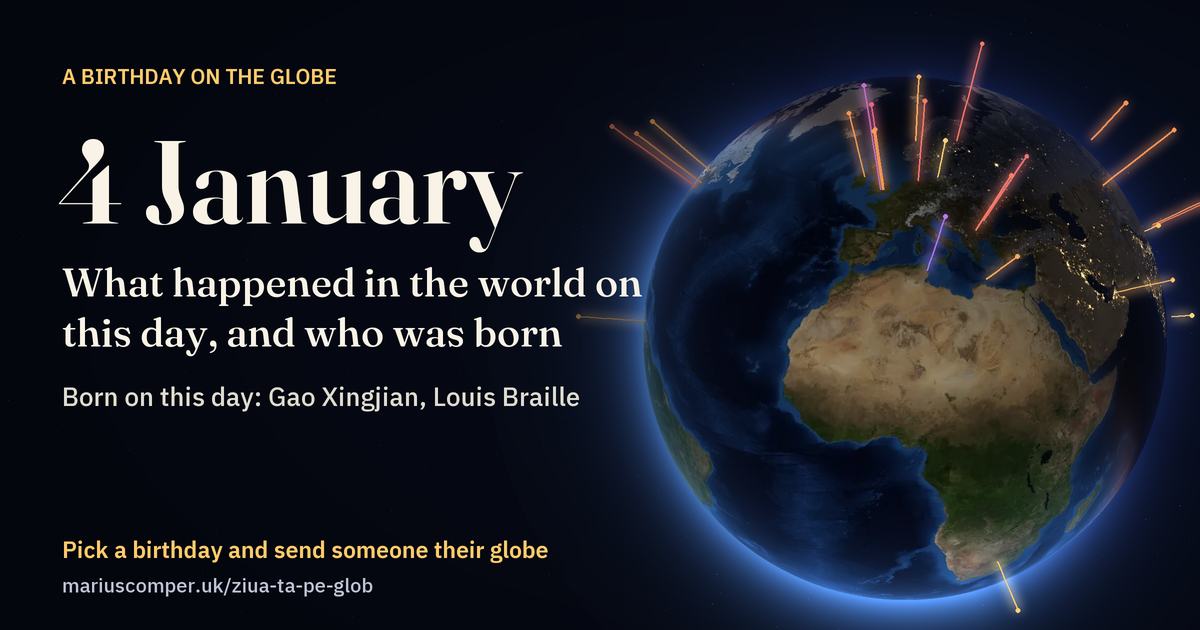
For 4 January, the English Wikipedia lists 52 events and 196 births. 25 of the events stand at their places as rays of light; six more are dashed circles, where the sentence links only to a country or a sea. The taller the ray, the longer ago it happened. The people born that day come further down, as blue points.
A birthday, yours or someone else’s:
Turn it into a greetingScroll: the globe turns to each place
The day you were born, on the globe.
Three things from your day
Scroll: your day first, then 4 January through the years
The Earth on 4 January
The picture on the globe was assembled by NASA from satellite photographs taken in January 2004: the snow, the ice and the green are those of the month.
On 4 January the Sun passes straight overhead at noon along the parallel of 22.7° south. In London, the day lasts about 8 hours.
Beyond 67° south the Sun no longer sets; beyond 67° north it no longer rises.
The line between day and night is tilted on the globe exactly as on this day of the year. On the dark side you can see the lights of towns.
Britain & Ireland · Old Bailey
1972
Rose Heilbron becomes the first female judge to sit at the Old Bailey in London, UK.
On the map: Old Bailey.
Britain & Ireland · Heathrow Airport
1977
The English punk-rock band Sex Pistols' lewd and disruptive behaviour at Heathrow Airport prompted the record label EMI to end their contract.
On the map: Heathrow Airport.
Also on the day’s list of Wikipedia in Chinese.
Europe · Bucharest
1798
Constantine Hangerli arrives in Bucharest, Wallachia, as its new Prince, invested by the Ottoman Empire.
On the map: Bucharest.
Also on the day’s list of Wikipedia in Romanian.
Europe · Kuopio
1844
The first issue of the Swedish-languaged Saima newspaper founded by J. V. Snellman is published in Kuopio, Finland.
On the map: Kuopio.
Europe · Hamburg
1863
The New Apostolic Church, a Christian and chiliastic church, is established in Hamburg, Germany.
On the map: Hamburg.
Asia · Burj Khalifa
2010
The Burj Khalifa, the current tallest building in the world, officially opens in Dubai.
On the map: Burj Khalifa.
Also on the day’s list of Wikipedia in Spanish, Romanian and Chinese.
Asia · Sembawang Hot Spring Park
2020
Sembawang Hot Spring Park in Singapore reopened after being redeveloped by the National Parks Board.
On the map: Sembawang Hot Spring Park.
4 January
What the other Wikipedias remember#
For these years the English list has nothing on this day. The events below come from the same day’s lists on Wikipedia in Romanian, Chinese and Spanish and were translated for this page.
From Wikipedia in Romanian · Chimborazo
1880
The British mountaineer Edward Whymper becomes the first to climb Chimborazo (6,267 m), one of the highest peaks in the Andes.
On the map: Chimborazo.
Translated from the list on Wikipedia in Romanian.
From Wikipedia in Chinese · Peking University
1917
Cai Yuanpei takes up the post of president of Peking University.
On the map: Peking University.
Translated from the list on Wikipedia in Chinese.
From Wikipedia in Spanish · Jerusalem
1964
Pope Paul VI visits Jerusalem, where he meets Athenagoras (Patriarch of Constantinople and head of the Greek Orthodox Church).
On the map: Jerusalem.
Translated from the list on Wikipedia in Spanish.
4 January
Born on 4 January#
The English Wikipedia lists 196 births for this day. The blue points are the birthplaces of 60 of these people: those written about in the most Wikipedia editions, where Wikidata gives a place of birth.
Born on 4 January
1940
Gao Xingjian, Chinese novelist, playwright, and critic, Nobel Prize laureate
Place of birth: Ganxian District.
Born on 4 January
1809
Louis Braille, French educator, invented Braille (died 1852)
Place of birth: Coupvray.
Born on 4 January
1940
Brian Josephson, Welsh physicist and academic, Nobel Prize laureate
Place of birth: Cardiff.
Born in Britain and Ireland
1965
Julia Ormond, English actress and producer
Place of birth: Epsom.
Born in Britain and Ireland
1942
John McLaughlin, English guitarist and songwriter
Place of birth: Doncaster.
Born in Britain and Ireland
1958
Julian Sands, English actor (died 2023)
Place of birth: Otley.
4 January
Number one in the charts that week
At the cinema
An animal recorded that day
The record can be seen in GBIF, which brings together wildlife records from around the world.
All your birthdays
The weather that day
Data: Met Office Hadley Centre (HadCET); NOAA (GHCN-Daily, Mauna Loa).
Above the Earth
Sources: Jonathan McDowell, GCAT (launches); GFZ Potsdam (Kp index). Days are counted in Universal Time.
Football that day
International matches played that day:
Source: the “International football results” dataset kept by Mart Jürisoo (CC0).
Also that day
The earthquake’s page at the USGS
Source: the USGS catalogue. The day is counted in Universal Time (UTC).
In those days
Make a link for someone
Type the name, pick the day and the year of birth. The link opens straight on their day, with their name in the greeting.
The link carries the name, date and place typed here; anyone who gets it can see them.
Put another birthday beside it
Your mother’s, your child’s, a friend’s: the two days appear side by side.
Below: 4 January through the years.
The whole globe of the day
Drag the globe to turn it. Touch a ray or a point to read what happened there.
Everything Wikipedia lists for 4 January
The list is the English Wikipedia’s, in its own wording, as it stood in October 2026. 21 events have no place on the map: the sentence links to no place with coordinates, only to places too wide to mark, or to several countries.
- 46 BC
Julius Caesar fights Titus Labienus in the Battle of Ruspina.
Africa · Battle of RuspinaWikipedia: Battle of Ruspina - 871
Battle of Reading: Æthelred of Wessex and his brother Alfred are defeated by a Danish invasion army.
Britain & Ireland · Battle of ReadingWikipedia: Battle of Reading - 1642
English Civil War: King Charles I, accompanied by 400 soldiers, attempts to arrest five members of Parliament for treason, only to discover the men had been tipped off and fled.
no place on the mapWikipedia: Charles I of England - 1649
English Civil War: The Rump Parliament votes to put Charles I on trial.
no place on the mapWikipedia: Rump Parliament - 1698
Most of London's Palace of Whitehall, the main residence of English monarchs since 1530, was destroyed by fire.
Britain & Ireland · Palace of WhitehallWikipedia: Palace of Whitehall - 1717
The Netherlands, Great Britain, and France sign the Triple Alliance.
no place on the mapWikipedia: Triple Alliance - 1762
Great Britain declares war on Spain, which meant the entry of Spain into the Seven Years' War.
Europe · SpainWikipedia: Seven Years' War - 1798
Constantine Hangerli arrives in Bucharest, Wallachia, as its new Prince, invested by the Ottoman Empire.
Europe · BucharestWikipedia: Constantine Hangerli - 1844
The first issue of the Swedish-languaged Saima newspaper founded by J. V. Snellman is published in Kuopio, Finland.
Europe · KuopioWikipedia: Saima - 1853
After having been kidnapped and sold into slavery in the American South, Solomon Northup regains his freedom; his memoir Twelve Years a Slave later becomes a national bestseller.
no place on the mapWikipedia: Solomon Northup - 1854
The McDonald Islands are discovered by Captain William McDonald aboard the Samarang.
Oceans · Heard Island and McDonald IslandsWikipedia: Heard Island and McDonald Islands - 1863
The New Apostolic Church, a Christian and chiliastic church, is established in Hamburg, Germany.
Europe · HamburgWikipedia: New Apostolic Church - 1878
Russo-Turkish War (1877–78): Sofia is liberated from Ottoman rule.
Europe · SofiaWikipedia: Russo-Turkish War - 1884
The Fabian Society is founded in London, United Kingdom.
no place on the mapWikipedia: Fabian Society - 1885
Sino-French War: French troops under General Oscar de Négrier defeat a numerically superior Qing force at Núi Bop in northern Vietnam.
Asia · Battle of Núi BopWikipedia: Sino-French War - 1896
Utah is admitted as the 45th U.S. state.
North America · UtahWikipedia: Utah - 1903
Topsy, an elephant, is electrocuted by the owners of Luna Park, Coney Island. The Edison film company records the film Electrocuting an Elephant of Topsy's death.
North America · Luna ParkWikipedia: Topsy - 1909
Explorer Aeneas Mackintosh of the Imperial Trans-Antarctic Expedition escaped death by fleeing across ice floes.
no place on the mapWikipedia: Imperial Trans-Antarctic Expedition - 1912
The Scout Association is incorporated throughout the British Empire by royal charter.
Britain & Ireland · British EmpireWikipedia: The Scout Association - 1918
The Finnish Declaration of Independence is recognized by Russia, Sweden, Germany and France.
no place on the mapWikipedia: Finnish Declaration of Independence - 1936
Billboard published its first music hit parade.
no place on the mapWikipedia: Billboard - 1944
World War II: Operation Carpetbagger, involving the dropping of arms and supplies to resistance fighters in Europe, begins.
no place on the mapWikipedia: World War II - 1946
The first day of a three-day "disastrous" tornado outbreak across the south-central United States leaves 41 people dead and at least 412 others injured.
no place on the mapWikipedia: Tornado outbreak of January 4–6, 1946 - 1948
Burma gains its independence from the United Kingdom, becoming an independent republic.
Asia · MyanmarWikipedia: Myanmar - 1951
Korean War: Chinese and North Korean forces capture Seoul for the second time.
Asia · Third Battle of SeoulWikipedia: Korean War - 1956
The Greek National Radical Union is formed by Konstantinos Karamanlis.
no place on the mapWikipedia: National Radical Union - 1958
Sputnik 1, the first artificial Earth satellite, launched by the Soviet Union in 1957, falls to Earth from orbit.
no place on the mapWikipedia: Sputnik 1 - 1959
Luna 1 becomes the first spacecraft to reach the vicinity of the Moon.
no place on the mapWikipedia: Luna 1 - 1965
Aeroflot Flight 101/X-20 crashes on approach to Alma-Ata Airport, killing 64 people.
Asia · Aeroflot Flight 101/X-20Wikipedia: Aeroflot Flight 101/X-20 - 1967
The Doors released their eponymous debut album.
no place on the mapWikipedia: The Doors - 1970
A magnitude-7.1 earthquake occurred in Tonghai County, China, killing at least 15,000 people.
Asia · 1970 Tonghai earthquakeWikipedia: 1970 Tonghai earthquake - 1972
Rose Heilbron becomes the first female judge to sit at the Old Bailey in London, UK.
Britain & Ireland · Old BaileyWikipedia: Rose Heilbron - 1973
Last of the Summer Wine, the longest-running sitcom in the world, premiered as an episode of the BBC's Comedy Playhouse.
no place on the mapWikipedia: Last of the Summer Wine - 1975
This date overflowed the 12-bit field that had been used in TOPS-10. There were numerous problems and crashes related to this bug while an alternative format was developed.
no place on the mapWikipedia: TOPS-10 - 1976
The Troubles: The Ulster Volunteer Force shoots dead six Irish Catholic civilians in County Armagh, Northern Ireland. The next day, gunmen would shoot dead ten Protestant civilians nearby in retaliation.
Britain & Ireland · Reavey and O'Dowd killingsWikipedia: The Troubles - 1977
The English punk-rock band Sex Pistols' lewd and disruptive behaviour at Heathrow Airport prompted the record label EMI to end their contract.
Britain & Ireland · Heathrow AirportWikipedia: Punk rock - 1987
The Maryland train collision: An Amtrak train en route to Boston from Washington, D.C., collides with Conrail engines in Chase, Maryland, United States, killing 16 people.
North America · BostonWikipedia: 1987 Maryland train collision - 1989
Second Gulf of Sidra incident: A pair of Libyan MiG-23 "Floggers" are shot down by a pair of US Navy F-14 Tomcats during an air-to-air confrontation.
Africa · 1989 air battle near TobrukWikipedia: 1989 air battle near Tobruk - 1990
In Pakistan's deadliest train accident an overloaded passenger train collides with an empty freight train, resulting in 307 deaths and 700 injuries.
no place on the mapWikipedia: Sukkur rail disaster - 1998
A massive ice storm hits eastern Canada and the northeastern United States, continuing through January 10 and causing widespread destruction.
North America · January 1998 North American ice stormWikipedia: January 1998 North American ice storm - 1999
Former professional wrestler Jesse Ventura is sworn in as governor of Minnesota, United States.
North America · MinnesotaWikipedia: Jesse Ventura - 2000
A Norwegian passenger train departing from Trondheim, collides with a local train coming from Hamar in Åsta in Åmot Municipality; 19 people are killed and 68 injured in the accident.
Europe · TrondheimWikipedia: Åsta accident - 2004
Mikheil Saakashvili is elected President of Georgia following the November 2003 Rose Revolution.
no place on the mapWikipedia: 2004 Georgian presidential election - 2004
Spirit, a NASA Mars rover, lands successfully on Mars at 04:35 UTC.
no place on the mapWikipedia: Spirit - 2006
Ehud Olmert becomes acting Prime Minister of Israel after the incumbent, Ariel Sharon, suffers a second, apparently more serious stroke.
no place on the mapWikipedia: Ehud Olmert - 2007
The 110th United States Congress convenes, electing Nancy Pelosi as the first female Speaker of the House in U.S. history.
no place on the mapWikipedia: 110th United States Congress - 2008
A Let L-410 Turbolet crashes in the Los Roques Archipelago in Venezuela, killing 14 people.
Latin America · 2008 Los Roques Archipelago Transaven Let L-410 crashWikipedia: 2008 Los Roques Archipelago Transaven Let L-410 crash - 2010
The Burj Khalifa, the current tallest building in the world, officially opens in Dubai.
Asia · Burj KhalifaWikipedia: Burj Khalifa - 2013
A gunman kills eight people in a house-to-house rampage in Kawit, Cavite, Philippines.
Asia · CaviteWikipedia: Kawit shooting - 2018
Hennenman–Kroonstad train crash: A passenger train operated by Shosholoza Meyl collides with a truck on a level crossing at Geneva Station between Hennenman and Kroonstad, Free State, South Africa. Twenty people are killed and 260 injured.
Africa · HennenmanWikipedia: Hennenman–Kroonstad train crash - 2019
A fire in an escape room in Koszalin, Poland, kills five teenagers through carbon monoxide poisoning.
Europe · Koszalin escape room fireWikipedia: Koszalin escape room fire - 2020
Sembawang Hot Spring Park in Singapore reopened after being redeveloped by the National Parks Board.
Asia · Sembawang Hot Spring ParkWikipedia: Sembawang Hot Spring Park
What the other Wikipedias remember
For these years the English list has nothing on this day. The events below come from the same day’s lists on Wikipedia in Romanian, Chinese and Spanish and were translated for this page.
- 1880
The British mountaineer Edward Whymper becomes the first to climb Chimborazo (6,267 m), one of the highest peaks in the Andes.
- 1917
Cai Yuanpei takes up the post of president of Peking University.
- 1964
Pope Paul VI visits Jerusalem, where he meets Athenagoras (Patriarch of Constantinople and head of the Greek Orthodox Church).
Who was born on 4 January
In order of how many Wikipedia editions have an article about each. The first 60 of 196 are shown.
- 1940
Gao Xingjian, Chinese novelist, playwright, and critic, Nobel Prize laureate
Ganxian DistrictWikipedia: Gao Xingjian - 1809
Louis Braille, French educator, invented Braille (died 1852)
CoupvrayWikipedia: Louis Braille - 1990
Toni Kroos, German footballer
GreifswaldWikipedia: Toni Kroos - 1785
Jacob Grimm, German philologist and mythologist (died 1863)
- 1940
Brian Josephson, Welsh physicist and academic, Nobel Prize laureate
CardiffWikipedia: Brian Josephson - 1986
James Milner, English footballer
- 1963
Till Lindemann, German singer, songwriter, and poet
LeipzigWikipedia: Till Lindemann - 1710
Giovanni Battista Pergolesi, Italian composer, violinist, and organist (died 1736)
- 1932
Carlos Saura, Spanish director and screenwriter (died 2023)
HuescaWikipedia: Carlos Saura - 659
Ali ibn Husayn Zayn al-Abidin (died 680)
MedinaWikipedia: Ali al-Sajjad - 1945
Richard R. Schrock, American chemist and academic, Nobel Prize laureate
- 1848
Katsura Tarō, Japanese general and politician, 6th Prime Minister of Japan (died 1913)
- 1965
Julia Ormond, English actress and producer
- 1937
Dyan Cannon, American actress, director, producer, and screenwriter
TacomaWikipedia: Dyan Cannon - 1960
Michael Stipe, American singer-songwriter and producer
DecaturWikipedia: Michael Stipe - 2005
Dafne Keen, British-Spanish actress
MadridWikipedia: Dafne Keen - 1929
Günter Schabowski, German journalist and politician (died 2015)
- 1934
Rudolf Schuster, Slovak politician, 2nd President of Slovakia
- 2003
Jaeden Martell, American actor
PhiladelphiaWikipedia: Jaeden Martell - 1903
Georg Elser, German carpenter and attempted assassin of Adolf Hitler (died 1945)
HermaringenWikipedia: Georg Elser - 1942
John McLaughlin, English guitarist and songwriter
DoncasterWikipedia: John McLaughlin - 1958
Julian Sands, English actor (died 2023)
- 2004
Victor Wembanyama, French basketball player
Le ChesnayWikipedia: Victor Wembanyama - 1896
André Masson, French painter and illustrator (died 1987)
Balagny-sur-ThérainWikipedia: André Masson - 1980
Miguel Monteiro, Portuguese footballer
- 1992
Quincy Promes, Dutch footballer
AmsterdamWikipedia: Quincy Promes - 1997
Angeliño, Spanish footballer
SilvánWikipedia: Angeliño - 1874
Josef Suk, Czech violinist and composer (died 1935)
KřečoviceWikipedia: Josef Suk - 1958
Matt Frewer, American-Canadian actor
Washington, D.C.Wikipedia: Matt Frewer - 1581
James Ussher, Irish archbishop and historian (died 1656)
DublinWikipedia: James Ussher - 1987
Przemysław Tytoń, Polish footballer
- 2001
Odilon Kossounou, Ivorian footballer
AbidjanWikipedia: Odilon Kossounou - 1913
Malietoa Tanumafili II, Samoan ruler (died 2007)
- 1935
Floyd Patterson, American boxer (died 2006)
- 1996
Jasmine Paolini, Italian tennis player
Castelnuovo di GarfagnanaWikipedia: Jasmine Paolini - 2000
Max Aarons, English footballer
LondonWikipedia: Max Aarons - 1985
Ross Turnbull, English footballer and coach
Bishop AucklandWikipedia: Ross Turnbull - 1987
Danny Simpson, English footballer
EcclesWikipedia: Danny Simpson - 1990
Alberto Paloschi, Italian footballer
- 2006
Marc Guiu, Spanish footballer
GranollersWikipedia: Marc Guiu - 1077
Emperor Zhezong of China (died 1100)
KaifengWikipedia: Emperor Zhezong - 1985
Jung Sung-ryong, South Korean footballer
SeongnamWikipedia: Jung Sung-ryong - 1953
Norberto Alonso, Argentinian footballer
FloridaWikipedia: Norberto Alonso - 1986
Younès Kaboul, French footballer
Saint-Julien-en-GenevoisWikipedia: Younes Kaboul - 1941
George P. Cosmatos, Italian-Canadian director and screenwriter (died 2005)
FlorenceWikipedia: George P. Cosmatos - 1881
Wilhelm Lehmbruck, German sculptor (died 1919)
MeiderichWikipedia: Wilhelm Lehmbruck - 1990
Iago Falque, Spanish footballer
- 1998
Coco Jones, American singer-songwriter and actress
ColumbiaWikipedia: Coco Jones - 1998
Liza Soberano, Filipina actress
Santa ClaraWikipedia: Liza Soberano - 1897
Chen Cheng, Chinese politician, Vice President of the Republic of China (died 1965)
QingtianWikipedia: Chen Cheng - 1900
James Bond, American ornithologist and zoologist (died 1989)
PhiladelphiaWikipedia: James Bond - 1927
Barbara Rush, American actress (died 2024)
DenverWikipedia: Barbara Rush - 1991
Charles Melton, American actor
- 1995
Adam Webster, English footballer
ChichesterWikipedia: Adam Webster - 1334
Amadeus VI, Count of Savoy (died 1383)
ChambéryWikipedia: Amadeus VI of Savoy - 1965
Beth Gibbons, English singer and songwriter
ExeterWikipedia: Beth Gibbons - 1999
Daniel Arzani, Iranian-Australian footballer
KhorramabadWikipedia: Daniel Arzani - 1901
C. L. R. James, Trinidadian journalist and theorist (died 1989)
TunapunaWikipedia: C. L. R. James - 1978
Dominik Hrbatý, Slovak tennis player
BratislavaWikipedia: Dominik Hrbatý - 1948
Cissé Mariam Kaïdama Sidibé, Malian civil servant and politician, Prime Minister of Mali (died 2021)
What is celebrated on 4 January
- Christian feast day: Angela of Foligno
- Christian feast day: Elizabeth Ann Seton
- Christian feast day: Ferréol of Uzès
- Christian feast day: Mavilus
- Christian feast day: Pharaildis of Ghent
- Christian feast day: Rigobert
- Christian feast day: January 4 (Eastern Orthodox liturgics)
- The eleventh of the Twelve Days of Christmas. (Western Christianity)
- Independence Day (Myanmar), celebrates the independence of Myanmar from the United Kingdom in 1948.
- Colonial Martyrs Repression Day (Angola)
- Day of the Martyrs (Democratic Republic of the Congo)
- Ogoni Day (Movement for the Survival of the Ogoni People)
- Tokyo Dome Show: The annual Wrestle Kingdom event run by New Japan Pro-Wrestling
- World Braille Day
A greeting link for someone
Type a name and, if you like, the year of birth. The link opens with a greeting, and beside each event it says how old the person turned that day, or how many years before their birth it happened.
The name and the year go only into the link you send.
All 366 days
How the globe is made
Where the events come from
Each edition of this page uses the day’s list from Wikipedia in its own language: Romanian, English, Spanish, Chinese. The lists are written by volunteers and differ from one edition to the next; the text of each event is Wikipedia’s, with a link to the article. A row that appears twice in a list is shown once. The lists have not been checked event by event: they are Wikipedia’s, mistakes included.
For events before 1582, and for countries that moved to the Gregorian calendar later (Britain in 1752, Russia in 1918), the same day may be counted Old Style in one list and New Style in another.
The chapter “What the other Wikipedias remember” adds up to five events a day from the lists of the other three editions, only for years in which the English list has nothing on that day. They were translated for this page, passed the same filters as the tour, and are not counted among the events of the English list.
How an event gets onto the map
The place comes from Wikidata. If the sentence links to the article about the event itself (a battle, an opening, an earthquake), dated to the same year, the ray stands on its coordinates or on those of its location. Otherwise it stands on the first place the sentence links to: a town, a building, a mountain, an island. This second step can be wrong: sometimes the sentence only mentions the place. That is why the page says, under each event, which place the ray stands on.
When the sentence links to a single state or province, or to a single sea, lake or desert larger than 5,000 km², the globe shows a dashed circle, not a ray. The circle has the area Wikidata gives, with its radius kept between 1.2° and 16°, or a radius of 4.5° when Wikidata gives no area; it says only that the sentence links to that place. Organisations, ships, spacecraft, museum objects, rivers, mountain ranges, languages and continents are never used as places. When a sentence names several states and no exact place, the event stays in the list only.
What the height means
The height of a ray shows how many years have passed, on a logarithmic scale: 10 years, 100 years and 1,000 years are equal steps apart; anything older than about 2,600 years has the tallest ray. The colour runs from pale yellow for recent years to violet for antiquity.
Where the tour stops
In each region the tour stops at up to three events (five in Britain and Ireland), chosen mainly by three things: whether Wikipedia’s editors put the event in the “On this day” box of their main page (the English, Spanish and Chinese editions), how many Wikipedia editions have an article about it, and how many of the four lists include it. Events whose sentence or article is about a war, an attack, a crime or a disaster are left out of the tour; they stay in the whole list, in Wikipedia’s wording. The filter is a list of words and a list of Wikidata types, so it can miss some.
The tour of births names the people with articles in the most editions and leaves aside those whom the list or Wikidata describes as rulers, politicians, commanders, leaders of movements or criminals; they stay in the list.
The Earth and the Sun
The daytime images are NASA’s Blue Marble Next Generation mosaics, one for each month of 2004; the night side is Black Marble 2016. The tilt of the line between day and night is computed for the day; the hour is chosen so that the place being read is in daylight. The latitude where the Sun stands overhead is the average of the four years of the leap cycle; in a given year it can differ by up to 0.4°.
The day you were born
The number ones come from the weekly lists on Wikipedia: Billboard for the United States (from 1940; the Hot 100 from August 1958), the UK Singles Chart (from November 1952), Los 40 Principales for Spain (from July 1966) and, for Romania, the Romanian Top 100 and Airplay 100 (2001–2021, with missing weeks). The page shows the chart of the week in which the day of birth falls, with its date; Billboard and the UK chart are dated at the end of their week. For Romania before 2001 and for China these sources have no weekly chart.
The films are those that reached cinemas in the United States up to ten days before or three days after that day (some of them in a few cinemas at first), from the English Wikipedia’s yearly lists (from 1968), in order of how many editions have an article about them. The events “in those days” are the ones on the neighbouring days’ lists that carry the year of birth, passed through the same filter as the tour.
The day of birth, year included
The Moon, the star sign and the constellation are worked out by the page itself, for noon Universal Time on the day. The lit part of the Moon is rounded and can differ by a few per cent from that at the hour of birth. The sign follows the usual zodiac of twelve equal parts starting at the March equinox; the constellation is the one the Sun actually stood in front of, by the borders set by the International Astronomical Union, and within a day of a border the page does not name it. When the Sun changes sign while it is that day anywhere on Earth, the page gives the moment of crossing, rounded to ten minutes and accurate to within about a quarter of an hour, and the clock time in a few cities, with the time zone and summer time of that year.
The year in the Chinese calendar is the one your device’s own calendar gives for the date, checked against the Hong Kong Observatory’s tables. “All your birthdays” uses the same sources as the rest of the chapter for the same day in every year since the birth: the temperature, well-known launches that took place on that very day, matches of the teams the edition follows, snow deeper than 10 cm and strong geomagnetic storms. The three things at the top and the four on the picture are chosen in a fixed order (the song, the animal, a full Moon, a well-known launch before an ordinary earthquake); on the picture you can change them.
When the link carries a year of birth, the page adds a few things about that exact day. The weather is the Met Office’s Central England temperature record and the readings from New York’s Central Park; the “usual high” is the average of the daily highs of 1961–1990 for that date, with two days either side. The carbon dioxide figure is the monthly mean at the Mauna Loa observatory, where measurements begin in March 1958.
The earthquake is the one with the largest magnitude in the USGS catalogue for that day, counted in Universal Time. Before the 1960s the catalogue has gaps even above magnitude 5.5, so in the older years many days have no earthquake. The page gives only the magnitude and the place: the country the epicentre falls in or, when the epicentre is at sea within 300 km of a coast, the nearest country; farther out, only the ocean.
The launches are those that reached orbit or left for the Moon and the planets, from Jonathan McDowell’s GCAT catalogue. If nothing left that day, the page shows the nearest launch within three days before or after, and says how many days away it was. The geomagnetic storm appears only when the Kp index reached at least 5 in one of the day’s eight three-hour intervals.
The animal comes from GBIF: an observation made by a person (the animal seen or heard, or its tracks), dated to that exact day, with coordinates and a CC0 or CC BY licence. Only a few hundred well-known species are searched (mammals, birds, turtles, butterflies); of those noted that day, mammals and species with articles in many Wikipedia editions come first; birds noted almost every day, and species used recently, wait their turn. Observations dated 1 January are left out, because records without a day are often filed there. An observation shows that the animal was recorded there, not how many animals there were.
The matches are those between national teams. Only matches of England, Scotland, Wales, Northern Ireland, the Republic of Ireland, the United States, Canada and Australia are shown, along with those at the big final tournaments. The picture to send is drawn in the page from the day’s globe and the facts above, and stays on your device until you send it.
Sources
- Events, births and holidays: the day’s page on Wikipedia, text under CC BY-SA 4.0.
- Coordinates, places of birth and the number of editions: Wikidata (CC0).
- The Earth by day: NASA Blue Marble Next Generation. The Earth by night: NASA Black Marble 2016.
- Borders and regions: Natural Earth.
- World population and births per year: UN World Population Prospects 2024.
- Charts and films: Wikipedia’s lists for Billboard, the UK Singles Chart, Los 40 Principales, Romanian Top 100, Airplay 100 and American films by year (CC BY-SA 4.0).
- Weather: Met Office Hadley Centre, HadCET (Open Government Licence) and NOAA GHCN-Daily, New York Central Park. Carbon dioxide: NOAA Global Monitoring Laboratory, Mauna Loa.
- Earthquakes: the USGS catalogue. Launches: Jonathan McDowell, GCAT (CC BY). Kp index: GFZ Potsdam (CC BY 4.0). Matches: International football results, Mart Jürisoo (CC0).
- Animal observations: GBIF, with a link to each record; species names come from Wikidata.