A birthday on the globe
12 July on the globe: what happened in the world on this day, and who was born
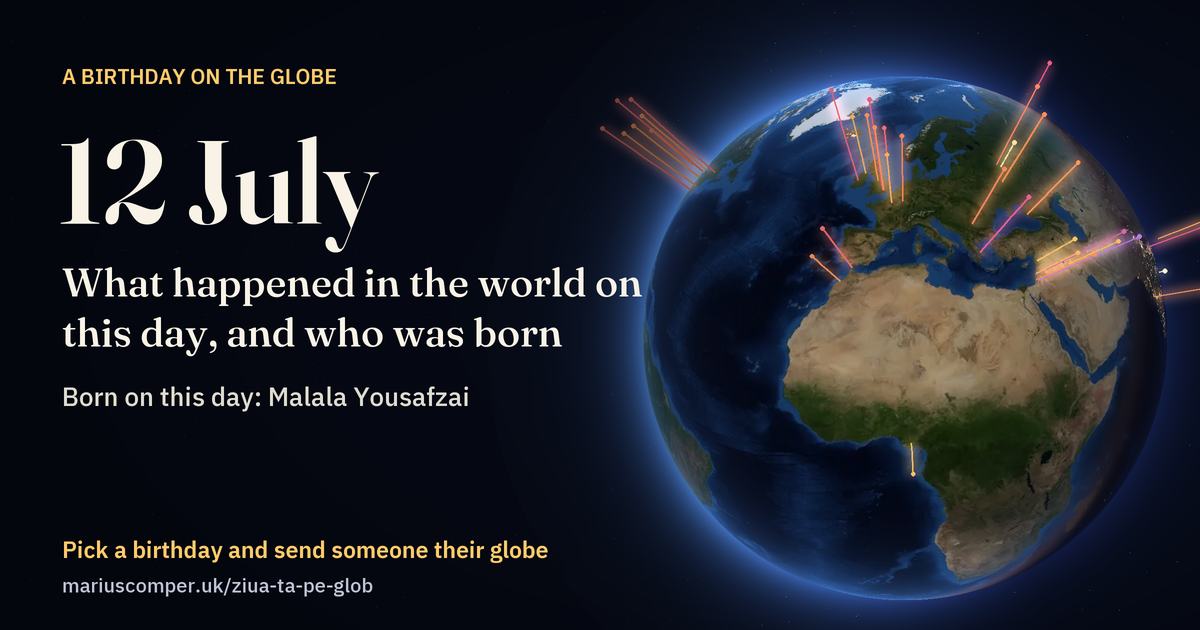
For 12 July, the English Wikipedia lists 58 events and 238 births. 35 of the events stand at their places as rays of light; four more are dashed circles, where the sentence links only to a country or a sea. The taller the ray, the longer ago it happened. The people born that day come further down, as blue points.
A birthday, yours or someone else’s:
Turn it into a greetingScroll: the globe turns to each place
The day you were born, on the globe.
Three things from your day
Scroll: your day first, then 12 July through the years
The Earth on 12 July
The picture on the globe was assembled by NASA from satellite photographs taken in July 2004: the snow, the ice and the green are those of the month.
On 12 July the Sun passes straight overhead at noon along the parallel of 22.0° north. In London, the day lasts about 16 hours 15 minutes.
Beyond 68° north the Sun no longer sets; beyond 68° south it no longer rises.
The line between day and night is tilted on the globe exactly as on this day of the year. On the dark side you can see the lights of towns.
Britain & Ireland · Hampton Court Palace
1543
King Henry VIII of England marries his sixth and last wife, Catherine Parr, at Hampton Court Palace.
On the map: Hampton Court Palace.
Britain & Ireland · Marquee Club
1962
The English rock band the Rolling Stones played their first concert at the Marquee Club in London.
On the map: Marquee Club.
Europe · Saint Basil's Cathedral
1561
Saint Basil's Cathedral, located in Red Square, Moscow, was consecrated.
On the map: Saint Basil's Cathedral.
Also on the day’s list of Wikipedia in Spanish and Chinese.
Europe · Storming of the Bastille
1789
In response to the dismissal of the French finance minister Jacques Necker, the radical journalist Camille Desmoulins gives a speech which results in the storming of the Bastille two days later.
On the map: the coordinates Wikidata gives for the article “Storming of the Bastille”.
Also on the day’s list of Wikipedia in Spanish.
Europe · Moscow
1920
The Soviet–Lithuanian Peace Treaty is signed, by which Soviet Russia recognizes the independence of Lithuania.
On the map: Moscow.
Also on the day’s list of Wikipedia in Chinese.
North America · United States Congress
1862
The Medal of Honor is authorized by the United States Congress.
On the map: United States Congress.
Also on the day’s list of Wikipedia in Chinese.
North America · Disco Demolition Night
1979
Rowdy fans at Comiskey Park in Chicago stormed the field during a Major League Baseball promotional event at which a crate of disco records was blown up.
On the map: the coordinates Wikidata gives for the article “Disco Demolition Night”.
12 July
What the other Wikipedias remember#
For these years the English list has nothing on this day. The events below come from the same day’s lists on Wikipedia in Spanish and Chinese and were translated for this page.
From Wikipedia in Spanish · Pabellón de la República Española
1937
In the Pavilion of the Spanish Republic, as part of the International Exposition in Paris, the work Guernica by the artist Pablo Picasso (55 years old) is shown to the public.
On the map: Pabellón de la República Española.
Translated from the list on Wikipedia in Spanish.
From Wikipedia in Chinese · FNB Stadium
2010
Spain's men's football team wins the 2010 World Cup, becoming the eighth nation to lift the trophy, after Uruguay, Italy, Germany, Brazil, England, Argentina and France.
On the map: FNB Stadium.
Translated from the list on Wikipedia in Chinese.
12 July
Born on 12 July#
The English Wikipedia lists 238 births for this day. The blue points are the birthplaces of 60 of these people: those written about in the most Wikipedia editions, where Wikidata gives a place of birth.
Born on 12 July
1997
Malala Yousafzai, Pakistani-English activist, Nobel Prize laureate
Place of birth: Mingora.
Born on 12 July
1817
Henry David Thoreau, American essayist, poet, and philosopher (died 1862)
Place of birth: Concord.
Born on 12 July
1884
Amedeo Modigliani, Italian painter and sculptor (died 1920)
Place of birth: Livorno.
Born on 12 July
1895
Buckminster Fuller, American architect and engineer, designed the Montreal Biosphère (died 1983)
Place of birth: Milton.
Born in Britain and Ireland
1995
Luke Shaw, English footballer
Place of birth: Kingston upon Thames.
Born in Britain and Ireland
1943
Christine McVie, English singer-songwriter and keyboard player (died 2022)
Place of birth: Bouth.
Born in Britain and Ireland
1730
Josiah Wedgwood, English potter, founded the Wedgwood Company (died 1795)
Place of birth: Burslem.
12 July
Number one in the charts that week
At the cinema
An animal recorded that day
The record can be seen in GBIF, which brings together wildlife records from around the world.
All your birthdays
The weather that day
Data: Met Office Hadley Centre (HadCET); NOAA (GHCN-Daily, Mauna Loa).
Above the Earth
Sources: Jonathan McDowell, GCAT (launches); GFZ Potsdam (Kp index). Days are counted in Universal Time.
Football that day
International matches played that day:
Source: the “International football results” dataset kept by Mart Jürisoo (CC0).
Also that day
The earthquake’s page at the USGS
Source: the USGS catalogue. The day is counted in Universal Time (UTC).
In those days
Make a link for someone
Type the name, pick the day and the year of birth. The link opens straight on their day, with their name in the greeting.
The link carries the name, date and place typed here; anyone who gets it can see them.
Put another birthday beside it
Your mother’s, your child’s, a friend’s: the two days appear side by side.
Below: 12 July through the years.
The whole globe of the day
Drag the globe to turn it. Touch a ray or a point to read what happened there.
Everything Wikipedia lists for 12 July
The list is the English Wikipedia’s, in its own wording, as it stood in October 2026. 19 events have no place on the map: the sentence links to no place with coordinates, only to places too wide to mark, or to several countries.
- 70
The armies of Titus attack the walls of Jerusalem after a six-month siege. Three days later they breach the walls, which enables the army to destroy the Second Temple.
Asia · JerusalemWikipedia: Siege of Jerusalem - 526
Election of Pope Felix IV following the death of Pope John I earlier that year.
no place on the mapWikipedia: Pope Felix IV - 813
Leo V the Armenian is crowned as Byzantine Emperor after he successfully forced previous emperor Michael I Rangabe to abdicate the previous day.
no place on the mapWikipedia: Leo V the Armenian - 927
King Constantine II of Scotland, King Hywel Dda of Deheubarth, Ealdred of Bamburgh and King Owain of the Cumbrians accept the overlordship of King Æthelstan of England, leading to seven years of peace in the north.
Britain & Ireland · DeheubarthWikipedia: Constantine II of Scotland - 1191
Third Crusade: Saladin's garrison surrenders to Philip Augustus, ending the two-year siege of Acre.
Asia · Siege of AcreWikipedia: Third Crusade - 1335
Pope Benedict XII issues the papal bull Fulgens sicut stella matutina to reform the Cistercian Order.
no place on the mapWikipedia: Pope Benedict XII - 1450
Although he had been previously pardoned, Jack Cade is killed while fleeing, bringing an end to Jack Cade's Rebellion.
no place on the mapWikipedia: Jack Cade's Rebellion - 1470
The Ottomans capture Euboea.
Europe · Siege of NegroponteWikipedia: Siege of Negroponte - 1488
Joseon Dynasty official Choe Bu returns to Korea after months of shipwrecked travel in China.
Asia · JoseonWikipedia: Joseon - 1493
Hartmann Schedel's Nuremberg Chronicle, one of the best-documented early printed books, is published.
no place on the mapWikipedia: Hartmann Schedel - 1527
Lê Cung Hoàng cedes the throne to Mạc Đăng Dung, ending the Lê dynasty and starting the Mạc dynasty.
no place on the mapWikipedia: Lê Cung Hoàng - 1543
King Henry VIII of England marries his sixth and last wife, Catherine Parr, at Hampton Court Palace.
Britain & Ireland · Hampton Court PalaceWikipedia: Henry VIII - 1561
Saint Basil's Cathedral, located in Red Square, Moscow, was consecrated.
Europe · Saint Basil's CathedralWikipedia: Saint Basil's Cathedral - 1562
Fray Diego de Landa, acting Bishop of Yucatán, burns the sacred idols and books of the Maya.
no place on the mapWikipedia: Diego de Landa - 1576
Mughal Empire annexes Bengal after defeating the Bengal Sultanate at the Battle of Rajmahal.
Asia · RajmahalWikipedia: Battle of Rajmahal - 1580
The Ostrog Bible, one of the early printed Bibles in a Slavic language, is published.
no place on the mapWikipedia: Ostrog Bible - 1691
Battle of Aughrim (Julian calendar): The decisive victory of William III of England's forces in Ireland.
Britain & Ireland · Battle of AughrimWikipedia: Battle of Aughrim - 1776
Captain James Cook begins his third voyage.
no place on the mapWikipedia: James Cook - 1789
In response to the dismissal of the French finance minister Jacques Necker, the radical journalist Camille Desmoulins gives a speech which results in the storming of the Bastille two days later.
Europe · Storming of the BastilleWikipedia: Storming of the Bastille - 1790
The Civil Constitution of the Clergy is passed in France by the National Constituent Assembly.
no place on the mapWikipedia: Civil Constitution of the Clergy - 1799
Ranjit Singh conquers Lahore and becomes Maharaja of the Punjab (Sikh Empire).
no place on the mapWikipedia: Ranjit Singh - 1801
British ships inflict heavy damage on Spanish and French ships in the Second Battle of Algeciras.
Europe · Second Battle of AlgecirasWikipedia: Second Battle of Algeciras - 1806
At the insistence of Napoleon, Bavaria, Baden, Württemberg and thirteen minor principalities leave the Holy Roman Empire and form the Confederation of the Rhine.
no place on the mapWikipedia: Bavaria - 1812
The American Army of the Northwest briefly occupies the Upper Canadian settlement at what is now at Windsor, Ontario.
North America · Windsor, OntarioWikipedia: Army of the Northwest - 1847
A riot occurs in Woodstock, New Brunswick, between Catholics and members of the Orange Order that results in up to ten deaths.
North America · 1847 Woodstock riotWikipedia: 1847 Woodstock riot - 1862
The Medal of Honor is authorized by the United States Congress.
North America · United States CongressWikipedia: United States Congress - 1913
Serbian forces begin their siege of the Bulgarian city of Vidin; the siege is later called off when the war ends.
Europe · Siege of VidinWikipedia: Siege of Vidin - 1913
The Second Revolution breaks out against the Beiyang government, as Li Liejun proclaims Jiangxi independent from the Republic of China.
no place on the mapWikipedia: Second Revolution - 1916
First World War: Second Lieutenant Kléber Dupuy defeated a German attack on Fort Souville at a key moment of the Battle of Verdun.
Europe · Fort SouvilleWikipedia: World War I - 1917
The Bisbee Deportation occurs as vigilantes kidnap and deport nearly 1,300 striking miners and others from Bisbee, Arizona.
North America · Bisbee, ArizonaWikipedia: Bisbee Deportation - 1918
The Imperial Japanese Navy battleship Kawachi blows up at Shunan, western Honshu, Japan, killing at least 621.
no place on the mapWikipedia: Imperial Japanese Navy - 1920
The Soviet–Lithuanian Peace Treaty is signed, by which Soviet Russia recognizes the independence of Lithuania.
Europe · MoscowWikipedia: Soviet–Lithuanian Peace Treaty - 1943
World War II: Battle of Kursk: German and Soviet forces engage in the Battle of Prokhorovka, one of the largest armored engagements of all time.
Europe · Battle of KurskWikipedia: Battle of Kursk - 1948
Israeli Prime Minister David Ben-Gurion orders the expulsion of Palestinians from the towns of Lod and Ramla.
Asia · Palestinian expulsion from Lydda and RamleWikipedia: Palestinian expulsion from Lydda and Ramle - 1960
Orlyonok, the main Young Pioneer camp of the Russian SFSR, is founded.
Europe · OrlyonokWikipedia: Orlyonok - 1961
Indian city Pune floods due to failure of the Khadakwasla and Panshet dams, killing at least two thousand people.
Asia · PuneWikipedia: Khadakwasla Dam - 1961
ČSA Flight 511 crashes at Casablanca–Anfa Airport in Morocco, killing 72.
Africa · ČSA Flight 511Wikipedia: ČSA Flight 511 - 1962
The English rock band the Rolling Stones played their first concert at the Marquee Club in London.
Britain & Ireland · Marquee ClubWikipedia: The Rolling Stones - 1963
Pauline Reade, 16, disappears in Gorton, England, the first victim in the Moors murders.
Britain & Ireland · GortonWikipedia: Moors murders - 1967
Riots begin in Newark, New Jersey.
North America · 1967 Newark riotsWikipedia: 1967 Newark riots - 1971
The Australian Aboriginal flag is flown for the first time.
no place on the mapWikipedia: Australian Aboriginal flag - 1973
A fire destroys the entire sixth floor of the National Personnel Records Center of the United States.
North America · National Personnel Records Center fireWikipedia: National Personnel Records Center fire - 1975
São Tomé and Príncipe declare independence from Portugal.
Africa · São Tomé and PríncipeWikipedia: São Tomé and Príncipe - 1979
Rowdy fans at Comiskey Park in Chicago stormed the field during a Major League Baseball promotional event at which a crate of disco records was blown up.
North America · Disco Demolition NightWikipedia: Disco Demolition Night - 1979
The island nation of Kiribati becomes independent from the United Kingdom.
Oceania · KiribatiWikipedia: Kiribati - 1995
Chinese seismologists successfully predict the 1995 Myanmar–China earthquake, reducing the number of casualties to 11.
Asia · 1995 Myanmar–China earthquakeWikipedia: Seismology - 1997
Hayao Miyazaki's animated film Princess Mononoke is released, becoming the highest-grossing film in Japan for a few months.
no place on the mapWikipedia: Hayao Miyazaki - 1998
France win their first World Cup title, defeating defending champions Brazil 3–0.
Europe · Stade de FranceWikipedia: 1998 FIFA World Cup final - 1998
The Ulster Volunteer Force attack a house in Ballymoney, County Antrim, Northern Ireland with a petrol bomb, killing the Quinn brothers.
Britain & Ireland · Murder of the Quinn brothersWikipedia: Murder of the Quinn brothers - 2001
Space Shuttle program: Space Shuttle Atlantis is launched on mission STS-104, carrying the Quest Joint Airlock to the International Space Station.
no place on the mapWikipedia: Space Shuttle program - 2006
A cross-border raid by Hezbollah militants starts the 2006 Lebanon War.
Asia · 2006 Hezbollah cross-border raidWikipedia: 2006 Hezbollah cross-border raid - 2007
U.S. Army Apache helicopters engage in airstrikes against armed insurgents in Baghdad, Iraq, where civilians are killed; footage from the cockpit is later leaked to the Internet.
Asia · July 12, 2007, Baghdad airstrikeWikipedia: July 12, 2007, Baghdad airstrike - 2008
An edit on the page of the coati nicknamed it the Brazilian aardvark, in which multiple news channels followed in pursuit.
no place on the mapWikipedia: Coati - 2012
A tank truck explosion kills more than 100 people in Okobie, Nigeria.
Africa · OkobieWikipedia: List of tank truck fires and explosions - 2012
Syrian Civil War: Government forces target the homes of rebels and activists in Tremseh and kill anywhere between 68 and 150 people.
Asia · Battle of TremsehWikipedia: Battle of Tremseh - 2013
Six people are killed and 200 injured in a French passenger train derailment in Brétigny-sur-Orge.
no place on the mapWikipedia: Brétigny-sur-Orge train crash - 2024
Gazpromavia Flight 9608 crashes in Russia's Kolomensky District near Kolomna, killing three.
Europe · Gazpromavia Flight 9608Wikipedia: Gazpromavia Flight 9608 - 2026
A bar fire kills 33 people in Bangkok, Thailand.
Asia · 2026 Bangkok pub fireWikipedia: 2026 Bangkok pub fire
What the other Wikipedias remember
For these years the English list has nothing on this day. The events below come from the same day’s lists on Wikipedia in Spanish and Chinese and were translated for this page.
- 1937
In the Pavilion of the Spanish Republic, as part of the International Exposition in Paris, the work Guernica by the artist Pablo Picasso (55 years old) is shown to the public.
Europe · Pabellón de la República EspañolaTranslated from the list on Wikipedia in SpanishWikipedia: Guernica - 2010
Spain's men's football team wins the 2010 World Cup, becoming the eighth nation to lift the trophy, after Uruguay, Italy, Germany, Brazil, England, Argentina and France.
Who was born on 12 July
In order of how many Wikipedia editions have an article about each. The first 60 of 238 are shown.
- 100 BC
Julius Caesar, Roman politician and general (died 44 BC)
- 1904
Pablo Neruda, Chilean poet and diplomat, Nobel Prize laureate (died 1973)
ParralWikipedia: Pablo Neruda - 1997
Malala Yousafzai, Pakistani-English activist, Nobel Prize laureate
MingoraWikipedia: Malala Yousafzai - 1817
Henry David Thoreau, American essayist, poet, and philosopher (died 1862)
- 1991
James Rodríguez, Colombian footballer
- 1884
Amedeo Modigliani, Italian painter and sculptor (died 1920)
LivornoWikipedia: Amedeo Modigliani - 1895
Buckminster Fuller, American architect and engineer, designed the Montreal Biosphère (died 1983)
- 1937
Bill Cosby, American actor, comedian, producer, and screenwriter
PhiladelphiaWikipedia: Bill Cosby - 1948
Richard Simmons, American fitness trainer and actor (died 2024)
New OrleansWikipedia: Richard Simmons - 1978
Michelle Rodriguez, American actress
San AntonioWikipedia: Michelle Rodriguez - 2000
Vinícius Júnior, Brazilian footballer
São GonçaloWikipedia: Vinícius Júnior - 1813
Claude Bernard, French physiologist and academic (died 1878)
Saint-JulienWikipedia: Claude Bernard - 1913
Willis Lamb, American physicist and academic, Nobel Prize laureate (died 2008)
Los AngelesWikipedia: Willis Lamb - 1937
Lionel Jospin, French civil servant and politician, 165th Prime Minister of France (died 2026)
MeudonWikipedia: Lionel Jospin - 1995
Luke Shaw, English footballer
Kingston upon ThamesWikipedia: Luke Shaw - 1854
George Eastman, American businessman, founded Eastman Kodak (died 1933)
WatervilleWikipedia: George Eastman - 1935
Satoshi Ōmura, Japanese biochemist and academic, Nobel Prize laureate
KamiyamaWikipedia: Satoshi Ōmura - 1916
Lyudmila Pavlichenko, Ukrainian-Russian soldier and sniper (died 1974)
Bila TserkvaWikipedia: Lyudmila Pavlichenko - 1959
Tupou VI, King of Tonga
Royal Palace of NukuʻalofaWikipedia: Tupou VI - 1982
Antonio Cassano, Italian footballer
- 2002
Nico Williams, Spanish footballer
PamplonaWikipedia: Nico Williams - 1892
Bruno Schulz, Ukrainian-Polish author and painter (died 1942)
DrohobychWikipedia: Bruno Schulz - 1928
Elias James Corey, American chemist and academic, Nobel Prize laureate
MethuenWikipedia: Elias James Corey - 1952
Irina Bokova, Bulgarian politician, Bulgarian Minister of Foreign Affairs
- 1868
Stefan George, German poet and translator (died 1933)
BüdesheimWikipedia: Stefan George - 1973
Christian Vieri, Italian footballer
BolognaWikipedia: Christian Vieri - 1876
Max Jacob, French poet, painter, and critic (died 1944)
QuimperWikipedia: Max Jacob - 1977
Brock Lesnar, American mixed martial artist and wrestler
WebsterWikipedia: Brock Lesnar - 1824
Eugène Boudin, French painter (died 1898)
HonfleurWikipedia: Eugène Boudin - 1852
Hipólito Yrigoyen, Argentinian lawyer and politician, 19th President of Argentina (died 1933)
Buenos AiresWikipedia: Hipólito Yrigoyen - 1989
Phoebe Tonkin, Australian actress
SydneyWikipedia: Phoebe Tonkin - 1957
Catherine Connolly, Irish politician, 10th President of Ireland
- 1849
William Osler, Canadian physician and author (died 1919)
Bond HeadWikipedia: William Osler - 1872
Emil Hácha, Czech lawyer and politician, 3rd President of Czechoslovakia (died 1945)
Trhové SvinyWikipedia: Emil Hácha - 1881
Natalia Goncharova, Russian theatrical costume and set designer, painter and illustrator (died 1962)
Nagaevo-KarbonierWikipedia: Natalia Goncharova - 1974
Sharon den Adel, Dutch singer-songwriter
WaddinxveenWikipedia: Sharon den Adel - 1978
Topher Grace, American actor
New York CityWikipedia: Topher Grace - 1990
Rachel Brosnahan, American actress
MilwaukeeWikipedia: Rachel Brosnahan - 1884
Louis B. Mayer, Russian-born American film producer, co-founded Metro-Goldwyn-Mayer (died 1957)
- 1967
John Petrucci, American singer-songwriter and guitarist
Long IslandWikipedia: John Petrucci - 1998
Shai Gilgeous-Alexander, Canadian basketball player
- 1917
Andrew Wyeth, American artist (died 2009)
Chadds Ford TownshipWikipedia: Andrew Wyeth - 1970
Lee Byung-hun, South Korean actor
- 1943
Christine McVie, English singer-songwriter and keyboard player (died 2022)
- 1908
Milton Berle, American comedian and actor (died 2002)
New York CityWikipedia: Milton Berle - 1957
Rick Husband, American colonel, pilot, and astronaut (died 2003)
AmarilloWikipedia: Rick Husband - 1992
Bartosz Bereszyński, Polish footballer
- 1730
Josiah Wedgwood, English potter, founded the Wedgwood Company (died 1795)
BurslemWikipedia: Josiah Wedgwood - 1861
Anton Arensky, Russian pianist, composer, and educator (died 1906)
Veliky NovgorodWikipedia: Anton Arensky - 1955
Timothy Garton Ash, English historian and author
- 1870
Louis II, Prince of Monaco (died 1949)
Baden-BadenWikipedia: Louis II of Monaco - 1974
Stelios Giannakopoulos, Greek footballer and manager
- 1880
Tod Browning, American actor, director, and screenwriter (died 1962)
LouisvilleWikipedia: Tod Browning - 1996
Moussa Dembélé, French footballer
PontoiseWikipedia: Moussa Dembélé - 1990
Bebé, Portuguese footballer
Agualva-CacémWikipedia: Bebé - 1863
Paul Drude, German physicist and academic (died 1906)
BrunswickWikipedia: Paul Drude - 1954
Wolfgang Dremmler, German footballer and coach
SalzgitterWikipedia: Wolfgang Dremmler - 1976
Anna Friel, English actress
RochdaleWikipedia: Anna Friel - 1980
Kristen Connolly, American actress
MontclairWikipedia: Kristen Connolly - 1895
Kirsten Flagstad, Norwegian soprano (died 1962)
Hamar MunicipalityWikipedia: Kirsten Flagstad
What is celebrated on 12 July
- Christian feast day: Feast of Saints Peter and Paul (Eastern Orthodox)
- Christian feast day: Hermagoras and Fortunatus
- Christian feast day: Jason of Thessalonica (Catholic Church)
- Christian feast day: John Gualbert
- Christian feast day: John Jones
- Christian feast day: Drostan
- Christian feast day: Louis Martin and Marie-Azélie Guérin
- Christian feast day: Nabor and Felix
- Christian feast day: Nathan Söderblom (Lutheran, Episcopal Church (USA))
- Christian feast day: Veronica
- Christian feast day: Viventiolus
- Christian feast day: July 12 (Eastern Orthodox liturgics)
- The second day of Naadam (Mongolia)
- The Twelfth, also known as Orangemen's Day (Northern Ireland, Scotland, England, Republic of Ireland, Australia, Newfoundland and Labrador)
A greeting link for someone
Type a name and, if you like, the year of birth. The link opens with a greeting, and beside each event it says how old the person turned that day, or how many years before their birth it happened.
The name and the year go only into the link you send.
All 366 days
How the globe is made
Where the events come from
Each edition of this page uses the day’s list from Wikipedia in its own language: Romanian, English, Spanish, Chinese. The lists are written by volunteers and differ from one edition to the next; the text of each event is Wikipedia’s, with a link to the article. A row that appears twice in a list is shown once. The lists have not been checked event by event: they are Wikipedia’s, mistakes included.
For events before 1582, and for countries that moved to the Gregorian calendar later (Britain in 1752, Russia in 1918), the same day may be counted Old Style in one list and New Style in another.
The chapter “What the other Wikipedias remember” adds up to five events a day from the lists of the other three editions, only for years in which the English list has nothing on that day. They were translated for this page, passed the same filters as the tour, and are not counted among the events of the English list.
How an event gets onto the map
The place comes from Wikidata. If the sentence links to the article about the event itself (a battle, an opening, an earthquake), dated to the same year, the ray stands on its coordinates or on those of its location. Otherwise it stands on the first place the sentence links to: a town, a building, a mountain, an island. This second step can be wrong: sometimes the sentence only mentions the place. That is why the page says, under each event, which place the ray stands on.
When the sentence links to a single state or province, or to a single sea, lake or desert larger than 5,000 km², the globe shows a dashed circle, not a ray. The circle has the area Wikidata gives, with its radius kept between 1.2° and 16°, or a radius of 4.5° when Wikidata gives no area; it says only that the sentence links to that place. Organisations, ships, spacecraft, museum objects, rivers, mountain ranges, languages and continents are never used as places. When a sentence names several states and no exact place, the event stays in the list only.
What the height means
The height of a ray shows how many years have passed, on a logarithmic scale: 10 years, 100 years and 1,000 years are equal steps apart; anything older than about 2,600 years has the tallest ray. The colour runs from pale yellow for recent years to violet for antiquity.
Where the tour stops
In each region the tour stops at up to three events (five in Britain and Ireland), chosen mainly by three things: whether Wikipedia’s editors put the event in the “On this day” box of their main page (the English, Spanish and Chinese editions), how many Wikipedia editions have an article about it, and how many of the four lists include it. Events whose sentence or article is about a war, an attack, a crime or a disaster are left out of the tour; they stay in the whole list, in Wikipedia’s wording. The filter is a list of words and a list of Wikidata types, so it can miss some.
The tour of births names the people with articles in the most editions and leaves aside those whom the list or Wikidata describes as rulers, politicians, commanders, leaders of movements or criminals; they stay in the list.
The Earth and the Sun
The daytime images are NASA’s Blue Marble Next Generation mosaics, one for each month of 2004; the night side is Black Marble 2016. The tilt of the line between day and night is computed for the day; the hour is chosen so that the place being read is in daylight. The latitude where the Sun stands overhead is the average of the four years of the leap cycle; in a given year it can differ by up to 0.4°.
The day you were born
The number ones come from the weekly lists on Wikipedia: Billboard for the United States (from 1940; the Hot 100 from August 1958), the UK Singles Chart (from November 1952), Los 40 Principales for Spain (from July 1966) and, for Romania, the Romanian Top 100 and Airplay 100 (2001–2021, with missing weeks). The page shows the chart of the week in which the day of birth falls, with its date; Billboard and the UK chart are dated at the end of their week. For Romania before 2001 and for China these sources have no weekly chart.
The films are those that reached cinemas in the United States up to ten days before or three days after that day (some of them in a few cinemas at first), from the English Wikipedia’s yearly lists (from 1968), in order of how many editions have an article about them. The events “in those days” are the ones on the neighbouring days’ lists that carry the year of birth, passed through the same filter as the tour.
The day of birth, year included
The Moon, the star sign and the constellation are worked out by the page itself, for noon Universal Time on the day. The lit part of the Moon is rounded and can differ by a few per cent from that at the hour of birth. The sign follows the usual zodiac of twelve equal parts starting at the March equinox; the constellation is the one the Sun actually stood in front of, by the borders set by the International Astronomical Union, and within a day of a border the page does not name it. When the Sun changes sign while it is that day anywhere on Earth, the page gives the moment of crossing, rounded to ten minutes and accurate to within about a quarter of an hour, and the clock time in a few cities, with the time zone and summer time of that year.
The year in the Chinese calendar is the one your device’s own calendar gives for the date, checked against the Hong Kong Observatory’s tables. “All your birthdays” uses the same sources as the rest of the chapter for the same day in every year since the birth: the temperature, well-known launches that took place on that very day, matches of the teams the edition follows, snow deeper than 10 cm and strong geomagnetic storms. The three things at the top and the four on the picture are chosen in a fixed order (the song, the animal, a full Moon, a well-known launch before an ordinary earthquake); on the picture you can change them.
When the link carries a year of birth, the page adds a few things about that exact day. The weather is the Met Office’s Central England temperature record and the readings from New York’s Central Park; the “usual high” is the average of the daily highs of 1961–1990 for that date, with two days either side. The carbon dioxide figure is the monthly mean at the Mauna Loa observatory, where measurements begin in March 1958.
The earthquake is the one with the largest magnitude in the USGS catalogue for that day, counted in Universal Time. Before the 1960s the catalogue has gaps even above magnitude 5.5, so in the older years many days have no earthquake. The page gives only the magnitude and the place: the country the epicentre falls in or, when the epicentre is at sea within 300 km of a coast, the nearest country; farther out, only the ocean.
The launches are those that reached orbit or left for the Moon and the planets, from Jonathan McDowell’s GCAT catalogue. If nothing left that day, the page shows the nearest launch within three days before or after, and says how many days away it was. The geomagnetic storm appears only when the Kp index reached at least 5 in one of the day’s eight three-hour intervals.
The animal comes from GBIF: an observation made by a person (the animal seen or heard, or its tracks), dated to that exact day, with coordinates and a CC0 or CC BY licence. Only a few hundred well-known species are searched (mammals, birds, turtles, butterflies); of those noted that day, mammals and species with articles in many Wikipedia editions come first; birds noted almost every day, and species used recently, wait their turn. Observations dated 1 January are left out, because records without a day are often filed there. An observation shows that the animal was recorded there, not how many animals there were.
The matches are those between national teams. Only matches of England, Scotland, Wales, Northern Ireland, the Republic of Ireland, the United States, Canada and Australia are shown, along with those at the big final tournaments. The picture to send is drawn in the page from the day’s globe and the facts above, and stays on your device until you send it.
Sources
- Events, births and holidays: the day’s page on Wikipedia, text under CC BY-SA 4.0.
- Coordinates, places of birth and the number of editions: Wikidata (CC0).
- The Earth by day: NASA Blue Marble Next Generation. The Earth by night: NASA Black Marble 2016.
- Borders and regions: Natural Earth.
- World population and births per year: UN World Population Prospects 2024.
- Charts and films: Wikipedia’s lists for Billboard, the UK Singles Chart, Los 40 Principales, Romanian Top 100, Airplay 100 and American films by year (CC BY-SA 4.0).
- Weather: Met Office Hadley Centre, HadCET (Open Government Licence) and NOAA GHCN-Daily, New York Central Park. Carbon dioxide: NOAA Global Monitoring Laboratory, Mauna Loa.
- Earthquakes: the USGS catalogue. Launches: Jonathan McDowell, GCAT (CC BY). Kp index: GFZ Potsdam (CC BY 4.0). Matches: International football results, Mart Jürisoo (CC0).
- Animal observations: GBIF, with a link to each record; species names come from Wikidata.