A birthday on the globe
6 September on the globe: what happened in the world on this day, and who was born
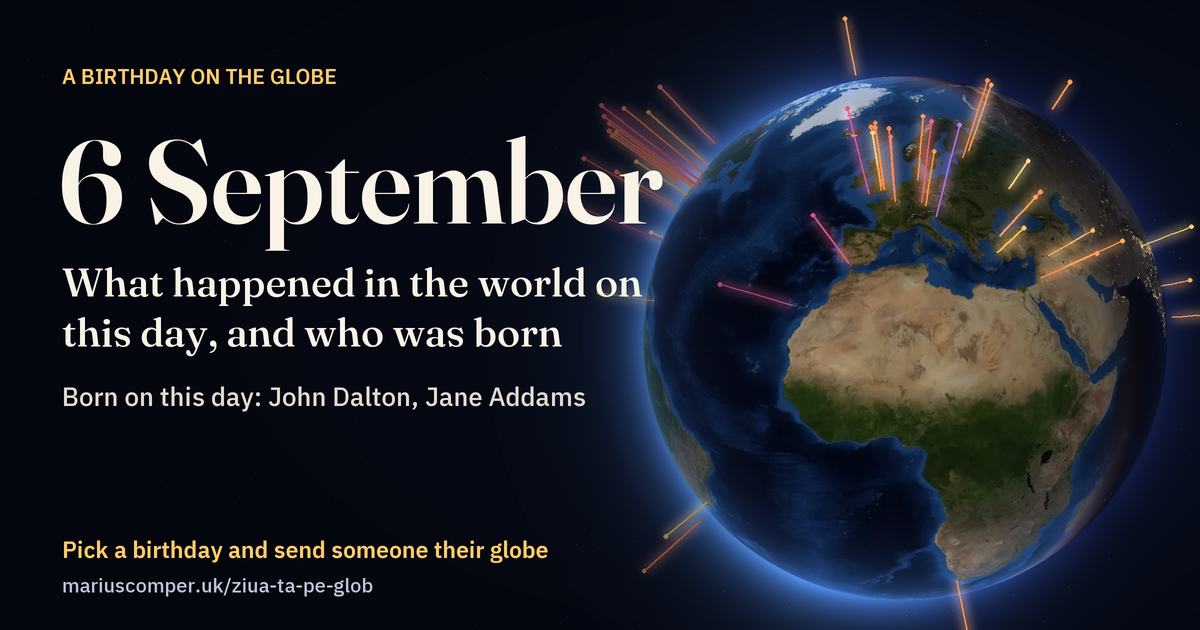
For 6 September, the English Wikipedia lists 66 events and 249 births. 46 of the events stand at their places as rays of light; eight more are dashed circles, where the sentence links only to a country or a sea. The taller the ray, the longer ago it happened. The people born that day come further down, as blue points.
A birthday, yours or someone else’s:
Turn it into a greetingScroll: the globe turns to each place
The day you were born, on the globe.
Three things from your day
Scroll: your day first, then 6 September through the years
The Earth on 6 September
The picture on the globe was assembled by NASA from satellite photographs taken in September 2004: the snow, the ice and the green are those of the month.
On 6 September the Sun passes straight overhead at noon along the parallel of 6.4° north. In London, the day lasts about 13 hours 15 minutes.
Beyond 84° north the Sun no longer sets; beyond 84° south it no longer rises.
The line between day and night is tilted on the globe exactly as on this day of the year. On the dark side you can see the lights of towns.
Britain & Ireland · Plymouth
1620
The Pilgrim Fathers sail from Plymouth, England, on the Mayflower to settle in North America. (Old Style date; September 16 per New Style date.)
On the map: Plymouth.
Also on the day’s list of Wikipedia in Spanish.
Europe · La Gomera
1492
Christopher Columbus sails from La Gomera in the Canary Islands, his final port of call before crossing the Atlantic Ocean for the first time.
On the map: La Gomera.
Also on the day’s list of Wikipedia in Spanish.
Europe · Sanlúcar de Barrameda
1522
The Victoria returns to Sanlúcar de Barrameda in Spain, the only surviving ship of Ferdinand Magellan's expedition and the first known ship to circumnavigate the world.
On the map: Sanlúcar de Barrameda.
Also on the day’s list of Wikipedia in Spanish and Romanian.
Europe · Saint Petersburg
1991
The Russian parliament approves the name change of Leningrad back to Saint Petersburg. The change is effective October 1.
On the map: Saint Petersburg.
Also on the day’s list of Wikipedia in Spanish, Romanian and Chinese.
Asia · The Arts House
1999
The Parliament of Singapore relocated from the Old Parliament House to its current meeting place.
On the map: The Arts House.
Asia · Supreme Court of India
2018
Supreme Court of India decriminalises all consensual sex among adults in private, making homosexuality legal on the Indian lands.
On the map: Supreme Court of India.
Latin America · Monterrey Institute of Technology and Higher Education
1943
The Monterrey Institute of Technology is founded in Monterrey, Mexico as one of the largest and most influential private universities in Latin America.
On the map: Monterrey Institute of Technology and Higher Education.
Also on the day’s list of Wikipedia in Spanish.
Wikipedia: Monterrey Institute of Technology and Higher Education
North America · Salem, Massachusetts
1628
Puritans settle Salem, which became part of Massachusetts Bay Colony.
On the map: Salem, Massachusetts.
North America · Memphis, Tennessee
1916
The first self-service grocery store, Piggly Wiggly, was founded in Memphis, Tennessee, U.S.
On the map: Memphis, Tennessee.
Also on the day’s list of Wikipedia in Chinese.
North America · Mid-Atlantic Regional Spaceport
2013
The first Minotaur V rocket is launched from the Mid-Atlantic Regional Spaceport on Wallops Island, carrying NASA's LADEE spacecraft.
On the map: Mid-Atlantic Regional Spaceport.
6 September
What the other Wikipedias remember#
For these years the English list has nothing on this day. The events below come from the same day’s lists on Wikipedia in Spanish and were translated for this page.
From Wikipedia in Spanish · Palace of Versailles
1919
In Austria, the National Assembly authorises the signing of the Treaty of Versailles.
On the map: Palace of Versailles.
Translated from the list on Wikipedia in Spanish.
From Wikipedia in Spanish · Venice Film Festival
1956
The film Calle Mayor, directed by Juan Antonio Bardem and starring Betsy Blair and José Suárez, premieres at the Venice Film Festival.
On the map: Venice Film Festival.
Translated from the list on Wikipedia in Spanish.
The article on Wikipedia in Spanish: Festival Internacional de Cine de Venecia
6 September
Born on 6 September#
The English Wikipedia lists 249 births for this day. The blue points are the birthplaces of 60 of these people: those written about in the most Wikipedia editions, where Wikidata gives a place of birth.
Born on 6 September
1766
John Dalton, English chemist, meteorologist, and physicist (died 1844)
Place of birth: Cumberland.
Born on 6 September
1860
Jane Addams, American sociologist and author, Nobel Prize laureate (died 1935)
Place of birth: Cedarville.
Born on 6 September
1972
Idris Elba, English actor
Place of birth: London Borough of Hackney.
Born on 6 September
1892
Edward Victor Appleton, English-Scottish physicist and academic, Nobel Prize laureate (died 1965)
Born on 6 September
1943
Roger Waters, English singer-songwriter and bass player
Place of birth: Great Bookham.
Born in Britain and Ireland
1971
Dolores O'Riordan, Irish singer-songwriter (died 2018)
Place of birth: Ballybricken North.
Born in Britain and Ireland
1876
John Macleod, Scottish physician and physiologist, Nobel Prize laureate (died 1935)
Place of birth: Clunie.
Born in Britain and Ireland
1976
Naomie Harris, English actress
Place of birth: London.
6 September
Number one in the charts that week
At the cinema
An animal recorded that day
The record can be seen in GBIF, which brings together wildlife records from around the world.
All your birthdays
The weather that day
Data: Met Office Hadley Centre (HadCET); NOAA (GHCN-Daily, Mauna Loa).
Above the Earth
Sources: Jonathan McDowell, GCAT (launches); GFZ Potsdam (Kp index). Days are counted in Universal Time.
Football that day
International matches played that day:
Source: the “International football results” dataset kept by Mart Jürisoo (CC0).
Also that day
The earthquake’s page at the USGS
Source: the USGS catalogue. The day is counted in Universal Time (UTC).
In those days
Make a link for someone
Type the name, pick the day and the year of birth. The link opens straight on their day, with their name in the greeting.
The link carries the name, date and place typed here; anyone who gets it can see them.
Put another birthday beside it
Your mother’s, your child’s, a friend’s: the two days appear side by side.
Below: 6 September through the years.
The whole globe of the day
Drag the globe to turn it. Touch a ray or a point to read what happened there.
Everything Wikipedia lists for 6 September
The list is the English Wikipedia’s, in its own wording, as it stood in October 2026. 12 events have no place on the map: the sentence links to no place with coordinates, only to places too wide to mark, or to several countries.
- 394
Battle of the Frigidus: Roman emperor Theodosius I defeats and kills Eugenius the usurper. His Frankish magister militum Arbogast escapes but commits suicide two days later.
Europe · Battle of the FrigidusWikipedia: Battle of the Frigidus - 1492
Christopher Columbus sails from La Gomera in the Canary Islands, his final port of call before crossing the Atlantic Ocean for the first time.
Europe · La GomeraWikipedia: La Gomera - 1522
The Victoria returns to Sanlúcar de Barrameda in Spain, the only surviving ship of Ferdinand Magellan's expedition and the first known ship to circumnavigate the world.
Europe · Sanlúcar de BarramedaWikipedia: Victoria - 1566
Suleiman the Magnificent, the longest-reigning sultan of the Ottoman Empire, died at the age of 71.
Asia · Ottoman EmpireWikipedia: Suleiman the Magnificent - 1620
The Pilgrim Fathers sail from Plymouth, England, on the Mayflower to settle in North America. (Old Style date; September 16 per New Style date.)
Britain & Ireland · PlymouthWikipedia: Pilgrims - 1622
The Spanish treasure galleon Atocha sinks during a hurricane off Key West in the Straits of Florida, taking 40 short tons (36 t) of gold and silver and 260 of its 265 passengers and crew to the bottom.
North America · Key WestWikipedia: Galleon - 1628
Puritans settle Salem, which became part of Massachusetts Bay Colony.
North America · Salem, MassachusettsWikipedia: Puritans - 1634
Thirty Years' War: In the Battle of Nördlingen, the Catholic Imperial army defeats Swedish and German Protestant forces.
Europe · Battle of NördlingenWikipedia: Thirty Years' War - 1781
American Revolutionary War: The Battle of Groton Heights takes place, resulting in a British victory.
North America · Battle of Groton HeightsWikipedia: Battle of Groton Heights - 1803
British scientist John Dalton begins using symbols to represent the atoms of different elements.
no place on the mapWikipedia: John Dalton - 1859
Imam Shamil surrenders to the Russians, bringing the Caucasian Imamate to an end.
no place on the mapWikipedia: Imam Shamil - 1861
American Civil War: Forces under Union General Ulysses S. Grant bloodlessly capture Paducah, Kentucky, giving the Union control of the Tennessee River's mouth.
North America · Paducah, KentuckyWikipedia: American Civil War - 1863
American Civil War: Confederate forces evacuate Battery Wagner and Morris Island in South Carolina.
North America · Fort WagnerWikipedia: Confederate States of America - 1863
General John S. Marmaduke fatally wounded his Confederate Army colleague Lucius M. Walker in a formal duel in Arkansas.
North America · Marmaduke–Walker duelWikipedia: Marmaduke–Walker duel - 1870
Louisa Ann Swain of Laramie, Wyoming becomes the first woman in the United States to cast a vote legally after 1807.
North America · Laramie, WyomingWikipedia: Louisa Swain - 1885
Eastern Rumelia declares its union with Bulgaria, thus accomplishing Bulgarian unification.
Europe · BulgariaWikipedia: Bulgarian unification - 1901
Leon Czolgosz, an unemployed anarchist, shoots and fatally wounds US president William McKinley at the Pan-American Exposition in Buffalo, New York.
North America · Assassination of William McKinleyWikipedia: Assassination of William McKinley - 1914
World War I: The First Battle of the Marne, which would halt the Imperial German Army's advance into France, begins.
Europe · First Battle of the MarneWikipedia: World War I - 1915
World War I: The first tank prototype, developed by William Foster & Co. for the British army, is completed and given its first test drive.
no place on the mapWikipedia: British heavy tanks of the First World War - 1916
The first self-service grocery store, Piggly Wiggly, was founded in Memphis, Tennessee, U.S.
North America · Memphis, TennesseeWikipedia: Grocery store - 1930
Democratically elected Argentine president Hipólito Yrigoyen is deposed in a military coup.
Latin America · Buenos AiresWikipedia: 1930 Argentine coup d'état - 1936
Spanish Civil War: The Interprovincial Council of Asturias and León is established.
no place on the mapWikipedia: Spanish Civil War - 1939
World War II: The British Royal Air Force suffers its first fighter pilot casualty of the Second World War at the Battle of Barking Creek as a result of friendly fire.
Britain & Ireland · Battle of Barking CreekWikipedia: Battle of Barking Creek - 1939
World War II: Union of South Africa declares war on Germany.
Africa · Union of South AfricaWikipedia: Union of South Africa - 1940
King Carol II of Romania abdicates and is succeeded by his son Michael. General Ion Antonescu becomes the Conducător of Romania.
Europe · Kingdom of RomaniaWikipedia: Carol II of Romania - 1943
Pennsylvania Railroad's premier train derails at Frankford Junction in Philadelphia, killing 79 people and injuring 117 others.
North America · PhiladelphiaWikipedia: 1943 Frankford Junction train wreck - 1943
The Monterrey Institute of Technology is founded in Monterrey, Mexico as one of the largest and most influential private universities in Latin America.
Latin America · Monterrey Institute of Technology and Higher EducationWikipedia: Monterrey Institute of Technology and Higher Education - 1944
World War II: Soviet forces capture the city of Tartu, Estonia.
Europe · Tartu offensiveWikipedia: Tartu offensive - 1944
World War II: The city of Ypres, Belgium is liberated by Allied forces.
Europe · YpresWikipedia: Ypres - 1946
United States Secretary of State James F. Byrnes announces that the U.S. will follow a policy of economic reconstruction in postwar Germany.
no place on the mapWikipedia: Restatement of Policy on Germany - 1952
A prototype aircraft crashes at the Farnborough Airshow in Hampshire, England, killing 29 spectators and the two on board.
Britain & Ireland · Farnborough Airshow crashWikipedia: Farnborough Airshow crash - 1955
Istanbul's Greek, Jewish, and Armenian minorities are the target of a government-sponsored pogrom; dozens are killed in ensuing riots.
Asia · IstanbulWikipedia: Istanbul pogrom - 1962
Archaeologist Peter Marsden discovers the first of the Blackfriars Ships dating back to the second century AD in the Blackfriars area of the banks of the River Thames in London.
Britain & Ireland · Blackfriars shipwrecksWikipedia: Blackfriars shipwrecks - 1962
The United States government begins the Exercise Spade Fork nuclear readiness drill.
no place on the mapWikipedia: Federal Emergency Plan D-Minus - 1963
The Kennedy administration sent Victor H. Krulak and Joseph Mendenhall on a mission to assess the progress of the Vietnam War.
no place on the mapWikipedia: Vietnam War - 1965
India retaliates following Pakistan's Operation Grand Slam which results in the Indo-Pakistani War of 1965 that ends in a stalemate followed by the signing of the Tashkent Declaration.
no place on the mapWikipedia: Tashkent Declaration - 1966
Prime Minister Hendrik Verwoerd, the architect of apartheid, is stabbed to death in Cape Town, South Africa during a parliamentary meeting.
Africa · Cape TownWikipedia: Prime Minister of South Africa - 1968
Swaziland becomes independent.
Africa · EswatiniWikipedia: Eswatini - 1970
Two passenger jets bound from Europe to New York are simultaneously hijacked by Palestinian terrorist members of the PFLP and taken to Dawson's Field, Jordan.
Asia · Dawson's Field hijackingsWikipedia: Dawson's Field hijackings - 1971
Paninternational Flight 112 crashes on the Bundesautobahn 7 highway near Hamburg Airport, in Hamburg, Germany, killing 22.
Europe · Paninternational Flight 112Wikipedia: Paninternational Flight 112 - 1972
Munich massacre: Nine Israeli athletes die (along with a German policeman) at the hands of the Palestinian "Black September" terrorist group after being taken hostage at the Munich Olympic Games. Two other Israeli athletes were slain in the initial attack the previous day.
Europe · Munich massacreWikipedia: Munich massacre - 1976
Cold War: Soviet Air Defence Forces pilot Viktor Belenko lands a Mikoyan-Gurevich MiG-25 jet fighter at Hakodate in Japan and requests political asylum in the United States; his request is granted.
Asia · HakodateWikipedia: Cold War - 1983
The Soviet Union admits to shooting down Korean Air Lines Flight 007, stating that its operatives did not know that it was a civilian aircraft when it reportedly violated Soviet airspace.
Asia · Soviet UnionWikipedia: Korean Air Lines Flight 007 - 1985
Midwest Express Airlines Flight 105 crashes near Milwaukee Mitchell International Airport in Milwaukee, Wisconsin, killing all 31 people on board.
North America · Midwest Express Airlines Flight 105Wikipedia: Midwest Express Airlines Flight 105 - 1986
In Istanbul, two terrorists from Abu Nidal's organization kill 22 and wound six congregants inside the Neve Shalom Synagogue during Shabbat services.
Asia · Neve Shalom Synagogue massacreWikipedia: Neve Shalom Synagogue massacre - 1988
End of the last stage of the Anfal campaign of Ba'athist Iraq against its Kurdish population, which resulted in major destructions and major civilian losses.
Asia · Anfal campaignWikipedia: Anfal campaign - 1991
The Russian parliament approves the name change of Leningrad back to Saint Petersburg. The change is effective October 1.
Europe · Saint PetersburgWikipedia: Saint Petersburg - 1991
The Soviet Union recognizes the independence of the Baltic states Estonia, Latvia, and Lithuania.
no place on the mapWikipedia: Soviet Union - 1992
A group of hunters at the Stampede trail near Healy, Alaska come across a male corpse in abandoned bus, later identified as Christopher McCandless.
North America · Healy, AlaskaWikipedia: Healy, Alaska - 1995
Cal Ripken Jr. of the Baltimore Orioles plays in his 2,131st consecutive game, breaking a record that had stood for 56 years.
no place on the mapWikipedia: Cal Ripken Jr. - 1997
Royal Brunei Airlines Flight 839 crashes in the Lambir Hills National Park while on approach to Miri Airport in Malaysia, killing 10.
Asia · Royal Brunei Airlines Flight 839Wikipedia: Royal Brunei Airlines Flight 839 - 1997
The funeral of Diana, Princess of Wales takes place in London. Well over a million people line the streets and 21⁄2 billion watch around the world on television.
Britain & Ireland · Funeral of Diana, Princess of WalesWikipedia: Funeral of Diana, Princess of Wales - 1999
The Parliament of Singapore relocated from the Old Parliament House to its current meeting place.
Asia · The Arts HouseWikipedia: Parliament of Singapore - 2000
The Los Angeles Dodgers hosted the first Pride Night in Major League Baseball history.
no place on the mapWikipedia: Los Angeles Dodgers - 2003
Mahmoud Abbas resigns from his position of Palestinian Prime Minister.
no place on the mapWikipedia: Mahmoud Abbas - 2007
Israel executes the air strike Operation Orchard to destroy a nuclear reactor in Syria.
Asia · Operation Outside the BoxWikipedia: Operation Outside the Box - 2009
The ro-ro ferry SuperFerry 9 sinks off the Zamboanga Peninsula in the Philippines with 971 persons aboard; all but ten are rescued.
Asia · Zamboanga PeninsulaWikipedia: Roll-on/roll-off - 2012
Sixty-one people die after a fishing boat capsizes off the İzmir Province coast of Turkey, near the Greek Aegean islands.
Asia · September 2012 Baradan Bay, Turkey, migrant boat disasterWikipedia: September 2012 Baradan Bay, Turkey, migrant boat disaster - 2013
Forty-one elephants are poisoned with cyanide in salt pans, by poachers in Hwange National Park.
Africa · Hwange National ParkWikipedia: Hwange National Park - 2013
The first Minotaur V rocket is launched from the Mid-Atlantic Regional Spaceport on Wallops Island, carrying NASA's LADEE spacecraft.
North America · Mid-Atlantic Regional SpaceportWikipedia: Mid-Atlantic Regional Spaceport - 2017
Hurricane Irma reached peak intensity near the Caribbean islands of Barbuda, Saint Martin, and Virgin Gorda.
Latin America · BarbudaWikipedia: Barbuda - 2018
Brazilian presidential candidate Jair Bolsonaro survives a stabbing at a campaign rally in Juiz de Fora, Minas Gerais.
Latin America · Attempted assassination of Jair BolsonaroWikipedia: Attempted assassination of Jair Bolsonaro - 2018
Supreme Court of India decriminalises all consensual sex among adults in private, making homosexuality legal on the Indian lands.
Asia · Supreme Court of IndiaWikipedia: Supreme Court of India - 2022
Boris Johnson resigns as Prime Minister of the United Kingdom, and is replaced by Liz Truss. Their meetings with Queen Elizabeth II at Balmoral Castle were the Queen's final official duties before her death two days later.
Britain & Ireland · Balmoral CastleWikipedia: July–September 2022 Conservative Party leadership election - 2022
Russo-Ukrainian war: Ukraine begins its Kharkiv counteroffensive, surprising Russian forces and retaking over 3,000 square kilometers of land, recapturing the entire Kharkiv Oblast west of the Oskil River, within the next week.
Europe · 2022 Kharkiv counteroffensiveWikipedia: Russo-Ukrainian war - 2026
21 Air Flight 7598, a Boeing 767 freighter operating on behalf of Amazon Air, overruns the runway upon landing at Miami International Airport, striking multiple ground vehicles, killing at least five people, and injuring five others.
North America · 21 Air Flight 7598Wikipedia: 21 Air Flight 7598
What the other Wikipedias remember
For these years the English list has nothing on this day. The events below come from the same day’s lists on Wikipedia in Spanish and were translated for this page.
- 1919
In Austria, the National Assembly authorises the signing of the Treaty of Versailles.
Europe · Palace of VersaillesTranslated from the list on Wikipedia in SpanishWikipedia: Tratado de Versalles - 1956
The film Calle Mayor, directed by Juan Antonio Bardem and starring Betsy Blair and José Suárez, premieres at the Venice Film Festival.
Europe · Venice Film FestivalTranslated from the list on Wikipedia in SpanishWikipedia: Festival Internacional de Cine de Venecia
Who was born on 6 September
In order of how many Wikipedia editions have an article about each. The first 60 of 249 are shown.
- 1766
John Dalton, English chemist, meteorologist, and physicist (died 1844)
CumberlandWikipedia: John Dalton - 1860
Jane Addams, American sociologist and author, Nobel Prize laureate (died 1935)
CedarvilleWikipedia: Jane Addams - 1972
Idris Elba, English actor
London Borough of HackneyWikipedia: Idris Elba - 1892
Edward Victor Appleton, English-Scottish physicist and academic, Nobel Prize laureate (died 1965)
- 1808
Emir Abdelkader, Algerian religious and military leader (died 1883)
GuittenaWikipedia: Emir Abdelkader - 1943
Roger Waters, English singer-songwriter and bass player
Great BookhamWikipedia: Roger Waters - 1757
Gilbert du Motier, Marquis de Lafayette, French general (died 1834)
Chavaniac-LafayetteWikipedia: Marquis de Lafayette - 1963
Geert Wilders, Dutch lawyer and politician
- 1971
Dolores O'Riordan, Irish singer-songwriter (died 2018)
Ballybricken NorthWikipedia: Dolores O'Riordan - 1876
John Macleod, Scottish physician and physiologist, Nobel Prize laureate (died 1935)
ClunieWikipedia: John Macleod - 1666
Ivan V of Russia, Russian tsar (died 1696)
- 1729
Moses Mendelssohn, German philosopher and theologian (died 1786)
- 1939
Susumu Tonegawa, Japanese biologist and immunologist, Nobel Prize laureate (died 2026)
- 1906
Luis Federico Leloir, French-Argentine physician and biochemist, Nobel Prize laureate (died 1987)
16th arrondissement of ParisWikipedia: Luis Federico Leloir - 1976
Naomie Harris, English actress
LondonWikipedia: Naomie Harris - 1981
Yuki Abe, Japanese footballer
IchikawaWikipedia: Yuki Abe - 1957
José Sócrates, Portuguese engineer and politician, 119th Prime Minister of Portugal
Vilar de MaçadaWikipedia: José Sócrates - 1923
Peter II of Yugoslavia (died 1970)
- 1879
Joseph Wirth, German educator and politician, Chancellor of Germany (died 1956)
Freiburg im BreisgauWikipedia: Joseph Wirth - 1869
Felix Salten, Austrian-Swiss author and critic (died 1945)
- 1913
Leônidas, Brazilian footballer (died 2004)
São PauloWikipedia: Leônidas - 1915
Franz Josef Strauss, German lieutenant and politician, Minister President of Bavaria (died 1988)
- 1978
Homare Sawa, Japanese footballer
- 1980
Joseph Yobo, Nigerian footballer
- 1900
Julien Green, French-American author (died 1998)
17th arrondissement of ParisWikipedia: Julien Green - 1957
Michaëlle Jean, Haitian-Canadian journalist and politician, 27th Governor General of Canada
Port-au-PrinceWikipedia: Michaëlle Jean - 1954
Carly Fiorina, American businesswoman and activist
AustinWikipedia: Carly Fiorina - 1958
Jeff Foxworthy, American comedian, actor, producer, and screenwriter
AtlantaWikipedia: Jeff Foxworthy - 1943
Richard J. Roberts, English biochemist and biologist, Nobel Prize laureate
- 1888
Joseph P. Kennedy Sr., American businessman and diplomat, 44th United States Ambassador to the United Kingdom (died 1969)
East BostonWikipedia: Joseph P. Kennedy Sr. - 1944
Donna Haraway, American author, academic, and activist
DenverWikipedia: Donna Haraway - 1964
Rosie Perez, American actress, dancer, and director
BushwickWikipedia: Rosie Perez - 1802
Alcide d'Orbigny, French zoologist, palaeontologist, and geologist (died 1857)
CouëronWikipedia: Alcide d'Orbigny - 1925
Andrea Camilleri, Italian author, screenwriter, and director (died 2019)
Porto EmpedocleWikipedia: Andrea Camilleri - 2006
Prince Hisahito of Akishino, Japanese prince
Aiiku HospitalWikipedia: Prince Hisahito of Akishino - 1926
Prince Claus of the Netherlands (died 2002)
- 1962
Chris Christie, American lawyer and politician, 55th Governor of New Jersey
- 1967
Macy Gray, American singer-songwriter, producer, and actress
CantonWikipedia: Macy Gray - 1974
Tim Henman, English tennis player and sportscaster
OxfordWikipedia: Tim Henman - 2002
Leylah Fernandez, Canadian tennis player
MontrealWikipedia: Leylah Fernandez - 1973
Carlo Cudicini, Italian footballer
- 1928
Fumihiko Maki, Japanese architect and academic, designed the Tokyo Metropolitan Gymnasium and Makuhari Messe (died 2024)
- 1928
Robert M. Pirsig, American novelist and philosopher (died 2017)
MinneapolisWikipedia: Robert M. Pirsig - 2002
Asher Angel, American actor
PhoenixWikipedia: Asher Angel - 1974
Nina Persson, Swedish singer-songwriter and musician
ÖrebroWikipedia: Nina Persson - 2001
Freya Allan, English actress
OxfordshireWikipedia: Freya Allan - 1983
Pippa Middleton, English socialite and author
Royal Berkshire HospitalWikipedia: Pippa Middleton - 1983
Braun Strowman, American wrestler and strongman
Sherrills FordWikipedia: Braun Strowman - 1475
Sebastiano Serlio, Italian Mannerist architect (died 1554)
BolognaWikipedia: Sebastiano Serlio - 1947
Jane Curtin, American actress and comedian
CambridgeWikipedia: Jane Curtin - 1990
John Wall, American basketball player
RaleighWikipedia: John Wall - 1879
Max Schreck, German actor (died 1936)
BerlinWikipedia: Max Schreck - 1944
Swoosie Kurtz, American actress
- 1921
Carmen Laforet, Spanish author (died 2004)
Esquerra de l'EixampleWikipedia: Carmen Laforet - 1958
Michael Winslow, American actor
SpokaneWikipedia: Michael Winslow - 1961
Scott Travis, American rock drummer
NorfolkWikipedia: Scott Travis - 1925
Jimmy Reed, American singer-songwriter and guitarist (died 1976)
DunleithWikipedia: Jimmy Reed - 1963
Betsy Russell, American actress
San DiegoWikipedia: Betsy Russell - 1967
Igor Štimac, Croatian footballer and manager
MetkovićWikipedia: Igor Štimac - 1973
Greg Rusedski, Canadian-English tennis player and sportscaster
MontrealWikipedia: Greg Rusedski
What is celebrated on 6 September
- Christian feast days: Begga
- Christian feast days: Chagnoald
- Christian feast days: Faustus, Abibus and Dionysius of Alexandria
- Christian feast days: Gondulphus of Metz
- Christian feast days: Blessed Jan Franciszek Czartoryski
- Christian feast days: Magnus of Füssen
- Christian feast days: Onesiphorus
- Christian feast days: Zechariah (Hebrew prophet) (Catholic church)
- Christian feast days: September 6 (Eastern Orthodox liturgics)
- The earliest date on which the Abbots Bromley Horn Dance is performed
- Armed Forces Day (São Tomé and Príncipe)
- Defence Day or Army Day (Pakistan)
- Flag Day (Bonaire)
- Independence Day (Swaziland), celebrates the independence of Eswatini from the United Kingdom in 1968
A greeting link for someone
Type a name and, if you like, the year of birth. The link opens with a greeting, and beside each event it says how old the person turned that day, or how many years before their birth it happened.
The name and the year go only into the link you send.
All 366 days
How the globe is made
Where the events come from
Each edition of this page uses the day’s list from Wikipedia in its own language: Romanian, English, Spanish, Chinese. The lists are written by volunteers and differ from one edition to the next; the text of each event is Wikipedia’s, with a link to the article. A row that appears twice in a list is shown once. The lists have not been checked event by event: they are Wikipedia’s, mistakes included.
For events before 1582, and for countries that moved to the Gregorian calendar later (Britain in 1752, Russia in 1918), the same day may be counted Old Style in one list and New Style in another.
The chapter “What the other Wikipedias remember” adds up to five events a day from the lists of the other three editions, only for years in which the English list has nothing on that day. They were translated for this page, passed the same filters as the tour, and are not counted among the events of the English list.
How an event gets onto the map
The place comes from Wikidata. If the sentence links to the article about the event itself (a battle, an opening, an earthquake), dated to the same year, the ray stands on its coordinates or on those of its location. Otherwise it stands on the first place the sentence links to: a town, a building, a mountain, an island. This second step can be wrong: sometimes the sentence only mentions the place. That is why the page says, under each event, which place the ray stands on.
When the sentence links to a single state or province, or to a single sea, lake or desert larger than 5,000 km², the globe shows a dashed circle, not a ray. The circle has the area Wikidata gives, with its radius kept between 1.2° and 16°, or a radius of 4.5° when Wikidata gives no area; it says only that the sentence links to that place. Organisations, ships, spacecraft, museum objects, rivers, mountain ranges, languages and continents are never used as places. When a sentence names several states and no exact place, the event stays in the list only.
What the height means
The height of a ray shows how many years have passed, on a logarithmic scale: 10 years, 100 years and 1,000 years are equal steps apart; anything older than about 2,600 years has the tallest ray. The colour runs from pale yellow for recent years to violet for antiquity.
Where the tour stops
In each region the tour stops at up to three events (five in Britain and Ireland), chosen mainly by three things: whether Wikipedia’s editors put the event in the “On this day” box of their main page (the English, Spanish and Chinese editions), how many Wikipedia editions have an article about it, and how many of the four lists include it. Events whose sentence or article is about a war, an attack, a crime or a disaster are left out of the tour; they stay in the whole list, in Wikipedia’s wording. The filter is a list of words and a list of Wikidata types, so it can miss some.
The tour of births names the people with articles in the most editions and leaves aside those whom the list or Wikidata describes as rulers, politicians, commanders, leaders of movements or criminals; they stay in the list.
The Earth and the Sun
The daytime images are NASA’s Blue Marble Next Generation mosaics, one for each month of 2004; the night side is Black Marble 2016. The tilt of the line between day and night is computed for the day; the hour is chosen so that the place being read is in daylight. The latitude where the Sun stands overhead is the average of the four years of the leap cycle; in a given year it can differ by up to 0.4°.
The day you were born
The number ones come from the weekly lists on Wikipedia: Billboard for the United States (from 1940; the Hot 100 from August 1958), the UK Singles Chart (from November 1952), Los 40 Principales for Spain (from July 1966) and, for Romania, the Romanian Top 100 and Airplay 100 (2001–2021, with missing weeks). The page shows the chart of the week in which the day of birth falls, with its date; Billboard and the UK chart are dated at the end of their week. For Romania before 2001 and for China these sources have no weekly chart.
The films are those that reached cinemas in the United States up to ten days before or three days after that day (some of them in a few cinemas at first), from the English Wikipedia’s yearly lists (from 1968), in order of how many editions have an article about them. The events “in those days” are the ones on the neighbouring days’ lists that carry the year of birth, passed through the same filter as the tour.
The day of birth, year included
The Moon, the star sign and the constellation are worked out by the page itself, for noon Universal Time on the day. The lit part of the Moon is rounded and can differ by a few per cent from that at the hour of birth. The sign follows the usual zodiac of twelve equal parts starting at the March equinox; the constellation is the one the Sun actually stood in front of, by the borders set by the International Astronomical Union, and within a day of a border the page does not name it. When the Sun changes sign while it is that day anywhere on Earth, the page gives the moment of crossing, rounded to ten minutes and accurate to within about a quarter of an hour, and the clock time in a few cities, with the time zone and summer time of that year.
The year in the Chinese calendar is the one your device’s own calendar gives for the date, checked against the Hong Kong Observatory’s tables. “All your birthdays” uses the same sources as the rest of the chapter for the same day in every year since the birth: the temperature, well-known launches that took place on that very day, matches of the teams the edition follows, snow deeper than 10 cm and strong geomagnetic storms. The three things at the top and the four on the picture are chosen in a fixed order (the song, the animal, a full Moon, a well-known launch before an ordinary earthquake); on the picture you can change them.
When the link carries a year of birth, the page adds a few things about that exact day. The weather is the Met Office’s Central England temperature record and the readings from New York’s Central Park; the “usual high” is the average of the daily highs of 1961–1990 for that date, with two days either side. The carbon dioxide figure is the monthly mean at the Mauna Loa observatory, where measurements begin in March 1958.
The earthquake is the one with the largest magnitude in the USGS catalogue for that day, counted in Universal Time. Before the 1960s the catalogue has gaps even above magnitude 5.5, so in the older years many days have no earthquake. The page gives only the magnitude and the place: the country the epicentre falls in or, when the epicentre is at sea within 300 km of a coast, the nearest country; farther out, only the ocean.
The launches are those that reached orbit or left for the Moon and the planets, from Jonathan McDowell’s GCAT catalogue. If nothing left that day, the page shows the nearest launch within three days before or after, and says how many days away it was. The geomagnetic storm appears only when the Kp index reached at least 5 in one of the day’s eight three-hour intervals.
The animal comes from GBIF: an observation made by a person (the animal seen or heard, or its tracks), dated to that exact day, with coordinates and a CC0 or CC BY licence. Only a few hundred well-known species are searched (mammals, birds, turtles, butterflies); of those noted that day, mammals and species with articles in many Wikipedia editions come first; birds noted almost every day, and species used recently, wait their turn. Observations dated 1 January are left out, because records without a day are often filed there. An observation shows that the animal was recorded there, not how many animals there were.
The matches are those between national teams. Only matches of England, Scotland, Wales, Northern Ireland, the Republic of Ireland, the United States, Canada and Australia are shown, along with those at the big final tournaments. The picture to send is drawn in the page from the day’s globe and the facts above, and stays on your device until you send it.
Sources
- Events, births and holidays: the day’s page on Wikipedia, text under CC BY-SA 4.0.
- Coordinates, places of birth and the number of editions: Wikidata (CC0).
- The Earth by day: NASA Blue Marble Next Generation. The Earth by night: NASA Black Marble 2016.
- Borders and regions: Natural Earth.
- World population and births per year: UN World Population Prospects 2024.
- Charts and films: Wikipedia’s lists for Billboard, the UK Singles Chart, Los 40 Principales, Romanian Top 100, Airplay 100 and American films by year (CC BY-SA 4.0).
- Weather: Met Office Hadley Centre, HadCET (Open Government Licence) and NOAA GHCN-Daily, New York Central Park. Carbon dioxide: NOAA Global Monitoring Laboratory, Mauna Loa.
- Earthquakes: the USGS catalogue. Launches: Jonathan McDowell, GCAT (CC BY). Kp index: GFZ Potsdam (CC BY 4.0). Matches: International football results, Mart Jürisoo (CC0).
- Animal observations: GBIF, with a link to each record; species names come from Wikidata.