A birthday on the globe
21 April on the globe: what happened in the world on this day, and who was born
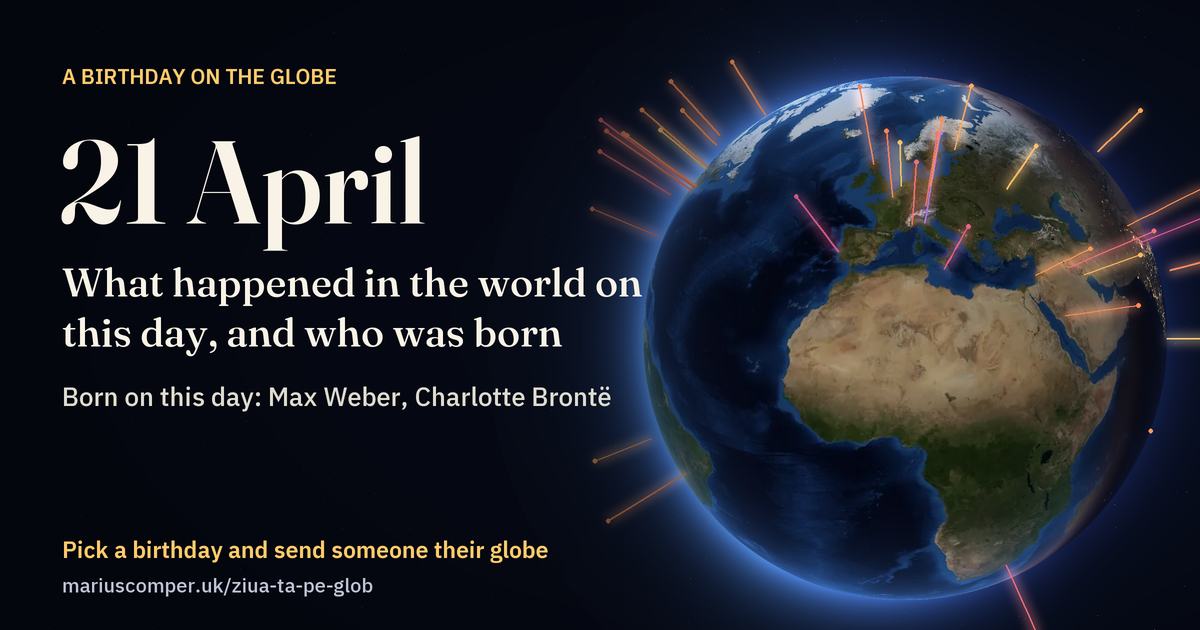
For 21 April, the English Wikipedia lists 57 events and 164 births. 37 of the events stand at their places as rays of light; two more are dashed circles, where the sentence links only to a country or a sea. The taller the ray, the longer ago it happened. The people born that day come further down, as blue points.
A birthday, yours or someone else’s:
Turn it into a greetingScroll: the globe turns to each place
The day you were born, on the globe.
Three things from your day
Scroll: your day first, then 21 April through the years
The Earth on 21 April
The picture on the globe was assembled by NASA from satellite photographs taken in April 2004: the snow, the ice and the green are those of the month.
On 21 April the Sun passes straight overhead at noon along the parallel of 12.0° north. In London, the day lasts about 14 hours 15 minutes.
Beyond 78° north the Sun no longer sets; beyond 78° south it no longer rises.
The line between day and night is tilted on the globe exactly as on this day of the year. On the dark side you can see the lights of towns.
Britain & Ireland · Loch Ness Monster
1934
The "Surgeon's Photograph", the most famous photo allegedly showing the Loch Ness Monster, is published in the Daily Mail (in 1994, it is revealed to be a hoax).
On the map: Loch Ness Monster.
Also on the day’s list of Wikipedia in Chinese.
Europe · Wignacourt Aqueduct
1615
The Wignacourt Aqueduct is inaugurated in Malta.
On the map: Wignacourt Aqueduct.
Europe · Kharkiv
2010
The controversial Kharkiv Pact (Russian Ukrainian Naval Base for Gas Treaty) is signed in Kharkiv, Ukraine, by Ukrainian president Viktor Yanukovych and Russian president Dmitry Medvedev; it was unilaterally terminated by Russia on March 31, 2014.
On the map: Kharkiv.
Asia · Bangkok
1782
The city of Rattanakosin, now known internationally as Bangkok, is founded on the eastern bank of the Chao Phraya River by King Buddha Yodfa Chulaloke.
On the map: Bangkok.
Also on the day’s list of Wikipedia in Chinese.
Asia · Al-Baqi Cemetery
1926
Al-Baqi cemetery, former site of the mausoleum of four Shi'a Imams, is leveled to the ground by Wahhabis.
On the map: Al-Baqi Cemetery.
Asia · Universal House of Justice
1963
The first election of the Universal House of Justice is held, marking its establishment as the supreme governing institution of the Baháʼí Faith.
On the map: Universal House of Justice.
Oceania · Principality of Hutt River
1970
In response to a dispute over wheat production quotas, Leonard Casley declared his 75 km2 (29 sq mi) farm in Western Australia to be an independent country as the Hutt River Province.
On the map: Principality of Hutt River.
Latin America · Brasília
1960
Brasília, Brazil's capital, is officially inaugurated. At 09:30, the Three Powers of the Republic are simultaneously transferred from the old capital, Rio de Janeiro.
On the map: Brasília.
Also on the day’s list of Wikipedia in Spanish, Romanian and Chinese.
North America · George Washington's reception at Trenton
1789
George Washington's reception at Trenton is hosted by the Ladies of Trenton as he journeys to New York City for his first inauguration.
On the map: the coordinates Wikidata gives for the article “George Washington's reception at Trenton”.
North America · 1964 New York World's Fair
1965
The 1964–1965 New York World's Fair opens for its second and final season.
On the map: 1964 New York World's Fair.
North America · Broadway theatre
1977
Annie opens on Broadway.
On the map: Broadway theatre.
21 April
What the other Wikipedias remember#
For these years the English list has nothing on this day. The events below come from the same day’s lists on Wikipedia in Spanish and were translated for this page.
From Wikipedia in Spanish · Cathedral of Santiago de Compostela
1211
In Galicia, Archbishop Pedro Muñiz consecrates the cathedral of Santiago de Compostela.
On the map: Cathedral of Santiago de Compostela.
Translated from the list on Wikipedia in Spanish.
From Wikipedia in Spanish · Baghdad
1863
In the city of Baghdad (Iraq), the religious figure Bahá'u'lláh publicly announces his mission in the Garden of Ridván. Bahá'ís celebrate it as a holy day that begins the Festival of Ridván.
On the map: Baghdad.
Translated from the list on Wikipedia in Spanish.
From Wikipedia in Spanish · Library of Congress
2009
At the UNESCO headquarters in Paris (France), the United States Library of Congress and UNESCO inaugurate the World Digital Library.
On the map: Library of Congress.
Translated from the list on Wikipedia in Spanish.
The article on Wikipedia in Spanish: Biblioteca del Congreso de Estados Unidos
21 April
Born on 21 April#
The English Wikipedia lists 164 births for this day. The blue points are the birthplaces of 59 of these people: those written about in the most Wikipedia editions, where Wikidata gives a place of birth.
Born on 21 April
1864
Max Weber, German economist and sociologist (died 1920)
Place of birth: Erfurt.
Born on 21 April
1816
Charlotte Brontë, English novelist and poet (died 1855)
Place of birth: Thornton.
Born on 21 April
1915
Anthony Quinn, Mexican-American actor (died 2001)
Place of birth: Chihuahua City.
Born on 21 April
1882
Percy Williams Bridgman, American physicist and academic, Nobel Prize laureate (died 1961)
Place of birth: Cambridge.
Born on 21 April
1947
Iggy Pop, American singer-songwriter, producer, and actor
Place of birth: Muskegon.
Born in Britain and Ireland
1979
James McAvoy, Scottish actor
Place of birth: Glasgow.
Born in Britain and Ireland
1838
John Muir, Scottish-American environmentalist and author (died 1914)
Place of birth: Dunbar.
Born in Britain and Ireland
1959
Robert Smith, English singer-songwriter and guitarist
Place of birth: Blackpool.
21 April
Number one in the charts that week
At the cinema
An animal recorded that day
The record can be seen in GBIF, which brings together wildlife records from around the world.
All your birthdays
The weather that day
Data: Met Office Hadley Centre (HadCET); NOAA (GHCN-Daily, Mauna Loa).
Above the Earth
Sources: Jonathan McDowell, GCAT (launches); GFZ Potsdam (Kp index). Days are counted in Universal Time.
Football that day
International matches played that day:
Source: the “International football results” dataset kept by Mart Jürisoo (CC0).
Also that day
The earthquake’s page at the USGS
Source: the USGS catalogue. The day is counted in Universal Time (UTC).
In those days
Make a link for someone
Type the name, pick the day and the year of birth. The link opens straight on their day, with their name in the greeting.
The link carries the name, date and place typed here; anyone who gets it can see them.
Put another birthday beside it
Your mother’s, your child’s, a friend’s: the two days appear side by side.
Below: 21 April through the years.
The whole globe of the day
Drag the globe to turn it. Touch a ray or a point to read what happened there.
Everything Wikipedia lists for 21 April
The list is the English Wikipedia’s, in its own wording, as it stood in October 2026. 18 events have no place on the map: the sentence links to no place with coordinates, only to places too wide to mark, or to several countries.
- 753 BC
Romulus founds Rome (traditional date).
Europe · Ancient RomeWikipedia: Founding of Rome - 43 BC
Battle of Mutina: Mark Antony is again defeated in battle by Aulus Hirtius, who is killed. Antony fails to capture Mutina and Decimus Brutus is murdered shortly after.
Europe · ModenaWikipedia: Battle of Mutina - 900
The Laguna Copperplate Inscription (the earliest known written document found in what is now the Philippines): the Commander-in-Chief of the Kingdom of Tondo, as represented by the Honourable Jayadewa, Lord Minister of Pailah, pardons from all debt the Honourable Namwaran and his relations.
no place on the mapWikipedia: Laguna Copperplate Inscription - 995
Ælfric of Abingdon was appointed Archbishop of Canterbury.
no place on the mapWikipedia: Ælfric of Abingdon - 1092
The Diocese of Pisa is elevated to the rank of metropolitan archdiocese by Pope Urban II.
no place on the mapWikipedia: Archdiocese of Pisa - 1506
The three-day Lisbon Massacre comes to an end with the slaughter of over 1,900 suspected Jews by Portuguese Catholics.
Europe · Lisbon massacreWikipedia: Lisbon massacre - 1509
Henry VIII ascends the throne of England on the death of his father, Henry VII.
no place on the mapWikipedia: Henry VIII - 1526
The last ruler of the Lodi dynasty, Ibrahim Lodi, is defeated and killed by Babur in the First Battle of Panipat.
Asia · First Battle of PanipatWikipedia: First Battle of Panipat - 1615
The Wignacourt Aqueduct is inaugurated in Malta.
Europe · Wignacourt AqueductWikipedia: Hospitaller Malta - 1725
J. S. Bach's cantata Bleib bei uns, denn es will Abend werden, was first performed on Easter Monday.
no place on the mapWikipedia: Johann Sebastian Bach - 1782
The city of Rattanakosin, now known internationally as Bangkok, is founded on the eastern bank of the Chao Phraya River by King Buddha Yodfa Chulaloke.
Asia · BangkokWikipedia: Bangkok - 1789
George Washington's reception at Trenton is hosted by the Ladies of Trenton as he journeys to New York City for his first inauguration.
North America · George Washington's reception at TrentonWikipedia: George Washington's reception at Trenton - 1789
John Adams sworn in as first US Vice President (nine days before George Washington).
no place on the mapWikipedia: John Adams - 1792
Tiradentes, a revolutionary leading a movement for Brazil's independence, is hanged, drawn and quartered.
no place on the mapWikipedia: Independence of Brazil - 1796
War of the First Coalition: In the climax of the Montenotte Campaign, Napoleon Bonaparte decisively defeats the army of Piedmont at the Battle of Mondovi, leading to Piedmont's surrender a week later and decisively turning the Italian campaign in France's favor.
Europe · Battle of MondovìWikipedia: Montenotte campaign - 1802
Twelve thousand Wahhabis sack Karbala, killing over three thousand inhabitants.
Asia · KarbalaWikipedia: Wahhabi sack of Karbala - 1806
Action of 21 April 1806: A French frigate escapes British forces off the coast of South Africa.
Africa · Action of 21 April 1806Wikipedia: Action of 21 April 1806 - 1809
Two Austrian army corps are driven from Landshut by a First French Empire army led by Napoleon as two French corps to the north hold off the main Austrian army on the first day of the Battle of Eckmühl.
Europe · MunichWikipedia: Battle of Eckmühl - 1821
Benderli Ali Pasha arrives in Constantinople as the new Grand Vizier of the Ottoman Empire; he remains in power for only nine days before being sent into exile.
no place on the mapWikipedia: Benderli Ali Pasha - 1836
Texas Revolution: The Battle of San Jacinto: Republic of Texas forces under Sam Houston defeat troops under Mexican General Antonio López de Santa Anna.
North America · Battle of San JacintoWikipedia: Battle of San Jacinto - 1856
Australian labour movement: Stonemasons and building workers on building sites around Melbourne march from the University of Melbourne to Parliament House to achieve an eight-hour day.
no place on the mapWikipedia: Australian labour movement - 1894
Norway formally adopts the Krag–Jørgensen bolt-action rifle as the main arm of its armed forces, a weapon that would remain in service for almost 50 years.
no place on the mapWikipedia: Krag–Jørgensen - 1898
Spanish–American War: The United States Navy begins a blockade of Cuban ports. When the U.S. Congress issued a declaration of war on April 25, it declared that a state of war had existed from this date.
North America · United States CongressWikipedia: Spanish–American War - 1914
Ypiranga incident: A German arms shipment to Mexico is intercepted by the U.S. Navy near Veracruz.
Latin America · VeracruzWikipedia: Ypiranga incident - 1918
World War I: German fighter ace Manfred von Richthofen, better known as "The Red Baron", is shot down and killed over Vaux-sur-Somme in France.
Europe · Vaux-sur-SommeWikipedia: World War I - 1926
Al-Baqi cemetery, former site of the mausoleum of four Shi'a Imams, is leveled to the ground by Wahhabis.
Asia · Al-Baqi CemeteryWikipedia: Demolition of al-Baqi - 1934
The "Surgeon's Photograph", the most famous photo allegedly showing the Loch Ness Monster, is published in the Daily Mail (in 1994, it is revealed to be a hoax).
Britain & Ireland · Loch Ness MonsterWikipedia: Loch Ness Monster - 1945
World War II: Soviet forces south of Berlin at Zossen attack the German High Command headquarters.
Europe · ZossenWikipedia: World War II - 1946
The U.S. Weather Bureau records that a tornado which struck Timber Lake, South Dakota was 4 miles (6.4 km), among the widest tornadoes on record.
North America · Timber Lake, South DakotaWikipedia: National Weather Service - 1948
United Nations Security Council Resolution 47 relating to Kashmir conflict is adopted.
Asia · Kashmir conflictWikipedia: Kashmir conflict - 1950
The Nainital wedding massacre occurs, killing 22 members of the Harijan caste.
no place on the mapWikipedia: List of mass stabbing incidents - 1952
Secretary's Day (now Administrative Professionals' Day) is first celebrated.
no place on the mapWikipedia: Administrative Professionals Day - 1958
United Air Lines Flight 736 collides with a United States Air Force fighter jet near Arden, Nevada in what is now Enterprise, Nevada.
North America · United Air Lines Flight 736Wikipedia: United Air Lines Flight 736 - 1960
Brasília, Brazil's capital, is officially inaugurated. At 09:30, the Three Powers of the Republic are simultaneously transferred from the old capital, Rio de Janeiro.
Latin America · BrasíliaWikipedia: Brasília - 1962
The Seattle World's Fair (Century 21 Exposition) opens. It is the first World's Fair in the United States since World War II.
North America · Century 21 ExpositionWikipedia: Century 21 Exposition - 1963
The first election of the Universal House of Justice is held, marking its establishment as the supreme governing institution of the Baháʼí Faith.
Asia · Universal House of JusticeWikipedia: Universal House of Justice - 1964
A Transit-5bn satellite fails to reach orbit after launch; as it re-enters the atmosphere, 2.1 pounds (0.95 kg) of radioactive plutonium in its SNAP RTG power source is widely dispersed.
no place on the mapWikipedia: Transit - 1965
The 1964–1965 New York World's Fair opens for its second and final season.
North America · 1964 New York World's FairWikipedia: 1964 New York World's Fair - 1966
Rastafari movement: Haile Selassie of Ethiopia visits Jamaica, an event now celebrated as Grounation Day.
no place on the mapWikipedia: Rastafari - 1967
A few days before the general election in Greece, Colonel George Papadopoulos leads a coup d'état, establishing a military regime that lasts for seven years.
no place on the mapWikipedia: Greek junta - 1967
A tornado outbreak in Illinois, United States, kills over 50 and injures over 1,000. Belvidere sustains over 500 casualties as a violent tornado strikes the high school. Another tornado near Chicago causes another 500 casualties, devastating Oak Lawn.
North America · Belvidere, IllinoisWikipedia: 1967 Belvidere tornado - 1970
In response to a dispute over wheat production quotas, Leonard Casley declared his 75 km2 (29 sq mi) farm in Western Australia to be an independent country as the Hutt River Province.
Oceania · Principality of Hutt RiverWikipedia: Western Australia - 1972
Astronauts John Young and Charles Duke fly Apollo 16's Apollo Lunar Module to the Moon's surface, the fifth NASA Apollo Program crewed lunar landing.
no place on the mapWikipedia: John Young - 1975
Vietnam War: President of South Vietnam Nguyễn Văn Thiệu flees Saigon, as Xuân Lộc, the last South Vietnamese outpost blocking a direct North Vietnamese assault on Saigon, falls.
Asia · Ho Chi Minh CityWikipedia: Vietnam War - 1977
Annie opens on Broadway.
North America · Broadway theatreWikipedia: Annie - 1982
Baseball: Rollie Fingers of the Milwaukee Brewers becomes the first pitcher to record 300 saves.
no place on the mapWikipedia: Baseball - 1985
The compound of the militant group The Covenant, The Sword, and the Arm of the Lord surrenders to federal authorities in Arkansas after a two-day government siege.
no place on the mapWikipedia: The Covenant, the Sword, and the Arm of the Lord - 1987
The Tamil Tigers are blamed for a car bomb that detonates in the Sri Lankan capital city of Colombo, killing 106 people.
Asia · ColomboWikipedia: Liberation Tigers of Tamil Eelam - 1989
Tiananmen Square protests of 1989: In Beijing, around 100,000 students gather in Tiananmen Square to commemorate Chinese reform leader Hu Yaobang.
Asia · 1989 Tiananmen Square protests and massacreWikipedia: 1989 Tiananmen Square protests and massacre - 1993
The Supreme Court in La Paz, Bolivia, sentences former dictator Luis García Meza to 30 years in jail without parole for murder, theft, fraud and violating the constitution.
Latin America · La PazWikipedia: La Paz - 1996
Four people are killed and 75 are injured in a train accident in Jokela, Finland.
Europe · JokelaWikipedia: Jokela rail accident - 2004
Five suicide car bombers target police stations in and around Basra, killing 74 people and wounding 160.
Asia · BasraWikipedia: 2004 Basra police station bombings - 2010
The controversial Kharkiv Pact (Russian Ukrainian Naval Base for Gas Treaty) is signed in Kharkiv, Ukraine, by Ukrainian president Viktor Yanukovych and Russian president Dmitry Medvedev; it was unilaterally terminated by Russia on March 31, 2014.
Europe · KharkivWikipedia: Kharkiv Pact - 2012
Two trains are involved in a head-on collision near Sloterdijk, Amsterdam, in the Netherlands, killing one person and injuring 116 others.
Europe · Amsterdam Westerpark train collisionWikipedia: Amsterdam Westerpark train collision - 2014
The city of Flint, Michigan, U.S., changed its water source to the Flint River, which exposed residents to lead poisoning.a
North America · Flint, MichiganWikipedia: Flint, Michigan - 2019
Eight bombs explode at churches, hotels, and other locations in Sri Lanka on Easter Sunday, killing at least 269.
Asia · 2019 Sri Lanka Easter bombingsWikipedia: 2019 Sri Lanka Easter bombings - 2021
Indonesian Navy submarine KRI Nanggala (402) sinks in the Bali Sea during a military drill, killing all 53 on board.
Asia · Bali SeaWikipedia: Indonesian Navy
What the other Wikipedias remember
For these years the English list has nothing on this day. The events below come from the same day’s lists on Wikipedia in Spanish and were translated for this page.
- 1211
In Galicia, Archbishop Pedro Muñiz consecrates the cathedral of Santiago de Compostela.
Europe · Cathedral of Santiago de CompostelaTranslated from the list on Wikipedia in SpanishWikipedia: Galicia - 1863
In the city of Baghdad (Iraq), the religious figure Bahá'u'lláh publicly announces his mission in the Garden of Ridván. Bahá'ís celebrate it as a holy day that begins the Festival of Ridván.
- 2009
At the UNESCO headquarters in Paris (France), the United States Library of Congress and UNESCO inaugurate the World Digital Library.
North America · Library of CongressTranslated from the list on Wikipedia in SpanishWikipedia: Biblioteca del Congreso de Estados Unidos
Who was born on 21 April
In order of how many Wikipedia editions have an article about each. The first 60 of 164 are shown.
- 1926
Elizabeth II, Queen of the United Kingdom and her other realms (died 2022)
17 Bruton StreetWikipedia: Elizabeth II - 1864
Max Weber, German economist and sociologist (died 1920)
ErfurtWikipedia: Max Weber - 1816
Charlotte Brontë, English novelist and poet (died 1855)
ThorntonWikipedia: Charlotte Brontë - 1915
Anthony Quinn, Mexican-American actor (died 2001)
Chihuahua CityWikipedia: Anthony Quinn - 1882
Percy Williams Bridgman, American physicist and academic, Nobel Prize laureate (died 1961)
CambridgeWikipedia: Percy Williams Bridgman - 1947
Iggy Pop, American singer-songwriter, producer, and actor
MuskegonWikipedia: Iggy Pop - 1979
James McAvoy, Scottish actor
GlasgowWikipedia: James McAvoy - 1774
Jean-Baptiste Biot, French physicist, astronomer, and mathematician (died 1862)
- 1889
Paul Karrer, Russian-Swiss chemist and academic, Nobel Prize laureate (died 1971)
MoscowWikipedia: Paul Karrer - 1992
Isco, Spanish footballer
BenalmádenaWikipedia: Isco - 1958
Andie MacDowell, American model, actress, and producer
GaffneyWikipedia: Andie MacDowell - 1837
Fredrik Bajer, Danish lieutenant and politician, Nobel Prize laureate (died 1922)
Vester EgedeWikipedia: Fredrik Bajer - 1838
John Muir, Scottish-American environmentalist and author (died 1914)
DunbarWikipedia: John Muir - 1997
Mikel Oyarzabal, Spanish footballer
- 1488
Ulrich von Hutten, German religious reformer (died 1523)
Steckelberg CastleWikipedia: Ulrich von Hutten - 1930
Silvana Mangano, Italian actress (died 1989)
- 1959
Robert Smith, English singer-songwriter and guitarist
BlackpoolWikipedia: Robert Smith - 2003
Xavi Simons, Dutch footballer
AmsterdamWikipedia: Xavi Simons - 1671
John Law, Scottish economist (died 1729)
EdinburghWikipedia: John Law - 1619
Jan van Riebeeck, Dutch founder of Cape Town (died 1677)
CulemborgWikipedia: Jan van Riebeeck - 1555
Ludovico Carracci, Italian painter and etcher (died 1619)
BolognaWikipedia: Ludovico Carracci - 1922
Alistair MacLean, Scottish novelist and screenwriter (died 1987)
ShettlestonWikipedia: Alistair MacLean - 2007
Princess Isabella of Denmark, daughter of King Frederik X and Queen Mary of Denmark
RigshospitaletWikipedia: Princess Isabella of Denmark - 1994
Ludwig Augustinsson, Swedish footballer
StockholmWikipedia: Ludwig Augustinsson - 1951
Michael Freedman, American mathematician and academic
Los AngelesWikipedia: Michael Freedman - 1132
Sancho VI, king of Navarre (died 1194)
- 1970
Glen Hansard, Irish singer-songwriter (died 2026)
DublinWikipedia: Glen Hansard - 1970
Rob Riggle, American actor and comedian
LouisvilleWikipedia: Rob Riggle - 1870
Edwin Stanton Porter, American director, producer, and screenwriter (died 1941)
ConnellsvilleWikipedia: Edwin S. Porter - 1932
Elaine May, American actress, comedian, director, and screenwriter
PhiladelphiaWikipedia: Elaine May - 1673
Wilhelmine Amalia of Brunswick-Lüneburg (died 1742)
- 1904
Odilo Globocnik, Italian-Austrian SS officer and Holocaust perpetrator (died 1945)
TriesteWikipedia: Odilo Globocnik - 1652
Michel Rolle, French mathematician and academic (died 1719)
AmbertWikipedia: Michel Rolle - 1949
Patti LuPone, American actress and singer
NorthportWikipedia: Patti LuPone - 1790
Manuel Blanco Encalada, Spanish-Chilean admiral and politician, 1st President of Chile (died 1876)
Buenos AiresWikipedia: Manuel Blanco Encalada - 1912
Marcel Camus, French director and screenwriter (died 1982)
ChappesWikipedia: Marcel Camus - 1935
Charles Grodin, American actor and talk show host (died 2021)
PittsburghWikipedia: Charles Grodin - 1969
Toby Stephens, English actor
LondonWikipedia: Toby Stephens - 1991
Frank Dillane, British actor
LondonWikipedia: Frank Dillane - 1932
Angela Mortimer, English tennis player (died 2025)
PlymouthWikipedia: Angela Mortimer - 1940
Souleymane Cissé, Malian director, producer, and screenwriter (died 2025)
- 1915
Garrett Hardin, American ecologist, author, and academic (died 2003)
- 1919
Licio Gelli, Italian financer (died 2015)
PistoiaWikipedia: Licio Gelli - 1970
Nicole Sullivan, American actress and comedian
ManhattanWikipedia: Nicole Sullivan - 1951
Tony Danza, American actor and producer
BrooklynWikipedia: Tony Danza - 1957
Hervé Le Tellier, French linguist and author
- 1963
John Cameron Mitchell, American actor and director
- 1958
Yoshito Usui, Japanese illustrator (died 2009)
ShizuokaWikipedia: Yoshito Usui - 1988
Jencarlos Canela, American singer-songwriter and actor
- 1651
Joseph Vaz, Sri Lankan priest, missionary, and saint (died 1711)
BenaulimWikipedia: Joseph Vaz - 1933
Ignatius Zakka I Iwas, Iraqi patriarch (died 2014)
- 1905
Pat Brown, American lawyer and politician, 32nd Governor of California (died 1996)
San FranciscoWikipedia: Pat Brown - 1930
Jack Taylor, English footballer and referee (died 2012)
WolverhamptonWikipedia: Jack Taylor - 1998
Jarrett Allen, American basketball player
San DiegoWikipedia: Jarrett Allen - 1814
Angela Burdett-Coutts, 1st Baroness Burdett-Coutts, English art collector and philanthropist (died 1906)
- 1912
Eve Arnold, Russian-American photojournalist (died 2012)
PhiladelphiaWikipedia: Eve Arnold - 1980
Tony Romo, American football player and announcer
San DiegoWikipedia: Tony Romo - 1988
Christoph Sanders, American actor
- 1923
John Mortimer, English lawyer and author (died 2009)
HampsteadWikipedia: John Mortimer - 1893
Romeo Bertini, Italian runner (died 1973)
GessateWikipedia: Romeo Bertini
What is celebrated on 21 April
- Christian feast day: Abdecalas
- Christian feast day: Anastasius Sinaita
- Christian feast day: Anselm of Canterbury
- Christian feast day: Conrad of Parzham
- Christian feast day: Holy Infant of Good Health
- Christian feast day: Máel Ruba
- Christian feast day: Shemon Bar Sabbae
- Christian feast day: Wolbodo
- Christian feast day: April 21 (Eastern Orthodox liturgics)
- Natale di Roma (Rome)
- Parilia (ancient Rome)
- Civil Service Day (India)
- Grounation Day (Rastafari)
- National Tea Day (United Kingdom)
A greeting link for someone
Type a name and, if you like, the year of birth. The link opens with a greeting, and beside each event it says how old the person turned that day, or how many years before their birth it happened.
The name and the year go only into the link you send.
All 366 days
How the globe is made
Where the events come from
Each edition of this page uses the day’s list from Wikipedia in its own language: Romanian, English, Spanish, Chinese. The lists are written by volunteers and differ from one edition to the next; the text of each event is Wikipedia’s, with a link to the article. A row that appears twice in a list is shown once. The lists have not been checked event by event: they are Wikipedia’s, mistakes included.
For events before 1582, and for countries that moved to the Gregorian calendar later (Britain in 1752, Russia in 1918), the same day may be counted Old Style in one list and New Style in another.
The chapter “What the other Wikipedias remember” adds up to five events a day from the lists of the other three editions, only for years in which the English list has nothing on that day. They were translated for this page, passed the same filters as the tour, and are not counted among the events of the English list.
How an event gets onto the map
The place comes from Wikidata. If the sentence links to the article about the event itself (a battle, an opening, an earthquake), dated to the same year, the ray stands on its coordinates or on those of its location. Otherwise it stands on the first place the sentence links to: a town, a building, a mountain, an island. This second step can be wrong: sometimes the sentence only mentions the place. That is why the page says, under each event, which place the ray stands on.
When the sentence links to a single state or province, or to a single sea, lake or desert larger than 5,000 km², the globe shows a dashed circle, not a ray. The circle has the area Wikidata gives, with its radius kept between 1.2° and 16°, or a radius of 4.5° when Wikidata gives no area; it says only that the sentence links to that place. Organisations, ships, spacecraft, museum objects, rivers, mountain ranges, languages and continents are never used as places. When a sentence names several states and no exact place, the event stays in the list only.
What the height means
The height of a ray shows how many years have passed, on a logarithmic scale: 10 years, 100 years and 1,000 years are equal steps apart; anything older than about 2,600 years has the tallest ray. The colour runs from pale yellow for recent years to violet for antiquity.
Where the tour stops
In each region the tour stops at up to three events (five in Britain and Ireland), chosen mainly by three things: whether Wikipedia’s editors put the event in the “On this day” box of their main page (the English, Spanish and Chinese editions), how many Wikipedia editions have an article about it, and how many of the four lists include it. Events whose sentence or article is about a war, an attack, a crime or a disaster are left out of the tour; they stay in the whole list, in Wikipedia’s wording. The filter is a list of words and a list of Wikidata types, so it can miss some.
The tour of births names the people with articles in the most editions and leaves aside those whom the list or Wikidata describes as rulers, politicians, commanders, leaders of movements or criminals; they stay in the list.
The Earth and the Sun
The daytime images are NASA’s Blue Marble Next Generation mosaics, one for each month of 2004; the night side is Black Marble 2016. The tilt of the line between day and night is computed for the day; the hour is chosen so that the place being read is in daylight. The latitude where the Sun stands overhead is the average of the four years of the leap cycle; in a given year it can differ by up to 0.4°.
The day you were born
The number ones come from the weekly lists on Wikipedia: Billboard for the United States (from 1940; the Hot 100 from August 1958), the UK Singles Chart (from November 1952), Los 40 Principales for Spain (from July 1966) and, for Romania, the Romanian Top 100 and Airplay 100 (2001–2021, with missing weeks). The page shows the chart of the week in which the day of birth falls, with its date; Billboard and the UK chart are dated at the end of their week. For Romania before 2001 and for China these sources have no weekly chart.
The films are those that reached cinemas in the United States up to ten days before or three days after that day (some of them in a few cinemas at first), from the English Wikipedia’s yearly lists (from 1968), in order of how many editions have an article about them. The events “in those days” are the ones on the neighbouring days’ lists that carry the year of birth, passed through the same filter as the tour.
The day of birth, year included
The Moon, the star sign and the constellation are worked out by the page itself, for noon Universal Time on the day. The lit part of the Moon is rounded and can differ by a few per cent from that at the hour of birth. The sign follows the usual zodiac of twelve equal parts starting at the March equinox; the constellation is the one the Sun actually stood in front of, by the borders set by the International Astronomical Union, and within a day of a border the page does not name it. When the Sun changes sign while it is that day anywhere on Earth, the page gives the moment of crossing, rounded to ten minutes and accurate to within about a quarter of an hour, and the clock time in a few cities, with the time zone and summer time of that year.
The year in the Chinese calendar is the one your device’s own calendar gives for the date, checked against the Hong Kong Observatory’s tables. “All your birthdays” uses the same sources as the rest of the chapter for the same day in every year since the birth: the temperature, well-known launches that took place on that very day, matches of the teams the edition follows, snow deeper than 10 cm and strong geomagnetic storms. The three things at the top and the four on the picture are chosen in a fixed order (the song, the animal, a full Moon, a well-known launch before an ordinary earthquake); on the picture you can change them.
When the link carries a year of birth, the page adds a few things about that exact day. The weather is the Met Office’s Central England temperature record and the readings from New York’s Central Park; the “usual high” is the average of the daily highs of 1961–1990 for that date, with two days either side. The carbon dioxide figure is the monthly mean at the Mauna Loa observatory, where measurements begin in March 1958.
The earthquake is the one with the largest magnitude in the USGS catalogue for that day, counted in Universal Time. Before the 1960s the catalogue has gaps even above magnitude 5.5, so in the older years many days have no earthquake. The page gives only the magnitude and the place: the country the epicentre falls in or, when the epicentre is at sea within 300 km of a coast, the nearest country; farther out, only the ocean.
The launches are those that reached orbit or left for the Moon and the planets, from Jonathan McDowell’s GCAT catalogue. If nothing left that day, the page shows the nearest launch within three days before or after, and says how many days away it was. The geomagnetic storm appears only when the Kp index reached at least 5 in one of the day’s eight three-hour intervals.
The animal comes from GBIF: an observation made by a person (the animal seen or heard, or its tracks), dated to that exact day, with coordinates and a CC0 or CC BY licence. Only a few hundred well-known species are searched (mammals, birds, turtles, butterflies); of those noted that day, mammals and species with articles in many Wikipedia editions come first; birds noted almost every day, and species used recently, wait their turn. Observations dated 1 January are left out, because records without a day are often filed there. An observation shows that the animal was recorded there, not how many animals there were.
The matches are those between national teams. Only matches of England, Scotland, Wales, Northern Ireland, the Republic of Ireland, the United States, Canada and Australia are shown, along with those at the big final tournaments. The picture to send is drawn in the page from the day’s globe and the facts above, and stays on your device until you send it.
Sources
- Events, births and holidays: the day’s page on Wikipedia, text under CC BY-SA 4.0.
- Coordinates, places of birth and the number of editions: Wikidata (CC0).
- The Earth by day: NASA Blue Marble Next Generation. The Earth by night: NASA Black Marble 2016.
- Borders and regions: Natural Earth.
- World population and births per year: UN World Population Prospects 2024.
- Charts and films: Wikipedia’s lists for Billboard, the UK Singles Chart, Los 40 Principales, Romanian Top 100, Airplay 100 and American films by year (CC BY-SA 4.0).
- Weather: Met Office Hadley Centre, HadCET (Open Government Licence) and NOAA GHCN-Daily, New York Central Park. Carbon dioxide: NOAA Global Monitoring Laboratory, Mauna Loa.
- Earthquakes: the USGS catalogue. Launches: Jonathan McDowell, GCAT (CC BY). Kp index: GFZ Potsdam (CC BY 4.0). Matches: International football results, Mart Jürisoo (CC0).
- Animal observations: GBIF, with a link to each record; species names come from Wikidata.