A birthday on the globe
4 February on the globe: what happened in the world on this day, and who was born
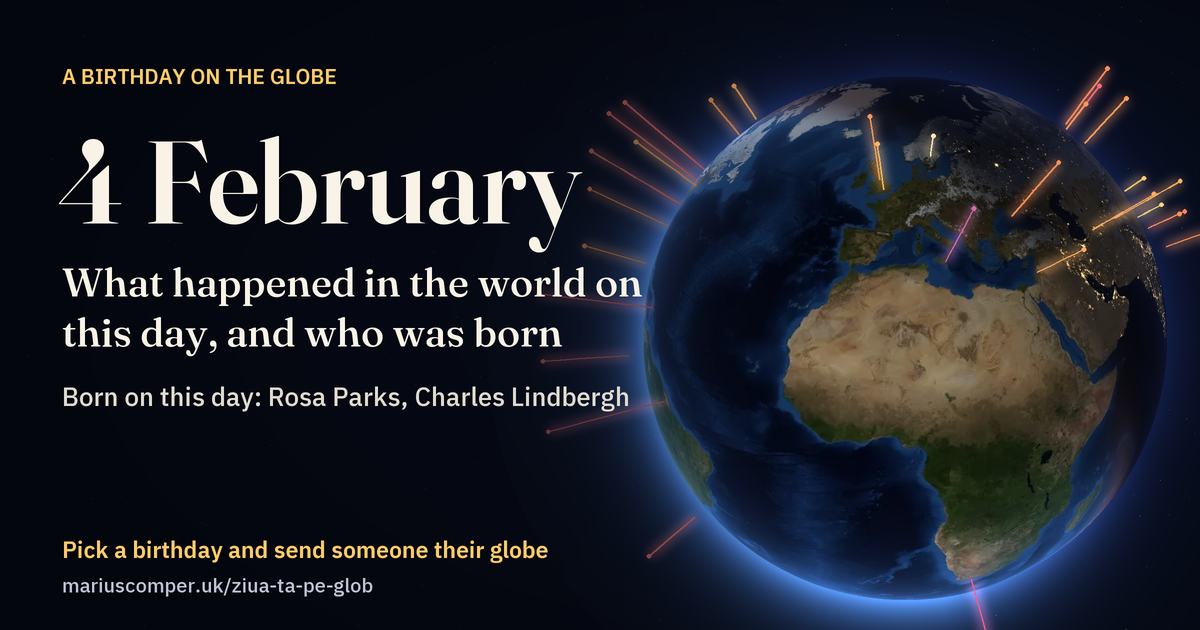
For 4 February, the English Wikipedia lists 49 events and 160 births. 30 of the events stand at their places as rays of light; five more are dashed circles, where the sentence links only to a country or a sea. The taller the ray, the longer ago it happened. The people born that day come further down, as blue points.
A birthday, yours or someone else’s:
Turn it into a greetingScroll: the globe turns to each place
The day you were born, on the globe.
Three things from your day
Scroll: your day first, then 4 February through the years
The Earth on 4 February
The picture on the globe was assembled by NASA from satellite photographs taken in February 2004: the snow, the ice and the green are those of the month.
On 4 February the Sun passes straight overhead at noon along the parallel of 16.4° south. In London, the day lasts about 9 hours 20 minutes.
Beyond 74° south the Sun no longer sets; beyond 74° north it no longer rises.
The line between day and night is tilted on the globe exactly as on this day of the year. On the dark side you can see the lights of towns.
Africa · Mossel Bay
1488
Bartolomeu Dias landed in Mossel Bay, becoming the first European known to have sailed around the Cape of Good Hope, the southern tip of Africa, beginning Portuguese influence and trade in the Indian Ocean.
On the map: Mossel Bay.
Also on the day’s list of Wikipedia in Chinese.
Latin America · Macapá
1758
The city of Macapá in Brazil is founded by Sebastião Veiga Cabral.
On the map: Macapá.
North America · Nauvoo, Illinois
1846
The first Mormon pioneers make their exodus from Nauvoo, Illinois, westward towards Salt Lake Valley.
On the map: Nauvoo, Illinois.
North America · Cape Canaveral Space Force Station
1967
Lunar Orbiter program: Lunar Orbiter 3 lifts off from Cape Canaveral's Launch Complex 13 on its mission to identify possible landing sites for the Surveyor and Apollo spacecraft.
On the map: Cape Canaveral Space Force Station.
North America · Coos Bay, Oregon
1999
The Philippine-flagged freighter New Carissa ran aground near Coos Bay, Oregon, causing one of the worst oil spills in the state's history.
On the map: Coos Bay, Oregon.
4 February
What the other Wikipedias remember#
For these years the English list has nothing on this day. The events below come from the same day’s lists on Wikipedia in Chinese and Spanish and were translated for this page.
From Wikipedia in Chinese · Sun Yat-sen Museum Penang
2001
Malaysian Prime Minister Mahathir Mohamad officiates at the opening ceremony of the Sun Yat-sen Penang Base Memorial Museum.
On the map: Sun Yat-sen Museum Penang.
Translated from the list on Wikipedia in Chinese.
From Wikipedia in Spanish · 2022 Winter Olympics
2022
In Beijing (China), the opening ceremony of the 2022 Winter Olympic Games takes place.
On the map: 2022 Winter Olympics.
Translated from the list on Wikipedia in Spanish.
The article on Wikipedia in Spanish: Juegos Olímpicos de Pekín 2022
4 February
Born on 4 February#
The English Wikipedia lists 160 births for this day. The blue points are the birthplaces of 60 of these people: those written about in the most Wikipedia editions, where Wikidata gives a place of birth.
Born on 4 February
1913
Rosa Parks, American civil rights activist (died 2005)
Place of birth: Tuskegee.
Born on 4 February
1902
Charles Lindbergh, American pilot and explorer (died 1974)
Place of birth: Detroit.
Born on 4 February
1923
Conrad Bain, Canadian-American actor (died 2013)
Place of birth: Lethbridge.
Born on 4 February
1948
Alice Cooper, American singer-songwriter
Place of birth: Detroit.
Born on 4 February
1900
Jacques Prévert, French poet and screenwriter (died 1977)
Place of birth: Neuilly-sur-Seine.
Born in Britain and Ireland
1918
Ida Lupino, English-American actress and director (died 1995)
Place of birth: London.
Born in Britain and Ireland
1970
Gabrielle Anwar, English-American actress
Place of birth: Laleham.
Born in Britain and Ireland
1915
Norman Wisdom, English comedian, actor and singer-songwriter (died 2010)
Place of birth: Marylebone.
4 February
Number one in the charts that week
At the cinema
An animal recorded that day
The record can be seen in GBIF, which brings together wildlife records from around the world.
All your birthdays
The weather that day
Data: Met Office Hadley Centre (HadCET); NOAA (GHCN-Daily, Mauna Loa).
Above the Earth
Sources: Jonathan McDowell, GCAT (launches); GFZ Potsdam (Kp index). Days are counted in Universal Time.
Football that day
International matches played that day:
Source: the “International football results” dataset kept by Mart Jürisoo (CC0).
Also that day
The earthquake’s page at the USGS
Source: the USGS catalogue. The day is counted in Universal Time (UTC).
In those days
Make a link for someone
Type the name, pick the day and the year of birth. The link opens straight on their day, with their name in the greeting.
The link carries the name, date and place typed here; anyone who gets it can see them.
Put another birthday beside it
Your mother’s, your child’s, a friend’s: the two days appear side by side.
Below: 4 February through the years.
The whole globe of the day
Drag the globe to turn it. Touch a ray or a point to read what happened there.
Everything Wikipedia lists for 4 February
The list is the English Wikipedia’s, in its own wording, as it stood in October 2026. 14 events have no place on the map: the sentence links to no place with coordinates, only to places too wide to mark, or to several countries.
- 211
Following the death of the Roman Emperor Septimius Severus at Eboracum (modern York, England) while preparing to lead a campaign against the Caledonians, the empire is left in the control of his two quarrelling sons, Caracalla and Geta, whom he had instructed to make peace.
no place on the mapWikipedia: Septimius Severus - 960
Zhao Kuangyin declares himself Emperor Taizu of Song, ending the Later Zhou and beginning the Song dynasty.
no place on the mapWikipedia: Emperor Taizu of Song - 1169
A strong earthquake strikes the Ionian coast of Sicily, causing tens of thousands of injuries and deaths, especially in Catania.
Europe · 1169 Sicily earthquakeWikipedia: 1169 Sicily earthquake - 1454
Thirteen Years' War: The Secret Council of the Prussian Confederation sends a formal act of disobedience to the Grand Master of the Teutonic Knights, sparking the Thirteen Years' War.
no place on the mapWikipedia: Thirteen Years' War - 1488
Bartolomeu Dias landed in Mossel Bay, becoming the first European known to have sailed around the Cape of Good Hope, the southern tip of Africa, beginning Portuguese influence and trade in the Indian Ocean.
Africa · Mossel BayWikipedia: Bartolomeu Dias - 1555
John Rogers is burned at the stake, becoming the first English Protestant martyr under Queen Mary I.
no place on the mapWikipedia: Death by burning - 1703
In Edo (now Tokyo), all but one of the Forty-seven Ronin commit seppuku (ritual suicide) as recompense for avenging their master's death.
Asia · Forty-seven rōninWikipedia: Forty-seven rōnin - 1758
The city of Macapá in Brazil is founded by Sebastião Veiga Cabral.
Latin America · MacapáWikipedia: Macapá - 1789
George Washington is unanimously elected as the first President of the United States by the U.S. Electoral College.
no place on the mapWikipedia: George Washington - 1794
The French legislature abolishes slavery throughout all territories of the French First Republic. It would be reestablished in the French West Indies in 1802.
Europe · French First RepublicWikipedia: Slavery - 1797
The Riobamba earthquake strikes Ecuador, causing up to 40,000 casualties.
Latin America · 1797 Riobamba earthquakeWikipedia: 1797 Riobamba earthquake - 1801
John Marshall is sworn in as Chief Justice of the United States.
no place on the mapWikipedia: John Marshall - 1810
Napoleonic Wars: Britain seizes Guadeloupe.
Europe · Invasion of GuadeloupeWikipedia: Invasion of Guadeloupe - 1820
The Chilean Navy under the command of Lord Cochrane completes the two-day long Capture of Valdivia with just 300 men and two ships.
Latin America · Capture of ValdiviaWikipedia: Capture of Valdivia - 1825
The Ohio Legislature authorizes the construction of the Ohio and Erie Canal and the Miami and Erie Canal.
North America · Ohio General AssemblyWikipedia: Ohio General Assembly - 1846
The first Mormon pioneers make their exodus from Nauvoo, Illinois, westward towards Salt Lake Valley.
North America · Nauvoo, IllinoisWikipedia: Mormon pioneers - 1859
The Codex Sinaiticus is discovered in Egypt.
Africa · EgyptWikipedia: Codex Sinaiticus - 1861
American Civil War: In Montgomery, Alabama, delegates from six breakaway U.S. states meet and initiate the process that would form the Confederate States of America on February 8.
North America · Montgomery, AlabamaWikipedia: American Civil War - 1899
The Philippine–American War begins when four Filipino soldiers enter the "American Zone" in Manila, igniting the Battle of Manila.
Asia · Battle of ManilaWikipedia: Battle of Manila - 1932
Second Sino-Japanese War: Harbin, Manchuria, falls to Japan.
Asia · HarbinWikipedia: Defense of Harbin - 1938
Adolf Hitler appoints himself as head of the Armed Forces High Command.
no place on the mapWikipedia: Adolf Hitler - 1941
The United Service Organization (USO) is created to entertain American troops.
no place on the mapWikipedia: United Service Organizations - 1945
World War II: Santo Tomas Internment Camp is liberated from Japanese authority.
Asia · Santo Tomas Internment CampWikipedia: World War II - 1945
World War II: The British Indian Army and Imperial Japanese Army begin a series of battles known as the Battle of Pokoku and Irrawaddy River operations.
Asia · Battle of Pokoku and Irrawaddy River operationsWikipedia: British Indian Army - 1945
World War II: The Yalta Conference between the "Big Three" (Churchill, Roosevelt, and Stalin) opens at the Livadia Palace in the Crimea.
Europe · Yalta ConferenceWikipedia: Yalta Conference - 1948
Ceylon (later renamed Sri Lanka) becomes independent within the British Commonwealth.
no place on the mapWikipedia: Dominion of Ceylon - 1961
The Angolan War of Independence and the greater Portuguese Colonial War begin.
no place on the mapWikipedia: Angolan War of Independence - 1966
All Nippon Airways Flight 60 plunges into Tokyo Bay, killing 133.
Asia · All Nippon Airways Flight 60Wikipedia: All Nippon Airways Flight 60 - 1967
Lunar Orbiter program: Lunar Orbiter 3 lifts off from Cape Canaveral's Launch Complex 13 on its mission to identify possible landing sites for the Surveyor and Apollo spacecraft.
North America · Cape Canaveral Space Force StationWikipedia: Lunar Orbiter program - 1969
Yasser Arafat was elected chairman of the Palestine Liberation Organization.
no place on the mapWikipedia: Yasser Arafat - 1974
M62 coach bombing: The Provisional Irish Republican Army (IRA) explodes a bomb on a bus carrying off-duty British Armed Forces personnel in Yorkshire, England. Nine soldiers and three civilians are killed.
Britain & Ireland · M62 coach bombingWikipedia: M62 coach bombing - 1974
The Symbionese Liberation Army kidnaps Patty Hearst in Berkeley, California.
North America · Berkeley, CaliforniaWikipedia: Symbionese Liberation Army - 1975
Haicheng earthquake (magnitude 7.3 on the Richter scale) occurs in Haicheng, Liaoning, China.
Asia · 1975 Haicheng earthquakeWikipedia: 1975 Haicheng earthquake - 1976
In Guatemala and Honduras an earthquake kills more than 22,000.
Latin America · 1976 Guatemala earthquakeWikipedia: 1976 Guatemala earthquake - 1977
A Chicago Transit Authority elevated train rear-ends another and derails, killing 11 and injuring 180, the worst accident in the agency's history.
no place on the mapWikipedia: 1977 Chicago Loop derailment - 1992
A coup d'état is led by Hugo Chávez against Venezuelan President Carlos Andrés Pérez.
Latin America · VenezuelaWikipedia: February 1992 Venezuelan coup attempt - 1997
En route to Lebanon, two Israeli Sikorsky CH-53 troop-transport helicopters collide in mid-air over northern Galilee, Israel, killing 73.
Asia · 1997 Israeli helicopter disasterWikipedia: 1997 Israeli helicopter disaster - 1997
The Bojnurd earthquake measuring Mw 6.5 strikes Iran. With a Mercalli intensity of VIII, it kills at least 88 and damages 173 villages.
Asia · 1997 Bojnurd earthquakeWikipedia: 1997 Bojnurd earthquake - 1998
The 5.9 Mw Afghanistan earthquake shakes the Takhar Province with a maximum Mercalli intensity of VII (Very strong). With 2,323 killed, and 818 injured, damage is considered extreme.
Asia · February 1998 Afghanistan earthquakeWikipedia: February 1998 Afghanistan earthquake - 1999
The Philippine-flagged freighter New Carissa ran aground near Coos Bay, Oregon, causing one of the worst oil spills in the state's history.
North America · Coos Bay, OregonWikipedia: New Carissa - 1999
Unarmed West African immigrant Amadou Diallo is shot 19 times by four plainclothes New York City police officers on an unrelated stake-out, inflaming race relations in the city.
North America · Killing of Amadou DialloWikipedia: Killing of Amadou Diallo - 2000
The World Summit Against Cancer for the New Millennium, Charter of Paris is signed by the President of France, Jacques Chirac and the Director General of UNESCO, Koichiro Matsuura, initiating World Cancer Day which is held on February 4 every year.
no place on the mapWikipedia: Jacques Chirac - 2003
The Federal Republic of Yugoslavia adopts a new constitution, becoming a loose confederacy between Montenegro and Serbia.
Europe · Serbia and MontenegroWikipedia: Serbia and Montenegro - 2004
Facebook, a mainstream online social networking site, is founded by Mark Zuckerberg and Eduardo Saverin.
no place on the mapWikipedia: Facebook - 2008
Civic mobilizations in Colombia against FARC, under the name A million voices against the FARC.
Latin America · ColombiaWikipedia: One million voices against FARC - 2008
The London low emission zone, charging certain diesel-powered commercial vehicles to enter Greater London, came into operation.
Britain & Ireland · Greater LondonWikipedia: London low emission zone - 2015
TransAsia Airways Flight 235, with 58 people on board, en route from the Taiwanese capital Taipei to Kinmen, crashes into the Keelung River just after takeoff, killing 43 people.
Asia · TransAsia Airways Flight 235Wikipedia: TransAsia Airways Flight 235 - 2020
The COVID-19 pandemic causes all casinos in Macau to be closed down for 15 days.
Asia · MacauWikipedia: COVID-19 pandemic - 2025
Ten people are killed in a mass shooting at an adult education centre in Örebro, Sweden.
Europe · Örebro school shootingWikipedia: Örebro school shooting
What the other Wikipedias remember
For these years the English list has nothing on this day. The events below come from the same day’s lists on Wikipedia in Chinese and Spanish and were translated for this page.
- 2001
Malaysian Prime Minister Mahathir Mohamad officiates at the opening ceremony of the Sun Yat-sen Penang Base Memorial Museum.
- 2022
In Beijing (China), the opening ceremony of the 2022 Winter Olympic Games takes place.
Asia · 2022 Winter OlympicsTranslated from the list on Wikipedia in SpanishWikipedia: Juegos Olímpicos de Pekín 2022
Who was born on 4 February
In order of how many Wikipedia editions have an article about each. The first 60 of 160 are shown.
- 1913
Rosa Parks, American civil rights activist (died 2005)
TuskegeeWikipedia: Rosa Parks - 1947
Dan Quayle, American sergeant, lawyer, and politician, 44th Vice President of the United States
IndianapolisWikipedia: Dan Quayle - 1897
Ludwig Erhard, German soldier and politician, second Chancellor of West Germany (died 1977)
- 1902
Charles Lindbergh, American pilot and explorer (died 1974)
DetroitWikipedia: Charles Lindbergh - 1923
Conrad Bain, Canadian-American actor (died 2013)
LethbridgeWikipedia: Conrad Bain - 1948
Alice Cooper, American singer-songwriter
DetroitWikipedia: Alice Cooper - 1900
Jacques Prévert, French poet and screenwriter (died 1977)
Neuilly-sur-SeineWikipedia: Jacques Prévert - 1871
Friedrich Ebert, German lawyer and politician, first President of Germany (died 1925)
HeidelbergWikipedia: Friedrich Ebert - 1906
Dietrich Bonhoeffer, German pastor and theologian (died 1945)
- 1931
Isabel Perón, Argentinian dancer and politician, 41st President of Argentina
La RiojaWikipedia: Isabel Perón - 1881
Kliment Voroshilov, Soviet politician and Marshal of the Soviet Union, People's Commissar for Defence (died 1969)
VerkhneeWikipedia: Kliment Voroshilov - 1906
Clyde Tombaugh, American astronomer and academic, discovered Pluto (died 1997)
StreatorWikipedia: Clyde Tombaugh - 1921
Betty Friedan, American author and feminist (died 2006)
PeoriaWikipedia: Betty Friedan - 1917
Yahya Khan, Pakistan general and politician, third President of Pakistan (died 1980)
ChakwalWikipedia: Yahya Khan - 1975
Natalie Imbruglia, Australian singer-songwriter and actress
- 1688
Pierre de Marivaux, French author and playwright (died 1763)
- 1943
Ken Thompson, American computer scientist and programmer, co-developed the B programming language
New OrleansWikipedia: Ken Thompson - 1940
George A. Romero, American director and producer (died 2017)
New York CityWikipedia: George A. Romero - 1918
Ida Lupino, English-American actress and director (died 1995)
LondonWikipedia: Ida Lupino - 1881
Fernand Léger, French painter and sculptor (died 1955)
ArgentanWikipedia: Fernand Léger - 1778
Augustin Pyramus de Candolle, Swiss botanist, mycologist, and academic (died 1841)
- 1495
Jean Parisot de Valette, Grand Master of the Knights Hospitaller (died 1568)
- 1921
Lotfi Zadeh, Iranian-American mathematician and computer scientist and founder of fuzzy logic (died 2017)
NovkhanyWikipedia: Lotfi A. Zadeh - 1952
Jenny Shipley, New Zealand politician, Prime Minister of New Zealand
- 1973
Oscar De La Hoya, American boxer
East Los AngelesWikipedia: Oscar De La Hoya - 2003
Rasmus Højlund, Danish footballer
CopenhagenWikipedia: Rasmus Højlund - 1849
Jean Richepin, French poet, author, and playwright (died 1926)
- 1868
Constance Markievicz, Irish revolutionary and first woman elected to the UK House of Commons (died 1927)
WestminsterWikipedia: Constance Markievicz - 1818
Emperor Norton, San Francisco eccentric and visionary (died 1880)
- 1955
Mikuláš Dzurinda, Slovak politician, Prime Minister of Slovakia
Spišský ŠtvrtokWikipedia: Mikuláš Dzurinda - 1970
Hunter Biden, American attorney and lobbyist
WilmingtonWikipedia: Hunter Biden - 1987
Lucie Šafářová, Czech tennis player
- 1740
Carl Michael Bellman, Swedish poet and composer (died 1795)
Maria Magdalena parishWikipedia: Carl Michael Bellman - 1943
Wanda Rutkiewicz, Lithuanian-Polish mountaineer (died 1992)
- 1970
Gabrielle Anwar, English-American actress
LalehamWikipedia: Gabrielle Anwar - 1896
Friedrich Hund, German physicist and academic (died 1997)
KarlsruheWikipedia: Friedrich Hund - 1926
Gyula Grosics, Hungarian footballer and manager (died 2014)
- 1875
Ludwig Prandtl, German physicist and engineer (died 1953)
FreisingWikipedia: Ludwig Prandtl - 1799
Almeida Garrett, Portuguese journalist and author (died 1854)
- 1872
Gotse Delchev, Bulgarian and Macedonian revolutionary activist (died 1903)
KilkisWikipedia: Gotse Delchev - 1495
Francesco II Sforza, Duke of Milan (died 1535)
- 1893
Raymond Dart, Australian paleoanthropologist (died 1988)
ToowongWikipedia: Raymond Dart - 1914
Alfred Andersch, German-Swiss author and publisher (died 1980)
- 1984
Mauricio Pinilla, Chilean footballer
SantiagoWikipedia: Mauricio Pinilla - 1505
Mikołaj Rej, Polish poet and author (died 1580)
ZhuravnoWikipedia: Mikołaj Rej - 1915
Norman Wisdom, English comedian, actor and singer-songwriter (died 2010)
MaryleboneWikipedia: Norman Wisdom - 1998
Maximilian Wöber, Austrian footballer
- 1979
Giorgio Pantano, Italian racing driver
ConselveWikipedia: Giorgio Pantano - 1960
Jonathan Larson, American lyricist, composer, and playwright (died 1996)
White PlainsWikipedia: Jonathan Larson - 1895
Nigel Bruce, English actor (died 1953)
EnsenadaWikipedia: Nigel Bruce - 1966
Viatcheslav Ekimov, Russian cyclist
- 1981
Jason Kapono, American basketball player
Long BeachWikipedia: Jason Kapono - 1988
Carly Patterson, American gymnast and singer
Baton RougeWikipedia: Carly Patterson - 1922
Bhimsen Joshi, Indian vocalist of the Hindustani classical music tradition (died 2011)
- 1937
Birju Maharaj, Indian dancer, composer, singer and exponent of the Lucknow "Kalka-Bindadin" Gharana of Kathak dance (died 2022)
LucknowWikipedia: Birju Maharaj - 1963
Pirmin Zurbriggen, Swiss skier
Saas-AlmagellWikipedia: Pirmin Zurbriggen - 1971
Rob Corddry, American actor, producer, and screenwriter
WeymouthWikipedia: Rob Corddry - 1983
Hannibal Buress, American comedian and actor
ChicagoWikipedia: Hannibal Buress - 1987
Darren O'Dea, Irish footballer
DublinWikipedia: Darren O'Dea - 1869
Bill Haywood, American labor organizer (died 1928)
Salt Lake CityWikipedia: Bill Haywood
What is celebrated on 4 February
- Christian feast day: Andrew Corsini
- Christian feast day: Eduardo Francisco Pironio
- Christian feast day: Gilbert of Sempringham
- Christian feast day: John de Brito
- Christian feast day: Goldrofe of Arganil
- Christian feast day: Blessed Rabanus Maurus
- Christian feast day: Rimbert
- Christian feast day: February 4 (Eastern Orthodox liturgics)
- Day of the Armed Struggle (Angola)
- Earliest day on which Ash Wednesday can fall, while March 10 is the latest; celebrated on the first day of Lent (Western Christianity)
- Independence Day (Sri Lanka)
- Rosa Parks Day (California and Missouri, United States)
- World Cancer Day
- International Day of Human Fraternity
A greeting link for someone
Type a name and, if you like, the year of birth. The link opens with a greeting, and beside each event it says how old the person turned that day, or how many years before their birth it happened.
The name and the year go only into the link you send.
All 366 days
How the globe is made
Where the events come from
Each edition of this page uses the day’s list from Wikipedia in its own language: Romanian, English, Spanish, Chinese. The lists are written by volunteers and differ from one edition to the next; the text of each event is Wikipedia’s, with a link to the article. A row that appears twice in a list is shown once. The lists have not been checked event by event: they are Wikipedia’s, mistakes included.
For events before 1582, and for countries that moved to the Gregorian calendar later (Britain in 1752, Russia in 1918), the same day may be counted Old Style in one list and New Style in another.
The chapter “What the other Wikipedias remember” adds up to five events a day from the lists of the other three editions, only for years in which the English list has nothing on that day. They were translated for this page, passed the same filters as the tour, and are not counted among the events of the English list.
How an event gets onto the map
The place comes from Wikidata. If the sentence links to the article about the event itself (a battle, an opening, an earthquake), dated to the same year, the ray stands on its coordinates or on those of its location. Otherwise it stands on the first place the sentence links to: a town, a building, a mountain, an island. This second step can be wrong: sometimes the sentence only mentions the place. That is why the page says, under each event, which place the ray stands on.
When the sentence links to a single state or province, or to a single sea, lake or desert larger than 5,000 km², the globe shows a dashed circle, not a ray. The circle has the area Wikidata gives, with its radius kept between 1.2° and 16°, or a radius of 4.5° when Wikidata gives no area; it says only that the sentence links to that place. Organisations, ships, spacecraft, museum objects, rivers, mountain ranges, languages and continents are never used as places. When a sentence names several states and no exact place, the event stays in the list only.
What the height means
The height of a ray shows how many years have passed, on a logarithmic scale: 10 years, 100 years and 1,000 years are equal steps apart; anything older than about 2,600 years has the tallest ray. The colour runs from pale yellow for recent years to violet for antiquity.
Where the tour stops
In each region the tour stops at up to three events (five in Britain and Ireland), chosen mainly by three things: whether Wikipedia’s editors put the event in the “On this day” box of their main page (the English, Spanish and Chinese editions), how many Wikipedia editions have an article about it, and how many of the four lists include it. Events whose sentence or article is about a war, an attack, a crime or a disaster are left out of the tour; they stay in the whole list, in Wikipedia’s wording. The filter is a list of words and a list of Wikidata types, so it can miss some.
The tour of births names the people with articles in the most editions and leaves aside those whom the list or Wikidata describes as rulers, politicians, commanders, leaders of movements or criminals; they stay in the list.
The Earth and the Sun
The daytime images are NASA’s Blue Marble Next Generation mosaics, one for each month of 2004; the night side is Black Marble 2016. The tilt of the line between day and night is computed for the day; the hour is chosen so that the place being read is in daylight. The latitude where the Sun stands overhead is the average of the four years of the leap cycle; in a given year it can differ by up to 0.4°.
The day you were born
The number ones come from the weekly lists on Wikipedia: Billboard for the United States (from 1940; the Hot 100 from August 1958), the UK Singles Chart (from November 1952), Los 40 Principales for Spain (from July 1966) and, for Romania, the Romanian Top 100 and Airplay 100 (2001–2021, with missing weeks). The page shows the chart of the week in which the day of birth falls, with its date; Billboard and the UK chart are dated at the end of their week. For Romania before 2001 and for China these sources have no weekly chart.
The films are those that reached cinemas in the United States up to ten days before or three days after that day (some of them in a few cinemas at first), from the English Wikipedia’s yearly lists (from 1968), in order of how many editions have an article about them. The events “in those days” are the ones on the neighbouring days’ lists that carry the year of birth, passed through the same filter as the tour.
The day of birth, year included
The Moon, the star sign and the constellation are worked out by the page itself, for noon Universal Time on the day. The lit part of the Moon is rounded and can differ by a few per cent from that at the hour of birth. The sign follows the usual zodiac of twelve equal parts starting at the March equinox; the constellation is the one the Sun actually stood in front of, by the borders set by the International Astronomical Union, and within a day of a border the page does not name it. When the Sun changes sign while it is that day anywhere on Earth, the page gives the moment of crossing, rounded to ten minutes and accurate to within about a quarter of an hour, and the clock time in a few cities, with the time zone and summer time of that year.
The year in the Chinese calendar is the one your device’s own calendar gives for the date, checked against the Hong Kong Observatory’s tables. “All your birthdays” uses the same sources as the rest of the chapter for the same day in every year since the birth: the temperature, well-known launches that took place on that very day, matches of the teams the edition follows, snow deeper than 10 cm and strong geomagnetic storms. The three things at the top and the four on the picture are chosen in a fixed order (the song, the animal, a full Moon, a well-known launch before an ordinary earthquake); on the picture you can change them.
When the link carries a year of birth, the page adds a few things about that exact day. The weather is the Met Office’s Central England temperature record and the readings from New York’s Central Park; the “usual high” is the average of the daily highs of 1961–1990 for that date, with two days either side. The carbon dioxide figure is the monthly mean at the Mauna Loa observatory, where measurements begin in March 1958.
The earthquake is the one with the largest magnitude in the USGS catalogue for that day, counted in Universal Time. Before the 1960s the catalogue has gaps even above magnitude 5.5, so in the older years many days have no earthquake. The page gives only the magnitude and the place: the country the epicentre falls in or, when the epicentre is at sea within 300 km of a coast, the nearest country; farther out, only the ocean.
The launches are those that reached orbit or left for the Moon and the planets, from Jonathan McDowell’s GCAT catalogue. If nothing left that day, the page shows the nearest launch within three days before or after, and says how many days away it was. The geomagnetic storm appears only when the Kp index reached at least 5 in one of the day’s eight three-hour intervals.
The animal comes from GBIF: an observation made by a person (the animal seen or heard, or its tracks), dated to that exact day, with coordinates and a CC0 or CC BY licence. Only a few hundred well-known species are searched (mammals, birds, turtles, butterflies); of those noted that day, mammals and species with articles in many Wikipedia editions come first; birds noted almost every day, and species used recently, wait their turn. Observations dated 1 January are left out, because records without a day are often filed there. An observation shows that the animal was recorded there, not how many animals there were.
The matches are those between national teams. Only matches of England, Scotland, Wales, Northern Ireland, the Republic of Ireland, the United States, Canada and Australia are shown, along with those at the big final tournaments. The picture to send is drawn in the page from the day’s globe and the facts above, and stays on your device until you send it.
Sources
- Events, births and holidays: the day’s page on Wikipedia, text under CC BY-SA 4.0.
- Coordinates, places of birth and the number of editions: Wikidata (CC0).
- The Earth by day: NASA Blue Marble Next Generation. The Earth by night: NASA Black Marble 2016.
- Borders and regions: Natural Earth.
- World population and births per year: UN World Population Prospects 2024.
- Charts and films: Wikipedia’s lists for Billboard, the UK Singles Chart, Los 40 Principales, Romanian Top 100, Airplay 100 and American films by year (CC BY-SA 4.0).
- Weather: Met Office Hadley Centre, HadCET (Open Government Licence) and NOAA GHCN-Daily, New York Central Park. Carbon dioxide: NOAA Global Monitoring Laboratory, Mauna Loa.
- Earthquakes: the USGS catalogue. Launches: Jonathan McDowell, GCAT (CC BY). Kp index: GFZ Potsdam (CC BY 4.0). Matches: International football results, Mart Jürisoo (CC0).
- Animal observations: GBIF, with a link to each record; species names come from Wikidata.