A birthday on the globe
10 April on the globe: what happened in the world on this day, and who was born
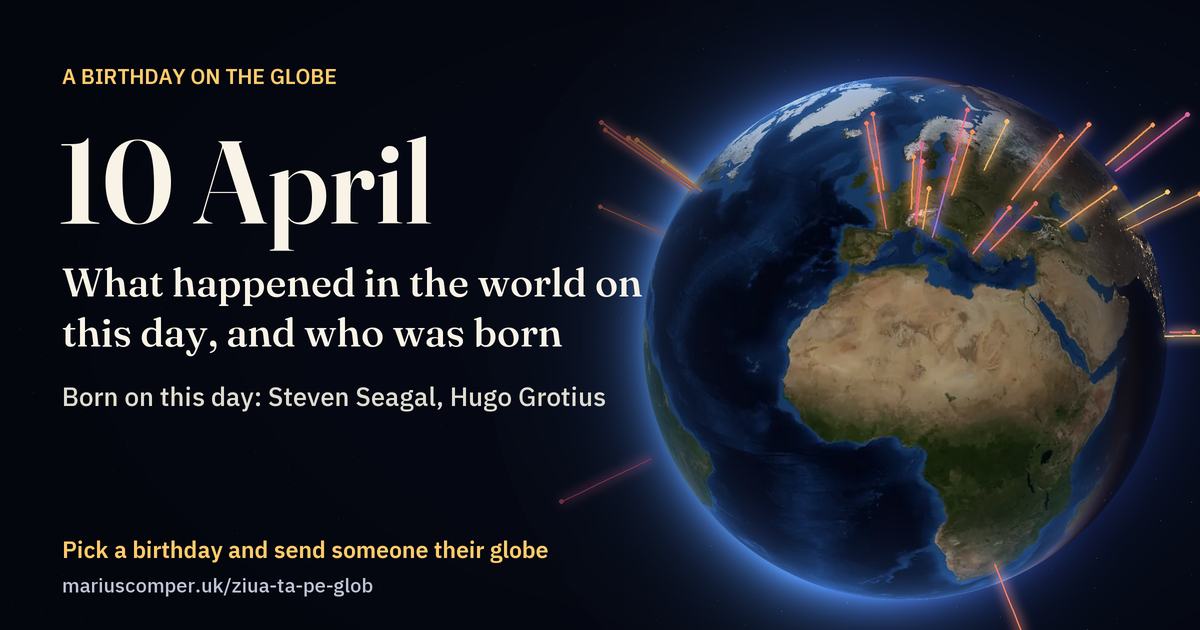
For 10 April, the English Wikipedia lists 55 events and 236 births. 31 of the events stand at their places as rays of light; six more are dashed circles, where the sentence links only to a country or a sea. The taller the ray, the longer ago it happened. The people born that day come further down, as blue points.
A birthday, yours or someone else’s:
Turn it into a greetingScroll: the globe turns to each place
The day you were born, on the globe.
Three things from your day
Scroll: your day first, then 10 April through the years
The Earth on 10 April
The picture on the globe was assembled by NASA from satellite photographs taken in April 2004: the snow, the ice and the green are those of the month.
On 10 April the Sun passes straight overhead at noon along the parallel of 8.1° north. In London, the day lasts about 13 hours 35 minutes.
Beyond 82° north the Sun no longer sets; beyond 82° south it no longer rises.
The line between day and night is tilted on the globe exactly as on this day of the year. On the dark side you can see the lights of towns.
Britain & Ireland · Big Ben
1858
After the original Big Ben, a 14.5 tonnes (32,000 lb) bell for the Palace of Westminster, had cracked during testing, it is recast into the current 13.76 tonnes (30,300 lb) bell by Whitechapel Bell Foundry.
On the map: Big Ben.
Europe · Huliaipole
1919
The Third Regional Congress of Peasants, Workers and Insurgents is held by the Makhnovshchina at Huliaipole.
On the map: Huliaipole.
Wikipedia: Regional Congress of Peasants, Workers and Insurgents
Asia · Nanjing
1407
Deshin Shekpa, 5th Karmapa Lama visits the Ming dynasty capital at Nanjing and is awarded the title "Great Treasure Prince of Dharma".
On the map: Nanjing.
North America · Second Bank of the United States
1816
The Federal government of the United States approves the creation of the Second Bank of the United States.
On the map: Second Bank of the United States.
North America · Catholic University of America
1887
On Easter Sunday, Pope Leo XIII authorizes the establishment of the Catholic University of America.
On the map: Catholic University of America.
10 April
What the other Wikipedias remember#
For these years the English list has nothing on this day. The events below come from the same day’s lists on Wikipedia in Spanish and were translated for this page.
From Wikipedia in Spanish · Seville
1899
In Seville (Spain), the first Spanish trial of the wireless telegraph takes place.
On the map: Seville.
Translated from the list on Wikipedia in Spanish.
10 April
Born on 10 April#
The English Wikipedia lists 236 births for this day. The blue points are the birthplaces of 60 of these people: those written about in the most Wikipedia editions, where Wikidata gives a place of birth.
Born on 10 April
1952
Steven Seagal, American actor, producer, and martial artist
Place of birth: Lansing.
Born on 10 April
1583
Hugo Grotius, Dutch philosopher and jurist (died 1645)
Place of birth: Delft.
Born on 10 April
1932
Omar Sharif, Egyptian actor and screenwriter (died 2015)
Place of birth: Alexandria.
Born on 10 April
1973
Roberto Carlos, Brazilian footballer and manager
Place of birth: Garça.
Born on 10 April
1929
Max von Sydow, Swedish-French actor (died 2020)
Place of birth: Lund.
Born in Britain and Ireland
1992
Daisy Ridley, English actress
Place of birth: Westminster.
Born in Britain and Ireland
1778
William Hazlitt, English essayist and critic (died 1830)
Place of birth: Maidstone.
Born in Britain and Ireland
1868
George Arliss, English actor and playwright (died 1946)
Place of birth: London.
10 April
Number one in the charts that week
At the cinema
An animal recorded that day
The record can be seen in GBIF, which brings together wildlife records from around the world.
All your birthdays
The weather that day
Data: Met Office Hadley Centre (HadCET); NOAA (GHCN-Daily, Mauna Loa).
Above the Earth
Sources: Jonathan McDowell, GCAT (launches); GFZ Potsdam (Kp index). Days are counted in Universal Time.
Football that day
International matches played that day:
Source: the “International football results” dataset kept by Mart Jürisoo (CC0).
Also that day
The earthquake’s page at the USGS
Source: the USGS catalogue. The day is counted in Universal Time (UTC).
In those days
Make a link for someone
Type the name, pick the day and the year of birth. The link opens straight on their day, with their name in the greeting.
The link carries the name, date and place typed here; anyone who gets it can see them.
Put another birthday beside it
Your mother’s, your child’s, a friend’s: the two days appear side by side.
Below: 10 April through the years.
The whole globe of the day
Drag the globe to turn it. Touch a ray or a point to read what happened there.
Everything Wikipedia lists for 10 April
The list is the English Wikipedia’s, in its own wording, as it stood in October 2026. 18 events have no place on the map: the sentence links to no place with coordinates, only to places too wide to mark, or to several countries.
- 238
During the year of Six Emperors, forces of Gordian I and Gordian II are defeated by those of Maximinus Thrax in the battle of Carthage.
Europe · Year of the Six EmperorsWikipedia: Year of the Six Emperors - 428
Nestorius becomes the Patriarch of Constantinople.
no place on the mapWikipedia: Nestorius - 837
Halley's Comet makes its closest approach to Earth at a distance equal to 0.0342 AU (5.1 million kilometres/3.2 million miles).
no place on the mapWikipedia: Halley's Comet - 847
Election of Pope Leo IV following the death of Pope Sergius II.
no place on the mapWikipedia: Pope Leo IV - 1407
Deshin Shekpa, 5th Karmapa Lama visits the Ming dynasty capital at Nanjing and is awarded the title "Great Treasure Prince of Dharma".
Asia · NanjingWikipedia: 5th Karmapa, Deshin Shekpa - 1500
Ludovico Sforza is captured by Swiss troops at Novara and is handed over to the French.
Europe · NovaraWikipedia: Ludovico Sforza - 1545
The settlement of Villa Imperial de Carlos V (now the city of Potosí) in Bolivia is founded after the discovery of huge silver deposits in the area.
Latin America · PotosíWikipedia: Potosí - 1606
The Virginia Company of London is established by royal charter by James I of England with the purpose of establishing colonial settlements in North America.
no place on the mapWikipedia: Virginia Company of London - 1710
The Statute of Anne, the first law regulating copyright, comes into force in Great Britain.
Britain & Ireland · Kingdom of Great BritainWikipedia: Statute of Anne - 1717
Robert Walpole resigns from the British government, commencing the Whig Split which lasts until 1720.
no place on the mapWikipedia: Robert Walpole - 1724
Bach leads the first performance of his cantata Erfreut euch, ihr Herzen, BWV 66, his first cantata composed for Easter in Leipzig.
no place on the mapWikipedia: Johann Sebastian Bach - 1741
War of the Austrian Succession: Prussia gains control of Silesia at the Battle of Mollwitz.
Europe · Battle of MollwitzWikipedia: Battle of Mollwitz - 1796
War of the First Coalition: A surprise Austrian attack at the Battle of Voltri marks the beginning of the Italian Campaign, the decisive campaign under Napoleon Bonaparte that will end the war a year later.
Europe · Battle of VoltriWikipedia: Battle of Voltri - 1809
Napoleonic Wars: The War of the Fifth Coalition begins when forces of the Austrian Empire invade Bavaria.
no place on the mapWikipedia: War of the Fifth Coalition - 1814
Allied forces under the Duke of Wellington attack Toulouse held by Marshall Soult, driving out the French after fierce fighting.
Europe · Battle of ToulouseWikipedia: Battle of Toulouse - 1815
The Mount Tambora volcano begins a three-month-long eruption, lasting until July 15. The eruption ultimately kills 71,000 people and affects Earth's climate for the next two years.
Asia · Mount TamboraWikipedia: Mount Tambora - 1816
The Federal government of the United States approves the creation of the Second Bank of the United States.
North America · Second Bank of the United StatesWikipedia: Federal government of the United States - 1821
Greek War of Independence: the island of Psara joins the Greek struggle for independence.
Europe · PsaraWikipedia: Greek War of Independence - 1821
Patriarch Gregory V of Constantinople is hanged by the Ottoman government from the main gate of the Patriarchate and his body is thrown into the Bosphorus.
Asia · Ottoman EmpireWikipedia: Gregory V of Constantinople - 1826
The 10,500 inhabitants of the Greek town of Missolonghi begin leaving the town after a year's siege by Turkish forces. Very few of them survive.
Europe · MissolonghiWikipedia: Third siege of Missolonghi - 1858
After the original Big Ben, a 14.5 tonnes (32,000 lb) bell for the Palace of Westminster, had cracked during testing, it is recast into the current 13.76 tonnes (30,300 lb) bell by Whitechapel Bell Foundry.
Britain & Ireland · Big BenWikipedia: Big Ben - 1864
Archduke Maximilian of Habsburg is proclaimed emperor of Mexico during the French intervention in Mexico.
no place on the mapWikipedia: Second French intervention in Mexico - 1865
American Civil War: A day after his surrender to Union forces, Confederate General Robert E. Lee addresses his troops for the last time.
North America · United StatesWikipedia: American Civil War - 1866
The American Society for the Prevention of Cruelty to Animals (ASPCA) is founded in New York City by Henry Bergh.
no place on the mapWikipedia: American Society for the Prevention of Cruelty to Animals - 1868
At Arogee in Abyssinia, British and Indian forces defeat an army of Emperor Tewodros II. While 700 Ethiopians are killed and many more injured, only two British/Indian troops die.
no place on the mapWikipedia: British expedition to Abyssinia - 1872
The first Arbor Day is celebrated in Nebraska.
North America · NebraskaWikipedia: Arbor Day - 1887
On Easter Sunday, Pope Leo XIII authorizes the establishment of the Catholic University of America.
North America · Catholic University of AmericaWikipedia: Easter - 1896
Summer Olympics: The Olympic marathon is run ending with the victory of Greek athlete Spyridon Louis.
no place on the mapWikipedia: 1896 Summer Olympics - 1900
British suffer a sharp defeat by the Boers south of Brandfort. Six hundred British troops are killed and wounded and 800 taken prisoner.
Africa · BrandfortWikipedia: Brandfort - 1912
RMS Titanic sets sail from Southampton, UK, on her maiden and only voyage.
Britain & Ireland · SouthamptonWikipedia: Titanic - 1919
Mexican Revolution leader Emiliano Zapata is ambushed and shot dead by government forces in Morelos.
Latin America · MorelosWikipedia: Mexican Revolution - 1919
The Third Regional Congress of Peasants, Workers and Insurgents is held by the Makhnovshchina at Huliaipole.
Europe · HuliaipoleWikipedia: Regional Congress of Peasants, Workers and Insurgents - 1925
The Great Gatsby, a novel by American author F. Scott Fitzgerald, was first published by Scribner's.
no place on the mapWikipedia: The Great Gatsby - 1925
The Russian city of Tsaritsyn is renamed Stalingrad to honor the Soviet leader Joseph Stalin, Soviet Communist Party General Secretary, who had guided the defense of Tsaritsyn during the Russian Civil War in 1920.
Europe · VolgogradWikipedia: Volgograd - 1941
World War II: The Axis powers establish the Independent State of Croatia.
Europe · Independent State of CroatiaWikipedia: World War II - 1944
Rudolf Vrba and Alfréd Wetzler escape from Birkenau death camp.
Europe · Auschwitz concentration campWikipedia: Rudolf Vrba - 1963
One hundred twenty-nine American sailors die when the submarine USS Thresher sinks at sea.
Oceans · USS ThresherWikipedia: Submarine - 1968
The TEV Wahine, a New Zealand ferry, sinks in Wellington harbour due to a fierce storm – the strongest winds ever in Wellington. Out of the 734 people on board, fifty-three died.
Oceania · TEV WahineWikipedia: TEV Wahine - 1970
Paul McCartney announces that he is leaving The Beatles for personal and professional reasons.
no place on the mapWikipedia: Paul McCartney - 1972
Tombs containing bamboo slips, among them Sun Tzu's Art of War and Sun Bin's lost military treatise, are discovered by construction workers in Shandong.
Asia · Yinqueshan Han Tombs Bamboo Slips MuseumWikipedia: Yinqueshan Han Tombs Bamboo Slips Museum - 1972
Vietnam War: For the first time since November 1967, American B-52 bombers reportedly begin bombing North Vietnam.
Asia · North VietnamWikipedia: Vietnam War - 1973
Invicta International Airlines Flight 435 crashes in a snowstorm on approach to Basel, Switzerland, killing 108 people.
Europe · Invicta International Airlines Flight 435Wikipedia: Invicta International Airlines Flight 435 - 1979
Red River Valley tornado outbreak: A tornado lands in Wichita Falls, Texas, killing 42 people.
North America · Wichita Falls, TexasWikipedia: 1979 Red River Valley tornado outbreak - 1981
Imprisoned IRA hunger striker Bobby Sands is elected to Westminster as the MP for Fermanagh and South Tyrone, Northern Ireland. He died twenty-six days later.
no place on the mapWikipedia: April 1981 Fermanagh and South Tyrone by-election - 1988
The Ojhri Camp explosion kills or injures more than 1,000 people in Rawalpindi and Islamabad, Pakistan.
Asia · Ojhri Camp disasterWikipedia: Ojhri Camp disaster - 1991
A rare tropical storm develops in the South Atlantic Ocean near Angola, the first to be documented by satellites.
no place on the mapWikipedia: South Atlantic tropical cyclone - 1991
Italian ferry MS Moby Prince collides with an oil tanker in dense fog off Livorno, Italy, killing 140.
Europe · Moby Prince disasterWikipedia: Moby Prince disaster - 1992
First Nagorno-Karabakh War: Dozens of Armenian civilians were massacred in the village of Maraga by Azerbaijani forces.
Asia · Maraga massacreWikipedia: Maraga massacre - 1998
The Good Friday Agreement is signed in Northern Ireland.
no place on the mapWikipedia: Good Friday Agreement - 2009
President of Fiji Ratu Josefa Iloilo announces the abrogation of the constitution and assumes all governance in the country, creating a constitutional crisis.
no place on the mapWikipedia: 2009 Fijian constitutional crisis - 2010
Polish Air Force Tu-154M crashes near Smolensk, Russia, killing 96 people, including Polish President Lech Kaczyński, his wife, and dozens of other senior officials and dignitaries.
Europe · Smolensk air disasterWikipedia: Smolensk air disaster - 2016
An earthquake of 6.6 magnitude strikes 39 km west-southwest of Ashkasham, impacting India, Afghanistan, Tajikistan, Srinagar and Pakistan.
Asia · 2016 Afghanistan earthquakeWikipedia: 2016 Afghanistan earthquake - 2016
The Paravur temple accident, in which a devastating fire caused by the explosion of firecrackers stored for Vishu kills more than one hundred people out of the thousands gathered for the seventh day of Bhadrakali worship.
Asia · Puttingal temple fireWikipedia: Puttingal temple fire - 2019
Scientists from the Event Horizon Telescope project released the first image of the black hole at the center of the galaxy M87.
no place on the mapWikipedia: Event Horizon Telescope - 2023
A mass shooting occurs at the Old National Bank in Louisville, Kentucky, that leaves five victims dead and eight wounded.
North America · 2023 Louisville bank shootingWikipedia: 2023 Louisville bank shooting
What the other Wikipedias remember
For these years the English list has nothing on this day. The events below come from the same day’s lists on Wikipedia in Spanish and were translated for this page.
- 1899
In Seville (Spain), the first Spanish trial of the wireless telegraph takes place.
Who was born on 10 April
In order of how many Wikipedia editions have an article about each. The first 60 of 236 are shown.
- 1952
Steven Seagal, American actor, producer, and martial artist
LansingWikipedia: Steven Seagal - 1583
Hugo Grotius, Dutch philosopher and jurist (died 1645)
- 1932
Omar Sharif, Egyptian actor and screenwriter (died 2015)
AlexandriaWikipedia: Omar Sharif - 1973
Roberto Carlos, Brazilian footballer and manager
- 1847
Joseph Pulitzer, Hungarian-American journalist, publisher, and politician, founded Pulitzer, Inc. (died 1911)
- 401
Theodosius II, Roman emperor (died 450)
ConstantinopleWikipedia: Theodosius II - 1929
Max von Sydow, Swedish-French actor (died 2020)
- 1512
James V, king of Scotland (died 1542)
Linlithgow PalaceWikipedia: James V - 1755
Samuel Hahnemann, German-French medical doctor and academic (died 1843)
MeissenWikipedia: Samuel Hahnemann - 1917
Robert Burns Woodward, American chemist and academic, Nobel Prize laureate (died 1979)
- 1986
Vincent Kompany, Belgian footballer and manager
- 1887
Bernardo Houssay, Argentinian physiologist and academic, Nobel Prize laureate (died 1971)
Buenos AiresWikipedia: Bernardo Houssay - 1992
Daisy Ridley, English actress
WestminsterWikipedia: Daisy Ridley - 1937
Bella Akhmadulina, Soviet and Russian poet, short story writer, and translator (died 2010)
- 1984
Mandy Moore, American singer-songwriter and actress
NashuaWikipedia: Mandy Moore - 1927
Marshall Warren Nirenberg, American biochemist and geneticist, Nobel Prize laureate (died 2010)
- 1986
Fernando Gago, Argentine footballer and manager
CiudadelaWikipedia: Fernando Gago - 1996
Andreas Christensen, Danish footballer
LillerødWikipedia: Andreas Christensen - 1778
William Hazlitt, English essayist and critic (died 1830)
MaidstoneWikipedia: William Hazlitt - 1988
Haley Joel Osment, American actor
Los AngelesWikipedia: Haley Joel Osment - 1868
George Arliss, English actor and playwright (died 1946)
LondonWikipedia: George Arliss - 1929
Mike Hawthorn, English racing driver (died 1959)
MexboroughWikipedia: Mike Hawthorn - 1963
Doris Leuthard, Swiss lawyer and politician, 162nd President of the Swiss Confederation
MerenschwandWikipedia: Doris Leuthard - 1980
Charlie Hunnam, English actor
Newcastle upon TyneWikipedia: Charlie Hunnam - 1018
Nizam al-Mulk, Persian scholar and vizier (died 1092)
- 1769
Jean Lannes, French marshal (died 1809)
LectoureWikipedia: Jean Lannes - 1873
Kyösti Kallio, Finnish farmer, banker, and politician, 4th President of Finland (died 1940)
NivalaWikipedia: Kyösti Kallio - 1827
Lew Wallace, American general, lawyer, author and politician, 11th Governor of New Mexico Territory (died 1905)
BrookvilleWikipedia: Lew Wallace - 1979
Rachel Corrie, American activist (died 2003)
OlympiaWikipedia: Rachel Corrie - 1979
Sophie Ellis-Bextor, English singer-songwriter
HounslowWikipedia: Sophie Ellis-Bextor - 1983
Jamie Chung, American actress
San FranciscoWikipedia: Jamie Chung - 1829
William Booth, English minister, founded The Salvation Army (died 1912)
NottinghamWikipedia: William Booth - 1957
Aliko Dangote, Nigerian businessman, founded Dangote Group
- 1973
Guillaume Canet, French actor and director
Boulogne-BillancourtWikipedia: Guillaume Canet - 1990
Alex Pettyfer, English actor
StevenageWikipedia: Alex Pettyfer - 1794
Matthew C. Perry, English-Scottish American commander (died 1858)
NewportWikipedia: Matthew C. Perry - 1910
Helenio Herrera, Argentinian footballer and manager (died 1997)
Buenos AiresWikipedia: Helenio Herrera - 1939
Claudio Magris, Italian scholar, author, and translator
TriesteWikipedia: Claudio Magris - 1985
Barkhad Abdi, Somali-American actor and director
MogadishuWikipedia: Barkhad Abdi - 1968
Orlando Jones, American actor, producer, and screenwriter
ToulminvilleWikipedia: Orlando Jones - 1954
Peter MacNicol, American actor
- 1864
Eugen d'Albert, Scottish-German pianist and composer (died 1932)
GlasgowWikipedia: Eugen d'Albert - 1880
Frances Perkins, American sociologist, academic, and politician, United States Secretary of Labor (died 1965)
- 1932
Delphine Seyrig, Swiss/Alsatian French actress (died 1990)
- 1987
Hayley Westenra, New Zealand soprano
Christchurch Women's HospitalWikipedia: Hayley Westenra - 1959
Babyface, American singer-songwriter and producer
IndianapolisWikipedia: Babyface - 1990
Ben Amos, English footballer
MacclesfieldWikipedia: Ben Amos - 1894
Ben Nicholson, British painter (died 1982)
DenhamWikipedia: Ben Nicholson - 1913
Stefan Heym, German-American soldier and author (died 2001)
ChemnitzWikipedia: Stefan Heym - 1942
Ian Callaghan, English footballer
ToxtethWikipedia: Ian Callaghan - 1981
Michael Pitt, American actor, model and musician
West OrangeWikipedia: Michael Pitt - 1651
Ehrenfried Walther von Tschirnhaus, German mathematician, physicist and medical doctor (died 1708)
Sławnikowice, Lower SilesiaWikipedia: Ehrenfried Walther von Tschirnhaus - 1877
Alfred Kubin, Austrian author and illustrator (died 1959)
LitoměřiceWikipedia: Alfred Kubin - 1984
Damien Perquis, French-Polish footballer
- 1941
Paul Theroux, American novelist, short story writer, and travel writer
MedfordWikipedia: Paul Theroux - 1984
Gonzalo Javier Rodríguez, Argentinian footballer
Buenos AiresWikipedia: Gonzalo Rodríguez - 1921
Chuck Connors, American baseball player and actor (died 1992)
BrooklynWikipedia: Chuck Connors - 1930
Dolores Huerta, American activist, co-founded the United Farm Workers
- 1915
Harry Morgan, American actor and director (died 2011)
DetroitWikipedia: Harry Morgan - 1929
Liz Sheridan, American actress (died 2022)
What is celebrated on 10 April
- Christian feast day: Blessed Anthony Neyrot
- Christian feast day: Fulbert of Chartres
- Christian feast day: James, Azadanus and Abdicius
- Christian feast day: Magdalene of Canossa
- Christian feast day: Mikael Agricola (Lutheran)
- Christian feast day: Pierre Teilhard de Chardin (Episcopal Church)
- Christian feast day: William of Ockham (Anglicanism)
- Christian feast day: William Law (Anglicanism)
- Christian feast day: April 10 (Eastern Orthodox liturgics)
- Day of the Builder (Azerbaijan)
- Feast of the Third Day of the Writing of the Book of the Law (Thelema)
- Siblings Day (International observance)
A greeting link for someone
Type a name and, if you like, the year of birth. The link opens with a greeting, and beside each event it says how old the person turned that day, or how many years before their birth it happened.
The name and the year go only into the link you send.
All 366 days
How the globe is made
Where the events come from
Each edition of this page uses the day’s list from Wikipedia in its own language: Romanian, English, Spanish, Chinese. The lists are written by volunteers and differ from one edition to the next; the text of each event is Wikipedia’s, with a link to the article. A row that appears twice in a list is shown once. The lists have not been checked event by event: they are Wikipedia’s, mistakes included.
For events before 1582, and for countries that moved to the Gregorian calendar later (Britain in 1752, Russia in 1918), the same day may be counted Old Style in one list and New Style in another.
The chapter “What the other Wikipedias remember” adds up to five events a day from the lists of the other three editions, only for years in which the English list has nothing on that day. They were translated for this page, passed the same filters as the tour, and are not counted among the events of the English list.
How an event gets onto the map
The place comes from Wikidata. If the sentence links to the article about the event itself (a battle, an opening, an earthquake), dated to the same year, the ray stands on its coordinates or on those of its location. Otherwise it stands on the first place the sentence links to: a town, a building, a mountain, an island. This second step can be wrong: sometimes the sentence only mentions the place. That is why the page says, under each event, which place the ray stands on.
When the sentence links to a single state or province, or to a single sea, lake or desert larger than 5,000 km², the globe shows a dashed circle, not a ray. The circle has the area Wikidata gives, with its radius kept between 1.2° and 16°, or a radius of 4.5° when Wikidata gives no area; it says only that the sentence links to that place. Organisations, ships, spacecraft, museum objects, rivers, mountain ranges, languages and continents are never used as places. When a sentence names several states and no exact place, the event stays in the list only.
What the height means
The height of a ray shows how many years have passed, on a logarithmic scale: 10 years, 100 years and 1,000 years are equal steps apart; anything older than about 2,600 years has the tallest ray. The colour runs from pale yellow for recent years to violet for antiquity.
Where the tour stops
In each region the tour stops at up to three events (five in Britain and Ireland), chosen mainly by three things: whether Wikipedia’s editors put the event in the “On this day” box of their main page (the English, Spanish and Chinese editions), how many Wikipedia editions have an article about it, and how many of the four lists include it. Events whose sentence or article is about a war, an attack, a crime or a disaster are left out of the tour; they stay in the whole list, in Wikipedia’s wording. The filter is a list of words and a list of Wikidata types, so it can miss some.
The tour of births names the people with articles in the most editions and leaves aside those whom the list or Wikidata describes as rulers, politicians, commanders, leaders of movements or criminals; they stay in the list.
The Earth and the Sun
The daytime images are NASA’s Blue Marble Next Generation mosaics, one for each month of 2004; the night side is Black Marble 2016. The tilt of the line between day and night is computed for the day; the hour is chosen so that the place being read is in daylight. The latitude where the Sun stands overhead is the average of the four years of the leap cycle; in a given year it can differ by up to 0.4°.
The day you were born
The number ones come from the weekly lists on Wikipedia: Billboard for the United States (from 1940; the Hot 100 from August 1958), the UK Singles Chart (from November 1952), Los 40 Principales for Spain (from July 1966) and, for Romania, the Romanian Top 100 and Airplay 100 (2001–2021, with missing weeks). The page shows the chart of the week in which the day of birth falls, with its date; Billboard and the UK chart are dated at the end of their week. For Romania before 2001 and for China these sources have no weekly chart.
The films are those that reached cinemas in the United States up to ten days before or three days after that day (some of them in a few cinemas at first), from the English Wikipedia’s yearly lists (from 1968), in order of how many editions have an article about them. The events “in those days” are the ones on the neighbouring days’ lists that carry the year of birth, passed through the same filter as the tour.
The day of birth, year included
The Moon, the star sign and the constellation are worked out by the page itself, for noon Universal Time on the day. The lit part of the Moon is rounded and can differ by a few per cent from that at the hour of birth. The sign follows the usual zodiac of twelve equal parts starting at the March equinox; the constellation is the one the Sun actually stood in front of, by the borders set by the International Astronomical Union, and within a day of a border the page does not name it. When the Sun changes sign while it is that day anywhere on Earth, the page gives the moment of crossing, rounded to ten minutes and accurate to within about a quarter of an hour, and the clock time in a few cities, with the time zone and summer time of that year.
The year in the Chinese calendar is the one your device’s own calendar gives for the date, checked against the Hong Kong Observatory’s tables. “All your birthdays” uses the same sources as the rest of the chapter for the same day in every year since the birth: the temperature, well-known launches that took place on that very day, matches of the teams the edition follows, snow deeper than 10 cm and strong geomagnetic storms. The three things at the top and the four on the picture are chosen in a fixed order (the song, the animal, a full Moon, a well-known launch before an ordinary earthquake); on the picture you can change them.
When the link carries a year of birth, the page adds a few things about that exact day. The weather is the Met Office’s Central England temperature record and the readings from New York’s Central Park; the “usual high” is the average of the daily highs of 1961–1990 for that date, with two days either side. The carbon dioxide figure is the monthly mean at the Mauna Loa observatory, where measurements begin in March 1958.
The earthquake is the one with the largest magnitude in the USGS catalogue for that day, counted in Universal Time. Before the 1960s the catalogue has gaps even above magnitude 5.5, so in the older years many days have no earthquake. The page gives only the magnitude and the place: the country the epicentre falls in or, when the epicentre is at sea within 300 km of a coast, the nearest country; farther out, only the ocean.
The launches are those that reached orbit or left for the Moon and the planets, from Jonathan McDowell’s GCAT catalogue. If nothing left that day, the page shows the nearest launch within three days before or after, and says how many days away it was. The geomagnetic storm appears only when the Kp index reached at least 5 in one of the day’s eight three-hour intervals.
The animal comes from GBIF: an observation made by a person (the animal seen or heard, or its tracks), dated to that exact day, with coordinates and a CC0 or CC BY licence. Only a few hundred well-known species are searched (mammals, birds, turtles, butterflies); of those noted that day, mammals and species with articles in many Wikipedia editions come first; birds noted almost every day, and species used recently, wait their turn. Observations dated 1 January are left out, because records without a day are often filed there. An observation shows that the animal was recorded there, not how many animals there were.
The matches are those between national teams. Only matches of England, Scotland, Wales, Northern Ireland, the Republic of Ireland, the United States, Canada and Australia are shown, along with those at the big final tournaments. The picture to send is drawn in the page from the day’s globe and the facts above, and stays on your device until you send it.
Sources
- Events, births and holidays: the day’s page on Wikipedia, text under CC BY-SA 4.0.
- Coordinates, places of birth and the number of editions: Wikidata (CC0).
- The Earth by day: NASA Blue Marble Next Generation. The Earth by night: NASA Black Marble 2016.
- Borders and regions: Natural Earth.
- World population and births per year: UN World Population Prospects 2024.
- Charts and films: Wikipedia’s lists for Billboard, the UK Singles Chart, Los 40 Principales, Romanian Top 100, Airplay 100 and American films by year (CC BY-SA 4.0).
- Weather: Met Office Hadley Centre, HadCET (Open Government Licence) and NOAA GHCN-Daily, New York Central Park. Carbon dioxide: NOAA Global Monitoring Laboratory, Mauna Loa.
- Earthquakes: the USGS catalogue. Launches: Jonathan McDowell, GCAT (CC BY). Kp index: GFZ Potsdam (CC BY 4.0). Matches: International football results, Mart Jürisoo (CC0).
- Animal observations: GBIF, with a link to each record; species names come from Wikidata.