A birthday on the globe
6 November on the globe: what happened in the world on this day, and who was born
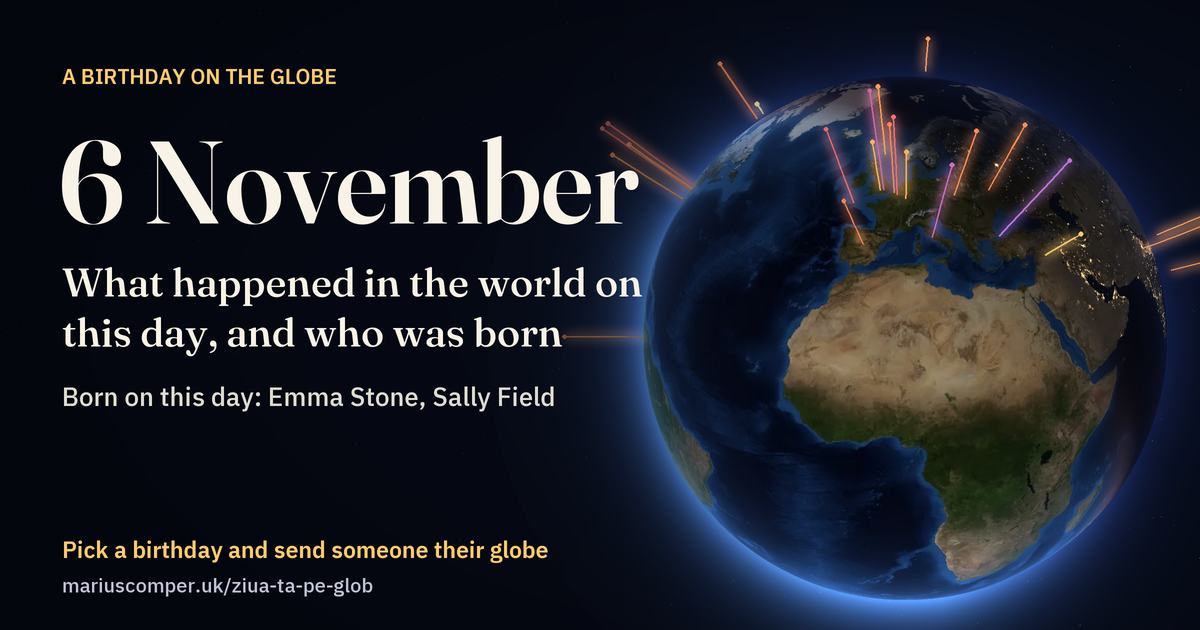
For 6 November, the English Wikipedia lists 32 events and 106 births. 24 of the events stand at their places as rays of light. The taller the ray, the longer ago it happened. The people born that day come further down, as blue points.
A birthday, yours or someone else’s:
Turn it into a greetingScroll: the globe turns to each place
The day you were born, on the globe.
Three things from your day
Scroll: your day first, then 6 November through the years
The Earth on 6 November
The picture on the globe was assembled by NASA from satellite photographs taken in November 2004: the snow, the ice and the green are those of the month.
On 6 November the Sun passes straight overhead at noon along the parallel of 16.0° south. In London, the day lasts about 9 hours 25 minutes.
Beyond 74° south the Sun no longer sets; beyond 74° north it no longer rises.
The line between day and night is tilted on the globe exactly as on this day of the year. On the dark side you can see the lights of towns.
Asia · Palwal district
1976
Uttawar forced sterilisations: Mass vasectomy of nearly 800 men of Uttawar village, Palwal district, Haryana during India's Emergency imposed by Indira Gandhi.
On the map: Palwal district.
North America · B Reactor
1944
The B Reactor at the Hanford Site in the U.S. state of Washington began producing plutonium, with the facility later going on to create more for nearly the entire American nuclear arsenal.
On the map: B Reactor.
Also on the day’s list of Wikipedia in Chinese.
North America · Baltimore
1995
Cleveland Browns relocation controversy: Art Modell announces that he signed a deal that would relocate the Cleveland Browns to Baltimore.
On the map: Baltimore.
6 November
What the other Wikipedias remember#
For these years the English list has nothing on this day. The events below come from the same day’s lists on Wikipedia in Spanish and Romanian and were translated for this page.
From Wikipedia in Spanish · Congress of Chilpancingo
1813
At the Congress of Chilpancingo (Mexico), the priest José María Morelos formally declares independence from Spanish rule with the promulgation of the Solemn Act of the Declaration of Independence of Northern America.
On the map: Congress of Chilpancingo.
Translated from the list on Wikipedia in Spanish.
From Wikipedia in Spanish · Glasgow
1887
In Glasgow (Scotland), Celtic Football Club is founded.
On the map: Glasgow.
Translated from the list on Wikipedia in Spanish.
From Wikipedia in Spanish · United States Congress
1934
The Democratic Party, led by Franklin Delano Roosevelt, wins the elections to the United States Congress.
On the map: United States Congress.
Translated from the list on Wikipedia in Spanish.
The article on Wikipedia in Spanish: Congreso de los Estados Unidos
From Wikipedia in Romanian · New York City
2001
Michael Bloomberg is elected mayor of New York.
On the map: New York City.
Translated from the list on Wikipedia in Romanian.
6 November
Born on 6 November#
The English Wikipedia lists 106 births for this day. The blue points are the birthplaces of 59 of these people: those written about in the most Wikipedia editions, where Wikidata gives a place of birth.
Born on 6 November
1988
Conchita Wurst, Austrian singer
Place of birth: Gmunden.
Born on 6 November
1932
François Englert, Belgian physicist and academic, Nobel Prize laureate (died 2026)
Place of birth: Etterbeek.
Born on 6 November
1987
Ana Ivanovic, Serbian tennis player
Place of birth: Belgrade.
Born in Britain and Ireland
1997
Hero Fiennes-Tiffin, English actor and model
Place of birth: London.
Born in Britain and Ireland
1940
Johnny Giles, Irish footballer and manager
Place of birth: Dublin.
Born in Britain and Ireland
1946
George Young, Scottish guitarist, songwriter, and producer (died 2017)
Place of birth: Glasgow.
6 November
Number one in the charts that week
At the cinema
An animal recorded that day
The record can be seen in GBIF, which brings together wildlife records from around the world.
All your birthdays
The weather that day
Data: Met Office Hadley Centre (HadCET); NOAA (GHCN-Daily, Mauna Loa).
Above the Earth
Sources: Jonathan McDowell, GCAT (launches); GFZ Potsdam (Kp index). Days are counted in Universal Time.
Football that day
International matches played that day:
Source: the “International football results” dataset kept by Mart Jürisoo (CC0).
Also that day
The earthquake’s page at the USGS
Source: the USGS catalogue. The day is counted in Universal Time (UTC).
In those days
Make a link for someone
Type the name, pick the day and the year of birth. The link opens straight on their day, with their name in the greeting.
The link carries the name, date and place typed here; anyone who gets it can see them.
Put another birthday beside it
Your mother’s, your child’s, a friend’s: the two days appear side by side.
Below: 6 November through the years.
The whole globe of the day
Drag the globe to turn it. Touch a ray or a point to read what happened there.
Everything Wikipedia lists for 6 November
The list is the English Wikipedia’s, in its own wording, as it stood in October 2026. Eight events have no place on the map: the sentence links to no place with coordinates, only to places too wide to mark, or to several countries.
- 447
A powerful earthquake destroys large portions of the Walls of Constantinople, including 57 towers.
Asia · Walls of ConstantinopleWikipedia: Walls of Constantinople - 963
Synod of Rome: Emperor Otto I calls a council at St. Peter's Basilica in Rome. Pope John XII is deposed on charges of an armed rebellion against Otto.
Europe · RomeWikipedia: Synod of Rome - 1217
The Charter of the Forest is sealed at St Paul's Cathedral, London by King Henry III, acting under the regency of William Marshall, 1st Earl of Pembroke which re-establishes for free men rights of access to the royal forest that had been eroded by William the Conqueror and his heirs.
Britain & Ireland · St Paul's CathedralWikipedia: Charter of the Forest - 1792
Battle of Jemappes in the French Revolutionary Wars.
Europe · Battle of JemappesWikipedia: Battle of Jemappes - 1794
French Revolutionary Wars: Two British ships were intercepted by a French squadron, leading to the French seizure of HMS Alexander.
Oceans · Action of 6 November 1794Wikipedia: Action of 6 November 1794 - 1856
The first story from the collection Scenes of Clerical Life by the English author George Eliot was submitted for publication.
no place on the mapWikipedia: Scenes of Clerical Life - 1860
Abraham Lincoln is elected the 16th president of the United States with only 40% of the popular vote, defeating John C. Breckinridge, John Bell, and Stephen A. Douglas in a four-way race.
no place on the mapWikipedia: 1860 United States presidential election - 1863
American Civil War: A Union brigade defeated a Confederate force at the Battle of Droop Mountain in Pocahontas County, West Virginia.
North America · Battle of Droop MountainWikipedia: American Civil War - 1868
Red Cloud, a Native American leader of the Oglala Lakota tribe, signed the Treaty of Fort Laramie, ending Red Cloud's War and establishing the Great Sioux Reservation.
no place on the mapWikipedia: Treaty of Fort Laramie - 1869
In New Brunswick, New Jersey, Rutgers College defeats Princeton University (then known as the College of New Jersey), 6–4, in the first official intercollegiate American football game.
North America · New Brunswick, New JerseyWikipedia: 1869 college football season - 1900
President William McKinley is re-elected, along with his vice-presidential running mate, Governor Theodore Roosevelt of New York.
no place on the mapWikipedia: 1900 United States presidential election - 1917
First World War: Canadian forces captured Passendale, Belgium, after three months of fighting against the Germans at the Battle of Passchendaele.
Europe · PassendaleWikipedia: World War I - 1924
The Spanish anarchist group Los Solidarios unsuccessfully attempted to launch an insurrection against the dictatorship of Miguel Primo de Rivera.
no place on the mapWikipedia: Los Solidarios - 1936
Spanish Civil War: The republican government flees from Madrid to Valencia, leading to the formation of the Madrid Defense Council in its stead.
Europe · Siege of MadridWikipedia: Spanish Civil War - 1939
As part of their plan to eradicate the Polish intellectual elite, the Gestapo arrested 184 professors, students and employees of the Jagiellonian University in Kraków.
Europe · KrakówWikipedia: Intelligenzaktion - 1943
World War II: The 1st Ukrainian Front liberates Kyiv from German occupation.
Europe · Battle of KievWikipedia: Battle of Kiev - 1944
The B Reactor at the Hanford Site in the U.S. state of Washington began producing plutonium, with the facility later going on to create more for nearly the entire American nuclear arsenal.
North America · B ReactorWikipedia: B Reactor - 1947
Meet the Press, the longest running television program in history, makes its debut on NBC Television.
no place on the mapWikipedia: Meet the Press - 1963
Nguyễn Ngọc Thơ is appointed to head the South Vietnamese government by General Dương Văn Minh's junta, five days after the latter deposed and assassinated President Ngô Đình Diệm.
Asia · 1963 South Vietnamese coup d'étatWikipedia: 1963 South Vietnamese coup d'état - 1971
The United States Atomic Energy Commission tests the largest U.S. underground hydrogen bomb, code-named Cannikin, on Amchitka Island in the Aleutians.
North America · CannikinWikipedia: United States Atomic Energy Commission - 1976
Uttawar forced sterilisations: Mass vasectomy of nearly 800 men of Uttawar village, Palwal district, Haryana during India's Emergency imposed by Indira Gandhi.
Asia · Palwal districtWikipedia: Uttawar forced sterilisations - 1977
The Kelly Barnes Dam, located above Toccoa Falls College near Toccoa, Georgia, fails, killing 39.
North America · Kelly Barnes DamWikipedia: Kelly Barnes Dam - 1985
Colombian conflict: leftist guerrillas of the 19th of April Movement seize control of the Palace of Justice in Bogotá.
Latin America · BogotáWikipedia: Palace of Justice siege - 1986
Sumburgh disaster: A British International Helicopters Boeing 234LR Chinook crashes 2.5 miles (4.0 km) east of Sumburgh Airport killing 45 people. It is the deadliest civilian helicopter crash on record.
Britain & Ireland · 1986 British International Helicopters Chinook crashWikipedia: 1986 British International Helicopters Chinook crash - 1988
Lancang–Gengma earthquakes: At least 730 are killed after two powerful earthquakes rock the China–Myanmar border in Yunnan Province.
Asia · 1988 Lancang–Gengma earthquakesWikipedia: 1988 Lancang–Gengma earthquakes - 1995
Cleveland Browns relocation controversy: Art Modell announces that he signed a deal that would relocate the Cleveland Browns to Baltimore.
North America · BaltimoreWikipedia: Cleveland Browns relocation controversy - 2002
A Fokker 50 crashes near Luxembourg Airport, killing 20 and injuring three.
Europe · Luxair Flight 9642Wikipedia: Luxair Flight 9642 - 2002
Jiang Lijun is detained by Chinese police for signing the Open Letter to the 16th National Congress of the Chinese Communist Party.
no place on the mapWikipedia: Jiang Lijun - 2004
An express train collides with a stationary car near the village of Ufton Nervet, England, killing seven and injuring 120.
Britain & Ireland · Ufton NervetWikipedia: Ufton Nervet rail crash - 2012
Tammy Baldwin becomes the first openly gay politician to be elected to the United States Senate.
no place on the mapWikipedia: 2012 United States Senate election in Wisconsin - 2016
Syrian civil war: The Syrian Democratic Forces launch an offensive to capture the ISIL-held city of Raqqa.
Asia · Raqqa campaignWikipedia: Raqqa campaign - 2025
Canadian ostrich cull: The Government of Canada kills 314 ostriches after H5N8 is detected in an ostrich farm in Edgewood, BC.
North America · Edgewood, British ColumbiaWikipedia: 2025 Canadian ostrich culling controversy
What the other Wikipedias remember
For these years the English list has nothing on this day. The events below come from the same day’s lists on Wikipedia in Spanish and Romanian and were translated for this page.
- 1813
At the Congress of Chilpancingo (Mexico), the priest José María Morelos formally declares independence from Spanish rule with the promulgation of the Solemn Act of the Declaration of Independence of Northern America.
Latin America · Congress of ChilpancingoTranslated from the list on Wikipedia in SpanishWikipedia: Congreso de Anáhuac - 1887
In Glasgow (Scotland), Celtic Football Club is founded.
- 1934
The Democratic Party, led by Franklin Delano Roosevelt, wins the elections to the United States Congress.
North America · United States CongressTranslated from the list on Wikipedia in SpanishWikipedia: Congreso de los Estados Unidos - 2001
Michael Bloomberg is elected mayor of New York.
North America · New York CityTranslated from the list on Wikipedia in RomanianWikipedia: Michael Bloomberg
Who was born on 6 November
In order of how many Wikipedia editions have an article about each. The first 60 of 106 are shown.
- 1494
Suleiman the Magnificent, Sultan of the Ottoman Empire (died 1566)
- 1988
Emma Stone, American actress
ScottsdaleWikipedia: Emma Stone - 1946
Sally Field, American actress
PasadenaWikipedia: Sally Field - 1988
Conchita Wurst, Austrian singer
GmundenWikipedia: Conchita Wurst - 1661
Charles II of Spain, last Habsburg ruler of the Spanish Empire (died 1700)
- 1932
François Englert, Belgian physicist and academic, Nobel Prize laureate (died 2026)
EtterbeekWikipedia: François Englert - 1987
Ana Ivanovic, Serbian tennis player
BelgradeWikipedia: Ana Ivanovic - 1990
André Schürrle, German footballer
LudwigshafenWikipedia: André Schürrle - 1972
Rebecca Romijn, American model and actress
BerkeleyWikipedia: Rebecca Romijn - 1814
Adolphe Sax, Belgian-French instrument designer, invented the saxophone (died 1894)
DinantWikipedia: Adolphe Sax - 1931
Mike Nichols, German-born American actor, director, producer, and screenwriter (died 2014)
BerlinWikipedia: Mike Nichols - 1861
James Naismith, Canadian-American physician and educator, invented basketball (died 1939)
AlmonteWikipedia: James Naismith - 1948
Glenn Frey, American singer-songwriter, guitarist, and actor (died 2016)
DetroitWikipedia: Glenn Frey - 1854
John Philip Sousa, American composer and bandleader (died 1932)
Washington, D.C.Wikipedia: John Philip Sousa - 1952
Michael Cunningham, American novelist and screenwriter
CincinnatiWikipedia: Michael Cunningham - 1989
Jozy Altidore, American soccer player
LivingstonWikipedia: Jozy Altidore - 1968
Jerry Yang, Taiwanese-American engineer and businessman, co-founded Yahoo!
TaipeiWikipedia: Jerry Yang - 1979
Lamar Odom, American basketball player
QueensWikipedia: Lamar Odom - 1926
Zig Ziglar, American soldier, businessman, and author (died 2012)
Coffee CountyWikipedia: Zig Ziglar - 1997
Hero Fiennes-Tiffin, English actor and model
- 1955
Maria Shriver, American journalist and author
ChicagoWikipedia: Maria Shriver - 1968
Kelly Rutherford, American actress
ElizabethtownWikipedia: Kelly Rutherford - 1949
Ariel Henry, Haitian prime-minister, neurosurgeon, and politician
Port-au-PrinceWikipedia: Ariel Henry - 1992
Stefan Ortega, German footballer
HofgeismarWikipedia: Stefan Ortega - 1966
Paul Gilbert, American guitarist
CarbondaleWikipedia: Paul Gilbert - 1851
Charles Dow, American journalist and economist (died 1902)
SterlingWikipedia: Charles Dow - 1967
Rebecca Schaeffer, American actress and model (died 1989)
- 1971
Laura Flessel-Colovic, French fencer and politician
Pointe-à-PitreWikipedia: Laura Flessel-Colovic - 1983
Nicole Hosp, Austrian skier
EhenbichlWikipedia: Nicole Hosp - 1550
Karin Månsdotter, Swedish queen (died 1612)
UpplandWikipedia: Karin Månsdotter - 1940
Johnny Giles, Irish footballer and manager
DublinWikipedia: Johnny Giles - 1981
Kaspars Gorkšs, Latvian footballer
- 1974
Frank Vandenbroucke, Belgian cyclist (died 2009)
MouscronWikipedia: Frank Vandenbroucke - 1990
Bowen Yang, Australian-born American actor, comedian, podcaster, and writer
BrisbaneWikipedia: Bowen Yang - 1946
George Young, Scottish guitarist, songwriter, and producer (died 2017)
GlasgowWikipedia: George Young - 1997
Elena-Gabriela Ruse, Romanian tennis player
BucharestWikipedia: Elena-Gabriela Ruse - 1989
Aaron Hernandez, American football player (died 2017)
BristolWikipedia: Aaron Hernandez - 1941
Guy Clark, American singer-songwriter, guitarist, and producer (died 2016)
MonahansWikipedia: Guy Clark - 1995
Sam Reinhart, Canadian ice hockey player
North VancouverWikipedia: Sam Reinhart - 1887
Walter Johnson, American baseball player and manager (died 1946)
HumboldtWikipedia: Walter Johnson - 1841
Nelson W. Aldrich, American businessman and politician (died 1915)
- 1985
Sun Yue, Chinese basketball player
CangzhouWikipedia: Sun Yue - 1997
Aliona Bolsova, Spanish-Moldovan tennis player
ChișinăuWikipedia: Aliona Bolsova - 1479
Philip I, Margrave of Baden (died 1533)
- 1880
Yoshisuke Aikawa, Japanese businessman and politician, founded Nissan Motor Company (died 1967)
- 1963
Rozz Williams, American singer, musician and artist (died 1998)
PomonaWikipedia: Rozz Williams - 1967
Shuzo Matsuoka, Japanese tennis player and sportscaster
- 1992
Paula Kania-Choduń, Polish tennis player
SosnowiecWikipedia: Paula Kania-Choduń - 1978
Erik Cole, American ice hockey player
OswegoWikipedia: Erik Cole - 1391
Edmund Mortimer, 5th Earl of March, English politician (died 1425)
County MeathWikipedia: Edmund Mortimer, 5th Earl of March - 1962
Nadezhda Kuzhelnaya, Russian pilot and former cosmonaut
AlexeyevskoyeWikipedia: Nadezhda Kuzhelnaya - 1979
Brad Stuart, Canadian ice hockey player
Rocky Mountain HouseWikipedia: Brad Stuart - 1988
John Holland, Puerto Rican-American basketball player
The BronxWikipedia: John Holland - 2001
Day'Ron Sharpe, American basketball player
GreenvilleWikipedia: Day'Ron Sharpe - 1832
Joseph Smith III, American religious leader (died 1914)
KirtlandWikipedia: Joseph Smith III - 1913
Cho Ki-chon, North Korean poet (died 1951)
UssuriyskWikipedia: Cho Ki-chon - 1941
Doug Sahm, American singer-songwriter and musician (died 1999)
San AntonioWikipedia: Doug Sahm - 1960
Lance Kerwin, American actor (died 2023)
Newport BeachWikipedia: Lance Kerwin - 1981
Luke Jackson, American basketball player and coach
EugeneWikipedia: Luke Jackson - 1986
Conor Sammon, Irish footballer
DublinWikipedia: Conor Sammon
What is celebrated on 6 November
- Christian feast days: Barlaam of Khutyn
- Christian feast days: Demetrian
- Christian feast days: Illtud
- Christian feast days: Leonard of Noblac
- Christian feast days: Melaine of Rennes
- Christian feast days: Winnoc
- Christian feast days: November 6 (Eastern Orthodox liturgics)
- Gustavus Adolphus Day (in Sweden, Finland and Estonia)
- Finnish Swedish Heritage Day (in Finland)
- International Day for Preventing the Exploitation of the Environment in War and Armed Conflict
- Obama Day (in Kenya)
A greeting link for someone
Type a name and, if you like, the year of birth. The link opens with a greeting, and beside each event it says how old the person turned that day, or how many years before their birth it happened.
The name and the year go only into the link you send.
All 366 days
How the globe is made
Where the events come from
Each edition of this page uses the day’s list from Wikipedia in its own language: Romanian, English, Spanish, Chinese. The lists are written by volunteers and differ from one edition to the next; the text of each event is Wikipedia’s, with a link to the article. A row that appears twice in a list is shown once. The lists have not been checked event by event: they are Wikipedia’s, mistakes included.
For events before 1582, and for countries that moved to the Gregorian calendar later (Britain in 1752, Russia in 1918), the same day may be counted Old Style in one list and New Style in another.
The chapter “What the other Wikipedias remember” adds up to five events a day from the lists of the other three editions, only for years in which the English list has nothing on that day. They were translated for this page, passed the same filters as the tour, and are not counted among the events of the English list.
How an event gets onto the map
The place comes from Wikidata. If the sentence links to the article about the event itself (a battle, an opening, an earthquake), dated to the same year, the ray stands on its coordinates or on those of its location. Otherwise it stands on the first place the sentence links to: a town, a building, a mountain, an island. This second step can be wrong: sometimes the sentence only mentions the place. That is why the page says, under each event, which place the ray stands on.
When the sentence links to a single state or province, or to a single sea, lake or desert larger than 5,000 km², the globe shows a dashed circle, not a ray. The circle has the area Wikidata gives, with its radius kept between 1.2° and 16°, or a radius of 4.5° when Wikidata gives no area; it says only that the sentence links to that place. Organisations, ships, spacecraft, museum objects, rivers, mountain ranges, languages and continents are never used as places. When a sentence names several states and no exact place, the event stays in the list only.
What the height means
The height of a ray shows how many years have passed, on a logarithmic scale: 10 years, 100 years and 1,000 years are equal steps apart; anything older than about 2,600 years has the tallest ray. The colour runs from pale yellow for recent years to violet for antiquity.
Where the tour stops
In each region the tour stops at up to three events (five in Britain and Ireland), chosen mainly by three things: whether Wikipedia’s editors put the event in the “On this day” box of their main page (the English, Spanish and Chinese editions), how many Wikipedia editions have an article about it, and how many of the four lists include it. Events whose sentence or article is about a war, an attack, a crime or a disaster are left out of the tour; they stay in the whole list, in Wikipedia’s wording. The filter is a list of words and a list of Wikidata types, so it can miss some.
The tour of births names the people with articles in the most editions and leaves aside those whom the list or Wikidata describes as rulers, politicians, commanders, leaders of movements or criminals; they stay in the list.
The Earth and the Sun
The daytime images are NASA’s Blue Marble Next Generation mosaics, one for each month of 2004; the night side is Black Marble 2016. The tilt of the line between day and night is computed for the day; the hour is chosen so that the place being read is in daylight. The latitude where the Sun stands overhead is the average of the four years of the leap cycle; in a given year it can differ by up to 0.4°.
The day you were born
The number ones come from the weekly lists on Wikipedia: Billboard for the United States (from 1940; the Hot 100 from August 1958), the UK Singles Chart (from November 1952), Los 40 Principales for Spain (from July 1966) and, for Romania, the Romanian Top 100 and Airplay 100 (2001–2021, with missing weeks). The page shows the chart of the week in which the day of birth falls, with its date; Billboard and the UK chart are dated at the end of their week. For Romania before 2001 and for China these sources have no weekly chart.
The films are those that reached cinemas in the United States up to ten days before or three days after that day (some of them in a few cinemas at first), from the English Wikipedia’s yearly lists (from 1968), in order of how many editions have an article about them. The events “in those days” are the ones on the neighbouring days’ lists that carry the year of birth, passed through the same filter as the tour.
The day of birth, year included
The Moon, the star sign and the constellation are worked out by the page itself, for noon Universal Time on the day. The lit part of the Moon is rounded and can differ by a few per cent from that at the hour of birth. The sign follows the usual zodiac of twelve equal parts starting at the March equinox; the constellation is the one the Sun actually stood in front of, by the borders set by the International Astronomical Union, and within a day of a border the page does not name it. When the Sun changes sign while it is that day anywhere on Earth, the page gives the moment of crossing, rounded to ten minutes and accurate to within about a quarter of an hour, and the clock time in a few cities, with the time zone and summer time of that year.
The year in the Chinese calendar is the one your device’s own calendar gives for the date, checked against the Hong Kong Observatory’s tables. “All your birthdays” uses the same sources as the rest of the chapter for the same day in every year since the birth: the temperature, well-known launches that took place on that very day, matches of the teams the edition follows, snow deeper than 10 cm and strong geomagnetic storms. The three things at the top and the four on the picture are chosen in a fixed order (the song, the animal, a full Moon, a well-known launch before an ordinary earthquake); on the picture you can change them.
When the link carries a year of birth, the page adds a few things about that exact day. The weather is the Met Office’s Central England temperature record and the readings from New York’s Central Park; the “usual high” is the average of the daily highs of 1961–1990 for that date, with two days either side. The carbon dioxide figure is the monthly mean at the Mauna Loa observatory, where measurements begin in March 1958.
The earthquake is the one with the largest magnitude in the USGS catalogue for that day, counted in Universal Time. Before the 1960s the catalogue has gaps even above magnitude 5.5, so in the older years many days have no earthquake. The page gives only the magnitude and the place: the country the epicentre falls in or, when the epicentre is at sea within 300 km of a coast, the nearest country; farther out, only the ocean.
The launches are those that reached orbit or left for the Moon and the planets, from Jonathan McDowell’s GCAT catalogue. If nothing left that day, the page shows the nearest launch within three days before or after, and says how many days away it was. The geomagnetic storm appears only when the Kp index reached at least 5 in one of the day’s eight three-hour intervals.
The animal comes from GBIF: an observation made by a person (the animal seen or heard, or its tracks), dated to that exact day, with coordinates and a CC0 or CC BY licence. Only a few hundred well-known species are searched (mammals, birds, turtles, butterflies); of those noted that day, mammals and species with articles in many Wikipedia editions come first; birds noted almost every day, and species used recently, wait their turn. Observations dated 1 January are left out, because records without a day are often filed there. An observation shows that the animal was recorded there, not how many animals there were.
The matches are those between national teams. Only matches of England, Scotland, Wales, Northern Ireland, the Republic of Ireland, the United States, Canada and Australia are shown, along with those at the big final tournaments. The picture to send is drawn in the page from the day’s globe and the facts above, and stays on your device until you send it.
Sources
- Events, births and holidays: the day’s page on Wikipedia, text under CC BY-SA 4.0.
- Coordinates, places of birth and the number of editions: Wikidata (CC0).
- The Earth by day: NASA Blue Marble Next Generation. The Earth by night: NASA Black Marble 2016.
- Borders and regions: Natural Earth.
- World population and births per year: UN World Population Prospects 2024.
- Charts and films: Wikipedia’s lists for Billboard, the UK Singles Chart, Los 40 Principales, Romanian Top 100, Airplay 100 and American films by year (CC BY-SA 4.0).
- Weather: Met Office Hadley Centre, HadCET (Open Government Licence) and NOAA GHCN-Daily, New York Central Park. Carbon dioxide: NOAA Global Monitoring Laboratory, Mauna Loa.
- Earthquakes: the USGS catalogue. Launches: Jonathan McDowell, GCAT (CC BY). Kp index: GFZ Potsdam (CC BY 4.0). Matches: International football results, Mart Jürisoo (CC0).
- Animal observations: GBIF, with a link to each record; species names come from Wikidata.