A birthday on the globe
23 November on the globe: what happened in the world on this day, and who was born
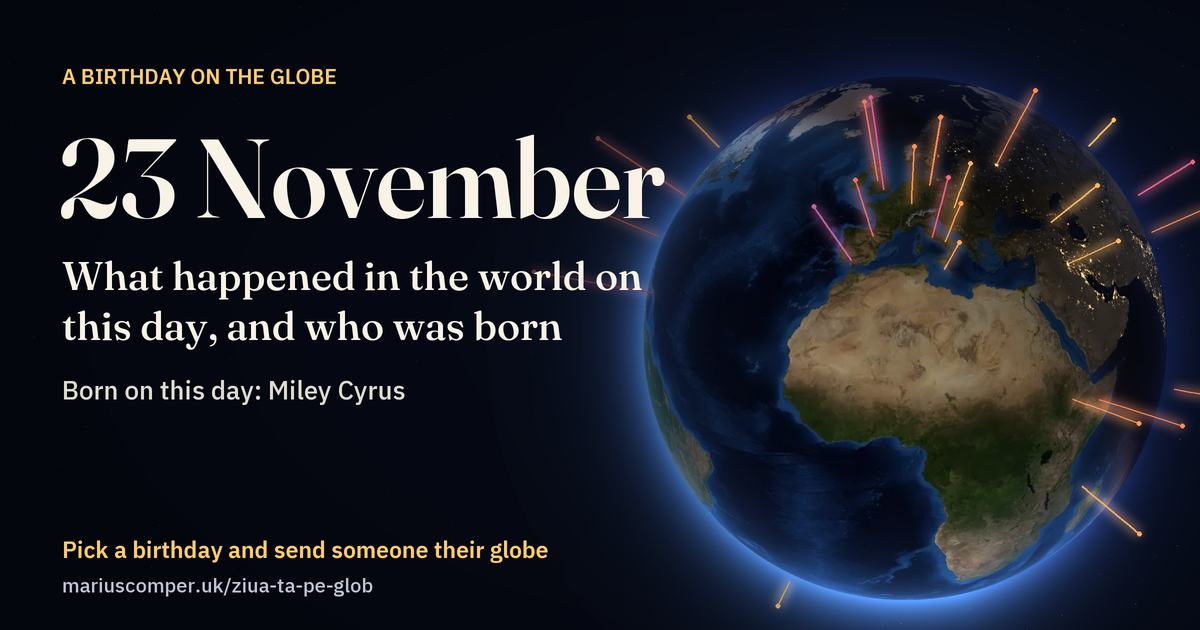
For 23 November, the English Wikipedia lists 52 events and 227 births. 28 of the events stand at their places as rays of light; two more are dashed circles, where the sentence links only to a country or a sea. The taller the ray, the longer ago it happened. The people born that day come further down, as blue points.
A birthday, yours or someone else’s:
Turn it into a greetingScroll: the globe turns to each place
The day you were born, on the globe.
Three things from your day
Scroll: your day first, then 23 November through the years
The Earth on 23 November
The picture on the globe was assembled by NASA from satellite photographs taken in November 2004: the snow, the ice and the green are those of the month.
On 23 November the Sun passes straight overhead at noon along the parallel of 20.3° south. In London, the day lasts about 8 hours 30 minutes.
Beyond 70° south the Sun no longer sets; beyond 70° north it no longer rises.
The line between day and night is tilted on the globe exactly as on this day of the year. On the dark side you can see the lights of towns.
Europe · Strasbourg
1959
French President Charles de Gaulle declares in a speech in Strasbourg his vision for "Europe, from the Atlantic to the Urals".
On the map: Strasbourg.
Also on the day’s list of Wikipedia in Chinese.
Europe · Budapest
2001
The Budapest Convention on Cybercrime is signed in Budapest, Hungary.
On the map: Budapest.
Also on the day’s list of Wikipedia in Spanish and Chinese.
Asia · Dutch pacification campaign on Formosa
1635
Dutch pacification campaign on Formosa: Soldiers from the Dutch East India Company razed the village of Mattau, now part of modern-day Tainan, Taiwan.
On the map: the coordinates Wikidata gives for the article “Dutch pacification campaign on Formosa”.
Also on the day’s list of Wikipedia in Chinese.
Asia · Cocos (Keeling) Islands
1955
The Cocos Islands are transferred from the control of the United Kingdom to that of Australia.
On the map: Cocos (Keeling) Islands.
Also on the day’s list of Wikipedia in Spanish.
Asia · Holy Trinity Cathedral of Tbilisi
2004
The Holy Trinity Cathedral of Tbilisi, the largest religious building in Georgia, is consecrated.
On the map: Holy Trinity Cathedral of Tbilisi.
North America · Las Vegas
1992
The first smartphone, the IBM Simon, is introduced at COMDEX in Las Vegas, Nevada.
On the map: Las Vegas.
Also on the day’s list of Wikipedia in Chinese.
23 November
What the other Wikipedias remember#
For these years the English list has nothing on this day. The events below come from the same day’s lists on Wikipedia in Spanish and were translated for this page.
From Wikipedia in Spanish · Madrid
1909
In Madrid, the Palace of Communications is inaugurated.
On the map: Madrid.
Translated from the list on Wikipedia in Spanish.
23 November
Born on 23 November#
The English Wikipedia lists 227 births for this day. The blue points are the birthplaces of 60 of these people: those written about in the most Wikipedia editions, where Wikidata gives a place of birth.
Born on 23 November
1992
Miley Cyrus, American singer-songwriter and actress
Place of birth: Franklin.
Born on 23 November
1837
Johannes Diderik van der Waals, Dutch physicist and thermodynamicist, Nobel Prize laureate (died 1923)
Place of birth: Leiden.
Born on 23 November
1926
Sathya Sai Baba, Indian guru and philosopher (died 2011)
Place of birth: Puttaparthi.
Born on 23 November
1920
Paul Celan, Romanian-French poet and translator (died 1970)
Place of birth: Chernivtsi.
Born on 23 November
1933
Krzysztof Penderecki, Polish composer and conductor (died 2020)
Place of birth: Dębica.
Born in Britain and Ireland
1887
Boris Karloff, English actor (died 1969)
Place of birth: Dulwich.
Born in Britain and Ireland
1887
Henry Moseley, English physicist and chemist (died 1915)
Place of birth: Weymouth.
Born in Britain and Ireland
1979
Kelly Brook, English model and actress
Place of birth: Rochester.
23 November
Number one in the charts that week
At the cinema
An animal recorded that day
The record can be seen in GBIF, which brings together wildlife records from around the world.
All your birthdays
The weather that day
Data: Met Office Hadley Centre (HadCET); NOAA (GHCN-Daily, Mauna Loa).
Above the Earth
Sources: Jonathan McDowell, GCAT (launches); GFZ Potsdam (Kp index). Days are counted in Universal Time.
Football that day
International matches played that day:
Source: the “International football results” dataset kept by Mart Jürisoo (CC0).
Also that day
The earthquake’s page at the USGS
Source: the USGS catalogue. The day is counted in Universal Time (UTC).
In those days
Make a link for someone
Type the name, pick the day and the year of birth. The link opens straight on their day, with their name in the greeting.
The link carries the name, date and place typed here; anyone who gets it can see them.
Put another birthday beside it
Your mother’s, your child’s, a friend’s: the two days appear side by side.
Below: 23 November through the years.
The whole globe of the day
Drag the globe to turn it. Touch a ray or a point to read what happened there.
Everything Wikipedia lists for 23 November
The list is the English Wikipedia’s, in its own wording, as it stood in October 2026. 22 events have no place on the map: the sentence links to no place with coordinates, only to places too wide to mark, or to several countries.
- 534 BC
Thespis of Icaria becomes the first recorded actor to portray a character on stage.
no place on the mapWikipedia: Thespis - 1248
Conquest of Seville by Christian troops under King Ferdinand III of Castile.
Europe · Siege of SevilleWikipedia: Siege of Seville - 1499
Seven days after being convicted of treason, Perkin Warbeck, a pretender to the throne of England, is hanged for attempting to escape from the Tower of London; his supporter John Atwater is executed with him.
Britain & Ireland · Tower of LondonWikipedia: Perkin Warbeck - 1635
Dutch pacification campaign on Formosa: Soldiers from the Dutch East India Company razed the village of Mattau, now part of modern-day Tainan, Taiwan.
Asia · Dutch pacification campaign on FormosaWikipedia: Dutch pacification campaign on Formosa - 1644
John Milton publishes Areopagitica, a pamphlet decrying censorship.
no place on the mapWikipedia: John Milton - 1700
A papal conclave, which had been deadlocked due to concerns over how a successor would respond to the impending death of Charles II of Spain, ended with the election of Clement XI.
Europe · 1700 conclaveWikipedia: 1700 conclave - 1733
The start of the 1733 slave insurrection on St. John in what was then the Danish West Indies.
Latin America · 1733 slave insurrection on St. JohnWikipedia: 1733 slave insurrection on St. John - 1808
French and Poles defeat the Spanish at Battle of Tudela.
Europe · Battle of TudelaWikipedia: Battle of Tudela - 1863
American Civil War: Battle of Chattanooga begins: Union forces led by General Ulysses S. Grant reinforce troops at Chattanooga, Tennessee, and counter-attack Confederate troops.
North America · Chattanooga campaignWikipedia: American Civil War - 1867
The Manchester Martyrs are hanged in Manchester, England, for killing a police officer while freeing two Irish Republican Brotherhood members from custody.
Britain & Ireland · Manchester MartyrsWikipedia: Manchester Martyrs - 1876
Corrupt Tammany Hall leader William Magear Tweed (better known as Boss Tweed) is delivered to authorities in New York City after being captured in Spain.
no place on the mapWikipedia: Tammany Hall - 1890
King William III of the Netherlands dies without a male heir and a special law is passed to allow his daughter Princess Wilhelmina to succeed him.
no place on the mapWikipedia: William III of the Netherlands - 1910
Johan Alfred Ander becomes the last person to be executed in Sweden.
no place on the mapWikipedia: Capital punishment in Sweden - 1914
Mexican Revolution: The last of U.S. forces withdraw from Veracruz, occupied seven months earlier in response to the Tampico Affair.
Latin America · Battle of VeracruzWikipedia: Battle of Veracruz - 1921
Warren G. Harding, 29th President of the United States, signs the Willis–Campbell Act into law, prohibiting doctors from prescribing beer or liquor for medicinal purposes.
no place on the mapWikipedia: Warren G. Harding - 1923
Thousands of Irish Republicans end the 1923 Irish hunger strikes, five die from starvation.
no place on the mapWikipedia: 1923 Irish hunger strikes - 1924
Edwin Hubble's discovery, that the Andromeda "nebula" is actually another island galaxy far outside our own Milky Way, is first published in The New York Times.
no place on the mapWikipedia: Edwin Hubble - 1934
An Anglo-Ethiopian boundary commission in the Ogaden discovers an Italian garrison at Walwal, well within Ethiopian territory. This leads to the Abyssinia Crisis.
Africa · WalwalWikipedia: Ogaden - 1939
World War II: HMS Rawalpindi is sunk by the German battleships Scharnhorst and Gneisenau.
no place on the mapWikipedia: World War II - 1940
World War II: Romania becomes a signatory of the Tripartite Pact, officially joining the Axis powers.
Europe · BerlinWikipedia: Tripartite Pact - 1943
World War II: Tarawa and Makin atolls fall to American forces.
Oceania · TarawaWikipedia: Tarawa - 1943
World War II: The Deutsche Opernhaus on Bismarckstraße in the Berlin neighborhood of Charlottenburg is destroyed. It will eventually be rebuilt in 1961 and be called the Deutsche Oper Berlin.
Europe · Deutsche Oper BerlinWikipedia: Deutsche Oper Berlin - 1944
World War II: The Lotta Svärd Movement is disbanded under the terms of the armistice treaty in Finland after the Continuation War.
Europe · MoscowWikipedia: Moscow Armistice - 1946
French naval bombardment of Hai Phong, Vietnam, kills thousands of civilians.
Asia · HaiphongWikipedia: Haiphong - 1955
The Cocos Islands are transferred from the control of the United Kingdom to that of Australia.
Asia · Cocos (Keeling) IslandsWikipedia: Cocos (Keeling) Islands - 1959
French President Charles de Gaulle declares in a speech in Strasbourg his vision for "Europe, from the Atlantic to the Urals".
Europe · StrasbourgWikipedia: European integration - 1963
The first episode of Doctor Who ("An Unearthly Child") is broadcast by the BBC, which is now the world's longest running science fiction drama.
no place on the mapWikipedia: Doctor Who - 1971
Representatives of the People's Republic of China attend the United Nations, including the United Nations Security Council, for the first time.
no place on the mapWikipedia: China and the United Nations - 1972
The Soviet Union makes its final attempt at launching the N1 rocket.
no place on the mapWikipedia: N1 - 1974
Sixty Ethiopian politicians, aristocrats, military officers, and other persons are executed by the provisional military government.
Africa · Alem BekagnWikipedia: Massacre of the Sixty - 1976
Jacques Mayol is the first man to reach a depth of 100 m (330 ft) undersea without breathing equipment.
no place on the mapWikipedia: Jacques Mayol - 1978
Cyclone kills about 1,000 people in eastern Sri Lanka.
no place on the mapWikipedia: 1978 Sri Lanka cyclone - 1978
The Geneva Frequency Plan of 1975 goes into effect, realigning many of Europe's longwave and mediumwave broadcasting frequencies.
no place on the mapWikipedia: Geneva Frequency Plan of 1975 - 1980
The 6.9 Mw Irpinia earthquake shakes southern Italy with a maximum Mercalli intensity of X (Extreme), killing 2,483–4,900, and injuring 7,700–8,934.
Europe · 1980 Irpinia earthquakeWikipedia: 1980 Irpinia earthquake - 1981
Iran–Contra affair: Ronald Reagan signs the top secret National Security Decision Directive 17 (NSDD-17), giving the Central Intelligence Agency the authority to recruit and support Contra rebels in Nicaragua.
Latin America · NicaraguaWikipedia: Iran–Contra affair - 1985
Gunmen hijack EgyptAir Flight 648 en route from Athens to Cairo. When the plane lands in Malta, Egyptian commandos storm the aircraft, but 60 people die in the raid.
Europe · EgyptAir Flight 648Wikipedia: EgyptAir Flight 648 - 1991
Queen lead singer Freddie Mercury announces in a statement that he is HIV-positive. He dies the following day.
no place on the mapWikipedia: Queen - 1992
The first smartphone, the IBM Simon, is introduced at COMDEX in Las Vegas, Nevada.
North America · Las VegasWikipedia: COMDEX - 1996
Ethiopian Airlines Flight 961 is hijacked, then crashes into the Indian Ocean off the coast of Comoros after running out of fuel, killing 125.
Africa · Ethiopian Airlines Flight 961Wikipedia: Ethiopian Airlines Flight 961 - 2001
The Budapest Convention on Cybercrime is signed in Budapest, Hungary.
Europe · BudapestWikipedia: Budapest Convention on Cybercrime - 2002
Space Shuttle Endeavour launches on STS-113 to the International Space Station carrying the Expedition 6 crew and the P1 truss.
no place on the mapWikipedia: Space Shuttle Endeavour - 2003
Rose Revolution: Georgian president Eduard Shevardnadze resigns following weeks of mass protests over flawed elections.
Asia · GeorgiaWikipedia: Rose Revolution - 2004
The Holy Trinity Cathedral of Tbilisi, the largest religious building in Georgia, is consecrated.
Asia · Holy Trinity Cathedral of TbilisiWikipedia: Holy Trinity Cathedral of Tbilisi - 2005
Ellen Johnson Sirleaf is elected president of Liberia and becomes the first woman to lead an African country.
no place on the mapWikipedia: 2005 Liberian general election - 2006
A series of bombings kills at least 215 people and injures 257 others in Sadr City, making it the second deadliest sectarian attack since the beginning of the Iraq War in 2003.
Asia · 23 November 2006 Sadr City bombingsWikipedia: 23 November 2006 Sadr City bombings - 2007
MS Explorer, a cruise liner carrying 154 people, sinks in the Antarctic Ocean south of Argentina after hitting an iceberg near the South Shetland Islands. There are no fatalities.
Oceans · South Shetland IslandsWikipedia: South Shetland Islands - 2009
The Maguindanao massacre occurs in Ampatuan, Philippines; 58 opponents of Andal Ampatuan Jr. are kidnapped and killed.
Asia · Maguindanao massacreWikipedia: Maguindanao massacre - 2010
Bombardment of Yeonpyeong: North Korean artillery attack kills two civilians and two marines on Yeonpyeong Island, South Korea.
Asia · 2010 Yeonpyeongdo bombardmentWikipedia: 2010 Yeonpyeongdo bombardment - 2011
Arab Spring: After 11 months of protests in Yemen, Yemeni president Ali Abdullah Saleh signs a deal to transfer power to the vice president, in exchange for legal immunity.
no place on the mapWikipedia: Arab Spring - 2015
Blue Origin's New Shepard space vehicle became the first rocket to successfully fly to space and then return to Earth for a controlled, vertical landing.
no place on the mapWikipedia: Blue Origin - 2018
Founders of Italian fashion brand Dolce & Gabbana issue an apology following a series of offensive advertisements on social media promoting a fashion show in Shanghai, China, which was canceled.
no place on the mapWikipedia: Dolce & Gabbana - 2019
The last Sumatran rhinoceros in Malaysia, Imam, dies, making the species officially extinct in the country.
no place on the mapWikipedia: Sumatran rhinoceros
What the other Wikipedias remember
For these years the English list has nothing on this day. The events below come from the same day’s lists on Wikipedia in Spanish and were translated for this page.
- 1909
In Madrid, the Palace of Communications is inaugurated.
Who was born on 23 November
In order of how many Wikipedia editions have an article about each. The first 60 of 227 are shown.
- 1962
Nicolás Maduro, Venezuelan union leader and politician, President of Venezuela
CaracasWikipedia: Nicolás Maduro - 1992
Miley Cyrus, American singer-songwriter and actress
FranklinWikipedia: Miley Cyrus - 1804
Franklin Pierce, American general, lawyer, and politician, 14th President of the United States (died 1869)
HillsboroughWikipedia: Franklin Pierce - 1837
Johannes Diderik van der Waals, Dutch physicist and thermodynamicist, Nobel Prize laureate (died 1923)
- 912
Otto I, Holy Roman Emperor (died 973)
WallhausenWikipedia: Otto the Great - 1221
Alfonso X of Castile (died 1284)
- 1190
Pope Clement IV (died 1268)
Saint-GillesWikipedia: Pope Clement IV - 1926
Sathya Sai Baba, Indian guru and philosopher (died 2011)
PuttaparthiWikipedia: Sathya Sai Baba - 1860
Hjalmar Branting, Swedish journalist and politician, 16th Prime Minister of Sweden, Nobel Prize laureate (died 1925)
Klara Church ParishWikipedia: Hjalmar Branting - 1875
Anatoly Lunacharsky, Russian journalist and politician (died 1933)
- 1920
Paul Celan, Romanian-French poet and translator (died 1970)
ChernivtsiWikipedia: Paul Celan - 1950
Charles Schumer, American lawyer and politician
New York CityWikipedia: Chuck Schumer - 1896
Klement Gottwald, Czechoslovak politician, President of the Czechoslovak Socialist Republic (died 1953)
- 1933
Krzysztof Penderecki, Polish composer and conductor (died 2020)
- 1966
Vincent Cassel, French actor and producer
15th arrondissement of ParisWikipedia: Vincent Cassel - 1887
Boris Karloff, English actor (died 1969)
DulwichWikipedia: Boris Karloff - 1760
François-Noël Babeuf, French journalist and activist (died 1797)
Saint-QuentinWikipedia: François-Noël Babeuf - 1876
Manuel de Falla, Spanish pianist and composer (died 1946)
- 1496
Clément Marot, French poet (died 1544)
CahorsWikipedia: Clément Marot - 1887
Henry Moseley, English physicist and chemist (died 1915)
WeymouthWikipedia: Henry Moseley - 1941
Franco Nero, Italian actor and producer
San Prospero ParmenseWikipedia: Franco Nero - 1982
Asafa Powell, Jamaican sprinter
Spanish TownWikipedia: Asafa Powell - 1890
El Lissitzky, Russian photographer and architect (died 1941)
PochinokWikipedia: El Lissitzky - 1933
Ali Shariati, Iranian sociologist and activist (died 1977)
MazinanWikipedia: Ali Shariati - 1916
Michael Gough, Malaysian-English actor (died 2011)
Kuala LumpurWikipedia: Michael Gough - 1971
Chris Hardwick, American comedian, actor, producer, and television host
LouisvilleWikipedia: Chris Hardwick - 1883
José Clemente Orozco, Mexican painter (died 1949)
Ciudad GuzmánWikipedia: José Clemente Orozco - 1979
Kelly Brook, English model and actress
RochesterWikipedia: Kelly Brook - 1906
Betti Alver, Estonian author and poet (died 1989)
JõgevaWikipedia: Betti Alver - 870
Alexander, Byzantine emperor (died 913)
ConstantinopleWikipedia: Alexander - 1955
Ludovico Einaudi, Italian pianist and composer
- 1888
Harpo Marx, American comedian and musician (died 1964)
New York CityWikipedia: Harpo Marx - 1996
James Maddison, English footballer
CoventryWikipedia: James Maddison - 1927
Angelo Sodano, Italian cardinal (died 2022)
Isola d'AstiWikipedia: Angelo Sodano - 1985
Viktor An, South Korean speed skater
SeoulWikipedia: Viktor An - 1979
Ivica Kostelić, Croatian skier
- 1984
Lucas Grabeel, American actor, singer, and songwriter
SpringfieldWikipedia: Lucas Grabeel - 1991
Christian Cueva, Peruvian footballer
TrujilloWikipedia: Christian Cueva - 1907
Run Run Shaw, Chinese-Hong Kong businessman and philanthropist, founded Shaw Brothers Studio and TVB (died 2014)
NingboWikipedia: Run Run Shaw - 1935
Vladislav Volkov, Russian engineer and astronaut (died 1971)
- 1998
Caoimhín Kelleher, Irish footballer
- 1922
Manuel Fraga Iribarne, Spanish politician, 3rd President of the Xunta of Galicia (died 2012)
VilalbaWikipedia: Manuel Fraga - 1632
Jean Mabillon, French monk and scholar (died 1707)
Saint-PierremontWikipedia: Jean Mabillon - 1897
Karl Gebhardt, German physician and war criminal (died 1948)
Haag in OberbayernWikipedia: Karl Gebhardt - 1970
Oded Fehr, Israeli-American actor
Tel AvivWikipedia: Oded Fehr - 1963
Gwynne Shotwell, American businesswoman, President and Chief Operating Officer of SpaceX
EvanstonWikipedia: Gwynne Shotwell - 1999
Boubacar Kamara, French footballer
MarseilleWikipedia: Boubacar Kamara - 1932
Renato Martino, Italian Roman Catholic cardinal (died 2024)
SalernoWikipedia: Renato Martino - 1934
Robert Towne, American actor, director, and screenwriter (died 2024)
Los AngelesWikipedia: Robert Towne - 1953
Francis Cabrel, French singer-songwriter and guitarist
- 1972
Alf-Inge Haaland, Norwegian footballer
StavangerWikipedia: Alf-Inge Haaland - 1991
Willian José, Brazilian footballer
Porto CalvoWikipedia: Willian José - 1869
Valdemar Poulsen, Danish engineer (died 1942)
CopenhagenWikipedia: Valdemar Poulsen - 1925
José Napoleón Duarte, Salvadoran engineer and politician, President of El Salvador (died 1990)
Santa AnaWikipedia: José Napoleón Duarte - 1955
Mary Landrieu, American politician
Arlington CountyWikipedia: Mary Landrieu - 1934
Lew Hoad, Australian tennis player (died 1994)
GlebeWikipedia: Lew Hoad - 1956
Shane Gould, Australian swimmer and coach
SydneyWikipedia: Shane Gould - 1967
Salli Richardson, American actress, director, and producer
- 1974
Saku Koivu, Finnish ice hockey player
- 1922
Võ Văn Kiệt, Vietnamese soldier and politician, 6th Prime Minister of Vietnam (died 2008)
Vĩnh LongWikipedia: Võ Văn Kiệt
What is celebrated on 23 November
- Christian feast day: Alexander Nevsky (Repose, Russian Orthodox Church)
- Christian feast day: Blessed Miguel Agustín Pro – one of Saints of the Cristero War (Roman Catholic Church and the Lutheran Church)
- Christian feast day: Columbanus
- Christian feast day: Felicitas of Rome
- Christian feast day: Paulinus of Wales
- Christian feast day: Pope Clement I (Roman Catholic Church, the Anglican Communion, and the Lutheran Church)
- Christian feast day: Trudo (or Trond)
- Christian feast day: Wilfetrudis (or Vulfetrude)
- Christian feast day: November 23 (Eastern Orthodox liturgics)
- Labor Thanksgiving Day (Japan)
- Repudiation Day (Frederick County, Maryland, United States)
- St George's Day (Georgia) or Giorgoba (Georgia)
A greeting link for someone
Type a name and, if you like, the year of birth. The link opens with a greeting, and beside each event it says how old the person turned that day, or how many years before their birth it happened.
The name and the year go only into the link you send.
All 366 days
How the globe is made
Where the events come from
Each edition of this page uses the day’s list from Wikipedia in its own language: Romanian, English, Spanish, Chinese. The lists are written by volunteers and differ from one edition to the next; the text of each event is Wikipedia’s, with a link to the article. A row that appears twice in a list is shown once. The lists have not been checked event by event: they are Wikipedia’s, mistakes included.
For events before 1582, and for countries that moved to the Gregorian calendar later (Britain in 1752, Russia in 1918), the same day may be counted Old Style in one list and New Style in another.
The chapter “What the other Wikipedias remember” adds up to five events a day from the lists of the other three editions, only for years in which the English list has nothing on that day. They were translated for this page, passed the same filters as the tour, and are not counted among the events of the English list.
How an event gets onto the map
The place comes from Wikidata. If the sentence links to the article about the event itself (a battle, an opening, an earthquake), dated to the same year, the ray stands on its coordinates or on those of its location. Otherwise it stands on the first place the sentence links to: a town, a building, a mountain, an island. This second step can be wrong: sometimes the sentence only mentions the place. That is why the page says, under each event, which place the ray stands on.
When the sentence links to a single state or province, or to a single sea, lake or desert larger than 5,000 km², the globe shows a dashed circle, not a ray. The circle has the area Wikidata gives, with its radius kept between 1.2° and 16°, or a radius of 4.5° when Wikidata gives no area; it says only that the sentence links to that place. Organisations, ships, spacecraft, museum objects, rivers, mountain ranges, languages and continents are never used as places. When a sentence names several states and no exact place, the event stays in the list only.
What the height means
The height of a ray shows how many years have passed, on a logarithmic scale: 10 years, 100 years and 1,000 years are equal steps apart; anything older than about 2,600 years has the tallest ray. The colour runs from pale yellow for recent years to violet for antiquity.
Where the tour stops
In each region the tour stops at up to three events (five in Britain and Ireland), chosen mainly by three things: whether Wikipedia’s editors put the event in the “On this day” box of their main page (the English, Spanish and Chinese editions), how many Wikipedia editions have an article about it, and how many of the four lists include it. Events whose sentence or article is about a war, an attack, a crime or a disaster are left out of the tour; they stay in the whole list, in Wikipedia’s wording. The filter is a list of words and a list of Wikidata types, so it can miss some.
The tour of births names the people with articles in the most editions and leaves aside those whom the list or Wikidata describes as rulers, politicians, commanders, leaders of movements or criminals; they stay in the list.
The Earth and the Sun
The daytime images are NASA’s Blue Marble Next Generation mosaics, one for each month of 2004; the night side is Black Marble 2016. The tilt of the line between day and night is computed for the day; the hour is chosen so that the place being read is in daylight. The latitude where the Sun stands overhead is the average of the four years of the leap cycle; in a given year it can differ by up to 0.4°.
The day you were born
The number ones come from the weekly lists on Wikipedia: Billboard for the United States (from 1940; the Hot 100 from August 1958), the UK Singles Chart (from November 1952), Los 40 Principales for Spain (from July 1966) and, for Romania, the Romanian Top 100 and Airplay 100 (2001–2021, with missing weeks). The page shows the chart of the week in which the day of birth falls, with its date; Billboard and the UK chart are dated at the end of their week. For Romania before 2001 and for China these sources have no weekly chart.
The films are those that reached cinemas in the United States up to ten days before or three days after that day (some of them in a few cinemas at first), from the English Wikipedia’s yearly lists (from 1968), in order of how many editions have an article about them. The events “in those days” are the ones on the neighbouring days’ lists that carry the year of birth, passed through the same filter as the tour.
The day of birth, year included
The Moon, the star sign and the constellation are worked out by the page itself, for noon Universal Time on the day. The lit part of the Moon is rounded and can differ by a few per cent from that at the hour of birth. The sign follows the usual zodiac of twelve equal parts starting at the March equinox; the constellation is the one the Sun actually stood in front of, by the borders set by the International Astronomical Union, and within a day of a border the page does not name it. When the Sun changes sign while it is that day anywhere on Earth, the page gives the moment of crossing, rounded to ten minutes and accurate to within about a quarter of an hour, and the clock time in a few cities, with the time zone and summer time of that year.
The year in the Chinese calendar is the one your device’s own calendar gives for the date, checked against the Hong Kong Observatory’s tables. “All your birthdays” uses the same sources as the rest of the chapter for the same day in every year since the birth: the temperature, well-known launches that took place on that very day, matches of the teams the edition follows, snow deeper than 10 cm and strong geomagnetic storms. The three things at the top and the four on the picture are chosen in a fixed order (the song, the animal, a full Moon, a well-known launch before an ordinary earthquake); on the picture you can change them.
When the link carries a year of birth, the page adds a few things about that exact day. The weather is the Met Office’s Central England temperature record and the readings from New York’s Central Park; the “usual high” is the average of the daily highs of 1961–1990 for that date, with two days either side. The carbon dioxide figure is the monthly mean at the Mauna Loa observatory, where measurements begin in March 1958.
The earthquake is the one with the largest magnitude in the USGS catalogue for that day, counted in Universal Time. Before the 1960s the catalogue has gaps even above magnitude 5.5, so in the older years many days have no earthquake. The page gives only the magnitude and the place: the country the epicentre falls in or, when the epicentre is at sea within 300 km of a coast, the nearest country; farther out, only the ocean.
The launches are those that reached orbit or left for the Moon and the planets, from Jonathan McDowell’s GCAT catalogue. If nothing left that day, the page shows the nearest launch within three days before or after, and says how many days away it was. The geomagnetic storm appears only when the Kp index reached at least 5 in one of the day’s eight three-hour intervals.
The animal comes from GBIF: an observation made by a person (the animal seen or heard, or its tracks), dated to that exact day, with coordinates and a CC0 or CC BY licence. Only a few hundred well-known species are searched (mammals, birds, turtles, butterflies); of those noted that day, mammals and species with articles in many Wikipedia editions come first; birds noted almost every day, and species used recently, wait their turn. Observations dated 1 January are left out, because records without a day are often filed there. An observation shows that the animal was recorded there, not how many animals there were.
The matches are those between national teams. Only matches of England, Scotland, Wales, Northern Ireland, the Republic of Ireland, the United States, Canada and Australia are shown, along with those at the big final tournaments. The picture to send is drawn in the page from the day’s globe and the facts above, and stays on your device until you send it.
Sources
- Events, births and holidays: the day’s page on Wikipedia, text under CC BY-SA 4.0.
- Coordinates, places of birth and the number of editions: Wikidata (CC0).
- The Earth by day: NASA Blue Marble Next Generation. The Earth by night: NASA Black Marble 2016.
- Borders and regions: Natural Earth.
- World population and births per year: UN World Population Prospects 2024.
- Charts and films: Wikipedia’s lists for Billboard, the UK Singles Chart, Los 40 Principales, Romanian Top 100, Airplay 100 and American films by year (CC BY-SA 4.0).
- Weather: Met Office Hadley Centre, HadCET (Open Government Licence) and NOAA GHCN-Daily, New York Central Park. Carbon dioxide: NOAA Global Monitoring Laboratory, Mauna Loa.
- Earthquakes: the USGS catalogue. Launches: Jonathan McDowell, GCAT (CC BY). Kp index: GFZ Potsdam (CC BY 4.0). Matches: International football results, Mart Jürisoo (CC0).
- Animal observations: GBIF, with a link to each record; species names come from Wikidata.