A birthday on the globe
24 April on the globe: what happened in the world on this day, and who was born
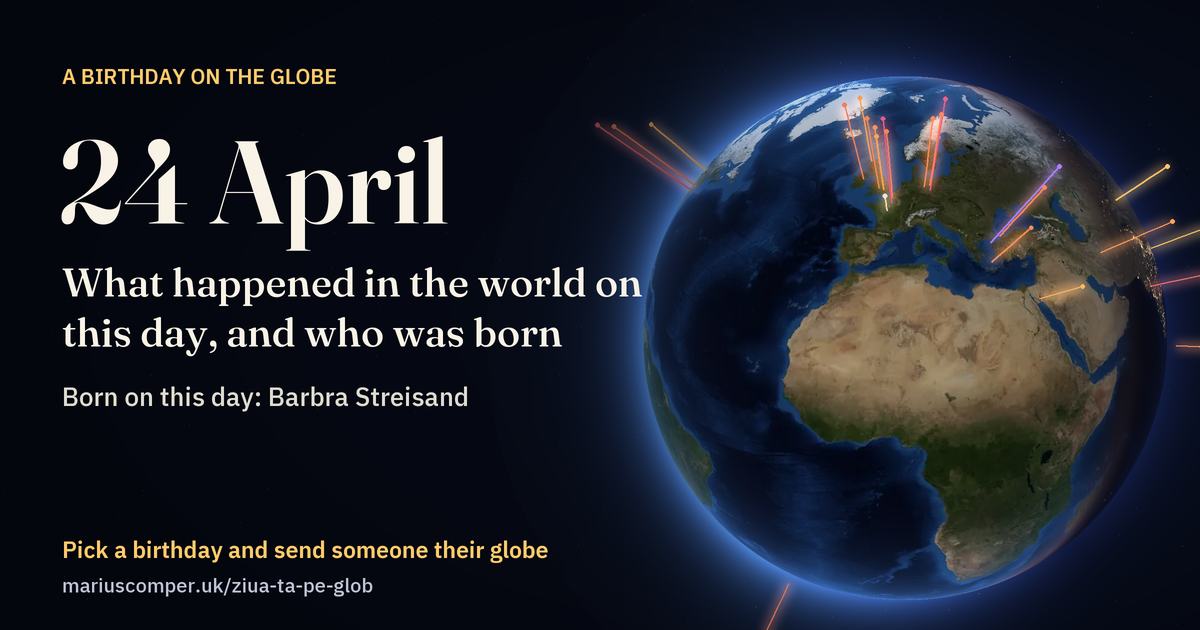
For 24 April, the English Wikipedia lists 50 events and 206 births. 25 of the events stand at their places as rays of light; seven more are dashed circles, where the sentence links only to a country or a sea. The taller the ray, the longer ago it happened. The people born that day come further down, as blue points.
A birthday, yours or someone else’s:
Turn it into a greetingScroll: the globe turns to each place
The day you were born, on the globe.
Three things from your day
Scroll: your day first, then 24 April through the years
The Earth on 24 April
The picture on the globe was assembled by NASA from satellite photographs taken in April 2004: the snow, the ice and the green are those of the month.
On 24 April the Sun passes straight overhead at noon along the parallel of 13.0° north. In London, the day lasts about 14 hours 25 minutes.
Beyond 77° north the Sun no longer sets; beyond 77° south it no longer rises.
The line between day and night is tilted on the globe exactly as on this day of the year. On the dark side you can see the lights of towns.
Britain & Ireland · Leafield Technical Centre
1922
The first segment of the Imperial Wireless Chain providing wireless telegraphy between Leafield in Oxfordshire, England, and Cairo, Egypt, comes into operation.
On the map: Leafield Technical Centre.
Britain & Ireland · Westminster Abbey
1963
Marriage of Princess Alexandra of Kent to Angus Ogilvy at Westminster Abbey in London.
On the map: Westminster Abbey.
Britain & Ireland · Gruinard Island
1990
Gruinard Island, Scotland, is officially declared free of the anthrax disease after 48 years of quarantine.
On the map: Gruinard Island.
Europe · Notre-Dame de Paris
1558
Mary, Queen of Scots, marries the Dauphin of France, François, at Notre-Dame de Paris.
On the map: Notre-Dame de Paris.
Also on the day’s list of Wikipedia in Spanish and Romanian.
Wikipedia: Wedding of Mary, Queen of Scots, and Francis, Dauphin of France
North America · Library of Congress
1800
The United States Library of Congress is established when President John Adams signs legislation to appropriate $5,000 to purchase "such books as may be necessary for the use of Congress".
On the map: Library of Congress.
Also on the day’s list of Wikipedia in Spanish and Romanian.
North America · Woolworth Building
1913
The Woolworth Building, a skyscraper in New York City, is opened.
On the map: Woolworth Building.
Also on the day’s list of Wikipedia in Spanish.
24 April
What the other Wikipedias remember#
For these years the English list has nothing on this day. The events below come from the same day’s lists on Wikipedia in Spanish and were translated for this page.
From Wikipedia in Spanish · Troy
1184 BC
In what is now Turkey, according to legend, the Greeks enter the city of Troy using the trick of the Trojan Horse.
On the map: Troy.
Translated from the list on Wikipedia in Spanish.
24 April
Born on 24 April#
The English Wikipedia lists 206 births for this day. The blue points are the birthplaces of 59 of these people: those written about in the most Wikipedia editions, where Wikidata gives a place of birth.
Born on 24 April
1942
Barbra Streisand, American singer, actress, activist, and producer
Place of birth: Brooklyn.
Born on 24 April
1934
Shirley MacLaine, American actress, singer, and dancer
Place of birth: Richmond.
Born on 24 April
1845
Carl Spitteler, Swiss poet and author, Nobel Prize laureate (died 1924)
Place of birth: Liestal.
Born on 24 April
1982
Kelly Clarkson, American singer-songwriter, talk show host
Place of birth: Burleson.
Born on 24 April
1973
Sachin Tendulkar, Indian cricketer
Place of birth: Mumbai.
Born in Britain and Ireland
1815
Anthony Trollope, English novelist, essayist, and short story writer (died 1882)
Place of birth: London.
Born in Britain and Ireland
1968
Aidan Gillen, Irish actor
Place of birth: Dublin.
Born in Britain and Ireland
1993
Ben Davies, Welsh international footballer
Place of birth: Neath.
24 April
Number one in the charts that week
At the cinema
An animal recorded that day
The record can be seen in GBIF, which brings together wildlife records from around the world.
All your birthdays
The weather that day
Data: Met Office Hadley Centre (HadCET); NOAA (GHCN-Daily, Mauna Loa).
Above the Earth
Sources: Jonathan McDowell, GCAT (launches); GFZ Potsdam (Kp index). Days are counted in Universal Time.
Football that day
International matches played that day:
Source: the “International football results” dataset kept by Mart Jürisoo (CC0).
Also that day
The earthquake’s page at the USGS
Source: the USGS catalogue. The day is counted in Universal Time (UTC).
In those days
Make a link for someone
Type the name, pick the day and the year of birth. The link opens straight on their day, with their name in the greeting.
The link carries the name, date and place typed here; anyone who gets it can see them.
Put another birthday beside it
Your mother’s, your child’s, a friend’s: the two days appear side by side.
Below: 24 April through the years.
The whole globe of the day
Drag the globe to turn it. Touch a ray or a point to read what happened there.
Everything Wikipedia lists for 24 April
The list is the English Wikipedia’s, in its own wording, as it stood in October 2026. 18 events have no place on the map: the sentence links to no place with coordinates, only to places too wide to mark, or to several countries.
- 1479 BC
Thutmose III ascends to the throne of Egypt, although power effectively shifts to Hatshepsut (according to the Low Chronology of the 18th dynasty).
Africa · Ancient EgyptWikipedia: Thutmose III - 1183 BC
Traditional reckoning of the Fall of Troy marking the end of the legendary Trojan War, given by chief librarian of the Library of Alexandria Eratosthenes, among others.
Asia · TroyWikipedia: Troy - 858
Consecration of Pope Nicholas I following the death of Pope Benedict III earlier that month.
no place on the mapWikipedia: Pope Nicholas I - 934
Abbasid Caliph Al-Qahir is deposed and blinded. His nephew al-Radi succeeds him as caliph.
no place on the mapWikipedia: List of Abbasid caliphs - 1547
Battle of Mühlberg. Duke of Alba, commanding Spanish-Imperial forces of Charles I of Spain, defeats the troops of Schmalkaldic League.
Europe · Battle of MühlbergWikipedia: Battle of Mühlberg - 1558
Mary, Queen of Scots, marries the Dauphin of France, François, at Notre-Dame de Paris.
Europe · Notre-Dame de ParisWikipedia: Wedding of Mary, Queen of Scots, and Francis, Dauphin of France - 1704
The first regular newspaper in British Colonial America, The Boston News-Letter, is published.
North America · Thirteen ColoniesWikipedia: Thirteen Colonies - 1793
French revolutionary Jean-Paul Marat is acquitted by the Revolutionary Tribunal of charges brought by the Girondin in Paris.
no place on the mapWikipedia: Jean-Paul Marat - 1800
The United States Library of Congress is established when President John Adams signs legislation to appropriate $5,000 to purchase "such books as may be necessary for the use of Congress".
North America · Library of CongressWikipedia: Library of Congress - 1837
The great fire in Surat, India causes more than 500 deaths and destruction of more than 9,000 houses.
Asia · 1837 Surat fireWikipedia: 1837 Surat fire - 1866
German composer Max Bruch conducted the premiere of his first violin concerto.
no place on the mapWikipedia: Max Bruch - 1877
Russo-Turkish War: The Russian Empire declares war on the Ottoman Empire.
no place on the mapWikipedia: Russo-Turkish War - 1885
American sharpshooter Annie Oakley is hired by Nate Salsbury to be a part of Buffalo Bill's Wild West.
no place on the mapWikipedia: Sharpshooter - 1895
Joshua Slocum, the first person to sail single-handedly around the world, sets sail from Boston, Massachusetts aboard the sloop Spray.
no place on the mapWikipedia: Joshua Slocum - 1904
Realizing that the Russification of Lithuania was not working, the Russian Empire lifted the 40-year-old ban on publications written in Lithuanian language using the Latin alphabet.
Asia · Russian EmpireWikipedia: Russification - 1913
The Woolworth Building, a skyscraper in New York City, is opened.
North America · Woolworth BuildingWikipedia: Woolworth Building - 1914
The Franck–Hertz experiment, a pillar of quantum mechanics, is presented to the German Physical Society.
no place on the mapWikipedia: Franck–Hertz experiment - 1915
The arrest of 250 Armenian intellectuals and community leaders in Istanbul marks the beginning of the Armenian genocide.
- 1916
Easter Rising: Irish rebels, led by Patrick Pearse and James Connolly, launch an uprising in Dublin against British rule and proclaim an Irish Republic.
Britain & Ireland · County MeathWikipedia: Easter Rising - 1916
Ernest Shackleton and five men of the Imperial Trans-Antarctic Expedition launch a lifeboat from uninhabited Elephant Island in the Southern Ocean to organise a rescue for the crew of the sunken Endurance.
Oceans · Elephant IslandWikipedia: Imperial Trans-Antarctic Expedition - 1918
World War I: First tank-to-tank combat, during the second Battle of Villers-Bretonneux. Three British Mark IVs meet three German A7Vs.
Europe · Second Battle of Villers-BretonneuxWikipedia: World War I - 1922
The first segment of the Imperial Wireless Chain providing wireless telegraphy between Leafield in Oxfordshire, England, and Cairo, Egypt, comes into operation.
Britain & Ireland · Leafield Technical CentreWikipedia: Imperial Wireless Chain - 1924
Thorvald Stauning becomes premier of Denmark (first term).
Europe · DenmarkWikipedia: Thorvald Stauning - 1926
The Treaty of Berlin is signed. Germany and the Soviet Union each pledge neutrality in the event of an attack on the other by a third party for the next five years.
Europe · BerlinWikipedia: Treaty of Berlin - 1932
Benny Rothman leads the mass trespass of Kinder Scout, leading to substantial legal reforms in the United Kingdom.
no place on the mapWikipedia: Benny Rothman - 1933
Nazi Germany begins its persecution of Jehovah's Witnesses by shutting down the Watch Tower Society office in Magdeburg.
Europe · MagdeburgWikipedia: Nazi Germany - 1944
World War II: The SBS launches a raid against the garrison of Santorini in Greece.
Europe · Raid on SantoriniWikipedia: Raid on Santorini - 1953
Winston Churchill is knighted by Queen Elizabeth II.
no place on the mapWikipedia: Winston Churchill - 1955
The Bandung Conference ends: Twenty-nine non-aligned nations of Asia and Africa finish a meeting that condemns colonialism, racism, and the Cold War.
Asia · Bandung ConferenceWikipedia: Bandung Conference - 1957
Suez Crisis: The Suez Canal is reopened following the introduction of UNEF peacekeepers to the region.
Africa · Sinai PeninsulaWikipedia: Suez Crisis - 1963
Marriage of Princess Alexandra of Kent to Angus Ogilvy at Westminster Abbey in London.
Britain & Ireland · Westminster AbbeyWikipedia: Princess Alexandra of Kent - 1965
Civil war breaks out in the Dominican Republic when Colonel Francisco Caamaño overthrows the triumvirate that had been in power since the coup d'état against Juan Bosch.
Latin America · Dominican RepublicWikipedia: Dominican Civil War - 1967
Cosmonaut Vladimir Komarov dies in Soyuz 1 when its parachute fails to open. He is the first human to die during a space mission.
no place on the mapWikipedia: Astronaut - 1967
Vietnam War: American General William Westmoreland says in a news conference that the enemy had "gained support in the United States that gives him hope that he can win politically that which he cannot win militarily".
no place on the mapWikipedia: Vietnam War - 1970
China launches Dong Fang Hong I, becoming the fifth nation to put an object into orbit using its own booster.
no place on the mapWikipedia: Dong Fang Hong 1 - 1970
The Gambia becomes a republic within the Commonwealth of Nations, with Dawda Jawara as its first President.
Africa · The GambiaWikipedia: The Gambia - 1980
Eight U.S. servicemen die in Operation Eagle Claw as they attempt to end the Iran hostage crisis.
Asia · Operation Eagle ClawWikipedia: Iran hostage crisis - 1990
Gruinard Island, Scotland, is officially declared free of the anthrax disease after 48 years of quarantine.
Britain & Ireland · Gruinard IslandWikipedia: Gruinard Island - 1990
STS-31: The Hubble Space Telescope is launched from the Space Shuttle Discovery.
no place on the mapWikipedia: STS-31 - 1993
An IRA bomb devastates the Bishopsgate area of London.
Britain & Ireland · 1993 Bishopsgate bombingWikipedia: 1993 Bishopsgate bombing - 1994
A Douglas DC-3 ditches in Botany Bay after takeoff from Sydney Airport. All 25 people on board survive.
Oceania · 1994 South Pacific Airmotive DC-3 crashWikipedia: 1994 South Pacific Airmotive DC-3 crash - 1996
In the United States, the Antiterrorism and Effective Death Penalty Act of 1996 is passed into law.
no place on the mapWikipedia: Antiterrorism and Effective Death Penalty Act of 1996 - 2003
A backhoe breached a pipeline in Toronto, Canada, which caused a gas explosion that killed seven people.
North America · 2003 Etobicoke gas explosionWikipedia: 2003 Etobicoke gas explosion - 2004
The United States lifts economic sanctions imposed on Libya 18 years previously, as a reward for its cooperation in eliminating weapons of mass destruction.
no place on the mapWikipedia: Economic sanctions - 2005
Cardinal Joseph Ratzinger is inaugurated as the 265th Pope of the Catholic Church taking the name Pope Benedict XVI.
no place on the mapWikipedia: Cardinal - 2006
Bombings in the Egyptian resort city of Dahab kill 23 people and injure about 80.
Africa · DahabWikipedia: 2006 Dahab bombings - 2011
WikiLeaks starts publishing the Guantanamo Bay files leak.
no place on the mapWikipedia: WikiLeaks - 2013
A building collapses near Dhaka, Bangladesh, killing 1,134 people and injuring about 2,500 others.
Asia · Rana Plaza collapseWikipedia: Rana Plaza collapse - 2013
Violence in Bachu County, Kashgar Prefecture, of China's Xinjiang results in death of 21 people.
Asia · SeriqbuyaWikipedia: April 2013 Bachu unrest - 2025
A mass stabbing at a school in Nantes, France, leaves one person dead and three others wounded.
Europe · 2025 Nantes school stabbingWikipedia: 2025 Nantes school stabbing
What the other Wikipedias remember
For these years the English list has nothing on this day. The events below come from the same day’s lists on Wikipedia in Spanish and were translated for this page.
- 1184 BC
In what is now Turkey, according to legend, the Greeks enter the city of Troy using the trick of the Trojan Horse.
Who was born on 24 April
In order of how many Wikipedia editions have an article about each. The first 60 of 206 are shown.
- 1942
Barbra Streisand, American singer, actress, activist, and producer
BrooklynWikipedia: Barbra Streisand - 1856
Philippe Pétain, French general and politician, 119th Prime Minister of France (died 1951)
Cauchy-à-la-TourWikipedia: Philippe Pétain - 1934
Shirley MacLaine, American actress, singer, and dancer
RichmondWikipedia: Shirley MacLaine - 1845
Carl Spitteler, Swiss poet and author, Nobel Prize laureate (died 1924)
LiestalWikipedia: Carl Spitteler - 1982
Kelly Clarkson, American singer-songwriter, talk show host
BurlesonWikipedia: Kelly Clarkson - 1973
Sachin Tendulkar, Indian cricketer
- 1533
William I of Orange, founding father of the Netherlands (died 1584)
DillenburgWikipedia: William the Silent - 1968
Hashim Thaçi, Kosovan soldier and politician, 5th Prime Minister of Kosovo
SkenderajWikipedia: Hashim Thaçi - 1947
Roger D. Kornberg, American biochemist and academic, Nobel Prize laureate
St. LouisWikipedia: Roger D. Kornberg - 1947
Josep Borrell, Spanish engineer and politician, 22nd President of the European Parliament
La Pobla de SegurWikipedia: Josep Borrell - 1581
Vincent de Paul, French priest and saint (died 1660)
Saint-Vincent-de-PaulWikipedia: Vincent de Paul - 1987
Jan Vertonghen, Belgian international footballer
Sint-NiklaasWikipedia: Jan Vertonghen - 1951
Enda Kenny, Irish educator and politician, 13th Taoiseach of Ireland
CastlebarWikipedia: Enda Kenny - 1876
Erich Raeder, German admiral (died 1960)
WandsbekWikipedia: Erich Raeder - 1815
Anthony Trollope, English novelist, essayist, and short story writer (died 1882)
- 1964
Djimon Hounsou, Beninese-American actor and producer
CotonouWikipedia: Djimon Hounsou - 1908
Józef Gosławski, Polish sculptor (died 1963)
PolanówkaWikipedia: Józef Gosławski - 1952
Jean Paul Gaultier, French fashion designer
- 1903
José Antonio Primo de Rivera, Spanish lawyer and politician, founded the Falange (died 1936)
- 1941
Richard Holbrooke, American journalist, banker, and diplomat, 22nd United States Ambassador to the United Nations (died 2010)
New York CityWikipedia: Richard Holbrooke - 1996
Ashleigh Barty, Australian tennis player
IpswichWikipedia: Ashleigh Barty - 1904
Willem de Kooning, Dutch-American painter and educator (died 1997)
RotterdamWikipedia: Willem de Kooning - 1930
José Sarney, Brazilian lawyer and politician, 31st President of Brazil
PinheiroWikipedia: José Sarney - 1966
Alessandro Costacurta, Italian footballer, coach, and manager
Jerago con OragoWikipedia: Alessandro Costacurta - 1897
Benjamin Lee Whorf, American linguist, anthropologist, and engineer (died 1941)
WinthropWikipedia: Benjamin Lee Whorf - 1905
Robert Penn Warren, American novelist, poet, and literary critic (died 1989)
- 1968
Aidan Gillen, Irish actor
DublinWikipedia: Aidan Gillen - 1987
Varun Dhawan, Indian actor
MumbaiWikipedia: Varun Dhawan - 1897
Manuel Ávila Camacho, Mexican colonel and politician, 45th President of Mexico (died 1955)
TeziutlánWikipedia: Manuel Ávila Camacho - 1993
Ben Davies, Welsh international footballer
- 1930
Richard Donner, American actor, director, and producer (died 2021)
The BronxWikipedia: Richard Donner - 1880
Gideon Sundback, Swedish-American engineer and businessman, developed the zipper (died 1954)
- 1940
Sue Grafton, American author (died 2017)
LouisvilleWikipedia: Sue Grafton - 1976
Steve Finnan, Irish international footballer
LimerickWikipedia: Steve Finnan - 1926
Thorbjörn Fälldin, Swedish farmer and politician, 27th Prime Minister of Sweden (died 2016)
Högsjö församlingWikipedia: Thorbjörn Fälldin - 1964
Cedric the Entertainer, American comedian, actor, and producer
Jefferson CityWikipedia: Cedric the Entertainer - 1086
Ramiro II of Aragon (died 1157)
- 1919
Glafcos Clerides, Cypriot lawyer and politician, 4th President of Cyprus (died 2013)
NicosiaWikipedia: Glafcos Clerides - 1608
Gaston, Duke of Orléans, third son of King Henry IV of France (died 1660)
Palace of FontainebleauWikipedia: Gaston, Duke of Orléans - 1992
Jack Quaid, American actor
Los AngelesWikipedia: Jack Quaid - 1962
Stuart Pearce, English footballer, coach, and manager
HammersmithWikipedia: Stuart Pearce - 1889
Stafford Cripps, English academic and politician, Chancellor of the Exchequer (died 1952)
- 1823
Sebastián Lerdo de Tejada, Mexican politician, President of Mexico (died 1889)
- 1889
Lyubov Popova, Russian painter and academic (died 1924)
KrasnovidovoWikipedia: Lyubov Popova - 1953
Eric Bogosian, American actor and writer
WoburnWikipedia: Eric Bogosian - 1967
Dino Rađa, Croatian basketball player
SplitWikipedia: Dino Rađa - 1995
Kehlani, American singer-songwriter
OaklandWikipedia: Kehlani - 1954
Mumia Abu-Jamal, American journalist, activist, and convicted murderer
PhiladelphiaWikipedia: Mumia Abu-Jamal - 1974
Eric Kripke, American director, producer, and screenwriter
ToledoWikipedia: Eric Kripke - 1562
Xu Guangqi, Ming Dynasty Chinese politician, scholar and lay Catholic leader (died 1633)
ShanghaiWikipedia: Xu Guangqi - 1882
Hugh Dowding, 1st Baron Dowding, Scottish-English air marshal (died 1970)
MoffatWikipedia: Hugh Dowding - 1906
William Joyce, American-born Irish-British Nazi propaganda broadcaster (died 1946)
BrooklynWikipedia: William Joyce - 1931
Bridget Riley, English painter and illustrator
LondonWikipedia: Bridget Riley - 1973
Damon Lindelof, American screenwriter and producer
EnglewoodWikipedia: Damon Lindelof - 1706
Giovanni Battista Martini, Italian pianist and composer (died 1780)
- 1899
Oscar Zariski, Russian-American mathematician and academic (died 1986)
KobrynWikipedia: Oscar Zariski - 1936
Jill Ireland, English actress (died 1990)
HounslowWikipedia: Jill Ireland - 1969
Rory McCann, Scottish actor
GlasgowWikipedia: Rory McCann - 1990
Jan Veselý, Czech basketball player
OstravaWikipedia: Jan Veselý - 1998
Ryan Newman, American actress
Manhattan BeachWikipedia: Ryan Whitney
What is celebrated on 24 April
- Armenian Genocide Remembrance Day (Armenia, California, France)
- Christian feast day: Benedict Menni
- Christian feast day: Dermot of Armagh
- Christian feast day: Dyfnan of Anglesey
- Christian feast day: Ecgberht of Ripon
- Christian feast day: Elizabeth Hesselblad
- Christian feast day: Fidelis of Sigmaringen
- Christian feast day: Gregory of Elvira
- Christian feast day: Ivo of Ramsey
- Christian feast day: Johann Walter (Lutheran)
- Christian feast day: Mary of Clopas
- Christian feast day: Mary Euphrasia Pelletier
- Christian feast day: Mellitus
- Christian feast day: Salome (disciple)
A greeting link for someone
Type a name and, if you like, the year of birth. The link opens with a greeting, and beside each event it says how old the person turned that day, or how many years before their birth it happened.
The name and the year go only into the link you send.
All 366 days
How the globe is made
Where the events come from
Each edition of this page uses the day’s list from Wikipedia in its own language: Romanian, English, Spanish, Chinese. The lists are written by volunteers and differ from one edition to the next; the text of each event is Wikipedia’s, with a link to the article. A row that appears twice in a list is shown once. The lists have not been checked event by event: they are Wikipedia’s, mistakes included.
For events before 1582, and for countries that moved to the Gregorian calendar later (Britain in 1752, Russia in 1918), the same day may be counted Old Style in one list and New Style in another.
The chapter “What the other Wikipedias remember” adds up to five events a day from the lists of the other three editions, only for years in which the English list has nothing on that day. They were translated for this page, passed the same filters as the tour, and are not counted among the events of the English list.
How an event gets onto the map
The place comes from Wikidata. If the sentence links to the article about the event itself (a battle, an opening, an earthquake), dated to the same year, the ray stands on its coordinates or on those of its location. Otherwise it stands on the first place the sentence links to: a town, a building, a mountain, an island. This second step can be wrong: sometimes the sentence only mentions the place. That is why the page says, under each event, which place the ray stands on.
When the sentence links to a single state or province, or to a single sea, lake or desert larger than 5,000 km², the globe shows a dashed circle, not a ray. The circle has the area Wikidata gives, with its radius kept between 1.2° and 16°, or a radius of 4.5° when Wikidata gives no area; it says only that the sentence links to that place. Organisations, ships, spacecraft, museum objects, rivers, mountain ranges, languages and continents are never used as places. When a sentence names several states and no exact place, the event stays in the list only.
What the height means
The height of a ray shows how many years have passed, on a logarithmic scale: 10 years, 100 years and 1,000 years are equal steps apart; anything older than about 2,600 years has the tallest ray. The colour runs from pale yellow for recent years to violet for antiquity.
Where the tour stops
In each region the tour stops at up to three events (five in Britain and Ireland), chosen mainly by three things: whether Wikipedia’s editors put the event in the “On this day” box of their main page (the English, Spanish and Chinese editions), how many Wikipedia editions have an article about it, and how many of the four lists include it. Events whose sentence or article is about a war, an attack, a crime or a disaster are left out of the tour; they stay in the whole list, in Wikipedia’s wording. The filter is a list of words and a list of Wikidata types, so it can miss some.
The tour of births names the people with articles in the most editions and leaves aside those whom the list or Wikidata describes as rulers, politicians, commanders, leaders of movements or criminals; they stay in the list.
The Earth and the Sun
The daytime images are NASA’s Blue Marble Next Generation mosaics, one for each month of 2004; the night side is Black Marble 2016. The tilt of the line between day and night is computed for the day; the hour is chosen so that the place being read is in daylight. The latitude where the Sun stands overhead is the average of the four years of the leap cycle; in a given year it can differ by up to 0.4°.
The day you were born
The number ones come from the weekly lists on Wikipedia: Billboard for the United States (from 1940; the Hot 100 from August 1958), the UK Singles Chart (from November 1952), Los 40 Principales for Spain (from July 1966) and, for Romania, the Romanian Top 100 and Airplay 100 (2001–2021, with missing weeks). The page shows the chart of the week in which the day of birth falls, with its date; Billboard and the UK chart are dated at the end of their week. For Romania before 2001 and for China these sources have no weekly chart.
The films are those that reached cinemas in the United States up to ten days before or three days after that day (some of them in a few cinemas at first), from the English Wikipedia’s yearly lists (from 1968), in order of how many editions have an article about them. The events “in those days” are the ones on the neighbouring days’ lists that carry the year of birth, passed through the same filter as the tour.
The day of birth, year included
The Moon, the star sign and the constellation are worked out by the page itself, for noon Universal Time on the day. The lit part of the Moon is rounded and can differ by a few per cent from that at the hour of birth. The sign follows the usual zodiac of twelve equal parts starting at the March equinox; the constellation is the one the Sun actually stood in front of, by the borders set by the International Astronomical Union, and within a day of a border the page does not name it. When the Sun changes sign while it is that day anywhere on Earth, the page gives the moment of crossing, rounded to ten minutes and accurate to within about a quarter of an hour, and the clock time in a few cities, with the time zone and summer time of that year.
The year in the Chinese calendar is the one your device’s own calendar gives for the date, checked against the Hong Kong Observatory’s tables. “All your birthdays” uses the same sources as the rest of the chapter for the same day in every year since the birth: the temperature, well-known launches that took place on that very day, matches of the teams the edition follows, snow deeper than 10 cm and strong geomagnetic storms. The three things at the top and the four on the picture are chosen in a fixed order (the song, the animal, a full Moon, a well-known launch before an ordinary earthquake); on the picture you can change them.
When the link carries a year of birth, the page adds a few things about that exact day. The weather is the Met Office’s Central England temperature record and the readings from New York’s Central Park; the “usual high” is the average of the daily highs of 1961–1990 for that date, with two days either side. The carbon dioxide figure is the monthly mean at the Mauna Loa observatory, where measurements begin in March 1958.
The earthquake is the one with the largest magnitude in the USGS catalogue for that day, counted in Universal Time. Before the 1960s the catalogue has gaps even above magnitude 5.5, so in the older years many days have no earthquake. The page gives only the magnitude and the place: the country the epicentre falls in or, when the epicentre is at sea within 300 km of a coast, the nearest country; farther out, only the ocean.
The launches are those that reached orbit or left for the Moon and the planets, from Jonathan McDowell’s GCAT catalogue. If nothing left that day, the page shows the nearest launch within three days before or after, and says how many days away it was. The geomagnetic storm appears only when the Kp index reached at least 5 in one of the day’s eight three-hour intervals.
The animal comes from GBIF: an observation made by a person (the animal seen or heard, or its tracks), dated to that exact day, with coordinates and a CC0 or CC BY licence. Only a few hundred well-known species are searched (mammals, birds, turtles, butterflies); of those noted that day, mammals and species with articles in many Wikipedia editions come first; birds noted almost every day, and species used recently, wait their turn. Observations dated 1 January are left out, because records without a day are often filed there. An observation shows that the animal was recorded there, not how many animals there were.
The matches are those between national teams. Only matches of England, Scotland, Wales, Northern Ireland, the Republic of Ireland, the United States, Canada and Australia are shown, along with those at the big final tournaments. The picture to send is drawn in the page from the day’s globe and the facts above, and stays on your device until you send it.
Sources
- Events, births and holidays: the day’s page on Wikipedia, text under CC BY-SA 4.0.
- Coordinates, places of birth and the number of editions: Wikidata (CC0).
- The Earth by day: NASA Blue Marble Next Generation. The Earth by night: NASA Black Marble 2016.
- Borders and regions: Natural Earth.
- World population and births per year: UN World Population Prospects 2024.
- Charts and films: Wikipedia’s lists for Billboard, the UK Singles Chart, Los 40 Principales, Romanian Top 100, Airplay 100 and American films by year (CC BY-SA 4.0).
- Weather: Met Office Hadley Centre, HadCET (Open Government Licence) and NOAA GHCN-Daily, New York Central Park. Carbon dioxide: NOAA Global Monitoring Laboratory, Mauna Loa.
- Earthquakes: the USGS catalogue. Launches: Jonathan McDowell, GCAT (CC BY). Kp index: GFZ Potsdam (CC BY 4.0). Matches: International football results, Mart Jürisoo (CC0).
- Animal observations: GBIF, with a link to each record; species names come from Wikidata.