A birthday on the globe
2 January on the globe: what happened in the world on this day, and who was born
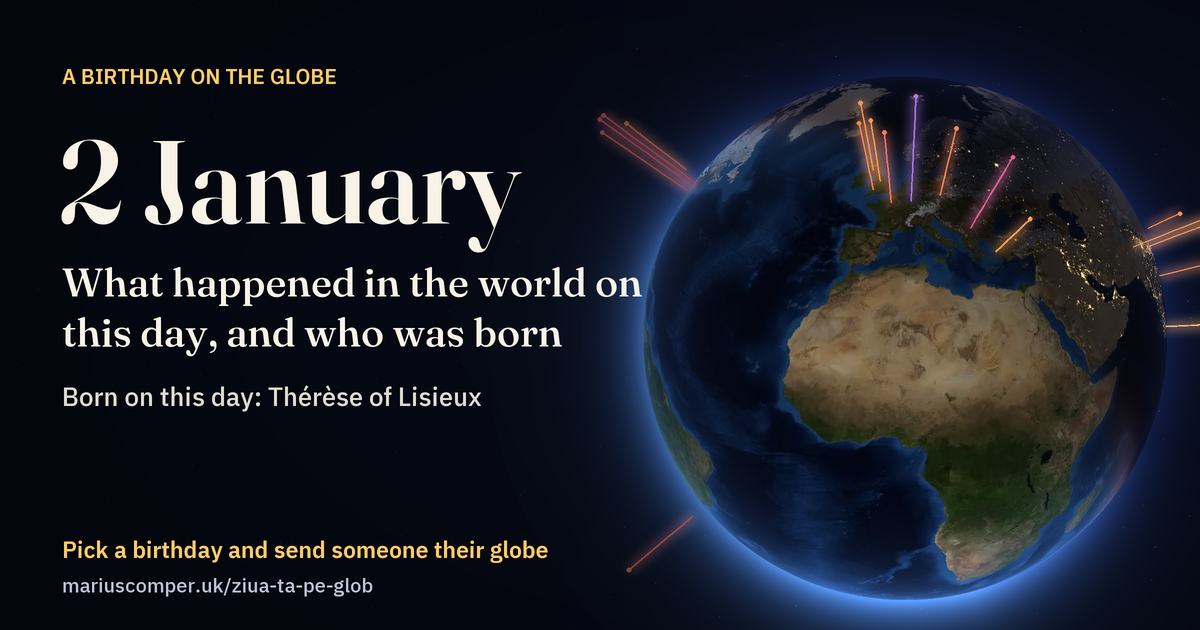
For 2 January, the English Wikipedia lists 42 events and 156 births. 21 of the events stand at their places as rays of light; seven more are dashed circles, where the sentence links only to a country or a sea. The taller the ray, the longer ago it happened. The people born that day come further down, as blue points.
A birthday, yours or someone else’s:
Turn it into a greetingScroll: the globe turns to each place
The day you were born, on the globe.
Three things from your day
Scroll: your day first, then 2 January through the years
The Earth on 2 January
The picture on the globe was assembled by NASA from satellite photographs taken in January 2004: the snow, the ice and the green are those of the month.
On 2 January the Sun passes straight overhead at noon along the parallel of 22.9° south. In London, the day lasts about 7 hours 55 minutes.
Beyond 67° south the Sun no longer sets; beyond 67° north it no longer rises.
The line between day and night is tilted on the globe exactly as on this day of the year. On the dark side you can see the lights of towns.
Europe · French Academy of Sciences
1860
French mathematician Urbain Le Verrier announced the putative discovery of the planet Vulcan at a meeting at the French Academy of Sciences in Paris.
On the map: French Academy of Sciences.
Europe · Hradec Králové
1921
World premiere of the science fiction play R.U.R. by the Czech writer Karel Čapek in a theater in Hradec Králové.
On the map: Hradec Králové.
Also on the day’s list of Wikipedia in Spanish.
2 January
Born on 2 January#
The English Wikipedia lists 156 births for this day. The blue points are the birthplaces of 60 of these people: those written about in the most Wikipedia editions, where Wikidata gives a place of birth.
Born on 2 January
1873
Thérèse of Lisieux, French nun and saint (died 1897)
Place of birth: Alençon.
Born on 2 January
1822
Rudolf Clausius, Polish-German physicist and mathematician (died 1888)
Place of birth: Koszalin.
Born on 2 January
1837
Mily Balakirev, Russian pianist and composer (died 1910)
Place of birth: Nizhny Novgorod.
Born on 2 January
1968
Cuba Gooding, Jr., American actor and producer
Place of birth: The Bronx.
Born on 2 January
1981
Maxi Rodríguez, Argentine footballer
Place of birth: Rosario.
Born in Britain and Ireland
1991
Ben Hardy, English actor
Place of birth: Bournemouth.
Born in Britain and Ireland
1905
Michael Tippett, English composer and conductor (died 1998)
Place of birth: London Borough of Hillingdon.
Born in Britain and Ireland
1913
Anna Lee, English-American actress (died 2004)
Place of birth: Kent.
2 January
Number one in the charts that week
At the cinema
An animal recorded that day
The record can be seen in GBIF, which brings together wildlife records from around the world.
All your birthdays
The weather that day
Data: Met Office Hadley Centre (HadCET); NOAA (GHCN-Daily, Mauna Loa).
Above the Earth
Sources: Jonathan McDowell, GCAT (launches); GFZ Potsdam (Kp index). Days are counted in Universal Time.
Football that day
International matches played that day:
Source: the “International football results” dataset kept by Mart Jürisoo (CC0).
Also that day
The earthquake’s page at the USGS
Source: the USGS catalogue. The day is counted in Universal Time (UTC).
In those days
Make a link for someone
Type the name, pick the day and the year of birth. The link opens straight on their day, with their name in the greeting.
The link carries the name, date and place typed here; anyone who gets it can see them.
Put another birthday beside it
Your mother’s, your child’s, a friend’s: the two days appear side by side.
Below: 2 January through the years.
The whole globe of the day
Drag the globe to turn it. Touch a ray or a point to read what happened there.
Everything Wikipedia lists for 2 January
The list is the English Wikipedia’s, in its own wording, as it stood in October 2026. 14 events have no place on the map: the sentence links to no place with coordinates, only to places too wide to mark, or to several countries.
- 69
The Roman legions in Germania Superior refuse to swear loyalty to Galba. They rebel and proclaim Vitellius as emperor.
Europe · Germania SuperiorWikipedia: Roman legion - 366
The Alemanni cross the frozen Rhine in large numbers, invading the Roman Empire.
Europe · Roman EmpireWikipedia: Alemanni - 533
Mercurius becomes Pope John II, the first pope to adopt a new name upon elevation to the papacy.
no place on the mapWikipedia: Pope John II - 1444
Christian forces defeat the Turks in the battle of Kunovica.
Europe · Battle of KunovicaWikipedia: Battle of Kunovica - 1492
Reconquista: The Emirate of Granada, the last Moorish stronghold in Spain, surrenders.
no place on the mapWikipedia: Reconquista - 1680
Trunajaya rebellion: Amangkurat II of Mataram and his bodyguards execute the rebel leader Trunajaya.
no place on the mapWikipedia: Trunajaya rebellion - 1776
Empress Maria Theresa of Austria amends the Constitutio Criminalis Theresiana to include the abolition of torture throughout the Habsburg-ruled countries of Austria and Bohemia.
no place on the mapWikipedia: Maria Theresa - 1777
American Revolutionary War: American forces under the command of General George Washington repulse a British attack led by General Charles Cornwallis at the Battle of the Assunpink Creek near Trenton, New Jersey.
North America · Battle of the Assunpink CreekWikipedia: Battle of the Assunpink Creek - 1788
Georgia becomes the fourth state to ratify the United States Constitution.
North America · GeorgiaWikipedia: Georgia - 1791
Northwest Indian War: The Big Bottom massacre is committed by Lenape and Wyandot warriors in the Ohio Country, North America.
North America · Big Bottom massacreWikipedia: Big Bottom massacre - 1818
The British Institution of Civil Engineers is founded by a group of six engineers; Thomas Telford would later become its first president.
no place on the mapWikipedia: Institution of Civil Engineers - 1860
French mathematician Urbain Le Verrier announced the putative discovery of the planet Vulcan at a meeting at the French Academy of Sciences in Paris.
Europe · French Academy of SciencesWikipedia: Urbain Le Verrier - 1863
American Civil War: The three-day Battle of Stones River ends in a Union victory when the Confederate Army of Tennessee under General Braxton Bragg are repulsed for the final time by the Army of the Cumberland under General William S. Rosecrans.
North America · Battle of Stones RiverWikipedia: American Civil War - 1865
Uruguayan War: The Siege of Paysandú ends as the Brazilians and Coloradans capture Paysandú, Uruguay.
Latin America · Siege of PaysandúWikipedia: Uruguayan War - 1900
American statesman and diplomat John Hay announces the Open Door Policy to promote trade with China.
no place on the mapWikipedia: John Hay - 1900
Chicago Canal opens.
no place on the mapWikipedia: Chicago Sanitary and Ship Canal - 1920
The second Palmer Raid, ordered by the US Department of Justice, results in 6,000 suspected communists and anarchists being arrested and held without trial.
no place on the mapWikipedia: Palmer raids - 1921
World premiere of the science fiction play R.U.R. by the Czech writer Karel Čapek in a theater in Hradec Králové.
Europe · Hradec KrálovéWikipedia: R.U.R. - 1932
The Young Brothers engaged in a gun battle resulting in the deaths of six law enforcement officers; the worst single killing of US police officers in the 20th century.
North America · Young Brothers massacreWikipedia: Young Brothers massacre - 1941
World War II: The Cardiff Blitz severely damages the cathedral in Cardiff, Wales.
Britain & Ireland · Cardiff Metropolitan CathedralWikipedia: World War II - 1942
The Federal Bureau of Investigation (FBI) obtains the conviction of 33 members of a German spy ring headed by Fritz Joubert Duquesne in the largest espionage case in United States history; Also known as the Duquesne Spy Ring.
Europe · Nazi GermanyWikipedia: Federal Bureau of Investigation - 1942
World War II: Manila is captured by Japanese forces, enabling them to control the Philippines.
Asia · ManilaWikipedia: Manila - 1944
World War II: United States and Australian forces successfully landed in Papua New Guinea in an attempt to cut off a Japanese retreat.
Oceania · Landing at SaidorWikipedia: Landing at Saidor - 1949
Luis Muñoz Marín is inaugurated as the first democratically elected Governor of Puerto Rico.
no place on the mapWikipedia: Luis Muñoz Marín - 1954
India establishes its highest civilian awards, the Bharat Ratna and the Padma Vibhushan.
Asia · IndiaWikipedia: India - 1955
Following the assassination of the Panamanian president José Antonio Remón Cantera, his deputy, José Ramón Guizado, takes power, but is quickly deposed after his involvement in Cantera's death is discovered.
Latin America · PanamaWikipedia: Panama - 1959
Luna 1, the first spacecraft to reach the vicinity of the Moon and to orbit the Sun, is launched by the Soviet Union.
Asia · Soviet UnionWikipedia: Luna 1 - 1963
Vietnam War: The Viet Cong wins its first major victory, at the Battle of Ap Bac.
Asia · Battle of Ap BacWikipedia: Vietnam War - 1967
Ronald Reagan, past movie actor and future President of the United States, is sworn in as Governor of California.
no place on the mapWikipedia: Ronald Reagan - 1971
The second Ibrox disaster kills 66 fans at a Rangers-Celtic association football match.
Britain & Ireland · 1971 Ibrox disasterWikipedia: 1971 Ibrox disaster - 1975
At the opening of a new railway line, a bomb blast at Samastipur, Bihar, India, fatally wounds Lalit Narayan Mishra, Minister of Railways.
Asia · SamastipurWikipedia: Samastipur - 1976
The Gale of January 1976 begins, resulting in coastal flooding around the southern North Sea coasts, affecting countries from Ireland to Yugoslavia and causing at least 82 deaths and US$1.3 billion in damage.
no place on the mapWikipedia: Gale of January 1976 - 1978
On the orders of the President of Pakistan, Muhammad Zia-ul-Haq, paramilitary forces opened fire on peaceful protesting workers in Multan, Pakistan; it is known as 1978 massacre at Multan Colony Textile Mills.
- 1981
One of the largest investigations by a British police force ends when serial killer Peter Sutcliffe, the "Yorkshire Ripper", is arrested in Sheffield, South Yorkshire.
Britain & Ireland · SheffieldWikipedia: United Kingdom - 1988
Condor Flugdienst Flight 3782 crashes near Seferihisar, Turkey, killing 16 people.
Asia · Condor Flugdienst Flight 3782Wikipedia: Condor Flugdienst Flight 3782 - 1991
Sharon Pratt Dixon becomes the first African American woman mayor of a major city and first woman Mayor of the District of Columbia.
no place on the mapWikipedia: Sharon Pratt - 1993
Sri Lankan Civil War: The Sri Lanka Navy kill 35–100 civilians on the Jaffna Lagoon.
Asia · JaffnaWikipedia: Jaffna lagoon massacre - 2004
Stardust successfully flies past Comet Wild 2, collecting samples that are returned to Earth.
no place on the mapWikipedia: Stardust - 2009
Sri Lankan civil war: The Sri Lankan army captured the town of Kilinochchi from the Liberation Tigers of Tamil Eelam, concluding the Battle of Kilinochchi.
Asia · KilinochchiWikipedia: Sri Lankan civil war - 2016
Nimr al-Nimr, a prominent Shia cleric in Saudi Arabia, was executed by the Saudi government along with 46 other people.
no place on the mapWikipedia: Execution of Nimr al-Nimr - 2022
Massive nationwide protests and unrest break out in Kazakhstan over the sudden increase of liquefied petroleum gas prices, leading to 238 people dead and thousands injured by January 11.
Asia · KazakhstanWikipedia: 2022 Kazakh unrest - 2024
Two aircraft collide on a runway at Haneda Airport in Tokyo, killing 5 and injuring 18.
Asia · 2024 Haneda Airport runway collisionWikipedia: 2024 Haneda Airport runway collision
Who was born on 2 January
In order of how many Wikipedia editions have an article about each. The first 60 of 156 are shown.
- 1873
Thérèse of Lisieux, French nun and saint (died 1897)
- 1822
Rudolf Clausius, Polish-German physicist and mathematician (died 1888)
KoszalinWikipedia: Rudolf Clausius - 1642
Mehmed IV, Ottoman sultan (died 1693)
ConstantinopleWikipedia: Mehmed IV - 1837
Mily Balakirev, Russian pianist and composer (died 1910)
Nizhny NovgorodWikipedia: Mily Balakirev - 1968
Cuba Gooding, Jr., American actor and producer
The BronxWikipedia: Cuba Gooding Jr. - 1699
Osman III, Ottoman sultan (died 1757)
EdirneWikipedia: Osman III - 1981
Maxi Rodríguez, Argentine footballer
RosarioWikipedia: Maxi Rodríguez - 1896
Dziga Vertov, Polish-Russian director and screenwriter (died 1954)
BiałystokWikipedia: Dziga Vertov - 1983
Kate Bosworth, American actress
Los AngelesWikipedia: Kate Bosworth - 1931
Toshiki Kaifu, Japanese lawyer and politician, Prime Minister of Japan (died 2022)
NagoyaWikipedia: Toshiki Kaifu - 1909
Barry Goldwater, American politician, businessman, and author (died 1998)
PhoenixWikipedia: Barry Goldwater - 1967
Tia Carrere, American actress
HonoluluWikipedia: Tia Carrere - 1976
Paz Vega, Spanish actress
SevilleWikipedia: Paz Vega - 1980
Kemi Badenoch, English politician
WimbledonWikipedia: Kemi Badenoch - 1870
Ernst Barlach, German sculptor and playwright (died 1938)
- 1987
Loïc Rémy, French footballer
Rillieux-la-PapeWikipedia: Loïc Rémy - 1997
Carlos Soler, Spanish footballer
ValenciaWikipedia: Carlos Soler - 1462
Piero di Cosimo, Italian painter (died 1522)
FlorenceWikipedia: Piero di Cosimo - 1903
Kane Tanaka, Japanese Supercentenarian, Oldest Japanese person ever, Second oldest verified person in world history (died 2022)
WajiroWikipedia: Kane Tanaka - 1895
Folke Bernadotte, Swedish diplomat (died 1948)
Skeppsholm church parishWikipedia: Folke Bernadotte - 1727
James Wolfe, English general (died 1759)
WesterhamWikipedia: James Wolfe - 1961
Todd Haynes, American film director, screenwriter, and producer
EncinoWikipedia: Todd Haynes - 869
Yōzei, Japanese emperor (died 949)
Heian-kyōWikipedia: Emperor Yōzei - 1827
Pyotr Semyonov-Tyan-Shansky, Russian geographer and statistician (died 1914)
- 1938
Lynn Conway, American computer scientist and electrical engineer (died 2024)
Mount VernonWikipedia: Lynn Conway - 1969
Christy Turlington, American model
Walnut CreekWikipedia: Christy Turlington - 1987
Shelley Hennig, American actress and model
New OrleansWikipedia: Shelley Hennig - 1997
Arshad Nadeem, Pakistani javelin thrower
KhanewalWikipedia: Arshad Nadeem - 1992
Paulo Gazzaniga, Argentine footballer
- 1836
Mendele Mocher Sforim, Russian author (died 1917)
- 1873
Antonie Pannekoek, Dutch astronomer and theorist (died 1960)
VaassenWikipedia: Anton Pannekoek - 1938
Robert Smithson, American sculptor and photographer (died 1973)
PassaicWikipedia: Robert Smithson - 1998
Timothy Fosu-Mensah, Dutch footballer
AmsterdamWikipedia: Timothy Fosu-Mensah - 1942
Dennis Hastert, American educator and politician, 59th Speaker of the United States House of Representatives (died 2026)
- 1975
Dax Shepard, American actor
YpsilantiWikipedia: Dax Shepard - 1991
Ben Hardy, English actor
BournemouthWikipedia: Ben Hardy - 1904
Walter Heitler, German physicist and chemist (died 1981)
Karlstadt am MainWikipedia: Walter Heitler - 1940
Saud bin Faisal bin Abdulaziz Al Saud, Saudi Arabian economist and politician, Saudi Arabian Minister of Foreign Affairs (died 2015)
- 1971
Renée Elise Goldsberry, American actress
- 1905
Michael Tippett, English composer and conductor (died 1998)
London Borough of HillingdonWikipedia: Michael Tippett - 1905
Luigi Zampa, Italian director and screenwriter (died 1991)
- 1944
Norodom Ranariddh, Cambodian field marshal and politician, 1st Prime Minister of Cambodia (died 2021)
Phnom PenhWikipedia: Norodom Ranariddh - 1981
Kirk Hinrich, American basketball player
Sioux CityWikipedia: Kirk Hinrich - 1961
Gabrielle Carteris, American actress
ScottsdaleWikipedia: Gabrielle Carteris - 1969
Tommy Morrison, American boxer and actor (died 2013)
GravetteWikipedia: Tommy Morrison - 2001
Luiz Henrique, Brazilian footballer
PetrópolisWikipedia: Luiz Henrique - 2003
Elye Wahi, French footballer
CourcouronnesWikipedia: Elye Wahi - 2006
Claudio Echeverri, Argentine footballer
ResistenciaWikipedia: Claudio Echeverri - 1777
Christian Daniel Rauch, German sculptor and educator (died 1857)
Bad ArolsenWikipedia: Christian Daniel Rauch - 1944
Péter Eötvös, Hungarian composer and conductor (died 2024)
Odorheiu SecuiescWikipedia: Péter Eötvös - 1968
Anky van Grunsven, Dutch dressage champion
- 1971
Taye Diggs, American actor and singer
NewarkWikipedia: Taye Diggs - 1993
Bryson Tiller, American singer and rapper
LouisvilleWikipedia: Bryson Tiller - 1913
Anna Lee, English-American actress (died 2004)
- 1967
Francois Pienaar, South African rugby player
VereenigingWikipedia: Francois Pienaar - 1967
Jón Gnarr, Icelandic actor and politician; 20th Mayor of Reykjavík
ReykjavíkWikipedia: Jón Gnarr - 1979
Jonathan Greening, English footballer
ScarboroughWikipedia: Jonathan Greening - 1886
Apsley Cherry-Garrard, English explorer and author (died 1959)
- 1918
Willi Graf, German physician and activist (died 1943)
KuchenheimWikipedia: Willi Graf - 1949
Iris Marion Young, American political scientist and academic (died 2006)
New York CityWikipedia: Iris Marion Young
What is celebrated on 2 January
- Ancestry Day (Haiti)
- Berchtold's Day (Switzerland)
- Christian feast day: Basil the Great (Catholic Church and Church of England)
- Christian feast day: Gregory of Nazianzus (Catholic Church)
- Christian feast day: John the Good
- Christian feast day: Macarius of Alexandria
- Christian feast day: Blessed Marie Anne Blondin
- Christian feast day: Seraphim of Sarov (Eastern Orthodox Church)
- Christian feast day: Theodore of Marseille
- Christian feast day: Vedanayagam Samuel Azariah (Episcopal Church)
- Christian feast day: January 2 (Eastern Orthodox liturgics)
- The Day after New Year's Day (New Zealand)
- Kaapse Klopse (Cape Town, South Africa)
- The first day of Blacks and Whites' Carnival, celebrated until January 7 (Colombia)
A greeting link for someone
Type a name and, if you like, the year of birth. The link opens with a greeting, and beside each event it says how old the person turned that day, or how many years before their birth it happened.
The name and the year go only into the link you send.
All 366 days
How the globe is made
Where the events come from
Each edition of this page uses the day’s list from Wikipedia in its own language: Romanian, English, Spanish, Chinese. The lists are written by volunteers and differ from one edition to the next; the text of each event is Wikipedia’s, with a link to the article. A row that appears twice in a list is shown once. The lists have not been checked event by event: they are Wikipedia’s, mistakes included.
For events before 1582, and for countries that moved to the Gregorian calendar later (Britain in 1752, Russia in 1918), the same day may be counted Old Style in one list and New Style in another.
The chapter “What the other Wikipedias remember” adds up to five events a day from the lists of the other three editions, only for years in which the English list has nothing on that day. They were translated for this page, passed the same filters as the tour, and are not counted among the events of the English list.
How an event gets onto the map
The place comes from Wikidata. If the sentence links to the article about the event itself (a battle, an opening, an earthquake), dated to the same year, the ray stands on its coordinates or on those of its location. Otherwise it stands on the first place the sentence links to: a town, a building, a mountain, an island. This second step can be wrong: sometimes the sentence only mentions the place. That is why the page says, under each event, which place the ray stands on.
When the sentence links to a single state or province, or to a single sea, lake or desert larger than 5,000 km², the globe shows a dashed circle, not a ray. The circle has the area Wikidata gives, with its radius kept between 1.2° and 16°, or a radius of 4.5° when Wikidata gives no area; it says only that the sentence links to that place. Organisations, ships, spacecraft, museum objects, rivers, mountain ranges, languages and continents are never used as places. When a sentence names several states and no exact place, the event stays in the list only.
What the height means
The height of a ray shows how many years have passed, on a logarithmic scale: 10 years, 100 years and 1,000 years are equal steps apart; anything older than about 2,600 years has the tallest ray. The colour runs from pale yellow for recent years to violet for antiquity.
Where the tour stops
In each region the tour stops at up to three events (five in Britain and Ireland), chosen mainly by three things: whether Wikipedia’s editors put the event in the “On this day” box of their main page (the English, Spanish and Chinese editions), how many Wikipedia editions have an article about it, and how many of the four lists include it. Events whose sentence or article is about a war, an attack, a crime or a disaster are left out of the tour; they stay in the whole list, in Wikipedia’s wording. The filter is a list of words and a list of Wikidata types, so it can miss some.
The tour of births names the people with articles in the most editions and leaves aside those whom the list or Wikidata describes as rulers, politicians, commanders, leaders of movements or criminals; they stay in the list.
The Earth and the Sun
The daytime images are NASA’s Blue Marble Next Generation mosaics, one for each month of 2004; the night side is Black Marble 2016. The tilt of the line between day and night is computed for the day; the hour is chosen so that the place being read is in daylight. The latitude where the Sun stands overhead is the average of the four years of the leap cycle; in a given year it can differ by up to 0.4°.
The day you were born
The number ones come from the weekly lists on Wikipedia: Billboard for the United States (from 1940; the Hot 100 from August 1958), the UK Singles Chart (from November 1952), Los 40 Principales for Spain (from July 1966) and, for Romania, the Romanian Top 100 and Airplay 100 (2001–2021, with missing weeks). The page shows the chart of the week in which the day of birth falls, with its date; Billboard and the UK chart are dated at the end of their week. For Romania before 2001 and for China these sources have no weekly chart.
The films are those that reached cinemas in the United States up to ten days before or three days after that day (some of them in a few cinemas at first), from the English Wikipedia’s yearly lists (from 1968), in order of how many editions have an article about them. The events “in those days” are the ones on the neighbouring days’ lists that carry the year of birth, passed through the same filter as the tour.
The day of birth, year included
The Moon, the star sign and the constellation are worked out by the page itself, for noon Universal Time on the day. The lit part of the Moon is rounded and can differ by a few per cent from that at the hour of birth. The sign follows the usual zodiac of twelve equal parts starting at the March equinox; the constellation is the one the Sun actually stood in front of, by the borders set by the International Astronomical Union, and within a day of a border the page does not name it. When the Sun changes sign while it is that day anywhere on Earth, the page gives the moment of crossing, rounded to ten minutes and accurate to within about a quarter of an hour, and the clock time in a few cities, with the time zone and summer time of that year.
The year in the Chinese calendar is the one your device’s own calendar gives for the date, checked against the Hong Kong Observatory’s tables. “All your birthdays” uses the same sources as the rest of the chapter for the same day in every year since the birth: the temperature, well-known launches that took place on that very day, matches of the teams the edition follows, snow deeper than 10 cm and strong geomagnetic storms. The three things at the top and the four on the picture are chosen in a fixed order (the song, the animal, a full Moon, a well-known launch before an ordinary earthquake); on the picture you can change them.
When the link carries a year of birth, the page adds a few things about that exact day. The weather is the Met Office’s Central England temperature record and the readings from New York’s Central Park; the “usual high” is the average of the daily highs of 1961–1990 for that date, with two days either side. The carbon dioxide figure is the monthly mean at the Mauna Loa observatory, where measurements begin in March 1958.
The earthquake is the one with the largest magnitude in the USGS catalogue for that day, counted in Universal Time. Before the 1960s the catalogue has gaps even above magnitude 5.5, so in the older years many days have no earthquake. The page gives only the magnitude and the place: the country the epicentre falls in or, when the epicentre is at sea within 300 km of a coast, the nearest country; farther out, only the ocean.
The launches are those that reached orbit or left for the Moon and the planets, from Jonathan McDowell’s GCAT catalogue. If nothing left that day, the page shows the nearest launch within three days before or after, and says how many days away it was. The geomagnetic storm appears only when the Kp index reached at least 5 in one of the day’s eight three-hour intervals.
The animal comes from GBIF: an observation made by a person (the animal seen or heard, or its tracks), dated to that exact day, with coordinates and a CC0 or CC BY licence. Only a few hundred well-known species are searched (mammals, birds, turtles, butterflies); of those noted that day, mammals and species with articles in many Wikipedia editions come first; birds noted almost every day, and species used recently, wait their turn. Observations dated 1 January are left out, because records without a day are often filed there. An observation shows that the animal was recorded there, not how many animals there were.
The matches are those between national teams. Only matches of England, Scotland, Wales, Northern Ireland, the Republic of Ireland, the United States, Canada and Australia are shown, along with those at the big final tournaments. The picture to send is drawn in the page from the day’s globe and the facts above, and stays on your device until you send it.
Sources
- Events, births and holidays: the day’s page on Wikipedia, text under CC BY-SA 4.0.
- Coordinates, places of birth and the number of editions: Wikidata (CC0).
- The Earth by day: NASA Blue Marble Next Generation. The Earth by night: NASA Black Marble 2016.
- Borders and regions: Natural Earth.
- World population and births per year: UN World Population Prospects 2024.
- Charts and films: Wikipedia’s lists for Billboard, the UK Singles Chart, Los 40 Principales, Romanian Top 100, Airplay 100 and American films by year (CC BY-SA 4.0).
- Weather: Met Office Hadley Centre, HadCET (Open Government Licence) and NOAA GHCN-Daily, New York Central Park. Carbon dioxide: NOAA Global Monitoring Laboratory, Mauna Loa.
- Earthquakes: the USGS catalogue. Launches: Jonathan McDowell, GCAT (CC BY). Kp index: GFZ Potsdam (CC BY 4.0). Matches: International football results, Mart Jürisoo (CC0).
- Animal observations: GBIF, with a link to each record; species names come from Wikidata.