A birthday on the globe
27 January on the globe: what happened in the world on this day, and who was born
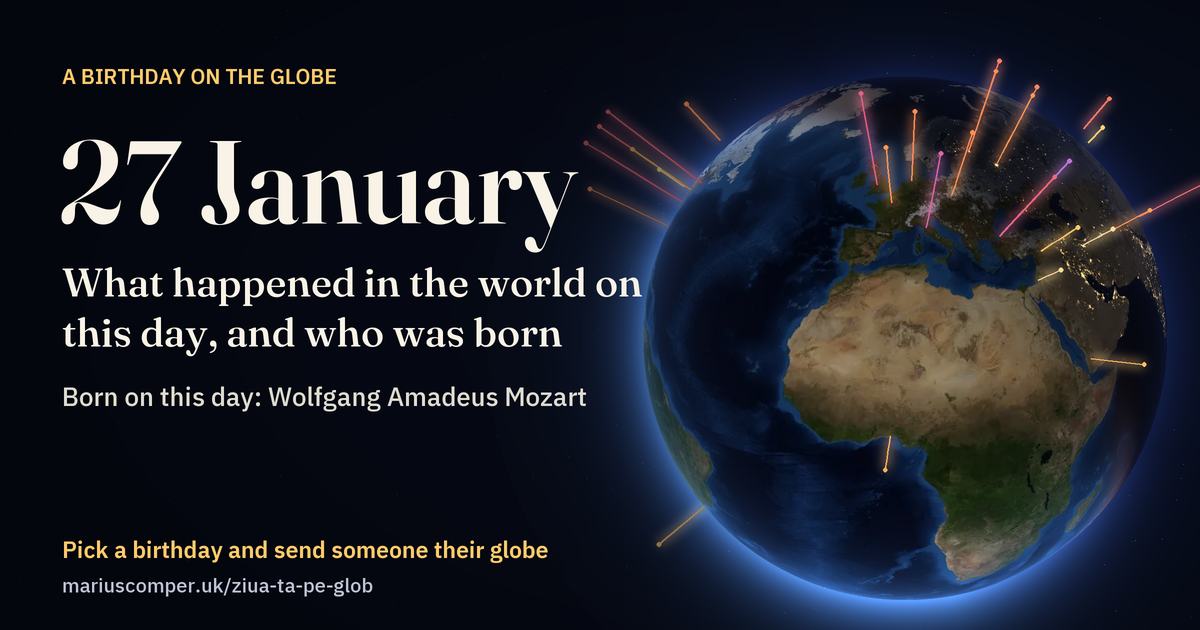
For 27 January, the English Wikipedia lists 53 events and 200 births. 29 of the events stand at their places as rays of light; three more are dashed circles, where the sentence links only to a country or a sea. The taller the ray, the longer ago it happened. The people born that day come further down, as blue points.
A birthday, yours or someone else’s:
Turn it into a greetingScroll: the globe turns to each place
The day you were born, on the globe.
Three things from your day
Scroll: your day first, then 27 January through the years
The Earth on 27 January
The picture on the globe was assembled by NASA from satellite photographs taken in January 2004: the snow, the ice and the green are those of the month.
On 27 January the Sun passes straight overhead at noon along the parallel of 18.6° south. In London, the day lasts about 8 hours 55 minutes.
Beyond 71° south the Sun no longer sets; beyond 71° north it no longer rises.
The line between day and night is tilted on the globe exactly as on this day of the year. On the dark side you can see the lights of towns.
Europe · Mariinsky Theatre
1874
Modest Mussorgsky's opera Boris Godunov premieres in Mariinsky Theatre in St.Petersburg.
On the map: Mariinsky Theatre.
North America · University of Georgia
1785
The University of Georgia is founded, the first state-chartered public university in the United States.
On the map: University of Georgia.
Also on the day’s list of Wikipedia in Chinese.
North America · Library of Congress
2003
The first selections for the National Recording Registry are announced by the Library of Congress.
On the map: Library of Congress.
27 January
What the other Wikipedias remember#
For these years the English list has nothing on this day. The events below come from the same day’s lists on Wikipedia in Chinese and were translated for this page.
From Wikipedia in Chinese · Paris
1887
Construction of the Eiffel Tower in Paris begins.
On the map: Paris.
Translated from the list on Wikipedia in Chinese.
27 January
Born on 27 January#
The English Wikipedia lists 200 births for this day. The blue points are the birthplaces of 60 of these people: those written about in the most Wikipedia editions, where Wikidata gives a place of birth.
Born on 27 January
1756
Wolfgang Amadeus Mozart, Austrian pianist and composer (died 1791)
Place of birth: Salzburg.
Born on 27 January
1832
Lewis Carroll, English novelist, poet, and mathematician (died 1898)
Place of birth: Daresbury.
Born on 27 January
1775
Friedrich Wilhelm Joseph Schelling, German-Swiss philosopher and academic (died 1854)
Place of birth: Leonberg.
Born on 27 January
1826
Mikhail Saltykov-Shchedrin, Russian journalist and author (died 1889)
Place of birth: Spas-Ugol.
Born on 27 January
1936
Samuel C. C. Ting, American physicist and academic, Nobel Prize laureate
Place of birth: Ann Arbor.
Born in Britain and Ireland
1944
Nick Mason, English drummer, songwriter, and producer
Place of birth: Birmingham.
Born in Britain and Ireland
1850
Edward Smith, English captain (died 1912)
Place of birth: Hanley.
Born in Britain and Ireland
1965
Alan Cumming, Scottish-American actor
Place of birth: Aberfeldy.
27 January
Number one in the charts that week
At the cinema
An animal recorded that day
The record can be seen in GBIF, which brings together wildlife records from around the world.
All your birthdays
The weather that day
Data: Met Office Hadley Centre (HadCET); NOAA (GHCN-Daily, Mauna Loa).
Above the Earth
Sources: Jonathan McDowell, GCAT (launches); GFZ Potsdam (Kp index). Days are counted in Universal Time.
Football that day
International matches played that day:
Source: the “International football results” dataset kept by Mart Jürisoo (CC0).
Also that day
The earthquake’s page at the USGS
Source: the USGS catalogue. The day is counted in Universal Time (UTC).
In those days
Make a link for someone
Type the name, pick the day and the year of birth. The link opens straight on their day, with their name in the greeting.
The link carries the name, date and place typed here; anyone who gets it can see them.
Put another birthday beside it
Your mother’s, your child’s, a friend’s: the two days appear side by side.
Below: 27 January through the years.
The whole globe of the day
Drag the globe to turn it. Touch a ray or a point to read what happened there.
Everything Wikipedia lists for 27 January
The list is the English Wikipedia’s, in its own wording, as it stood in October 2026. 21 events have no place on the map: the sentence links to no place with coordinates, only to places too wide to mark, or to several countries.
- 98
Trajan succeeds his adoptive father Nerva as Roman emperor.
no place on the mapWikipedia: Trajan - 417
Pope Innocent I declares Pelagius and his follower Caelestius excommunicated unless they return to orthodoxy.
no place on the mapWikipedia: Pope Innocent I - 532
Nika riots in Constantinople fail.
Asia · ConstantinopleWikipedia: Nika riots - 945
The co-emperors Stephen and Constantine are overthrown and forced to become monks by Constantine VII, who becomes sole emperor of the Byzantine Empire.
Asia · Byzantine EmpireWikipedia: Stephen Lekapenos - 1186
Henry VI, the son and heir of the Holy Roman Emperor Frederick I, marries Constance of Sicily.
no place on the mapWikipedia: Henry VI, Holy Roman Emperor - 1302
Dante Alighieri is condemned in absentia and exiled from Florence.
Europe · FlorenceWikipedia: Dante Alighieri - 1343
Pope Clement VI issues the papal bull Unigenitus, laying out the scriptural justification for indulgences, identifying only the Pope and episcopate as capable of accessing the treasury of merit, and establishing a jubilee year every half century.
no place on the mapWikipedia: Jubilee in the Catholic Church - 1606
Gunpowder Plot: The trial of Guy Fawkes and other conspirators begins, ending with their execution on January 31.
Britain & Ireland · Gunpowder PlotWikipedia: Gunpowder Plot - 1695
Mustafa II becomes the Ottoman sultan and Caliph of Islam in Istanbul on the death of Ahmed II. Mustafa rules until his abdication in 1703.
Asia · IstanbulWikipedia: Mustafa II - 1726
J. S. Bach leads the first performance of Alles nur nach Gottes Willen, BWV 72, concluding his third Christmas season in Leipzig on the Third Sunday after Epiphany.
no place on the mapWikipedia: Johann Sebastian Bach - 1759
Spanish forces clash with indigenous Huilliches of southern Chile in the battle of Río Bueno.
no place on the mapWikipedia: Battle of Río Bueno - 1776
American Revolutionary War: Henry Knox's "noble train of artillery" arrives in Cambridge, Massachusetts.
North America · Cambridge, MassachusettsWikipedia: Noble train of artillery - 1785
The University of Georgia is founded, the first state-chartered public university in the United States.
North America · University of GeorgiaWikipedia: University of Georgia - 1799
French Revolutionary Wars: In the Macau Incident, French and Spanish warships encountered a British Royal Navy escort squadron in the Wanshan Archipelago; subsequent events, including which side retreated, were disputed by the commanders present.
Asia · Macau IncidentWikipedia: Macau Incident - 1820
A Russian expedition led by Fabian Gottlieb von Bellingshausen and Mikhail Petrovich Lazarev discovers the Antarctic continent, approaching the Antarctic coast.
Asia · Russian EmpireWikipedia: Russian Empire - 1825
The U.S. Congress approves Indian Territory (in what is present-day Oklahoma), clearing the way for forced relocation of the Eastern Indians on the "Trail of Tears".
North America · United States CongressWikipedia: United States Congress - 1868
Boshin War: The Battle of Toba–Fushimi begins, between forces of the Tokugawa shogunate and pro-Imperial factions; it will end in defeat for the shogunate, and is a pivotal point in the Meiji Restoration.
Asia · Battle of Toba–FushimiWikipedia: Battle of Toba–Fushimi - 1869
Boshin War: Tokugawa rebels establish the Ezo Republic in Hokkaidō.
no place on the mapWikipedia: Republic of Ezo - 1874
Modest Mussorgsky's opera Boris Godunov premieres in Mariinsky Theatre in St.Petersburg.
Europe · Mariinsky TheatreWikipedia: Mariinsky Theatre - 1880
Thomas Edison receives a patent for his incandescent lamp.
no place on the mapWikipedia: Thomas Edison - 1916
World War I: The British government passes the Military Service Act that introduces conscription in the United Kingdom.
no place on the mapWikipedia: World War I - 1918
Beginning of the Finnish Civil War.
no place on the mapWikipedia: Finnish Civil War - 1924
Six days after his death, Vladimir Lenin's body is carried into a specially erected mausoleum.
Europe · Lenin's MausoleumWikipedia: Death and state funeral of Vladimir Lenin - 1927
A contaminated diphtheria vaccine was used in an Australian immunisation program, leading to the deaths of twelve children and the suspension of immunisation programs in several countries.
no place on the mapWikipedia: Bundaberg tragedy - 1927
Ibn Saud takes the title of King of Nejd.
no place on the mapWikipedia: Ibn Saud - 1928
Bundaberg tragedy: a diphtheria vaccine is contaminated with Staph. aureus bacterium, resulting in the deaths of twelve children in the Australian town of Bundaberg.
Oceania · BundabergWikipedia: Bundaberg tragedy - 1939
First flight of the Lockheed P-38 Lightning.
no place on the mapWikipedia: Lockheed P-38 Lightning - 1943
World War II: The Eighth Air Force sorties ninety-one B-17s and B-24s to attack the U-boat construction yards at Wilhelmshaven, Germany. This was the first American bombing attack on Germany.
Europe · WilhelmshavenWikipedia: World War II - 1944
World War II: The 872-day Siege of Leningrad is lifted.
Europe · Siege of LeningradWikipedia: Siege of Leningrad - 1945
World War II: The Soviet 322nd Rifle Division liberates the remaining inmates of Auschwitz-Birkenau.
Europe · Liberation of Auschwitz concentration campWikipedia: Liberation of Auschwitz concentration camp - 1951
Nuclear testing at the Nevada Test Site begins with Operation Ranger.
North America · Nevada Test SiteWikipedia: Nuclear weapons testing - 1961
The Soviet submarine S-80 sinks when its snorkel malfunctions, flooding the boat.
no place on the mapWikipedia: Soviet submarine S-80 - 1965
South Vietnamese Prime Minister Trần Văn Hương is removed by the military junta of Nguyễn Khánh.
no place on the mapWikipedia: Trần Văn Hương - 1967
Apollo program: Astronauts Gus Grissom, Ed White and Roger Chaffee are killed in a fire during a test of their Apollo 1 spacecraft at the Kennedy Space Center, Florida.
North America · Kennedy Space CenterWikipedia: Apollo 1 - 1967
Cold War: The Soviet Union, the United States, and the United Kingdom sign the Outer Space Treaty in Washington, D.C., banning deployment of nuclear weapons in space, and limiting the usage of the Moon and other celestial bodies to peaceful purposes.
Europe · MoscowWikipedia: Outer Space Treaty - 1973
The Paris Peace Accords officially ends the Vietnam War. Colonel William Nolde is killed in action becoming the conflict's last recorded American combat casualty.
Europe · Paris Peace AccordsWikipedia: Paris Peace Accords - 1980
Through cooperation between the U.S. and Canadian governments, six American diplomats secretly escape hostilities in Iran in the culmination of the Canadian Caper.
Asia · Iran hostage crisisWikipedia: Iran hostage crisis - 1983
The pilot shaft of the Seikan Tunnel, the world's longest sub-aqueous tunnel (53.85 km) between the Japanese islands of Honshū and Hokkaidō, breaks through.
no place on the mapWikipedia: Seikan Tunnel - 1996
Germany first observes the International Holocaust Remembrance Day.
no place on the mapWikipedia: International Holocaust Remembrance Day - 1996
In a military coup, Colonel Ibrahim Baré Maïnassara deposes the first democratically elected president of Niger, Mahamane Ousmane.
Africa · NigerWikipedia: 1996 Nigerien coup d'état - 2002
An explosion at a military storage facility in Lagos, Nigeria, kills at least 1,100 people and displaces over 20,000 others.
Africa · 2002 Lagos armoury explosionWikipedia: 2002 Lagos armoury explosion - 2003
The first selections for the National Recording Registry are announced by the Library of Congress.
North America · Library of CongressWikipedia: Library of Congress - 2010
Apple announces the iPad.
no place on the mapWikipedia: Apple Inc. - 2010
The 2009 Honduran constitutional crisis ends when Porfirio Lobo Sosa becomes the new President of Honduras.
no place on the mapWikipedia: 2009 Honduran constitutional crisis - 2011
Arab Spring: The Yemeni Revolution begins as over 16,000 protestors demonstrate in Sanaa.
Asia · SanaaWikipedia: Arab Spring - 2011
Within Ursa Minor, H1504+65, a white dwarf with the hottest known surface temperature in the universe at 200,000 K, was documented.
no place on the mapWikipedia: Ursa Minor - 2013
Two hundred and forty-two people die in a nightclub fire in the Brazilian city of Santa Maria, Rio Grande do Sul.
Latin America · Kiss nightclub fireWikipedia: Kiss nightclub fire - 2014
Rojava conflict: The Kobanî Canton declares its autonomy from the Syrian Arab Republic.
Asia · Euphrates RegionWikipedia: Rojava Revolution - 2017
A naming ceremony for the chemical element tennessine takes place in the United States.
no place on the mapWikipedia: Tennessine - 2019
MBC Newsdesk reported on a nightclub assault in Seoul, South Korea, leading to the Burning Sun scandal, which involved several Korean idols and police officials.
Asia · SeoulWikipedia: Seoul - 2023
A shooting at a synagogue in Neve Yaakov, East Jerusalem, kills seven people and injures three others.
Asia · 2023 Neve Yaakov shootingWikipedia: 2023 Neve Yaakov shooting - 2023
An attack on the Azerbaijani embassy in Pasdaran, Tehran, kills one person and injures three others.
Asia · 2023 attack on the Azerbaijani embassy in TehranWikipedia: 2023 attack on the Azerbaijani embassy in Tehran - 2023
Protests and public outrage spark across the U.S. after the release of multiple videos by the Memphis Police Department showing officers punching, kicking, and pepper spraying Tyre Nichols as a result of running away from a traffic stop, which resulted him dying in the hospital three days later after the incident.
North America · Killing of Tyre NicholsWikipedia: Killing of Tyre Nichols
What the other Wikipedias remember
For these years the English list has nothing on this day. The events below come from the same day’s lists on Wikipedia in Chinese and were translated for this page.
- 1887
Construction of the Eiffel Tower in Paris begins.
Who was born on 27 January
In order of how many Wikipedia editions have an article about each. The first 60 of 200 are shown.
- 1756
Wolfgang Amadeus Mozart, Austrian pianist and composer (died 1791)
- 1832
Lewis Carroll, English novelist, poet, and mathematician (died 1898)
DaresburyWikipedia: Lewis Carroll - 1859
Wilhelm II, German Emperor during World War I (died 1941)
KronprinzenpalaisWikipedia: Wilhelm II - 1775
Friedrich Wilhelm Joseph Schelling, German-Swiss philosopher and academic (died 1854)
- 1571
Abbas I of Persia (died 1629)
- 1944
Mairead Maguire, Northern Irish activist, Nobel Prize laureate
BelfastWikipedia: Mairead Maguire - 1826
Mikhail Saltykov-Shchedrin, Russian journalist and author (died 1889)
- 1980
Marat Safin, Russian tennis player and politician
MoscowWikipedia: Marat Safin - 1936
Samuel C. C. Ting, American physicist and academic, Nobel Prize laureate
Ann ArborWikipedia: Samuel C. C. Ting - 1836
Leopold von Sacher-Masoch, Austrian journalist and author (died 1895)
- 1948
Mikhail Baryshnikov, Russian-American dancer, choreographer, and actor
- 1814
Eugène Viollet-le-Duc, French architect, designed the Lausanne Cathedral (died 1879)
former 2nd arrondissement of ParisWikipedia: Eugène Viollet-le-Duc - 1974
Ole Einar Bjørndalen, Norwegian skier and biathlete
- 1964
Bridget Fonda, American actress
Los AngelesWikipedia: Bridget Fonda - 1934
Édith Cresson, French politician and diplomat, Prime Minister of France
Boulogne-BillancourtWikipedia: Édith Cresson - 1893
Soong Ching-ling, Chinese politician, Honorary President of the People's Republic of China (died 1981)
ShanghaiWikipedia: Soong Ching-ling - 1903
John Eccles, Australian-Swiss neurophysiologist and academic, Nobel Prize laureate (died 1997)
MelbourneWikipedia: John Eccles - 1955
John Roberts, American lawyer and judge, 17th Chief Justice of the United States
BuffaloWikipedia: John Roberts - 1921
Donna Reed, American actress (died 1986)
DenisonWikipedia: Donna Reed - 1942
Tasuku Honjo, Japanese immunologist, Nobel Prize laureate in Physiology or Medicine
- 2000
Aurélien Tchouaméni, French footballer
- 1924
Rauf Denktaş, Cypriot lawyer and politician, 1st President of Northern Cyprus (died 2012)
British CyprusWikipedia: Rauf Denktaş - 1944
Nick Mason, English drummer, songwriter, and producer
BirminghamWikipedia: Nick Mason - 1850
Edward Smith, English captain (died 1912)
HanleyWikipedia: Edward Smith - 1969
Patton Oswalt, American comedian and actor
PortsmouthWikipedia: Patton Oswalt - 1848
Tōgō Heihachirō, Japanese admiral (died 1934)
Kajiya-chōWikipedia: Tōgō Heihachirō - 1957
Frank Miller, American illustrator, director, producer, and screenwriter
- 1842
Arkhip Kuindzhi, Ukrainian-Russian painter (died 1910)
Yekaterinoslav GovernorateWikipedia: Arkhip Kuindzhi - 1808
David Strauss, German theologian and author (died 1874)
LudwigsburgWikipedia: David Strauss - 1940
James Cromwell, American actor
Los AngelesWikipedia: James Cromwell - 1965
Alan Cumming, Scottish-American actor
AberfeldyWikipedia: Alan Cumming - 1985
Ruben Amorim, Portuguese footballer and manager
LisbonWikipedia: Ruben Amorim - 1585
Hendrick Avercamp, Dutch painter (died 1634)
AmsterdamWikipedia: Hendrick Avercamp - 1708
Grand Duchess Anna Petrovna of Russia (died 1728)
- 1885
Jerome Kern, American composer and songwriter (died 1945)
ManhattanWikipedia: Jerome Kern - 1926
Ingrid Thulin, Swedish actress (died 2004)
SollefteåWikipedia: Ingrid Thulin - 1687
Johann Balthasar Neumann, German engineer and architect, designed Würzburg Residence and Basilica of the Fourteen Holy Helpers (died 1753)
- 1956
Mimi Rogers, American actress
Coral GablesWikipedia: Mimi Rogers - 1957
Janick Gers, English guitarist and songwriter
HartlepoolWikipedia: Janick Gers - 1987
Anton Shunin, Russian footballer
MoscowWikipedia: Anton Shunin - 1823
Édouard Lalo, French violinist and composer (died 1892)
- 1929
Mohamed Al-Fayed, Egyptian-Swiss businessman (died 2023)
Ras el-TinWikipedia: Mohamed Al-Fayed - 1941
Beatrice Tinsley, New Zealand astronomer and cosmologist (died 1981)
ChesterWikipedia: Beatrice Tinsley - 1912
Arne Næss, Norwegian philosopher and environmentalist (died 2009)
SlemdalWikipedia: Arne Næss - 1928
Hans Modrow, Polish-German lawyer and politician, 5th Prime Minister of East Germany (died 2023)
JasienicaWikipedia: Hans Modrow - 1976
Ahn Jung-hwan, South Korean footballer
- 1621
Thomas Willis, English physician and anatomist (died 1675)
Great BedwynWikipedia: Thomas Willis - 1910
Edvard Kardelj, Slovene general, economist, and politician, 2nd Foreign Minister of Yugoslavia (died 1979)
LjubljanaWikipedia: Edvard Kardelj - 1930
Bobby Bland, American blues singer-songwriter (died 2013)
RosemarkWikipedia: Bobby Bland - 1850
John Collier, English painter and author (died 1934)
LondonWikipedia: John Collier - 1940
Petru Lucinschi, Romanian activist and politician, 2nd President of Moldova
Rădulenii VechiWikipedia: Petru Lucinschi - 1968
Mike Patton, American singer, composer, and voice artist
EurekaWikipedia: Mike Patton - 2000
Morgan Gibbs-White, English footballer
StaffordWikipedia: Morgan Gibbs-White - 1968
Tricky, English rapper and producer
BristolWikipedia: Tricky - 1988
Kerlon, Brazilian footballer
IpatingaWikipedia: Kerlon - 1989
Alberto Botía, Spanish footballer
AlqueríasWikipedia: Alberto Botía - 1932
Boris Shakhlin, Russian-Ukrainian gymnast (died 2008)
- 1958
Susanna Thompson, American actress
San DiegoWikipedia: Susanna Thompson - 1981
Alicia Molik, Australian tennis player and sportscaster
AdelaideWikipedia: Alicia Molik - 1546
Joachim III Frederick, Elector of Brandenburg (died 1608)
What is celebrated on 27 January
- Christian feast day: Angela Merici
- Christian feast day: Blessed Paul Joseph Nardini
- Christian feast day: Devota (Monaco)
- Christian feast day: Enrique de Ossó y Cercelló
- Christian feast day: John Chrysostom (translation of relics) (Anglican, Lutheran, Eastern Orthodox)
- Christian feast day: Sava (Serbia)
- Christian feast day: January 27 (Eastern Orthodox liturgics)
- Day of the lifting of the siege of Leningrad (Russia)
- Liberation of the remaining inmates of Auschwitz-related observances: Holocaust Memorial Day (UK)
- Liberation of the remaining inmates of Auschwitz-related observances: International Holocaust Remembrance Day
- Liberation of the remaining inmates of Auschwitz-related observances: Memorial Day (Italy)
- Liberation of the remaining inmates of Auschwitz-related observances: Other Holocaust Memorial Days observances
A greeting link for someone
Type a name and, if you like, the year of birth. The link opens with a greeting, and beside each event it says how old the person turned that day, or how many years before their birth it happened.
The name and the year go only into the link you send.
All 366 days
How the globe is made
Where the events come from
Each edition of this page uses the day’s list from Wikipedia in its own language: Romanian, English, Spanish, Chinese. The lists are written by volunteers and differ from one edition to the next; the text of each event is Wikipedia’s, with a link to the article. A row that appears twice in a list is shown once. The lists have not been checked event by event: they are Wikipedia’s, mistakes included.
For events before 1582, and for countries that moved to the Gregorian calendar later (Britain in 1752, Russia in 1918), the same day may be counted Old Style in one list and New Style in another.
The chapter “What the other Wikipedias remember” adds up to five events a day from the lists of the other three editions, only for years in which the English list has nothing on that day. They were translated for this page, passed the same filters as the tour, and are not counted among the events of the English list.
How an event gets onto the map
The place comes from Wikidata. If the sentence links to the article about the event itself (a battle, an opening, an earthquake), dated to the same year, the ray stands on its coordinates or on those of its location. Otherwise it stands on the first place the sentence links to: a town, a building, a mountain, an island. This second step can be wrong: sometimes the sentence only mentions the place. That is why the page says, under each event, which place the ray stands on.
When the sentence links to a single state or province, or to a single sea, lake or desert larger than 5,000 km², the globe shows a dashed circle, not a ray. The circle has the area Wikidata gives, with its radius kept between 1.2° and 16°, or a radius of 4.5° when Wikidata gives no area; it says only that the sentence links to that place. Organisations, ships, spacecraft, museum objects, rivers, mountain ranges, languages and continents are never used as places. When a sentence names several states and no exact place, the event stays in the list only.
What the height means
The height of a ray shows how many years have passed, on a logarithmic scale: 10 years, 100 years and 1,000 years are equal steps apart; anything older than about 2,600 years has the tallest ray. The colour runs from pale yellow for recent years to violet for antiquity.
Where the tour stops
In each region the tour stops at up to three events (five in Britain and Ireland), chosen mainly by three things: whether Wikipedia’s editors put the event in the “On this day” box of their main page (the English, Spanish and Chinese editions), how many Wikipedia editions have an article about it, and how many of the four lists include it. Events whose sentence or article is about a war, an attack, a crime or a disaster are left out of the tour; they stay in the whole list, in Wikipedia’s wording. The filter is a list of words and a list of Wikidata types, so it can miss some.
The tour of births names the people with articles in the most editions and leaves aside those whom the list or Wikidata describes as rulers, politicians, commanders, leaders of movements or criminals; they stay in the list.
The Earth and the Sun
The daytime images are NASA’s Blue Marble Next Generation mosaics, one for each month of 2004; the night side is Black Marble 2016. The tilt of the line between day and night is computed for the day; the hour is chosen so that the place being read is in daylight. The latitude where the Sun stands overhead is the average of the four years of the leap cycle; in a given year it can differ by up to 0.4°.
The day you were born
The number ones come from the weekly lists on Wikipedia: Billboard for the United States (from 1940; the Hot 100 from August 1958), the UK Singles Chart (from November 1952), Los 40 Principales for Spain (from July 1966) and, for Romania, the Romanian Top 100 and Airplay 100 (2001–2021, with missing weeks). The page shows the chart of the week in which the day of birth falls, with its date; Billboard and the UK chart are dated at the end of their week. For Romania before 2001 and for China these sources have no weekly chart.
The films are those that reached cinemas in the United States up to ten days before or three days after that day (some of them in a few cinemas at first), from the English Wikipedia’s yearly lists (from 1968), in order of how many editions have an article about them. The events “in those days” are the ones on the neighbouring days’ lists that carry the year of birth, passed through the same filter as the tour.
The day of birth, year included
The Moon, the star sign and the constellation are worked out by the page itself, for noon Universal Time on the day. The lit part of the Moon is rounded and can differ by a few per cent from that at the hour of birth. The sign follows the usual zodiac of twelve equal parts starting at the March equinox; the constellation is the one the Sun actually stood in front of, by the borders set by the International Astronomical Union, and within a day of a border the page does not name it. When the Sun changes sign while it is that day anywhere on Earth, the page gives the moment of crossing, rounded to ten minutes and accurate to within about a quarter of an hour, and the clock time in a few cities, with the time zone and summer time of that year.
The year in the Chinese calendar is the one your device’s own calendar gives for the date, checked against the Hong Kong Observatory’s tables. “All your birthdays” uses the same sources as the rest of the chapter for the same day in every year since the birth: the temperature, well-known launches that took place on that very day, matches of the teams the edition follows, snow deeper than 10 cm and strong geomagnetic storms. The three things at the top and the four on the picture are chosen in a fixed order (the song, the animal, a full Moon, a well-known launch before an ordinary earthquake); on the picture you can change them.
When the link carries a year of birth, the page adds a few things about that exact day. The weather is the Met Office’s Central England temperature record and the readings from New York’s Central Park; the “usual high” is the average of the daily highs of 1961–1990 for that date, with two days either side. The carbon dioxide figure is the monthly mean at the Mauna Loa observatory, where measurements begin in March 1958.
The earthquake is the one with the largest magnitude in the USGS catalogue for that day, counted in Universal Time. Before the 1960s the catalogue has gaps even above magnitude 5.5, so in the older years many days have no earthquake. The page gives only the magnitude and the place: the country the epicentre falls in or, when the epicentre is at sea within 300 km of a coast, the nearest country; farther out, only the ocean.
The launches are those that reached orbit or left for the Moon and the planets, from Jonathan McDowell’s GCAT catalogue. If nothing left that day, the page shows the nearest launch within three days before or after, and says how many days away it was. The geomagnetic storm appears only when the Kp index reached at least 5 in one of the day’s eight three-hour intervals.
The animal comes from GBIF: an observation made by a person (the animal seen or heard, or its tracks), dated to that exact day, with coordinates and a CC0 or CC BY licence. Only a few hundred well-known species are searched (mammals, birds, turtles, butterflies); of those noted that day, mammals and species with articles in many Wikipedia editions come first; birds noted almost every day, and species used recently, wait their turn. Observations dated 1 January are left out, because records without a day are often filed there. An observation shows that the animal was recorded there, not how many animals there were.
The matches are those between national teams. Only matches of England, Scotland, Wales, Northern Ireland, the Republic of Ireland, the United States, Canada and Australia are shown, along with those at the big final tournaments. The picture to send is drawn in the page from the day’s globe and the facts above, and stays on your device until you send it.
Sources
- Events, births and holidays: the day’s page on Wikipedia, text under CC BY-SA 4.0.
- Coordinates, places of birth and the number of editions: Wikidata (CC0).
- The Earth by day: NASA Blue Marble Next Generation. The Earth by night: NASA Black Marble 2016.
- Borders and regions: Natural Earth.
- World population and births per year: UN World Population Prospects 2024.
- Charts and films: Wikipedia’s lists for Billboard, the UK Singles Chart, Los 40 Principales, Romanian Top 100, Airplay 100 and American films by year (CC BY-SA 4.0).
- Weather: Met Office Hadley Centre, HadCET (Open Government Licence) and NOAA GHCN-Daily, New York Central Park. Carbon dioxide: NOAA Global Monitoring Laboratory, Mauna Loa.
- Earthquakes: the USGS catalogue. Launches: Jonathan McDowell, GCAT (CC BY). Kp index: GFZ Potsdam (CC BY 4.0). Matches: International football results, Mart Jürisoo (CC0).
- Animal observations: GBIF, with a link to each record; species names come from Wikidata.