A birthday on the globe
22 January on the globe: what happened in the world on this day, and who was born
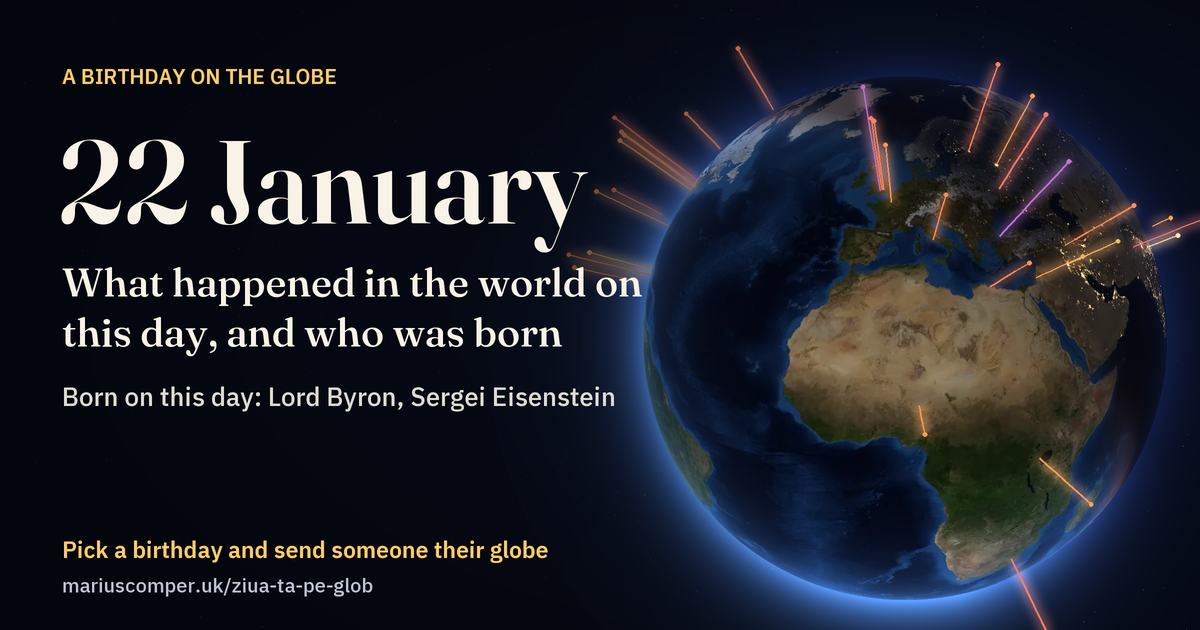
For 22 January, the English Wikipedia lists 54 events and 212 births. 32 of the events stand at their places as rays of light; six more are dashed circles, where the sentence links only to a country or a sea. The taller the ray, the longer ago it happened. The people born that day come further down, as blue points.
A birthday, yours or someone else’s:
Turn it into a greetingScroll: the globe turns to each place
The day you were born, on the globe.
Three things from your day
Scroll: your day first, then 22 January through the years
The Earth on 22 January
The picture on the globe was assembled by NASA from satellite photographs taken in January 2004: the snow, the ice and the green are those of the month.
On 22 January the Sun passes straight overhead at noon along the parallel of 19.8° south. In London, the day lasts about 8 hours 40 minutes.
Beyond 70° south the Sun no longer sets; beyond 70° north it no longer rises.
The line between day and night is tilted on the globe exactly as on this day of the year. On the dark side you can see the lights of towns.
Britain & Ireland · Arsenal Stadium
1927
Teddy Wakelam gives the first live radio commentary of a football match, between Arsenal F.C. and Sheffield United at Highbury.
On the map: Arsenal Stadium.
Europe · Élysée Palace
1963
The Élysée Treaty of cooperation between France and West Germany is signed by Charles de Gaulle and Konrad Adenauer.
On the map: Élysée Palace.
Also on the day’s list of Wikipedia in Spanish and Chinese.
Asia · Constantinople
613
Eight-month-old Heraclius Constantine is crowned as co-emperor (Caesar) by his father Heraclius at Constantinople.
On the map: Constantinople.
Asia · Chahar Cheragh Square
1946
In Iran, Qazi Muhammad declares the independent people's Republic of Mahabad at Chahar Cheragh Square in the Kurdish city of Mahabad; he becomes the new president and Haji Baba Sheikh becomes the prime minister.
On the map: Chahar Cheragh Square.
Asia · Ram Mandir
2024
Ram Mandir is inaugurated by Indian Prime Minister Narendra Modi at Ayodhya, Uttar Pradesh after 500 years of dispute.
On the map: Ram Mandir.
Latin America · Independence Park
1973
In a bout for the world heavyweight boxing championship in Kingston, Jamaica, challenger George Foreman knocks down champion Joe Frazier six times in the first two rounds before the fight is stopped by referee Arthur Mercante Sr..
On the map: Independence Park.
North America · John F. Kennedy International Airport
1970
The Boeing 747, the world's first "jumbo jet", enters commercial service for launch customer Pan American Airways with its maiden voyage from New York's John F. Kennedy International Airport to London Heathrow Airport.
On the map: John F. Kennedy International Airport.
North America · Supreme Court of the United States
1973
The Supreme Court of the United States delivers its decisions in Roe v. Wade and Doe v. Bolton, legalizing elective abortion in all fifty states. This decision is subsequently overturned in Dobbs v. Jackson Women's Health Organization in 2022.
On the map: Supreme Court of the United States.
Also on the day’s list of Wikipedia in Chinese.
North America · Tampa Stadium
1984
During Super Bowl XVIII, Apple Computer introduced the Macintosh, the first successful personal computer to use a graphical user interface, with the television commercial "1984".
On the map: Tampa Stadium.
Also on the day’s list of Wikipedia in Chinese.
22 January
What the other Wikipedias remember#
For these years the English list has nothing on this day. The events below come from the same day’s lists on Wikipedia in Spanish and Romanian and were translated for this page.
From Wikipedia in Spanish · Seville
1809
The Supreme Central Junta of Seville declares that the Spanish colonies in America "are not properly colonies or factories, like those of other nations, but an essential and independent part of the Spanish Monarchy".
On the map: Seville.
Translated from the list on Wikipedia in Spanish.
From Wikipedia in Romanian · Wimbledon Championships
1983
Björn Borg retires from tennis after winning the Wimbledon tennis tournament five times in a row.
On the map: Wimbledon Championships.
Translated from the list on Wikipedia in Romanian.
The article on Wikipedia in Romanian: Turneul de tenis de la Wimbledon
22 January
Born on 22 January#
The English Wikipedia lists 212 births for this day. The blue points are the birthplaces of 60 of these people: those written about in the most Wikipedia editions, where Wikidata gives a place of birth.
Born on 22 January
1788
Lord Byron, English poet and playwright (died 1824)
Place of birth: City of Westminster.
Born on 22 January
1898
Sergei Eisenstein, Russian director and screenwriter (died 1948)
Place of birth: Riga.
Born on 22 January
1849
August Strindberg, Swedish novelist, poet, and playwright (died 1912)
Place of birth: Stockholm.
Born on 22 January
1729
Gotthold Ephraim Lessing, German philosopher and author (died 1781)
Place of birth: Kamenz.
Born on 22 January
1908
Lev Landau, Azerbaijani-Russian physicist and academic, Nobel Prize laureate (died 1968)
Place of birth: Baku.
Born in Britain and Ireland
1940
John Hurt, English actor (died 2017)
Place of birth: Chesterfield.
Born in Britain and Ireland
1920
Alf Ramsey, English footballer and coach (died 1999)
Place of birth: Dagenham.
Born in Britain and Ireland
1987
Shane Long, Irish footballer
Place of birth: Gortnahoe.
22 January
Number one in the charts that week
At the cinema
An animal recorded that day
The record can be seen in GBIF, which brings together wildlife records from around the world.
All your birthdays
The weather that day
Data: Met Office Hadley Centre (HadCET); NOAA (GHCN-Daily, Mauna Loa).
Above the Earth
Sources: Jonathan McDowell, GCAT (launches); GFZ Potsdam (Kp index). Days are counted in Universal Time.
Football that day
International matches played that day:
Source: the “International football results” dataset kept by Mart Jürisoo (CC0).
Also that day
The earthquake’s page at the USGS
Source: the USGS catalogue. The day is counted in Universal Time (UTC).
In those days
Make a link for someone
Type the name, pick the day and the year of birth. The link opens straight on their day, with their name in the greeting.
The link carries the name, date and place typed here; anyone who gets it can see them.
Put another birthday beside it
Your mother’s, your child’s, a friend’s: the two days appear side by side.
Below: 22 January through the years.
The whole globe of the day
Drag the globe to turn it. Touch a ray or a point to read what happened there.
Everything Wikipedia lists for 22 January
The list is the English Wikipedia’s, in its own wording, as it stood in October 2026. 16 events have no place on the map: the sentence links to no place with coordinates, only to places too wide to mark, or to several countries.
- 565
Eutychius of Constantinople was arrested after he refused Byzantine emperor Justinian I's order to adopt the tenets of the Aphthartodocetae, a sect of non-Chalcedonian Christians.
Asia · Byzantine EmpireWikipedia: Eutychius of Constantinople - 613
Eight-month-old Heraclius Constantine is crowned as co-emperor (Caesar) by his father Heraclius at Constantinople.
Asia · ConstantinopleWikipedia: Heraclius Constantine - 871
Battle of Basing: The West Saxons led by King Æthelred I are defeated by the Danelaw Vikings at Basing.
Britain & Ireland · Battle of BasingWikipedia: Battle of Basing - 1273
Muhammad II became Sultan of Granada after his father's death in a riding accident.
Europe · Emirate of GranadaWikipedia: Muhammad II of Granada - 1506
The first contingent of 150 Swiss Guards arrives at the Vatican.
Europe · Vatican CityWikipedia: Swiss Guard - 1517
The Ottoman Empire under Selim I defeats the Mamluk Sultanate and captures present-day Egypt at the Battle of Ridaniya.
no place on the mapWikipedia: Battle of Ridaniya - 1555
The Ava Kingdom falls to the Taungoo Dynasty in what is now Myanmar.
no place on the mapWikipedia: Kingdom of Ava - 1689
The Convention Parliament convenes to determine whether James II and VII, the last Roman Catholic monarch of England, Ireland and Scotland, had vacated the thrones of England and Ireland when he fled to France in 1688.
no place on the mapWikipedia: Convention Parliament - 1808
The Portuguese royal family arrives in Brazil after fleeing the French army's invasion of Portugal two months earlier.
no place on the mapWikipedia: Invasion of Portugal - 1849
Second Anglo-Sikh War: The Siege of Multan ends after nine months when the last Sikh defenders of Multan, Punjab, surrender.
Asia · Siege of MultanWikipedia: Second Anglo-Sikh War - 1863
The January Uprising breaks out in Poland, Lithuania and Belarus. The aim of the national movement is to regain Polish–Lithuanian–Ruthenian Commonwealth from occupation by Russia.
Europe · Treaty of HadiachWikipedia: Treaty of Hadiach - 1879
Anglo-Zulu War: the Battle of Isandlwana results in a Zulu victory.
Africa · Battle of IsandlwanaWikipedia: Battle of Isandlwana - 1879
Anglo-Zulu War: the Battle of Rorke's Drift, just some 15 km (9.3 mi) away from Isandlwana, results in a British victory.
Africa · Battle of Rorke's DriftWikipedia: Battle of Rorke's Drift - 1890
The United Mine Workers of America is founded in Columbus, Ohio.
North America · Columbus, OhioWikipedia: United Mine Workers of America - 1901
Edward VII is proclaimed King of the United Kingdom after the death of his mother, Queen Victoria.
Britain & Ireland · St George's Chapel, WindsorWikipedia: Death and state funeral of Queen Victoria - 1905
Bloody Sunday occurs in Saint Petersburg, beginning the 1905 revolution.
Europe · Saint PetersburgWikipedia: Bloody Sunday - 1906
SS Valencia runs aground on rocks on Vancouver Island, British Columbia, killing more than 130.
North America · SS ValenciaWikipedia: SS Valencia - 1915
Over 600 people are killed in Guadalajara, Mexico, when a train plunges off the tracks into a deep canyon.
Latin America · GuadalajaraWikipedia: Guadalajara train disaster - 1917
American entry into World War I: President Woodrow Wilson of the still-neutral United States calls for "peace without victory" in Europe.
no place on the mapWikipedia: American entry into World War I - 1919
Act Zluky is signed, unifying the Ukrainian People's Republic and the West Ukrainian National Republic.
no place on the mapWikipedia: Unification Act - 1924
Ramsay MacDonald becomes the first Labour Prime Minister of the United Kingdom.
no place on the mapWikipedia: Ramsay MacDonald - 1927
Teddy Wakelam gives the first live radio commentary of a football match, between Arsenal F.C. and Sheffield United at Highbury.
Britain & Ireland · Arsenal StadiumWikipedia: Sheffield United F.C. - 1941
World War II: British and Commonwealth troops capture Tobruk from Italian forces during Operation Compass.
Africa · TobrukWikipedia: World War II - 1943
World War II: Australian and American forces defeat Japanese army and navy units in the bitterly fought Battle of Buna–Gona.
Oceania · Battle of Buna–GonaWikipedia: Battle of Buna–Gona - 1944
World War II: The Allies commence Operation Shingle, an assault on Anzio and Nettuno, Italy.
Europe · Battle of AnzioWikipedia: Battle of Anzio - 1946
Creation of the Central Intelligence Group, forerunner of the Central Intelligence Agency.
no place on the mapWikipedia: Central Intelligence Agency - 1946
In Iran, Qazi Muhammad declares the independent people's Republic of Mahabad at Chahar Cheragh Square in the Kurdish city of Mahabad; he becomes the new president and Haji Baba Sheikh becomes the prime minister.
Asia · Chahar Cheragh SquareWikipedia: Iran - 1947
KTLA, the first commercial television station west of the Mississippi River, begins operation in Hollywood.
North America · KTLAWikipedia: KTLA - 1957
Israel withdraws from the Sinai Peninsula.
no place on the mapWikipedia: Israel - 1957
New York City police arrested George Metesky, better known as the "Mad Bomber", for planting over 30 bombs over 16 years throughout the city.
North America · New York City Police DepartmentWikipedia: New York City Police Department - 1963
The Élysée Treaty of cooperation between France and West Germany is signed by Charles de Gaulle and Konrad Adenauer.
Europe · Élysée PalaceWikipedia: Élysée Treaty - 1967
Between dozens and hundreds of anti-Somocista demonstrators are killed by the Nicaraguan National Guard in Managua.
Latin America · ManaguaWikipedia: Somoza family - 1968
Apollo Program: Apollo 5 lifts off carrying the first Lunar module into space.
no place on the mapWikipedia: Apollo program - 1968
Operation Igloo White, a US electronic surveillance system to stop communist infiltration into South Vietnam begins installation.
Asia · South VietnamWikipedia: Operation Igloo White - 1969
Soviet leader Leonid Brezhnev survived what was seen as an assassination attempt, an incident that was not revealed to the public until after the fall of the Soviet Union.
Europe · MoscowWikipedia: Attempted assassination of Leonid Brezhnev - 1970
The Boeing 747, the world's first "jumbo jet", enters commercial service for launch customer Pan American Airways with its maiden voyage from New York's John F. Kennedy International Airport to London Heathrow Airport.
North America · John F. Kennedy International AirportWikipedia: John F. Kennedy International Airport - 1971
The Singapore Declaration, one of the two most important documents to the uncodified constitution of the Commonwealth of Nations, is issued.
no place on the mapWikipedia: Singapore Declaration - 1973
A chartered Boeing 707 explodes in flames upon landing at Kano Airport, Nigeria, killing 176.
Africa · 1973 Kano Nigeria Airways Boeing 707 crashWikipedia: 1973 Kano Nigeria Airways Boeing 707 crash - 1973
In a bout for the world heavyweight boxing championship in Kingston, Jamaica, challenger George Foreman knocks down champion Joe Frazier six times in the first two rounds before the fight is stopped by referee Arthur Mercante Sr..
Latin America · Independence ParkWikipedia: Joe Frazier vs. George Foreman - 1973
The Supreme Court of the United States delivers its decisions in Roe v. Wade and Doe v. Bolton, legalizing elective abortion in all fifty states. This decision is subsequently overturned in Dobbs v. Jackson Women's Health Organization in 2022.
North America · Supreme Court of the United StatesWikipedia: Supreme Court of the United States - 1973
The crew of Apollo 17 addresses a joint session of Congress after the completion of the final Apollo Moon landing mission.
no place on the mapWikipedia: Apollo 17 - 1979
After surrounding Mutukula the previous day, Tanzanian forces attacked the town and caused Ugandan forces to flee.
Africa · Battle of MutukulaWikipedia: Battle of Mutukula - 1984
During Super Bowl XVIII, Apple Computer introduced the Macintosh, the first successful personal computer to use a graphical user interface, with the television commercial "1984".
North America · Tampa StadiumWikipedia: Super Bowl XVIII - 1987
After being convicted of receiving bribes, Pennsylvania state treasurer R. Budd Dwyer shot and killed himself in front of television cameras during a press conference.
North America · PennsylvaniaWikipedia: Bribery - 1987
Philippine security forces open fire on a crowd of 10,000–15,000 demonstrators at Malacañang Palace, Manila, killing 13.
Asia · Mendiola massacreWikipedia: Mendiola massacre - 1992
Space Shuttle program: The space shuttle Discovery launches on STS-42 carrying Dr. Roberta Bondar, who becomes the first Canadian woman and the first neurologist in space.
no place on the mapWikipedia: Space Shuttle program - 1995
Israeli–Palestinian conflict: Beit Lid suicide bombing: In central Israel, near Netanya, two Gazans blow themselves up at a military transit point, killing 19 Israeli soldiers.
Asia · Beit Lid suicide bombingWikipedia: Beit Lid suicide bombing - 1998
Space Shuttle program: space shuttle Endeavour launches on STS-89 to dock with the Russian space station Mir.
no place on the mapWikipedia: Space Shuttle Endeavour - 1999
Australian missionary Graham Staines and his two sons are burned alive by radical Hindus while sleeping in their car in Eastern India.
no place on the mapWikipedia: Graham Staines - 2006
Evo Morales is inaugurated as President of Bolivia, becoming the country's first indigenous president.
no place on the mapWikipedia: Evo Morales - 2007
At least 88 people are killed when two car bombs explode in the Bab Al-Sharqi market in central Baghdad, Iraq.
Asia · 22 January 2007 Baghdad bombingsWikipedia: 22 January 2007 Baghdad bombings - 2009
U.S. President Barack Obama signs an executive order to close the Guantanamo Bay detention camp; congressional opposition will prevent it being implemented.
Latin America · Guantanamo Bay detention campWikipedia: Barack Obama - 2012
Croatia held a referendum in which it voted to become a member of the European Union.
Europe · European UnionWikipedia: 2012 Croatian European Union membership referendum - 2024
Ram Mandir is inaugurated by Indian Prime Minister Narendra Modi at Ayodhya, Uttar Pradesh after 500 years of dispute.
Asia · Ram MandirWikipedia: Ram Mandir
What the other Wikipedias remember
For these years the English list has nothing on this day. The events below come from the same day’s lists on Wikipedia in Spanish and Romanian and were translated for this page.
- 1809
The Supreme Central Junta of Seville declares that the Spanish colonies in America "are not properly colonies or factories, like those of other nations, but an essential and independent part of the Spanish Monarchy".
- 1983
Björn Borg retires from tennis after winning the Wimbledon tennis tournament five times in a row.
Britain & Ireland · Wimbledon ChampionshipsTranslated from the list on Wikipedia in RomanianWikipedia: Turneul de tenis de la Wimbledon
Who was born on 22 January
In order of how many Wikipedia editions have an article about each. The first 60 of 212 are shown.
- 1788
Lord Byron, English poet and playwright (died 1824)
City of WestminsterWikipedia: Lord Byron - 1561
Francis Bacon, English philosopher and politician, Attorney General for England and Wales (died 1626)
LondonWikipedia: Francis Bacon - 1898
Sergei Eisenstein, Russian director and screenwriter (died 1948)
- 1891
Antonio Gramsci, Italian philosopher and politician (died 1937)
- 1849
August Strindberg, Swedish novelist, poet, and playwright (died 1912)
StockholmWikipedia: August Strindberg - 1729
Gotthold Ephraim Lessing, German philosopher and author (died 1781)
- 1908
Lev Landau, Azerbaijani-Russian physicist and academic, Nobel Prize laureate (died 1968)
- 1909
U Thant, Burmese educator and diplomat, 3rd United Nations Secretary-General (died 1974)
PantanawWikipedia: U Thant - 1875
D. W. Griffith, American director, producer, and screenwriter (died 1948)
CrestwoodWikipedia: D. W. Griffith - 1263
Ibn Taymiyyah, Syrian scholar and theologian (died 1328)
HarranWikipedia: Ibn Taymiyya - 1440
Ivan III of Russia (died 1505)
- 1977
Hidetoshi Nakata, Japanese footballer
- 1940
John Hurt, English actor (died 2017)
ChesterfieldWikipedia: John Hurt - 1953
Jim Jarmusch, American director and screenwriter
Cuyahoga FallsWikipedia: Jim Jarmusch - 1965
Diane Lane, American actress
New York CityWikipedia: Diane Lane - 1906
Robert E. Howard, American author and poet (died 1936)
PeasterWikipedia: Robert E. Howard - 1592
Pierre Gassendi, French mathematician, astronomer, and philosopher (died 1655)
ChamptercierWikipedia: Pierre Gassendi - 1931
Sam Cooke, American singer-songwriter (died 1964)
ClarksdaleWikipedia: Sam Cooke - 1936
Alan J. Heeger, American physicist and chemist, Nobel Prize laureate
Sioux CityWikipedia: Alan J. Heeger - 1879
Francis Picabia, French painter and poet (died 1953)
- 1911
Bruno Kreisky, Austrian lawyer and politician, 22nd Chancellor of Austria (died 1990)
ViennaWikipedia: Bruno Kreisky - 1932
Piper Laurie, American actress (died 2023)
DetroitWikipedia: Piper Laurie - 1992
Vincent Aboubakar, Cameroonian footballer
YaoundéWikipedia: Vincent Aboubakar - 2007
Pau Cubarsí, Spanish footballer
EstanyolWikipedia: Pau Cubarsí - 1945
Christoph Schönborn, Austrian cardinal
Skalka CastleWikipedia: Christoph Schönborn - 1959
Linda Blair, American actress
St. LouisWikipedia: Linda Blair - 1904
George Balanchine, Georgian-American dancer, choreographer, and director, co-founded the New York City Ballet (died 1983)
Saint PetersburgWikipedia: George Balanchine - 1974
Joseph Muscat, Maltese journalist and politician, 13th Prime Minister of Malta
Pietà, MaltaWikipedia: Joseph Muscat - 1988
Marcel Schmelzer, German footballer
MagdeburgWikipedia: Marcel Schmelzer - 1797
Maria Leopoldina of Austria (died 1826)
- 1973
Rogério Ceni, Brazilian footballer
Pato BrancoWikipedia: Rogério Ceni - 1920
Alf Ramsey, English footballer and coach (died 1999)
DagenhamWikipedia: Alf Ramsey - 1939
Alfredo Palacio, Ecuadoran physician and politician, President of Ecuador (died 2025)
GuayaquilWikipedia: Alfredo Palacio - 1972
Gabriel Macht, American actor
The BronxWikipedia: Gabriel Macht - 1982
Fabricio Coloccini, Argentine footballer
Alta GraciaWikipedia: Fabricio Coloccini - 1968
Frank Leboeuf, French footballer, sportscaster, and actor
MarseilleWikipedia: Frank Leboeuf - 1987
Shane Long, Irish footballer
GortnahoeWikipedia: Shane Long - 1645
William Kidd, Scottish sailor and pirate hunter (probable); (died 1701)
DundeeWikipedia: William Kidd - 1893
Conrad Veidt, German-American actor, director, and producer (died 1943)
BerlinWikipedia: Conrad Veidt - 1858
Beatrice Webb, English sociologist and economist (died 1943)
StandishWikipedia: Beatrice Webb - 1907
Dixie Dean, English footballer (died 1980)
BirkenheadWikipedia: Dixie Dean - 1962
Mizan Zainal Abidin of Terengganu, Yang di-Pertuan Agong of Malaysia
Kuala TerengganuWikipedia: Mizan Zainal Abidin of Terengganu - 1990
Alizé Cornet, French tennis player
- 1941
Jaan Kaplinski, Estonian poet, philosopher, and critic (died 2021)
- 1980
Jonathan Woodgate, English footballer
MiddlesbroughWikipedia: Jonathan Woodgate - 1990
Logic, American rapper
RockvilleWikipedia: Logic - 1965
Steven Adler, American rock drummer
ClevelandWikipedia: Steven Adler - 1904
Arkady Gaidar, Russian journalist and author (died 1941)
- 1960
Michael Hutchence, Australian singer-songwriter (died 1997)
- 1916
Henri Dutilleux, French pianist, composer, and educator (died 2013)
- 1934
Bill Bixby, American actor and director (died 1993)
San FranciscoWikipedia: Bill Bixby - 1865
Wilbur Scoville, American chemist and pharmacist (died 1942)
BridgeportWikipedia: Wilbur Scoville - 1892
Marcel Dassault, French businessman, founded Dassault Aviation (died 1986)
9th arrondissement of ParisWikipedia: Marcel Dassault - 1988
Greg Oden, American basketball player
BuffaloWikipedia: Greg Oden - 2002
Caitlin Clark, American basketball player
Des MoinesWikipedia: Caitlin Clark - 1981
Ben Moody, American musician, songwriter, and producer
Little RockWikipedia: Ben Moody - 1909
Ann Sothern, American actress and singer (died 2001)
Valley CityWikipedia: Ann Sothern - 1931
Galina Zybina, Russian shot putter and javelin thrower (died 2024)
Saint PetersburgWikipedia: Galina Zybina - 1946
Malcolm McLaren, English singer-songwriter and manager (died 2010)
Stoke NewingtonWikipedia: Malcolm McLaren - 1880
Frigyes Riesz, Hungarian mathematician and academic (died 1956)
What is celebrated on 22 January
- Christian feast day: Anastasius of Persia
- Christian feast day: Gaudentius of Novara
- Christian feast day: László Batthyány-Strattmann
- Christian feast day: Laura Vicuna
- Christian feast day: Vincent Pallotti
- Christian feast day: Vincent of Saragossa
- Christian feast day: Vincent, Orontius, and Victor
- Christian feast day: Blessed William Joseph Chaminade
- Christian feast day: January 22 (Eastern Orthodox liturgics)
- Day of Unity of Ukraine (Ukraine)
- Grandfather's Day (Poland)
A greeting link for someone
Type a name and, if you like, the year of birth. The link opens with a greeting, and beside each event it says how old the person turned that day, or how many years before their birth it happened.
The name and the year go only into the link you send.
All 366 days
How the globe is made
Where the events come from
Each edition of this page uses the day’s list from Wikipedia in its own language: Romanian, English, Spanish, Chinese. The lists are written by volunteers and differ from one edition to the next; the text of each event is Wikipedia’s, with a link to the article. A row that appears twice in a list is shown once. The lists have not been checked event by event: they are Wikipedia’s, mistakes included.
For events before 1582, and for countries that moved to the Gregorian calendar later (Britain in 1752, Russia in 1918), the same day may be counted Old Style in one list and New Style in another.
The chapter “What the other Wikipedias remember” adds up to five events a day from the lists of the other three editions, only for years in which the English list has nothing on that day. They were translated for this page, passed the same filters as the tour, and are not counted among the events of the English list.
How an event gets onto the map
The place comes from Wikidata. If the sentence links to the article about the event itself (a battle, an opening, an earthquake), dated to the same year, the ray stands on its coordinates or on those of its location. Otherwise it stands on the first place the sentence links to: a town, a building, a mountain, an island. This second step can be wrong: sometimes the sentence only mentions the place. That is why the page says, under each event, which place the ray stands on.
When the sentence links to a single state or province, or to a single sea, lake or desert larger than 5,000 km², the globe shows a dashed circle, not a ray. The circle has the area Wikidata gives, with its radius kept between 1.2° and 16°, or a radius of 4.5° when Wikidata gives no area; it says only that the sentence links to that place. Organisations, ships, spacecraft, museum objects, rivers, mountain ranges, languages and continents are never used as places. When a sentence names several states and no exact place, the event stays in the list only.
What the height means
The height of a ray shows how many years have passed, on a logarithmic scale: 10 years, 100 years and 1,000 years are equal steps apart; anything older than about 2,600 years has the tallest ray. The colour runs from pale yellow for recent years to violet for antiquity.
Where the tour stops
In each region the tour stops at up to three events (five in Britain and Ireland), chosen mainly by three things: whether Wikipedia’s editors put the event in the “On this day” box of their main page (the English, Spanish and Chinese editions), how many Wikipedia editions have an article about it, and how many of the four lists include it. Events whose sentence or article is about a war, an attack, a crime or a disaster are left out of the tour; they stay in the whole list, in Wikipedia’s wording. The filter is a list of words and a list of Wikidata types, so it can miss some.
The tour of births names the people with articles in the most editions and leaves aside those whom the list or Wikidata describes as rulers, politicians, commanders, leaders of movements or criminals; they stay in the list.
The Earth and the Sun
The daytime images are NASA’s Blue Marble Next Generation mosaics, one for each month of 2004; the night side is Black Marble 2016. The tilt of the line between day and night is computed for the day; the hour is chosen so that the place being read is in daylight. The latitude where the Sun stands overhead is the average of the four years of the leap cycle; in a given year it can differ by up to 0.4°.
The day you were born
The number ones come from the weekly lists on Wikipedia: Billboard for the United States (from 1940; the Hot 100 from August 1958), the UK Singles Chart (from November 1952), Los 40 Principales for Spain (from July 1966) and, for Romania, the Romanian Top 100 and Airplay 100 (2001–2021, with missing weeks). The page shows the chart of the week in which the day of birth falls, with its date; Billboard and the UK chart are dated at the end of their week. For Romania before 2001 and for China these sources have no weekly chart.
The films are those that reached cinemas in the United States up to ten days before or three days after that day (some of them in a few cinemas at first), from the English Wikipedia’s yearly lists (from 1968), in order of how many editions have an article about them. The events “in those days” are the ones on the neighbouring days’ lists that carry the year of birth, passed through the same filter as the tour.
The day of birth, year included
The Moon, the star sign and the constellation are worked out by the page itself, for noon Universal Time on the day. The lit part of the Moon is rounded and can differ by a few per cent from that at the hour of birth. The sign follows the usual zodiac of twelve equal parts starting at the March equinox; the constellation is the one the Sun actually stood in front of, by the borders set by the International Astronomical Union, and within a day of a border the page does not name it. When the Sun changes sign while it is that day anywhere on Earth, the page gives the moment of crossing, rounded to ten minutes and accurate to within about a quarter of an hour, and the clock time in a few cities, with the time zone and summer time of that year.
The year in the Chinese calendar is the one your device’s own calendar gives for the date, checked against the Hong Kong Observatory’s tables. “All your birthdays” uses the same sources as the rest of the chapter for the same day in every year since the birth: the temperature, well-known launches that took place on that very day, matches of the teams the edition follows, snow deeper than 10 cm and strong geomagnetic storms. The three things at the top and the four on the picture are chosen in a fixed order (the song, the animal, a full Moon, a well-known launch before an ordinary earthquake); on the picture you can change them.
When the link carries a year of birth, the page adds a few things about that exact day. The weather is the Met Office’s Central England temperature record and the readings from New York’s Central Park; the “usual high” is the average of the daily highs of 1961–1990 for that date, with two days either side. The carbon dioxide figure is the monthly mean at the Mauna Loa observatory, where measurements begin in March 1958.
The earthquake is the one with the largest magnitude in the USGS catalogue for that day, counted in Universal Time. Before the 1960s the catalogue has gaps even above magnitude 5.5, so in the older years many days have no earthquake. The page gives only the magnitude and the place: the country the epicentre falls in or, when the epicentre is at sea within 300 km of a coast, the nearest country; farther out, only the ocean.
The launches are those that reached orbit or left for the Moon and the planets, from Jonathan McDowell’s GCAT catalogue. If nothing left that day, the page shows the nearest launch within three days before or after, and says how many days away it was. The geomagnetic storm appears only when the Kp index reached at least 5 in one of the day’s eight three-hour intervals.
The animal comes from GBIF: an observation made by a person (the animal seen or heard, or its tracks), dated to that exact day, with coordinates and a CC0 or CC BY licence. Only a few hundred well-known species are searched (mammals, birds, turtles, butterflies); of those noted that day, mammals and species with articles in many Wikipedia editions come first; birds noted almost every day, and species used recently, wait their turn. Observations dated 1 January are left out, because records without a day are often filed there. An observation shows that the animal was recorded there, not how many animals there were.
The matches are those between national teams. Only matches of England, Scotland, Wales, Northern Ireland, the Republic of Ireland, the United States, Canada and Australia are shown, along with those at the big final tournaments. The picture to send is drawn in the page from the day’s globe and the facts above, and stays on your device until you send it.
Sources
- Events, births and holidays: the day’s page on Wikipedia, text under CC BY-SA 4.0.
- Coordinates, places of birth and the number of editions: Wikidata (CC0).
- The Earth by day: NASA Blue Marble Next Generation. The Earth by night: NASA Black Marble 2016.
- Borders and regions: Natural Earth.
- World population and births per year: UN World Population Prospects 2024.
- Charts and films: Wikipedia’s lists for Billboard, the UK Singles Chart, Los 40 Principales, Romanian Top 100, Airplay 100 and American films by year (CC BY-SA 4.0).
- Weather: Met Office Hadley Centre, HadCET (Open Government Licence) and NOAA GHCN-Daily, New York Central Park. Carbon dioxide: NOAA Global Monitoring Laboratory, Mauna Loa.
- Earthquakes: the USGS catalogue. Launches: Jonathan McDowell, GCAT (CC BY). Kp index: GFZ Potsdam (CC BY 4.0). Matches: International football results, Mart Jürisoo (CC0).
- Animal observations: GBIF, with a link to each record; species names come from Wikidata.